Ice wall at crippled Fukushima Daiichi nuclear power plant damaged by typhoon rain
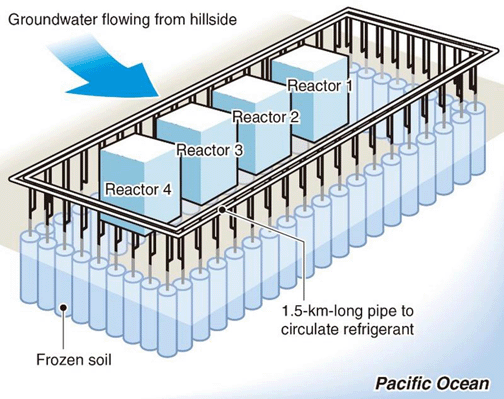
Tokyo Electric Power Company (TEPCO) has announced that the “ice wall” (formally known as the “Land-Side Impermeable Wall”) under construction at the crippled Fukushima Daiichi nuclear power plant in Japan has been
critically affected by rainfall from recent typhoons that have melted parts of the ice structure, allowing new pathways for highly contaminated waterto leak from the basements of the reactor buildings.
http://enformable.com/2016/09/ice-wall-fukushima-daiichi-damaged-recent-typhoons-japan/
Tension increased as USA and South Korea deploy more fire power on the Korean Peninsula
In its report to the National Assembly’s defense committee, the ministry also said that its military will stage a unilateral live-fire drill, which involves Taurus air-to-surface guided missiles mounted on its F-15K fighter jets, this month. The missile with a range of 500 kilometers is capable of launching precision strikes on the North’s key nuclear and missile facilities.
“We will push for the option of deploying strategic assets such as the U.S. carrier strike group and strategic bombers after consultation with the U.S.,” the ministry said.
The show-of-force measures were unveiled a day after Pyongyang conducted what it claims to be a test of a hydrogen bomb mountable onto an intercontinental ballistic missile, sharply raising military tensions.
At the parliamentary session, Defense Minister Song Young-moo said that during his recent talks with U.S. Defense Secretary James Mattis, he demanded that the U.S. deploy its strategic assets to Korea on a “regular” basis. He made the demand, citing local politicians’ calls for the redeployment of U.S. tactical nukes.
But he dismissed the news report that he actually demanded the redeployment of the U.S. nuclear arsenal withdrawn from the peninsula in the early 1990s…….http://m.yna.co.kr/mob2/en/contents_en.jsp?cid=AEN20170904010952315
Heavier warheads and lots more USA weapons sales to South Korea
 S.Korea, US to lift warhead weight limit on South Korean missiles | 04 Sept 2017 | The US agreed to allow South Korea deploy heavier warheads on its missiles after the latest nuclear test by Pyongyang. The existing limit set in a missile pact between Washington and Seoul is 500 kg. The agreement to lift the weight limit was reached by US President Donald Trump and his South Korean counterpart Moon Jae-in in a phone call on Monday, the South Korean presidential office said in a statement. With tensions rising on the Korean peninsula, Donald Trump also gave “conceptual approval” for billions worth of US weapons to be sold to South Korea.
The problem facing the world – dealing with a nuclear North Korea
North Korea: What can actually be done to deal with a nuclear Pyongyang? http://www.abc.net.au/news/2017-09-03/north-korea-is-it-time-to-accept-it-will-remain-a-nuclear-threat/8868138, ANALYSIS By chief foreign correspondent Philip Williams, From the first tweak of the seismograph it was clear this was no ordinary tremor — it signalled the most powerful bomb of all.
The North Korean TV newsreader announced with a flourish this was the state’s first hydrogen bomb.If that now means Pyongyang has the weapon and the delivery system that could wipe out a Los Angeles, a San Francisco or a Sydney in a flash, then the world is now a different place.
Nuclear weapons are supposed to be a deterrent — make yourself so dangerous no-one will ever dare challenge you — and it is a fact that barring some Scuds aimed at Israel during the 1991 Gulf War and some border skirmishes between China and Vietnam and India and Pakistan, no nuclear-armed state has ever faced a serious attack by another country.
Clearly the thinking for three generations of Kim is that the regime is made safe if everyone fears you. And the clear impression you are crazy helps too — no-one wants to aggravate a disturbed mind.
But what to do? US President Donald Trump has described the test as hostile and dangerous and said Pyongyang “only understands one thing”.
Appeasement was not working, he said, and the rogue nation has become a “great threat and embarrassment” to China. He later tweeted the US was considering “stopping trade with any country doing business with North Korea”.
That would include both China and Russia. While both signed on to the latest UN sanctions, cutting trade altogether would be a far more serious step.
Beijing would have to cut off oil supplies and Moscow send back the North Korean labourers who “volunteer” to work in Siberian forestry camps in what have been described as slave-like conditions.
The whole region and beyond is in a fix. China especially is feeling the squeeze from the United States, and even Australia has argued Beijing has not applied full muscle against North Korea to mend its errant ways.
But the Chinese Government has agreed to the latest sanctions and deeply resents the assertion it could stop Kim Jong-un if it really wanted to. There is nothing for the Chinese to gain from a nuclear war on the Korean Peninsula.
Not only would there be the risk of nuclear contamination, what really worries Beijing is the thought of millions of refugees pouring over the border seeking shelter from a nuclear storm. Not to mention the terrible human and economic cost of shattered neighbours.
The constant refrain from Mr Trump and Malcolm Turnbull for China to do more and do it now could soon become counterproductive. Beijing’s influence on North Korea’s leadership is often overstated.
Its troublesome neighbour has repeatedly embarrassed China by testing bombs or missiles at an inopportune moment. This latest test happened at the opening of a major BRICS (Brazil, Russia, India, China and South Africa) conference held in China and hosted by President Xi Jinping.
Not only was his thunder stolen, he and guest Vladimir Putin were forced to issue a joint statement condemning the test but urging a negotiated solution. Mr Trump underlined that via a tweet, saying: “North Korea is a rogue nation which has become a great threat and embarrassment to China, which is trying to help but with little success.”
For his part, the US leader has wedged himself with rhetoric — it was only a couple of days ago he said the time for talking was over. But what does that leave?
The US military will have its plans ready, just in case. And Mr Trump is the only person with power to order what would be the destruction of North Korea. Is he really contemplating the death of millions, the ruin of cites on both sides of the 38th parallel?
Only if North Korea crosses his red lines. Do they exist in the seas off Guam, Hawaii, or the West coast of the mainland itself?
Surely Mr Kim and his predecessors have not come all this way to self-destruct. After all, these bombs and missiles are supposed to protect, not trigger an end game conflict. No party to this conundrum wants this to happen.
But the scene is set, the main players less than predictable and the talk tough. North Korea will never willingly trade away its newfound military clout, it is seen as vital for survival, but successive US presidents have made it clear they will never live with a nuclear armed and able North Korea.
It is a country that revels in regular threats to wipe out entire US cities. It is no longer trash talk that can be ignored and no-one, it seems, has a plausible answer.
One commentator suggested arming both South Korea and Japan with nuclear weapons to act as a foil to the North. That would mean five countries in the region with the ability to erase entire cities from the planet.
Our once relatively safe and increasingly prosperous neighbourhood is taking a serious turn for the worse. Only two people on the planet can change all that, and neither is showing signs there is a safe way out.
Asked by a reporter if the US would attack North Korea, Mr Trump said: “We’ll see.”
North Korea claims to have successfully tested hydrogen bomb
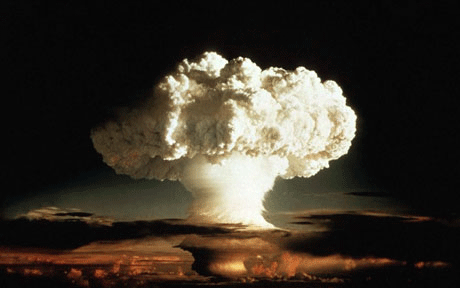 North Korea says it successfully tested hydrogen bomb, marking sixth nuclear test since 2006, ABC News, 3 Sept 17, North Korea has said it successfully tested a hydrogen bomb designed to be mounted on its newly developed intercontinental ballistic missile (ICBM), producing a greater yield than any of its previous nuclear tests.
Key points:
- Previous recent tremors in North Korea have been caused by nuclear tests
- Tremor came hours after state media said Kim Jong-un inspected new hydrogen bomb
- Witnesses on the Chinese side of the border said tremor lasted roughly 10 seconds
The hydrogen bomb test ordered by leader Kim Jong-un was a “perfect success” and was a “meaningful” step in completing the country’s nuclear weapons programme, according to state television.
The announcement came hours after a large quake that appeared to be man-made was detected near the North’s known nuclear test site, indicating that the reclusive country had conducted its sixth nuclear test since 2006.
The tremor struck within a kilometre of the site of a magnitude-5.3 “nuclear explosion” from September last year, according to the United States Geological Survey (USGS).
South Korea said this most recent test appeared to be several times stronger than its previous test, estimating the nuclear blast yield was between 50 to 60 kilotons — or five to six times stronger than the North Korea’s fifth test a year ago…….http://www.abc.net.au/news/2017-09-03/north-korea-says-it-successfully-tested-hydrogen-bomb/8867568
Japan’s Rokkasho nuclear reprocessing plant runs into trouble yet again
 Nuclear plant operator halts uranium production, https://www3.nhk.or.jp/nhkworld/en/news/20170903_04/, The operator of a uranium enrichment plant in northern Japan has suspended uranium production to see if there are problems with its quality control system.
The plant in Rokkasho Village, Aomori Prefecture, is the only commercial facility in Japan to enrich uranium for nuclear power generation. A division of Japan Nuclear Fuel Limited that operates the plant was ordered to improve its quality control system last year.
It reported to the president that steps were taken, which turned out not to be true.
The Nuclear Regulation Authority then approved measures to prevent similar irregularities. The operator met the government requirements for producing uranium in May.
In one of a series of safety mishaps, a fire started at an emergency power generator. The operator had failed to replace parts for 28 years, more than 10 years longer than recommended by the manufacturer.
Officials at the authority said they wonder if the operator has the ability to determine problems and challenges. Japan Nuclear Fuel decided to take uranium out from enrichment facilities and once again check quality control problems.
Japan will fully insure bank loans for costly UK nuclear projects!
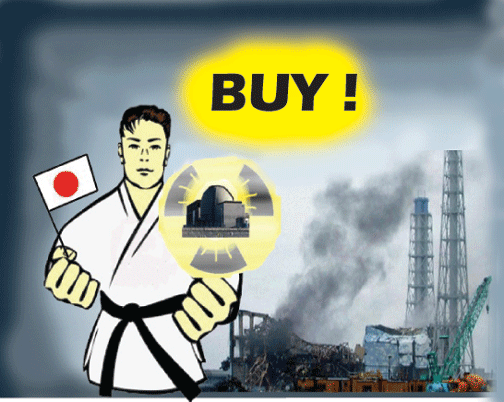
 Hitachi UK reactors to get full Japanese loan insurance https://asia.nikkei.com/Politics-Economy/Policy-Politics/Hitachi-UK-reactors-to-get-full-Japanese-loan-insurance, Lenders seek guarantees as nuclear projects face post-Fukushima cost overruns, 2 Sept 17, TOKYO — Japan intends to fully insure bank loans for one of Hitachi‘s British nuclear plant projects in order to encourage domestic lenders to finance a particularly risky type of infrastructure export that Prime Minister Shinzo Abe’s government seeks to promote.
State-owned Nippon Export and Investment Insurance will write the loan insurance for reactors, which Hitachi will build through British arm Horizon Nuclear Power. The Japanese conglomerate, together with Tokyo and London, will conduct working-level talks to hash out a funding support framework, with the aim of breaking ground in 2019.
The project is estimated to cost over 2 trillion yen ($18.1 billion). Hitachi, the U.K. government and two state-backed entities — Japan Bank for International Cooperation and the Development Bank of Japan — are expected to pick up part of the tab. But private-sector financing will also be needed to close the funding gap.
NEXI, which normally indemnifies private lenders for 90-95% of financing, will enter into talks with Japanese banks toward fully guaranteeing loans for the Wylfa project.
Nuclear project costs have tended to balloon since since Japan’s 2011 Fukushima disaster owing to increased safety precautions. Seeing a higher risk of debt default, Japanese megabanks Bank of Tokyo-Mitsubishi UFJ and Mizuho Bank have sought full coverage by NEXI for any loans for nuclear plant development. Such insurance typically covers financing for projects in developing countries. NEXI is expected to impose conditions, such as a loan period of several decades, in return for an exception.
An accident or other troubles at the plant could expose BTMU and Mizuho to lawsuits from third parties because the banks would bear responsibility for financing the project. The two banks will decide on Wylfa financing based partly on discussions between Tokyo and London concerning damage compensation.
A default on the Wylfa loans would entail a taxpayer-funded repairs to the balance sheets of NEXI and JBIC. The loan insurance proposal is likely to spark a debate on whether promoting infrastructure exports in this way is worth the risk. The Abe government, for its part, will try to use the NEXI assurances to elicit more funding, public and private, from the British side.
With little prospect of constructing new reactors in Japan following the meltdowns at the Fukushima Daiichi nuclear power plant, domestic builders have focused their business offshore. Chinese state-owned enterprises are undertaking more global infrastructure projects, emboldening those who argue that Japan will be left behind in the race for overseas orders unless the country takes risks. In 2015, the U.K. became the first developed nation to approve a Chinese-made reactor.
Trump is considering abandoning trade agreement with South Korea – (strange timing!)
 Amid Nuclear Tensions, Trump Mulls Exit From South Korea Trade Deal, NYT, SEPT. 2, 2017, WASHINGTON — President Trump is considering pulling out of a major trade agreement with South Korea as he tries to fulfill get-tough campaign pledges on international trade. But he has not yet made a final decision, two senior administration officials said Saturday.
The problem for nuclear energy is social acceptance
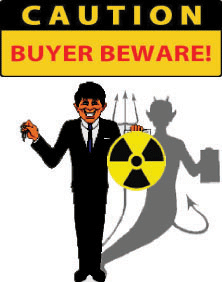 Social acceptance a big challenge to nuclear energy’ Manila Times
Energy Undersecretary Donato Marcos said a wide public acceptance regarding the use of nuclear energy would make it easier for the executive and legislative departments to make a decision regarding the mothballed Bataan Nuclear Power Plant (BNPP).
A national position is one of the 19 requirements prescribed by the International Atomic Energy Agency (IAEA) for the Development of a National Infrastructure for Nuclear Power.
Pre-feasibility study
A pre-feasibility study on rehabilitating the BNPP is also vital to crafting a national position on the 620-megawatt (MW) facility in this province, Marcos said.
He told reporters on Wednesday that six countries were interested in conducting due diligence on the nuclear power facility, including China, Korea, Japan, France, and the United States.
The Nuclear Energy Program Implementing Organization (Nepio) is currently working on a national leadership for the objective recommendation on BNPP by December…..http://www.manilatimes.net/social-acceptance-big-challenge-nuclear-energy/348176/
Two reactors at Tepco’s giant Niigata plant close to being restarted
NRA eager to clear Kashiwazaki-Kariya plant
 Tokyo Electric Power Company Holdings Inc. employees take part in a drill in the simulator of the central control room for a reactor inside the seismic isolation building at the company’s Kashiwazaki-Kariwa nuclear power station in Kashiwazaki, Niigata Prefecture, in February 2015.
Two Tokyo Electric reactors at the massive Kashiwazaki-Kariwa power station in Niigata Prefecture are expected to clear the initial safety hurdle for restarts soon, sources said Friday.
According to the sources, the Nuclear Regulation Authority will start talks on the issue on Wednesday, with a view to compiling a document that will certify the two units passed the new safety requirements introduced after the Fukushima nuclear crisis.
Tokyo Electric Power Company Holdings Inc. has been struggling to recover ever since the triple core meltdown in March 2011 because the seven-reactor Niigata plant is a crucial money maker. The utility has spent years trying to restart the plant, which is the only nuclear complex it runs aside from the disaster-hit Fukushima No. 1 plant in Fukushima Prefecture.
It filed for safety assessments for reactor Nos. 6 and 7 in September 2013.
The NRA wants to reach a conclusion on the issue before Chairman Shunichi Tanaka’s five-year term expires on Sept. 18, the sources said. But the move may trigger public criticism because Tepco still has a long way to go to scrap the ruined reactors at Fukushima No. 1, which was engulfed by quake-triggered tsunami and lost all power.
The Kashiwazaki-Kariwa complex is one of the world’s largest nuclear power plants and has an output capacity of 8.2 million kilowatts. Units 6 and 7 are boiling water reactors — the same type as the ones at Fukushima No. 1 — and the newest of the seven sitting along the Sea of Japan coast.
The governments hosting the Kashiwazaki-Kariwa plant are also cautious about restarting the units, with Niigata Gov. Ryuichi Yoneyama saying it will take “around three to four years” for the utility to win local consent on the matter.
Tepco, which is facing massive compensation payments and other costs from dealing with the world’s worst nuclear crises since Chernobyl, has been desperate to restart the idled reactors so it can reduce spending on costly fossil fuel imports needed to run the thermal power plants making up for the nationwide nuclear shutdowns.
Some reactors at other utilities have already resumed operations, but Tepco has been under constant scrutiny to determine whether it is qualified to once again operate a nuclear power plant.
Some inside the NRA have been reluctant to move ahead with the safety review at Kashiwazaki-Kariwa. But Tanaka strongly wants to set a course on the issue before he leaves his position at the NRA, and this was one of the factors that led to the latest development in Niigata, the sources said.
Tactical nuclear weapons for South Korea: U.S. and South Korean defense leaders considering this



| Song, Mattis reportedly discuss redeployment of tactical nuclear weapons to South Korea, The Hankyoreh, Sep.1,2017 |
China rethinks nuclear plant on North Korea’s border – has set up solar farm instead
Solar farm may spell end for China’s plan to build nuclear plant on North Korea’s border
Renewable development on site earmarked for reactors raises speculation the authorities have gone cold on the idea, SCMP, Stephen Chen Thursday, 31 August, 2017 China has set up a solar farm near the North Korean border on a site previously earmarked for a nuclear power plant, in an apparent sign that the authorities have abandoned plans to build a reactor.
The Baishan solar farm in Jingyu county, Jilin province was recently connected to the local power grid after a three-month construction period plagued with problems.
A farmer living near Baishan reservoir said solar panels had been put up over the past few months and now covered half of a large swathe of elevated land by the lake’s west bank.
The solar plant can generate up to 10 megawatts of power, provincial newspaper Jilin Daily reported in July…….
Authorities had earlier acquired the area south of Gangding village, which was once used for cultivating corn and beans, to build the Jingyu nuclear power station, according to the county government website.
The planned power plant was one of two Chinese nuclear projects proposed near the North Korean border.
Ground-clearing work on the site, meant to house four AP1000 nuclear reactors, was completed in 2013.
The reactors, if built, would have been situated less than 100km north of Chunggang, a North Korean county bordering China across the Yalu river.
Chunggang is home to an intermediate-range ballistic missile base targeting the US military base on the Japanese island of Okinawa, according to globalsecurity.org.
In the border city of Dandong in Liaoning province, construction of the Donggang nuclear power plant has also been put on hold, according to Chinese media reports……..http://www.scmp.com/news/china/society/article/2109018/solar-farm-may-spell-end-chinas-plan-build-nuclear-plant-north
China’s Parliament passes a new nuclear safety law
 China’s legislature passes nuclear safety law, Reuters Staff by David Stanway; Editing by Tom Hogue SHANGHAI (Reuters), 1 Sept 17, – China’s parliament passed a new nuclear safety law on Friday aimed at improving regulation in the nuclear power sector as new projects are built across the country.
Officials say the law will give more powers to the regulator, the National Nuclear Safety Administration (NNSA), and establish new systems that will improve the disclosure of information on issues like radiation, and prevent or minimise risks from nuclear accidents.
………weak and opaque governance has long been seen as an industry problem, especially when it comes to determining the precise roles of the government, the military and state-owned nuclear enterprises on issues such as the handling of nuclear materials and the disposal of spent fuel.
Guo said the new law focused on strengthening China’s nuclear safety regime, and would create “institutional mechanisms” and a “division of labour” among regulators and enterprises to clarify responsibilities for safety…..
the decision to construct dozens of new projects, many using advanced and untested “third-generation” reactor designs, has put the government under pressure to improve regulation and build public trust in nuclear power.
China also needs to expand its waste processing capacity and train hundreds of new technicians and safety staff.
Mark Hibbs, senior fellow of the Nuclear Policy Program at the Carnegie Endowment for International Peace, said China has until now not addressed the legal authority of the NNSA, a relatively under-resourced division of China’s environment ministry……https://www.reuters.com/article/us-china-nuclearpower/chinas-legislature-passes-nuclear-safety-law-idUSKCN1BC4ER
Shift to solar, wind and water power by China’s energy agencies
China’s amazing green shift to solar, wind and water power, REneweconomy, [good graphs] By John Mathews on 1 September 2017 Global Green Shift
China’s energy-related agencies, the National Energy Administration (NEA) and the China Electricity Council (CEC), have released data on the operation of China’s electric power system in the first half of 2017 (1H 2017), noting that renewable sources (water, wind and sun) accounted for just on 69.8% of new capacity added, with thermal sources (mainly coal) accounting for 28%, and nuclear for just on 2% (Fig. 1).
These results reveal a marked shift towards green sources of electric power, when compared with the 2016 data which show that renewable sources (WWS) added 51.9% of new capacity, while thermal accounted for 42.9% and nuclear for 5.2%.
The first half results for 2017 thus reveal that the electric power system is continuing its green shift, edging closer to placing more reliance on WWS sources at the margin, with WWS sources increasing their influence and thermal sources declining in proportion.
The trends therefore continue those analyzed previously by Dr Hao Tan and myself (http://apjjf.org/2017/10/Mathews.html)……..
When we turn to examine new capacity additions and investments in WWS sources in 2017 (1H) we see that the green shift continues to operate at a level that far exceeds what is found elsewhere in the world.
Solar
The 23.6 GW new solar PV capacity added in 2017 (1H) is another world record for China, taking the cumulative installed capacity to 101 GW by end of June 2017 (and to 112.3 GW by July 2017– which is already above the (conservative) target of 105 GW set for 2020 by the ND&RC in its 13th FYP for energy).
Some observers like the AECEA see China’s solar PV installations as likely to top 40 GW in 2017 for the full year (https://www.pv-magazine.com/2017/08/22/aecea-china-installations-to-surpass-40-gw-in-2017).
The AECEA sees the 2020 cumulative total for China as likely to reach 230 GW, which would dominate the global picture.
Now the NEA in China in August has acted to raise the target for solar PV in China by 2020, setting a new target of 213 GW – or a doubling of the previous target total, which is already five times the current installed capacity in the US (https://www.ecowatch.com/china-solar-target-2476947208.html)……
Wind
The 6.0 GW new capacity added for wind in China for 2017 (1H) – or 1 GW per month (equivalent to 400 new turbines built and erected, rated at 2.5 MW each).
This is a 4.7% increase on the pro rata figure for 2016, which saw wind capacity additions reaching 17.3 GW, and the cumulative total reaching 154.6 GW, easily the largest in the world.
According to Greenpeace, China is on track to install 110 GW onshore wind capacity by 2020 – raising cumulative wind capacity to 259 GW, well in excess of the 210 GW target set for the end of the 13th FYP period in 2020……..http://reneweconomy.com.au/chinas-amazing-green-shift-solar-wind-water-power-57490/
Death of Sumiteru Taniguchi, Nagasaki Survivor and Nuclear Arms Foe
 he gave a speech at the United Nations in New York during a meeting to consider a nonproliferation treaty.
A month before he died, the United Nations adopted the Treaty on the Prohibition of Nuclear Weapons.
“He played a tremendous role,” said Terumi Tanaka, secretary general of the Japan Confederation of A- and H-Bomb Sufferers Organizations. “But unless all countries sign the treaty, there is no guarantee that nuclear weapons will disappear.”
1 This Month

of the week – THE ONENESS of HUMANITY
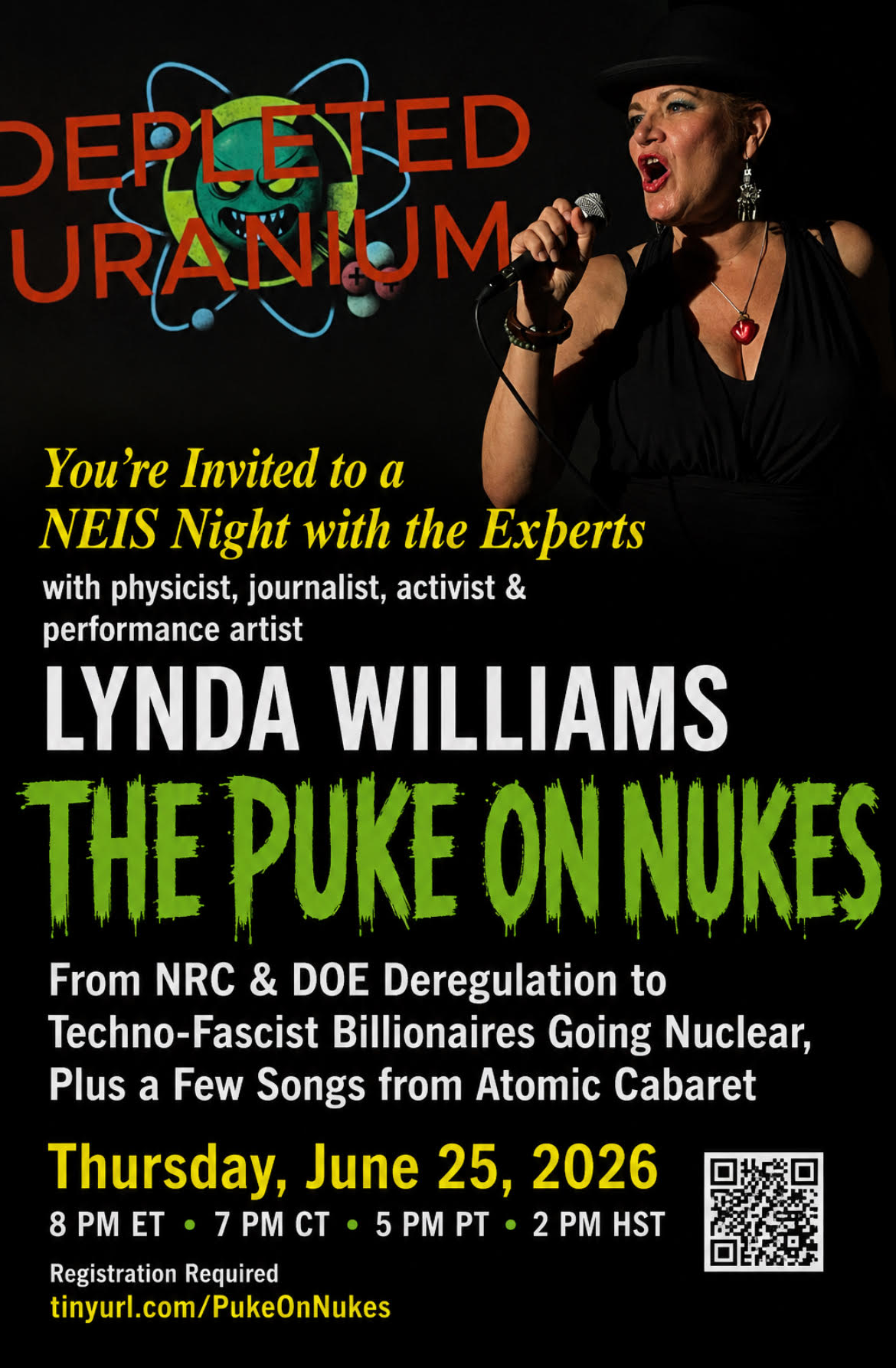
25 June- THE PUKE ON NUKES
Thursday, June 25, 2026
7pm Central Time (8pm ET, 6pm MT, 5pm PT) UTC – 5
From NRC & DOE Deregulation to Techno-Fascist Billionaires Going Nuclear, Plus a Few Songs from Atomic Cabaret REGISTER
26 June – Radiation Trainwreck at the NRC / Join the Protect Better Campaign – https://us02web.zoom.us/meeting/register/4ZlZ5_qLSHGiLSCg8FF6Bg#/registration

1st July – Webinar Waste of Space: The Environmental Harm of Military and Civil Space Activity st July, 7 pm

Report Launch Online: We are seeing an increasing exploitation of space for military and commercial purposes. This must change.

Protect Sazan Island from the Trump family! https://secure.avaaz.org/campaign/en/protect_sazan_island_from_the_trump_family_loc/?bqFCVab&v=174511&cl=22707147157&_checksum=5e9dde668860e8231c33699735e16a1fbf22ab2cb01da50c999fe8732b9775ef&utm_source=email&utm_medium=blast_email&utm_campaign=174511


Cuba Is Not a Failed State – It Is a Besieged State
PETITION: “Global Appeal to Endorse Palestinian Right of Return of Refugees”
To see nuclear-related stories in greater depth and intensity – go to https://nuclearinformation.wordpress.com
-
Archives
- June 2026 (251)
- May 2026 (306)
- April 2026 (356)
- March 2026 (251)
- February 2026 (268)
- January 2026 (308)
- December 2025 (358)
- November 2025 (359)
- October 2025 (376)
- September 2025 (257)
- August 2025 (319)
- July 2025 (230)
-
Categories
- 1
- 1 NUCLEAR ISSUES
- business and costs
- climate change
- culture and arts
- ENERGY
- environment
- health
- history
- indigenous issues
- Legal
- marketing of nuclear
- media
- opposition to nuclear
- PERSONAL STORIES
- politics
- politics international
- Religion and ethics
- safety
- secrets,lies and civil liberties
- spinbuster
- technology
- Uranium
- wastes
- weapons and war
- Women
- 2 WORLD
- ACTION
- AFRICA
- Atrocities
- AUSTRALIA
- Christina's notes
- Christina's themes
- culture and arts
- Events
- Fuk 2022
- Fuk 2023
- Fukushima 2017
- Fukushima 2018
- fukushima 2019
- Fukushima 2020
- Fukushima 2021
- general
- global warming
- Humour (God we need it)
- Nuclear
- RARE EARTHS
- Reference
- resources – print
- Resources -audiovicual
- Weekly Newsletter
- World
- World Nuclear
- YouTube
-
RSS
Entries RSS
Comments RSS
 nuclear-news