A nuclear North Korea is not a threat, but an ideal stabilizer.
 Why the United States Needs North Korea to Stay Nuclear, A nuclear North Korea is not a threat, but an ideal stabilizer. National Interest
Many are hopeful that the June 12 summit in Singapore between President Trump and North Korean leader Kim Jong-un will lead to denuclearization and peace on the Korean Peninsula. Others believe the historical record makes clear that such a hope is overly optimistic. But what if allowing North Korea to retain its nuclear arsenal could both lead to peace and benefit America’s long-term security interests in the region?
There are two reasons for this. First, possessing nuclear weapons is the best way to pacify North Korea and constrain its aggression. Second, a secure and independent North Korea (without the presence of Chinese or U.S. forces) would also provide a buffer against great power tensions. The long-term primary objective of U.S. strategy in East Asia should be to contain a rising China. To achieve this, the United States must minimize Chinese influence on its neighboring states—whether they are U.S. allies or not. A limited North Korean nuclear arsenal is the most effective way to make this happen.
The View From Pyongyang: A Need for Balance
During the Cold War, the Soviet Union’s backing of North Korea and U.S. backing of South Korea were roughly equal, resulting in a stable power balance on the Korean Peninsula. However, since the Soviet collapse, the balance of power has rapidly shifted against North Korea. The United States continues to lead the Republic of Korea (ROK)-U.S. Combined Forces Command and regularly renews its security commitments in the region. In contrast, Russia abolished its alliance treaty with North Korea in 1994. China also refused to replace the Soviet Union as North Korea’s patron when the matter was discussed between Deng Xiaoping and Kim Il-sung in 1991.
Without this balance, the peninsula has been in prolonged instability and frequently came close to military confrontation. As a sovereign state ruled by a totalitarian regime, North Korea has shown its willingness to guarantee its security at any cost. Intensifying military and economic pressure against the North has only made it more defiant and unpredictable. Therefore, any solution to the present crisis must take into account the security of this sovereign nation. Clearly, massive militarization and isolation are not a long-term solution for North Korea.
……… not only do nuclear weapons offer a level of security that Chinese assurances do not, but they also are the most cost-effective way for a resource-poor North Korea to achieve sustainable security. A nuclear North Korea is not a threat, but an ideal stabilizer. The balance of power on the Korean peninsula and that between the United States and China are interrelated. China’s rise has the potential to shift the regional balance, making confrontation more likely in the future. If a limited nuclear capability guarantees North Korea’s existence and independence, it can provide a buffer space to keep Chinese forces in China and U.S. troops stationed in South Korea separate. ……….
North Korea’s fear of Chinese control is one area where North Korean and American interests of containing China actually align. Moreover, North Korea would prefer to have the ability to hedge between two superpowers to get the best deal, which is only possible by reducing China’s monopoly on economic leverage over North Korea. In the same way that a nuclear China was useful in containing the USSR in the 1970s, North Korea may be helpful in containing China today.
A tacit agreement to allow the DPRK to retain a minimal but credible nuclear deterrent is advantageous to U.S. interests in that it maintains a source of friction in Sino-North Korean relations. By possessing nukes, North Korea will be more independent from Chinese influence and can turn away from China. Thus, a nuclear North Korea would be a viable solution to the imbalance of power on the Korean peninsula after the end of the Cold War. Finally, North Korea would also benefit the long-term U.S. strategy of containing Chinese expansionism. This China containment policy can only be successful if the United States is willing to politically and economically engage with North Korea.
In a 1967 article in Foreign Affairs, Richard Nixon stated that “Taking the long view, we simply cannot afford to leave China forever outside the family of nations, there to nurture its fantasies, cherish its hates and threaten its neighbors.” If Nixon, along with Henry Kissinger’s support, could understand the strategic value of engaging a former adversary with newly acquired nuclear weapons, perhaps policymakers can see the strategic value of doing so with North Korea today.
Hongyu Zhang is a Visiting Assistant Professor of Government at the College of William & Mary, and can be reached at hzhang17@wm.edu. His research focuses on nuclear proliferation, East Asian security, and Chinese foreign policy.
Kevin Wang is a Research Assistant at the National Defense University’s College of International Security Affairs (CISA) for Nuclear Security and Nonproliferation Issues. He can be reached at kwang@email.wm.edu. http://nationalinterest.org/feature/why-the-united-states-needs-north-korea-stay-nuclear-26382
Japanese firms shift to clean energy despite state’s cling to nuclear power

Rokkasho Election Results


Japan’s business firms shifting to clean energy, despite govt’s pro nuclear policy
Japanese firms shift to clean energy despite state’s cling to nuclear power, Japan Today , By Hidetoshi Takada, TOKYO While Japan’s government clings to atomic power even after the Fukushima nuclear crisis, its private sector is moving ahead with more use of renewables to power their operations amid growing international awareness of global warming.
Daiwa House Industries Co, for instance, became in March a member of both RE100 (Renewable Electricity) and EP100 (Energy Productivity), two global initiatives by the Climate Group.
RE100 is a global, collaborative initiative of influential businesses committed to using 100 percent renewable electricity, while EP100 brings together companies committed to doubling energy productivity to lower greenhouse gas emissions.
Among RE100’s 136 members are U.S. General Motors Co and Dutch consumer goods giant Unilever.
Printer maker Ricoh Co, the first Japanese firm to join RE100, was followed by five firms such as online stationery retailer Askul Corp and retail giant Aeon Co., aiming to meet the electricity needs of their global operations with renewable energy between 2030 and 2050.
Daiwa House says it is the world’s first company in the construction and housing sectors to join both campaigns and the first to declare it is taking bold action as part of EP100 among Japanese firms. Currently, there are 15 EP members. Daiwa aims to achieve the both by 2040.
Katsuhiro Koyama, general manager of Daiwa’s environment department, spurred debate to achieve the targets after returning to Japan from the COP23 global climate round in Germany last November.
He had previously taken a cynical view of such tech giants as Apple Inc, Google Inc and Microsoft Corp participating in the RE100 clean energy initiative, seeing it as an “atonement for their sins” of consuming huge amounts of electricity.
But Koyama, one of the Japanese delegate members to the global conference, said he was “inspired” by the firms’ “serious aspirations to leverage clean energy producers” after hearing various discussions.
The Osaka-based Daiwa group has invested an estimated 46.6 billion yen (about $424 million) in the construction of its own solar, hydro and wind power plants nationwide since 2007, producing power equivalent to about 60 percent of the group’s annual use of 481 million kilowatt hours. Meanwhile, it doubled its electricity use efficiency in fiscal 2016 compared to fiscal 2005.
Japanese businesses became much more aware of renewable energy in the wake of the Hokkaido Toyako summit in 2008 in which the Group of Eight countries set a long-term target to reduce greenhouse gas emissions.
The 2011 Great East Japan Earthquake, which triggered the suspension of all nuclear power plants in Japan, also sparked public concerns over the country’s energy mix.
The ratio of renewable energy to the nation’s entire power output capacity has risen from 10 percent in fiscal 2010 to 15 percent in fiscal 2016, according to the Agency for Natural Resources and Energy, boosted by a feed-in tariff system that obliges utilities to buy electricity generated by renewable energy at fixed prices.
The scheme has attracted businesses large and small, even individuals, to pour money into the photovoltaic field as it requires less effort to install and operate in a shorter period of time compared to other types of energy sources, said Yushi Inoue, a research director at Mitsubishi Research Institute, a think tank.
Individual power producers are actively trying to connect with grids in northeastern Japan, and sought to supply “more than three times what we can accept” in a recent offering, said a spokesman of Tohoku-Electric Power Co, the regional utility.
The region, part of which was devastated by the mega quake seven years ago and the subsequent nuclear disaster, has a number of favorable locations for wind power plants. “A vast majority of the seekers are renewable-energy oriented,” he said.
Meanwhile, a similar scheme in Europe that utilizes renewable energy certificates under a guarantee of origin of electricity generated from such sources has gained momentum among environmentally conscious firms, particularly after the 2008 summit on Japan’s northernmost island………
The Ministry of Economy, Trade and Industry drafted the latest energy mix plan due to be finalized this summer, calling nuclear power “an important baseload energy source.” This stance appears to conflict with public opinion which shifted after the 2011 Fukushima disaster. In addition to public sentiment against nuclear power plants, the government’s tougher safety standards led to the shutdown of all the countries reactors. ……..https://japantoday.com/category/business/feature-japan-firms-shift-to-clean-energy-despite-state%27s-cling-to-nuclear-power
Draft revision of Japan’s Basic Energy Plan does not call for new nuclear power reactors.
 Japan’s nuclear energy policy at crossroads , Japan News June 23, 2018, By Koichi Kuranuki / Yomiuri Shimbun Senior Writer The Economy, Trade and Industry Ministry has compiled a draft revision of the nation’s Basic Energy Plan. The revised plan will serve as the new guidelines for long-term energy policies. In the plan, nuclear power is defined as “an important mainstay energy source,” but the plan does not specifically call for construction of new and additional nuclear power reactors.
If the situation is left as it is, Japan will move slowly toward zero nuclear energy over the long term. How can the people’s understanding of nuclear power deepen? Japan’s nuclear power policy is at a crossroads.
Mainstay energy source
The draft revision of the Basic Energy Plan presented on May 16 laid out a policy aiming to make solar power and other renewable energy the nation’s key energy sources. At the same time, it also listed technical issues such as fluctuations in energy output according to weather conditions and time of day……..
Growing costs
However, major power companies have to overcome high hurdles to independently build new plants or replace current reactors with new ones.
The total cost of Hitachi, Ltd.’s nuclear power business in Britain has ballooned to more than ¥3 trillion with two reactors. The project is likely to receive financial support from the British government, but negotiations are still under way for the prices of electricity the government guarantees to purchase, and no final conclusion has been reached.
The cost of building the Nos. 6 and 7 reactors at Tokyo Electric Power Company Holdings, Inc.’s Kashiwazaki-Kariwa nuclear power plant in Niigata Prefecture, which began operating in the 1990s, was about ¥400 billion per reactor. TEPCO was a blue chip company before its nuclear accident in 2011, and it was able to procure low-interest funding. Its interest burden for the construction funds of the reactors was only ¥10 billion in total.
However, the situation has changed completely since the nuclear accident. Nuclear safety standards have been ramped up worldwide, and construction costs have soared. TEPCO has spent a total of ¥700 billion on safety measures for the Nos. 6 and 7 reactors at the Kashiwazaki-Kariwa plant.
Even if companies build new plants at tremendous cost, a good return on the investment seems unlikely, and it is difficult to procure funds.
……. Public resistance…….. Many residents in Niigata Prefecture are opposed to nuclear power. A local resident related to the electric power industry who supported Hanazumi said, “I feel that possible votes for him are sure to decrease if constituents see [Hanazumi as being linked to] the activities of electric power companies.”…… Not only those living in the vicinity of nuclear power plants, but Japanese citizens in general have negative views on nuclear power generation…….http://the-japan-news.com/news/article/0004518947
Adivasis (indigenous people) in a remote area of India, suffer health effects from the nuclear industry?
News Click 21st June 2018 , Sanjay Gope, a 13-year-old boy from Bango village near Jadugora town in
East Singhbhum district of Jharkhand, cannot move or speak because he has
been suffering from muscular dystrophy – a group of disorders that
involves a progressive loss of muscle mass and consequent loss of strength
– for the past nine years. At least one person of his family has to be
with him all the time to look after him. He cannot be left unattended.
Eighteen-year-old Parvati Gope from the same village is suffering from
lumbar scoliosis – a C-shpaed curve formation of her vertebral column.
Rakesh Gope, a 13-year-old school-going boy, is also suffering from
muscular dystrophy. Although he is active and walks with arched feet and
soles, he is unable to speak normally.
A three-year-old child Kartik Gope has been having seizures since birth and is developing muscular dystrophy
too. These examples are not enough; there are hundreds of such cases of
congenital illness and other birth defects in addition to high incidence of
infertility, miscarriages and pre-mature deliveries.
Now, a pertinent question arises here: why are such large number of health hazards being
reported from this remote and overlooked corner of the country? While India
is dreaming to become energy efficient by 2032 by generating 63 Gigawatts
of nuclear power, it is taking a major toll on human lives in a small
township of Jharkhand. Jadugora has the deposits of world’s best quality
uranium ore, magnesium diuranate. It is because of the rich deposits of the
region, India is capitalising its nuclear dreams. The whole belt of the
reactors is affecting the Adivasis (indigenous people) disproportionately
in and around the uranium mining operational area.
https://newsclick.in/uranium-mining-jharkhand-radioactive-poisoning-ravaging-lives-villages
Trouble-hit nuclear reactor in southwestern Japan resumes operations

Donald Trump says North Korean leader Kim Jong Un had committed to destroy a western North Korea missile site: USA names it
U.S. identifies North Korea missile test site it says Kim committed to destroy , Matt Spetalnick,
WASHINGTON (Reuters) 21June 18- The missile engine test site that President Donald Trump said North Korean leader Kim Jong Un had committed to destroy is a major facility in the western part of the country that has been used for testing engines for long-range missiles, according to a U.S. official.
Trump told reporters after their June 12 summit that Kim had pledged to dismantle one of his missile installations, which would be North Korea’s most concrete concession at the landmark meeting in Singapore.
However, the president at the time did not name the site.
A U.S. official identified it on Wednesday as the Sohae Satellite Launching Ground, saying North Korea “has used this site to test liquid-propellant engines for its long-range ballistic missiles.”
Pyongyang has said its missiles can reach the United States.
“Chairman Kim promised that North Korea would destroy a missile engine test stand soon,” the official told Reuters, speaking on condition of anonymity.
There was no immediate word on the exact timetable, and North Korea has not publicly confirmed that Kim made such a commitment.
CBS News was the first to identify the site, which is the newest of North Korea’s known major missile testing facilities.
Although Trump has hailed the Singapore summit as a success, skeptics have questioned whether he achieved anything, given that Pyongyang, which has rejected unilateral nuclear disarmament, appeared to make no new tangible commitments in a joint written declaration.
The U.S.-based North Korea monitoring group 38 North said in an analysis at the end of last week there had been no sign of any activity toward dismantling Sohae or any other missile test site.
India and Pakistan have increased their stockpiles of nuclear weapons
I ndia, Pakistan expanding their new nuclear weapons stockpiles: SIPRI https://www.moneycontrol.com/news/india/india-pakistan-expanding-their-new-nuclear-weapons-stockpiles-sipri-2605161.html There are nine countries which have nuclear warheads. They include Russia, the US, the UK, France, China, Israel, India, Pakistan and North Korea, Moneycontrol News@moneycontrolcom , 19 June 18
The Stockholm International Peace Research Institute in its 2018 edition of the yearly report on the current state of armaments, disarmament and international security said despite the overall decrease in global nuclear weapons year-on-year, India and Pakistan have increased their stockpiles.
India, which had an estimated 120-130 nuclear warheads as per 2017 report, now has 130-140 warheads. Similarly, Pakistan, which had 130-140 warheads now has increased to 140-150 warheads. Both countries are also developing new land, sea and air-based missile delivery systems.
Another nuclear country in Asia, China continues to modernise its nuclear weapon delivery systems and is slowly increasing the size of its nuclear arsenal. The country now has an estimated 280 nuclear warheads. In 2017 report, the number was 270.
The US and Russia still constitute a major share of approximately 14,465 nuclear weapons that exist in the world. Both together account for nearly 92 percent of all nuclear weapons despite reducing their strategic nuclear forces pursuant to the implementation of the 2010 Treaty on Measures for the Further Reduction and Limitation of Strategic Offensive Arms.
Moreover, the cold war-era rivals also have long-term programmes underway to replace and modernise their nuclear warheads, missile and aircraft delivery systems, and nuclear weapon production facilities.
“The renewed focus on the strategic importance of nuclear deterrence and capacity is a very worrying trend,” says Ambassador Jan Eliasson, Chair of the SIPRI Governing Board.
“The world needs a clear commitment from the nuclear weapon states to an effective, legally binding process towards nuclear disarmament.”
Other countries which are a nuclear state include the UK (215 warheads), France (300 warheads), Israel (80 warheads) and North Korea (10-20 warheads). The figures for North Korea are uncertain, the report said, however, there was no doubt that it has nuclear weapons.
In 2017, North Korea has made technical progress in developing its nuclear weapon capabilities, including the test of—what was claimed to be—a thermonuclear weapon, in September. North Korea also demonstrated unexpected rapid progress in the testing of two new types of long-range ballistic missile delivery systems. These testing led to a crisis in the Korean peninsula.
However, in a meeting with US president Donald Trump, North Korean supreme leader Kim Jong-un vowed to work towards the complete denuclearisation of the Koran peninsula.
Why Japan should disconnect from fast-breeder reactor project – The Asahi Shimbun
EDITORIAL: Japan should disconnect from fast-breeder reactor project http://www.asahi.com/ajw/articles/AJ201806180025.html, June 18, 2018
France has decided to sharply scale down its ASTRID fast-reactor project, which is supported by Japan.
France’s decision underscores afresh the dismal outlook of Japan’s plan to continue the development of fast-reactor technology by relying on an overseas project.
Now that it has become unclear whether participation in the ASTRID project will pay off in future benefits that justify the huge investment required, Japan should pull out of the French undertaking.
Fast reactors are a special type of nuclear reactors that burn plutonium as fuel. The ASTRID is a demonstration reactor, the stage in reactor technology development just before practical use.
The French government has said the Advanced Sodium Technological Reactor for Industrial Demonstration, if it comes on stream, will generate 100 to 200 megawatts of electricity instead of 600 megawatts as originally planned. Paris will decide in 2024 whether the reactor will actually be built.
Japan has been seeking to establish a nuclear fuel recycling system, in which spent nuclear fuel from reactors will be reprocessed to extract plutonium, which will then be burned mainly in fast reactors.
When the Japanese government in 2016 pulled the plug on the troubled Monju prototype fast-breeder reactor, which was at the technology stage prior to that of a demonstration reactor, it decided to make the joint development of the ASTRID the centerpiece of its plan to continue the nuclear fuel recycling program.
The government will provide some 5 billion yen ($45.2 million) annually for the French project through the next fiscal year, which starts in April, and decide, by the end of this year, whether and how it will be involved in the project after that.
Because of significant differences in the roles of prototype and demonstration reactors, a simple comparison between the Monju and the ASTRID can be misleading.
But it is clearly doubtful whether the ASTRID, which will be smaller than the Monju, will offer sufficient benefits for Japan’s fuel recycling program.
If it fully commits itself to the joint development of the ASTRID in response to France’s request, Japan will have to shoulder half the construction cost, estimated to be hundreds of billions to 1 trillion yen, and assign many engineers to the project. But these resources could end up being wasted.
Over the years, the government spent more than 1.1 trillion yen of taxpayer money on the Monju, designed to be a small-scale example of the potential of the fast-breeder reactor technology. But the prototype reactor remained out of operation for most of the two decades after it became operational. It actually accomplished only a small fraction of what it was designed to achieve.
The government should make an early decision to end its involvement in the ASTRID to avoid repeating the mistake it made with the Monju project, which was kept alive at massive cost for far too long as the decision to terminate it was delayed for years without good reason.
The government has only itself to blame for the current situation. Despite deciding to decommission the Monju, it stuck to the old fuel cycle policy without conducting an effective postmortem on the Monju debacle. Instead, the government too readily embraced the ASTRID project as a stopgap to keep its fast-reactor dream alive.
The government needs to rigorously assess whether it is wise to continue developing fast-reactor technology.
Producing electricity with a fast reactor is costlier than power generation with a conventional reactor that uses uranium as fuel. The United States, Britain and Germany phased out their own fast-reactor projects long ago.
France has continued developing the technology, but feels no urgent need to achieve the goal. The country predicts that the technology will be put to practical use around 2080 if it ever is.
Even if Japan wants to continue developing fast-reactor technology, it would be extremely difficult to build a demonstration reactor for the project within the country given that even finding a site to build an ordinary reactor is now virtually impossible.
The government would be utterly irresponsible if it aimlessly keeps pouring huge amounts of money into the project when there is no realistic possibility of the technology reaching the stage of practical application.
If it abandons the plan to develop fast-reactor technology, the government will have to rethink the entire nuclear fuel recycling program.
Any such fundamental change of the nuclear power policy would have serious implications. But there is no justification for postponing the decision any further.
Strong earthquake shakes Osaka: Officials in neighboring Fukui Prefecture say all 15 nuclear reactors are still functioning
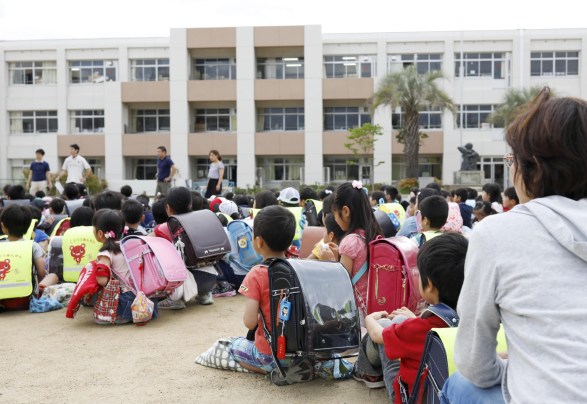

What it would take to dismantle North Korea’s nuclear military power
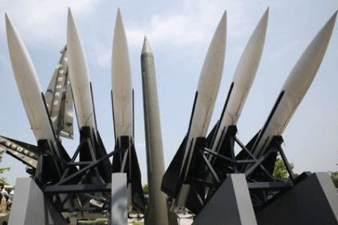 Here’s a look at North Korea’s nuclear power and what it would take to dismantle it, Business Insider, Eleanor Albert, Council on Foreign Relations, Jun. 16, 2018 North Korea has one of the world’s largest conventional military forces — combined with its missile and nuclear tests, the nation is a worldwide concern.
South Korean nuclear reactor to be shut down early. Plans for new reactors cancelled
 Korea Times 15th June 2018 , The Korea Hydro & Nuclear Power (KHNP) said Friday its board has decided to shut down the Wolsong-1 nuclear reactor in Gyeongju, North Gyeongsang Province, before the end of its lifespan and scrap all plans for building
four new reactors across the country.
“According to the government’s energy policy shift, we have reviewed operational plans of Wolsong reactors several times and concluded keeping the Wolsong-1 operating under strengthened safety regulations would not be economical,” KHNP CEO Chung
Jae-hoon said in a press conference in Seoul.
“Also, the plans for building new reactors of Cheonji-1,2 and Daejin-1,2 would be terminated in order to eradicate uncertainties in the KHNP’s management and restore smooth relations with local residents.”
https://www.koreatimes.co.kr/www/tech/2018/06/325_250740.html
UK govt providing $billions for Wylfa nuclear power project, but Hitachi still scrambling for more money from Japan and USA

Nikkei Asian Review 16th June 2018 , Hitachi continues to search for ways to share the burdens of building a British nuclear power plant and now is sounding out the Development Bank of Japan and several Japanese power companies about taking stakes in the
project, a high hurdle as many are still struggling with the heavy financial fallout from the 2011 meltdown at Fukushima.
The cost projection for the project on the Welsh island of Anglesey has ballooned to 3 trillion yen ($27.1 billion). To keep it commercially viable, the British government pledged on June 4 to arrange the entire 2 trillion yen in necessary loans, twice its original offer. In addition, 900 billion yen is to be invested in the Hitachi subsidiary responsible for developing and building the plant, with 300 billion yen coming from a consortium of Japanese companies and the Japanese government.
The DBJ is considering an investment as a government-affiliated financial institution. Chubu Electric Power, Tokyo Electric Power Co. Holdings, Kansai Electric Power, Chugoku Electric Power and Hokuriku Electric Power are some of the utilities being approached
about taking small stakes in the project, as well as Japan Atomic Power. Hitachi is also asking the utilities for technical support.
Japan Atomic Power already plans to support such aspects as operation and maintenance of the U.K. plant with U.S. energy provider Exelon. Tepco and Chubu Electric both operate in Japan boiling water reactors, the same type that will bebbuilt on Anglesey. But winning participation from these companies will not be an easy task. Tepco must raise 16 trillion yen of the 22 trillion yen needed to decommission the Fukushima Dai-ichi nuclear plant and compensate victims of the meltdown. The company has said it will improve profitability to do so, but such efforts are still in the preliminary stages.
https://asia.nikkei.com/Business/Business-Deals/Hitachi-seeks-Japanese-partners-in-building-27bn-UK-nuclear-plant
Powerful earthquake north of Tokyo
Powerful quake jolts Gunma north of Tokyo; no injuries http://www.asahi.com/ajw/articles/AJ201806170031.html, THE ASAHI SHIMBUN, June 17, 2018
A strong earthquake shook the northern part of the Kanto region on the afternoon of June 17, the Meteorological Agency said.
The quake registered a lower 5 on the Japanese seismic intensity scale of 7 in Shibukawa, Gunma Prefecture, when it hit at 3:27 p.m. with a focus 14 kilometers from the ground surface. It originated in southern Gunma Prefecture. No injuries have been reported.
The agency said this is the first time a quake originating in the prefecture and measuring a lower 5 or stronger has been recorded since 1923.
The magnitude of the temblor is estimated at 4.6. No tsunami is expected, according to the agency.
1 This Month
26 September – International Day for the Total Elimination of Nuclear Weapons





PLEASE OPPOSE HR 8255 AND S.3639 – bills would accelerate satellite deployment, with no environmental review or safeguards – https://ncstd5li.quorum.us/campaign/169331/
To see nuclear-related stories in greater depth and intensity – go to https://nuclearinformation.wordpress.com
-
Archives
- September 2026 (313)
- August 2026 (330)
- July 2026 (355)
- June 2026 (287)
- May 2026 (306)
- April 2026 (356)
- March 2026 (251)
- February 2026 (267)
- January 2026 (308)
- December 2025 (358)
- November 2025 (359)
- October 2025 (375)
-
Categories
- 1
- 1 NUCLEAR ISSUES
- business and costs
- climate change
- culture and arts
- ENERGY
- environment
- health
- history
- indigenous issues
- Legal
- marketing of nuclear
- media
- opposition to nuclear
- PERSONAL STORIES
- politics
- politics international
- Religion and ethics
- safety
- secrets,lies and civil liberties
- spinbuster
- technology
- Uranium
- wastes
- weapons and war
- Women
- 2 WORLD
- ACTION
- AFRICA
- Atrocities
- AUSTRALIA
- Christina's notes
- Christina's themes
- culture and arts
- Events
- Fuk 2022
- Fuk 2023
- Fukushima 2017
- Fukushima 2018
- fukushima 2019
- Fukushima 2020
- Fukushima 2021
- general
- global warming
- Humour (God we need it)
- Nuclear
- RARE EARTHS
- Reference
- resources – print
- Resources -audiovicual
- Weekly Newsletter
- World
- World Nuclear
- YouTube
-
RSS
Entries RSS
Comments RSS

