TEPCO aims to build more Fukushima-type nuclear reactors, vows to ‘excel in safety’ this time

U.S. Secretary of State Mike Pompeo urges China to enforce sanctions on North Korea
Pompeo tells China continued North Korea sanctions enforcement needed David Brunnstrom WASHINGTON (Reuters) 29 June 18 – U.S. Secretary of State Mike Pompeo has stressed to China the importance of continued enforcement of sanctions on North Korea to press it to give up its nuclear weapons, after warning of signs of backsliding by Beijing.
The State Department said Pompeo had spoken to his Chinese counterpart Wang Yi on Thursday and discussed efforts “to achieve our shared goal of the complete, verifiable, and irreversible denuclearization of the Korean Peninsula.”
Pompeo reiterated that North Korea would have a bright future if it denuclearized and emphasized “the continued importance of full enforcement of all relevant UN Security Council resolutions related to North Korea,” the department said in a statement.
It said this was especially important when it came to preventing North Korea’s illegal export of coal and imports of refined petroleum through ship-to-ship transfers prohibited by the United Nations.
……… Pompeo also spoke with South Korean Foreign Minister Kang Kyung-wha on Thursday to discuss the next steps on engagement with North Korea, the State Department said. It said they agreed on the need to maintain pressure until North Korea denuclearizes.
On Thursday, the Financial Times quoted U.S. officials as saying that Pompeo plans to travel to North Korea next week for talks, but the State Department has declined to confirm this…….https://www.reuters.com/article/us-northkorea-usa-china/pompeo-tells-china-continued-north-korea-sanctions-enforcement-needed-idUSKBN1JP2OA
South Asia will cop huge climate change effects over the coming decades

Half of South Asia living in vulnerable climate ‘hotspots’: World Bank https://www.reuters.com/article/us-south-asia-climatechange-worldbank/half-of-south-asia-living-in-vulnerable-climate-hotspots-world-bank-idUSKBN1JO2AV, Malini Menon– 29 June 18
NEW DELHI (Reuters) – Changes in temperature and rainfall will impact almost half of South Asia in the coming decades, reducing economic growth in one of the world’s poorest regions, the World Bank said.
A World Bank report released on Thursday analyses two scenarios – “climate sensitive”, based on collective action by nations to limit greenhouse gas emissions, and “carbon intensive”, which assumes no action on climate change.
The report combines future changes in temperature and rainfall with household survey data linking living standards to weather conditions for the first time.
More than 800 million people now live in areas predicted to become moderate-to-severe “hotspots”, or affected areas, by 2050 under the carbon intensive scenario, with India accounting for almost three quarters of them, the report said.
Moderate hotspots are areas where projected consumption spending declines by 4-8 percent and severe ones are where the drop exceeds 8 percent.
“There seems to be some kind of correlation between climate hotspots and water stressed areas,” Muthukumara Mani, a World Bank economist, said.
The World Bank’s expectation of about half of India living in moderately or severely-affected areas by 2050 tallies with a federal think tank’s report two weeks ago. This warned that 600 million Indians could suffer high to extreme water stress as the country faces the worst long-term water crisis in its history.
Rising temperature and changing monsoon rainfall patterns from climate change could cost India 2.8 percent of gross domestic product (GDP) and depress the living standards of one in every two Indians by 2050, the World Bank report said.
Delay in removing spent nuclear fuel from Fukushima’s crippled nuclear reactor
Fuel removal from Fukushima reactor may be delayed, https://www3.nhk.or.jp/nhkworld/en/news/20180629_14/The operator of the damaged Fukushima Daiichi nuclear power plant says work to remove spent nuclear fuel from a cooling pool at one of its reactors may be delayed.
A total of 566 fuel units remain in the cooling pool at the No.3 reactor, which suffered a meltdown in 2011. Tokyo Electric Power Company, or TEPCO, planned to start removing the fuel as early as this autumn, as part of the decommissioning of the nuclear complex.
But on Thursday, TEPCO revealed the control board of a crane used in the removal malfunctioned during a test run last month. It blamed a voltage error and said the board will be replaced.
The company said the test run may be delayed by one or 2 months, pushing back the start date for fuel removal.
TEPCO’s chief decommissioning officer, Akira Ono, says he takes the glitch seriously as it shows key equipment was not handled properly.
He says that although safety must come first, his team still aims to stick to the original timetable and start the removal of nuclear fuel by around the middle of the current fiscal year, which ends in March next year.
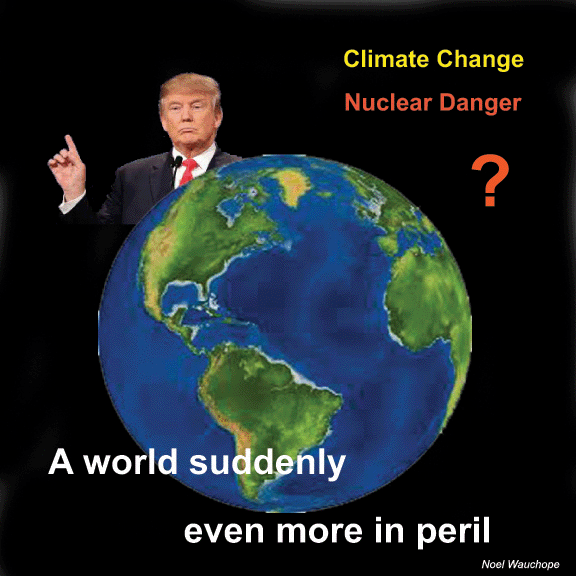
North Korea has little incentive to “denuclearize”. Trump’s incoherent strategy leaves the world in danger
 North Korea’s nuclear facilities cannot be closed with a handshake http://www.kbzk.com/story/38534251/north-koreas-nuclear-facilities-cannot-be-closed-with-a-handshake: Jun 29, 2018 By Jonathan Cristol , Research Fellow in the Levermore Global Scholars Program at Adelphi University and Senior Fellow at the Center for Civic Engagement at Bard College. @jonathancristol.
(CNN) — On Wednesday, the North Korea watchers at 38 North released satellite imagery that shows North Korea making improvements to the Yongbyon Nuclear Scientific Research Center. While this report is unsettling, it is not at all surprising.
More unsettling than the report is the possibility that President Donald Trump believed that the North Korean nuclear threat could be solved by a handshake. In the immediate aftermath of the Singapore Summit, Trump said that, “There is no longer a Nuclear Threat from North Korea.” That statement was false, and the North Korean activity at Yongbyon proves it.
But North Korean nuclear activity is not in violation of the terms of the summit, since Trump and Kim Jong Un did not sign paperwork regarding immediate and complete denuclearization. Instead, they signed an agreement that includes a vague statement that North Korea will “work toward” denuclearization of the Korean Peninsula.
So far, the Trump administration is the only side moving in that direction — by agreeing to suspend joint military exercises with South Korea in exchange for vague promises. The improvements at Yongbyon, however, do not even violate Kim’s vague promise, which was only to stop nuclear and ballistic missile testing.
But, more importantly, Kim has little incentive to cease nuclear activity, and for that he can thank the incoherent strategy of Trump. The “maximum pressure” campaign of ever-tightening, crippling sanctions against North Korea is all but forgotten by Washington, and even Secretary of State Mike Pompeo says, “I am not going to put a timeline on [denuclearization].”
Additionally, Trump’s statements that the problem is solved gives China little incentive to apply pressure on its southern ally and gives America little leverage over China. Historically, China has been reluctant to apply too much pressure on Pyongyang for fear of a North Korean collapse that would both inundate China with refugees and potentially bring US troops to the Chinese border. It was Kim’s nuclear program that brought China into the sanctions regime. If, as the President said, the nuclear program is solved, then Washington has little recourse if China chooses to resume trading with North Korea.
CNN reports that the upgrades at Yongbyon were long-planned. These upgrades and further actions to strengthen Pyongyang’s nuclear deterrent will continue overtly in absence of an explicit agreement to stop them. And if such an agreement is reached, upgrades to the nuclear program and further research and development will likely continue in underground facilities. North Korea is not likely to give up its nuclear weapons for any reason or for any price.
Trump may think that a warm handshake and a few shared laughs will solve the North Korean problem, but Kim is not so naive. One of the world’s most brutal and repressive dictators, according to Human Rights Watch, is not going to be won over by Trump’s public remarks that he “got along great with Kim Jong Un, who wants to see wonderful things for his country” or that the two leaders share a “special bond.” Kim is going to take advantage of Trump’s pathological desire for praise and promise him the world, while continuing to develop his weapons programs.
The new developments at Yongbyon are not, on their face, cause for concern. But there are reasons to worry about the 38 North report. If Trump thinks that Kim agreed not to continue with his program, then this report (if discussed on his preferred news network) might cause Trump to return to his previous belligerent rhetoric vis-a-vis North Korea. If Trump thinks that this report makes him look weak, then he may be susceptible to John Bolton’s argument that there is a “legal case” to mount a preventive strike against North Korea.
Trump may think that the summit in Singapore prevented a war, but that is only true in the sense that it stopped him from starting one. That said, the summit does not need to be futile — it could also be the start of a genuine and serious set of arms control and limitation negotiations. These negotiations would require patience and skill without an obvious or immediate photo-op or half-clever tweet.
But since Trump is neither known for his patience nor his restraint on social media, we can expect North Korean nuclear research and facilities upgrades to continue apace.
India – the global nuclear weapons threat that is being ignored
 A global nuclear threat, The News CN, , 27 June 18, India’s nuclear weapons now pose a potential threat to the world. The Agni-V, India’s longest-range intercontinental ballistic missile (ICBM), can travel 6,000 kilometres.
Keep in mind that the Agni-V ICBM is capable of carrying a nuclear warhead to almost anywhere in Asia and to parts of Europe and Africa. Because it can be fired from a mobile launcher, essentially a canister mounted on a truck, instead of a hard concrete launch-pad, it gives the Indian armed forces operational flexibility. They now have the ability to launch the missile against any adversary, almost guaranteeing to take them by surprise by offering a shorter period of time to react. But the Agni-V is not the real danger and is only being seen as a stepping stone towards completing the Agni-VI ICBM, which is rumoured to be in its final phase of development.
The Agni-VI can potentially travel 12,000 kilometres or more, and is supposed to have MIRV capability – the ability to carry several independent nuclear warheads – and a manoeuvrable re-entry vehicle (MaRV) capability, the warhead of which is capable of autonomously tracking ground targets. Because of these capabilities, this missile will be unstoppable by the current anti-missile defence systems. Once completed, the Agni-VI will put the whole world within the range of India’s nuclear warheads.
India has taken advantage of the fact that the world has been distracted by North Korea’s nuclear capabilities and the threat they pose that they have entirely ignored the growing threat of India’s nuclear capabilities, its global ambitions, and its threat to international and regional security.
……….By investing on building up its nuclear and conventional forces, PM Modi hopes to project his country as a global power, standing shoulder to shoulder with the likes of the US and China. But, in fact, India is causing a massive headache for the South Asian region by threatening to destabilise the fragile strategic balance with its actions. If India’s ambitions are not kept in check, its growing capabilities are guaranteed to turn into a global threat. Instead of trying to impress the international community by investing so heavily on its defences (and causing havoc), PM Modi should perhaps first invest in his people, which include the more than 330 million Indians living in poverty – nearly a quarter of the country’s total population.There has been very little outcry in the West, particularly in the US, because American presidents in the past have turned a blind eye towards India’s dangerous global nuclear ambitions, hoping to create a new strategic partner capable of taking on China. This has provided India with a situation that it has taken, and continues to take, advantage of by growing its military’s conventional and nuclear capabilities………https://www.thenews.com.pk/print/334105-a-global-nuclear-threat
Thanks, Muhammad Umar, for this insightful article. But that last paragraph? Have you forgotten who President Trump is? He is a ruthless and not terribly intelligent salesman and attention-seeker. His over-riding aim would be to SELL NUCLEAR TECHNOLOGY to India – quite the opposite of “curbing the country’s massive and extremely dangerous military nuclear weapons programme”
Previously angry and aggressive, John Bolton, Trump’s national security adviser, now chummy with Putin and Kim Jong Un
The new John Bolton: Trump ally swaps fire and brimstone for a spoonful of sugar
Trump’s national security adviser seems to have abandoned his firebrand persona – and in Moscow the change of tone was striking, Guardian, Julian Borger, 28 June 18,
The trademark walrus moustache was still there, and the penetrating gaze was just the same, but in almost every other way the new John Bolton and the old John Bolton seemed very different.
The old Bolton was a firebrand pundit, raining derision from television talkshows and editorials on US diplomats promoting compromise with America’s enemies. Almost a year ago he wrote a commentary describing Vladimir Putin as a serial liar responsible for an “act of war” in the form of his interference in the US election and warned: “We negotiate with Russia at our peril.”
He described the nuclear deal with Iran, by which Tehran reduced its uranium stockpile by 98%, as an “American Munich” comparable to Neville Chamberlain’s short-lived agreement with Hitler, and he derided US diplomats as “appeasers” for pursuing contacts with adversaries for their own sake.
That was then, but this is now. And Bolton is now national security adviser to Donald Trump, whose defining diplomatic style is chumminess with dictators. In the past month, Bolton has shaken hands with Kim Jong-un and Vladimir Putin, with smiles all round. Face to face with Putin on Wednesday, Bolton replaced fire and brimstone with a large dose of honey………
The change in tone is even more evident in relation to North Korea. In January this year, Bolton said: “Talking to the North Koreans is a waste of time.” He repeatedly insisted that the only subject of discussion at a summit should be the details of how North Korean nuclear weapons would be dismantled and removed.
“I think it’s important if the president sees that they’re just looking for a way to waste time, that he make the point that he’s not there to waste time and that we expect real denuclearisation, not talks about talks about denuclearisation,” he wrote.
It is clear that Trump’s Singapore meeting with Kim Jong-un stopped very much short of that. The US failed in its effort to have its language insisting on “complete verifiable irreversible disarmament” and setting out a timetable.
Instead, Trump unilaterally suspended joint military exercises with South Korea, to the surprise of the government in Seoul and to the US military. In return, he claimed to have won a pledge from Kim to destroy a missile engine testing site. In terms of the overall North Korean weapons programme, the site was a small element, and there is no evidence so far that it has been dismantled.
…….Back in Moscow at a post-Putin press conference, the new Bolton had a one-line answer to a flurry of questions about what had become of the old Bolton.
“I don’t address what I have said before,” he said. https://www.theguardian.com/us-news/2018/jun/28/john-bolton-trump-adviser-new-style-putin
North Korea carrying out improvements at Yongbyon Nuclear Research Facility
North Korea improving nuclear facility despite Kim Jong-un’s pledge, satellite images show, ABC News , By Mary Lloyd , 28 June 18 Satellite images show improvements have continued at a North Korean nuclear facility, even though leader Kim Jong-un recently made commitments to dismantle the country’s nuclear program.
U.S. Secretary of State Mike Pompeo confident that North Korea understands what is expected in complete denuclearization
North Korea understands U.S. on ‘complete denuclearization’: Pompeo, Patricia Zengerle, WASHINGTON (Reuters) – U.S. Secretary of State Mike Pompeo said on Wednesday he was confident that North Korea understood the scope of the U.S. desire for complete denuclearization as the two countries negotiate after President Donald Trump’s summit with North Korean leader Kim Jong Un.
“We’ve been pretty unambiguous in our conversations about what we mean when we say complete denuclearization,” Pompeo told a Senate Appropriations subcommittee hearing on funding for the State Department.
Trump has drawn some criticism from national security analysts for an agreement that emerged from his June 12 summit with Kim that had few details on how Pyongyang would surrender its nuclear weapons and ballistic missiles…… https://www.reuters.com/article/us-usa-pompeo-senate-northkorea/n-korea-understands-u-s-on-complete-denuclearization-pompeo-idUSKBN1JN2W3
Renewable energy thriving across Asia
Physics World 27th June 2018 Dave Elliott: Renewables are booming across Asia, but there are variations
in pace and rival options also play a role. An interesting paper by Indian
academic Nandakumar Janardhanan looks at competition in renewables in
developing countries in Asia, focusing on India and China.
Janardhana notes that “India and China, being major developing economies and having huge
energy appetite, focused heavily on strengthening their respective
alternative energy sector” so as to reduce their over-reliance on
conventional fossil fuels. He adds that “India depends on external oil
supplies to meet two thirds of its oil demand, one third of oil demand in
China is met by imports”.
As a result, the renewable energy sector has
gained great momentum in these two countries and “as innovation and
development began to lead the growth of alternative energy sector,
opportunities for expansion within their respective borders as well as
outside emerged as promising avenues for the industry from both
countries”.
https://physicsworld.com/a/asian-renewables-contest-china-versus-the-rest/
Despite everything, Japan’s power companies are still loyal to nuclear power
Utilities reaffirm faith in nuclear power despite safety concerns http://www.asahi.com/ajw/articles/AJ201806280047.html, THE ASAHI SHIMBUN, June 28, 2018
Nine power companies said they are eager to restart their nuclear plants at their shareholder meetings on June 27, shunning calls to move toward renewables despite skepticism about the safety of relying on nuclear energy.
At the Kansai Electric Power Co. meeting, major shareholders such as the Kyoto and Osaka city governments called for nuclear power plants to be decommissioned.
“Kansai Electric should stop relying on nuclear power as soon as possible,” said Kyoto Mayor Daisaku Kadokawa.
In reply, Shigeki Iwane, president of Kansai Electric, said, “While giving top priority to the safety of nuclear plants, we intend to continue utilizing nuclear plants.”
He did not rule out the possibility of constructing new reactors.
Kyushu Electric Power Co., which is now operating four reactors, showed reluctance about a major shift to renewables.
A proposal to “significantly bolster” renewable energy was turned down at its shareholder meeting.
We cannot ensure the stability of frequency if we accept solar power more than at the current level,” said Michiaki Uriu, president of Kyushu Electric, noting the output of solar energy generated within the utility’s jurisdiction has reached the ceiling of 8.17 gigawatts.
At the Tokyo Electric Power Company Holdings Inc. meeting, a proposal was made to freeze preparatory work toward the planned resumption of its Kashiwazaki-Kariwa nuclear plant in Niigata Prefecture.
“Why does TEPCO bother to pursue nuclear power generation despite the Fukushima nuclear disaster?” said one shareholder. However, the proposal was rejected.
“The nuclear plant will continue to play an important role,” said Tomoaki Kobayakawa, president of TEPCO Holdings, referring to the Kashiwazaki-Kariwa plant, one of the largest in the world. “We will strive toward the restart by soul-searching and taking a lesson from the unprecedented accident.”
Some shareholders hailed the company’s decision to decommission the Fukushima No. 2 nuclear plant, announced by Kobayakawa, although they said the decision came belatedly.
But others voiced their regret over the decision, saying the plant is too good to be decommissioned.
The Fukushima No. 2 nuclear plant was damaged in the 2011 Great East Japan Earthquake and tsunami, but it managed to avert a meltdown, unlike the Fukushima No. 1 nuclear power plant nearby, where a triple meltdown occurred.
Another shareholder proposal concerned an end to providing financial support to Japan Atomic Power Co., which intends to resume operations at the Tokai No. 2 nuclear plant in Ibaraki Prefecture.
The same proposal was also made and rejected at a shareholder meeting of Tohoku Electric Power Co. the same day. Both TEPCO Holdings and Tohoku Electric fund Japan Atomic Power.
“We have offered debt guarantee to Japan Atomic Power due to the company’s efforts to ensure sustainability and cut fuel costs by restarting the nuclear plant,” said Jiro Masuko, vice president of Tohoku Electric.
All of Japan’s active nuclear power plants were shut down as part of precautionary measures after the 3/11 Fukushima disaster. Since then, nine have been restarted, and further 26 that remain idle could potentially be restarted.
India’s space dream – to develop nuclear fuel from helium on the moon
India’s quest to find a trillion-dollar zero-waste nuclear fuel on the moon, Financial Review by Anurag Kotoky, 28 June 18
India‘s space program wants to go where no nation has gone before – to the south side of the moon. And once it gets there, it will study the potential for mining a source of waste-free nuclear energy that could be worth trillions of dollars.
The nation’s equivalent of NASA will launch a rover in October to explore virgin territory on the lunar surface and analyse crust samples for signs of water and helium-3. That isotope is limited on Earth yet so abundant on the moon that it theoretically could meet global energy demands for 250 years if harnessed……..
The mission would solidify India’s place among the fleet of explorers racing to the moon, Mars and beyond for scientific, commercial or military gains. The governments of the US, China, India, Japan and Russia are competing with start-ups and billionaires Elon Musk, Jeff Bezos and Richard Branson to launch satellites, robotic landers, astronauts and tourists into the cosmos. ……..
In the US, President Donald Trump signed a directive calling for astronauts to return to the moon, and NASA’s proposed $US19 billion ($26 billion) budget this fiscal year calls for launching a lunar orbiter by the early 2020s. …….
A primary objective, though, is to search for deposits of helium-3. Solar winds have bombarded the moon with immense quantities of helium-3 because it’s not protected by a magnetic field like Earth is. ……. “It is thought that this isotope could provide safer nuclear energy in a fusion reactor, since it is not radioactive and would not produce dangerous waste products,” the European Space Agency said.
…….. there are numerous obstacles to overcome before the material can be used – including the logistics of collection and delivery back to Earth and building fusion power plants to convert the material into energy. Those costs would be stratospheric…….https://www.afr.com/news/world/asia/indias-quest-to-find-a-trilliondollar-zerowaste-nuclear-fuel-on-the-moon-20180627-h11ykr
USA’s General Electric and France’s EDF getting together to market to India huge and costly nuclear station

France’s EDF, GE to co-build reactors for huge Indian nuclear plant, Reuters Staff, NEW DELHI (Reuters) 28 June 18- GE and French utility EDF have agreed to team to build six reactors for a nuclear power project in western India, which is due to be the world’s biggest when finished……… The six European Pressurised Water reactors will be for a 9,900 mw nuclear power project at Jaitapur, south of Mumbai in the state of Maharashtra, GE and EDF said in a joint statement released on Tuesday…….
EDF will be responsible for engineering integration of the entire project, while GE Power will design the critical part of the plant and supply its main components, the companies said.
GE will also provide operational support services and a training programme to meet the needs of the state-run Nuclear Power Corp. of India Ltd, the plant’s owner and operator.
Reporting by Nidhi Verma; Editing by Alexander Smith https://www.reuters.com/article/us-india-nuclear-ge/frances-edf-ge-to-co-build-reactors-for-huge-indian-nuclear-plant-idUSKBN1JM1J8
1 This Month
26 September – International Day for the Total Elimination of Nuclear Weapons





PLEASE OPPOSE HR 8255 AND S.3639 – bills would accelerate satellite deployment, with no environmental review or safeguards – https://ncstd5li.quorum.us/campaign/169331/
To see nuclear-related stories in greater depth and intensity – go to https://nuclearinformation.wordpress.com
-
Archives
- September 2026 (313)
- August 2026 (330)
- July 2026 (355)
- June 2026 (287)
- May 2026 (306)
- April 2026 (356)
- March 2026 (251)
- February 2026 (267)
- January 2026 (308)
- December 2025 (358)
- November 2025 (359)
- October 2025 (375)
-
Categories
- 1
- 1 NUCLEAR ISSUES
- business and costs
- climate change
- culture and arts
- ENERGY
- environment
- health
- history
- indigenous issues
- Legal
- marketing of nuclear
- media
- opposition to nuclear
- PERSONAL STORIES
- politics
- politics international
- Religion and ethics
- safety
- secrets,lies and civil liberties
- spinbuster
- technology
- Uranium
- wastes
- weapons and war
- Women
- 2 WORLD
- ACTION
- AFRICA
- Atrocities
- AUSTRALIA
- Christina's notes
- Christina's themes
- culture and arts
- Events
- Fuk 2022
- Fuk 2023
- Fukushima 2017
- Fukushima 2018
- fukushima 2019
- Fukushima 2020
- Fukushima 2021
- general
- global warming
- Humour (God we need it)
- Nuclear
- RARE EARTHS
- Reference
- resources – print
- Resources -audiovicual
- Weekly Newsletter
- World
- World Nuclear
- YouTube
-
RSS
Entries RSS
Comments RSS

