Cesium Concentrated in Particles – Fukushima radiation
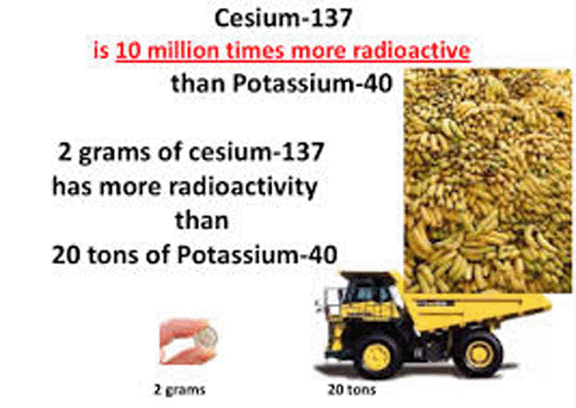 Fukushima Radiation Concentrated in Particles, Hot Spots, Laboratory equipment Wed, 08/15/2018 – by Seth Augenstein – Senior Science Writer – @SethAugenstein “….
A new report indicates that the estimates of how much radioactivity was released remain accurate, but where it is located and concentrated are a continual source of discovery.
In fact, more than three-quarters of radioactive cesium was released as glassy microparticles formed by the meltdown, and those particles are now gathered in the nuclear exclusion zone as radioactive hot spots, according to a recent paper and presentation.
The findings were published in Environmental Science and Technology, and also scheduled for presentation at the Goldschmidt Conference of the Geochemical Society, held this week in Boston.
The cesium-134 and cesium-137 particles thrown over a wide area have now been washed down from roofs and trees and plants, where it has clustered together in the ground, according to the scientists, led by Satoshi Utsunomiya of Kyushu University.
The microparticles were distinguished from the soluble cesium by its elevated radioactivity, using a novel procedure, the investigators said.
Twenty soil samples from around the disaster area were assessed using autoradiography, similar in concept to a medical X-ray in that it would expose a photographic film or detector to image the radiation. The scientists looked at the sieved soil samples and quantitatively determined the amount of microparticles using a comparison between the photo-stimulated glow, and the radioactivity levels, they report.
Although the total amount of radiation appears accurate, its concentrations have appeared to be inaccurate, they conclude.
The initial findings were originally covered earlier this year in Laboratory Equipment. However, the findings on the concentrations and possible health impacts are new.
An independent commenter, Ken Buesseler of the Wood Hole Oceanographic Association, said in a statement released by the conference that the work has advanced the understanding of the Japanese nuclear tragedy.
“The idea of microparticles has not been ‘missed in the assessment of total cesium levels in soil after Fukushima; it has been included, although this work highlights the fraction found in cesium microparticles,” Buesseler said. “These researchers have done a fine job of developing new tools to quantify these microparticles, and that is an important story to tell.”…….https://www.laboratoryequipment.com/news/2018/08/fukushima-radiation-concentrated-particles-hot-spots
A new Summit between South and North Korea
 Koreas prepare for summit as North asks US to ease sanctions, https://apnews.com/89398fce8c9a42fc9e3fc1f3fde1dd5e/Koreas-prepare-for-summit-as-North-asks-US-to-ease-sanction,By YOUKYUNG LEE Aug. 10, 2018 SEOUL, South Korea (AP) — The rival Koreas plan to hold high-level talks on Monday to prepare for a third summit between their leaders, as Pyongyang called on the United States to reciprocate its “goodwill measures” by easing sanctions and stopping demands that the North denuclearize first.
The plans by the Korean leaders to meet come as Washington and Pyongyang try to follow through on nuclear disarmament vows made at a U.S.-North Korea summit in June between President Donald Trump and North Korean leader Kim Jong Un.
In the most recent sign of growing frustration between Washington and Pyongyang, North Korea criticized senior American officials for insisting that North Korea give up its nuclear weapons first before easing sanctions. Notably, the statement didn’t directly criticize Trump.
North Korea said in a statement Thursday that “some high-level officials within the U.S. administration” were making “desperate attempts at intensifying the international sanctions and pressure.”
“We hoped that these goodwill measures would contribute to breaking down the high barrier of mistrust” between Pyongyang and Washington, the North’s Foreign Ministry spokesperson said. “However, the U.S. responded to our expectation by inciting international sanctions and pressure.”
Those American officials are “going against the intention of President Trump to advance the DPRK-U.S. relations, who is expressing gratitude to our goodwill measures for implementing the DPRK-U.S. joint statement,” it said referring to the North by its official name, the Democratic People’s Republic of Korea.
Washington has said that sanctions will not be lifted until Pyongyang fully and finally dismantles its nuclear weapons. Some experts say that North Korea does not want to denuclearize first or maybe denuclearize at all because it wants a long, drawn-out process that sees external aid shipped in in return for abandoning nuclear weapons.
Pyongyang has also stepped up its calls for a formal end to the Korean War, which some analysts believe is meant to be the first step in the North’s effort to eventually see all 28,500 U.S. troops leave the Korean Peninsula.
A South Korean official at the Unification Ministry, who spoke on condition of anonymity because of office rules, said the two Koreas will also discuss on Monday ways to push through tension-reducing agreements made during an earlier summit between Kim and South Korean President Moon Jae-in. Among the agreements was holding another inter-Korean summit in the fall in Pyongyang.
The rival Koreas may try to seek a breakthrough amid what experts see as little progress on nuclear disarmaments between Pyongyang and Washington despite the Singapore summit in June and U.S. Secretary of State Mike Pompeo’s several visits to North Korea.
Pyongyang insisted that the U.S. should reciprocate to the North’s suspension of missile launches and nuclear tests and other goodwill gestures such as the return of remains of American troops killed in the Korean War. The United States cancelled a joint war exercise with South Korea that was due to take place this month while dismissing calls to ease sanctions until the North delivers on its commitments to fully denuclearize.
The inter-Korean meeting on Monday will be held at Tongilgak, a North Korean-controlled building in the border village of Panmunjom. South Korea’s unification minister will lead the delegation from Seoul but North Korea, which proposed the Monday meeting first, did not confirm the makeup of its delegation.
It wasn’t clear when another inter-Korean summit might happen, but if the April 27 summit agreements between Moon and Kim are followed through on, the leaders will likely meet in Pyongyang in the next couple of months.
In the meantime, both Koreas are seeking an end of the Korean War. South Korea’s presidential spokesman said last month that Seoul wants a declaration of the end of the 1950-53 war sooner than later. The Korean Peninsula is still technically in a state of war because the fighting ended with a cease-fire, not a peace treaty.
Earlier Thursday, North Korea’s Rodong Sinmun said in a commentary that ending the Korean War is “the first process for ensuring peace and security not only in the Korean peninsula but also in the region and the world.”
Kim and Moon met in April at a highly publicized summit that saw the leaders hold hands and walk together across the border, and then again in a more informal summit in May, just weeks before Kim met Trump in Singapore.
North Korea Now in Standoff With U.S.A. on nuclear negotiations
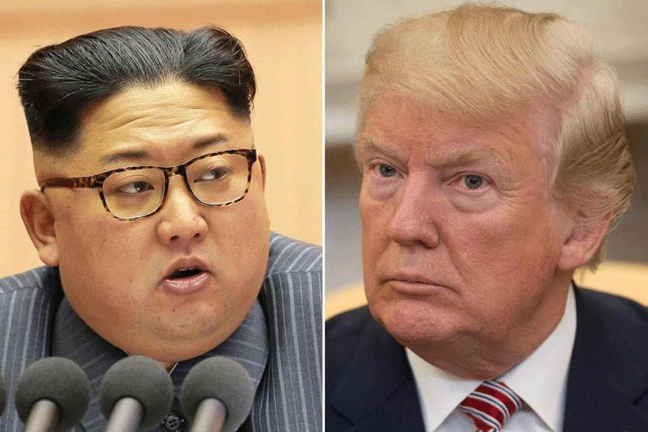 Once ‘No Longer a Nuclear Threat,’ North Korea Now in Standoff With U.S. NYT, By David E. Sanger and William J. Broad, Aug. 10, 2018 WASHINGTON — North Korea is insisting that the United States declare that the Korean War is over before providing a detailed, written disclosure of all its atomic weapons stockpiles, its nuclear production facilities and its missiles as a first major step toward denuclearization.
Two months after President Trump declared his summit meeting in Singapore with Kim Jong-un a complete success, North Korea has not yet even agreed to provide that list during private exchanges with Secretary of State Mike Pompeo, according to American and South Korean officials familiar with the talks.
Mr. Pompeo maintains progress is being made, although he has provided no details. But John R. Bolton, Mr. Trump’s national security adviser, this week said, “North Korea that has not taken the steps we feel are necessary to denuclearize.”
On Thursday, North Korea’s state-run newspaper, Rodong Sinmun, called the declaration of the end of the war “the demand of our time” and that would be the “first process” in moving toward a fulfillment of the June 12 deal struck between Mr. Trump and Mr. Kim. Pyonygang also wants peace treaty talks to begin before detailing its arsenal.
If the standoff over the parallel declarations remains, it is hard to see how the two countries can move forward with an agreement.
“The North Koreans have lied to us consistently for nearly 30 years,” Joseph Nye, who wrote one of the National Intelligence Council’s first assessments of the North’s weapons programs in 1993, said at the Aspen Institute on Tuesday.
“Trump is in a long tradition of American presidents who have been taken to the cleaners,” Mr. Nye said.
Neither Mr. Trump nor Mr. Pompeo has acknowledged the impasse. But officials said South Korea has quietly backed the North Korean position, betting that once Mr. Trump has issued a “peace declaration” it would be harder for him to later threaten military action if the North fails to disarm or discard its nuclear arsenal.
Against North Korea’s continuing nuclear buildup — and its threats to strike the United States — Washington has long refused to formally declare the end of the war, which was halted with a 1953 armistice but never officially brought to a close.
And fears remain that making concessions to Pyongyang — especially after Mr. Trump shelved annual American military exercises with South Korea that he called “war games,’’ the phrase used by the North — would outrage Republicans in Congress and open Mr. Trump to charges that he has been outmaneuvered by the North Korean leader.
The White House has never reconciled Mr. Trump’s post on Twitter after meeting Mr. Kim that “there is no longer a Nuclear Threat from North Korea” with Mr. Bolton’s assessment that the Singapore agreement has so far yielded almost no progress in the nuclear arena. That view is shared by many in Congress and the American intelligence agencies.
For Mr. Trump and Mr. Pompeo, much rides on how this standoff is resolved — or whether it results in the collapse of what the president called his determination to “solve” the nuclear crisis.
Mr. Pompeo has told associates that he believes his tenure as secretary of state will be judged largely on how he handles the negotiations. In recent weeks he has softened some of his statements toward North Korea, saying the United States is open to a step-by-step approach that most officials had previously rejected.
“The ultimate timeline for denuclearization will be set by Chairman Kim,”Mr. Pompeo said last week — a stark contrast to Mr. Trump’s statements last year that North Korea should give up its weapons rapidly, or face tremendous, if unspecified, consequences.
Challenged about the lack of progress so far, officials at the White House and State Department pointed to three developments as signs that the strategy with North Korea is advancing.
They noted that North Korea has not conducted a missile or nuclear test since November. Since the Singapore summit, Pyongyang has returned the remains of about 55 Americans killed in the Korean War, which appear genuine, a good-will gesture though one unrelated to the nuclear program. And satellite evidence suggests North Korea has begun dismantling a test site where it has developed missile technologies and launched space satellite missions. Experts cautioned, however, that all the steps taken so far are easily reversible……..https://www.nytimes.com/2018/08/10/us/politics/north-korea-denuclearize-peace-treaty.html
Tens of thousands rally for removal of US base off Okinawa
https://www.theage.com.au/world/asia/tens-of-thousands-rally-for-removal-of-us-base-off-okinawa-20180812-p4zx0r.html, By Mari Yamaguchi 12 August 2018 — Tokyo: Tens of thousands of protesters in Okinawa vowed to stop the planned relocation of a U.S military base, saying they want it off the southern Japanese island entirely.
Taiwan’s energy transition from nuclear to wind and solar power
Nuclear Ghost Town Reveals Power Risk for Taiwan’s Energy Shift, Bloomberg, By Dan Murtaugh, Miaojung Lin, and Samson Ellis August 7, 2018,
- Plan to shut reactors sparks race to develop wind, solar power
- Goal is 70% of electricity from gas, renewable sources by 2025
A map at the guard-house of the Lungmen Nuclear Power Plant in Taiwan shows what might have been: Classrooms, dormitories, a grocery store, a police station. It was supposed to be a self-contained city on the island’s northeast coast designed to meet growing demand for electricity in Asia’s seventh-largest economy.
Instead, the complex stands empty — unfinished and never used — a $10 billion casualty of growing public opposition to nuclear power. Since a disastrous 2011 reactor meltdown in Japan, more than 1,400 miles (2,250 kilometers) away, Taiwan has rewritten its energy plans. President Tsai Ing-wen ordered all of the country’s nuclear reactors to shut by 2025.
Taiwan’s Transition
Taichung gears up for wind power as Lungmen’s reactors are mothballed
That’s set off a high-risk gamble to find alternatives to nuclear, which supplies 12 percent of the island’s electricity, while limiting an increase in carbon emissions. The island’s sprint reflects a drive across the region toward cleaner energy sources such as sunlight, wind and natural gas. Nations from Australia to South Korea and mainland Chinato India are seeking to meet rising demand without belching more emissions blamed for climate change and smog.
Taiwan’s solution: Wind turbines are planned in the blustery Taiwan Strait, solar panels are popping up on coastal salt flats, and terminals are being planned to import more liquefied natural gas. But new sources could take years to develop, making power rationing and blackouts a possibility as the gap narrows between demand and generating capacity.
“There are going to be concerns over the next few years about reserve margins and power supply reliability,” said Zhouwei Diao, an IHS Markit analyst in Beijing.
The government’s plan has several parts. First, all nuclear and most oil-fueled generators will be shut. Together, they supplied 16 percent of Taiwan’s electricity in 2016. The country will still have about the same amount of coal capacity by 2025 as now, but its share of total power generation will drop to 30 percent from about half as sources of alternative energy expand. Natural gas will see the biggest usage gain, accounting for half of supply by 2025, while renewables like wind and solar will more than triple to 20 percent.
As electricity demand grows over the next seven years, the government says it will boost generating capacity while limiting carbon emissions and ridding itself of a political headache.
Taiwan’s state-run nuclear industry already was unpopular after it built a controversial waste-storage site on Orchid Island, home to one of the country’s indigenous peoples. But sentiment turned even more negative after the disaster in Japan, which occurred after a giant earthquake and tsunami. The disaster prompted countries including Germany and South Korea to ditch their nuclear programs.
Taiwan Power Co. operates three nuclear plants and was building the fourth in Lungmen when the Fukushima meltdown occurred. In 2014, the government halted construction that was nearly complete, with uranium-fuel rods in place. In 2016, the Democratic Progressive Party won election on an anti-nuclear platform. Last month, workers removed the unused fuel rods and sold them to a buyer in the U.S.
…….. The government has held firm to its plan. Part of the optimism comes from the plunging cost of building wind and solar projects around the world. There’s also expanding supplies of cheap liquefied natural gas available from the Middle East, Australia and the U.S…….. https://www.bloomberg.com/news/articles/2018-08-05/nuclear-ghost-town-reveals-power-risk-for-taiwan-s-energy-shift
Russia and China pushing to create their economic nuclear empires
Russia on an international offensive to sell its nuclear plants, Vladimir Putin’s government vies with China to become a superpower in the field MOSCOW — Russia is stepping up its overseas sales of nuclear power plants, with state-run nuclear energy company Rosatom agreeing in July to cooperate in building a plant in the Central Asian country of Uzbekistan and reaching an accord with China to build a plant in that country.
Russia accounts for 67% of the world’s nuclear plant deals currently in development. By 2030, Rosatom aims to increase its overseas sales to two-thirds of total sales, from 50% at currently. Vladimir Putin’s government is looking to expand Russian influence through nuclear diplomacy, vying with China — which is promoting its own nuclear plants — for the status of nuclear energy superpower.
“We hope that a lot of other countries will become our partners, and as they say, ‘nuclear newcomers,'” Rosatom Chief Executive Alexey Likhachev told Prime Minister Dmitry Medvedev at a meeting in early July…….
During a visit by Putin to China in June, Rosatom entered into a framework agreement to cooperate in nuclear plant construction, including four reactors in Jiangsu and Liaoning provinces.
Russia intends to make nuclear power plants a major revenue earner alongside exports of crude oil and natural gas. Rosatom’s annual business report for 2016 showed it was involved in nuclear plant projects in more than 10 countries, including China, Bangladesh and India. The company had $133.4 billion of overseas orders, up 21% from a year earlier. It targets $150 billion to $200 billion in orders in 2030…….
Russia’s strength in the field is the all-out support of the government, and its ability to take on all aspects of a nuclear energy project. The Putin government attaches much importance to nuclear plants, seeing them as a globally competitive, technology-intensive industry with an important role to play in revitalizing Russia’s domestic industry. Putin himself has successfully pitched Russian nuclear plants to foreign leaders during international summits.
Russian nuclear plants also boast price competitiveness, with the government providing loans to finance the high costs. Not only does Russia build the plant, but it supplies the fuel, operates and maintains the reactors, and disposes of the used fuel. This makes a deal with Russia attractive for countries that want to build their first nuclear plant, but which lack the operational know-how…….
China has made it clear that its policy is to expand overseas nuclear plant deals by building on the technology of Russia, France and other countries that have been at the forefront of nuclear plant development. …….https://asia.nikkei.com/Business/Energy/Russia-on-an-international-offensive-to-sell-its-nuclear-plants
To the dismay of the global nuclear industry, China’s nuclear expansion has stalled

 Why has China’s nuclear expansion programme stalled? By Compelo Staff Writer, 9 Aug 18, Completion of the first EPR and AP1000 reactors in China marks a major milestone, but, as Steve Kidd of East Cliff Consulting explains, the nation’s ambitious nuclear expansion programme is no longer on track. Many of the negative factors which have affected nuclear programmes elsewhere in the world are now also equally applicable in China. Despite many new reactors starting up, it is clear that the programme has continued to slow.
The most obvious sign of this is the lack of approvals for new construction starts. There have been no new approvals for approaching three years, so the number of reactors under construction has been falling sharply. Other indications of trouble are:
uncertainties about the type of reactor to be utilised in the future
the position of the power market
the structure of the industry with its large state-owned enterprises (SOEs)
the degree of support from state planners and the level of public opposition to nuclear plans.
where China now stands with its planned transition to advanced reactors and a fuel reprocessing strategy.
Over-supply and the AP1000 reactor
Start-ups of two imported Gen III reactor designs (Westinghouse AP1000 and the Areva EPR) are now happening at last, but the delays no doubt concerned the regulatory authorities. The problems with the AP1000 (at Sanmen and Haiyang) are the more serious, as this reactor was destined for most of the future sites in China. Although the units at both sites are now ready to enter commercial operation, this is unlikely to bring forward a flood of new approvals. China has suffered a severe dent in its confidence in the AP1000, not helped by Westinghouse’s US bankruptcy. The authorities now no doubt wish to see clear evidence of successful operation before authorising more units. There may be further reactors at the two existing sites, but there are many others that have been “ready to go” for several years now.
Another important reason for the slowdown relates to the size of nuclear programme China needs. Problems of power over-supply in particular regions are now pressing and connected to the continued construction of coal generating stations and the rapid expansion of wind and solar power. There are important questions to be resolved about how many reactors are needed to satisfy power demand and the price that can be paid for their electricity. Nevertheless, most of the Chinese nuclear companies want to build lots of new units and feel they are being held back by the authorities. The rapid expansion of wind and solar generating capacity has reminded the planners that there are alternative means of achieving environmental goals, while the Chinese hydroelectric programme is still enormous.
The shadow of Fukushima
The Fukushima accident still casts a significant shadow over the nuclear sector in China and regulators are clearly very cautious about having a big nuclear programme. Ultimately one person at the top of the regulatory authority has to take responsibility for safety and having 100 reactors in operation is far more burdensome than 20 or 40. South Korea’s apparent turning away from nuclear and the tardiness of Japanese reactor restarts are also unhelpful in inspiring confidence in the region.
China’s nuclear programme is now much harder to assess. The picture up to 2020 is fairly certain, as units under construction come into operation). The 58GW capacity target by end-2020 will be missed by perhaps 5GW, but more serious is another goal – having 30GW under construction by then. This would imply a programme of six reactors a year up to 2025, a similar level to 2015-2020. Almost all will have to be approved before the end of 2020. On recent trends, this looks unlikely and so it may be prudent to assume a programme of only 3-4 units per year beyond 2020. This means nuclear generating capacity of only 90GW or so by 2030, well below previous expectations. Beyond then it is difficult to judge, but the chance of China having a huge nuclear programme by 2050, perhaps consisting of 200-400 reactors, is much less than a few years ago. Estimates that China may move ahead of the USA in nuclear generating capacity by the mid or late 2020s now look wide of the mark. Even if 10-20 US units do eventually shut down by 2030, it could happen after then.
The dent in confidence surrounding the imported Gen III designs has been overcome, to some extent, by China’s development of the Hualong reactor, which satisfies the regulators’ insistence that all approved designs are at the Gen III level. Four units are now under construction in China (plus two in Pakistan). The two units being built by CNNC at Fuqing are on schedule to go online in 2020-2021, but CGN’s pair at Fangchenggang are apparently unlikely before 2021-2022. Whether Hualongs will replace AP1000s at any of its sites in China remains to be seen.
Big questions surround the CAP1400, the larger version of the AP1000, which China has developed, and the extent of the programme for high-temperature gas-cooled reactors (HTGRs) and small modular reactors (SMRs).
Approval of construction of the initial CAP1400s has been long-delayed and surely still awaits the regulator’s satisfaction with the AP1000. It appears that the HTGRs and SMRs will remain as marginal components of the main Chinese nuclear programme, but may offer useful additional export opportunities. The economics of the HTGRs are apparently questionable versus large LWRs, while there are lots of SMR designs around the world without anyone committing to build them.
Economic issues
Perhaps surprisingly, a big issue today affecting the Chinese nuclear programme is its economic viability. With nuclear power only currently representing 3-4% of China’s electricity supply, one would think that there is still plenty of room for dramatic growth. However, the slowing of the Chinese economy and the switch to less energy-intensive activities, together with over-investment in power generation capacity, means that there is now more than can be carried in the grids in some provinces. It cannot therefore be assumed that new nuclear units will run at the 80-90% capacity factors necessary to pay back the funds invested in their construction.
Tariffs that producers receive when they sell power to the grid are also under threat. The central government wishes to liberalise the Chinese power sector and make it more responsive to economic criteria and this may not help nuclear. The rising costs of building Gen III units are also a factor. Reactors may have to load-follow, which is not ideal in the technical or economic sense. Nuclear has to compete against other generation options…………
Power to the people
Many people used to believe that because China is a centrally-planned economy with a strong one-party government, public opinion did not matter much and any opposition to nuclear could be easily overcome. Nothing could be further from the truth. Public opinion matters a great deal in China and politicians fight shy of any issue that could inflame public opinion in any way. The last thing the Chinese government wants is people protesting on the streets – and this has already happened with two proposed fuel cycle plants. Both were quickly cancelled.
One particular public acceptance problem is inland sites for nuclear plants. Having imposed a moratorium on these for now (in fact to slow the nuclear programme down), the government has made a huge problem for itself by giving the impression that these sites are “second best” and maybe not as safe as the coastal sites (where all current Chinese reactors are located).
The threat in China is that nuclear may become no more than a niche, bridging technology, as a route to something better in the future.
This article originally appeared in Nuclear Engineering International.
Steve Kidd is an independent nuclear consultant and economist with East Cliff Consulting. https://www.compelo.com/energy/news/china-nuclear-expansion/
Primed Minister Abe rejects Japan’s participation in UN nuclear test ban treaty
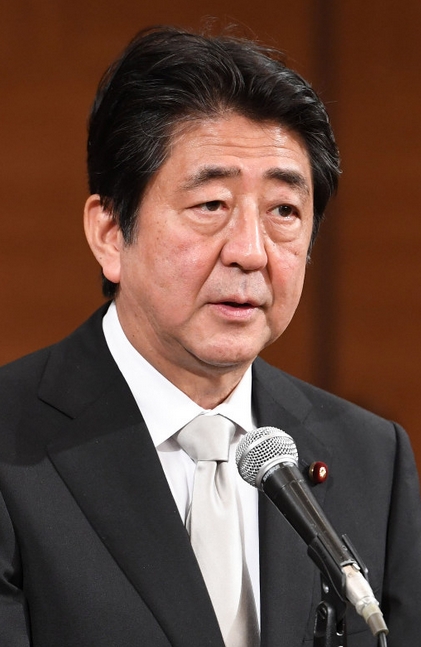 Abe should keep pledge to lead on elimination of nuclear weapons, Asahi Shimbun , August 10, 2018
Prime Minister Shinzo Abe, representative of the government of Japan, and atomic bomb survivors, witnesses to the horrific scenes of 1945, appeared to have little language in common.
That unfortunate scene, almost too painful to bear, was repeated again this summer.
During the peace memorial ceremonies to mark the 73rd anniversary of the atomic bombings of Hiroshima and Nagasaki, the mayors of the two cities and a representative of atomic bomb survivors all expressed their positive hopes for the Treaty on the Prohibition of Nuclear Weapons and called on Tokyo to take serious action.
But Abe did not even mention the treaty during his speeches at the ceremonies. When he met with atomic bomb survivors, he said Tokyo has a “different approach” to the shared goal of eliminating nuclear weapons, thereby denying Japan’s participation in the pact.
The nuclear weapons ban treaty, adopted last year with approvals of 122 countries at the United Nations, embodies the fruition of longstanding calls by atomic bomb survivors. The treaty’s spirit, which stresses the inhumane nature of nuclear arms, has a universal value that has much in common with “human security,” one of the stated pillars of Japan’s diplomacy.
Abe, however, did not even pay homage to the significance of the pact, any more than he did last year………
Abe described himself as a “mediator” for bridging the gap between nuclear weapon states and non-nuclear weapon states. Given that, his words would sound persuasive only if he took initial action to call on nuclear weapon states to reduce their nuclear arsenals.
Far from that, Foreign Minister Taro Kono has “highly appreciated” a new strategy of nuclear arms buildup that was set out by the U.S. administration of President Donald Trump. By no means would Japan be able to live up to its duty of a country that suffered atomic bombings if it were only ratifying a military policy that could be described as representing a superpower’s egotism………….http://www.asahi.com/ajw/articles/AJ201808100022.html
China aims to lead the world with its own nuclear reactor design

China promoting own technical standards to aid nuclear push overseas https://www.reuters.com/article/us-china-nuclear-standards/china-promoting-own-technical-standards-to-aid-nuclear-push-overseas-idUSKBN1KV05O Reuters Staff, SHANGHAI (Reuters), 10 Aug 18 – China’s State Council said it would promote the use of China’s nuclear industry’s independent technological standards worldwide, aiming to play “a leading role” in the global standardization process by 2027.
Its two major nuclear project developers, China National Nuclear Corporation (CNNC) and the China General Nuclear Project Corporation (CGN), are jointly promoting an advanced third-generation reactor known as the Hualong One to overseas clients, with CGN aiming to deploy the technology at a proposed nuclear project at Bradwell in England.
The push to extend Chinese technological standards was disclosed in new cabinet guidelines published late on Thursday.
China aims to raise its total nuclear capacity to 58 gigawatts (GW) by the end of the decade, up from 37 GW at the end of June.
Capacity could reach as high as 200 GW by 2030, and China also has ambitions to dominate the global nuclear industry via its homegrown technologies.
Reporting by David Stanway; Editing by Eric Meijer
Safety review sought for new Japanese reactor
WNN 10 August 2018
Chugoku becomes the second Japanese utility to apply to the NRA for pre-operation safety inspections for a new nuclear power reactor since the Fukushima Daiichi accident. The first was Japan Electric Power Development Corp (J-Power), which applied in December 2014 for inspections of unit 1 at its Ohma nuclear power plant, also an ABWR, being built in Aomori prefecture. However, with construction of Shimane 3 more advanced than Ohma 1, Shimane 3 is likely to be the first new reactor to begin operating in Japan. http://www.world-nuclear-news.org/Articles/Safety-review-sought-for-new-Japanese-reactor
Strange thought processes that resulted in the nuclear bombing of Nagasaki
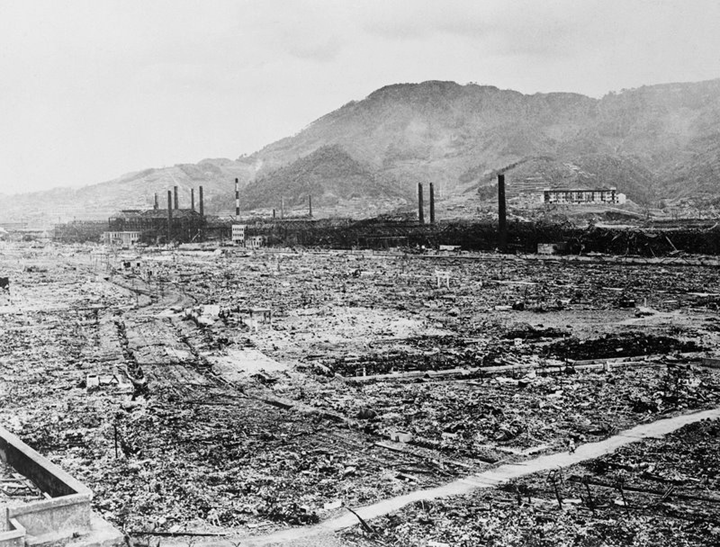 The Nagasaki bombing mission: excused by “just NOT following orders” http://www.litbyimagination.com/2018/08/the-nagasaki-bombing-mission-excused-by.html The thought process that never happened on August 9, 1945:
“Well, let’s see here. The reserve fuel tank pump was broken before take-off, and we knew it, so we were supposed to call off the mission then. Next, we failed to rendezvous over Yakushima with one of the crucial planes in the mission. At the primary target of Kokura we encountered cloud cover and flak. Now we are so dangerously low on fuel that there’s a good chance we’re going to lose the bomb and our lives by ditching in the Pacific. If we carry out the mission at the secondary target, and survive, there’s a good chance we’ll be court-martialed for not following orders to abort the mission if troubles like these arose. Hmmm. Let’s just spare Nagasaki, get back to base safely, and hope this war is over soon before we have to drop the second bomb.”
Unfortunately, the commanding officers of Bockscar, the plane that dropped the bomb on Nagasaki, were eager to not look like failures after the “success” of the Enola Gay over Hiroshima three days earlier. The full story is told in the article “The harrowing story of the Nagasaki bombing mission“ (Bulletin of Atomic Scientists, August 4, 2015). After encountering the many troubles listed above, the plane went to the secondary target, Nagasaki, and the pilot determined to drop the bomb by radar through the cloud cover, against specific orders to drop it only with a clear view of the target. “Fortunately,” there was an opening in the clouds over the Urakami district, which was not the intended target over the center of the city. They hastily decided to drop the bomb there, then headed toward Okinawa for an emergency landing. They approached Okinawa with empty fuel tanks, expecting they would have to ditch in the ocean and die. The crew was literally willing to die rather than return as “failures” compared to their colleagues who had flown on the Enola Gay. In this regard, they were much like the fictional Major T.J. King Kong in Dr. Strangelove who carried out a suicide mission in order to start WWIII.
Public outcry makes TEPCO stop selling Fukushima nuclear power plant souvenirs
 Tepco halts sales of souvenirs from Fukushima No. 1 nuclear plant following public outcry. Japan Times, BY CHISATO TANAKA, STAFF WRITER, 9 Aug 18
Tepco suspended the sale of souvenirs at its crippled Fukushima No. 1 nuclear power plant Wednesday — just eight days after launching the products — following public outcry that it was looking to profit from the 2011 disaster.
Tokyo Electric Power Company Holdings Inc. had been selling plastic file folders imprinted with pictures of the Nos. 1 to 4 units at the crisis-hit plant at two of the facility’s convenience stores since Aug. 1, after receiving requests for memorabilia from visitors and workers.
But the sales by the utility immediately drew criticism with many people posting angry comments on social media. One comment said Tepco was responsible for the disaster and “had no right to profit from” it, adding that the move was “arrogant and showed scant consideration for the disaster victims.” Others said the plant operator should at least donate the proceeds from the sales to local residents and charities……https://www.japantimes.co.jp/news/2018/08/09/national/tepco-halts-sales-souvenirs-fukushima-no-1-nuclear-plant-following-public-outcry/#.W2y2aCQzbGg
North Korea finding fault with USA’s diplomat Mike Pompeo
North Korea’s Pompeo Problem Exposes Widening Rift Over Talks, Bloomberg By Bill Faries, August 7, 2018,
- Top U.S. diplomat rebuked after two latest trips to Asia
- U.S. told it will ‘get nothing’ from its pressure campaign
North Korea appears to have a Pompeo problem.
The widening gulf between Secretary of State Michael Pompeo’s description of nuclear talks with North Korea and Pyongyang’s criticism of his efforts is adding further confusion to the status of negotiations intended to lead to the denuclearization of the Korean peninsula.
Twice in recent weeks North Korean officials and state media have rebutted the top U.S. diplomat’s characterization of events and suggested the administration has a myopic focus on denuclearization while ignoring issues such as bringing about a final resolution of the Korean War. Even as President Donald Trump and North Korean leader Kim Jong Un exchange optimistic messages about their push for peace, Pompeo has increasingly become a target of public disparagement from Pyongyang.
Hiroshima survivors tell of that day on 6th August 1945

‘I still hate the glow of the sun’: Hiroshima survivors’ tales, https://au.news.yahoo.com/thewest/a/31704344/i-still-hate-the-glow-of-the-sun-hiroshima-suvivors-tales/ May 26, 2016, Hiroshima (Japan) (AFP) – For survivors of the world’s first nuclear attack, the day America unleashed a terrible bomb over the city of Hiroshima remains seared forever in their minds.
Though their numbers are dwindling and the advancing years are taking a toll, their haunting memories are undimmed by the passage of more than seven decades.
On the occasion of Barack Obama’s offering of a floral tribute on Friday at the cenotaph in Hiroshima Peace Memorial Park — the first ever visit by a sitting US president — some of them share their stories with AFP.
Emiko Okada
Emiko Okada, now 79, was about 2.8 kilometres (1.7 miles) from ground zero and suffered severe injuries in the blast. Her sister was killed.
“All of a sudden a flash of light brightened the sky and I was slammed to the ground. I didn’t know what on earth had happened. There were fires everywhere. We rushed away as the blaze roared toward us.
“The people I saw looked nothing like human beings. Their skin and flesh hung loose. Some children’s eyeballs were popping out of their sockets.
“I still hate to see the glow of the setting sun. It reminds me of that day and brings pain to my heart.
“In the aftermath, many children who had evacuated during the war came back here, orphaned by the bomb. Many gangsters came to Hiroshima from around the country and gave them food and guns.
“President Obama is a person who can influence the world. I hope that this year will be the beginning of knowing what actually happened in Hiroshima and Nagasaki under the mushroom clouds.”
Keiko Ogura
Keiko Ogura, now 78, has devoted her life to keeping alive the memory of the devastating day. Continue reading
Ahead of Olympic Games, Fukushima nuclear power plant gets an extreme makeover
 Extreme makeover: Fukushima nuclear plant tries image overhaul,
  Channel News Asia, 3 August 18,
FUKUSHIMA: Call it an extreme makeover: In Japan’s Fukushima, officials are attempting what might seem impossible, an image overhaul at the site of the worst nuclear meltdown in decades.
At the Fukushima Daiichi nuclear plant, there’s a flashy new administrative building, debris has been moved and covered, and officials tout the “light” radioactive security measures now possible.
“You see people moving around on foot, just in their uniforms. Before that was banned,” an official from the plant’s operator TEPCO says.
“These cherry blossoms bloom in the spring,” he adds, gesturing to nearby foliage.
If it sounds like a hard sell, that might be because the task of rehabilitating the plant’s reputation is justifiably Herculean.
………TEPCO officials have been gradually trying to rebrand the plant, bringing in school groups, diplomats and other visitors, and touting a plan to attract 20,000 people a year by 2020, when Tokyo hosts the Summer Olympics.
Officials point out that protective gear is no longer needed in most of the plant, except for a small area, where some 3,000 to 4,000 workers are still decontaminating the facility.
Since May, visitors have been able to move around near the reactors on foot, rather than only in vehicles, and they can wear “very light equipment,” insists TEPCO spokesman Kenji Abe.
That ensemble includes trousers, long sleeves, a disposable face mask, glasses, gloves, special shoes and two pairs of socks, with the top pair pulled up over the trouser hem to seal the legs underneath.
And of course there’s a geiger counter.
The charm offensive extends beyond the plant, with TEPCO in July resuming television and billboard adverts for the first time since 2011, featuring a rabbit mascot with electrical bolt whiskers called “Tepcon”.
But the upbeat messaging belies the enormity of the task TEPCO faces to decommission the plant.
It has installed an “icewall” that extends deep into the ground around the plant in a bid to prevent groundwater seeping in and becoming decontaminated, or radioactive water from inside flowing out to the sea.
But about 100,000 litres of water still seeps into the plant each day, some of which is used for cooling. It requires extensive treatment to reduce its radioactivity.
Once treated, the water is stored in tanks, which have multiplied around the plant as officials wrangle over what to do with the contaminated liquid.
There are already nearly 900 tanks containing a million cubic metres of water – equal to about 400 Olympic swimming pools.
And the last stage of decommissioning involves the unprecedented task of extracting molten nuclear fuel from the reactors…….https://www.channelnewsasia.com/news/asia/extreme-makeover–fukushima-nuclear-plant-tries-image-overhaul-10586540
1 This Month
26 September – International Day for the Total Elimination of Nuclear Weapons





PLEASE OPPOSE HR 8255 AND S.3639 – bills would accelerate satellite deployment, with no environmental review or safeguards – https://ncstd5li.quorum.us/campaign/169331/
To see nuclear-related stories in greater depth and intensity – go to https://nuclearinformation.wordpress.com
-
Archives
- September 2026 (313)
- August 2026 (330)
- July 2026 (355)
- June 2026 (287)
- May 2026 (306)
- April 2026 (356)
- March 2026 (251)
- February 2026 (267)
- January 2026 (308)
- December 2025 (358)
- November 2025 (359)
- October 2025 (375)
-
Categories
- 1
- 1 NUCLEAR ISSUES
- business and costs
- climate change
- culture and arts
- ENERGY
- environment
- health
- history
- indigenous issues
- Legal
- marketing of nuclear
- media
- opposition to nuclear
- PERSONAL STORIES
- politics
- politics international
- Religion and ethics
- safety
- secrets,lies and civil liberties
- spinbuster
- technology
- Uranium
- wastes
- weapons and war
- Women
- 2 WORLD
- ACTION
- AFRICA
- Atrocities
- AUSTRALIA
- Christina's notes
- Christina's themes
- culture and arts
- Events
- Fuk 2022
- Fuk 2023
- Fukushima 2017
- Fukushima 2018
- fukushima 2019
- Fukushima 2020
- Fukushima 2021
- general
- global warming
- Humour (God we need it)
- Nuclear
- RARE EARTHS
- Reference
- resources – print
- Resources -audiovicual
- Weekly Newsletter
- World
- World Nuclear
- YouTube
-
RSS
Entries RSS
Comments RSS

