£10bn Moorside nuclear power plant plunged into further doubt
 Moorside nuclear bidder stripped of preferred status, Construction News, 3 AUGUST, 2018
The £10bn Moorside nuclear power plant has been plunged into further doubt after Korean energy firm Kepco lost its preferred bidder status to develop the scheme.
The plant’s current developer Toshiba is now looking at alternative options for the future of the site after negotiations with Kepco failed to reach a conclusion.
Kepco looked to have saved the embattled project when it swooped in December last year and was named preferred bidder ahead of China’s CGN.
Toshiba said this week that a sale to Kepco was still on the table and it was in “consultation with stakeholders including the UK government” to find a solution.
The protracted negotiations have also forced NuGen, Toshiba’s Moorside development body, to restructure its business………
the National Infrastructure Commission last month called on government to withhold financial support for all but one of the planned new nuclear projects until at least 2025.
The commission said the government should focus on investing in renewable energy projects instead, some of which are now being built with no government subsidies. https://www.constructionnews.co.uk/markets/sectors/nuclear/moorside-nuclear-bidder-stripped-of-preferred-status/10033902.article
TEPCO considers scrapping some reactors – at request of municipalities
NHK 2nd Aug 2018 The president of Tokyo Electric Power Company says the utility is
considering scrapping some of the reactors at its Kashiwazaki-Kariwa plant,
at the request of one of the 2 municipalities that host the nuclear
facility. TEPCO President Tomoaki Kobayakawa revealed for first time the
request is under consideration during a meeting with Kashiwazaki Mayor
Masahiro Sakurai. The pair met in the Niigata Prefecture city located on
the Japan Sea coast on Thursday.
https://www3.nhk.or.jp/nhkworld/en/news/20180802_36/
Japan’s NRA plans nuclear wastes burial at least 70 meters deep for about 100,000 years

Mainichi 2nd Aug 2018 , The Nuclear Regulation Authority (NRA) plans to require that highly
radioactive waste generated when nuclear reactors are decommissioned be
buried underground at least 70 meters deep for about 100,000 years until
the waste becomes no longer hazardous.
Moreover, disposal sites for such waste should not be built in areas that could be affected by active faults
or volcanoes. The plan is part of the proposed regulatory standards on
disposal sites for radioactive waste from dismantled nuclear reactors,
which the NRA approved on Aug. 1. The NRA will hear opinions from power
companies operating nuclear plants and other entities before finalizing the
regulatory standards.
https://mainichi.jp/english/articles/20180802/p2a/00m/0na/008000c
Japanese children will pass on the history of Nagasaki’s horror nuclear bombing on 9 Aug 1945

Mini-storytellers’: Japanese children pass on horror of Nagasaki bombings, As more and more survivors who directly witnessed the nuclear attack die, students are taking on responsibility for telling their stories, Guardian Daniel Hurst in Nagasaki, 2 August 18
The 500 students at Shiroyama Elementary School gather in the assembly hall on the ninth day of every month to sing a song. This is no ordinary school anthem, however.
Dear Children’s Souls deals with the most traumatic chapter in the school’s long history: the moment 1,400 students and 28 staff members died when the United States dropped an atomic bomb on the southern Japanese city of Nagasaki in the closing stages of the second world war.
Nearly 73 years have passed since the bombing of Nagasaki on 9 August 1945 – and Hiroshima three days earlier – but the school feels a special responsibility to keep the memories alive.
“Shiroyama Elementary School is situated closest to the ground zero of the A-bombing compared to other municipal elementary schools in Nagasaki,” explains the softly spoken principal, Hiroaki Takemura, adding that the hypo-centre was just 500m away.
“The feelings for peace are very strong here.”The task is becoming increasingly vital as more and more of the survivors who directly witnessed the events pass away. The ranks of these survivors, known as hibakusha, have halved over the past two decades and their average age is now 82. As they become less mobile, they find it more difficult to travel and give first-hand accounts of the horrors of nuclear war in the hope of preventing any repeat amid growing global tensions. Continue reading
Japan keen to have a nuclear export business: it all depends on building nuclear reactors in the UK

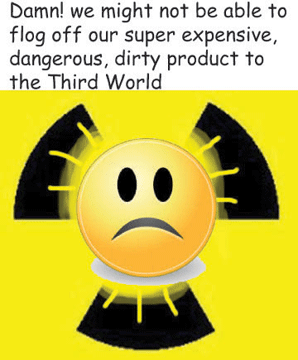 Japan and Hitachi pin nuclear export hopes on U.K. project in Wales https://www.japantimes.co.jp/news/2018/07/29/business/japan-hitachi-pin-nuclear-export-hopes-u-k-project-wales/#.W14xP9IzbGg, BY JUNKO HORIUCHI KYODO
A nuclear power plant project in Britain is giving Japan a glimmer of hope for spurring infrastructure exports, a key growth strategy of Prime Minister Shinzo Abe.
Hitachi Ltd. and the U.K. government started official talks last month on building new reactors in Wales, with a goal of firing them up in the first half of the 2020s.
The outlook for the ¥3 trillion project is unclear, with both sides facing a string of challenges in the talks going forward.
For Tokyo, the plan is one of its few remaining major overseas projects on the horizon, with other nuclear power generation plans discontinued or facing cancellation.
The government’s bet on nuclear power plants as a pillar of infrastructure exports comes as the likes of Germany, Italy, Taiwan and South Korea are pulling out of atomic power generation.
Critics argue that a surge in safety costs and accident worries caused by the 2011 Fukushima disaster, in addition to the lack of viable disposal solutions for radioactive waste, mean there is no justification for keeping faith in nuclear energy. Compounding the sector’s decline is the rapidly dropping cost of tapping such renewable energy sources as wind and solar power.
Still, some emerging economies look like they will need new nuclear power plants, and Japanese builders see few chances to construct new ones anytime soon in Japan.
“The Japanese government has been pushing hard for exports of nuclear power plants but it’s clear that it’s not going well,” said Tadahiro Katsuta, a professor at Meiji University. “The government will spare no effort in giving momentum to the exports.”
If the project in Britain proves successful, it will give the government “a good excuse” to push harder abroad, he said.
Before the official talks began, Hitachi had told Britain it might not take part in the project to build two advanced boiling water reactors on the Isle of Anglesey in Wales, because the price tag had soared higher than initially estimated.
But an offer by London to shoulder about two-thirds of the cost convinced Hitachi stay in. Tokyo welcomed its decision to begin the talks.
“The nuclear business overseas is significant … it would lead to strengthening and maintaining human resources and technology for nuclear power in Japan,” Minister of Economy, Trade and Industry Hiroshige Seko told a news conference.
Under the agreement, the British government will subsidize much of the cost through direct investment and loan guarantees, according to sources close to the matter.
“We are currently examining the financial and cost issues of the project, before making a final decision in 2019 on whether to invest in the project,” Hitachi Chief Financial Officer Mitsuaki Nishiyama said Friday at a news conference to announce earnings.
For Hitachi, nuclear power is a core operation. It wants to increase revenue from the business by more than 33 percent to ¥250 billion over the four years through March 2022, mainly through boosting overseas revenue.
Rival Toshiba Corp. exited overseas nuclear operations after incurring huge losses in the United States, a decision that could cripple Tokyo’s efforts to promote Japanese nuclear plants abroad.
Mitsubishi Heavy Industries Ltd., is pursuing a nuclear power plant project in Turkey. But it hit a snag when it saw safety-related costs surge and trading house Itochu Corp. walked away from the project.
In another blow to the government, Vietnam in 2016 decided to abandon a plan to build its first nuclear power plant with Japanese assistance due to tight state finances.
Those failures have led to an increased focus on the new power station in Wales. But London and Hitachi still need to address such issues as how to spread the remainder of the costs among Hitachi, local companies and Japan-backed financial institutions. They also need to determine who should be held liable if there’s a major accident.
They are also at odds over how much the electricity produced at the plant should cost. Britain at one point offered a price some 20 percent lower than what Hitachi wanted, a source familiar with the matter said.
“A key focus of discussions with Hitachi has been and will continue to be achieving lower-cost electricity for consumers,” Greg Clark, British business and energy secretary, told Parliament last month.
The two sides also need to talk to residents and win over those worried about the new power station.
“We have a major multinational and two governments supposed to be democracies playing a high-stakes game of poker … without any transparency or scrutiny for the people that they are representing,” Mei Tomos, a resident of Wales, said at a news conference in Tokyo during a recent visit to Japan.
“We have seen the destruction which nuclear power can cause. It is really too much to expect us to take the same risks. Even if such an accident didn’t happen at Anglesey we will still be faced with over a hundred years of storage of nuclear waste on site which presents a massive danger to us,” another resident, Robert Davies, said at the news conference.
Warning about China’s state-owned companies being involved in Britain’s nuclear industry
Beware China’s role in UK nuclear industry https://www.theguardian.com/environment/2018/jul/29/beware-china-role-in-uk-nuclear-industry
Jeffrey Henderson warns against Chinese state-owned firms playing a decisive part in one of our most strategically important industries.
While we need to be concerned about China’s growing presence in Britain’s electricity generation (Nuclear power: China’s move into UK hints at scale of its wider ambitions, July 27), we should be asking searching questions of our government. They seem not to understand (or don’t care about) the nature of the companies they are dealing with.
Chinese state-owned enterprises are not like EDF or the German, Dutch and French state-owned firms that run our railways. They are dramatically different because China is governed by a Leninist state. Consequently, Chinese state firms are ultimately controlled not by the State Council’s State Owned Assets Supervision and Administration Commission, but by the Communist party.
Furthermore, one of the two Chinese companies initially involved in the Hinkley Point plant, China National Nuclear (CNNC), while having a civil division, is mainly involved in the production of the country’s nuclear weapons. Consequently, it is almost certainly controlled by the Chinese military: the People’s Liberation Army.
Jeffrey Henderson
Professor of international development, School of Sociology, Politics and International Studies, University of Bristol
Public opinion being influenced by biased and inaccurate reporting on North Korea
They have thus obscured the reality that the fate of the negotiations depends not only North Korean policy but on the willingness of the United States to make changes in its policy toward the DPRK and the Korean Peninsula that past administrations have all been reluctant to make.
These stories also underscore a broader problem with media coverage of the US-North Korean negotiations: a strong underlying bias toward the view that it is futile to negotiate with North Korea. The latest stories have constructed a dark narrative of North Korean deception that is not based on verified facts. If this narrative is not rebutted or corrected, it could shift public opinion—which has been overwhelmingly favorable to negotiations with North Korea—against such a policy.
How the Media Wove a Narrative of North Korean Nuclear Deception 38 North, BY: GARETH PORTER, JULY 26, 2018
Since the June 12 Singapore Summit between US President Trump and North Korean leader Kim Jong Un, the US media has woven a misleading narrative that both past and post-summit North Korean actions indicate an intent to deceive the US about its willingness to denuclearize. The so-called intelligence that formed the basis of these stories was fed to reporters by individuals within the administration pushing their own agenda.
The Case of the Secret Uranium Enrichment Sites
In late June and early July, a series of press stories portrayed a North Korean policy of deceiving the United States by keeping what were said to be undeclared uranium enrichment sites secret from the United States. The stories were published just as Secretary of State Mike Pompeo was preparing for the first meetings with North Korean officials to begin implementing the Singapore Summit Declaration.
The first such story appeared on NBC News on June 29, which reported: Continue reading
China’s plan for global nuclear dominance depends on Britain
 China’s long game to dominate nuclear power relies on the UK https://www.theguardian.com/environment/2018/jul/26/chinas-long-game-to-dominate-nuclear-power-relies-on-the-uk
Approval of Chinese nuclear technology in the UK would act as a springboard to the rest of the world, Guardian, Adam Vaughan and Lily Kuo in Beijing, 27 Jul 2018
China wants to become a global leader in nuclear power and the UK is crucial to realising its ambitions.
While other countries have scaled back on atomic energy in the wake of the Fukushima disaster, state-backed Chinese companies benefit from the fact that China is still relying on nuclear energy to reach the country’s low-carbon goals.
“China is going in the opposite direction. The massive experience possessed by the Chinese nuclear industry, consistently building for the past 30 years and adopting various next-generation technologies, is being recognised by the global nuclear industry,” said Zaf Coelho, the director of Asia Nuclear Business Platform, based in Singapore.
The UK, where as many as six new nuclear power stations could be built over the next two decades, is an obvious export target for Chinese nuclear. If state-owned China General Nuclear Power (GNP) – the main player in China’s nuclear industry – buys a 49% stake in the UK’s existing nuclear plants, as it was recently reported to be considering, that would mark a significant expansion of China’s role in the UK nuclear sector.
But the depth of CGN’s existing involvement in UK nuclear may surprise some.
The most high-profile project is the £20bn Hinkley Point C power station in Somerset, which is being built by EDF Energy with a French reactor design but was only made possible by CGN UK’s 33.5% stake to underwrite its daunting finances.
It was that Chinese ownership of a strategic piece of infrastructure that led Theresa May to temporarily halt the signing of the crucial subsidy deal for Hinkley when she became prime minister.
Isabel Hilton, the CEO of Chinadialogue.net, said the UK opening up vital infrastructure to China was without parallel in the western world. “No other OECD country has done this. This is strategic infrastructure, and China is a partner but not an ally in the security sense.
“You are making a 50-year bet, not only that there will be no dispute between the UK and China, but also no dispute between China and one of the UK’s allies. It makes no strategic sense.”
The UK has appeared amenable to Chinese investment, though recently the UK cybersecurity watchdog warned British telecommunications companies against dealing with Chinese tech firm ZTE. One expert acknowledges that security concerns are a potential check to Chinese ambitions.
Zha Daojiong, a professor of non-traditional security studies at Peking University, said: “The question is not whether your nuclear technology is safe or not, it’s a question of politics. To be blunt, most countries think: ‘Anybody but China.’ This kind of thinking is becoming more and more popular among western countries. It’s a serious problem.”
CGN is also drawing up plans for Bradwell B in Essex, where China hopes to showcase its own nuclear reactor technology. CGN UK holds the majority stake (66.5%) in the development company, with EDF in a supporting role. Then there is a third joint venture to get Bradwell’s Chinese reactor design through the UK nuclear regulatory process.
Finally, there is Sizewell C in Suffolk, where EDF wants to build a clone of Hinkley Point C if it can attract enough private investment. CGN holds a 20% share.
While Germany and other western countries have turned their backs on nuclear, the UK is strongly committed to new nuclear to meet its carbon goals and this means, despite security concerns, the government needs Chinese involvement.
Robert Davies, the chief operating officer of CGN UK, said: “The UK is open to investment, and we want to invest in clean energy in this country.”
He is acutely aware of the need for future plants to be cheaper, given criticism over the cost of the EDF subsidy deal. “We understand the cost of electricity has to fall significantly from Hinkley Point,” he said.
But the company is open about the bigger prize – the UK as a springboard for exporting Chinese nuclear technology to other countries.
“For us, the UK is an important stepping stone into Europe. The GDA process [UK regulatory approval] is recognised in the nuclear world as having a lot of clout,” said Davies.
Asked if the UK should be concerned about China owning its nuclear power stations, he said: “We are not surprised and see nothing wrong with governments questioning our rationale for investing in their country.”
For now, the company’s UK footprint is small – just 70 of its 44,000 staff are based here. But his hope is the firm will become viewed “not as an outsider that has come in, but part of the furniture”.
China’s commitment was on show at a recent lavish nuclear industry event in London. No expense was spared on hosting the summit at the prestigious Guildhall building, where the Chinese ambassador to the UK told jokes and argued the case for new nuclear.
Mycle Schneider, a Paris-based nuclear industry analyst, said cost was not an issue for Beijing because the Chinese are playing a long game. “It was clear quite early on there was a strategy to make the UK a platform … A few billion here or there is not the point. It’s about strategic assets.”
But he said CGN still had a lot to learn about how the UK worked. “China does not have any building experience in any countries other than Pakistan, and that is not really comparable to the UK.”
Zhou Dali, a former Chinese energy official, as director of the energy research institute of China’s National Development and Reform Commission, said: “We are learning how to do business with patience. Because you cannot force others to do something. You can only help.
“We will give more and more information about the technology’s improvements, but the final decision will be made by the UK people and your politicians.”
Additional reporting by Wang Xueying
Japan has amassed enough plutonium to make 6,000 nuclear bombs

 Economist 25th July 2018 Japan has now amassed 47 tonnes of plutonium, enough to make 6,000 bombs.
What is Japan doing with so much plutonium? Plutonium is at the heart of
Japan’s tarnished dream of energy independence. Spent fuel from nuclear
reactors can be reprocessed to extract plutonium, which is then recycled
into mixed oxide, or MOX, fuel. This was intended for use in Japan’s
reactors but most of its nuclear power plants have been offline since the
2011 Fukushima disaster.
Tougher safety checks have failed to reassure the
nuclear-phobic public that the reactors can be restarted. And Japan’s
nuclear-energy fleet is ageing. Taro Kono, Japan’s foreign minister, has
admitted that this situation is “extremely unstable”.
Japan’s status as a plutonium superpower is increasingly under scrutiny. The government
says it has no intention of building a bomb. But China and other countries
question how long it can be allowed to stockpile plutonium. Analysts worry
about a competitive build-up of plutonium in Asia.
Moreover Japan’s stock, which is weapons-grade, is reprocessed and stored in France and
Britain. It is moved across the world in heavily armed convoys. America
says those shipments and the storage of plutonium in civilian sites present
a potential threat to non-proliferation goals: they could be redirected to
make weapons, or targeted by terrorists. It is nudging its ally to start
reducing the hoard.
https://www.economist.com/the-economist-explains/2018/07/25/why-does-japan-have-so-much-plutonium
Japan’s biggest utility, Tokyo Electric Power Company moving from nuclear power to renewables

 Japan’s Tepco plans 7GW renewables roll-out, in pivot away from nuclear, REneweconomy, By Sophie Vorrath on 26 July 2018
Japan’s biggest utility, Tokyo Electric Power Company, has revealed plans to develop up to 7GW of new renewable energy capacity, marking a major departure from nuclear as the company strives to re-gain “the competitive advantage” in energy generation.
Tepco President Tomoaki Kobayakawa told the Nikkei Asian Review on Monday that the company planned to pour tens of billions of dollars into between 6 and 7GW of renewable energy projects both in Japan and abroad, including offshore wind and hydro power.
Reports suggest the focus in Japan will largely be on offshore wind, including the use of floating turbine technology that is considered to be well suited to the island nation’s relatively deep coastal waters.
And in hydro, Tepco plans to develop sites in south-east Asia, alongside its overseas and domestic wind power businesses. The company reportedly hopes to have each of the three renewables components generating at least 2GW of power.
……..The new tack for Tepco suggests a major change in direction and thinking in the Japanese electricity market, where a skew towards nuclear and “baseload” generation has roughly mirrored Australia’s attachment to coal.
As a 2016 Greenpeace Japan report noted, the nation’s nuclear utilities have had a history of “(lobbying) hard for the right to block access to the grid for renewable power plants” whenever they deemed it necessary to preserve grid stability.
They argued, said Greenpeace Japan, the all-too familiar line that the fluctuating output of renewables was incompatible with the output of nuclear reactors the government was trying to restart.
But this thinking appears to be shifting, and not just among power companies. A separate report last week in the Nikkei Asian Review noted that renewable energy momentum was also building in Japan’s corporate and industrial sectors, boosted by the liberalisation of the nation’s energy market in 2016.
“More Japanese companies are promising to source all of their electricity from renewable energy in 10 to 30 years,” the news site said. “A trend that could in turn spur investment to bolster grid capacity, to accommodate demand.” https://reneweconomy.com.au/japans-tepco-plans-7gw-renewables-roll-out-in-pivot-away-from-nuclear-72286/
AS heatwave engulfs Japan, climate change adds to the nuclear danger
 The 2020 Olympics will open in 2 years, and the heat is on, https://apnews.com/0a64bd6df7f349879fb5ff7c3b6cafd7 By JIM ARMSTRONG, 24 July 18 Since being awarded the games, which will be the largest ever with 33 sports and 339 events, Tokyo organizers have had to deal with a series of problems ranging from stadium and construction delays , natural disasters and a scandal involving the official logo.
Most of the obstacles have been cleared up, but a deadly heatwave gripping Japan has focused organizerson ways to keep fans and athletes cool when the Olympics begin on July 24, 2020.
Potential for scorching summer conditions has always concerned organizers, with temperatures in central Tokyo often exceeding 35 Celsius (95 Fahrenheit) in July and August, made more difficult because of high humidity.
This summer heatwave has resulted in more than 65 deaths and sent tens of thousands to hospitals. The temperature on Monday reached 41.1 Celsius (106 Fahrenheit), the highest ever recorded in Japan.
Experts have warned the risk of heatstroke in Tokyo has escalated in recent years, while noting the Olympics are expected to take place in conditions when sports activities should normally be halted.
“We are mindful that we do have to prepare for extreme heat,” John Coates, head of the IOC’s coordination commission for the Tokyo Games, told a recent news conference.
The 1964 Games in Tokyo were held in October to avoid the harshest of the heat. That was before the Olympics schedule was influenced by rights-paying broadcasters and sponsors.
Local organizers are doing what they can to help athletes combat the conditions. The marathon and some other outside events will be held early in the morning to avoid extreme heat.
The federal and the Tokyo metropolitan governments are also planning to lay pavements that emit less surface heat and plant taller roadside trees for shade.
“The spectators as well as the athletes have to be taken care of,” Coates said. “The timing of the marathon and road walks will be as early as possible as they have been in previous games to beat the heat.”
Organizers want the games to help showcase Japan’s recovery from the 2011 earthquake and tsunami that took more than 18,000 lives and triggered meltdowns at the Fukushima nuclear power plant.
While reconstruction from the disaster is making steady progress, and work on the new 68,000-seat main stadium in Tokyo is 40 percent complete, more than 70,000 people remain displaced from their communities.
The construction of the main stadium was more than a year behind schedule when it started in December 2016, as earlier plans were scrapped because of spiraling costs and a contentious design.
The Japanese government approved the new 150 billion yen ($1.5 billion) stadium, which is expected to be completed in November of 2019. The previous construction timeline would have allowed the main stadium to host the 2019 Rugby World Cup final on Nov. 2 as a test event, but that idea was scrapped.
Meanwhile, organizers say the other newly-constructed venues are 20 to 40 percent complete.
The torch relay will start March 26, 2020, in Fukushima, an area hit hard by the disaster.
Coates said local organizers are on track with 24 months to go.
“Tokyo 2020 comes a significant step closer to delivering an Olympic Games that will bring Japan and the world together,” he said. “The organizing committee has presented considerable progress … especially as it related to venue and operational readiness.”
Japan’s former Prime Minister Junichiro Koizumi calls on opposition to challenge LDP’s nuclear policy
 Koizumi calls on opposition to challenge LDP’s nuclear policy, THE ASAHI SHIMBUN, July 24, 2018
Former Prime Minister Junichiro Koizumi has criticized the Abe administration for its pro-nuclear energy stance and called for the policy to be made an election issue when Japanese go to the polls next year.
In a recent interview with The Asahi Shimbun in Tokyo, Koizumi, 76, said, “It isn’t possible any more for Prime Minister Shinzo Abe to end nuclear power generation. He did not try to do so, even though he could have.”
Among extremely rare remarks for a former prime minister and former Liberal Democratic Party lawmaker to make, Koizumi also said he expects opposition parties to make ending Japan’s reliance on nuclear power a key point for debate in the next Upper House election to be held in summer 2019.
Koizumi made his anti-nuclear stance clear in a news conference in 2013, seven years after he stepped down as prime minister.
Since then, he has repeatedly demanded that the Abe administration change its energy policies and bring nuclear power generation to an end.
Koizumi expressed disappointment at Abe’s response to that demand……..http://www.asahi.com/ajw/articles/AJ201807240057.html
Japan’s Olympic-sized dangers of climate change and nuclear radiation
Climate change is bringing unprecedented heat sweeping Japan right now, and is predicted to continue through August – Japan: Heat spikes to 41.1C near Tokyo as high temps to continue until August
Tokyo 2020 will host the XXXII Olympic Summer Games, Jul 24 – Aug 9.
How safe will the athletes be – competing in this new era of climate change heat?
How safe will anyone be, with the continuing danger of Fukushima’s wrecked nuclear reactors, and Japan’s accumulations of nuclear radioactive trash?
Ironically, Japan would appear to most thinking people to be a most unwise choice for the 2020 Olympics, because of the continuing dangerous situation at Fukushima.
But most people have missed the connection to the military-industrial-corporate-global-nuclear-complex.
It’s a large part of the reason WHY JAPAN WAS CHOSEN – TO PROVE TO THE WORLD THAT FUKUSHIMA DOESN’T MATTER – THAT THE NUCLEAR INDUSTRY IS JUST FINE!
Steve Dale comments: Trees take up the Cesium-137 via their roots and pump it to their growth tips. A forest fire could spread radioactivity everywhere again. People avoiding the No-Go areas might have the radiation come to their lungs via smoke.
Japan to deploy large patrol boats to guard nuclear plants


Japan readies for nuclear terrorism as 2020 Olympics approach

Japan to deploy large patrol boats to guard nuclear plants (Mainichi Japan)
TOKYO (Kyodo) — The Japan Coast Guard will deploy two large patrol vessels to areas of the Sea of Japan to reinforce protection of nuclear power plants against terrorism, sources familiar with the matter said Saturday.
Two new 1,500-ton vessels with helipads will be deployed between fiscal 2019 and 2020 to the coast guard’s Tsuruga office in Fukui Prefecture where several nuclear plants are located, according to the sources.
Patrol boats of similar size, each costing about 6 billion yen ($54 million), will be introduced in other parts of the country in the future, they said.
The government is moving to strengthen counterterrorism measures in the run-up to the 2020 Tokyo Olympics and Paralympics, in line with an agreement in February with the International Atomic Energy Agency to bolster Japan’s capacity to respond to nuclear terrorism…….
The new ships could also be used to respond to emergency situations at nuclear plants in other areas, and crew will receive special training in dealing with radioactive substances, they said. ……
https://mainichi.jp/english/articles/20180722/p2g/00m/0dm/007000c
1 This Month
26 September – International Day for the Total Elimination of Nuclear Weapons





PLEASE OPPOSE HR 8255 AND S.3639 – bills would accelerate satellite deployment, with no environmental review or safeguards – https://ncstd5li.quorum.us/campaign/169331/
To see nuclear-related stories in greater depth and intensity – go to https://nuclearinformation.wordpress.com
-
Archives
- September 2026 (313)
- August 2026 (330)
- July 2026 (355)
- June 2026 (287)
- May 2026 (306)
- April 2026 (356)
- March 2026 (251)
- February 2026 (267)
- January 2026 (308)
- December 2025 (358)
- November 2025 (359)
- October 2025 (375)
-
Categories
- 1
- 1 NUCLEAR ISSUES
- business and costs
- climate change
- culture and arts
- ENERGY
- environment
- health
- history
- indigenous issues
- Legal
- marketing of nuclear
- media
- opposition to nuclear
- PERSONAL STORIES
- politics
- politics international
- Religion and ethics
- safety
- secrets,lies and civil liberties
- spinbuster
- technology
- Uranium
- wastes
- weapons and war
- Women
- 2 WORLD
- ACTION
- AFRICA
- Atrocities
- AUSTRALIA
- Christina's notes
- Christina's themes
- culture and arts
- Events
- Fuk 2022
- Fuk 2023
- Fukushima 2017
- Fukushima 2018
- fukushima 2019
- Fukushima 2020
- Fukushima 2021
- general
- global warming
- Humour (God we need it)
- Nuclear
- RARE EARTHS
- Reference
- resources – print
- Resources -audiovicual
- Weekly Newsletter
- World
- World Nuclear
- YouTube
-
RSS
Entries RSS
Comments RSS

