Japan’s ‘plutonium exception’ under fire as nuclear pact extended https://asia.nikkei.com/Politics/International-Relations/Japan-s-plutonium-exception-under-fire-as-nuclear-pact-extended Beijing and Seoul question why US allows only Tokyo to reprocess, YUKIO TAJIMA, Nikkei staff writer, TOKYO — Japan’s nuclear cooperation agreement with the U.S. — the pillar of Tokyo’s nuclear energy policy — renews automatically on Monday after the current pact, which took effect in 1988, expires.
The agreement allows Japan to be the sole non-nuclear-weapons state to use plutonium for peaceful purposes and underlies the country’s policy of recycling spent nuclear fuel.
But the renewal comes at a time when Japan’s “plutonium exception” is increasingly under scrutiny. Instead of negotiating a new pact that could last several decades, Washington and Tokyo chose an automatic extension of the current agreement.
The agreement signed three decades ago stated that after the 30-year period expired, the terms would remain in force but could be terminated by either side with a six months’ notice. Japan worries that without a new long-term agreement, the country enters an “extremely unstable situation,” Foreign Minister Taro Kono has said.
Japan’s neighbors have cried foul over Japan’s plutonium exception. China has said it creates a path for Japan to obtain nuclear weapons. South Korea, which also has a nuclear cooperation agreement with the U.S., has pressed Washington hard to be granted similar freedom on fuel reprocessing.
Countries such as Saudi Arabia that are looking to develop their own nuclear programs have also protested.
Under President Barack Obama, Japan’s plutonium stockpiles — much of which is stored in the U.K. — drew uncomfortable attention in Washington. In March 2016, Thomas Countryman, the then-assistant secretary of state for nonproliferation, told a Senate hearing that he “would be very happy to see all countries get out of the plutonium reprocessing business.”
President Donald Trump has shown less interest in preventing nuclear proliferation, but is committed to dismantling North Korea’s nuclear facilities and materials. Resolving the inconsistent treatment afforded Japan’s plutonium stockpile would make it easier to convince Pyongyang to give up reprocessing capabilities as part of its denuclearization, Countryman told Nikkei recently.
The Trump administration appears aware of these arguments. The National Security Council and State Department have requested that Japan reduce its stockpile and otherwise ensure its plutonium is used and managed appropriately. On July 3, Japan’s cabinet approved a new basic energy plan that includes reducing plutonium holdings, aiming to assuage American concerns.
But Japan’s mostly idled nuclear power industry makes working through the stockpile a challenge.At one point after the 2011 Fukushima nuclear disaster, all of the country’s reactors were offline. Nine have managed to restart under stricter safety standards adopted in the wake of the meltdowns, but only a few Japanese reactors can run on so-called mixed-oxide fuel containing plutonium.
Regulators have asked utilities such as Shikoku Electric Power and Kyushu Electric Power that are working to restart nuclear reactors to look into consuming plutonium fuel held by other power companies. But this would require potentially difficult negotiations with local governments.
One other option is to pay overseas countries that store plutonium on Japan’s behalf to dispose of them, but that would involve discussion on the international level.
“The only viable option is to explain to the world the steady efforts we are making toward reduction,” said an official at the Ministry of Economy, Trade and Industry, which is responsible for Japan’s energy policy.
So far, the U.S. has not called on Japan to abandon its plutonium entirely, or to speed up its reduction. And there is little chance the U.S. will end the cooperation agreement, as “Japan’s nuclear technology is indispensable to the American nuclear industry,” according to a Japanese government source.
But Tokyo worries that the Trump administration may apply the same transactional approach it has to other foreign policy issues to the question of Japan’s plutonium.
At least four firms used foreign trainees to clean up radioactive contamination from Fukushima nuclear plant: ministry, Japan Times, BY SHUSUKE MURAI, STAFF WRITER , 14 July 18
The Justice Ministry revealed Friday that at least four construction companies have used foreign trainees in radioactive cleanup work related to the triple meltdown at the Fukushima No. 1 nuclear power plant, which occurred in 2011.
The interim report of the ministry’s probe, covering 182 companies with foreign trainee programs as of June 29, said one of the four companies, based in Iwate Prefecture, has been banned from accepting foreign trainees for five years.
The other three firms — two in Fukushima Prefecture and one in Chiba Prefecture — are still under investigation. The names of the companies were not revealed.
The ministry plans to compile a full report covering 1,002 companies in eight prefectures, including Miyagi, Ibaraki, Tochigi, Gunma and Saitama, this fall.
The research started in the wake of a government announcement in March banning the use of foreign trainees in work to remove radioactive contamination. The government says such work is not consistent with the true purpose of the foreign trainee program.
The Technical Intern Training Program was introduced in 1993 with the aim of transferring skills to developing countries. But the scheme has drawn criticism both at home and abroad as a cover for importing cheap labor for the manufacturing, construction and other industrial sectors, where blue-collar workers are in short supply…….
Fukushima Minpo News 2nd July 2018,Nearly 50% of residents in Fukushima Prefecture are against a central
government policy to remove some 2,400 posts in the prefecture for
monitoring nuclear radiation from fallout left by the 2011 accident at
Tokyo Electric Power Co.’s Fukushima Daiichi plant, according to an
opinion poll jointly conducted by Fukushima-Minpo Co., publisher of the
namesake local daily, and Fukushima Television Broadcasting Co. http://www.fukushimaminponews.com/news.html?id=901
The existing accord, officially called the Agreement for Cooperation Between the Government of the United States of America and the Government of Japan Concerning Peaceful Uses of Nuclear Energy, recognizes Japan’s extraction of plutonium from spent nuclear fuel and use of mixed oxide (MOX) fuel as part of its “nuclear fuel cycle.” Renewing the pact will enable Japan to continue with its nuclear fuel cycle policy.
However, after the pact is renewed, if either Japan or the U.S. gives notice, then the agreement will be halted after six months — which would mean that Japan’s nuclear policy would be more easily affected by the will of the U.S.
The nuclear energy agreements that the U.S. has in place with other countries control the handling of nuclear materials and related equipment — from the standpoint of non-proliferation — whenever the U.S. provides nuclear technology to those other nations.
Under the existing agreement between Japan, a non-nuclear nation, and the U.S., nuclear fuel cycle operations such as the reprocessing of spent nuclear fuel and also uranium enrichment are recognized, in what is considered an exceptional case.
With the pact coming into effect in July 1988, the 30-year deadline of the current agreement will be reached on July 16, 2018. As long as neither Japan nor the U.S. give notice to withdraw six months prior to the deadline, the pact will be automatically renewed.
The Japanese government did try to negotiate with the U.S. about maintaining the agreement as it is. However, the administration under U.S. President Donald Trump has not been in a position to negotiate, and so the pact looks set to renew automatically, without any serious negotiations taking place.
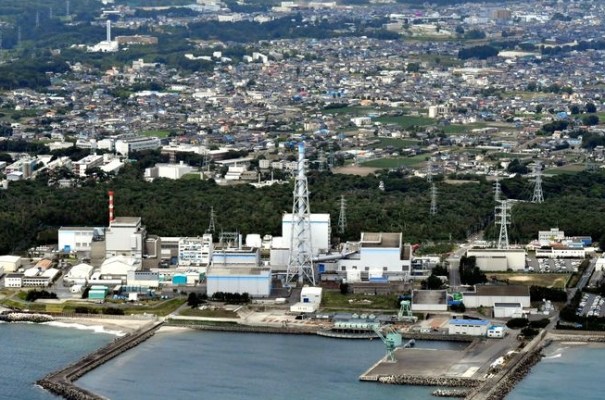
The Tokai No. 2 nuclear power plant in Tokai village, Ibaraki Prefecture, which is operated by Japan Atomic Power Co.
July 5, 2018
The Nuclear Regulation Authority has concluded that the Tokai No. 2 nuclear power plant in Ibaraki Prefecture, operated by Japan Atomic Power Co., meets improved safety standards for a restart.
The watchdog body’s decision effectively paves the way for bringing the idled facility back online.
But a slew of questions and concerns cast serious doubt on the wisdom of restarting this aging nuclear plant located at the northern tip of the Tokyo metropolitan area, given that it is approaching the end of its 40-year operational lifespan.
There is a compelling case against bringing the plant back on stream unless these concerns are properly addressed.
The first major question is how the project can be squared with the rules for reducing the risk of accidents at aging nuclear facilities.
The 40-year lifespan for nuclear reactors is an important rule to reduce the risk of accidents involving aging reactors that was introduced in the aftermath of the disaster at the Fukushima No. 1 nuclear power plant in 2011.
Although a reactor’s operational life can be extended by up to 20 years if approved by the NRA, the government, at the time of the revision to the law, said it would be granted only in exceptional cases.
Despite this caveat, Kansai Electric Power Co.’s applications for extensions for its three aging reactors all got the green light.
The NRA has yet to approve the requested extension of the Tokai No. 2 plant’s operational life. But it is obvious that the nuclear watchdog’s approval will cause further erosion of the rule. It will also undermine the regulatory regime to limit the lifespan of nuclear facilities per se.
Local communities have also raised objections to restarting the Tokai No. 2 plant. Some 960,000 people live within 30 kilometers of the plant, more than in any other 30-km emergency planning zone.
The local governments within the zone are struggling to develop legally required emergency evacuation plans to prepare for major accidents.
This spring, an agreement was reached between Japan Atomic Power and five municipalities around the plant, including Mito, that commits the operator to seek approval from local authorities within the 30-km zone before restarting the plant.
Winning support from the local communities for the plant reactivation plan is undoubtedly a colossal challenge, given strong anxiety about the facility’s safety among local residents. The gloomy situation was brought home by the Mito municipal assembly’s adoption of a written opinion opposing the plan.
But Japan Atomic Power is determined to carry through the plan as its survival depends on the plant continuing operation.
The company was set up simply to produce and sell electricity by using atomic energy. Its nuclear reactors are all currently offline, which has placed the entity in serious financial difficulty.
Since the company is unable to raise on its own funds to implement the necessary safety measures at the Tokai No. 2 plant, which are estimated to exceed 170 billion yen ($1.54 billion), Tokyo Electric Power Co. (TEPCO) and Tohoku Electric Power Co., which are both shareholders and customers of the company, will provide financial support.
But TEPCO has been put under effective state control to deal with the costly consequences of the Fukushima disaster.
It is highly doubtful that the utility, which is kept alive with massive tax-financed support, is qualified to take over the financial risk of the business of another company in trouble.
TEPCO claims the Tokai No. 2 plant is promising as a source of low-cost and stable power supply, although it has not offered convincing grounds for the claim.
Some members of the NRA have voiced skepticism about this view.
TEPCO and the Ministry of Economy, Trade and Industry, which supervises the power industry, have a responsibility to offer specific and detailed explanations about related issues to win broad public support for the plan to reactivate the Tokai No. 2 nuclear plant.
A hard look at the grim situation surrounding the plant leaves little doubt that restarting it does not make sense.
Japan Atomic Power and the major electric utilities that own it should undertake a fundamental review of the management of the nuclear power company without delaying efforts to tackle the problems besetting the operator of the Tokai No. 2 plant.
A plaintiff and a lawyer hold signs on July 4 criticizing a ruling by the Nagoya High Court’s Kanazawa branch that nullified an injunction intended to halt operations at the Oi nuclear plant in Fukui Prefecture.
Court overturns injunction, says Oi nuclear plant safe to operate
KANAZAWA–A high court branch here overturned a lower court order to halt operations of two reactors at a nuclear plant in Fukui Prefecture, saying it poses no tangible danger to residents there.
“The danger is within negligible levels in light of social norms,” Presiding Judge Masayuki Naito of the Nagoya High Court’s Kanazawa branch said on July 4, nullifying an injunction against Kansai Electric Power Co., operator of the Oi nuclear plant.
Plaintiffs sought the injunction to block the restarts of the No. 3 and No. 4 reactors at the plant in Oi. They argued that dangers from the plant violated their right to protect their lives and sustain their livelihood.
The Fukui District Court sided with the plaintiffs in 2014, saying the plant was not thoroughly prepared to withstand a powerful earthquake.
The district court focused more on whether a tangible danger existed that could result in a serious accident similar to the one that hit Tokyo Electric Power Co.’s Fukushima No. 1 nuclear plant in March 2011, not on the Nuclear Regulation Authority’s decision to clear the Oi reactors for operations.
However, the high court said its decision was based on whether the NRA’s new safety regulations were appropriate, and whether the watchdog’s assessment that the two Oi reactors passed the safety regulations was reasonable.
The stricter regulations took effect in July 2013 based on lessons learned from the Fukushima nuclear disaster.
“They were established by incorporating the latest scientific and technological expertise,” the high court said of the new standards.
The court supported both the NRA’s regulations and its decision to clear the No. 3 and 4 reactors as meeting the requirements.
Kunihiko Shimazaki, a seismologist and a former NRA member, raised doubts about the safety of the plant as a witness in the court proceedings.
He said the NRA’s current formula for calculating the scope of sway in an earthquake may have underestimated the expected maximum shaking from a powerful earthquake that could strike the plant.
The high court rejected Shimazaki’s argument.
“The extent of the maximum shaking was not underestimated because (the calculations) used an active geological fault zone larger than it should be in reality to provide an extra safety cushion,” the judge said.
The court also supported the NRA’s decision that the Oi reactors meet the new regulations concerning measures against tsunami and volcanic eruptions.
As for evaluating the soundness of nuclear power generation, the court said that is not its role.
“It will be possible to abolish and ban the operation of nuclear power plants in light of the grave consequences of the Fukushima nuclear disaster, but judging on the issue goes beyond the jurisdiction of the judiciary,” the court said. “(The nuclear issue) should be widely debated by the public and left to a political judgment.”
The Japan Atomic Power Co.’s Tokai No. 2 Nuclear Power Station, front, and the Tokai Power Station, right back, which is currently being decommissioned, are seen from a Mainichi Shimbun helicopter
Nuclear watchdog OKs restart of aging nuclear plant hit by tsunami
The Japan Atomic Power Co.’s Tokai No. 2 Nuclear Power Station, front, and the Tokai Power Station, right back, which is currently being decommissioned, are seen from a Mainichi Shimbun helicopter
July 4, 2018
TOKYO (Kyodo) — Japan’s nuclear watchdog on Wednesday gave the green light to the restart of an aging nuclear power plant northeast of Tokyo, idled since it was hit by the tsunami that caused meltdowns at the Fukushima Daiichi plant.
The Tokai No. 2 plant is the first nuclear plant affected by the March 2011 earthquake and tsunami disaster to have cleared screening by the Nuclear Regulation Authority, part of the steps required before it can actually resume operations.
The plant, located in the village of Tokai in Ibaraki Prefecture, suffered an emergency automatic shutdown of its reactor and was cut off from its external power source following the quake.
After being hit by a 5.4-meter tsunami, one of its three emergency power generators was incapacitated. But the other two remained intact and allowed the reactor to cool down three and a half days after the disaster.
Despite the approval by the NRA, the Tokai plant still needs to clear two more screenings by regulators by November, when it will turn 40 years old, otherwise it could face the prospect of decommissioning.
Tougher safety rules introduced in the post-Fukushima years prohibit in principle the operation of nuclear reactors beyond 40 years. But extending a unit’s life for an additional 20 years is possible if operators make safety upgrades and pass regulators’ screening.
Actual plant operation is unlikely before March 2021 when construction to bolster safety measures is scheduled to be completed. The restart plan also needs to be approved by local municipalities.
The Tokai No. 2 plant, operated by Japan Atomic Power Co., uses a boiling water reactor, the same type as those used at the crisis-hit Fukushima Daiichi plant, which saw core meltdowns and spewed a massive amount of radioactive materials into the atmosphere in the 2011 disaster.
It is the eighth plant approved of a restart under the stricter safety rules introduced after the 2011 Fukushima nuclear crisis and the second with a boiling water reactor following the Kashiwazaki-Kariwa nuclear plant run by Tokyo Electric Power Company Holdings Inc.
The plant’s evacuation plan — which covers 960,000 residents, the largest number of potential evacuees for a nuclear plant in Japan due to its location in a metropolitan area — has yet to be compiled.
The operator filed for a safety screening to restart the plant in May 2014. It predicts a potential tsunami as high as 17.1 meter and expects some 180 billion yen ($1.63 billion) is needed to construct coastal levees and beef up power sources among other safety measures.
Japan Atomic Power solely engages in the nuclear energy business but none of its reactors has been online since the 2011 quake. Given its financial problems, the NRA has asked it to show how it will finance the safety measures and Tokyo Electric Power and Tohoku Electric Power Co. have offered to financially support the company.
Ibaraki citizens demonstrate against the restart of the Tokai No. 2 nuclear power plant outside the Nuclear Regulation Authority headquarters in Tokyo’s Minato Ward on Wednesday.
Nuclear watchdog OKs restart of aging tsunami-hit Tokai nuclear plant
Jul 4, 2018
Ibaraki unit needs to clear two more screenings by November, when it will turn 40
The Nuclear Regulation Authority on Wednesday gave the green light to the restart of an aging nuclear power plant northeast of Tokyo, idled since it was hit by the tsunami that caused meltdowns at the Fukushima No. 1 plant.
The Tokai No. 2 plant is the first nuclear plant affected by the March 2011 earthquake and tsunami disaster to have cleared screening by the nuclear watchdog. Other steps are still required before it can resume operations.
Due to the quake, the plant in the Ibaraki Prefecture village of Tokai suffered an emergency automatic shutdown of its reactor and was cut off from its external power source.
After then being hit by a 5.4-meter tsunami, one of its three emergency power generators was incapacitated. But the other two remained intact and allowed the reactor to cool down 3½ days after the disaster.
Despite the approval by the NRA, the plant still needs to clear two more screenings by regulators by November, when it will turn 40 years old. If it fails, it could face the prospect of decommissioning.
Following the decision, Ibaraki Gov. Kazuhiko Oigawa told reporters he intends to “closely monitor the remaining screenings” and called on the NRA “to conduct strict examinations.”
Tougher safety rules introduced after the Fukushima disaster in principle prohibit the operation of nuclear reactors beyond 40 years. But extending a unit’s life for an additional 20 years is possible if operators make safety upgrades and it passes screenings.
Actual operation is unlikely before March 2021, when construction to bolster safety measures is scheduled to be completed. The restart plan also needs to be approved by local municipalities.
On Wednesday morning, a group of about 10 citizens protested the restart outside the NRA’s offices in Tokyo’s Minato Ward.
Mika Tsubata, a 47-year-old resident of Tokai who observed the NRA meeting, blasted the decision. “The Tokai No. 2 plant is old and was damaged in the 2011 disaster,” she said. “It’s evident to everyone that (the restart) is highly risky — I don’t think the NRA made the appropriate decision.”
But Eiji Sato, the 69-year-old chair of the village’s chamber of commerce, said the plant’s resumption is key to Tokai’s future. “The village has thrived on nuclear power generation,” he said.
The Tokai No. 2 plant, operated by Japan Atomic Power Co., uses a boiling-water reactor, the same type as those used at the Fukushima No. 1 plant, which suffered core meltdowns and spewed a massive amount of radioactive material into the atmosphere in 2011.
It is the eighth plant to get approval for a restart under the stricter safety rules and the second with a boiling-water reactor, following the Kashiwazaki-Kariwa plant, run by Tokyo Electric Power Company Holdings Inc.
The plant’s evacuation plan — which covers 960,000 residents, the largest number of potential evacuees for a nuclear plant in Japan due to its location near a metropolitan area — has yet to be compiled.
“Because of the large number of residents around the plant, compiling effective anti-disaster measures and an evacuation plan in a wide area is a huge challenge,” Oigawa said.
The operator filed for a safety screening to restart the plant in May 2014. It predicts a potential tsunami as high as 17.1 meters and expects ¥180 billion ($1.63 billion) will be needed to construct coastal levees and beef up power sources, among other safety measures.
Although Japan Atomic Power’s sole business is nuclear energy, none of its reactors has been online since the 2011 quake. Given its financial problems, the NRA has asked the utility to show how it will finance the safety measures. Tepco and Tohoku Electric Power Co., which had been receiving electricity from the plant when it was in operation, have offered to financially support the company.
The NRA decided at the meeting to seek industry minister Hiroshige Seko’s views on whether Tepco’s financial contribution could affect the costs of scrapping the Fukushima No. 1 plant and enhancing safety at the Kashiwazaki-Kariwa plant.
Secretary of state predicts ‘productive’ meeting on his third visit, joking: ‘If I come one more time, I will have to pay taxes here’, Guardian, Julian Borger in Washington and Justin McCurry in Tokyo 7 Jul 2018
Mike Pompeo and a US delegation held talks in Pyongyang with North Korean officials on Friday, in an effort to make progress towards disarmament and improved bilateral relations three weeks after Donald Trump’s Singapore summit with Kim Jong-un.
The US secretary of state is seeking to persuade the North Korean leadership to take concrete steps that Trump said he was promised in Singapore, including the destruction of a missile engine testing site and the repatriation of remains of US soldiers killed in the Korean war.
Pompeo is also asking for more substantial steps towards disarmament, reportedly including an inventory of the North Korean arsenal of warheads and missiles.
Mike Pompeo and a US delegation held talks in Pyongyang with North Korean officials on Friday, in an effort to make progress towards disarmament and improved bilateral relations three weeks after Donald Trump’s Singapore summit with Kim Jong-un.
The US secretary of state is seeking to persuade the North Korean leadership to take concrete steps that Trump said he was promised in Singapore, including the destruction of a missile engine testing site and the repatriation of remains of US soldiers killed in the Korean war.
Pompeo is also asking for more substantial steps towards disarmament, reportedly including an inventory of the North Korean arsenal of warheads and missiles.
…….. He is under time pressure to produce results by August, when the US and South Korea were due to hold joint military exercises. Those exercises were cancelled on Trump’s orders in Singapore as an up-front concession. Adding to the pressure, the president has repeatedly claimed that the testing site has already been destroyed, and that the soldiers’ remains have been sent back, neither of which has happened.
Trump has also made extravagant claims about what was agreed in Singapore. At a rally in Montana on Thursday, he claimed: “We signed a wonderful paper saying they’re going to denuclearise their whole thing. It’s going to all happen.”
In a joint statement with Trump, Kim agreed to move towards “complete denuclearisation” but that has been a stock phrase in North Korean rhetoric since 1992 and signifies a vague and long-term process of multilateral disarmament on the Korean peninsula. Since the Singapore meeting, satellite images and intelligence leaks have suggested that North Korea is upgrading critical parts of its nuclear programme
……….. The meeting lasted two hours and 45 minutes and Pompeo then had dinner with his senior aides. The next session is due to start at 9am. It is unclear whether Pompeo will meet Kim Jong-un on this trip.
There were reports before Pompeo began his visit, that he might relax the US demand for complete, verifiable, irreversible disarmament (CVID), and settle for mutual confidence-building measures that defused tensions without dismantling the North Korean arsenal.
His spokeswoman, Heather Nauert, denied those reports on Thursday, saying: “Nothing could be further from the truth. Our policy toward North Korea has not changed.
Make US-Japanese nuclear cooperation stable again: End reprocessing, Bulletin of the Atomic Scientists, By Victor Gilinsky, Henry Sokolski, June 27, 2018
In a little-noticed but remarkable statement last week, Japanese Foreign Minister Taro Kono described a key pillar of the Japanese-American alliance—US-Japanese peaceful nuclear cooperation—as “unstable.” His pronouncement comes on the eve of the automatic renewal of the 1988 US-Japan peaceful nuclear cooperation agreement in July and days after US officials privately pressured Tokyo to reduce its vast plutonium holdings (some 45 tons —which translates to nearly 9,000 nuclear bombs’ worth).
The starting point in dealing with this massive plutonium stockpile: Keep it from growing. That means Tokyo needs to freeze plans to open its large Rokkasho reprocessing plant, which can separate eight more tons of plutonium a year.
The United States and Japan got to this awkward spot in the 1970s and ‘80s, when Tokyo insisted it needed plutonium to fuel a future generation of fast breeder reactors and sought permission to extract it from irradiated US-supplied uranium fuel. We had earlier allowed the Euratom countries to do this and so President Reagan, hesitating to distinguish among close allies, relented. As Under Secretary of State Richard T. Kennedy told the Senate in 1982 in explaining blanket approvals for Japan and Euratom, “The US will not inhibit or set back civil reprocessing and breeder reactor development abroad in nations with advanced nuclear programs where it does not constitute a proliferation risk … nations which regard the uses of plutonium as crucial to meeting their future nuclear energy needs.”
The 1988 understanding with Japan was the only US nuclear cooperation agreement with an individual country that granted blanket reprocessing approval for the duration of the agreement (which, with automatic extensions, effectively meant forever). The agreement approved reprocessing for Japan both in British and French reprocessing plants and in any that Japan itself might build. Meanwhile, Japan’s fast breeder development faltered (as did other such breeder programs around the world), and Japan installed no commercial reactors of this type. Because it has a large fleet of nuclear power plants that produce spent nuclear fuel containing plutonium and reprocessing arrangements at home and abroad, Japan has amassed an enormous plutonium stockpile.
The legal basis of this blanket approval was problematic from the start. The General Accounting Office (GAO) told Congress that the agreement was so permissive it violated the strict nonproliferation requirements in Section 131 of the US Atomic Energy Act. For this reason, the Senate Foreign Relations Committee urged the Reagan administration to renegotiate the agreement, but the administration overrode Congressional opposition.
In Section 131 b 2, the Atomic Energy Act requires that reprocessing of nuclear reactor fuel supplied by the United States, and extraction of plutonium, take place only with US permission and sets forth the standard for granting reprocessing approvals: The secretaries of Energy and State must find that the action “will not result in a significant increase of the risk of proliferation.” The “foremost consideration” in making that finding is whether the United States will have “timely warning,” that is, “well in advance of the time at which the non-nuclear weapon state could transform the diverted material into a nuclear explosive device.”………..
The official justification for allowing nuclear power systems based on plutonium—a fuel that is also a nuclear explosive—argued that they would be subject to IAEA inspections, which are intended to deter diversion of fissile material to military use by providing warning in time to thwart any such diversion. But the IAEA couldn’t do that in the case of separated plutonium, so something had to give. What buckled was the definition of timely warning, which was rationalized to be met if we had sufficient confidence that the recipient of our exports would not build nuclear weapons. Hence, Under Secretary of State Kennedy could speak in 1982 of countries like Japan where nuclear explosive materials do “not constitute a proliferation risk.”
The situation today, though, is radically different. The economic prospects of civilian nuclear power are now generally far less favorable than they were then; the rationale for plutonium-fueled breeder reactors, once widely believed to be the energy source of the future, has essentially evaporated.
There is no longer any reason to twist the plain meaning of the Atomic Energy Act’s requirement for timely warning. It effectively rules out approvals for plutonium separation, and therefore for reprocessing. Whereas one could have once plausibly argued that this would impose a severe cost on Japan, the situation is now completely reversed: If Japan shut down its Rokkasho reprocessing plant, it would now be freed from an outdated policy and would save a great deal of money.
The Rokkasho decision is of course up to Japan. But the United States should make clear where it stands, which it has not yet done. Such a step should be part of an overall US approach to end plutonium separation throughout the world, for which current nuclear power programs have no need. Nonproliferation and economics point in the same direction: no reprocessing provisions in future 123 agreements and urging other countries that sell nuclear material and technology to include such provisions in their agreements. The recent Korean summits emphasizing denuclearization and Secretary Pompeo’s recent stand against reprocessing in the United Arab Emirates, Saudi Arabia, and Iran are steps in the right direction. They underline the importance of Japan ending its reprocessing. https://thebulletin.org/2018/06/make-us-japanese-nuclear-cooperation-stable-again-end-reprocessing/
Many argue that NPPs are necessary to mitigate climate change, but only one stage out of the 14-stage nuclear fuel cycle is carbon free. Unless equipped with desalination facilities, reactors consume vast amounts of water, an increasingly-scarce resource in countries like Pakistan, which is predicted to completely run out of water by 2025. Nuclear waste must be stored and secured for tens of thousands of years, not to mention the environmental disasters caused by reactor meltdowns. There are other strategies to limit global temperature rise below two degrees, and the idea that countries should deploy all low-carbon technologies no matter the costs should not be used to support such a volatile industry
Why the Civil Nuclear Trap Is Part and Parcel of the Belt and Road Strategy
Civil nuclear energy presents grave pitfalls in terms of cost, innovation and security that BRI countries cannot and should not afford. The Diplomat By Sam Reynolds July 05, 2018 The Larger Point
Although China will continue to promote the benevolent aspects of the BRI, countries along its corridors and elsewhere should not fall victim to the civil nuclear trap. Nuclear energy is too costly, too time-consuming and too risky, especially in light of better alternatives. Instead, developing countries should lead the way towards a secure, low-carbon, low-cost energy future without NPPs.
Nuclear advocates argue correctly that nuclear has comparable levelized costs to solar photovoltaics (PV). The irony is that projects regularly go over budget and costs can actually increase the more nuclear experience a country has, contradicting the learning curve phenomenon. Although the French nuclear program was incredibly successful, it demonstrated “negative learning,” wherein costs actually increased for additional projects. (Solar PV and wind costs decreased the fastest with every doubling of experience.)
Therefore, innovations and experience in nuclear technology might not lead to cost reductions. Continue reading →
Mike Pompeo under pressure to secure nuclear progress in North Korea visit , Guardian Justin McCurry in Tokyo and agencies 5 Jul 2018 Secretary of state faces pressure to establish timeline for denuclearisation as well as duty to reassure regional allies Weeks after Donald Trump declared the world a safer place following his historic summit with Kim Jong-un, Mike Pompeo is due to arrive in Pyongyang on Friday amid growing doubts over the regime’s willingness to abandon its nuclear weapons.
Pompeo will also use his visit to consult and reassure Washington’s allies in the region, with meetings planned with Japanese and South Korean officials in Tokyo on Sunday. Japan has voiced support for the leaders’ Singapore declaration, but reacted cautiously to Trump’s decision to cancel a joint US-South Korea military exercise scheduled for August.
Pompeo must establish how far North Korea’s nuclear and missile programmes have advanced before US officials can even attempt to draw up a potential timeline for America’s central demand – their complete, irreversible and verifiable dismantlement [CVID].
At present, the US has no reliable information on where all of North Korea’s production and testing facilities are located or the size of its ballistic inventory.
In a tweet this week, Trump said Washington and Pyongyang had been having “many good conversations” with North Korea over denuclearisation. “In the meantime, no Rocket Launches or Nuclear Testing in 8 months, he said. “All of Asia is thrilled. Only the Opposition Party, which includes the Fake News, is complaining. If not for me, we would now be at War with North Korea!”
Sceptics have pointed out that Kim no longer believes such tests are necessary now that the North has successful developed an intercontinental ballistic missile, and that dismantling North Korea’s missile and nuclear infrastructure represents a much tougher diplomatic challenge that could take years and cost billions of dollars, if it happens at all.
“Denuclearisation is no simple task,” Daryl Kimball, executive director of the Arms Control Association, wrote in a commentary. “There is no precedent for a country that has openly tested nuclear weapons and developed a nuclear arsenal and infrastructure as substantial as the one in North Korea to give up its nuclear weapons.”
Experts have played down Trump’s upbeat appraisal of his 12 June meeting with Kim in Singapore, where the leaders made a loose commitment to work towards the denuclearisation of the Korean peninsula and agreed goodwill measures such as the possible return of the remains of US soldiers from the 1950-53 Korean war.
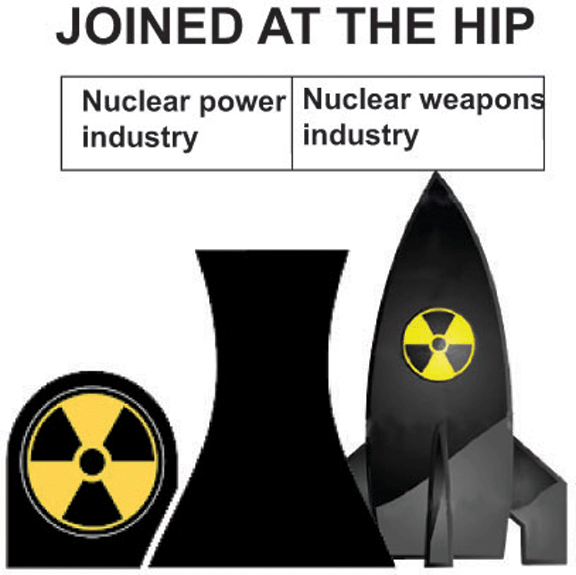
This loss of nuclear competence is being cited by nuclear and national security experts in both the U.S. and in Europe’s nuclear weapons states as a threat to their military nuclear programs. The White House cited this nuclear nexus in a May memo instructing Rick Perry, the Secretary of Energy, to force utilities to buy power from unprofitable nuclear and coal plants. The memo states that the “entire US nuclear enterprise” including nuclear weapons and naval propulsion, “depends on a robust civilian nuclear industry.”
A Double First in China for Advanced Nuclear Reactors, https://spectrum.ieee.org/energywise/energy/nuclear/a-double-first-in-china-for-advanced-nuclear-reactorsBy Peter Fairley 5 July 18 Call it the world’s slowest photo finish. After several decades of engineering, construction flaws and delays, and cost overruns — a troubled birth that cost their developers dearly — the most advanced commercial reactor designs from Europe and the United States just delivered their first megawatt-hours of electricity within one day of each other. But their benefits — including safety advances such as the AP1000’s passive cooling and the EPR’s airplane crash-proof shell — may offer too little, too late to secure future projects.
Both projects are coming online years behind schedule, and they are still at least several months away from full commercial operation. But the real problem for the AP1000 and the EPR are the designs’ unfinished Western debuts.
The AP1000 is designed to passively cool itself during an accidental shutdown, theoretically avoiding accidents like the one at Japan’s Fukushima Daiichi. But AP1000 developer Westinghouse declared bankruptcy last year due to construction troubles, particularly at dual-reactor plants for utilities in Georgia and South Carolina. The latter abandoned their pair of partially built AP1000s after investing US $9 billion. The Georgia plant, initiated in 2012, is projected to be completed five years late in 2022 and at a cost of $25 billion — $11 billion more than budgeted.
Delays for the EPR, whose dual-layered concrete shield protects against airplane strikes, contributed to the breakup of Paris-based nuclear giant Areva in 2015. And the first EPR projects in France and Finland remain troubled under French utility Electricité de France (EDF), which absorbed Areva’s reactor business, Fromatome. The Finnish plant, started in 2005 and expected to take four years, is currently slated for startup next year, and deadlines continue to come and go. In June, Finnish utility Teollisuuden Voima Oyj announced that startup had slid another four months to September 2019.
The troubled EPR and AP1000 projects show that U.S. and European firms have lost competence in nuclear construction and management. ”It’s no coincidence that two of the four AP1000s in the U.S. were abandoned, and that the EPRs that started much earlier than Taishan’s in Finland and France are still under construction,” says nuclear energy consultant Mycle Schneider, principal author of the annual World Nuclear Industry Status Report. “The Chinese have a very large workforce that they move from one project to another, so their skills are actually getting better, whereas European and North American companies haven’t completed reactors in decades,” says Schneider.
This loss of nuclear competence is being cited by nuclear and national security experts in both the U.S. and in Europe’s nuclear weapons states as a threat to their military nuclear programs. The White House cited this nuclear nexus in a May memo instructing Rick Perry, the Secretary of Energy, to force utilities to buy power from unprofitable nuclear and coal plants. The memo states that the “entire US nuclear enterprise” including nuclear weapons and naval propulsion, “depends on a robust civilian nuclear industry.”
A letter sent to Perry last month by 75 former U.S. military, industrial and academic leaders adds to the nexus argument, citing a statement from the Trump Administration’s 2018 Nuclear Posture Review about the United States’ inability to produce enriched uranium for nuclear weapons. “Re-establishing this capability will be far easier and more economical with a strong, thriving civil nuclear sector,” write the signatories.
Heavy dependence on China, meanwhile, puts the global nuclear industry in a vulnerable position. Total nuclear generation declined last year if one takes out China, notes Schneider. And he says a Chinese nuclear growth gap is coming since it hasn’t started building a new reactor in 18 months.
For more than a decade, the AP1000 has been the presumed successor to China’s mainstay reactors, which employ a 1970s-era French design. Areva’s EPR was a fallback option. The Chinese government may now wait to see how the first reactors actually operate before it approves a new wave of reactor construction.
All the while, nuclear is falling further behind renewable solar and wind power. As Schneider notes, the 3.3 GW of new nuclear capacity connected to the grid worldwide in 2017 (including three in China and a fourth in Pakistan built by Chinese firms) pales in comparison to the 53 GW of solar power installed in China alone.
In Case of a Nuclear Emergency, This New AI Shows Where Radioactive Fallout Will Spread Head upwind. Science Alert, DAVID NIELD 4 JUL 2018
One of the areas where artificial intelligence really excels is in working out scenarios with a huge number of complex variables – like how radiation might spread after an accident at a nuclear power plant.
This is the focus of a new AI system developed in Japan, and it’s showing us more accurately than ever before where the safest (and most dangerous) points could be following a meltdown. Spoiler: stay upwind.
While it’s obviously better if nuclear plants don’t fail in the first place, knowing which way the fallout will travel can be crucial in organising emergency responses and keeping people safe. It can quite literally save lives – and a lot of them.
The new AI, developed by a team from the Institute of Industrial Science at the University of Tokyo, is able to factor in accident variables and prevailing weather patterns to work out where the threat of radiation could be worst, up to 33 hours in advance.
“Our new tool was first trained using years of weather-related data to predict where radioactivity would be distributed if it were released from a particular point,” says one of the team, Takao Yoshikane.
“In subsequent testing, it could predict the direction of dispersion with at least 85 percent accuracy, with this rising to 95 percent in winter when there are more predictable weather patterns.”
You can see the model in action below:
……..The new prediction model can provide useful information about which areas will be worst affected and need evacuating, and which areas have a lower risk – in these areas the residents might just get warnings about being careful what they eat and drink.
With the high temperatures associated with nuclear disaster, radioactive material can travel up to 2,000 metres (6,562 feet) into the air, the scientists report – reaching winds in the upper troposphere that can spread fallout all across the world.
Why the Civil Nuclear Trap Is Part and Parcel of the Belt and Road Strategy
Civil nuclear energy presents grave pitfalls in terms of cost, innovation and security that BRI countries cannot and should not afford. The Diplomat By Sam Reynolds July 05, 2018
Since President Xi Jinping announced China’s Belt and Road Initiative (BRI) in 2013, there has been no shortage of speculation on the motivations behind it. While Beijing has extolled the $1 trillion initiative’s benefits — including trade creation, economic development, and renewable energy — it has also repeatedly tried to soft-pedal the BRI’s military strategic implications.
Nuclear power plant (NPP) projects, for example, are not listed on several Chinese government BRI websites. Yet, over the next decade China plans to build 30 reactors in BRI countries, many of which are either not party to global nuclear nonproliferation regimes or lack the regulatory basis for controlling nuclear fuel uses. These projects are certainly part of China’s grander energy strategy and paint a clearer, drearier picture of how the initiative might unravel.
Developing countries should not be enticed by NPPs, with or without Chinese funding. China is backing them to achieve its own economic and geostrategic goals rather than a public good. Civil nuclear energy presents grave pitfalls in terms of cost, innovation and security that BRI countries cannot and should not afford.
The vision statement for the BRI, issued by the Chinese government, states clearly that it will advance nuclear power cooperation, and the Belt and Road Energy Cooperation website lists a handful of bilateral nuclear agreements. Many independent sources like the Carnegie Endowment for International Peace, PricewaterhouseCoopers, and the Stockholm International Peace Research Institute include reactors under the official BRI umbrella. The Chinese National Nuclear Corporation stated that it has already sold eight to seven countries, and is in talks with more than 40 others. Many of them are BRI participants, including Sudan, Kenya, Egypt, Thailand, Malaysia, Turkey, Saudi Arabia, Iran, and the United Kingdom.
There are a number of reasons why Chinese websites might not list them. Nuclear technologies are dual-use, meaning that weapons-grade uranium enrichment requires essentially the same technology as enrichment for civil energy purposes (albeit with many more centrifuges). By leaving nuclear projects officially out of the BRI, China downplays the threat of nuclear weapons proliferation along BRI corridors, binding countries to Beijing via technological cooperation and long-term debt.
Another reason is that China wants to whitewash its violations of nuclear nonproliferation regimes. China is a member of the Nuclear Suppliers Group, prohibiting it from exporting nuclear material to countries like Pakistan, which has not signed the Non-Proliferation Treaty, acceded to full International Atomic Energy Agency (IAEA) safeguards, or decelerated its nuclear weapons program. Yet, Chinese officials have stated their involvement in six nuclear reactor projects there.
A third reason is that China is building NPPs in scant regulatory environments, regardless of the glaring security risks. Sudan, which plays a huge role in the BRI, recently signed a framework agreement with China to construct its first nuclear reactor. However, a 2017 study by the Institute for Science and International Security ranked 200 countries based on their ability to limit nuclear trafficking. Sudan ranked 194th. Moreover, it has not signed the IAEA Additional Protocol, which significantly improves the organization’s ability to verify that nuclear fuel is used only for civil energy purposes. Four countries on Sudan’s porous borders have not signed it either.
These highly irresponsible “geostrategic nuclear exports” are China’s attempt to compete with Russia. Both countries have signed nuclear deals with Iran, Egypt, Sudan and Turkey, and both have looked to dominate nuclear export markets by pushing reactors in places where they do not belong. For Beijing, these projects buy lasting influence in regions supplying raw materials and draw historically pro-Western countries further into the Chinese camp………
Disregarding Both Risk and Better Options
The “nuclear renaissance” that world leaders championed at the start of the century quickly deteriorated into a nuclear quagmire, with projects being delayed or abandoned throughout the developed world. Now, China is leading a nuclear resurgence without political, humanitarian or safety liabilities that is likely to yield similar results, if not worse.
None of this is to say that the BRI is entirely negative, but there are still unresolved security issues which NPPs will only exacerbate. The BRI includes a large number of renewable energy projects, which will certainly encourage countries to achieve their commitments to mitigating climate change. China and BRI participants should rely more heavily on these cheaper, cleaner and safer technologies.
There is enormous potential for wind power in Pakistan and solar in Sudan. Pakistan has an estimated wind energy potential of 346 GW, most of which would come from the southeastern province of Sindh, one of the most stable regions in the country where wind speeds reach up to 12 m/s. Sudan is considered one of the sunniest countries in the world, with an average sunlight duration of nine hours and solar energy densities of more than quadruple other regions. Still, solar power remains largely untapped there.
Sam Reynolds is pursuing his master’s degree in international relations from the Johns Hopkins School of Advanced International Studies. His primary areas of interest include the geopolitics of climate change, migration, and science diplomacy. He is currently an intern in the Asia-Pacific program of the EastWest Institute.
Donald Trump is typically bullish about North Korea nuclear talks – but the hard work begins this week
Analysis: However confident Mr Trump is about nuclear talks with Pyongyang, the hard work is just beginning, The Independent, Chris StevensonInternational Editor, 5 July 28, “……….In the lead-up to the unprecedented summit between Donald Trump and the North Korean leader in Singapore on 12 June – and in the weeks afterwards – the US president has sought to paint a picture of a problem solved. Indeed this week Mr Trump tweeted that talks were “going well,” and “All Asia is thrilled”.
“If not for me, we would now be at War with North Korea!” He added.
The reality is that there is still a long way to go. A number of recent reports have suggested US intelligence officials believe Pyongyang will not denuclearise and will instead look to hide and move nuclear assets. A Defence Intelligence Agency estimate, reported by The Washington Post, that North Korea will look to deceive the US about the scope of its nuclear programmes.
…….Critics hit out at the vague nature of that nuclear commitment after the Singapore summit, and much of the work is still to do. If the summit produced an agreement to aspire to, the hard yards start now.
It appears that Mr Kim and Pyongyang are not against making moves – the basketball games taking place this week between North and South Korea prove that, but it appears Washington is open to softening their “all or nothing” approach to denuclearisation with little sign of a breakthrough yet………
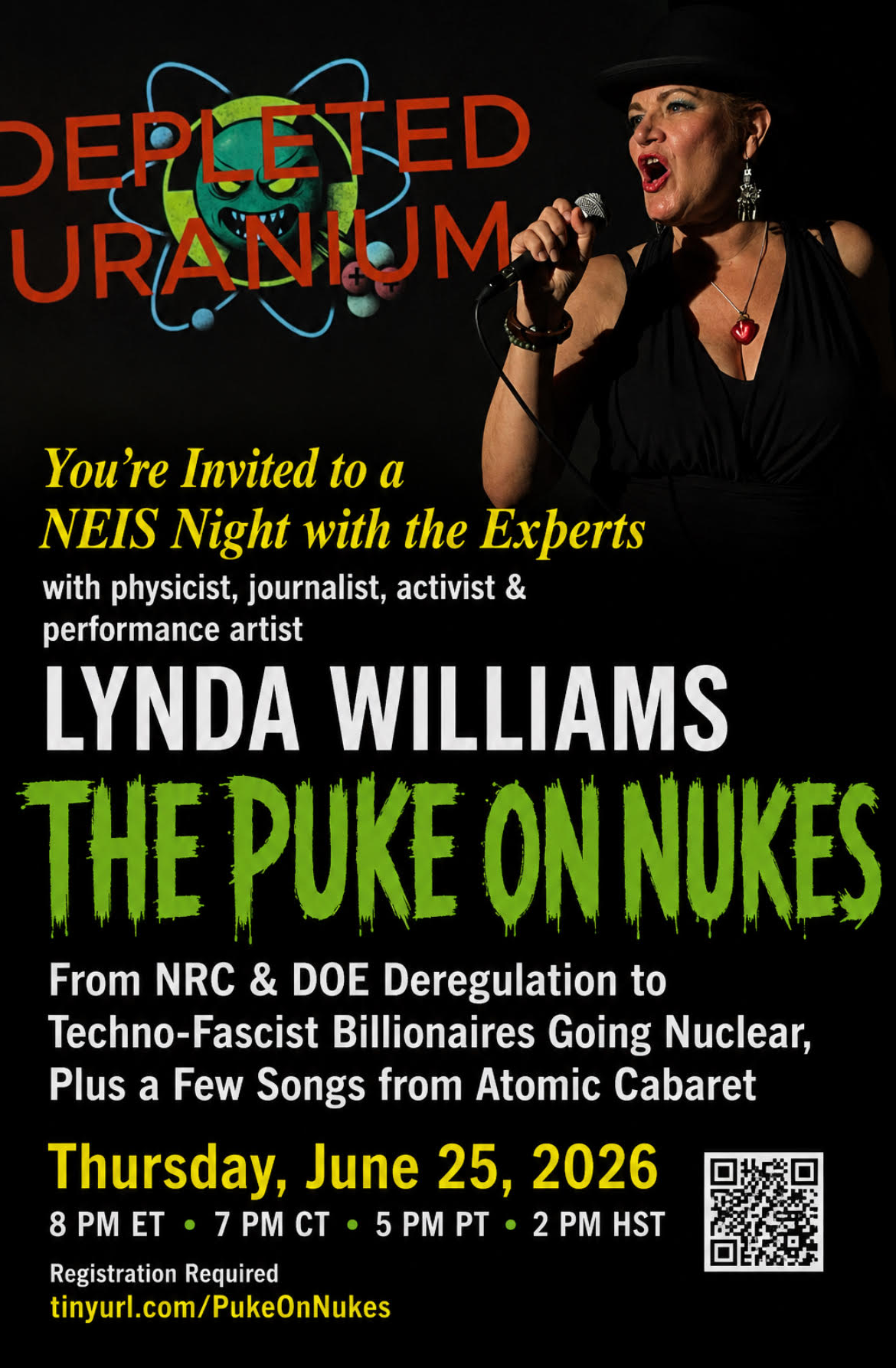
7pm Central Time (8pm ET, 6pm MT, 5pm PT) UTC – 5 From NRC & DOE Deregulation to Techno-Fascist Billionaires Going Nuclear, Plus a Few Songs from Atomic Cabaret REGISTER













 nuclear-news