Extended screening pushes back MOX fuel plant construction for 3rd time


Tomari nuclear power plant in Hokkaido is using emergency generators, due to earthquake
![]()
Tomari nuclear plant using emergency generators, Japan’s nuclear regulatory body says the Tomari nuclear power plant in Hokkaido is using emergency generators to cool fuel after the region was hit by a powerful earthquake.
The plant’s operator Hokkaido Electric Power Company says all 3 channels from outside power sources were cut off about 20 minutes after the quake struck early Thursday.
The plant’s 3 reactors are all currently offline, with a total of 1,527 fuel assemblies in its storage pools.
Following the quake, 6 emergency diesel-powered generators automatically switched on to cool the nuclear fuel. No changes in storage pool water levels or temperature have been reported. The Nuclear Regulation Authority and Hokkaido Electric say it is not yet clear when outside power sources will be restored, with all thermal power plants in Hokkaido currently shut down.
The emergency generators will be able to keep the Tomari plant running for at least 7 days, based on diesel fuel supplies stored on its premises.
They added that the earthquake did not seem to cause any irregularities in key plant facilities and radiation monitoring posts have shown no change.
For the first time, Japan acknowledges radiation death from Fukushima, and will compensate the family
Fukushima disaster: Japan acknowledges first radiation death from nuclear plant hit by tsunami Japan has acknowledged for the first time that a worker at the Fukushima nuclear power plant, destroyed by an earthquake and tsunami more than seven years ago, has died from radiation exposure.
Key points:
- The man had worked at the plant since the earthquake and tsunami in 2011
- He was diagnosed with lung cancer in 2016, in his 50s
- The Health, Labour and Welfare Ministry ruled that compensation should be paid to the family
The Health, Labour and Welfare Ministry ruled that compensation should be paid to the family of the man in his 50s who died from lung cancer, an official said.
The worker had spent his career working at nuclear plants around Japan and worked at the Fukushima Daiichi plant operated by Tokyo Electric Power at least twice after the March 2011 meltdowns at the station.
He was diagnosed with cancer in February 2016, the official said. ……..
The ministry had previously ruled exposure to radiation caused the illnesses of four workers at Fukushima, the official said.
But this was the first death……
Tokyo Electric is facing a string of legal cases seeking compensation over the disaster.
The news came as the northern Hokkaido region was hit by a 6.7 magnitude earthquake, sparking concerns at the three-reactor Tomari nuclear plant, which lost power as a result of the earthquake.
The Tomari plant has been in shutdown since the Fukushima disaster.
The Fukushima crisis led to the shutdown of the country’s nuclear industry, once the world’s third-biggest.
Seven reactors have come back online after a protracted relicensing process.
The majority of Japanese people remain opposed to nuclear power after Fukushima highlighted failings in regulation and operational procedures in the industry.http://www.abc.net.au/news/2018-09-06/first-man-dies-from-radiation-from-fukushima-nuclear-disaster/10208244
Japan holds public hearings on what to do with growing amounts of radioactive water from the ruined Fukushima No. 1 nuclear power plant.
EDITORIAL: All options need to be weighed for Fukushima plant tainted water http://www.asahi.com/ajw/articles/AJ201809060020.html September 6, 2018 The government has held public hearings on plans to deal with growing amounts of radioactive water from the ruined Fukushima No. 1 nuclear power plant.The hearings, held in Tomioka and Koriyama in Fukushima Prefecture as well as in Tokyo, underscored the enormous difficulty government policymakers are having in grappling with the complicated policy challenge.
The crippled reactors at the plant are still generating huge amounts of water contaminated with radiation every day. Tons of groundwater percolating into the damaged reactor buildings as well as water being injected into the reactors to cool the melted fuel are constantly becoming contaminated.
Almost all the radioactive elements are removed from the water with a filtering system. But the system cannot catch tritium, a mildly radioactive isotope of hydrogen.
The tritium-contaminated water is stored on-site in hundreds of large tanks. As the number of tanks has reached 900, the remaining space for them is shrinking and expected to run out by around 2020, according to the government.
Clearly, time is growing short on deciding what to do about the problem.
A task force of the Ministry of Economy, Trade and Industry has considered five options, including release into the Pacific Ocean after dilution, injection into deep underground strata and release into the air after vaporization. The group has concluded that dumping the water into the ocean would be the quickest and least costly way to get rid of it.
This is seen as the best option within the government.
Tritium is a common radioactive element in the environment that is formed naturally by atmospheric processes. Nuclear power plants across the nation release tritium produced in their operations into the sea according to legal safety standards.
But these facts do not automatically mean that releasing the tritium-laced water into the sea off Fukushima is a good approach to the problem.
Local communities in areas affected by the 2011 nuclear disaster are making strenuous efforts to rebuild the local fishing and agricultural industries that have been battered by the radiation scare. There are still countries that ban imports of foodstuffs produced in Fukushima Prefecture.
Local fishermen and other community members have every reason to oppose the idea of releasing tritium into the ocean. They are naturally concerned that the discharge would produce new bad rumors that deliver an additional blow to the reputation and sales of Fukushima food products.
Unsurprisingly, most of the citizens who spoke at the hearings voiced their opposition to the idea.
Moreover, it was reported last month that high levels of radioactive strontium and iodine surpassing safety standards had been detected in the treated water.
The revelation has made local communities even more distrustful of what they have been told about operations to deal with the radioactive water.
It is obvious that the hearings at only three locations are not enough to sell any plan to cope with the sticky problem to skeptical local residents. The government needs to create more opportunities for communication with them.
In doing so, the government should show a flexible stance without adamantly making the case for the idea of releasing the water into the sea. Otherwise, there can be no constructive debate on the issue.
It can only hope to win the trust of the local communities if it gives serious consideration to other options as well.
During the hearings, many speakers suggested that the water should be kept in large tanks until the radioactivity level falls to a very low level.
The pros and cons of all possible options, including this proposal, should be weighed carefully through cool-headed debate before the decision is made.
Repeated discussions with fruitful exchanges of views among experts and citizens including local residents are crucial for ensuring that the final decision on the plan will win broad public support.
The government and Tokyo Electric Power Co., the operator of the Fukushima plant, should disclose sufficient information for such discussions and give thoughtful and scrupulous explanations about relevant issues and details.
The government, which has been promoting nuclear power generation as a national policy priority, has the responsibility of building a broad and solid consensus on this problem.
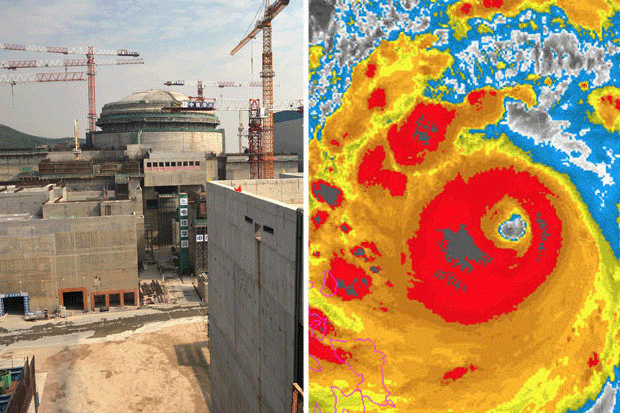
Mainstream media carefully avoids mentioning the typhoon danger to Japan’s nuclear power stations and waste dumps
Typhoon Man-yi hits Japan raising fears about Fukushima nuclear plant http://www.abc.net.au/news/2013-09-16/typhoon-man-yi-hits-japan2c-raising-fukushima-fears/4960034
Japan hit by a powerful typhoon
Typhoon Jebi path update: Where is Japan typhoon NOW? Will it hit Tokyo? https://www.express.co.uk/news/world/1012314/Typhoon-jebi-path-update-typhoon-tokyo-category-3-Japan-warning-western-central-japan
TYPHOON Jebi will make landfall in southern Japan on Tuesday as damaging winds, flooding and mudslides are expected to hit the country. But where is the typhoon now and will it hit the capital Tokyo?
Typhoon Jebi smashed into Japan on Tuesday, barreling across the mainland at speed in a northeasterly track.
Japan issued evacuation advisories for more than 1 million people and cancelled hundreds of flights in the face of extremely strong winds and heavy rain hammered the country.
AccuWeather senior meteorologist Adam Douty said: “Damaging winds and coastal flooding may be the most significant impacts with this storm.
Where is Typhoon Jebi now?
Typhoon Jebi is currently located just north of Kyoto, traveling back out into the sea in a northeasterly direction.
The storm avoided a direct hit with capital Tokyo, but the city is still expected to bear the brunt of winds of more than 60mph.
Osaka and Kobe also took a hammering from the storm when they were struck earlier on Tuesday, after Jebi moved in from Honshu. The storm made landfall on Shikoku, the smallest main island, around noon.
Jebi then raked across the western part of the largest main island, Honshu, near the city of Kobe, several hours later, heading rapidly north.
Wind gusts of up to 208 km/h (129 mph) were recorded in one part of Shikoku, with forecasts for gusts as high as 216 km/h (135 mph).
Around 100 mm (3.9 inches) of rain drenched one part of the tourist city of Kyoto in an hour, with as much as 500 mm (20 inches) set to fall in some areas in the 24 hours to noon on Wednesday. The Meteorological Agency advised the public to be on the lookout for even more flooding and mudslides, as well as high tides.
Prime Minister Shinzo Abe told a meeting of the government and ruling parties: “We have seen typhoons and torrential rains.
“The government will do its utmost to prevent disaster.
Jebi – whose name means “swallow” in Korean – was briefly a super typhoon and is the latest harsh weather to hit Japan this summer.
Japan has been hit by extreme weather since the beginning of July and western parts of the country have been left devastated by flooding and landslides, leaving more than 220 people dead.
typhoon Jebi’s course has brought it close to parts of western Japan hit by rains and flooding but the storm was set to speed up after making landfall, minimising the amount of rain that will fall in one place.
The country has experienced record-breaking heat as well as floods and landslides.
Nuclear reprocessing has little future in Japan, as utilities end funding
4 Sept 18, Kyodo,, Utilities that operate nuclear power plants stopped funding the reprocessing of nuclear fuel in fiscal 2016, their financial reports showed Sunday, a step that may affect resource-scarce Japan’s nuclear fuel recycling policy.
The 10 utilities, including Tokyo Electric Power Company Holdings Inc. and Japan Atomic Power Co., apparently halted allocating reserve funds for reprocessing costs due to the huge expenses linked to building the reprocessing facilities, sources said.
The government, along with the power companies, has been pushing for the reuse of mixed-oxide, or MOX, fuel, which is created from plutonium and uranium extracted from spent fuel.
While Japan has not changed its policy on spent fuel reprocessing, the outlook for it has remained uncertain since the 2011 Fukushima disaster. At the same time, the government’s latest energy plan in July also stated for the first time that disposal of spent MOX fuel as waste can be considered.
If MOX fuel cannot be reprocessed, nuclear fuel can only be reused once. For the reprocessing of spent MOX fuel, the utilities had allocated about ¥230 billion in reserves as of March 2016.
Currently, only two reactors at Kansai Electric Power Co.’s Takahama power plant, one reactor at Shikoku Electric Power Co.’s Ikata plant and one reactor at Kyushu Electric Power Co.’s Genkai power plant use MOX fuel in so-called pluthermal power generation.
As Japan has decided to cut its stockpile of plutonium, the government and utilities aim to increase plants for pluthermal generation. But if spent MOX fuel is not reprocessed, it would be considered nuclear waste, raising concerns over how to deal with it.
Japan Nuclear Fuel Ltd. — in which power companies have invested — has been pursuing the construction of a spent nuclear fuel reprocessing plant in northeastern Japan as well as a MOX fuel fabrication plant, with the costs coming to about ¥16 trillion.
But a series of problems has resulted in their delay. When operational, the Rokkasho plant in Aomori Prefecture, key to Japan’s nuclear fuel cycle policy, can reprocess up to 800 tons of spent nuclear fuel per year, extracting about 8 tons of plutonium.
With this setback, if new MOX reprocessing plants are to be built, it would be hard to secure further funding.
Climate change talks – in Bangkok – sinking below rising sea
With rising sea levels, Bangkok struggles to stay afloat https://www.afp.com/en/news/2265/rising-sea-levels-bangkok-struggles-stay-afloat-doc-18o4x91As Bangkok prepares to host climate-change talks, the sprawling city of more than 10 million is itself under siege from the environment, with dire forecasts warning it could be partially submerged in just over a decade.
A preparatory meeting begins Tuesday in Thailand’s capital for the next UN climate conference, a crunch summit in Poland at the end of 2018 to set rules on reducing greenhouse emissions and providing aid to vulnerable countries.
As temperatures rise, abnormal weather patterns — like more powerful cyclones, erratic rainfall, and intense droughts and floods — are predicted to worsen over time, adding pressure on governments tasked with bringing the 2015 Paris climate treaty to life.
Bangkok, built on once-marshy land about 1.5 metres (five feet) above sea level, is projected to be one of the world’s hardest hit urban areas, alongside fellow Southeast Asian behemoths Jakarta and Manila.
“Nearly 40 percent” of Bangkok will be inundated by as early as 2030 due to extreme rainfall and changes in weather patterns, according to a World Bank report.
Currently, the capital “is sinking one to two centimetres a year and there is a risk of massive flooding in the near future,” said Tara Buakamsri of Greenpeace.
Seas in the nearby Gulf of Thailand are rising by four millimetres a year, above the global average.
The city “is already largely under sea level”, said Buakamsri.
In 2011, when the monsoon season brought the worst floods in decades, a fifth of the city was under water. The business district was spared thanks to hastily constructed dikes.
But the rest of Thailand was not so fortunate and the death toll passed 500 by the end of the season.
Experts say unchecked urbanisation and eroding shorelines will leave Bangkok and its residents in a critical situation.
– ‘Venice of the East’ –
With the weight of skyscrapers contributing to the city’s gradual descent into water, Bangkok has become a victim of its own frenetic development.
Making things worse, the canals which used to traverse the city have now been replaced by intricate road networks, said Suppakorn Chinvanno, a climate expert at Chulalongkorn University in Bangkok.
“They had contributed to a natural drainage system,” he said, adding that the water pathways earned the city the nickname ‘Venice of the East’.
Shrimp farms and other aquacultural development — sometimes replacing mangrove forests that protected against storm surges — have also caused significant erosion to the coastline nearest the capital.
This means that Bangkok could be penned in by flooding from the sea in the south and monsoon floods from the north, said Chinvanno.
“Specialists anticipate more intense storms in this region in the years to come. Narong Raungsri, director of Bangkok’s Department of Drainage and Sewage, admitted that the city’s “weaknesses” stem from its small tunnels and the hyper-development of neighbourhoods.
“What used to act as water basins are now no more,” Raungsri said.
“Our system can only handle so much — we need to enlarge it.”
Today, the government is scrambling to mitigate the effects of climate change, constructing a municipal canal network of up to 2,600 kilometres with pumping stations and eight underground tunnels to evacuate water if disaster strikes.
Chulalongkorn University in 2017 also built in central Bangkok an 11-acre park specially designed to drain several million litres of rain and redirect it so surrounding neighbourhoods are not flooded.
But these ad-hoc fixes may not be enough.
“We need a clear policy of land management,” said Greenpeace’s Buakamsri, adding that the need for increased green spaces is outweighed by developers’ interests.
“The high price of land in Bangkok makes economic interests a priority.”
Work starts to decommission problem-plagued Monju reactor

Nuclear waste briefings in coastal areas
Opposition to release of Fukushima radioactive tritium water into the sea; longterm storage the better option
Fukushima water release into sea faces chorus of opposition https://mail.google.com/mail/u/0/#inbox?compose=DmwnWtDqNzxklZTsLVvsRFtgBQZHzxshPgMCgrVGpNqZnjrqDwNNWbPprDwxPlNFzCVZnfDvsQwVCitizens and environmental groups have expressed opposition to the idea of releasing into the ocean water tainted with tritium, a radioactive substance, from Tokyo Electric Power Company Holdings Inc.’s disaster-stricken Fukushima No. 1 nuclear power plant.“Long-term storage (of the tritium-containing water) is possible from technical and economic standpoints,” Komei Hosokawa, 63, an official of the Citizens’ Commission on Nuclear Energy, said at a public hearing held in Tokyo on Friday by a subcommittee of the Agency for Natural Resources and Energy. “The radiation levels in the water will decrease during the long-term storage,” he added.
At a similar hearing held the same day in Koriyama, Fukushima Prefecture, Aki Hashimoto, a housewife from the city, said, “I never want to see further worsening of ocean pollution from radiation.”
Opinions objecting to the release of the tritium-contaminated water into the ocean were also heard at a hearing held in the Fukushima town of Tomioka on Thursday.
After Friday’s hearings, Ichiro Yamamoto, who heads the subcommittee, told reporters that many participants in the hearings said the tainted water should continue to be held in storage tanks.
The subcommittee will study the option of keeping the water in the tanks, he added.
Tepco is lowering the radiation levels in contaminated water at the Fukushima No. 1 plant using special equipment, but the device cannot remove tritium.
The tritium-tainted water is stored in tanks within the premises of the power plant, which was heavily damaged in the March 2011 earthquake and tsunami.
In 2016, an expert panel of the Agency for Natural Resources and Energy discussed five methods to dispose of the tritium-tainted water —injection deep into the ground, release into the sea after dilution, release into the air through evaporation, conversion into hydrogen through electrolysis, and burying it after it is solidified.
The panel estimated that the ocean release is the cheapest option, costing up to about ¥3.4 billion.
USA negotiations with North Korea may be on the verge of breakdown

The current US negotiating strategy with North Korea is doomed, Bulletin of the Atomic Scientists, By Perry World House, August 30, 2018 US negotiations with North Korea over the latter’s nuclear weapons program appear to have hit a major roadblock. While North Korea has temporarily suspended nuclear and missile testing and partially destroyed its nuclear test site, both steps are reversible, and North Korea has largely balked at US President Donald Trump’s demand for “complete, verifiable, and irreversible denuclearization.” Consequently, negotiations with Pyongyang may be on the verge of breakdown. Trump recently cancelled his secretary of state’s planned trip to the country, and the administration has gone back and forth in the last few days about whether Washington will continue to suspend joint military exercises with South Korea, a concession Trump made to North Korean leader Kim Jong-un during their historic summit in June. Given this critical juncture in negotiations, it is time to reevaluate what talks can actually achieve. It would be great if Kim agreed to hand over all of his nuclear weapons, but the reality is that North Korea will not be completely, verifiably, or irreversibly denuclearizing anytime soon. Therefore, if the Trump Administration wants to salvage the negotiations, it needs a new strategy.
Why North Korea won’t denuclearize. The first step to a successful negotiating strategy is understanding how your opponent thinks. So why does North Korea want nuclear weapons in the first place? For the same reason Israel, France, India, and others wanted them—security. Specifically, security against the United States.
North Korea’s murderous dictator has good reason to worry about an American intervention to overthrow his regime. First of all, the United States is much more powerful than North Korea. While the size of North Korea’s entire economy is about $40 billion at most, America spends over $700 billion on its military alone. Second, this fact, combined with Washington’s long history of military interventions, is enough to make any despot shake in his shoes. Finally, the specific history between the United States and North Korea is not reassuring to Kim. The two countries fought against each other in the Korean War, President George W. Bush branded North Korea part of the “axis of evil,” and Trump threatened Pyongyang with “fire and fury like the world has never seen.”
Like many relatively weak countries facing a threat, North Korea turned towards nuclear weapons not because its leader is crazy, but to deter a stronger power. By threatening to punish the United States and its allies with a nuclear response if it is attacked, North Korea is able to effectively dissuade Washington from such attempts. Since Kim’s top priority, like most autocrats, is regime security, he will only give up the protection of his nuclear weapons if he is very confident that he can retain his power without them. Though Trump committed to guaranteeing North Korea’s security in the Singapore Declaration, a number of recent historical episodes will make it difficult to convince Kim he can remain safe if he surrenders all his nuclear weapons.
One example involves Libya. In 2003, Libyan dictator Muammar Gaddafi agreed to give up his nascent nuclear weapons program and permit international inspections. In return, US President George W. Bush promised that Libya could “regain a secure and respected place” among nations. However, just eight years later, in 2011, the United States led a NATO military intervention in Libya that resulted in the brutal killing of Gaddafi. In recent months John Bolton, Trump’s national security advisor, has repeatedly said that Washington has the “Libya model” in mind for North Korea, probably the least reassuring example that could be communicated to Kim.
A second leader who did not do well after suspending his nuclear weapons program was Iraq’s Saddam Hussein. While states that possess nuclear weapons can almost always effectively deter military intervention, states that do not, like Iraq in 2003, are vulnerable. In a fate not much better than Gaddafi’s, Saddam was removed from power by an American military intervention in 2003 and ultimately hung in 2006…….
Trump personally undermined American negotiating credibility in two ways; one indirect and one direct. Indirectly, he hurt Washington’s credibility by withdrawing from the Iran nuclear deal, even though, according to the International Atomic Energy Agency, Iran was complying with its terms. The Trump Administration has now moved to severely punish Iran for its compliance by instituting tough sanctions………..
Given this record, North Korea is very unlikely to agree to fully denuclearize in the short or medium-term, and demanding that it do so is only likely to lead to negotiation failure. To make real progress on this issue, the White House will need to take a different tack.
What Washington’s strategy should be. The Prussian statesman Otto von Bismarck said, “politics is the art of the possible, the attainable.” If North Korea will not be handing over its entire nuclear stockpile anytime soon, what possible, attainable options might curtail the threat? The most extreme option, of course, would be to launch a massive military attack against North Korea in an effort to destroy all of its nuclear weapons and infrastructure—the “fire and fury” Trump threatened. However, such an operation would be reckless to the point of insanity. North Korea has the ability to deliver nuclear missiles to South Korea, Japan, and American military bases in the Pacific. If even one or a handful of nuclear missiles survived an American first strike, hundreds of thousands could die beyond those killed in the initial US attack. Furthermore, even if the United States could reliably locate and destroy all of North Korea’s nuclear weapons in a first strike, Pyongyang would still be able to inflict tens of thousands of casualties daily using conventional and chemical weapons. Given that there is no imminent threat from North Korea’s nuclear program, a preventive war of this type would be nonsensical.
The most sensible option to address the nuclear threat from North Korea would be to pursue an approach dubbed “less for less” by nuclear scholar James Acton. Rather than demanding total denuclearization, the United States should seek a smaller-scale deal that puts significant restrictions on North Korea’s nuclear program in return for moderate sanctions relief and other limited concessions. ……….
Though the prospect of living with a nuclear-armed North Korea for the foreseeable future may seem unacceptable, the world has survived with a nuclear-armed Russia for the last 69 years, China for the last 54 years, Pakistan for the last 20 years, and, yes, North Korea for the last 12 years. Just as North Korea’s nuclear weapons have effectively deterred the United States from a major military intervention, America’s vastly superior nuclear arsenal and conventional capabilities will almost certainly deter North Korea.
This column was written by Joshua A. Schwartz, a PhD candidate in political science at the University of Pennsylvania. https://thebulletin.org/2018/08/the-current-us-negotiating-strategy-with-north-korea-is-doomed/?utm_source=Bulletin%20Newsletter&utm_medium=iContact%20email&utm_campaign=August31
Japan might sue journalist over his coverage of Fukushima, in Dark Tourist series
The Fukushima Prefectural Government and the Reconstruction Agency are looking to take legal action over the video over concerns it will stoke “unreasonable” fears of radiation in the Fukushima Prefecture, the Japan Times reports.
A senior official from the prefecture said they were “examining the video content”.
In the episode, Farrier is filmed taking a tour of areas affected by the 2011 meltdown of a nuclear plant in Fukushima where he suspects a meal served from a restaurant in Namie, a town in Fukushima Prefecture, has been contaminated by radiation.
It also shows the journalist enter a no-go zone around the Fukushima Daiichi nuclear power plant without permission from authorities, reporting from an abandoned game arcade, and tourists on a bus becoming distressed over rising radiation levels without information about the vehicle’s location.
The show has the journalist travel to different locations around the world associated with grim historical events, including the footsteps of serial killer Jeffrey Dahmer in Milwaukee, and voodoo rituals in Benin, West Africa.
Ecological risks of China’s floating nuclear power plants in South China Sea
China plans to power some of its claimed islets with nuclear energy, the U.S. Department of Defense recently told Congress in an annual report on Chinese military activities. Beijing had indicated last year it was planning to install “floating nuclear power stations” that would start operating before 2020, the report says.
That development would bulk up China’s maritime claim after about a decade of land reclamation in parts of the 3.5 million-square-kilometer sea and the sending of military units to some of the artificial islands, analysts say. Rival maritime claimants Brunei, Malaysia, the Philippines, Taiwan and Vietnam lack similar means to electrify their holdings.
“You are literally facilitating increase of physical control of the South China Sea,” said Collin Koh, maritime security research fellow at Nanyang Technological University in Singapore.
“I think the more immediate concerns of anyone, be they claimants, be they non-claimants, is a huge ecological risk, and taking into account that Chinese nuclear energy technology may not necessarily be one of the best in the world,” he said………
Ecological risks
China is unlikely to do an environmental impact study on any nuclear-power barges before installing them, Koh said. A “runaway reactor” could lead to a “major ecological disaster,” he said. The U.S. Defense Department report notes that the sea is prone to typhoons, during which most vessels seek shelter.
Pirates and terrorists at sea could also disrupt a nuclear power barge, said Andrew Yang, secretary-general of the Chinese Council of Advanced Policy Studies think tank.
“It certainly requires a different kind of infrastructure building, because it’s a floating nuclear power plant, never been doing it before, and the maritime conditions (are) putting a lot of potential risks or uncertainty in terms of maintaining such an installation,” Yang said. https://www.voanews.com/a/china-s-floating-nuclear-power-plants-risks-south-china-sea/4551979.html
|
ReplyForward
|
U.S.-North Korea Nuclear Talks are going nowhere
Why the U.S.-North Korea Nuclear Talks Have Stalled, Bloomberg, By David Tweed, August 29, 2018 Just a few months after Donald Trump’s historic handshake with Kim Jong Un in June, nuclear talks between the U.S. and North Korea are going nowhere.
Last week the U.S. president publicly acknowledged for the first time that discussions weren’t going according to plan, canceling a trip to Pyongyang by Secretary of State Michael Pompeo. North Korean state media then accused the U.S. of “double-dealing attitudes” and returning to “gunboat diplomacy.”
The problem is, neither side can agree on what the Singapore Declaration signed by both leaders actually means. Pompeo asserts that Kim accepted the “final, fully verified denuclearization of North Korea.” North Korean Foreign Minister Ri Yong Ho says all four provisions must be implemented simultaneously, not denuclearization first.
……… The failure to formally resolve the 1950-53 Korean War lies at the heart of the dispute, with each side using the continued threat of attack to justify its own military activities. Thus, the agreement between Trump and Kim — like earlier deals by their predecessors — included a pledge to “build a lasting and stable peace regime on the Korean Peninsula.”
Signing a peace treaty without a disarmament deal carries risks for the U.S. because it could legitimize Kim’s control over half of the peninsula and undermine the rationale for stationing 28,000 or so American troops in South Korea. Although Trump suspended some military drills with South Korea, he has so far refused to accept a symbolic peace declaration. That’s prompted the North Koreans to accuse the U.S. of backtracking on its commitments.
Denuclearization
Despite Trump’s post-summit claim that North Korea was “no longer a nuclear threat,” his agreement with Kim provided no timetable for giving up his nuclear weapons. Even the phrase “complete denuclearization” — a term preferred by North Korea’s that could be read to include nuclear-capable U.S. bombers and submarines — was left open to negotiation.
While Kim has followed through on pledges to refrain from weapons tests and dismantle testing facilities, those were moves he committed to before meeting with Trump. Pompeo has conceded before the U.S. Senate that Kim’s regime continues producing fissile material and has provided no inventory of its nuclear program and facilities. North Korea has warned that the U.S.’s focus on “denuclearization first” risks derailing talks.……… https://www.bloomberg.com/news/articles/2018-08-29/why-u-s-north-korea-nuclear-talks-have-stalled-state-of-play
-
Archives
- April 2026 (220)
- March 2026 (251)
- February 2026 (268)
- January 2026 (308)
- December 2025 (358)
- November 2025 (359)
- October 2025 (376)
- September 2025 (257)
- August 2025 (319)
- July 2025 (230)
- June 2025 (348)
- May 2025 (261)
-
Categories
- 1
- 1 NUCLEAR ISSUES
- business and costs
- climate change
- culture and arts
- ENERGY
- environment
- health
- history
- indigenous issues
- Legal
- marketing of nuclear
- media
- opposition to nuclear
- PERSONAL STORIES
- politics
- politics international
- Religion and ethics
- safety
- secrets,lies and civil liberties
- spinbuster
- technology
- Uranium
- wastes
- weapons and war
- Women
- 2 WORLD
- ACTION
- AFRICA
- Atrocities
- AUSTRALIA
- Christina's notes
- Christina's themes
- culture and arts
- Events
- Fuk 2022
- Fuk 2023
- Fukushima 2017
- Fukushima 2018
- fukushima 2019
- Fukushima 2020
- Fukushima 2021
- general
- global warming
- Humour (God we need it)
- Nuclear
- RARE EARTHS
- Reference
- resources – print
- Resources -audiovicual
- Weekly Newsletter
- World
- World Nuclear
- YouTube
-
RSS
Entries RSS
Comments RSS