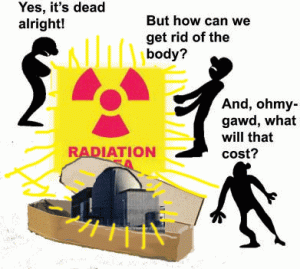
Taxpayers will be paying the costs for scrapping nuclear facilities.
TOKYO (Kyodo) — The state-backed Japan Atomic Energy Agency said Wednesday it would need to spend about 1.9 trillion yen ($17.1 billion) to close 79 facilities over 70 years, in its first such estimate.
The total costs could increase further, as the agency said the estimated figure, which would be shouldered by taxpayers, excludes expenses for maintenance and replacing aging equipment.
The JAEA plans to close more than half of the 79 facilities over the next 10 years due in part to the increased costs to operate them under stricter safety rules introduced after the 2011 Fukushima nuclear crisis. The agency, which has led nuclear energy research in Japan with its predecessors since the 1950s, owns a total of 89 facilities.
Of the estimated costs, the expense for closing the nation’s first spent-fuel reprocessing plant in the village of Tokai, Ibaraki Prefecture, northeast of Tokyo, accounts for the largest chunk of 770 billion yen. It will cost 150 billion yen to decommission the trouble-plagued Monju prototype fast-breeder nuclear reactor.
As for nuclear waste, the agency said about 100 kiloliters of high-level radioactive waste and up to 114,000 kl of low-level radioactive waste were estimated to have been produced but it has yet to decide on disposal locations.
The Japanese government aims to restart nuclear power plants after a nationwide halt following the nuclear crisis, despite persistent concern over the safety of atomic power generation.
January 2, 2019
Posted by dunrenard |
Japan | nuclear plants, Scrapping |
Leave a comment

Bill Gates shelves nuclear reactor in China, citing U.S. policy, Axios, Amy Harder, Dec 30
TerraPower, a nuclear-energy company founded by Bill Gates, is unlikely to follow through on building a demonstration reactor in China, due largely to the Trump administration’s crackdown on the country.
Why it matters: This is a blow to America’s attempts to commercialize advanced, smaller scale nuclear technology and, separately, further evidence of soured relations between the U.S. and China under President Trump.
Driving the news: In a year-end blog post covering various topics published Saturday night, Gates said of TerraPower: “We had hoped to build a pilot project in China, but recent policy changes here in the U.S. have made that unlikely.”
Details: The Trump administration, led by the Energy Department, announced in October that it was implementing measures to “prevent China’s illegal diversion of U.S. civil nuclear technology for military or other unauthorized purposes.”
- Those measures have made it nearly impossible for TerraPower’s project to go forward, according to multiple people familiar with the development.
- TerraPower had pursued plans to build a pilot reactor in China because that country has two things America doesn’t — growing electricity demand and a long-term strategic energy plan — a top TerraPower executive told me last year.
- Morning Consult and, separately, an analyst for the think tank International Institute for Strategic Studies, covered the impacts of the October policy change shortly after it occurred, with brief mentions of the likely negative impact on TerraPower………
What’s next: “We may be able to build it [the reactor] in the United States if the funding and regulatory changes that I mentioned earlier happen,” Gates said in his post, although he didn’t specify which funding or regulations.
Meanwhile, the Energy Department just announced it plans to buy some of the power from new advanced reactors being pursued by NuScale, another advanced nuclear company, for here in the United States. https://www.axios.com/bill-gates-nuclear-reactor-china-terrapower-be4c792c-6f76-4723-bf63-d8f9fb527dc1.html
January 1, 2019
Posted by Christina Macpherson |
business and costs, China, politics, USA |
2 Comments
 North Korea’s Kim sends ‘conciliatory message’ to Trump as nuclear weapon negotiations continue to stall Kim Jong-un had promised Donald Trump that they would work towards denuclearising North Korea, but negotiations haven’t advanced in months, Independent UK, Kristin Hugo New York 1 Jan 19
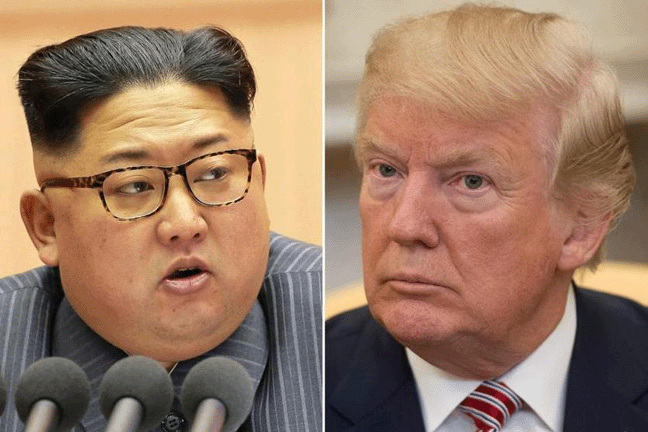
North Korean leader Kim Jong-un has sent a “conciliatory message” to Donald Trump as nuclear weapon talks between the two nations having stalled in recent months.
January 1, 2019
Posted by Christina Macpherson |
North Korea, politics international |
Leave a comment
 Kim Wants More Summits With Moon to Tackle Nuclear Issue ,Bloomberg, By Sam Kim and Youkyung Lee. December 30, 2018,
Kim intent on resolving nuclear impasse, Blue House says North Korean leader sent personal letter to South Korea’s Moon
Kim Jong Un is intent on resolving the nuclear impasse that has stalled negotiations with the U.S. and wants to hold more meetings with South Korean President Moon Jae-in, Moon’s office said.
The North Korean leader sent Moon a personal letter of well wishes on Sunday, expressing a willingness to meet often in 2019 to advance peace talks and achieve “denuclearization on the Korean peninsula,” Moon spokesman Kim Eui-keum said. Moon thanked him for the letter, tweeting that the North Korean leader “again made clear” that he would act on his agreement with the U.S. and South Korea.
The missive came amid increased skepticism over Kim’s willingness to dismantle his arsenal of nuclear weapons, months after a historic summit with President Donald Trump in which the two leaders agreed to work toward denuclearization. Kim’s letter made no mention of Trump or the U.S.
…….Earlier this month, North Korea told the U.S. that sanctions and pressure won’t work to force Pyongyang into action on its nuclear program. North Korean state media said the removal of the U.S.’s nuclear weapons from the region was a condition of its own disarmament, raising the stakes for Trump’s efforts to hold a second summit with Kim………https://www.bloomberg.com/news/articles/2018-12-30/kim-wants-more-summits-with-moon-to-tackle-nuclear-issue
December 31, 2018
Posted by Christina Macpherson |
North Korea, politics international, South Korea |
Leave a comment
 Local suspicions over Changsha plant heightened by failure to officially announce the plans until one day before public consultation process was due to end, SCMP, Mandy Zuo, 28 Dec 18, Dozens of residents in a city in central China have staged a protest over plans to build a nuclear research institute near their homes.
The protesters fear that radioactive materials used at the planned facility in Changsha, the capital of Hunan province, will pose a health risk.
The institute behind the project did not officially release their plans on Tuesday – after work had began on the site and one day before the public consultation period was supposed to end.
An environmental impact assessment into the project said No 230 Research Institute, a branch of the China National Nuclear Corporation, had acquired a space of over 20,000 square metres near a densely populated area to expand its offices and laboratories at the site, which will be dedicated to the geological exploration of uranium.
Although the facility is not intended to handle refined uranium, and scientists say that unprocessed material does not emit harmful levels of radiation, residents have expressed concerns about the possible health risks and have called for building work to be halted.
Their concerns were heightened by the failure to carry out an assessment of the radiological hazards and the decision to announce the plans a day before the consultation period was due to end.
Wu Xiaosha, one of the protesters, said people were also angry that the project is already being built without approval.
“The environmental impact assessment report lied about the population in the area – it said there are only 40,000 people in the area, but actually it’s nearly 250,000,” said Wu.
Yang Wenqiang, an official from the Changsha Urban Rural Planning Bureau, refused to comment on the matter, saying the government was holding an emergency meeting and would release a statement later……
Environmental concerns have fuelled a growing number of protests in China in recent years as public awareness of the possible health risks increases.
The Chinese Academy of Social Sciences reported that half of protests with more than 10,000 participants between 2001 and 2013 were sparked by concerns about pollution. https://www.scmp.com/news/china/society/article/2179905/chinese-city-residents-protest-over-plans-nuclear-research-plant
December 29, 2018
Posted by Christina Macpherson |
China, opposition to nuclear |
Leave a comment
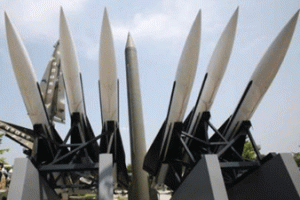
 [Photo] North Korea marks one-year anniversary of alleged nuclear weapons program completion, Daily NK, By Mun Dong Hui, 28 Dec 18,
December 29, 2018
Posted by Christina Macpherson |
North Korea, weapons and war |
Leave a comment
Projects to export nuclear power plants, a pillar of the “growth strategy” promoted by the administration of Prime Minister Shinzo Abe, appear to be crumbling.
Factors behind the failures include ballooning construction costs due to strengthened safety standards after the triple core meltdowns at Tokyo Electric Power Co.’s (TEPCO) Fukushima Daiichi Nuclear Power Station in March 2011, and growing anti-nuclear sentiments around the world.
Nothing else can be said but that the export projects have effectively failed. The prime minister’s office and the Ministry of Economy, Trade and Industry must bear the responsibility of continuing to promote these exports despite a massive change in the attitude toward nuclear power plants.
“We are really stretched to our limit,” Hitachi Chairman Hiroaki Nakanishi recently said of the company’s nuclear power plant construction plan in Britain. The statement came at a regular press conference of the Japan Business Federation, or Keidanren, indicating that continuing the project is not feasible.
Hitachi coordinated closely with the Japanese government to advance the U.K. project. The company was to build two nuclear power reactors in midwestern Britain through a local subsidiary, and to start operating the facilities in the first half of the 2020s.
But, the total estimated cost of the project has skyrocketed from the initial figure of 2 trillion yen to 3 trillion yen due to growing safety measure costs. Hitachi, hoping to distribute financial risk, sought investments from major power utilities and other firms, but the negotiations hit a snag due to the lowered profitability of the project.
In a bid to secure profits at an early stage, Hitachi requested that the British government raise the price of the electricity to be generated by the plants, which was guaranteed to be purchased in advance. This arrangement also hit a wall as confusion spread in the British political sphere over the nation’s planned exit from the European Union. Hitachi, which has a stake in the local subsidiary, would lose some 300 billion yen if the project was cancelled.
Similar trouble has arisen in Turkey. A plan to export nuclear power plants, which began from a close relationship between Prime Minister Abe and Turkish President Recep Tayyip Erdogan, has also run aground.
Under the original plan, Mitsubishi Heavy Industries and other businesses were to build four midsized reactors in Turkey along the coast of the Black Sea at a total estimated cost of 2.1 trillion yen. The amount has more than doubled to 5 trillion yen, due in part to increased cost estimates for earthquake-proof measures. This development now requires the Japanese and Turkish governments to extend additional financial support for the project, but the two sides have apparently failed to reach an agreement.
The Abe administration has thrown its weight behind the export of nuclear power plants as a major element of its economic “growth strategy,” with the trade ministry choreographing the moves for the projects. The ministry regards nuclear power generation as one of the main sources of power generation, always protecting and promoting the nuclear power industry.
However, after the Fukushima nuclear disaster in 2011, building such plants within Japan has become difficult, and the ministry hoped to maintain the size of the nuclear power industry through exports and the transference of relevant technologies and human resources to the next generation. But this has ignored the fact that international trends have shifted since the disaster.
The construction cost for nuclear power plants has grown exponentially with the increased focus on safety measures, while renewable energy sources such as solar power have become cheaper with the rapid expansion of their use. As such, the relative price competitiveness for nuclear power reactors has declined; it can no longer be called an “inexpensive energy source.”
According to the International Energy Agency (IEA), global investments for new nuclear power plant construction in 2017 dropped to 30 percent of the previous year’s figure. Global policy is moving away from nuclear power plants and instead tipping toward renewable energy sources.
The failure to reflect this trend led to the huge losses incurred by Toshiba Corp., which bought Westinghouse Electric Co. with backing from the trade ministry to pursue its troubled nuclear power projects in the United States.
In 2012, a national referendum in Lithuania voted down a project to build a Hitachi nuclear power plant, and then in 2016, Vietnam scrubbed a similar construction plan. The same year, Japan signed a nuclear cooperation agreement with India, eyeing exports of nuclear power plants despite concerns about the proliferation of nuclear materials to the nuclear weapon state outside of the Nuclear Non-proliferation Treaty. Still, the export plan has yet to materialize. It is clear that the export of nuclear power plants has been backed into a corner for quite some time already.
It is Japan that caused one of the world’s worst nuclear accidents, and is now working on decommissioning the damaged reactors in a process that will take decades to complete. Many people in Japan hold deeply rooted feelings against the government’s placement of nuclear power plant exports as a pillar of the nation’s growth strategy.
In response, the government has simply justified the projects by saying they will contribute to developing countries with a growing power demand by offering a cheap source of power to support their economic growth. Rising construction costs, however, has rendered this explanation moot.
Japan still has many nuclear power plants to run, and the decommissioning of older plants will soon be in full-swing. The latest technology and skilled experts are vital for these projects to be completed successfully.
Continuing to focus on nuclear power export, however, will lead Japan nowhere. The government should take another look at global trends, and review the basis of its nuclear power policy to rid Japan of nuclear power as soon as possible.
December 27, 2018
Posted by dunrenard |
Japan | Exports, nuclear plants, renewable energy |
Leave a comment
This is an ongoingly highly toxic and dangerous situation made even more difficult by lies and cover-ups and nuclear industry which owns way too many politicians.
For the 8th time mayors from five cities in Chiba prefecture requested that the central government deal with high level radioactive waste in their cities: Matsudo, Kashiwa, Nagareyama, Abiko, Inzai.
Since 2011, the waste from the Fukushima disaster has been left in temporary storage locations.
The mayors began formally requesting the central government establish a long term storage facility for this waste in January. At the 8th meeting again requesting this assistance they left empty handed again.
Much of this waste consists of contaminated soil, plant matter and possibly dried sewage sludge or incinerator ash. It was not specified what waste streams would be stored in the requested facility. Much of the contaminated soil has been stored in empty lots, some of these near homes or schools, others in watershed areas.
Parts of Chiba received unexpected levels of contamination. Southerly winds at the time of some of the larger releases from the nuclear meltdowns caused contamination into parts of Chiba and Tokyo. Places hours away from a nuclear power plant can find themselves dealing with high radiation levels and contamination due to bad timing and a change of the wind.
December 27, 2018
Posted by dunrenard |
Japan | Chiba Prefecture, Radioactive waste |
Leave a comment
 Costs for scrapping 79 nuclear facilities estimated at 1.9 tril. yen https://mainichi.jp/english/articles/20181227/p2g/00m/0na/001000c Costs for scrapping 79 nuclear facilities estimated at 1.9 tril. yen https://mainichi.jp/english/articles/20181227/p2g/00m/0na/001000c
December 27, 2018 (Mainichi Japan) TOKYO (Kyodo) — The state-backed Japan Atomic Energy Agency said Wednesday it would need to spend about 1.9 trillion yen ($17.1 billion) to close 79 facilities over 70 years, in its first such estimate.
The total costs could increase further, as the agency said the estimated figure, which would be shouldered by taxpayers, excludes expenses for maintenance and replacing aging equipment.
The JAEA plans to close more than half of the 79 facilities over the next 10 years due in part to the increased costs to operate them under stricter safety rules introduced after the 2011 Fukushima nuclear crisis. The agency, which has led nuclear energy research in Japan with its predecessors since the 1950s, owns a total of 89 facilities.
Of the estimated costs, the expense for closing the nation’s first spent-fuel reprocessing plant in the village of Tokai, Ibaraki Prefecture, northeast of Tokyo, accounts for the largest chunk of 770 billion yen. It will cost 150 billion yen to decommission the trouble-plagued Monju prototype fast-breeder nuclear reactor.
As for nuclear waste, the agency said about 100 kiloliters of high-level radioactive waste and up to 114,000 kl of low-level radioactive waste were estimated to have been produced but it has yet to decide on disposal locations.
The Japanese government aims to restart nuclear power plants after a nationwide halt following the nuclear crisis, despite persistent concern over the safety of atomic power generation.
|
|
|
December 27, 2018
Posted by Christina Macpherson |
decommission reactor, Japan, politics |
Leave a comment

 December 18, 2018 (Mainichi Japan) TOKYO — The Supreme Court on Dec. 13 upheld the lower court ruling ordering Tokyo Electric Power Co. (TEPCO) to pay about 16 million yen in compensation to a man in his 40s and his family that voluntarily evacuated Fukushima Prefecture to western Japan after the 2011 nuclear disaster.
The top court’s First Petty Bench confirmed an Osaka High Court ruling handed down in October 2017 that recognized the man had developed depression due to the disaster and became unable to work. It marked the first time that a ruling awarding compensation to voluntary evacuees from the Fukushima Daiichi Nuclear Power Station disaster has been finalized by the top court, according to a legal team for victims of the nuclear crisis. ….. https://mainichi.jp/english/articles/20181218/p2a/00m/0na/021000c
December 24, 2018
Posted by Christina Macpherson |
Japan, legal |
Leave a comment
 Why Is China Losing Interest In Nuclear Power? Oil Price, By Leonard Hyman & William Tilles – Dec 19, 2018 The future of the nuclear power industry lies in China. The Chinese are presently building more nuclear electric power generating stations than any other country. This year, the Chinese will add three more nuclear power stations to their fleet bringing their total up to 40, while eighteen nuclear plants are also under construction.
According to MIT estimates, the Chinese can erect a nuclear plant for half the cost of a plant here in the U.S. If so, what’s the problem?
First, let’s put the numbers into perspective. Nuclear power accounts for about 4 percent of Chinese electric power production. (Nuclear accounts for about 20 percent of electric power generation the U.S.) Solar and wind generation accounts for 7 percent of production in China and the renewable component has been growing far faster than nuclear. Chinese industries spent $127 billion in 2017 on developing renewables.
Returning to nuclear plant costs in China, MIT estimates show a two-to-one Chinese cost advantage over the U.S., based on “overnight costs.” This is an engineering concept. that gives short shrift to potentially major construction expenses such cost of capital, duration of project or risk of error and subsequent redress (either actual or compensatory). Appropriately valuing the true cost of capital alone could raise these so called overnight nuclear new build costs by at least 25 percent.
Adding insult to injury, perhaps half the Chinese nuclear fleet presently under construction is behind schedule and there are reports of (typical for this industry) cost overruns and construction problems.Now, let’s get to the disturbing item in the MIT analysis as far as the nuclear power industry is concerned. The money quote? “Officially China still sees nuclear power as a must have.
But unofficially, the technology is on a death watch.” The Chinese appear committed to completing all of the eighteen or so nuclear projects presently under construction, but they have not announced a new commercial project since 2016. This would give China 58 GWs of installed nuclear capacity by 2020 with another 30 GWs presently under construction. Not that much smaller than the U.S.
The real change here regards discussions of the future. Pre-Fukushima, China’s power planners were considering adding 400 GWs of nuclear power by the year 2050. It appears plans of this magnitude are no longer under consideration.
Perhaps the traumatic events at Japan’s Fukushima Daiichi nuclear facility dampened Chinese enthusiasm for all things nuclear. Also, a major industrial accident of this type could potentially undermine the government’s legitimacy by stirring up political protest. We can’t know the thinking of China’s economic planners. But it appears that rising nuclear costs coupled with a lack of public enthusiasm for nuclear power have influenced the lack of new orders.But we would argue that there are other factors for this waning interest in nuclear power. First is that renewables may be cheaper. Also, projections for power demand show a substantial falling off. The rate of Chinese electric power demand growth was 11 percent per year in 2000-2015 but is projected to fall to 2 percent per year in 2015-2030. These shifts show the Chinese economy coming to resemble those of the U.S. and Europe with less growth in the most energy intensive industries. An 11 percent growth rate in demand means a situation of almost chronic undersupply and shortage. A 2 percent growth rate in power demand permits a far more leisurely approach to long term energy planning……..
Whatever the underlying cause, China has de-emphasized its massive nuclear new build strategy. We suspect the reason is a combination of slowing demand for electricity and deteriorating cost competitiveness of the nuclear plants compared to the alternatives.
It is not a good sign when the country that that boasts one of the better construction cost records in the business steps back and says, in effect, “Maybe we have something better to do with our money.” Chinese nuclear operators will, no doubt, continue to sell their wares abroad. China’ s CNNC is building two indigenous designed Hualong One reactors in Pakistan and CGN’s strategy appears to be invest only with generous subsidies from host governments like the U.K. But ultimately why would people want to buy a product that the producer can no longer reliably sell in its home market? https://oilprice.com/Alternative-Energy/Nuclear-Power/Why-Is-China-Losing-Interest-In-Nuclear-Power.html
December 22, 2018
Posted by Christina Macpherson |
China, politics |
Leave a comment
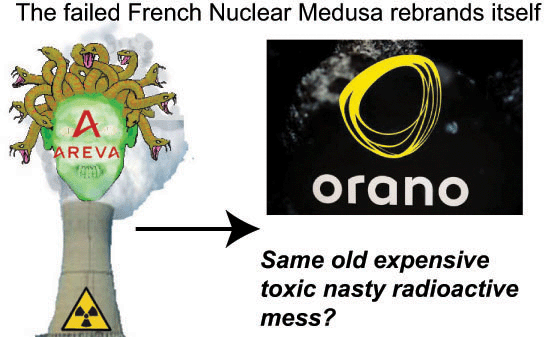
Orano’s activities in Mongolia under judicial investigation for suspicion of corruption https://www.lemonde.fr/energies/article/2018/12/19/les-activites-d-orano-en-mongolie-visees-par-une-enquete-judiciaire-pour-des-soupcons-de-corruption_5399983_1653054.html 19th Dec 2018 These suspicions of “bribery of a foreign public official” involve one of the service providers of Orano, the consulting firm Eurotradia International.
 The French nuclear group Orano, [or is it Framatome?] formerly Areva, is in
  the sights of the national prosecutor’s office that investigates suspicions of corruption in Mongolia, it was learned, Wednesday, December 19,from sources close to the case. These suspicions of “bribery of a foreign public official” involve one of the service providers of Orano, the consulting firm Eurotradia International.
Anti-corruption campaign in Mongolia
In October 2013, under the chairmanship of Luc Oursel, Areva entered into a strategic partnership to exploit two uranium deposits in the Gobi Desert (southeast) with Mongolian Mon-Atom and Japan’s Mitsubishi. The agreement came after more than ten years of exploration of the French group in Mongolia, but it remained uncertain until the last moment. The project had sparked strong environmental opposition in this huge country of three million inhabitants, whose subsoil is rich in ores (uranium, copper, gold, coal).
The case is part of an anti-corruption campaign in Mongolia where, in another case, two former prime ministers were jailed in April for controversial deals with the mining giant, Anglo-Australian Rio Tinto.
In addition, the French nuclear group has already been targeted since 2015 by a preliminary survey of the PNF. This case, dubbed “uraniumgate”, is about the controversial sale in the fall of 2011, a large amount of Nigerian uranium for $ 320 million. https://www.lemonde.fr/energies/article/2018/12/19/les-activites-d-orano-en-mongolie-visees-par-une-enquete-judiciaire-pour-des-soupcons-de-corruption_5399983_1653054.html
December 22, 2018
Posted by Christina Macpherson |
France, Mongolia, secrets,lies and civil liberties |
4 Comments
North Korea Says It Won’t Give Up Nuclear Weapons Unless the U.S. Removes Nuclear Threat, TIME, By KIM TONG-HYUNG / AP December 20, 2018 (SEOUL, South Korea) — North Korea said Thursday it will never unilaterally give up its nuclear weapons unless the United States first removes what Pyongyang called a nuclear threat. The surprisingly blunt statement jars with Seoul’s rosier presentation of the North Korean position and could rattle the fragile trilateral diplomacy to defuse a nuclear crisis that last year had many fearing war.
The latest from North Korea comes as the United States and North Korea struggle over the sequencing of the denuclearization that Washington wants and the removal of international sanctions desired by Pyongyang. The statement carried by the North’s official Korean Central News Agency also raises credibility problems for the liberal South Korean government, which has continuously claimed that North Korean leader Kim Jong Un is genuinely interested in negotiating away his nuclear weapons as Seoul tries to sustain a positive atmosphere for dialogue.
The North’s comments may also be seen as proof of what outside skeptics have long said: that Kim will never voluntarily relinquish an arsenal he sees as a stronger guarantee of survival than whatever security assurances the United States might provide. The statement suggests North Korea will eventually demand the United States withdraw or significantly reduce the 28,500 American troops stationed in South Korea, a major sticking point in any disarmament deal.
Kim and President Donald Trump met June 12 in Singapore where they agreed on a vague goal for the “complete denuclearization” of the Korean Peninsula without describing when and how it would occur. The leaders are trying to arrange another meeting for early next year.
But North Korea for decades has been pushing a concept of denuclearization that bears no resemblance to the American definition, with Pyongyang vowing to pursue nuclear development until the United States removes its troops and the nuclear umbrella defending South Korea and Japan. In Thursday’s statement, the North made clear it’s sticking to its traditional stance on denuclearization. It accused Washington of twisting what had been agreed on in Singapore and driving post-summit talks into an impasse.
“The United States must now recognize the accurate meaning of the denuclearization of the Korean Peninsula, and especially, must study geography,” the statement said.
“When we talk about the Korean Peninsula, it includes the territory of our republic and also the entire region of (South Korea) where the United States has placed its invasive force, including nuclear weapons. When we talk about the denuclearization of the Korean Peninsula, it means the removal of all sources of nuclear threat, not only from the South and North but also from areas neighboring the Korean Peninsula,” the statement said.
The United States removed its tactical nuclear weapons from South Korea in the 1990s. Washington and Seoul have not responded to the North Korean statement……..
“If we unilaterally give up our nuclear weapons without any security assurance despite being first on the U.S. list of targets for pre-emptive nuclear strikes, that wouldn’t be denuclearization — it would rather be a creation of a defenseless state where the balance in nuclear strategic strength is destroyed and the crisis of a nuclear war is brought forth,” the KCNA said.
“The corresponding measures we have asked the United States to take aren’t difficult for the United States to commit to and carry out. We are just asking the United States to put an end to its hostile policies (on North Korea) and remove the unjust sanctions, things it can do even without a snap of a finger.”…….http://time.com/5485553/north-korea-nuclear-weapons-us-threat/
December 22, 2018
Posted by Christina Macpherson |
North Korea, politics international |
Leave a comment
Japanese government keeps on trying to ram food exports from Fukushima radiation affected areas down the throats of their Asian neighbors ….
Japanese prime minister Shinzo Abe
IT IS UNSURPRISING that Taiwan will not be admitted to the Comprehensive and Progressive Agreement for Trans-Pacific Partnership (CFTPP) because of the referendum vote against food imports from Fukushima-affected areas held in late November concurrent with nine-in-one elections. Namely, the issue of food imports is one upon which Taiwan has long been pushed around by larger, more powerful countries, who dangle the threat of being denied admittance to international free trade agreements if Taiwan does not allow food imports.
The Abe administration has in the past made allowing food imports from Fukushima-affected areas a condition for stronger diplomatic relations with Japan. This would be part of a more general effort by the Abe administration to promote the prefecture of Fukushima as safe, with concerns that lingering radiation may still cause harmful effects in the region after the 2011 Fukushima disaster. The Abe administration has thus attempted to promote food exports from the area, as well as to encourage tourism to the area.
Concerns over whether food from Fukushima is safe are valid, seeing as this is an issue of contention in Japan itself. Abe’s Liberal Democratic Party (LDP) is deeply wedded to the Japanese nuclear industry, with an unusual willingness to push for nuclear energy in spite of outbreaks of large-scale public protest. Concerns have also been longstanding that the LDP has been unwilling to provide accurate nuclear assessments for the Fukushima area, or sought to mislead through official statistics.
After the results of the referendum in late November, in which 7,791,856 voted against allowing food imports from Fukushima, the Japanese government initially expressed understanding regarding the results of the referendum, suggesting that not allowing food imports from Fukushima would not be an obstacle for Japan-Taiwan relations going forward. However, this appears to have not entirely been the truth.
Indeed, as the KMT was a powerful force behind the push for the referendum, it is likely that the KMT sought to use the issue of food imports from Fukushima-affected areas as a means to not only to attack the DPP with the accusation that it was endangering public safety but also sabotage closer relations between Japan and Taiwan. Apart from that the KMT’s Chinese nationalism has a strong anti-Japanese element, the KMT is pro-unification and so opposes closer ties between Japan and Taiwan, seeing as Japan could be a powerful regional ally that interceded on behalf of Taiwan against Chinese incursion.
The CFTPP is a regional free trade agreement that is the form that the Trans-Pacific Partnership (TPP) took on after America withdrew from the trade agreement under Donald Trump. Despite the fact that the TPP was orchestrated under American auspices as a means to counter growing Chinese influence in the Asia-Pacific region, the Trump administration favored protectionism instead of free trade, seeing free trade as overextending American resources rather than expanding its economic reach.
Japan subsequently became the dominant power among former TPP signatories, continuing to push for the agreement because it was still beneficial to Asia-Pacific nations to economically integrate as a regional bloc against the threat of China.
This would not be the first time that food imports have been used as a condition of Taiwan’s admittance to or denial from the TPP framework. America previously made allowing American beef imports into Taiwan to be a condition of Taiwan’s possibly entering into the TPP, seeing as there were in concerns in Taiwan that the use of the hormone ractopamine—banned in most of the world’s countries but not in America—was unsafe. This, too, was a valid concern regarding food safety, but the KMT was interested in the issue because it hoped to use this as a wedge issue to sabotage relations between Taiwan and the US.
Now that Japan is the primary driving force behind the CFTPP, as the renewed version of the TPP, food imports from Fukushima-affected areas have taken priority as the issue which would determine Taiwan’s admittance or non-admittance to the CFTPP. As free trade agreements are more generally a way for large, powerful countries to coerce smaller, weaker countries into relations of economic subordination, this would be nothing surprising.
More generally, free trade agreements have also long been held over the heads of Taiwanese voters in order to influence how they vote, as observed in the examples of the Economic Cooperation Framework Agreement or the Cross-Strait Services Trade Agreement under the Ma administration. But in light of the issue of food imports from Fukushima-affected areas being a contested issue in Taiwan, it remains to be seen whether the CFTPP will become a significant wedge issue in Taiwanese politics going forward.
December 20, 2018
Posted by dunrenard |
Taiwan | Contaminated Food, Food Import Ban, Food safety |
Leave a comment
Post-Fukushima cost overruns may kill a giant power project in Turkey, and there are few other deals to replace it
Japan’s nuclear export industry could be dealt a fatal blow if Mitsubishi Heavy Industries pulls out of a massive project to build four large power plants on Turkey’s Black Sea coast, as reports have suggested.
The Sinop plant project in Turkey was seen as Japan’s best chance for an industry – battered and bruised after the 2011 tsunami and triple meltdown at Fukushima – to put together a workable export strategy that did not break the bank of potential international customers.
Aside from Sinop, the Japanese industry has only one viable export project still upcoming: Hitachi’s bid to build two reactors on the island of Anglesey in Britain. And even that deal is looking shaky.
Mitsubishi Heavy Industries (MHI) has not pulled the plug yet on its stake in the four-reactor project on Turkey’s Black Sea coast, but a slew of domestic media reports and talk in Tokyo, suggests that, in the face of seemingly ever-rising construction costs to meet new safety standards that have been put in place since the 2011 Fukushima disaster, the company will bail.
When the deal was signed with Ankara in 2013, the ownership profile was: 65% awarded to a consortium made up of MHI, Itochu, France’s Areva, and GDF Suez. The other 35% was covered by Turkey’s electric power utility, Elektrik Uretim.
However, in April, Itochu pulled out of the consortium, citing cost overruns. That left the consortium with 51%, and the remaining 49% owned by the Turkish utility.
Without Mitsubishi the viability of the project is in question, sources say, unless Turkey can find a new partner or is willing to take on the project without its largest foreign partner. The Russians, who are building a nuclear complex on Turkey’s southern Mediterranean coast, might be interested.
According to Kyodo, a thorough cost evaluation was to be completed by the end of this year. Itochu waited for the report to be released before bailing out of the deal. MHI is apparently waiting for the study to be completed before deciding its next move.
When the deal with Mitsubishi was signed in 2013, the estimated cost was $18 billion for four 1,100-megawatt nuclear power plants. But overall costs have soared, passing $42 billion in April – when Itochu withdrew, and is now put at about $44 billion.
Cost increases are nothing new in the nuclear power industry, but have been exacerbated in recent years by expensive adjustments phased in to meet more stringent safety concerns following the earthquake and tsunami that destroyed four units of the Fukushima Daiichi plant. The Sinop cost rises, however, also encompass other problems encountered in construction.
Fukushima, one of the most serious nuclear accidents in history, turned most of Japan against nuclear power. Before March 11, 2011, Japan had 54 nuclear plants. All were shut down after the accident and some are slowly returning to service having passed scrutiny by the regulator. Five are expected to restart within the next five years, and eight will likely be decommissioned. But prospects for the remaining plants are unclear.
Aware that no new nuclear plant may ever be built at home amid the anti-atomic public mood, Japan’s nuclear vendors have turned to overseas exports as the Fukushima accident does not appear to have destroyed the Japanese industry brand in other countries.
Endgame for nuclear exports?
If Mitsubishi does pull out of the huge project in Turkey it will be a blow to Prime Minister Shinzo Abe, who sees international exports of nuclear technology as an important way to boost the economy. On his many trips abroad, he often acts as a salesman for nuclear exports. For example, it was a topic of discussion with Turkish President Recep Erdogan on the sidelines of the G-20 meeting in Argentina.
Details of the conversation were not revealed, but it would be a good bet that they discussed the Sinop project with the threat of Mitsubishi hanging over them, and that Abe sought ways to keep the project viable.
Meanwhile, it is not just MHI that may have doubts about the sector. Japan’s nuclear export industry has suffered plenty of setbacks in the seven years since Fukushima. Questions about the future of the sector hang over all three main players in the sector.
Toshiba, one of Japan’s big-three nuclear constructors, recently pulled out of the nuclear power business overseas after incurring huge losses in the United States.
Toshiba has also suffered something of an administrative meltdown in its quest to win construction contracts in the US. In February it finally unloaded it money-losing American subsidiary, Westinghouse, for $1 billion less than it paid to acquire the company 10 years ago.
If the export program is to remain viable, it may be in Wales, where the British government is seeking to build a two-reactor nuclear power plant on the island of Anglesey. Among those bidding for the project is Japan’s third nuclear constructor, Hitachi, through a subsidiary called Horizon Nuclear.
In the nuclear world, there are constructors – like MHI, Toshiba and Hitachi – and operators, who run the plant after it is completed, and they are not always the same. Japan learned from Korea’s successful bid to build six nuclear plants in the United Arab Emirates that offering to build and also run them – a one-stop service – is key to making sales.
Hitachi is teaming up with the Japan Atomic Power Company, which operates two plants in Japan (although both are currently shut down pending the review by regulators). The plan is to present the British with a package deal.
Now, there are worries that Hitachi might pull out of the British project. Chairman Hiroaka Nakanishi was quoted in the Times of London saying his company was “facing an extreme situation,” and that a final decision on whether to stay with the project or leave it will be made next year.
If Mitsubishi does, as is widely expected, pull out of the huge project in Turkey, the only egg left in Japan’s overseas nuclear export basket will be Wales.
December 20, 2018
Posted by dunrenard |
Japan | Hitachi, Mitsubishi, Nuclear Exports, Toshiba |
Leave a comment