UK’s nuclear energy renaissance derailed, as Japanese companies step back from nuclear investment?
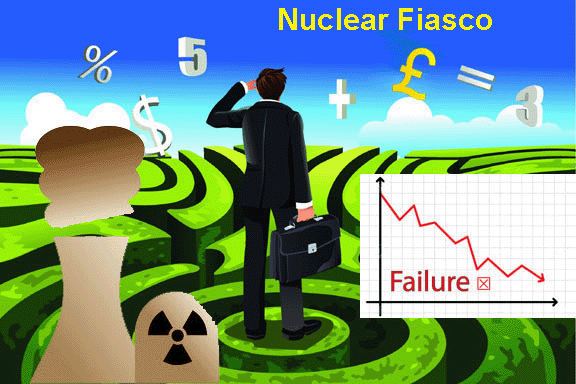 Japan’s nuclear rethink could derail UK energy plans, https://unearthed.greenpeace.org/2019/01/09/japan-uk-nuclear-plans-go-awry/, Doug Parr, 11 Jan 19, Reports in the Japanese press claim Hitachi is set to suspend all work on Wylfa, its nuclear power project in Wales.
Japan’s Prime Minister Abe in UK to beg for more money for Wylfa nuclear project?
Unearthed 9th Jan 2019 Doug Parr: Japan’s prime minister Shinzo Abe is in London this week, and it seems likely in his meeting with Theresa May that the Japanese-backed
nuclear power plant in Wales will come up. The Wylfa project, to be built
by Hitachi and its subsidiary Horizon, is one of a clutch of planned
nuclear power stations which the UK government has heavily prioritised for
security of power supply, and meeting the country’s climate obligations.
Late last year another of the 6 major projects, the proposed Moorside plant
in Cumbria, was effectively abandoned after Toshiba pulled out. And another
has come under fire as questions are raised about security issues flowing
from the Chinese builders.
These developments effectively illustrate that
UK nuclear power policy is heavily dependent on overseas developers.
What is less understood is that there are significant shifts underway in Japan
which strongly suggest Hitachi’s projects may too be at risk. The most
advanced of Horizon’s nuclear plans is a large power station to be built
at Wylfa on Anglesey, North Wales. In fact, with the collapse of Moorside,
the Wylfa plant is the only nuclear project that could realistically be
built before 2030, in addition to the plant already under construction at
Hinkley Point in Somerset.
Japan, however, is reconsidering its nuclear
export strategy. Because it keeps going wrong. Until recently it had 3
companies interested in building nuclear power stations abroad: Toshiba,
Mitsubishi and Hitachi. These companies have experience building nuclear
stations at home but since the Fukushima disaster in 2011, they have had to
look elsewhere.
Seeking to help these giants of Japanese industry to
maintain their businesses, Prime Minister Abe reportedly wanted to turn
Japan into a “nuclear export superpower”. Hitachi, however, are
reportedly be thinking of scrapping the project as its costs and risks
become unmanageable. Hitachi could be looking at Toshiba’s
near-bankruptcy and thinking ‘let’s not go there’. According to their
chairman the project was in “an extremely severe situation” as it
struggled to attract investors, even though UK government may have promised
as much as two thirds of the build cost.
Despite this already generouslargesse (on behalf of UK taxpayers, not offered to any other energy projects) Hitachi are intending to come back to UK government and ask for
more. It looks like no assessment of the risks by a private funder come
back looking good, and the only way nuclear plants can be built is with
government stepping into very risky projects that require taxpayers to
shoulder the risk.
The aversion from private investors may not only be
because of the rising costs, but also that the operating performance of the
proposed reactor is pretty poor (albeit partly due to earthquakes).
Notably Hitachi continues to be happy to spend many billions of pounds on power
grid investments, but not its own nuclear reactor, which it wants UK
taxpayers to fund. Major Japanese newspapers have opposed their own
taxpayers lending support to the Wylfa project, even though a home-grown
company would be getting the benefits.
And during the Xmas break, Japan’s
third largest newspaper called for the nuclear export strategy to be
abandoned. Another paper attacks the ‘bottomless swamp’ of nuclear
funding in UK and remarks upon how few countries seem to be following the
UK-style nuclear-focused policy. Reportedly Japanese government has asked
its development banks to fund the ‘nuclear export strategy’, and Wylfa
in particular, but they don’t want to. It is quite difficult to see how
Hitachi can manage the risks of this project without some home support, and
support in Japan is ebbing away.
https://unearthed.greenpeace.org/2019/01/09/japan-uk-nuclear-plans-go-awry/
Funding deadlock looks set to sink Japan’s last overseas nuclear project.
 Nikkei Asian Review 11th Jan 2019 , Hitachi to suspend all work on UK nuclear plant. Funding deadlock looks set to sink Japan’s last overseas nuclear project. Hitachi plans to put a U.K.
nuclear power project on hold as negotiations with the British government over funding hit an impasse, all but closing the book on Tokyo’s vision for nuclear infrastructure exports.
board is expected to officially decide next week to suspend all work on the
plant, including design and preparations for construction. Hitachi will
freeze the roughly 300 billion yen ($2.77 billion) in assets held by its
British nuclear business and write down their value, likely booking a loss
of 200 billion yen to 300 billion yen for the fiscal year ending in March.
after the news last month that a Japanese-led consortium including
Mitsubishi Heavy Industries was scrapping a project in Turkey. With the
aversion to nuclear power that took hold after the March 2011 Fukushima
Daiichi disaster showing little sign of abating, prospects look grim for a
sector that the Japanese government had positioned as a pillar of its
infrastructure export drive. Hitachi had taken on the planned construction
of two reactors on the Welsh island of Anglesey after acquiring U.K.-based
Horizon Nuclear Power in 2012. The company is leaving the door open to a
return. The project is “not being abandoned,” a source close to Hitachi
told Nikkei, suggesting the company would keep an eye on the situation and
resume the project if possible.
apparently set to continue, reworking the project to the extent Hitachi
requires will be no easy task. As things stand now, it appears likely that
the company will ultimately be forced to bow out.
https://asia.nikkei.com/Business/Business-Deals/Hitachi-to-suspend-all-work-on-UK-nuclear-plant
Kim Jong Un’s New Year’s Speech stressed energy development, and co-operation wit South Korea
Kim Jong Un’s New Year’s Speech: On the Domestic Front, 38 North, BY: GLYN FORD, JANUARY 9, 2019 “……
Kim acknowledged that challenges to this domestic agenda certainly exist, noting especially the misallocation of labor, lack of expertise and poor productivity. In his speech, he instructed a reallocation of labor and resources, both for the military and the Party, to start to address these barriers to success. He also indicated that contingency plans were being explored in case a second summit with Trump fails to set US-DPRK relations back on track.
………Focus on Energy Generation
The country’s principal economic bottleneck is the desperate need for a massive increase in electricity production. A first step is the renovation and modernization of the supply industry. By singling out the Pukchang Thermal Power Complex for praise all the others inevitably lie in its shadow. Yet the most aggravating problem is fuel shortages. Under the current sanctions regime, the short-term solution—and by no means good news for the climate-change lobby—to the electricity shortage is massive increases in productivity in the coal sector. ………..
While hydroelectric plants merit a passing mention, in reality, the North is close to maximizing the use of the water resources available with both floods and droughts sharply reducing output. In the longer term, Kim argued that the country needs to “create a capacity for generating tidal, wind and atomic power under a far-reaching plan.” The last underlines Pyongyang’s perception that denuclearization of the Korean Peninsula does not preclude ambitions to be a civil nuclear power. The ongoing construction of their indigenous Experimental Light Water Reactor (ELWR) at North Korea’s Yongbyon Nuclear Scientific Research Center suggests that light water reactors will form the backbone of the industry, harking back perhaps to the Korean Peninsula Energy Development Organization (KEDO) from the 1990s. ………..
There is no question the Party is now on top as well as on tap with constant references to its primacy. Kim emphasized in his speech that the KPA is to “defend the Party and revolution and the security of the country and the people and continuously perform miraculous feats at all sites of socialist construction.” Echoing that sentiment, the People’s Internal Security Forces are there to protect Party, system and people, in that order.
Delivering peace and prosperity to the Korean Peninsula is the stated goal for both Pyongyang and Seoul. Kim underscored this mandate with:
“When north and south join hands firmly and rely on the united strength of the fellow countrymen, no external sanctions and pressure, challenges and trials will be able to hinder us….We will never tolerate the interference and intervention of outside forces who stand in the way of national reconciliation, unity and reunification with the design to subordinate inter-Korean relations to their tastes and interests.”
The “dog that didn’t bark” is the “end-of-war” declaration. Last summer, Pyongyang complained long and hard that Washington had not delivered on its promise to sign a political declaration ending the Korean War. In Kim’s New Year’s speech, this declaration failed to get even a mention. Pyongyang seems to have moved on, from Washington at least. Kim stated, “it is also needed to actively promote multi-party negotiations for replacing the current ceasefire on the Korean peninsula with a peace mechanism in close contact with the signatories to the armistice agreement so as to lay a lasting and substantial peace-keeping foundation.” The concept of a bilateral US-DPRK declaration signed by Seoul and Beijing has now become a multilateral proposition and negotiation. Which parties would be involved is unclear, but this may have been one of many topics discussed between Kim and Chinese President Xi Jinping during Kim’s birthday visit to Beijing
……….Until now Pyongyang has rigidly adhered publicly to parallel bilateral negotiations, one with Washington looking for a peace settlement accompanied by sanctions relief and a second with Seoul on economic cooperation. Now with the potential for the first set of negotiations to go multilateral, the second set may follow suit, increasing pressure on Moon to put clear blue water between Seoul and Washington with respect to “maximum pressure.”https://www.38north.org/2019/01/gford010919/
JAPC denies granting local prior consent for Tokai reactor restart

Major financial group in Japan bans lending to those developing, making or possessing nuclear weapons
 Resona bans lending to those developing, making or possessing nuclear weapons https://mainichi.jp/english/articles/20190107/p2a/00m/0bu/024000c, January 7, 2019 (Mainichi Japan) TOKYO — Resona Holdings Inc., a major financial group in Japan, has announced a policy of not extending loans to borrowers that are involved in the development, production or possession of nuclear weapons.
The statement, the first of its kind by a major Japanese banking institution, came amid similar moves by an increasing number of European banks and institutional investors following the adoption at the United Nations of the Treaty on the Prohibition of Nuclear Weapons in 2017.
Whether other Japanese corporations will follow Resona’s action is a focus of attention for the future. There were other lenders banning loans for the production of nuclear weapons, but the Resona policy prohibits any loans to such companies even when such transactions are for non-nuclear related purposes.
The new posture was incorporated in a document titled “Efforts toward socially responsible investment and loans,” which was announced in November last year. According to the paper, Resona refuses to lend to those that are associated with the development, production or possession of weapons of mass destruction, such as nuclear, chemical and biological weapons, or inhuman weaponry including antipersonnel mines and cluster munitions.
Entities that can be subject to relevant restrictions or sanctions, or even those with the potential to be hit with such punitive measures, will be rejected as borrowers, the document says.
An official with Resona, which has never lent to companies making nuclear weapons, explained that the banking group decided to introduce the policy “because we thought it important for providers of funds to make such efforts toward a sustainable society.”
According to the Dutch nongovernmental organization PAX, 63 financial institutions had similar lending policies as of October 2017, an increase of nine from the previous year.
A Mainichi Shimbun poll of four Japanese mega banks — Mitsubishi UFJ Financial Group, Sumitomo Mitsui Financial Group, Mizuho Financial Group and Sumitomo Mitsui Trust Holdings — as well as four major life insurance companies — Nippon, Dai-ichi, Meiji Yasuda and Sumitomo — found that all of the eight companies and groups have policies to refrain from lending and investment over inhuman weapons. Yet the entities did not specify the production of nuclear weapons as a condition to disengage from borrowers.
Officials at Sumitomo Mitsui and Mizuho replied that their companies ban loans to be used in the production of nuclear weapons, while a Mitsubishi UFJ official explained that the company is “making careful judgment in each transaction.”
(Japanese original by Satoko Takeshita, Business News Department)
China reportedly tests powerful non-nuclear weapon
China has tested one of the most powerful non-nuclear weapons in existence, according to state media. Video released by the Xinhua news agency shows the testing of the massive bomb, dubbed the Chinese ‘Mother of All Bombs’.
Japanese gov’t plan to export nuclear power technology to Turkey floundering


Uranium mining brings disease, deaths, deformities to Jharkhand, India
Cancers, Abortions, Deformed Children are the High Cost of ‘Clean’ Nuclear Energy in Jharkhand https://www.thecitizen.in/index.php/en/NewsDetail/index/9/15948/Cancers-Abortions-Deformed-Children-are-the-High-Cost-of-Clean-Nuclear-Energy-in-Jharkhand – AMLAN HOME CHOWDHURY | 6 JANUARY, 2019
By 2050 the government intends to meet 25% of its electricity needs from nuclear power JADUGUDA, JHARKHAND: Nestled in the mountainous district of East Singhbhum, this tiny dot on India’s vast map has become a virtual cancer ward for its residents, following years of dangerous radiation being emitted from uranium mines and tailing ponds in the area.
Jaduguda (or Jadugora) made its tryst with the hazardous byproducts of ‘clean’ nuclear power just 20 years after independence, when the country launched its nuclear programme.
Meeting 25 percent of India’s uranium needs, the town is in the news again as the Uranium Corporation of India Limited (UCIL) recently announced that it would soon resume its excavation operations here, following the renewal of its land lease for another 50 years.
Will Jaduguda’s residents still be able to live there 50 years from now?
As part of its indigenous nuclear power programme, India aims to generate 14.6 GWe (gigawatts electrical) of power through nuclear reactors in the next seven years – and 63 GWe by 2032.
By 2050 the Indian government intends to meet 25% of its electricity needs from uranium-based nuclear power, as against 5% at present.
This ambition, however, may annihilate a large number of Adivasi citizens resident in Jaduguda – from the Ho, Birhore, Santhal, Kora, Beiga, Munda, Malpahari and Mahali communities – who already are paying very dearly for uranium mining.
Due to the dangerous fallout of radiation, they are suffering from a plethora of clinical problems which were unheard of in the area before the public sector UCIL began excavating uranium ores in 1967.
People in the area suffer disproportionately from congenital deformities, sterility, spontaneous abortions, cancers and a plethora of other serious diseases known to be caused by radiation and industrial pollution.
Despite the low risk and damage done by wind and solar renewable energy generation, large, destructive hydel projects and nuclear reactors with highly toxic byproducts continue to be a part of India’s energy generation plans – not to mention the use of fossil fuels which continues unabated.
Jaduguda’s residents inhale toxic air. They drink poisoned water. They consume vegetables and cereals laced with radioactive iodine. They are exposed to radiation 24×7.
As you enter the hamlets located around UCIL’s mines and tailing ponds, where radioactive elements are dumped, the gory sight of deformed children playing innocently with their homemade toys meets your eyes.
The culprit is uranium, the highly radioactive mineral used in making nuclear warheads and for generating electricity.
Uranium is a sleeping monster. An estimated 99.28% of mined uranium ore is effectively waste – referred as tailings. These wastes are very highly radioactive with a centuries’ long half life.
In India the process of neutralising the toxicity of tailings is still done in a rudimentary manner, with simple lime, with the wastes carried through pipes to tailing ponds.
Radioactive elements also leak out of the tailing ponds and enter the earth and water during floods, affecting people, livestock, rivers, forests and agricultural produce in and around Jaduguda.
Yellowcake or urania, processed from uranium, is the lifeblood of any nuclear programme. Jaduguda uranium ore can be enriched to 0.065-grade, making it highly valuable for nuclear power generation. The yellowcake produced Jaduguda is sent to nine nuclear reactors in India.
To obtain about 65 grams of usable uranium, UCIL needs to mine, grind and process 1000 tonnes of uranium ore. The waste is thrown into the tailing ponds.
As mentioned these tailings undergo radioactive decay to produce other radioactive substances, such as radium-226 which in turn produces radon-222 gas, a highly toxic cancer-causing gas, which emits high-energy alpha and gamma particles that can shred genetic material in our cells, leading to cancer and other illnesses.
For instance, radon-222 gas damages the air passages in our lungs. It remains radioactive for 1,600 years.
The ores go through several process of purification. At each and every process, the ores emit radiation and other carcinogens.
Since the mining is carried out at depths as great as 880 metres, the miners also endanger their lives.
As long as uranium remains buried deep inside the earth, it does not pose any danger to living beings. But the moment it is brought out to the surface of the earth and ground, levels of radioactivity become hazardous in the ways described above.
Inside the Cancer Ward
According to an official estimate by the Union Ministry of Social Justice and Empowerment, nearly 3 percent of Indians suffer from physical disabilities, with congenital deformity being one of them.
In Jaduguda the rate is 50 percent higher, at 4.49 percent.
Cases of impotency, frequent abortions, infant mortality, Down’s syndrome, cancers, thalassemia and other serious diseases have made Jaduguda their home.
Some 9,000 people here – almost a quarter of the population – are suffering from congenital deformities, leukemia, and various forms of cancer. Cancer deaths are commonplace here, and do not surprise locals at all now.
Donald Trump should negotiate with Kim Jong-un, who may be willing to limit nuclear production capability
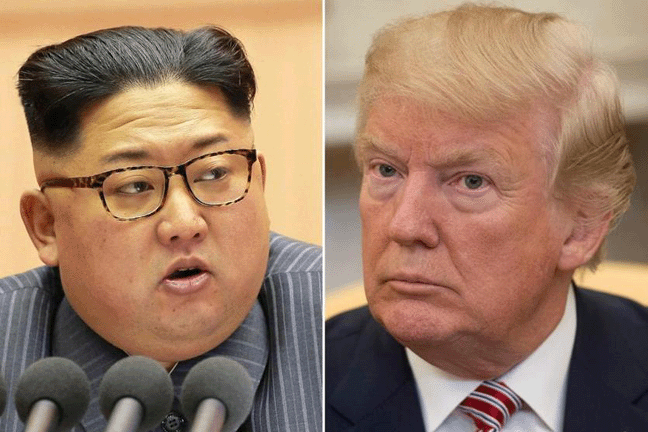 North Korea may be willing to begin denuclearization, and Donald Trump should make a deal. https://www.usatoday.com/story/opinion/2019/01/04/kim-jong-un-north-korea-donald-trump-denuclearization-offer-column/2473360002/
Kim Jon-Un indicated he would put nuclear production capability on the table as a bargaining chip, and Donald Trump should make that deal.
In his traditional New Year’s Day speech earlier this week, North Korean strongman leader Kim Jong-Un has just made an offer that, if serious, could present an opportunity for President Donald Trump to reach a historic breakthrough in the nuclear crisis on the Korean peninsula and record his greatest foreign-policy accomplishment as president.
Kim’s speech was not all sweetness and light. He warned that his patience is not infinite, and that in the absence of diplomatic progress, his country may resort to more confrontational tactics. Little has happened since the famous Singapore summit back in June between Kim and Trump; we seem no closer to a deal on North Korea’s threatening military capabilities now than we did six months ago. Meanwhile, Kim clearly resents and suffers from the tough international sanctions that the Trump administration has convinced the United Nations to impose these last two years, after North Korea’s big missile and nuclear tests of 2017. The latest statistics show that, despite sanctions evasion in multiple quarters, North Korean trade was down as much as half in 2018 compared to the year before.
But Kim held out an olive branch nonetheless. He seems to want a deal, and seems interested in another summit. He was much more specific than ever before about what he might offer in the course of such a tete-a-tete with Trump. So far, North Korea has only offered to place a moratorium on future nuclear and long-range missile tests, which has been a welcome development, but has only talked vaguely about “denuclearization” and has not stopped making more bombs. Now, apparently, Kim would put nuclear production capability on the table as a bargaining chip.
North Korea experts like Jonathan Pollack and Jung Pak have documented how unlikely Kim would be to give up all his nuclear bombs (U.S. intelligence estimates he has as many as 60 by now). They represent the collective accomplishments of a program that Kim’s grandfather and father prioritized when they led North Korea, so giving up all those bombs quickly would almost seem to dishonor the memory and legacy of his forefathers. And perhaps even more importantly, Kim as well as his generals remember the one cardinal mistake Saddam Hussein, Mohammar Quadhafi, and the Taliban all committed — leaving themselves vulnerable in war against the United States because of the lack of a nuclear deterrent. For Kim to give up the bomb, he would need a great deal of confidence that relations will remain peaceful.
There is an opportunity to compromise, relax
Yet there is still a big opportunity for compromise, if Kim is serious about ending production of more bombs. North Korea could stop expanding its nuclear arsenal, and we could relax, then lift some of the sanctions imposed on North Korea over the years, especially the U.N. sanctions that have really cut into North Korean trade with China and South Korea in the last couple years. The goal of complete denuclearization could await another day.
With this approach, the United States would keep enough sanctions in place to stay true to its principle that North Korea cannot be accepted as a nuclear-weapons state; before being fully welcomed into the community of nations, it will in fact have to honor its obligations under the Nuclear Non-Proliferation Treaty and give up all its bombs. Yet as a practical matter, that second stage of nuclear talks can wait for a number of months or years. That is ok. The world will be much safer if North Korea stops enlarging and improving its nuclear and long-range missile arsenals that could threaten not only South Korea and Japan (and the almost 300,000 Americans living in those two countries combined), but also eventually North America.
Trump should take what he can get for now
The real challenge is likely to be verification. We know where some, but not all, of North Korea’s nuclear infrastructure is located. As such, international inspectors would have to be allowed to return not only to the Yongbyon location where they have been before, and where North Korea has operated a nuclear reactor to make plutonium as well as centrifuges to enrich uranium. They would also need some degree of free reign to explore other suspicious sites around the country. On the one hand, this would not be an arrangement unique to North Korea; similar provisions are part of the Iran nuclear deal, for example. On the other hand, North Korea has shown extreme nervousness about such inspections in the past.
Another possible problem: John Bolton, Trump’s national security advisor, and Secretary of State Mike Pompeo may consider a deal that only freezes, rather than eliminates, North Korea’s nuclear arsenal inadequate for purposes of American and allied security. But they should reassess, or Trump should overrule them.
This compromise deal would go further than the Iran deal, in fact, if North Korea were willing to see its nuclear production facilities dismantled permanently. Yes, Kim would keep his nukes for a while. But he would have powerful economic and military reasons to behave himself. In this case, taking half a loaf is far more realistic than hoping for a complete denuclearization accord that just isn’t in the cards anytime soon. We should immediately engage in serious talks to see just how serious Kim really is about this intriguing and promising offer.
Michael O’Hanlon is director of research for the foreign policy program at the Brookings Institution. Follow him on Twitter: @MichaelEOHanlon
Chinese state media boasts nuclear weapons escalation, in response to Trump
Japan losing hope for having a nuclear export industry
 Japanese gov’t plan to export nuclear power technology floundering, January 4, 2019 (Mainichi Japan) (Japanese original by Takayuki Hakamada and Ryo Yanagisawa, Business News Department) TOKYO — The Japanese government’s strategy to export nuclear power technology has run aground amid rising safety costs and deteriorating prospects for project profitability. While the government has aimed to maintain the country’s nuclear technology and expert resources through construction of atomic reactors abroad amid stalled nuclear plant development at home, its projects with Turkey and Britain have both hit snags.
“The Turkish government is in the midst of evaluating the project. I believe it will respond to us in some way or other,” said Shunichi Miyanaga, president of Mitsubishi Heavy Industries Ltd., in mid-December about a plan to build a nuclear power plant in Sinop, northern Turkey. Miyanaga’s comment suggested that the fate of the project had been left up to the Turkish government.
At the end of July last year, Mitsubishi Heavy told the Turkish government that the cost of the project would total somewhere around 5 trillion yen, more than doubling from the original estimate of roughly 2.1 trillion yen. As the plan envisages recovering the costs through profits from power generation at the nuclear facility, it would not become profitable unless Turkey purchases the generated electricity at a higher price than originally expected. If Turkey does not comply with the increased burden, Japan would withdraw from the plan.
The nuclear plant project was pitched by Prime Minister Shinzo Abe to then Turkish Prime Minister Recep Tayyip Erdogan in 2013. At the time, Abe vowed at a press conference in Ankara, “We will share our experiences and lessons from the (2011) disaster at the nuclear plant (run by the Tokyo Electric Power Co. in Fukushima) with the rest of the world, and will strive to contribute to enhancing the safety of nuclear power generation.”
However, the catastrophe prompted the international community to turn a wary eye toward nuclear power, leaving the costs for safety measures at nuclear plants to swell. The steep fall in the Turkish lira over the past year by more than 30 percent also added to the project’s deteriorating profitability.
Under these circumstances, Tokyo plans to propose to Ankara that it would provide comprehensive energy cooperation in such spheres as coal-fired thermal power generation and liquefied natural gas, in place of the atomic plant project. Because the nuclear power project is based on an agreement struck by both leaders, such a proposal by Tokyo could face a backlash from Ankara, but Japan’s focus is already shifting to how to withdraw from the project without undermining bilateral diplomatic ties with Turkey.
Meanwhile, a nuclear plant construction project undertaken by Hitachi Ltd. on the Isle of Anglesey in central Britain has also run into rough waters, after the project’s costs soared to approximately 3 trillion yen, about 1.5 times the initial estimate.
n May last year, Hitachi Chairman Hiroaki Nakanishi held talks with British Prime Minister Theresa May, where the latter agreed to expand her government’s support for the project. However, British citizens have been wary of the scheme out of concern that it could lead to rising electricity bills should Japan’s request to raise the sale price of electricity be accepted.
As the May administration is suffering from sagging approval ratings amid turmoil over Britain’s exit from the European Union, it is becoming increasingly difficult for London to comply with an increased burden. At home, Japanese companies are also becoming more reluctant to invest in the project out of fears of poor profitability and accident risks. Given the circumstances, Tokyo is also likely to exit the project.
The Abe administration has made the export of nuclear power technology a pillar of its growth strategy, but to little avail thus far. While the government intends to pursue measures to counter China and Russia’s aggressive drive to export nuclear plants by stepping up financial support for partner countries and through other measures, such a strategy may end up bringing more harm than good………..
a senior official of an economy-related government body said, “It is difficult for Japanese manufacturers, which can’t even build nuclear plants in their own country, to win confidence (abroad),” suggesting that the government’s strategy to export nuclear power technology in itself is unreasonable.
https://mainichi.jp/english/articles/20190104/p2a/00m/0bu/030000c
Donald Trump and Kim Jong-un actually getting nowhere in nuclear diplomacy
Kim and Trump Back at Square 1: If U.S. Keeps Sanctions, North Will Keep Nuclear Program, NYT, By David E. Sanger, Jan. 1, 2019
Nearly two years into his presidency and more than six months after his historic summit meeting with Kim Jong-un of North Korea, President Trump finds himself essentially back where he was at the beginning in achieving the ambitious goal of getting Mr. Kim to relinquish his nuclear arsenal.
That was the essential message of Mr. Kim’s annual New Year’s televised speech, where he reiterated that international sanctions must be lifted before North Korea will give up a single weapon, dismantle a single missile site or stop producing nuclear material.
The list of recent North Korean demands was a clear indicator of how the summit meeting in Singapore last June altered the optics of the relationship more than the reality. Those demands were very familiar from past confrontations: that all joint military training between the United States and South Korea be stopped, that American nuclear and military capability within easy reach of the North be withdrawn, and that a peace treaty ending the Korean War be completed.
“It’s fair to say that not much has changed, although we now have more clarity regarding North Korea’s bottom line,’’ Evans J.R. Revere, a veteran American diplomat and former president of the Korea Society, wrote in an email.
“Pyongyang refused to accept the United States’ definition of ‘denuclearization’ in Singapore,’’ he wrote. To the United States, that means the North gives up its entire nuclear arsenal; in the North’s view, it includes a reciprocal pullback of any American ability to threaten it with nuclear weapons. “The two competing visions of denuclearization have not changed since then.”
o Mr. Trump and Mike Pompeo, the secretary of state, who is supposed to turn Mr. Trump’s enthusiasms into diplomatic achievements, dispute such conclusions. They note that the tone of one of the world’s fiercest armed standoffs has improved. It has, and both leaders say they want to meet again.
……….By some measures there has been modest progress. It has been 13 months since the North tested a nuclear weapon or a long-range missile, a change that Mr. Trump and Mr. Pompeo cite as the first fruits of what some officials now concede will be a long diplomatic push.
Relations between the two Koreas are warming, though there is considerable evidence that Mr. Kim sees his outreach to President Moon Jae-in of South Korea as a way to split the United States from its longtime ally.
But Mr. Trump’s strategic goal, from the moment he vowed to “solve” the North Korea problem rather than repeat the mistakes of past presidents, has been to end the North Korean nuclear and missile threat, not suspend it in place.
Mr. Trump dispatched his first secretary of state, Rex W. Tillerson, to Seoul in March 2017 to declare that a mere nuclear freeze would not be enough. Back then, Mr. Tillerson declared there would be no negotiations, and certainly no lifting of sanctions, until the North’s dismantling had begun. A nuclear freeze would essentially enshrine “a comprehensive set of capabilities,” he argued.
The decision Mr. Trump must make now is whether to backtrack on the objective of zero North Korean nuclear weapons even if that means accepting the North as a nuclear-armed state, as the United States has done with Pakistan, India and Israel. https://www.nytimes.com/2019/01/01/world/asia/kim-trump-nuclear.html
Earthquakes still being set off due to North Korea’s September 2017 nuclear test
 September 2017 nuclear test triggers 2019 earthquake in North Korea https://edition.cnn.com/2019/01/01/asia/north-korea-earthquake-intl/index.html, By Jake Kwon and Joshua Berlinger, CNN January 2, 2019 North Korea’s sixth nuclear test was so powerful that it’s still triggering earthquakes more than a year later.
Japan abandoning ambition to sell nuclear power reactors to Turkey
|
The Japanese government decided to ask for the increased coverage by Turkey as a final condition for constructing the plant. Under the current proposal, the plant is to be built by ATMEA, a joint venture of Japan’s Mitsubishi Heavy Industries Ltd. (MHI) and French nuclear plant maker Framatome, near the Black Sea coastal town of Sinop in northern Turkey. Besides the Turkish project, another plan to export nuclear power reactors to Britain by Hitachi Ltd. also faces difficulties. If both plans fail, a growth drive strategy of the administration of Prime Minister Shinzo Abe will collapse. The Turkish project has its roots in a 2013 joint declaration for cooperation over the construction of nuclear power plants signed by Prime Minister Abe and then Turkish Prime Minister Recep Tayyip Erdogan. Under the original plan, four medium-sized ATMEA1 reactors would be built for the start of operation in 2023……. Meanwhile, Hitachi, which also manufactures nuclear reactors, has acknowledged that it faces difficulties in completing a project to build two nuclear reactors in Britain. Chairman Hiroaki Nakanishi of the company told reporters in December that he informed the British government that the plan was “at a limit” due to a surge in project costs. Both the Turkish and British projects have been pitched directly by Prime Minister Abe, but those once promising plans now appear to be falling apart. (Japanese original by Ryo Yanagisawa and Takayuki Hakamada, Business News Department) However, the total cost estimate conducted in July 2018 by MHI for the project more than doubled from the original projection of some 2.1 trillion yen to around 5 trillion yen. The price hike occurred amid rising safety costs following the 2011 triple core meltdowns that hit the Tokyo Electric Power Co.’s Fukushima Daiichi Nuclear Power Station, as well as the finding of an active fault near the Sinop site. https://mainichi.jp/english/articles/20190104/p2a/00m/0bu/011000c |
|
|
1 This Month
26 September – International Day for the Total Elimination of Nuclear Weapons





PLEASE OPPOSE HR 8255 AND S.3639 – bills would accelerate satellite deployment, with no environmental review or safeguards – https://ncstd5li.quorum.us/campaign/169331/
To see nuclear-related stories in greater depth and intensity – go to https://nuclearinformation.wordpress.com
-
Archives
- September 2026 (305)
- August 2026 (330)
- July 2026 (355)
- June 2026 (287)
- May 2026 (306)
- April 2026 (356)
- March 2026 (251)
- February 2026 (267)
- January 2026 (308)
- December 2025 (358)
- November 2025 (359)
- October 2025 (375)
-
Categories
- 1
- 1 NUCLEAR ISSUES
- business and costs
- climate change
- culture and arts
- ENERGY
- environment
- health
- history
- indigenous issues
- Legal
- marketing of nuclear
- media
- opposition to nuclear
- PERSONAL STORIES
- politics
- politics international
- Religion and ethics
- safety
- secrets,lies and civil liberties
- spinbuster
- technology
- Uranium
- wastes
- weapons and war
- Women
- 2 WORLD
- ACTION
- AFRICA
- Atrocities
- AUSTRALIA
- Christina's notes
- Christina's themes
- culture and arts
- Events
- Fuk 2022
- Fuk 2023
- Fukushima 2017
- Fukushima 2018
- fukushima 2019
- Fukushima 2020
- Fukushima 2021
- general
- global warming
- Humour (God we need it)
- Nuclear
- RARE EARTHS
- Reference
- resources – print
- Resources -audiovicual
- Weekly Newsletter
- World
- World Nuclear
- YouTube
-
RSS
Entries RSS
Comments RSS

