Top North Korea envoy meets Trump at White House for nuclear talks
Straits Times, WASHINGTON (REUTERS) 18 Jan 19, – A top North Korean nuclear envoy met President Donald Trump at the White House after holding talks with Secretary of State Mike Pompeo on Friday (Jan 18) in a diplomatic flurry aimed at laying the groundwork for a second US-North Korea summit.
The visit of Kim Yong Chol, Pyongyang’s lead negotiator with the United States and a hardline former spy chief, marked a rare sign of potential movement in a denuclearisation effort that has stalled since a landmark meeting between Trump and North Korean leader Kim Jong Un in Singapore last year.
Kim Yong Chol and Pompeo, with tight smiles, posed together for photographs at a Washington hotel before holding about 45 minutes of talks that could help determine whether the two sides can make headway.
After that meeting, the White House said Trump hosted Kim Yong Chol in the Oval Office to “discuss relations between the two countries and continued progress on North Korea’s final, fully verified denuclearisation.”
There has been no indication of any narrowing of differences over US demands that North Korea abandon a nuclear weapons programme that threatens the United States or over Pyongyang’s demand for a lifting of punishing sanctions.
Hours before Kim Yong Chol’s arrival on Thursday, Trump – who declared after the Singapore summit in June that the nuclear threat posed by North Korea was over – unveiled a revamped US missile defence strategy that singled out the country as an ongoing and “extraordinary threat.”
The State Department said after Friday’s meeting that Pompeo had a “good discussion” with Kim Yong Chol “on efforts to make progress on commitments President Trump and Chairman Kim Jong Un made at their summit in Singapore.”
But it provided no specifics.
The high-level visit could yield an announcement of plans for a second summit. Both Trump and Kim have expressed an interest in arranging but some US-based analysts say it would be premature due to the lack of obvious progress so far………. https://www.straitstimes.com/world/united-states/north-korea-envoy-in-us-for-talks-with-secretary-of-states-mike-pompeo-possibly
We must not forget the Hibakusha
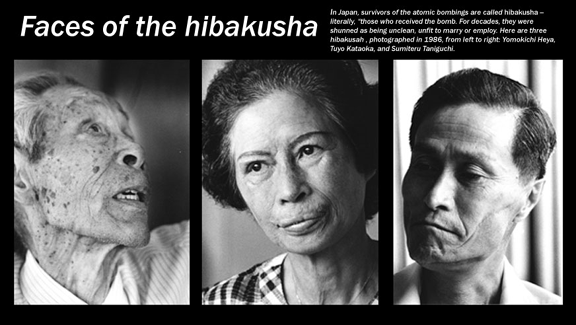
Ground Zero Nagasaki: Living the nuclear past – and future, Asia Times, By SUSAN SOUTHARD JANUARY 18, 2019 “…………….Hibakusha stories
It’s essential for us to remember such grim details, not just for the sake of history, but for our future, because nuclear weapons far more powerful and devastating than the Nagasaki bomb are now commonplace.
In a small area of Nagasaki that includes Hypocenter Park, the Nagasaki Atomic Bomb Museum, and Peace Park, dedicated teams of Japanese men and women still work tirelessly to counter the world’s inclination to forget what happened. For the past 35 years, one organization, the Nagasaki Foundation for the Promotion of Peace, has assembled cadres of hibakusha speakers – typically about 40 at any time – willing to tell their stories. They are now aging women and men with unique memories of the day of that bombing and the weeks, months and years that followed.
Sixteen-year-old Taniguchi Sumiteru was delivering mail on his bicycle about a kilometer and a half from the hypocenter when, a split-second after the bomb detonated, its tremendous force and searing heat blew him off his bicycle and slammed him face-down on to the road. His entire back was burned off. By all rights, he should never have survived. Three months later, he finally received medical treatment. Still in constant pain 10 years after the bombing, he became one of Nagasaki’s earliest anti-nuclear activists.
Wada Koichi, an 18-year-old streetcar driver at the time of the bombing, decided to speak out when he held his first grandchild and flashed back to the charred corpse of a baby he’d stepped over as he searched for his missing colleagues.
Do-oh Mineko, then 15, suffered critical injuries to her head and lingered near death for months. Though those injuries eventually healed, radiation exposure had caused all her hair to fall out. For nearly a decade, she hid in her house until her hair finally grew back. As an adult, she kept her identity as a hibakusha secret until, in her late 60s, she found new meaning for her life by telling her story to schoolchildren.
Yoshida Katsuji, only 13, was looking up in the direction of the bomb at the moment it exploded. His entire face was scorched. Years later, as friends and colleagues told their stories publicly, he remained silent, afraid of looks of disgust from audiences due to his disfigurement. He finally began speaking out in his late 60s after deciding that being shy was not a good reason to keep silent when it came to the terrorizing impact of nuclear weapons.
These four and many others dared to cross boundaries in Japanese culture to tell their personal stories of suffering and help others grasp what nuclear war would mean for the world. Unfortunately, most hibakusha – at least those who were old enough to have vivid memories of the bombing and its aftermath – have died or are reaching the end of their lives. They are the only people capable of telling us first-hand about the experience of nuclear war, and each year their numbers diminish. ………….. http://www.atimes.com/ground-zero-nagasaki-living-the-nuclear-past-and-future/
Pentagon report on China’s nuclear weapons program, still “significantly below” the U.S.
The Pentagon Believes China Is Likely Developing A Long-Range Nuclear Bomber, Task and Purpose, Tony Capaccio, Bloomberg News, January 17, 2019 WASHINGTON — China is likely developing a long-range bomber capable of delivering nuclear weapons and a space-based early warning system it could use to more quickly respond to an attack, according to a new report from the U.S. Defense Intelligence Agency.
The development of the bomber, when combined with China’s land-based nuclear weapons program and a deployed submarine with intercontinental ballistic missile technology, would give Beijing a “triad” of nuclear delivery systems similar to the U.S. and Russia, according to the report published Tuesday.
“China is building a robust, lethal force with capabilities spanning the air, maritime, space and information domains which will enable China to impose its will in the region,” the report’s author, Lt. Gen. Robert Ashley, said in the introduction.
The report comes as President Donald Trump’s administration focuses on the potential for “great power” conflict with countries like China and Russia as part of its national defense strategy. It also comes amid heightened trade tensions between Washington and Beijing, and continuing disputes about China’s posture in the South China Sea.
……… The DIA assessment released Tuesday underscores that China maintains a “no first-use” nuclear policy but adds that there is “some ambiguity, however, over the conditions under which China’s NFU policy would apply.”
Despite a slew of disputes over Taiwan, the South China Sea and global trade, the review also says there is no indication in Chinese military strategic documents that Beijing views war with the U.S. as looming.
Moreover, while China’s defense spending climbed an average of 10 percent per year from 2000 to 2016, total spending remains “significantly below” the U.S., the report said. Spending was about 1.3 percent of gross domestic product from 2014-2018, compared to more than 3 percent of GDP for the U.S. over the same period.
China is trying to strike a balance between expanding its capabilities and reach without “alarming the international community about China’s rise or provoking the United States, its allies and partners, or others in the Asia-Pacific region into military conflict or an anti-China coalition,” the report adds.
Underlying China’s concerns are its view that the U.S.-led security architecture in Asia seeks to constrain its rise and interfere with its sovereignty, particularly in a Taiwan conflict scenario and in the East and South China Seas, said DIA.
The DIA’s observations will likely be used by proponents of the Pentagon’s drive to modernize the U.S. aging nuclear weapons infrastructure over 30 years, an effort that, when operations and support costs are included, could total about $1 trillion………. https://taskandpurpose.com/the-pentagon-believes-china-is-likely-developing-a-long-range-nuclear-bomber
Concerns about safety of China’s planned 46 nuclear reactors within a radius of about 100 km from Hong Kong and Macau.

 China’s Guangdong to have 26 nuclear reactors, Indigenous Hualong reactors to be built at new megaplant in Huizhou, JANUARY 17, 2019 China’s southern Guangdong province is on a spree constructing nuclear power plants, with the latest addition to the province’s nuclear plant cluster in the city of Huizhou, 90 kilometers northeast of Hong Kong…..
The 120 billion yuan (US$17.74 billion) megaproject, to be run by the state-owned China General Nuclear Power Corp (CGN), will bring the total number of nuclear reactors in Guangdong, a manufacturing powerhouse and China’s largest provincial economy, to 26.
CGN’s ultimate plan is to boost that number to 46, spanning 11 plants, to power Guangdong’s booming economy, whose gross domestic product in 2018 is tipped to hit the 10-trillion-yuan mark and surpass South Korea and Canada.
The new reactors in Huizhou, already given the go-ahead by China’s environmental watchdog, will be built around China’s indigenous, third generation Hualong (China Dragon) pressurized water nuclear reactor ……..
The first Hualong reactor went live in Fujian province in 2017.
Still, concerns are being raised about the safety of so many nuclear plants, including Daya Bay, Ling’ao, Taishan, Lufeng, Yangjiang and Huizhou, within a radius of about 100 km from Hong Kong and Macau.
Guangdong’s aggressive plans to harness nuclear energy have long stoked fears about safe operations and the disposal of spent fuel rods.
CGN has sought to allay misgivings by promising more transparent consultation, reactor management and notification of incidents, but the company has given scant information about the Huizhou plant, the built-in safety infrastructure and contingency plans.
The company told Xinhua that the National Nuclear Safety Administration would conduct a further assessment of the plant’s design and safety facilities and decide the start of its construction. http://www.atimes.com/article/chinas-guangdong-to-have-26-nuclear-reactors/
Missile Defense Review: North Korea remains ‘extraordinary threat’ to US
The Missile Defense Review report, introduced by President Donald Trump during a speech at the Pentagon, was released just hours ahead of a top North Korean envoy’s arrival in Washington to discuss a potential second summit between Trump and North Korean leader Kim Jong Un……….https://www.usatoday.com/story/news/world/2019/01/17/missile-defense-review-north-korea-still-poses-extraordinary-threat/2610585002/
High radiation levels in Fukushima area, but the Japanese government is pushing people back there
Fukushima Residents Return Despite Radiation, Eight years after the nuclear meltdown, wary citizens are moving back to contaminated homesteads—some not by choice, Scientific American, By Jane Braxton Little January 16, 2019
 When the Fukushima Daiichi Nuclear Power Plant began spewing radioactive particles after it was clobbered by a tsunami in March 2011Kaori Sakuma fled. She bundled her infant and toddler into a car and left her husband and family in Koriyama, 44 miles west of the ruptured facility. “The truth is, I ran away,” she says. Confronting gas shortages and snarled roads, she transported her children 560 miles away to Hokkaido, about as far as she could get.
Radiation from the fuming plant spread over tile-roofed towns and rice paddies across an area the size of Connecticut. The meltdown 150 miles north of Tokyo drove more than 200,000 people out of the region. Most believed they were fleeing for their lives. Now, almost eight years after the accident, the government has lifted most evacuation orders. Nearly 122,000 people have been allowed to return to communities where weeds have overtaken parking lots. Most are elderly, relieved to be resuming their lives. Prime Minister Shinzo Abe is determined to end all evacuations by 2020, when Japan will host the Olympic Summer Games. The events will include baseball and softball competitions in Fukushima City, a mere 55 miles from the ruined reactors.
Around 35,000 other citizens still wait to return, but they and many others throughout northeastern Japan worry all of this is too soon. Radiation, which is generally linked to cancer, in some places continues to measure at least 5 millisieverts (mSv) a year beyond natural background radiation, five times the added level Japan had recommended for the general public prior to the incident. In certain spots radioactivity is as high as 20 mSv, the maximum exposure recommended by international safety experts for nuclear power workers.
In its haste to address the emergency, two months after the accident the Japanese government raised the allowable exposure from 1 mSv annually, an international benchmark, to 20 mSv. Evacuees now fear Abe’s determination to put the Daiichi accident behind the nation is jeopardizing public health, especially among children, who are more susceptible. Lifting most evacuations has also ended subsidies for evacuees, forcing many to return despite lingering questions.
As more people inside and outside the country absorb the radiation data, Japanese officials are confronting a collapse of public confidence. Before the accident residents in Japan (and the U.S.) were living with background radiation that averaged 3.1 mSv a year,most of it emanating naturally from the ground and space. In Japan and the U.S. many residents experience an additional 3.1 mSv annually, due mostly to medical testing. But the anxiety of Fukushima residents facing even higher levels is palpable. If the government is going to fully restore lives and livelihoods, it needs to regain their trust, says nuclear engineer Tatsujiro Suzuki, a professor at Nagasaki University and former vice chairman of the Japan Atomic Energy Commission. That, he says, should include respecting international safety standards for radiation and lowering the allowable level at least to 5 mSv, although he acknowledges “even 5 mSv is too high for children.”
……….Concern about children is one of the most controversial issues. When officials raised the allowable level of radiation to 20 mSv, including in schools, it was under the guise of giving people a measure of normalcy. But the May 2011decision became a flash point for opponents of the government’s handling of the accident. They were furious children would be subjected to the maximum radiation allowed for nuclear workers, spending day after day in buildings that increased their cancer risk to one in 200 people.
Sakuma was one of those who returned to Koriyama, from her outpost in Hokkaido. She did not want her young children to touch contaminated soil or water along their walk to school, so she carried them both on her small back. “We all want our kids to play in the dirt and pick flowers but I was afraid. We all were,” says Sakuma, now 46. ……https://www.scientificamerican.com/article/fukushima-residents-return-despite-radiation/
Japanese people losing trust in government, as the Fukushima nuclear catastrophe still poses health risks
 Fukushima Residents Return Despite Radiation Eight years after the nuclear meltdown, wary citizens are moving back to contaminated homesteads—some not by choice, SCIENTIFIC AMERICAN, BY JANE BRAXTON LITTLE JANUARY 16, 2019
“………. LACK OF PUBLIC TRUST
In the year after the accident Koriyama was one of 12 communities where the ongoing radiation rate measured between 3 and 5 mSv above background, but the town had not been evacuated. Today’s levels have stabilized at 1.5 mSv, but doubts remain. Skeptical of the government’s readings, Shigeru Otake, 49, takes his own. A slim man who wears a Dollar Store rope belt to give him “strength like a samurai,” he says he has measured radiation spikes at 15 mSv in Koriyama, where his family has lived for generations. Sakuma walks her sons, now eight and 10 years old, to school past a government monitoring post that she claims reads six times lower than her own dosimeter does.
Misgivings about government assurances of safety drove Hiroshi Ueki, 48, to move his family to Nagano Prefecture, where he is now growing “the best grapes in the world.” His parents stayed behind in Fukushima Prefecture. Ueki says he will never move back. “The prime minister says the accident is over but I won’t ever feel safe until the Daiichi plant itself is finally shut down. That will take 100 years.”
In spite of these concerns, Japan has continued to showcase repatriation as a barometer of progress toward recovery. By April 2017, the government had lifted all evacuations except for the most contaminated places closest to Daiichi. That decision also ended rent-free housing provided to people who were forced to leave as well as to some 26,600 people like Ueki who vacated voluntarily. Left without the $10,000 monthly subsidy provided by Tokyo Electric Company, some people have been forced to return home despite their safety concerns. They have no other economic options, says Hajime Matsukubo, general manager of the Citizens’ Nuclear Information Center. Some 16,000 people who refuse to return have been financially abandoned, according to the center.
Scientists generally agree on a few basics: The risks of getting leukemia or other cancers are higher for children than adults, and the risks for everyone increase significantly with exposure above 100 mSv annually. Various national agencies have set 20 mSv per year as a maximum for occupational exposure. Public exposure should be no more than 1 mSv per year above background levels, according to the International Commission for Radiological Protection. That raises questions about Japan’s 2011 emergency declaration of 20 mSv per year as the allowable exposure. …….
The public perception is that the Daiichi nuclear accident continues to pose health risks and, significantly, nuclear power is not safe. More than 80 percent of the Japanese public wants to phase it out, according to an October 2018 study by Suzuki, the former Japan Atomic Energy commissioner. He calls the erosion of public trust “the most unfortunate impact of the accident.”
Sakuma, the Koriyama mother, is using the Daiichi accident as a lesson in radical civic involvement. She intends to keep her sons in Koriyama despite radiation concerns. “I want them to grow up here so they can learn what the government does. I want them to tell other people about how it is to live with radiation,” she says. “This accident is not over.” https://www.scientificamerican.com/article/fukushima-residents-return-despite-radiation/
Japan must say NO to nuclear power, says former Prime Minister
 Koizumi says Japan must say ‘no’ to nuclear energy, THE ASAHI SHIMBUN, January 17, 2019, When he was prime minister, Junichiro Koizumi championed the use of atomic power to generate electricity.
Then the 2011 earthquake and tsunami disaster struck, triggering a crisis at the Fukushima No. 1 nuclear power plant in Fukushima Prefecture.
Koizumi, in office from 2001 to 2006, and widely regarded as one of Japan’s most popular postwar leaders, started reading up on the nuclear issue, and had a change of heart. Koizumi, 76, published his first book by his own hand titled “Genpatsu Zero Yareba Dekiru” (We can abolish all nuclear plants if we try) in December. It is available from Ohta Publishing Co.
In it, he lambasts consumers for lacking a sense of crisis and simply believing a serious accident like the Fukushima disaster will never happen again in Japan during their lifetime.
In a recent interview with The Asahi Shimbun, Koizumi said it was “a lie” to claim that nuclear power is “safe, low-cost and clean,” although that is precisely what he espoused when he held the reins of power.
Excerpts from the interview follow.
…….. Q: Is it really possible to replace all the nuclear reactors with other sorts of power plants?
A: No reactors were operated for two years after the Fukushima disaster. But no power shortages were reported during the period. That means Japan can do without nuclear plants. It is a fact……. http://www.asahi.com/ajw/articles/AJ201901170010.html
The high costs of scrapping Japan’s nuclear reactors
Japan News 14th Jan 2019 The total cost for scrapping the nation’s nuclear power facilities —
excluding Fukushima No. 1 nuclear power plants and other facilities under construction — is estimated to be about ¥6.72 trillion, according to a tally by The Yomiuri Shimbun.
The assessment only includes dismantlements of nuclear power facilities for which the cost can currently be estimated. Among these estimates, the cost for closing a spent nuclear fuel reprocessing plant now being built by Japan Nuclear Fuel Ltd. (JNFL) in Rokkasho, Aomori Prefecture, accounts for the largest amount at ¥1.6 trillion.
The cost for decommissioning 53 commercial nuclear reactors is estimated to total about ¥3.58 trillion, for an average at ¥57.7 billion per reactor. Of the 53 reactors, 19 reactors are scheduled or are likely to be scrapped.
http://the-japan-news.com/news/article/0005476533
USA-China co-operation in removing nuclear material from Nigeria
How the US and China collaborated to get nuclear material out of Nigeria — and away from terrorist groups, Defense News, By: Aaron Mehta, 14 Jan 19, “……… Moving the nuclear material out of Nigeria has been a long-sought goal for the United States and nonproliferation advocates. But the goal has taken on increased importance in recent years with the rise of militant groups in the region, particularly Boko Haram, a group the Pentagon calls a major terrorist concern in the region.
It was the mid-1990s when Nigeria, with technical support and backing from China, began work on what would become Nigerian Research Reactor 1, located at Ahmadu Bello University in Kaduna. The location opened in 2004, and is home to roughly 170 Nigerian workers.
The design, however, used highly enriched uranium, or HEU, a type of nuclear substance often referred to by the general public as weapons-grade uranium. This kind of uranium forms the core of any nuclear weapons material, and the Nigerian material was more than 90 percent enriched, making it particularly attractive for anyone looking to use it.
Since NIRR-1 went online, however, improvements in technology meant that experiments involving highly enriched uranium could now be run with a lesser substance. Across the globe, the IAEA and its partners have worked to swap out weapons-grade material with lightly enriched uranium, or LEU, which is enriched at less than 20 percent, and hence unusable for weapons. In all, 33 countries have now become free of HEU, including 11 countries in Africa.
With just over 1 kilogram of HEU, the Nigerian material, if stolen, would not be nearly enough to create a full nuclear warhead. However, a terrorist group would be able to create a dirty bombwith the substance or add the material into a stockpile gathered elsewhere to get close to the amount needed for a large explosion.
They’re small reactors, they’re not power reactors where the fuel is so radioactive it kills you,” he said. “This is very attractive to a proliferation point of view, and they are research reactors, so they are often at universities without high security.”
Replacing HEU with LEU in research reactors naturally requires caution, as anything nuclear-related comes with risks. But the Nigerian mission was particularly difficult because of security concerns, Hanlon said. He noted that Boko Haram, while not in the Kaduna region, has been operating in Nigeria for quite some time.
“All of our partners understood that operational security was paramount,” Schwartz said. “The world is a safer place today as a result of the determined work to remove this weapons useable Uranium from Nigeria.”
China’s role
The removal operation cost roughly $5.5 million, with the United States contributing $4.3 million. The United Kingdom ($900,000) and Norway ($290,000) also chipped in. But while it didn’t contribute money, China’s role in the operation was outsized — and occurred as the war of words from the Trump administration toward Beijing was reaching a fever pitch, one that did not die down in the weeks to come.
As the October operation was just hours from starting, U.S. President Donald Trump took to the press to discuss nuclear material and China.
“Until people come to their senses, we will build [the nuclear arsenal] up,” Trump told reporters just hours before the Nigeria operation was to begin. “It’s a threat to whoever you want. And it includes China, and it includes Russia, and it includes anybody else that wants to play that game. You can’t do that. You can’t play that game on me.”
By the time the Antonov plane — carrying the HEU, along with American inspectors and security — arrived at Shijiazhuang airport in China on Dec. 6, the arrest of a Chinese technology executive in Canada had inflamed fears of a trade conflict between the two countries.
“Even though the national level conversation is really poor because of trade and other issues, the technical collaboration between laboratories, between nuclear engineers, that’s generally gone pretty well,” he said. He added that China has invested heavily in LEU over the last decade, and therefore also has an interest in encouraging others to switch to that technology.
Whether that cooperation continues if relations between the two nations continue to deteriorate will be a true test going forward……… https://www.defensenews.com/news/pentagon-congress/2019/01/14/how-the-us-and-china-collaborated-to-get-nuclear-material-out-of-nigeria-and-away-from-terrorist-groups/
India’s nuclear submarines
ANGLES AND DANGLES: ARIHANT AND THE DILEMMA OF INDIA’S UNDERSEA NUCLEAR WEAPONS, YOGESH JOSHI, War on the Rocks,
JANUARY 14, 2019, SPECIAL SERIES – SOUTHERN (DIS)COMFORT Editor’s Note: This is the 24th installment of “Southern (Dis)Comfort,” a series from War on the Rocks and the Stimson Center. The series seeks to unpack the dynamics of intensifying competition — military, economic, diplomatic — in Southern Asia, principally between China, India, Pakistan, and the United States. Catch up on the rest of the series.
After INS Arihant, India’s first ballistic missile submarine (SSBN), finished its maiden deterrent patrol in November 2018, Prime Minister Narendra Modi emphatically declared India’s nuclear triad complete. Arihant’s operationalization has catapulted India into a select group of states with an underwater nuclear launch capability. It has also raised alarm over the safety and security of India’s nuclear arsenal because a sea-based deterrent may entail a ready-to-use arsenal and less restrictive command and control procedures, increasing probability of their accidental use. For Pakistan, India’s nuclear force modernization endangers the balance of strategic forces in the region and could intensify the nuclear arms race on the subcontinent……….
Arihant’s operationalization is an opportunity for New Delhi to reflect upon its nuclear trajectory. With China and Pakistan as nuclear adversaries, India confronts a unique challenge. It has to build up its nuclear capability enough to ensure that Chinese decision-makers fear it, without sending Islamabad into panic and undermining regional stability. This “Goldilocks dilemma” will be difficult to resolve, and India should not leave it to chance — especially as the United States, once South Asia’s chief crisis manager, loses both interest and influence in the region. India should reassure Pakistan by reaffirming its policy of no first use of nuclear weapons and a retaliation-only nuclear doctrine. More importantly, India should rethink its deterrence requirements vis-à-vis China.
Ultimately, the risk is that India will fail to achieve its aim of deterring China while unintentionally provoking its smaller rival……………..
To increase stability, India should publicly reaffirm its policy of no first use and adopt a retaliation-only nuclear posture, particularly since prominent voices in India’s strategic community have questioned these principles in the recent past. It should clarify that it has no intentions to use its nuclear forces in a preemptive mode. One Strategic Forces Command official told me that Arihant will only be used for countervalue strikes — that is, retaliatory strikes against Pakistani cities. Such declarations ought to be made at the highest levels of the Indian government. Arihant’s job — and, for that matter, the job of India’s entire nuclear arsenal — is to not create “fearlessness” in the Indian mind, as Modi’s office claimed. Rather, it is to ensure that India’s nuclear adversaries fear the consequences of their actions. A nuclear dialogue with Pakistan should therefore be reopened and shielded from the vagaries of domestic politics.
The nuclear competition between China, India, and Pakistan is a classic case of a triangular security dilemma. As India pursues deterrence stability vis-à-vis one adversary, it makes another adversary feel increasingly vulnerable……..
Yogesh Joshi is a Stanton Nuclear Security Postdoctoral Fellow at the Center for International Security and Cooperation, Stanford University. He is the coauthor of India and Nuclear Asia: Forces, Doctrine and Dangers (Georgetown University Press, 2018). https://warontherocks.com/2019/01/angles-and-dangles-arihant-and-the-dilemma-of-indias-undersea-nuclear-weapons/
Covert nuclear development in Taiwan was stopped, because a senior scientist feared danger
Colby Cosh: How Canada almost left the door to the nuclear club ajar … again, National Post, 14 Jan 19,
Covert nuclear development in Taiwan was finally stopped cold because a senior scientist became convinced nukes were dangerous
In November, historians David Albright and Andrea Stricker published a new book called Taiwan’s Former Nuclear Weapons Program: Nuclear Weapons On-Demand. The book pulls together the previously sketchy story of Nationalist China’s covert nuclear research, which had its roots in the postwar exodus of Chiang Kai-shek and the Kuomintang party (KMT). Albright and Stricker describe decades of effort by the offshore Republic of China on Taiwan to play a double game with nuclear weapons. ………
The key to the story is the 40-megawatt uranium-fuelled Taiwan Research Reactor (TRR), supplied, like CIRUS, by Canada. TRR was very similar to CIRUS in design and capability. The pile went critical in January 1973, giving Taiwan an indigenous source of plutonium. Under the sales agreement, the reactor was to be “safeguarded” by the International Atomic Energy Agency (IAEA), answering to its inspectors and accounting for the whereabouts of its fuel. But Taiwanese nuclear agencies immediately began to behave suspiciously, talking to some of the slimier European industrial concerns about buying reprocessing equipment that would allow weapons manufacture
……….Covert nuclear development in Taiwan was finally stopped cold because one of the Republic’s senior scientists, Chang Hsien-yi, became convinced that nukes were dangerous to the existence of the Republic………. Email: ccosh@postmedia.com | Twitter: https://nationalpost.com/opinion/colby-cosh-how-canada-almost-left-the-door-to-the-nuclear-club-ajar-again
USA govt could live with a Nuclear North Korea, but wouldn’t admit it
Can America Live with a Nuclear North Korea? National Interest, MilitaryTechnologyWorldICBM
Question: Can America live with an atomic North Korea, and could any presidential administration openly admit it can? The answer: Yes it can, and no it couldn’t.
Forcibly disarming Pyongyang could and probably would involve sacrificing thousands of American and Korean lives. Here’s a crude yardstick. The Korean War, a conventional conflict to preserve an independent South Korea, cost the United States some 37,000 military lives. Many more service folk suffered wounds. Thirty-seven thousand. That’s more than fivefold the combined American military death toll from the Afghanistan and Iraq wars since 9/11. And that leaves aside countless more Korean military and civilian lives expended fighting to the current standstill along the inter-Korean border.
It’s hard to see how war could be waged more cheaply than it was in 1950-1953 when the principal combatants, not to mention North Korea’s ally China and neighbor Russia, all boast nuclear weapons to accompany formidable conventional forces. And Washington must not delude itself into thinking air and sea power can do the job alone, any more than aviators and mariners repulsed the North Korean invasion in 1950. It took land forces back then—and today, in all likelihood, ground combat would be required to destroy the dug-in North Korean nuclear complex.
Any military strategy worth the name would demand that U.S. Army and Marine forces again seize and control ground—allowing them the leisure to ferret out underground facilities and armaments.
In short, a new Korean War would not be a come-and-go affair. Such a forecast is solidly grounded in the classics of strategy. For instance, Admiral J. C. Wylie points out that the proper goal of military strategy is to impose control on the foe. Aircraft and missiles flit by overhead while ships remain offshore. Though formidable, their presence is too intermittent to qualify as control. That being the case, he pronounces the soldier slogging through mud the “ultimate determinant” of who emerges the victor. The soldier goes and stays. “He is control,” proclaims Wylie. No control, no strategic success.
Nor is it obvious that winning control is crucial in Northeast Asia………
Chances are, then, Washington will continue to insist on complete disarmament on the Korean Peninsula but will refrain from using force to bring about that happy end. …….https://nationalinterest.org/blog/buzz/can-america-live-nuclear-north-korea-41387
Schoolchildren co-opted to promote propaganda on Fukushima food safety
 Students tasked to develop dishes with Fukushima produce to promote prefecture’s recovery, Japan Times, 13 Jan 19
A group of elementary, junior high and high school students in the city of Fukushima are taking part in an initiative to develop original recipes using local agricultural products as part of a broader project to highlight the city’s recovery from the 2011 Great East Japan Earthquake.
The first phase of the campaign, known as the Fukko Project, whereby the students create new dishes, started Dec. 16. It is designed to help the children learn about local agriculture so they will be able to implement their own action plans to assist Fukushima’s recovery……https://www.japantimes.co.jp/news/2019/01/13/national/students-tasked-develop-dishes-fukushima-produce-promote-prefectures-recovery/#.XDudF9IzbGg
Russia’s Rosatom to manage accident plan at the Fukushima NPP
 Russia’s Rosatom wins two bids for accident management at Fukushima NPP http://tass.com/world/1039631, January 12, 2019, MOSCOW, Russia’s state nuclear corporation Rosatom has been engaged in the nuclear control plan at Japan’s stricken Fukushima nuclear power plant and has already won two bids in that project, Rosatom CEO Alexei Likhachev said in a televised interview with Rossiya’24 news channel on Saturday.
“We have been engaged by Japan to implement the nuclear accident management plan at the Fukushima NPP. We have won two tenders and are getting ahead,” he said.
In September 2017, Rosatom’s First Deputy CEO Kirill Komarov said that Rosatom offered help to Japanese counterparts in handling the crippled Fukushima NPP.
The nuclear disaster at the Fukushima-1 power plant in March 2011 was triggered by an earthquake-induced tsunami that knocked out vital reactor cooling systems. This resulted in three nuclear meltdowns, hydrogen explosions and a massive release of radioactive waste, which contaminated the surrounding area. Clean-up operations continue at the power plant and adjacent territories. According to the current action plan, full decommissioning of the station may take place only around 2040.
1 This Month
26 September – International Day for the Total Elimination of Nuclear Weapons





PLEASE OPPOSE HR 8255 AND S.3639 – bills would accelerate satellite deployment, with no environmental review or safeguards – https://ncstd5li.quorum.us/campaign/169331/
To see nuclear-related stories in greater depth and intensity – go to https://nuclearinformation.wordpress.com
-
Archives
- September 2026 (305)
- August 2026 (330)
- July 2026 (355)
- June 2026 (287)
- May 2026 (306)
- April 2026 (356)
- March 2026 (251)
- February 2026 (267)
- January 2026 (308)
- December 2025 (358)
- November 2025 (359)
- October 2025 (375)
-
Categories
- 1
- 1 NUCLEAR ISSUES
- business and costs
- climate change
- culture and arts
- ENERGY
- environment
- health
- history
- indigenous issues
- Legal
- marketing of nuclear
- media
- opposition to nuclear
- PERSONAL STORIES
- politics
- politics international
- Religion and ethics
- safety
- secrets,lies and civil liberties
- spinbuster
- technology
- Uranium
- wastes
- weapons and war
- Women
- 2 WORLD
- ACTION
- AFRICA
- Atrocities
- AUSTRALIA
- Christina's notes
- Christina's themes
- culture and arts
- Events
- Fuk 2022
- Fuk 2023
- Fukushima 2017
- Fukushima 2018
- fukushima 2019
- Fukushima 2020
- Fukushima 2021
- general
- global warming
- Humour (God we need it)
- Nuclear
- RARE EARTHS
- Reference
- resources – print
- Resources -audiovicual
- Weekly Newsletter
- World
- World Nuclear
- YouTube
-
RSS
Entries RSS
Comments RSS

