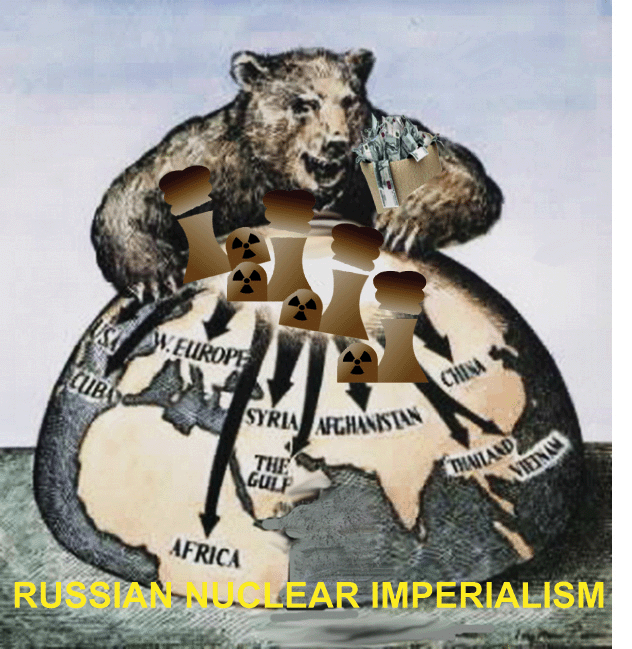
Russia withdraws from Cold War-era nuclear weapons treaty with US https://www.abc.net.au/news/2019-02-02/russia-withdraws-from-cold-war-era-nuclear-weapons-treaty/10774536 Russia has suspended a Cold War-era nuclear weapons treaty, President Vladimir Putin said, after the United States accused Moscow of violations and said it would withdraw from the arms control pact.
 Key points:
- Russia will start work on new missiles, including hypersonic ones

- US and Russia both allege the other has violated the INF treaty
- China urges dialogue amid fears of nuclear arms race
The Intermediate-range Nuclear Forces (INF) Treaty prevents the two superpowers from possessing, producing or test-flying ground-launched nuclear cruise missiles with a range of 500 to 5,500 kilometres.
The United States announced it will withdraw from the INF treaty in six months unless Moscow ends what it says are violations of the pact, but Russia denied violating the treaty.
“The American partners have declared that they suspend their participation in the deal, we suspend it as well,” Mr Putin said during a televised meeting with foreign and defence ministers.
Mr Putin said Russia will start work on creating new missiles, including hypersonic ones, and told ministers not to initiate disarmament talks with Washington, accusing the United States of being slow to respond to such moves.
“We have repeatedly, during a number of years, and constantly raised a question about substantiative talks on the disarmament issue,” Mr Putin said.
“We see that in the past few years the partners have not supported our initiatives.”
The US alleges a new Russian cruise missile violates the important pact, signed by former leaders Ronald Reagan and Mikhail Gorbachev in 1987.
The missile, the Novator 9M729, is known as the SSC-8 by the North Atlantic Treaty Organisation (NATO).
Russia said the missile’s range put it outside the treaty, and accused the US of inventing a false pretext to exit a treaty it wants to leave anyway so it can develop new missiles.
Russia also rejected the demand to destroy the new missile.
During the meeting with Mr Putin, Russian Foreign Minister Sergey Lavrov accused the US of violating the INF and other arms deals, including the non-proliferation treaty.
Mr Putin said Russia would not deploy its weapons in Europe and other regions unless the US did so.
Fears of new arms race
The row over the INF treaty is yet another twist in Russia’s worsening relations with the United States and the West, with tensions over Russia’s annexation of Crimea from Ukraine as well as allegations of it meddling with the presidential election in the US and being behind a nerve agent attack in Britain.
The treaty’s suspension has drawn a strong reaction from Europe and China.
European nations fear the treaty’s collapse could lead to a new arms race with possibly a new generation of US nuclear missiles stationed on the continent.
In a statement, China’s Ministry of Foreign Affairs said the bilateral treaty was important to maintain “global strategic balance and stability”.
“China is opposed to US withdrawal action and urges the United States and Russia to handle their differences properly through constructive dialogue,” the statement said, warning that unilateral withdrawal could trigger “negative consequences”.
February 4, 2019
Posted by Christina Macpherson |
China, politics international, Russia, USA, weapons and war |
Leave a comment
Does Russia Have a Plan to Solve the North Korea Nuclear Crisis? https://nationalinterest.org/blog/buzz/does-russia-have-plan-solve-north-korea-nuclear-crisis-43022 2 Feb 19, Some think so. by Stratfor Worldview
What Happened: The Russian government reportedly made a secret proposal to North Korea in the fall of 2018 to construct a nuclear power plant in the country in exchange for North Korea dismantling its nuclear weapons and ballistic missiles, The Washington Post reported Jan. 29, citing unnamed U.S. officials. The Russian envoy to North Korea, meanwhile, denied the report.
Why It Matters: Russia’s alleged offer would imply attempts to insert itself into the negotiation process over North Korea’s nuclear program. U.S. President Donald Trump is slated to hold a second summit with North Korean leader Kim Jong Un in late February.
Background: Kim placed a significant emphasis on rectifying North Korea’s electricity problems during his New Year’s speech. Meanwhile, Russian Deputy Foreign Minister Igor Morgulov received a delegation from North Korea’s Foreign Ministry in Moscow on Jan. 29.
February 4, 2019
Posted by Christina Macpherson |
North Korea, politics international, Russia |
Leave a comment
Tokyo’s Metropolitan Police Department (MPD) headquarters
TOKYO — Radioactive materials that appear to be uranium were sold and bought on an internet auction website, people close to a police investigation into the case told the Mainichi Shimbun on Jan. 30.
The materials have been confiscated by the Tokyo Metropolitan Police Department (MPD) consumer and environment protection division and passed on for identification to the Japan Atomic Energy Agency (JAEA) officials. The JAEA judged that the materials are extremely likely to be depleted uranium and yellowcake uranium concentrate powder.
Police have identified the sellers and buyers of the materials, and will launch a full-fledged investigation into the case shortly as a possible violation of the Act on the Regulation of Nuclear Source Material, Nuclear Fuel Material and Reactors. The law regulates unauthorized transfer of nuclear fuel material in the country. Violators face an imprisonment of up to 1 year or 1 million yen in fine.
According to individuals close to the investigation, the secretariat of the Nuclear Regulation Authority first spotted materials dubbed as “uranium” were placed on an auction website, and reported the issue to the MPD. Investigators identified the seller and several buyers and confiscated the materials in question. The items were either powdered or solid and radioactive. They were placed in glass casings and weighed several grams in total. The seller agreed to voluntary questioning by police, saying that he had bought the goods on an overseas website.
The MPD requested that the JAEA identify the items in mid-December last year. The materials are likely to include depleted uranium that was produced during uranium enrichment and yellowcake, according to the people close to the investigation. The final results of the agency examination are expected to be released soon. Depleted uranium contains the fissile uranium 235 isotope at a concentration less than the natural concentration of 0.7 percent.
Experts worry that such radioactive materials could be abused in “dirty bombs” designed to disperse such materials as a form of terrorism. Professor Mitsuru Fukuda of the Nihon University College of Risk Management says the use of such explosives could result in sealing off the detonation area so that residents can evacuate and the area can be decontaminated.
“People’s concerns would rise and economic activities could stop. Even a tiny amount of material with low radioactivity could have a major impact on society,” he said.
(Japanese original by Ikuko Ando, City News Department, and Toshiyuki Suzuki and Riki Iwama, Science & Environment News Department)
February 3, 2019
Posted by dunrenard |
Japan | Internet, Uranium sale |
Leave a comment
The Japan Atomic Energy Agency’s nuclear fuel reprocessing plant in Tokai, Ibaraki Prefecture, is seen in 1997.
Radiation leaks at Japan plutonium lab; no workers exposed
A Japanese state-run nuclear fuel laboratory near Tokyo said Wednesday it detected a radiation leak in its plutonium handling facility, but no workers were exposed.
The Japan Atomic Energy Agency said a radiation alarm went off after nine workers changed plastic covers on two canisters containing MOX, a mixture of plutonium and uranium, and removed them from a sealed compartment.
JAEA said the workers, each wearing a mask, escaped radiation exposure after running into another room. No leak was detected outside the Nuclear Fuel Cycle Engineering Laboratories in Tokai Village, northeast of Tokyo. The facility ended nuclear fuel production in 2001 and is being decommissioned.
The cause of the leak is under investigation. The agency suggested possible damage to the plastic covers during the routine change.
JAEA has been reprimanded repeatedly by Japanese nuclear authorities for its poor safety record in recent years. A bag of plutonium broke during an inspection at another facility operated by the agency in 2017, contaminating five workers. A plutonium-burning fast breeder reactor, Monju, is being scrapped after suffering an accident in 1995.
Japan’s possession of large plutonium stockpiles from its struggling nuclear spent-fuel recycling program has raised international concerns. Critics say Japan should stop extracting plutonium, citing risks of it being used to develop nuclear weapons. JAEA possesses about half of the 10.5 tons of separated plutonium that Japan has at home, while an additional 37 tons have been reprocessed and are stored overseas.
To reduce the stockpile, Japan burns plutonium as MOX fuel in conventional reactors. Restarts of halted nuclear plants have proceeded slowly amid persistent anti-nuclear sentiment since the 2011 Fukushima nuclear power plant disaster.
Alarm triggered at onetime nuclear fuel facility in Ibaraki after leak of radioactive substances
An alarm was triggered at a onetime nuclear fuel manufacturing facility Wednesday after radioactive substances leaked from materials that were being transferred at the facility operated by the Japan Atomic Energy Agency in Tokai, Ibaraki Prefecture, company officials said.
All nine of the workers who were in the room when the radiation leak occurred were cleared with no ill affects to their health, JAEA official Shinichi Nishikawa told a news conference.
JAEA said the workers, each wearing a mask, escaped radiation exposure after running into another room. No leak was detected outside the Nuclear Fuel Cycle Engineering Laboratories. The facility ended nuclear fuel production in 2001 and is being decommissioned.
The cause of the leak is under investigation. The agency suggested possible damage to the plastic covers during the routine change.
Officials told the news conference that they would begin assessing the site as soon as possible to determine how much radioactive material had been leaked and if it was still leaking.
The agency will file a report of its findings to the Nuclear Regulation Authority and come up with preventive measures.
The warning alarm that detects radioactive materials went off at around 2:30 p.m. as workers were removing radioactive materials — which were contained in a plastic bag — from sealed-up equipment that had been used for experiments.
The mixed oxide fuel (MOX) and plutonium was being kept in a sealed glove box container for future research.
The alarm is set up in an area of the facility once used for the production of MOX nuclear fuel made by mixing uranium with plutonium extracted from spent nuclear fuel.
In June 2017, a JAEA research facility in the town of Oarai, Ibaraki Prefecture, was the scene of another leak of radioactive substances, including powdered plutonium, when a plastic bag containing nuclear fuel remnants exploded. Five workers who were handling the materials were exposed to the substances.
JAEA possesses about half of the 10.5 tons of separated plutonium that Japan stores domestically, while an additional 37 tons have been reprocessed and are stored overseas. To reduce the stockpile, Japan burns plutonium as MOX fuel in conventional reactors.
Restarts of halted nuclear plants have proceeded slowly amid persistent anti-nuclear sentiment since the 2011 Fukushima nuclear power plant disaster.
February 3, 2019
Posted by dunrenard |
Japan | Leak, plutonium, Tokai NPP |
Leave a comment
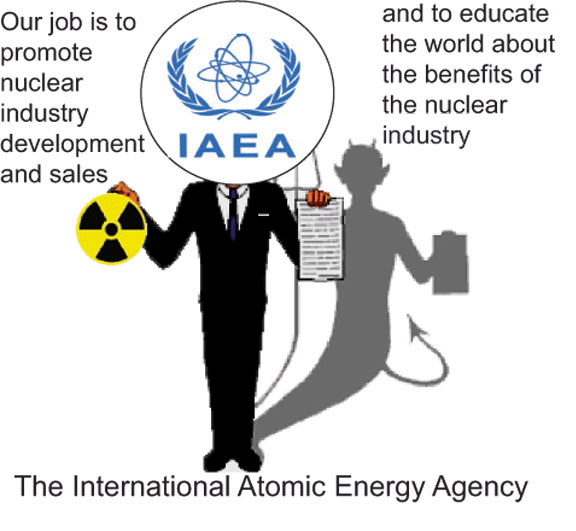
IAEA urges Japan to take ample time in Fukushima cleanup https://phys.org/news/2019-01-iaea-urges-japan-ample-fukushima.html January 31, 2019 by Mari Yamaguchi The International Atomic Energy Agency urged Japan on Thursday to spend ample time in developing a decommissioning plan for the tsunami-damaged Fukushima nuclear power plant and to be honest with the public about remaining uncertainties.
In a report based on a visit by an IAEA team to the plant in November, the agency urged the operator, Tokyo Electric Power Co., to secure adequate space and finish plans for managing highly radioactive melted fuel before starting to remove it from the three damaged reactors.
The cores of the three reactors melted after a massive 2011 earthquake and tsunami. Utility and government officials plan to start removing the melted fuel in 2021, but still know little about its condition and have not finalized waste management plans.
“The IAEA review team advises that before the commencement of the fuel debris retrieval activities, there should be a clear implementation plan defined to safely manage the retrieved material,” the report said. “TEPCO should ensure that appropriate containers and storage capacity are available before starting the fuel debris retrieval.”
The report also urged the government and TEPCO to carefully consider ways to express “the inherent uncertainties involved” in the project and develop “a credible plan” for the long term. It advised TEPCO to consider adopting contingency plans to “accommodate any schedule delays.”
Dale Klein, a former U.S. Nuclear Regulatory Commission chairman who heads a TEPCO reform committee, said in a recent interview that the decommissioning should not be rushed, even if the government and TEPCO have set a schedule and people want to see it move faster.
“It’s much better to do it right than do it fast,” he said, adding that it’s also good not to rush from a health and safety perspective. “Clearly, the longer you wait, the less the radiation is.”
He said he would be “astounded” if the current schedule ends up unchanged.
In order to make room in the plant compound to safely store the melted fuel and for other needed facilities, about 1 million tons of radioactive waste water currently stored in hundreds of tanks will have to be removed. The IAEA team, headed by Xerri Christoph, an expert on radioactive waste, urged the government and TEPCO to urgently decide how to dispose of it.
Nuclear experts, including officials at the IAEA and Japanese Nuclear Regulation Authority, have said a controlled release of the water into the Pacific Ocean is the only realistic option. A release, however, is unlikely until after the Tokyo 2020 Olympic Games in order to avoid concerns among visitors from overseas.
February 2, 2019
Posted by Christina Macpherson |
Fukushima continuing, politics, politics international, secrets,lies and civil liberties |
Leave a comment
While countries like Germany, Belgium, France, and Japan are trying to find an escape route from nuclear power, Bangladesh is taking two steps back. Although the 2,400-MW Rooppur nuclear power project has already garnered some support, there are critical issues that need to be addressed for the country’s safety and security. We need to establish whether the claims of cheap electricity, people’s acceptance, risk-free waste management and use of safe technology are simply rhetoric or not. We also need to draw a careful line between fact and propaganda.
Technology is not the answer
Technology is ever-changing, ever-developing. Thus, the glorification of the “third generation plus” reactor for Rooppur Nuclear Power Plant (NPP) must be challenged.
Russian company Rosatom won the bid to construct the plant in Bangladesh and is now trying to sell us on “post-Fukushima technology”. But can the same company guarantee that there will not be a thing such as “post-Rooppur technology”?
4,000 lives were lost in Chernobyl. Till date, USD 188 billion has been devoted towards cleaning up Fukushima. That too in a country renowned for its technological advancement. Right now, third-generation technology might be the latest one, but surely it’s not the last. When the Fukushima disaster happened, it had the most advanced technology yet, but that did not avert disaster.
Advanced technology could be their selling point, but it does not truly diminish any of our concerns. In fact, the question we should all be asking is: why is such “safe” technology in such dire need of the protection of the indemnity law—the Nuclear Power Plant Act 2015—in the case of any accidental loss of anyone related?
Radiation leaks are also very common in nuclear power plants, but the concerned authorities have always managed to shrug off the problem. That’s how this industry is still surviving. Only last October, the IRSN, France’s public authority on nuclear safety and security, identified a cloud of radioactive isotope ruthenium-106 in European territory originating from a Russian nuclear facility. But Russia’s nuclear agency has refused to accept responsibility (The Guardian, November 21, 2017).
In India, on the other hand, 1,733 scientists and employees who used to work in nuclear establishments and related facilities died between 1995 to 2010. Most of the victims were below 50 years of age (Rediff, October 4, 2010). However, there was neither any fact-finding committee nor any public disclosure about such a large number of untimely deaths in so-called “safe” nuclear facilities. The government of India has formed three committees so far for auditing the safety and security standards of nuclear power plants, but the recommendations, which require millions of dollars, are yet to be implemented.
Too expensive to matter?
The once-rhetorical claim made by the nuclear industry of making electricity “too cheap to matter” has already proven wrong and turned into a case of “too expensive to matter.” In fact, it matters so much that the world’s largest nuclear builder, Westinghouse, filed for bankruptcy protection in the US last year (The Guardian, March 29, 2017). And according to the latest World Nuclear Industry Status Report (WNISR), the French state-owned nuclear builder and service company AREVA had accumulated USD 12.3 billion in losses over the past six years and was at last bailed out by the government with a cash injection worth USD 5.3 billion and subsequently broken up.
Such extravagant expenditure is not new for the nuclear industry. Rather it has been surviving on state-sponsorship since its inception. But now the price of this arrangement is felt so heavily by some countries that they have decided to pull the plug on it. For example, Vietnam decided to backtrack from nuclear power projects even after its deals with Russia and Japan—not because of baseless fears, but because the costs were escalating at such a rate that within just seven years the projected costs doubled (Reuters, November 22, 2016).
Costs rising exponentially is nothing new. The construction of 75 nuclear reactors was started in the US between 1966 and 1976. In each of these cases, the actual construction cost was found to be 300 percent higher on average than the estimated cost at the beginning (Ramana M V, 2009). Similarly, the construction of the 1,600 MW Flamanville nuclear power plant has already required three times the predicted cost till date and is yet to be completed (Reuters, December 4, 2012).
Bangladesh’s Rooppur power plant is no exception. Even before construction started, the project cost increased from USD 4 billion to USD 12.65 billion within just three years of the time frame (WNISR 2017). As the contract with Russia is not a fixed price contract, but a cost plus one, the vendor retains every right to come up with a revised budget in coming days. 90 percent of its required budget is being taken from Russia on credit at an interest rate of the Intercontinental Exchange London Interbank Offered Rate plus 1.75 percent, which is not only going to increase national debt, but also impose a great threat on our economy as a whole. Worrying still, the government has not disclosed the estimated price per unit of electricity from this plant after accounting for fuel cost, waste management and disposal cost, and decommissioning cost.
Rhetorical claim
While the government is touting the international standards and guidelines that will be abided, in reality, without public participation and public disclosure of the much needed Environmental Impact Assessment (EIA) and without asserting the guideline of the International Atomic Energy Agency (IAEA), these claims are nothing but sheer rhetoric.
In Bangladesh, a 300-800 metre area surrounding the nuclear reactor is being considered as “Exclusion Zone” or “Sanitary Protection Zone”and it is being claimed that people are safe outside this 800-metre parameter. But according to IAEA safety standard guidelines, there are in fact two safety zones—the Precautionary Action Zone, which has a five-kilometre radius and where it is recommended to have evacuation facilities for an emergency evacuation within 15 minutes; and the Urgent Protective Action Planning Zone, which has a 30-kilometre radius and where it is recommended to have evacuation facilities for an emergency evacuation within an hour.
The people of Pabna, Bheramara, Lalpur, Kushtia, and Ishwardi all live within 30 kilometres of the proposed Rooppur nuclear power reactor. Has the government informed them of emergency evacuation? Is there any plan compliant with international safety and security standards to build the infrastructure required to evacuate millions of people within hours? Would it be possible to arrange its construction within the next few years?
Nuclear waste management is another concerning issue, which needs special infrastructure as well as separate budget allocation. But nothing is on the scene except a draft agreement to take back the spent nuclear fuel to Russia (Dhaka Tribune, March 18, 2017). Unfortunately, that’s not the end of the story. Russia can take back the spent fuel, reprocess it for fast breeder reactors, but it has to give it back the nuclear waste back to Bangladesh because according to the law of the Russian Federation, disposal of foreign nuclear waste is not possible in Russia (World-nuclear.org, January 15, 2018). What assurance do we have that Russia will change their law for the sake of Bangladesh and do this costly disposal free of cost? Or is Bangladesh going to be the next destination for the disposal of the Russian nuclear industry’s waste from all over the world?
Alternatives are cheap
The top-heavy, wasteful, authoritarian world of nuclear power is being challenged by the innovative, low-cost, democratic world of renewables. Rational societies are reaping the latter’s benefits. Germany has decided to close down all of its nuclear reactors by 2022 and replace those with solar and wind power. With the plummeting cost of renewables, they are winning (World-nuclear.org, January 15, 2018). They exported 53.7 TWh of electricity in 2016, setting a new record and are going on to become the biggest net power exporter in Europe (WNISR 2017). Renewables were the largest contributor to their power mix.
In India, solar and wind electricity is now being produced at costs below BDT 3.5 per unit and they have already set a target to install a combined 100 GW solar and 60 GW wind power plant by 2022 (Mnre.gov.in).
In Bangladesh, on the other hand, renewable energy and imported power were presented as substitutes for each other in the Power Sector Master Plan 2016 (PSMP–2016). In the whole energy mix, only 15 percent of the electricity generation target has been fixed for renewable energy or imported power capacity addition. The renewable energy based generation is shown as 7 TWh—a mere 3 percent of the total demand by 2041. The PSMP–2016 also estimated 3.6 GW of potential renewable-energy-based power generation all together. This is in sharp contrast to recent research with predicted that, only from wind power alone, Bangladesh has the potential to generate 20 GW of electricity (Saifullah et al, 2016).
Globally and locally, scholars from across different disciplines are working on developing better frameworks, methods and models of renewable energy. A group of scientists from Stanford University working extensively on clean energy, last year found that by 2050, a 100 percent renewable-energy-based solution for Bangladesh is not only possible, but is also the most economical option. According to their research, per unit electricity cost would be BDT 5.6 from renewables at the 2014 USD rate, which would save BDT 2,000 per person per year by 2050 (Jacobson et al, 2017).
The rationalisation for nuclear power hinges on a high initial cost for future benefit, but if we take into account its costly waste management, the need for decommissioning as well as loan repayment, Rooppur is little less than a future burden. Disregarding proper procedure and public consultation, the Bangladeshi government is not only constructing the 2,400 MW Rooppur nuclear power plant, but is also planning to install more such plants with a capacity of 4,800 MW across the country by 2041. Rooppur nuclear plant is not the technological milestone that it is portrayed to be. After all, how can imported technology and foreign dependency be a landmark or our nation’s scientific community? Without dealing with the contentious issues surrounding Rooppur, the plant may turn out to be the cause of endless misery for Bangladesh in the days to come.
Mowdud Rahman is an engineer and Energy Technology Researcher at the Indian Institute of Technology Bombay (IIT Bombay).
Debasish Sarker is an engineer and PhD Researcher on Nuclear Safety at Helmholtz-Zentrum Dresden-Rossendorf, Germany.
February 2, 2019
Posted by Christina Macpherson |
ASIA, Education |
Leave a comment
 Kudankulam: Nuclear power utility struggles to repay Russia for supplies https://indianexpress.com/article/india/kudankulam-nuclear-power-utility-struggles-to-repay-russia-for-supplies-5563744/ The sanctioning of lower than requisite funds comes at a time when NPCIL’s budgetary support requirement has gone up in light of the utility taking up 10 new projects that had been cleared by the government in May 2017. by Anil Sasi |New Delhi February 1, 2019
 Inadequate budgetary support to the strategic nuclear energy sector over the last two financial years has squeezed funds earmarked under the investment head for the Nuclear Power Corporation of India Limited (NPCIL), resulting in India’s frontline nuclear utility slipping back on its repayment obligations to the Russians for equipment supplies to the Kudankulam nuclear project.
The sanctioning of lower than requisite funds comes at a time when NPCIL’s budgetary support requirement has gone up in light of the utility taking up 10 new projects that had been cleared by the government in May 2017.
The problem of non-payment of Russian credit on account of a reduction in the provision for Russian credit to NPCIL was discussed before a parliamentary panel, responding to which the Department of Expenditure in the Finance Ministry subsequently “conveyed” the concerns to the Budget Division of the Department of Economic Affairs in the same Ministry for “further necessary action”.
Under a credit arrangement between the governments of Russia and India, as soon as equipment leaves Russia for Indian projects such as the nuclear station in Kudankulam, that much money is released by the Russian government to the suppliers, which then becomes a loan on the Government of India. This loan is then supposed to be routed to NPCIL by way of a budgetary provision. Against that, the same money would be given back to the Government of India so that it becomes a loan on NPCIL.
This arrangement has come under strain due to the reduction in budgetary allocation under the ‘investment in PSUs’ head, which has affected the loans payable to NPCIL towards ‘Russian credit utilisation’ that is outstanding in the books of the Controller of Aid Accounts and Audit. The CAAA is the division within the Department of Economic Affairs entrusted with the responsibility for withdrawal of loan and grant proceeds for all official development assistance where India is the recipient.
While the extent of the slip-up in the payment obligation to the Russians could not be ascertained, the trend was seen as serious enough for the Parliamentary Standing Committee on Science and Technology, Environment and Forests to flag this an issue to which the Ministry of Finance responded in the affirmative, a senior government official involved in the exercise confirmed. Queries sent to K N Vyas, Secretary of the Department of Atomic Energy and Chairman of the Atomic Energy Commission, did not elicit a response.
According to official estimates, while budgetary support to NPCIL had gone up from Rs 370 crore in the budget estimate for 2017-18 to Rs 1435 crore in the revised estimate for the year (entailing a total of Rs 685 crore under the investment head and Rs 750 crore as loan), the actual requirement in form of budgetary support submitted by the DAE was thrice that amount — Rs 4305 crore. The higher amount, official said, was primarily on account of a shortfall of earlier years in receipt of equity to the tune of Rs 402 crore and obligations under the Russian Credit of Rs 3,903 crore.
For 2018-19, while the allocation was hiked to Rs 1,665 crore in the budget estimate, it still left a funding gap of around Rs 2,870 crore, according to DAE estimates. The situation was exacerbated by 10 new projects based on the indigenous 700 MWe (mega watt electric) pressurised heavy water reactors (PHWRs) that had been sanctioned in mid-2017, due to which budgetary support requirement had also increased.
NPCIL is currently operating 22 commercial nuclear power reactors with an installed capacity of 6,780 MWe, while it has another eight reactors under various stages of construction totaling 6200 MWe capacity.
Russia and India had, in 2015, agreed to actively work on projects deploying 12 additional Light Water Reactor (LWR) nuclear reactors, for which, the localisation of manufacturing in India under the NDA government’s flagship ‘Make in India’ initiative and the commencement of serial construction of nuclear power plants was flagged as a joint initiative.
In this context, the Programme of Action for localisation between Russian state-owned utility Rosatom and the DAE was finalised during Prime Minister Narendra Modi’s Moscow visit in 2015. At the Kudankulam site, where the two Russian-designed VVER-1000 series reactors have being installed, nearly 100 Russian companies and organisations are involved in documentation, supply of equipment and controlling construction and equipping process. At the same site, four more Russian reactor units are slated to come up in the coming years.
February 2, 2019
Posted by Christina Macpherson |
business and costs, India, politics international, Russia |
Leave a comment
Nuclear power to be abolished in 2025 http://www.taipeitimes.com/News/front/archives/2019/02/01/2003709035
REFERENDUM No. 7:The government is to bar capacity expansions at coal-fired power plants and abide by local governments’ tightened environmental regulations
By Ted Chen / Staff reporter The Ministry of Economic Affairs yesterday published a revised national energy strategy that calls for the abolition of nuclear power by 2025 and reductions in the use of fossil fuels.
Although Taiwanese in November last year voted against the government’s 2025 deadline to abolish nuclear power, the energy source would still be completely removed from the nation’s energy mix after that year due to inevitable constraints, Minister of Economic Affairs Shen Jong-chin (沈榮津) told a news conference in Taipei.
Resistance from local governments, difficulty in procuring replacement parts for aging reactors, finding storage space for spent fuel rods and the inability to complete the stay-of-decommissioning application process have all but ruled out the use of nuclear power beyond 2025, Shen said.
Other remedies, such as reactivating decommissioned nuclear plants, are also unlikely due to the lengthy budget approval process at the legislature, Shen said, adding that General Electric Co is no longer able to provide technical support for reactors that were installed decades ago.
As for referendum No. 7, which called for the reduction of thermal power by at least 1 percent per year on average, Shen said that the goal is achievable this year and next year.
Achieving the goal would not increase the risk of energy shortages and 15 percent reserved power generation capacity could be maintained, he said.
However, energy shortages could happen in 2021 due to an anticipated rise in consumption, Shen said.
Resistance from local governments, difficulty in procuring replacement parts for aging reactors, finding storage space for spent fuel rods and the inability to complete the stay-of-decommissioning application process have all but ruled out the use of nuclear power beyond 2025, Shen said.
Other remedies, such as reactivating decommissioned nuclear plants, are also unlikely due to the lengthy budget approval process at the legislature, Shen said, adding that General Electric Co is no longer able to provide technical support for reactors that were installed decades ago.
As for referendum No. 7, which called for the reduction of thermal power by at least 1 percent per year on average, Shen said that the goal is achievable this year and next year.
Achieving the goal would not increase the risk of energy shortages and 15 percent reserved power generation capacity could be maintained, he said.
However, energy shortages could happen in 2021 due to an anticipated rise in consumption, Shen said.
February 2, 2019
Posted by Christina Macpherson |
politics, Taiwan |
Leave a comment
 Water wars: Are India and Pakistan heading for climate change-induced conflict? DW , 30 Jan 19,
Across the world, climate change is sparking conflict as people struggle over dwindling resources. The fight over water could quickly escalate between India and Pakistan — and both have nuclear arms.
Yemen, Somalia and Syria are just some of the places where climate change is increasingly regarded as a root cause of violent conflict. But while much of the focus on climate change-attributed conflict has predominantly been on Africa and the Middle East, a potentially even deadlier clash over resources may be looming on the horizon in Asia.
That’s because India and Pakistan — bitter rivals over water — both have nuclear weapons in their arsenal.
The two countries have a long but strained agreement over sharing water from the Indus River and its tributaries. Waters from the Indus, which flow from India and the disputed Kashmir region into Pakistan, were carved up between India and Pakistan under the 1960 Indus Water Treaty (IWT).
Read more: Water scarcity in Pakistan – A bigger threat than terrorism
The IWT divides the six major rivers of the Indus basin between Pakistan and India. Pakistan was granted rights to most of the water in the region’s western rivers — the Indus, Jhelum and Chenab — which flow through Indian-administered Kashmir.
The dispute over the Kashmir region — a flashpoint between India and Pakistan for more than six decades — is hugely intertwined with water security. Both countries claim the whole region, but each only controls a part of it.
While the IWT has managed to survive the wars and other hostilities, it is increasingly being strained to its limit. Pakistan has accused India of throttling its water supply and violating the IWT by constructing dams over the rivers flowing into Pakistan from Kashmir.
“Any country with nuclear weapons, if they’re backed into a corner because they have no water — that’s really dangerous,” said Jeff Nesbit, author and executive director of non-profit climate communication organization Climate Nexus.
‘A matter of survival’
For Sherry Rehman, Parliamentary Leader of the left-wing opposition Pakistan People’s Party (PPP) in the Senate, water security, especially in South Asia, “has become a regional security threat.”
“We are now facing challenges brought about by climate change which were not a primary focus during the negotiations for the Indus Water Treaty,” she told DW.
“It has become a matter of survival,” she continued. “Aside from the lack of formal dialogue, the rhetoric floating around suggesting a possible water war is particularly alarming.”
A treaty under threat
For Pakistan, the Indus waters are a lifeline: most of the country depends on it as the primary source of freshwater and it supports 90 percent of the country’s agricultural industry.
And while Pakistan was considered relatively plentiful with water, a mixture of mismanaged irrigation, water-intensive agriculture and climate change has reduced the Indus to a trickle in parts.
A 2018 report from the International Monetary Fund ranked Pakistan third among countries facing severe water shortages.
When the rapidly-melting glaciers in the Himalayas, which feed the Indus waters, eventually disappear as predicted, the dwindling rivers will be slashed even further…………
Elsewhere in Asia, other conflicts have also been linked to climate change. For instance the unprecedented flooding in Thailand in 2011 which sparked major protests over unfair emergency supplies distribution and ultimately led to a military coup that overthrew the democratically-elected government in 2014. The military junta is still in power to this day.
On a global level, Janani Vivekananda, climate security expert at consultancy Adelphi, is somewhat more hopeful about how the struggle over water will play out.
“The trend is people cooperate rather than fight over water because it’s just too important and I think this is what will happen just out of necessity,” she told DW. “Because there’s too much to lose.” https://www.dw.com/en/water-wars-are-india-and-pakistan-heading-for-climate-change-induced-conflict/a-47203933
January 31, 2019
Posted by Christina Macpherson |
climate change, India, Pakistan |
Leave a comment
SMH, By John Hudson and Ellen Nakashima, 30 January 2019 Washington: Russian officials made a secret proposal to North Korea last northern fall aimed at resolving deadlocked negotiations with the Trump administration over its nuclear weapons program, said US officials familiar with the discussions.
In exchange for dismantling its nuclear weapons and ballistic missiles, Moscow offered the country a nuclear power plant.
The Russian offer, which intelligence officials became aware of in late 2018, marks a new attempt by Moscow to intervene in the high-stakes nuclear talks as it reasserts itself into a string of geopolitical flash points from the Middle East to South Asia to Latin America. Its latest bid is expected to unsettle Chinese and US officials wary of granting Moscow an economic foothold on the Korean Peninsula.
As a part of the deal, the Russian government would operate the plant and transfer all byproducts and waste back to Russia, reducing the risk that North Korea uses the power plant to build nuclear weapons while providing the impoverished country a new energy source……. https://www.smh.com.au/world/north-america/russia-secretly-offered-north-korea-a-nuclear-power-plant-officials-20190130-p50ufz.html
January 31, 2019
Posted by Christina Macpherson |
North Korea, politics international, Russia |
Leave a comment
Nuclear programmes of India, Pakistan increase risk of security incident in South Asia: US spymaster, Economic Times, Jan 30, 2019 WASHINGTON: There is an increased risk of a nuclear security incident in South Asia due to continued growth and development of Pakistan and India’s nuclear weapons programmes, America’s top spymaster told lawmakers on Tuesday.
The remarks of National Intelligence Director Daniel Coats is part of US intelligence community’s assessment of worldwide threats in the year 2019.
While Pakistan continues to develop new types of nuclear weapons, including short-range tactical weapons, sea-based cruise missiles, air-launched cruise missiles, and longer range ballistic missiles, India this year has conducted its first deployment of a nuclear-powered submarine armed with nuclear missiles, he said.
“The continued growth and development of Pakistan and India’s nuclear weapons programmes increase the risk of a nuclear security incident in South Asia, and the new types .. ……..
January 31, 2019
Posted by Christina Macpherson |
India, Pakistan, safety, weapons and war |
Leave a comment
Toshiba unveils robot to probe melted Fukushima nuclear fuel, WP, By Mari Yamaguchi | AP, January 28 YOKOHAMA, Japan — Toshiba Corp. unveiled a remote-controlled robot with tongs on Monday that it hopes will be able to probe the inside of one of the three damaged reactors at Japan’s tsunami-hit Fukushima nuclear plant and grip chunks of highly radioactive melted fuel.
The device is designed to slide down an extendable 11-meter (36-foot) long pipe and touch melted fuel inside the Unit 2 reactor’s primary containment vessel. The reactor was built by Toshiba and GE.
An earlier probe carrying a camera captured images of pieces of melted fuel in the reactor last year, and robotic probes in the two other reactors have detected traces of damaged fuel, but the exact location, contents and other details remain largely unknown.
Toshiba’s energy systems unit said experiments with the new probe planned in February are key to determining the proper equipment and technologies needed to remove the fuel debris, the most challenging part of the decommissioning process expected to take decades.
…….. The probe will mainly examine the fuel debris’ physical condition rather than its radioactive components or other details which require actual sampling and safe storage……. https://www.washingtonpost.com/world/asia_pacific/toshiba-unveils-robot-to-probe-melted-fukushima-nuclear-fuel/2019/01/28/4214f596-2314-11e9-b5b4-1d18dfb7b084_story.html?utm_term=.3bfe336cb31c
January 31, 2019
Posted by Christina Macpherson |
Fukushima continuing |
Leave a comment
|
 Survey finds concentration of radioactive cesium-137 rapidly decreasing in 2 Fukushima rivers, Survey finds concentration of radioactive cesium-137 rapidly decreasing in 2 Fukushima rivers,
The Yomiuri ShimbunThe concentration of radioactive cesium-137, which was spread about following the accident at Tokyo Electric Power Company Holdings Inc.’s Fukushima No. 1 nuclear power plant, has been rapidly decreasing in river waters in municipalities near the facility in Fukushima Prefecture, according to a survey by the Japan Atomic Energy Agency.
Compared to the speed at which the radiation of cesium-137 naturally decreases, the concentration in the rivers is decreasing at a speed tantamount to 10 times that, said the JAEA, a national agency for research and development.
The JAEA assesses that cesium on top of the ground is carried into rivers by rain but as the radioactive substance seeps underground, among other possible factors, the volume flowing into rivers might have decreased.
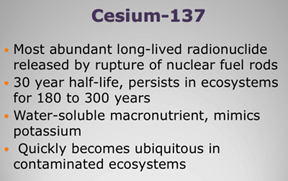
Following the March 2011 nuclear accident, radioactive materials were dispersed and fell onto the earth. Among these materials was cesium-137, which has a relatively long half-life of about 30 years and is releasing radiation even now.
From April 2015 to March 2018, the agency examined two rivers in the prefecture — the Ukedogawa river in Namie and the Otagawa river in Minamisoma. It sampled the waters in a 20-kilometer area around the nuclear power plant and precisely measured the concentration of cesium-137 in them.
Results showed the concentration in the Ukedogawa river was around 0.2 becquerels per liter at the start of the study, but had dropped to around 0.1 becquerels in March 2018, indicating the concentration was decreasing 10 times faster than normal. The Otagawa river also showed a similar trend, according to the agency.
Takahiro Nakanishi, a senior researcher at the JAEA, said, “If the concentration in river waters relied on for agricultural purpose decreases, the result could help local people resume their agricultural activities.”
|
|
January 29, 2019
Posted by Christina Macpherson |
Fukushima continuing |
1 Comment
Hampton Sides, author of a new book about a turning point in the Korea war, explores the state of the Koreas and Trump’s forthcoming visit. Interview, Bloomberg, By Tobin Harshaw, January 28, 2019,
“……It is a cliche that the so-called police action in Korea from 1950 to 1952 is America’s “forgotten war.” But, like most cliches, there is a lot of truth to it. American ignorance about the Korean War is a shame, and not only because it devalues the sacrifices of those who fought in it. With North Korea’s nuclear arsenal now threatening the U.S. mainland (not to mention Hawaii, Japan and the folks on the southern end of the peninsula), and President Donald Trump and Kim Jong Un set to meet again next month, a little historical perspective might be helpful.
………. HS: Be mindful of the fact that North Korea’s fear and loathing of the U.S., however warped it seems, does have legitimate historical roots. During the Korean War, the U.S. bombed that country back to the Stone Age: Every building, every bridge, every village. The stated goal was to not leave a single brick standing upon another brick. That air campaign was gratuitous and cruel. We killed hundreds of thousands of civilians. We’re a country that has a habit of bombing people and then wondering why those people hate us. As we parse the madness that is the Kim regime, we should always keep in mind that this underlying history of “terror from above” figures into that madness.
Kim strikes many as a lunatic, but his nuclear strategy has actually been quite rational and effective in achieving his goals. So coaxing him to give up his nukes will take some extremely creative and forceful negotiating. The Hermit Kingdom desperately needs many, many things from the outside world — food, medicines, capital, technology, expertise and so on, and Kim knows this. A big question is whether he would really allow his own people to benefit in any meaningful way from the flow of goods and amenities that a removal of sanctions would usher in. Another question is whether he’d actually allow outside experts to come in and closely monitor his regime’s nuclear compliance. Caveats aside, we can only hope the talks continue. I’m highly skeptical of Trump’s much-avowed skills as a deal-maker, but a deal is certainly in the interest of the whole wide world.
……….. HS: It was repeatedly said during the 2016 campaign that Douglas MacArthur is Trump’s “favorite general.” I don’t get the sense that Trump reads history — or anything else, for that matter — but it’s a telling detail. Because with Douglas MacArthur you had a grandiose and vainglorious autocrat who had surrounded himself with sycophants and yes-men. He was a colorful and interesting character — in narrative terms, a gift that keeps on giving. But he was a thoroughgoing narcissist. It was said that he didn’t have a staff; he had a court. He didn’t want to hear inconvenient information. He didn’t like experts — he was the expert. He was in love with the vertical pronoun. It was all about him.This sounds extremely familiar to me.
………. Of course, Korea should never have been divided in the first place — drawing that line created one of the great geopolitical tragedies of modern times. Many thousands of families were torn apart and never allowed to see each other again. Historically speaking, there’s no difference between northern and southern Korea. It’s one country, one language, one culture, one people.
Or at least it was. After more than 70 years of living apart, a reunification, if by some miracle it ever happened, would be a wrenching and doubtless violent process. It’s not clear how a brainwashed and traumatized people from an impoverished police state integrates into the dynamic capitalist society that is modern South Korea. Still, I believe it’s destined to happen one day.https://www.bloomberg.com/opinion/articles/2019-01-27/korean-war-in-current-events-from-the-1950s-to-a-nuclear-north
January 29, 2019
Posted by Christina Macpherson |
history, North Korea, politics international, USA |
Leave a comment
Japan Times, 26 Jan 19, DAVOS, SWITZERLAND – North Korea must make concrete pledges toward curbing its nuclear weapons program, such as dismantling its main nuclear complex and allowing international inspections to confirm the process, when leader Kim Jong Un meets U.S. President Donald Trump as soon as next month, South Korea’s foreign minister said.
Kang Kyung-wha said in an interview at the World Economic Forum in Davos that she is optimistic North Korea will agree to concrete steps toward abandoning its nuclear weapons and ballistic missile programs, developed in violation of United Nations resolutions.
“The (North Korean) leader has promised to his people many times that ‘I’m going to take this country toward economic development.’ He has to deliver that, and he’s not going to get the kind of significant assistance unless he takes concrete steps toward denuclearization and somehow eases the sanctions regime,” she said on Thursday.
“Given the strong political will on the part of the top leaders of the two sides. … I think we will see concrete results.”
Trump and Kim held a historic first summit in Singapore in June. The White House said last week a second summit would be held in late February but did not say where………https://www.japantimes.co.jp/news/2019/01/25/asia-pacific/south-koreas-looks-nuclear-dismantling-pledge-kim-summit-trump/#.XEttNNIzbGg
January 26, 2019
Posted by Christina Macpherson |
politics international, South Korea |
Leave a comment