South Korea says that Kim Jong Un is ready to accept nuclear-plant inspections
 Kim Ready to Accept Nuclear-Plant Inspections, South Korea Says, Bloomberg, By Youkyung Lee, February 16, 2019, Kim Ready to Accept Nuclear-Plant Inspections, South Korea Says, Bloomberg, By Youkyung Lee, February 16, 2019,
· South Korea presidential adviser sees Trump path to compromise · Trump says ‘I’m in no rush for speed’ in talks with Kim regime North Korean leader Kim Jong Un was ready to accept the dismantlement and inspection of a high-profile nuclear plant, a South Korean presidential adviser said, suggesting a possible point of compromise in upcoming talks with President Donald Trump. Moon Chung-in, a special adviser for foreign affairs and national security, said in an interview Friday that the verified destruction of the regime’s Yongbyon nuclear complex was an achievable goal during Trump’s planned Feb. 27-28 summit with Kim. Moon said it was his “understanding” that South Korean President Moon Jae-in got Kim’s personal assurance on that when they met in Pyongyang in September. ………..Moon Chung-in said the U.S. should agree to allow economic projects between the two Koreas to proceed in exchange for inspections of Yongbyon — something the U.S. has so far been reluctant to do. Kim has railed against the international sanctions regime choking his moribund economy and called for resuming the projects, including a industrial park and a mountain resort. “Those will be doable,” Moon Chung-in said. Such an exchange would advance talks, “without undermining the overall sanctions regime by the UN Security Council, yet giving some kind of incentives to North Korea in a way the U.S. can come up with some sort of compromise,” he said. Moon Chung-in, a strong advocate of South Korea rapprochement with North Korea, said the success of the Hanoi summit hinges on how North Korea proceeds with its nuclear arms program. Satellite-imagery analysis and leaked American intelligence suggest that North Korea has been churning out rockets and warheads as quickly as ever. If North Korea continues to produce nuclear materials even after the Hanoi summit, I would say that’s the most important indicator that the Hanoi summit failed,” Moon Chung-in said. https://www.bloomberg.com/news/articles/2019-02-15/kim-ready-to-accept-inspection-of-nuclear-plant-adviser-says |
The real nuclear crisis: danger of India-Pakistan nuclear war
 Billions Dead: That’s What Could Happen if India and Pakistan Wage a Nuclear War, This is the real nuclear crisis the world is missing. National Interest, rmed with what they believe is reasonable intelligence about the locations of Pakistan’s strategic forces, highly accurate missiles and MIRVs to target them, and a missile defense that has a shot at cleaning up any Pakistani missiles that survived the first strike, Indian leaders might be tempted to launch a counterforce first strike.
With the world’s attention firmly fixated on North Korea, the greatest possibility of nuclear war is in fact on the other side of Asia.
That place is what could be called the nuclear triangle of Pakistan, India and China. Although Chinese and Indian forces are currently engaged in a standoff, traditionally the most dangerous flashpoint along the triangle has been the Indo-Pakistani border. The two countries fought three major wars before acquiring nuclear weapons, and one minor one afterwards. And this doesn’t even include the countless other armed skirmishes and other incidents that are a regular occurrence.
At the heart of this conflict, of course, is the territorial dispute over the northern Indian state of Jammu and Kashmir, the latter part of which Pakistan lays claim to. Also key to the nuclear dimension of the conflict is the fact that India’s conventional capabilities are vastly superior to Pakistan’s. Consequently, Islamabad has adopted a nuclear doctrine of using tactical nuclear weapons against Indian forces to offset the latter’s conventional superiority………https://nationalinterest.org/blog/buzz/billions-dead-thats-what-could-happen-if-india-and-pakistan-wage-nuclear-war-44682
Long haul to clean up radioactive debris in Fukushima’s shattered nuclear reactors – remote probe in use
A headache for Britain – its reliance on China for nuclear technology

 UK’s reliance on China’s nuclear tech poses test for policymakers, Britain risks alienating Beijing if it scraps power deals over security concerns, Ft.com, 15 Feb 19,
The UK has no easy way to block China’s ambitions to export nuclear reactor technology to Britain on security grounds, despite growing public anxiety about Chinese involvement in sensitive infrastructure, according to people familiar with the situation. The government’s willingness to permit the state-owned utility, CGN, to participate in the UK’s nuclear power generation programme has raised eyebrows in recent months as Chinese investment has come under hostile scrutiny, both in Europe and the US.
In October, an assistant US secretary of state, Christopher Ashley Ford, even warned the UK explicitly against partnering with CGN, saying that Washington had evidence that the business was engaged in taking civilian technology and converting it to military uses. More recently, concerns about the Chinese telecoms company Huawei and cyber security have also prompted calls for the government to back away from closer energy ties. But government policies requiring nuclear projects to be “developer-led”, and interlocking commitments given to Chinese investors by David Cameron’s government in 2014, make it awkward for the government to reverse course………..
Is Chinese involvement really a problem? Opposition to the deal ranges from the strategic to the practical. Economist Dieter Helm said he finds it astonishing that an independent nuclear military power should be “complacent about allowing potential enemies into the core of its nuclear technologies”. Some critics also worry about the availability of fuel and spares in what will be a 60-year plant should Britain and China fall out………..
The bigger risk to CGN’s ambitions may be the UK’s waning appetite for more nuclear reactors, and the lack of competitive tension among developers in seeking new deals. A report last summer from the National Infrastructure Commission warned against “rushing” to support more nuclear stations and suggesting only one more be agreed before 2025, preferring to place bigger bets on renewable energy.
The government has been lobbied by EDF to consider a new form of financing for nuclear, known as the regulated asset base model, which would impose a charge on consumers during the construction phase, helping to reduce the project’s cost of capital, and potentially unlocking private sector investment. This could make the highly geared French group less dependent on Chinese capital to proceed with Sizewell C. According to one civil servant, the business department, BEIS, is considering these proposals “very seriously”.
In the meantime, CGN, which declined to comment on its UK operations, continues to invest heavily in the UK. The total is £2.7bn and counting on Hinkley, the design assessment for the Bradwell reactor and 340 megawatts of renewables plant. According to a source close to CGN: “This is an important year and it is important to remember that the company is a utility, not a bank.” “The Chinese see this UK deal as a strategic imperative and seem intent to do what it takes to make it happen,” said the consultant. “If the UK has changed its mind, it is going to be hard to let them down gently.” https://www.ft.com/content/7734e3be-2f6f-11e9-8744-e7016697f225
India’s submarine rivalry with China in the second nuclear age
The Strategist , 15 Feb 2019|Ramesh Thakur There are substantially fewer nuclear weapons today than at the height of the Cold War. Yet the overall risks of nuclear war—by design, accident, rogue launch or system error—have grown in the second nuclear age. That’s because more countries with fragile command-and-control systems possess these deadly weapons. Terrorists want them, and they are vulnerable to human error, system malfunction and cyberattack.
The site of great-power rivalry has shifted from Europe to Asia with crisscrossing threat perceptions between three or more nuclear-armed states simultaneously. With North Korea now possessing a weaponised ICBM capability, the US must posture for and contend with three potential nuclear adversaries—China, Russia and North Korea.
The only continent to have experienced the wartime use of atomic weapons, Asia is also the only continent on which nuclear stockpiles are growing. The total stockpiles in Asia make up only 3% of global nuclear arsenals, but warhead numbers are increasing in all four Asian nuclear-armed states (China, India, North Korea and Pakistan). None of them has yet ratified the Comprehensive Nuclear-Test-Ban Treaty, although China is a signatory. Asia stands alone in nuclear testing in this century.
The Cold War nuclear dyads have morphed into interlinked nuclear chains, with a resulting greater complexity of deterrence relations between the nuclear-armed states. Thus, as I’ve previously argued, the tit-for-tat suspensions of the Intermediate-Range Nuclear Forces Treaty by the US and Russia has a significant China dimension. The nuclear relationship between India and Pakistan is historically, conceptually, politically, strategically and operationally deeply intertwined with China. While Pakistan’s nuclear policy is India-specific, the primary external driver of India’s policy has always been China.
……….the race to attain a continuous at-sea deterrence capability through nuclear-armed submarines is potentially destabilising in Asia because the regional powers lack well-developed operational concepts, robust and redundant command-and-control systems, and secure communications over submarines at sea……… https://www.aspistrategist.org.au/indias-submarine-rivalry-with-china-in-the-second-nuclear-age/
Call to preserve Japan’s historic “Fukuryu Maru” memorial of atomic bombing

Final mission: Keep anti-nuke message at site of Tsukiji market, http://www.asahi.com/ajw/articles/AJ201902130004.html, By NAOMI NISHIMURA/ Staff Writer, February 13, 2019 Busy construction workers and fast-walking passers-by pay little notice to a metal plate that symbolizes one of the darker periods in the postwar history of the now-closed Tsukiji fish market in Tokyo.
The continuing dismantling work and the future of the iconic former market has gained much of the public’s attention. The plate, measuring 42 centimeters tall and 52 cm wide, will remain on a fence surrounding the site at least until the project is complete.
The plate, marking the fallout of nuclear bomb tests carried out in the 1950s, carries a message that many people hope will remain in one form or another at the site.
“We have set up this plate out of the wish that there will be no suffering again from nuclear weapons,” the plate says in part.
A Tokyo metropolitan government official said “nothing has been decided on what objects will be installed” afterward at the Tsukiji site.
The plate is witness to the “A-bomb tuna” that arrived 65 years ago at the Tsukiji market in the capital’s Chuo Ward.
“Nearly 460 tons of contaminated fish were found from more than 850 fishing boats across Japan … and fish consumption dropped sharply,” another part of the plate’s inscription reads.
The radioactive “A-bomb” fish were actually exposed to radiation from hydrogen-bomb tests.
The text on the plate refers to the Daigo Fukuryu Maru (Lucky Dragon No. 5), a fishing vessel caught in the fallout of a U.S. H-bomb test near the Bikini Atoll in March 1954.
Some of the tuna and other fish caught by the Daigo Fukuryu Maru ended up at the Tsukiji market.
“There was a real panic” when the haul tested positive for radiation, said Takuji Adachi, 92, who was a metropolitan government official at the time in charge of hygiene on the market grounds.
Radiation was also found in other tuna hauls that arrived later from different parts of the country.
Workers sat up all night testing fish with radiation detectors borrowed from a university lab and elsewhere before their early-morning auctions, sources said.
Tuna lost half to two-thirds of their prices, and the values of other fish species also dropped. The radiation tests continued through the year-end, with 3,000 tuna going to waste.
The names of 856 Japanese fishing boats were identified as having been contaminated by radioactive fallout from a series of hydrogen-bomb tests conducted between March and May 1954, according to officials of the Daigo Fukuryu Maru Exhibition Hall.
The plate was installed at the Tsukiji fish market 45 years later.
PETITION FOR RELOCATING STONE MONUMENT
Matashichi Oishi, who was a crew member on the Fukuryu Maru involved in freezing the catch, wanted to set up a physical testimony to peace.
The now 85-year-old had asked the Tokyo metropolitan government to allow the installation at Tsukiji of a stone monument engraved with “Maguro Zuka” (tuna memorial).
He called for donations in units of 10 yen ($0.09) each time he gave a public speech. He ended up collecting 3 million yen, and the stone monument was completed.
However, opinion was divided at the time over whether the Tsukiji market should be relocated or redeveloped on the same site. Authorities said there was no space available for the stone monument, but they allowed the plate to be attached by the side of the main gate.
The stone monument currently stands in an open space on the grounds of the exhibition hall in Tokyo’s Koto Ward, where the hull of the Daigo Fukuryu Maru remains preserved.
The plate has since served as a memento for about two decades, but the Tsukiji market was relocated to the Toyosu district of Koto Ward in October last year.
With the future of the plate unknown, Oishi has collected 5,622 signatures over three years for a petition to have the stone monument relocated to a corner of the former Tsukiji market.
“Words engraved in stone will stay 50 years and 100 years down the road,” Oishi said last September during a meeting on the possible uses of the stone monument. “History could be repeated unless someone keeps talking about the horror of nuclear weapons.”
He said he hopes to hand the signatures to Tokyo Governor Yuriko Koike to coincide with the March 1 Bikini Day, the anniversary of the Fukuryu Maru’s nuclear exposure.
Oishi said setting a path for the stone monument’s relocation is his “final mission in life.”
“The Fukuryu Maru later symbolized calls for eliminating nuclear weapons,” he said. “Tsukiji must also have the role of being a witness to the nuclear exposure incident.”
Japan’s Kyushu Electric to scrap aging nuclear reactor at Genkai
TOKYO (Reuters) – Japan’s Kyushu Electric Power Co Inc said on Wednesday it will decommission an aging reactor at its Genkai nuclear plant as the country’s power industry struggles to meet new nuclear safety standards set after the 2011 Fukushima disaster. 13 Feb 19,
This will bring the number of reactors being scrapped to 17 since the meltdowns at the Fukushima Daiichi plant nearly eight years ago.
The move comes as Japan’s return to nuclear power is slowly gathering pace, although the industry still faces public opposition, court challenges and unfavorable economics.
Kyushu Electric will scrap the No.2 reactor at the Genkai plant, about 930 km (580 miles) west of Tokyo. ……
Many of Japan’s reactors remain shut, with only nine operating, while they undergo relicensing to meet new standards set after the Fukushima crisis highlighted shortcomings in regulation.
Reporting by Yuka Obayashi; Editing by Gopakumar Warrier
Is nuclear power REALLY a clean-power fix for Africa – as Russia and China push it
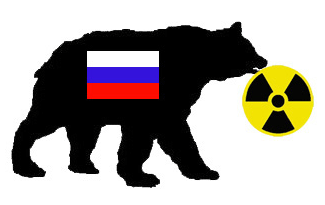 Russia, China back nuclear as a clean-power fix for Africa
But in recent years, at least seven other sub-Saharan African states have signed agreements to deploy nuclear power with backing from Russia, according to public announcements and the World Nuclear Association (WNA), an industry body………
Like Ethiopia, emerging nuclear states Sudan, Kenya, Uganda, Nigeria, Rwanda, Zambia and Ghana have signed agreements with Russia’s state nuclear corporation, ROSATOM – most since 2016.
Their content ranges from language on the construction of nuclear reactors to assistance with feasibility studies and personnel training, press statements show.
ROSATOM’s solutions for managing spent fuel and radioactive waste vary from country to country, but are normally worked out at the later stages of a nuclear new-build programme “in the strictest compliance with international law”, a spokeswoman told the Thomson Reuters Foundation.
Chinese state-owned nuclear firms have also taken the lead in the region, sealing deals with Kenya, Sudan and Uganda, WNA data shows.
South African student Masamaki Masanja, 23, won a ROSATOM competition for young people to make videos about Africa’s nuclear potential, and got to visit the Novovoronezh nuclear power plant in western Russia in 2017.
“It was mind-blowing,” said the second-year mechanical engineering student, via Skype.
The experience left him with a strong sense that nuclear power should be adapted quickly for Africa’s needs………
Rebel risk
Some political observers, however, are concerned about the prospect of nuclear reactors backed by Russia in some countries with rebel groups and weak government institutions.
An Africa-based Western diplomat, who asked to remain anonymous, doubted Russia’s assurances it would collect nuclear waste from projects it helped establish.
“You could end up with very unfortunate situations in parts of Africa … if you have a decaying nuclear power plant overrun by rebels, with waste that’s not going away,” he said.
Multiple requests for an interview with Russia’s ambassador in Ethiopia were declined.
So-called dirty bombs can combine conventional explosives like dynamite with radioactive material such as nuclear waste. ………
It could take 20 years for Ethiopia to build a nuclear power plant, estimated Hong-Jun Ahn, a Korean electrical engineer who advises the Ethiopian government on its nuclear plans.
Yonas Gebru, director of Addis Ababa-based advocacy group Forum for Environment, said green activists could prove another hurdle amid debate over whether nuclear power is “clean” energy.
“It would be good, and it would be wise also … to better capitalise on already started initiatives such as hydropower, wind energy (and) solar energy,” said Gebru. https://www.moneyweb.co.za/news/africa/russia-china-back-nuclear-as-a-clean-power-fix-for-africa/
What is USA willing to offer to North Korea at Vietnam Summit?
 Central to the meeting in Vietnam is what the U.S. might offer Kim in return for concrete steps to relinquish his nuclear arsenal, WSJ, By Andrew Jeong andTimothy W. Martin, Feb. 8, 2019 SEOUL—The U.S. special envoy for North Korea concluded three days of nuclear-disarmament talks in Pyongyang ahead of the second summit between President Trump and North Korean leader Kim Jong Un, scheduled for this month in Vietnam, expressing confidence that “real progress” was possible if both sides remain committed…….(subscribers only) https://www.wsj.com/articles/u-s-envoy-voices-optimism-ahead-of-north-korea-nuclear-summit-11549684347
Japan’s Reconstruction Agency to air ad for Fukushima products on TV, online and at cinemas
 https://www.japantimes.co.jp/news/2019/02/08/national/japans-reconstruction-agency-air-ad-fukushima-products-tv-online-cinemas/#.XF3p09IzbGg
JIJI, FEB 8, 2019, The Reconstruction Agency said Friday that it will run a television commercial advertising farm, fishery and forestry products made in Fukushima Prefecture for about a week from Saturday.
The 30-second spot is aimed at dispelling harmful rumors about the safety of products from the prefecture following the nuclear meltdown at Tokyo Electric Power Company Holdings Inc.’s Fukushima No. 1 power plant, which was heavily damaged in the March 2011 earthquake and tsunami.
The agency hopes to capitalize on rising interest in Fukushima Prefecture ahead of the eighth anniversary of the disaster on March 11.
The commercial, which will also highlight tourism spots in the prefecture, will be broadcast nationwide. It will also be run at movie theaters and online.
The agency has also created a section on its website to explain the current conditions in Fukushima Prefecture, helping visitors to learn about radiation and progress in reconstruction efforts.
Fire extinguisher system at nuclear plant freezes
Hokkaido Electric Power Company says a worker discovered the problem at its Tomari nuclear plant in the country’s northernmost prefecture of Hokkaido early Saturday morning.
The problem affected equipment designed to maintain water pressure in the event of firefighting at the No.1 and No.2 reactors. All three of the plant’s reactors have been offline since 2012, following the Fukushima nuclear accident.
The utility says a part of the equipment was frozen due to the severe cold, causing the system to break down. It says there is no problem with the plant’s fire extinguisher system, and the problem did not affect firefighting functions.
Temperatures fell to minus 30 degrees Celsius or lower in many parts of the prefecture on Saturday. A nearby town recorded minus 12.7 degrees Celsius.
.
The company also says the temperature was nearly minus five degrees in the room which houses the equipment, but a worker forgot to turn on the heating system.
The utility says it will work quickly to restore the faulty equipment and take measures to prevent a recurrence.
Despite the severe disadvantages to Uganda, of nuclear power, Uganda’s govt succumbs to China’s nuclear marketing
Uganda to generate nuclear energy amidst safety, environmental concerns, By February 9, 2019 KAMPALA – Uganda is in the final stages of efforts to start generating some 2000 megawatts of electricity from five nuclear plants it plans to build in five districts scattered in the country’s four geographical regions……..
Already memoranda of understanding have been signed with Russia and the China National Nuclear Corporation [CNNC), Beijing on cooperation in the peaceful uses of nuclear energy on May 10, 2018.
In both of these documents Uganda is to secure technical expertise and financing to lift the plan off the ground.
According to Ms Sarah Nafuna, the head of Nuclear Energy Unit in the ministry, the MoU with Beijing details areas of technical and engineering cooperation as well as financial support to develop reactors for the nuclear plant……….
Energy ministry’s Nafuna declined to disclose the cost of developing the nuclear plants, but a high-level source that asked not to be named because they were not authorised to speak on the matter, estimated the capital and operating costs upward of Shs145 trillion.
This working figure is higher than Uganda’s Shs29 trillion annual budget, raising questions about the country’s ability to mobilise such resources when it is already saddled with a total external debt exposure, including committed but undisbursed debt of USS$12.2 billion debt, [about Shs 45.4 trillion]……….
sceptics also argue that a sunshine-rich country such as Uganda should never think of going the risky route of nuclear energy. ………
while government officials strongly defend the nuclear project, questions abound about how a country – that has failed to handle minor fire disasters and basic household waste will effectively deal with toxic wastes, which are the by-product of nuclear power generation.
In Kampala for instance, garbage is littered all over, with roads becoming impassable when it rains. Moreover, some hospitals and clinics carelessly dispose their medical waste in landfills, yet the government insists it can handle nuclear waste.
Mr Nandala Mafabi, the secretary general of the FDC, a critic of nuclear power generation says the government should explore safer sources of energy such as solar and wind energy, and only consider nuclear as an energy source later……….
Opponents of the nuclear energy are also worried about health hazards, safety and radioactive waste management, with questions about the country’s preparedness to deal with radioactive waste and accidental leaks which advanced economies like Japan have grappled with.
Mr Frank Muramuzi, the executive director of National Association of Professional Environmentalists (NAPE), also opposed building of nuclear plants and instead pointed the government to harness electricity from other renewable energy sources such as solar.
“Nuclear plants are expensive, have long construction periods of about 10 years and expensive to de-commission the plants at the end of their lifespan, especially disposing of hazardous radioactive waste,” he said………http://www.pmldaily.com/features/2019/02/uganda-to-generate-nuclear-energy-amidst-safety-environmental-concerns.html
North Korea’s moves to hide its nuclear missiles from US strikes,
Measures said to include using civilian facilities to make and test missiles North Korea is trying to ensure its nuclear and ballistic missile capabilities are safe from US military strikes, a UN report has said, as officials from both countries prepared to meet to discuss a second summit between Donald Trump and Kim Jong-un.Trump is expected to meet the North Korean leader, possibly in Vietnam, at the end of the month to discuss measures that would lead to Pyongyang giving up its nuclear weapons in return for US security guarantees and other assurances.
But the report, seen by Reuters on Monday, suggested the regime was doing everything possible to protect its nuclear and missile programmes.
In the confidential report, recently submitted to UN security council members, sanctions monitors said they had “found evidence of a consistent trend on the part of [North Korea] to disperse its assembly, storage and testing locations”…….. https://www.theguardian.com/world/2019/feb/05/north-korea-trying-to-keep-its-nuclear-missiles-safe-from-us-strikes-says-un-report
2 billion people at risk, as Himalaya’s glaciers melt

A third of Himalayan ice cap doomed, finds report, Guardian, Damian Carrington, Environment edito@dpcarrington , 4 Feb 2019
Even radical climate change action won’t save glaciers, endangering 2 billion people At least a third of the huge ice fields in Asia’s towering mountain chain are doomed to melt due to climate change, according to a landmark report, with serious consequences for almost 2 billion people.
Even if carbon emissions are dramatically and rapidly cut and succeed in limiting global warming to 1.5C, 36% of the glaciers along in the Hindu Kush and Himalaya range will have gone by 2100. If emissions are not cut, the loss soars to two-thirds, the report found.
The glaciers are a critical water store for the 250 million people who live in the Hindu Kush-Himalaya (HKH) region, and 1.65 billion people rely on the great rivers that flow from the peaks into India, Pakistan, China and other nations.
“This is the climate crisis you haven’t heard of,” said Philippus Wester of the International Centre for Integrated Mountain Development (Icimod), who led the report. “In the best of possible worlds, if we get really ambitious [in tackling climate change], even then we will lose one-third of the glaciers and be in trouble. That for us was the shocking finding.”
Wester said that, despite being far more populous, the HKH region had received less attention than other places, such as low-lying island states and the Arctic, that are also highly vulnerable to global warming.
Prof Jemma Wadham, at the University of Bristol, said: “This is a landmark piece of work focused on a region that is a hotspot for climate change impacts.”
The new report, requested by the eight nations the mountains span, is intended to change that. More than 200 scientists worked on the report over five years, with another 125 experts peer reviewing their work. Until recently the impact of climate change on the ice in the HKH region was uncertain, said Wester. “But we really do know enough now to take action, and action is urgently needed,” he added.
The HKH region runs from Afghanistan to Myanmar and is the planet’s “third pole”, harbouring more ice than anywhere outside Arctic and Antarctica. Limiting the global temperature rise to 1.5C above pre-industrial levels requires cutting emissions to zero by 2050. This is felt to be extremely optimistic by many but still sees a third of the ice lost, according to the report. If the global rise is 2C, half of the glaciers are projected to melt away by 2100.
Since the 1970s, about 15% of the ice in the HKH region has disappeared as temperatures have risen. But the HKH range is 3,500km long and the impact of warming is variable. Some glaciers in Afghanistan and Pakistan are stable and a few are even gaining ice, most probably due to increased cloud cover that shields the sun and changed winds that bring more snow. But even these will start melting with future warming, Wester said…….https://www.theguardian.com/environment/2019/feb/04/a-third-of-himalayan-ice-cap-doomed-finds-shocking-report
Japan’s propaganda about Fukushima’s ‘recovery’- getting people back to nuclear irradiated areas
The returning residents of Fukushima’s nuclear disaster
Near site of Fukushima nuclear disaster, a shattered town and scattered lives, WP, By Simon Denyer, February 3 2019 NAMIE, Japan — Noboru Honda lost 12 members of his extended family when a tsunami struck the Fukushima prefecture in northern Japan nearly eight years ago. Last year, he was diagnosed with cancer and initially given a few months to live.
Today, he is facing a third sorrow: Watching what may be the last gasps of his hometown.
For six years, Namie was deemed unsafe after a multiple-reactor meltdown at the Fukushima Daiichi Nuclear Power Plant following a 2011 earthquake and tsunami.
In March 2017, the government lifted its evacuation order for the center of Namie. But so far, hardly anyone has ventured back.
Its people are scattered and divided. Families are split. The sense of community is coming apart.
“It has been eight years; we were hoping things would be settled now,” the 66-year-old Honda said. “This is the worst time, the most painful period.”
For the people of Namie and other towns near the Fukushima plant, the pain is sharpened by the way the Japanese government is trying to move beyond the tragedy, to use the 2020 Tokyo Olympics as a symbol of hope and recovery, a sign that life can return to normal after a disaster of this magnitude.
Its charm offensive is also tied up with efforts to restart the country’s nuclear-power industry, one of the world’s most extensive networks of atomic power generation.
Six Olympic softball games and a baseball game will be staged in Fukushima, the prefecture’s bustling and radiation-free capital city, and the Olympic torch relay will start from here.
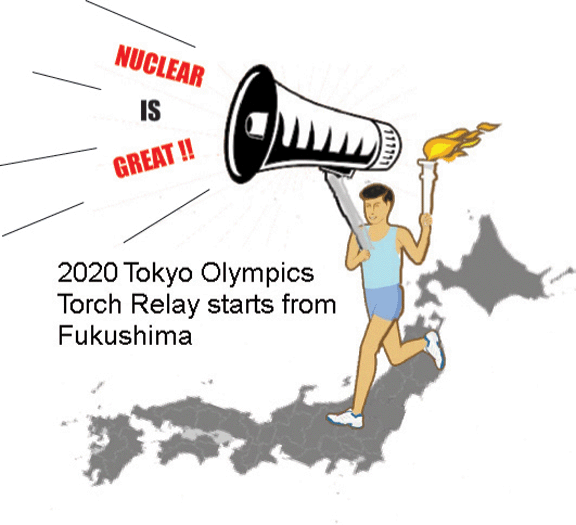
But in Namie, much closer to the ill-fated nuclear plant, that celebration rings hollow, residents say.
This was a close-knit community of farmers, fishermen and potters — of orchards, rice paddies and cattle sandwiched between the mountains and the sea. It was a place where people celebrated and mourned as a community, and families lived together across generations.
That’s all gone. On the main street, a small new shopping arcade has opened. But a short walk away, a barber shop stands abandoned, its empty chairs gathering years of dust. A sign telling customers to make themselves at home is still displayed in a bar, but inside debris litters the floor. A karaoke parlor is boarded up. Wild boars, monkeys and palm civets still roam the streets, residents say.
Just 873 people, or under 5 percent, of an original population of 17,613 have returned. Many are scared — with some obvious justification — that their homes and surroundings are still unsafe. Most of the returnees are elderly. Only six children are enrolled at the gleaming new elementary school. This is not a place for young families.
Four-fifths of Namie’s geographical area is mountain and forest, impossible to decontaminate, still deemed unsafe to return. When it rains, the radioactive cesium in the mountains flows into rivers and underground water sources close to the town.
Greenpeace has been taking thousands of radiation readings for years in the towns around the Fukushima nuclear plant. It says radiation levels in parts of Namie where evacuation orders have been lifted will remain well above international maximum safety recommendations for many decades, raising the risks of leukemia and other cancers to “unjustifiable levels,” especially for children.
In the rural areas around the town, radiation levels are much higher and could remain unsafe for people to live beyond the end of this century, Greenpeace concluded in a 2018 report.
“The scale of the problem is clearly not something the government wants to communicate to the Japanese people, and that’s driving the whole issue of the return of evacuees,” said Shaun Burnie, senior nuclear specialist with Greenpeace. “The idea that an industrial accident closes off an area of Japan, with its limited habitable land, for generations and longer — that would just remind the public why they are right to be opposed to nuclear power.”
Today, Namie’s former residents are scattered across all but one of Japan’s 47 prefectures. Many live in the nearby town of Nihonmatsu, in comfortable but isolating apartment blocks where communal space and interaction are limited. With young people moving away, the elderly, who already feel the loss of Namie most acutely, find themselves even more alone.
………. many residents say the central government is being heavy handed in its attempts to convince people to return, failing to support residents’ efforts to build new communities in places like Nihonmatsu, and then ending compensation payments within a year of evacuation orders being lifted. …….https://www.washingtonpost.com/world/asia_pacific/near-site-of-fukushima-nuclear-disaster-a-shattered-town-and-scattere
1 This Month
26 September – International Day for the Total Elimination of Nuclear Weapons





PLEASE OPPOSE HR 8255 AND S.3639 – bills would accelerate satellite deployment, with no environmental review or safeguards – https://ncstd5li.quorum.us/campaign/169331/
To see nuclear-related stories in greater depth and intensity – go to https://nuclearinformation.wordpress.com
-
Archives
- September 2026 (305)
- August 2026 (330)
- July 2026 (355)
- June 2026 (287)
- May 2026 (306)
- April 2026 (356)
- March 2026 (251)
- February 2026 (267)
- January 2026 (308)
- December 2025 (358)
- November 2025 (359)
- October 2025 (375)
-
Categories
- 1
- 1 NUCLEAR ISSUES
- business and costs
- climate change
- culture and arts
- ENERGY
- environment
- health
- history
- indigenous issues
- Legal
- marketing of nuclear
- media
- opposition to nuclear
- PERSONAL STORIES
- politics
- politics international
- Religion and ethics
- safety
- secrets,lies and civil liberties
- spinbuster
- technology
- Uranium
- wastes
- weapons and war
- Women
- 2 WORLD
- ACTION
- AFRICA
- Atrocities
- AUSTRALIA
- Christina's notes
- Christina's themes
- culture and arts
- Events
- Fuk 2022
- Fuk 2023
- Fukushima 2017
- Fukushima 2018
- fukushima 2019
- Fukushima 2020
- Fukushima 2021
- general
- global warming
- Humour (God we need it)
- Nuclear
- RARE EARTHS
- Reference
- resources – print
- Resources -audiovicual
- Weekly Newsletter
- World
- World Nuclear
- YouTube
-
RSS
Entries RSS
Comments RSS

