The Olympic Games and the second Tokai Nuclear Plant,
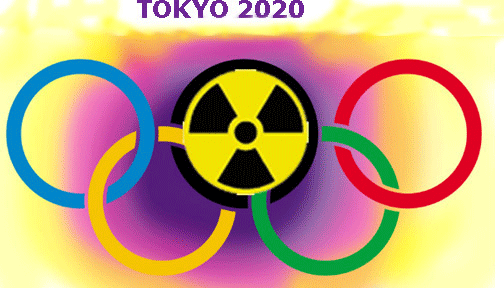 I am revealing some meaningful facts about Fukushima.
 3.On June 25,three days before the G 20 Summit in Osaka,white smoke was
The unpleasant reality behind the Tokyo Olympics’ shimmering curtain of propaganda

Is Tokyo Ready for the Olympic Juggernaut? Tokyo says that it’s ready to host the 2020 Olympics. The early numbers—and quality of Olympic leadership—are not encouraging. The Nation, By Dave Zirin and Jules Boykoff 18 July 19
Dave ZirinTWITTERDave Zirin is the sports editor of The Nation.
World security needs nuclear New Start agreement – USA-Russia, not a distraction about China
|
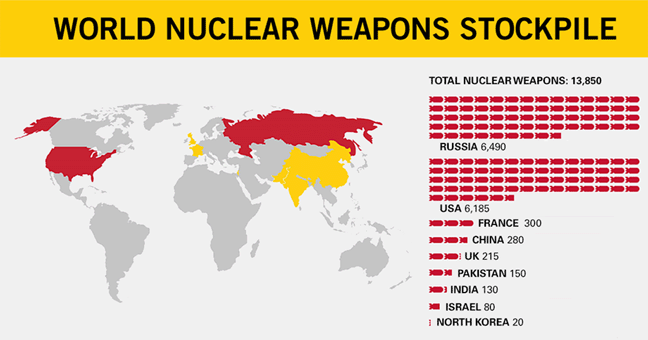
Nobody wins a nuclear war — especially not two nuclear behemoths. https://thehill.com/opinion/international/453576-nobody-wins-a-nuclear-war-especially-not-two-nuclear-behemoths BY DANIEL R. DEPETRIS,— 07/17/19 U.S. and Russian officials met this week in Geneva for what one hopes will be new strategic arms reduction talks. Trump administration officials are cautiously optimistic the discussions could lead to a more substantive negotiation about capping — and perhaps even decreasing — the number of nuclear weapons both countries have in their stockpiles. This matters for U.S. and global security because these two nations possess more than 90 percent of all nuclear weapons. President Trump, however, wants to go further than a simple extension of the 2010 The New Strategic Arms Reduction Treaty (START) agreement or a new bilateral treaty with the Russians. Instead, he is prodding China to join a trivariate arrangement. But in prefacing or linking an extension of New START to a fresh accord that includes the Chinese, the administration is increasing the possibility of ending up with neither. For one, pushing Beijing to into a three-way deal is like pushing on a locked door. The Chinese have shown no interest in a three-way deal, in large measure because their nuclear arsenal is a fraction (roughly 2 percent) of the globe’s entire inventory. At roughly 290 warheads, Beijing’s nuclear weapons program is minuscule when compared to the thousands of combined warheads Washington and Moscow have stockpiled. Indeed, China stockpile is less than 1/20th the size of the United States and about 1/22th the size of Russia’s. To expect the Chinese to participate in a new arms control negotiation with two nuclear superpowers when the numbers are so steadily stacked against them is a fool’s errand. Beijing’s no-first use nuclear policy, in place since its first ever nuclear explosive test in 1964, was recently reaffirmed just last year. An offensive nuclear strike is not something U.S. officials in Washington have to worry about. To focus on a U.S.-Russia-China nuclear agreement at the expense of keeping an already existing New START accord alive is the wrong priority. New START, signed in April 2010, was a win-win, pragmatic arms control agreement for both sides. The pact cut the U.S. and Russian stockpiles byaround one-third; capped the amount of nuclear warheads on deployed intercontinental ballistic missiles at 1,550; limited the number of deployed and non-deployed ICBM launchers to 800; and allowed each country to verify compliance with the treaty, including on-site inspections, information exchanges and advanced notices. Unlike the Intermediate Range Nuclear Forces Treaty, inspectors have verified Moscow’s compliance with the letter of the deal. For two countries that possess a combined 12,675 nuclear weapons, New START is a critical enforcing mechanism for nuclear parity and a stable balance of power. It is now the only functional arms control accord preventing the U.S. and Russia from entering another costly, risky arms race. The deal expires in February 2021 but could be extended for another five years if both Presidents Trump and Putin agree to do so. Putin has already expressed his interest. Trump, someone who considers himself a transactional pragmatist, shouldn’t waste any more time before doing the same. An extension of New START, however, is not only important for strategic stability between the two nuclear superpowers (without New START, there is nothing stopping either the United States or Russia from building and deploying more and better nuclear warheads). but also valuable for stabilizing the entire U.S.-Russia relationship in desperate need of improvement. For this reason, a constructive relationship with Moscow is unquestionably a good thing for U.S. security. Extending New START is a no-brainer and indeed could very well be an opportunity to mend relations. It’s not hyperbole to describe U.S.-Russia relations as being at their lowest since the land-based missile build-up in Europe in the early 1980s. From Syria and Ukraine to NATO and cybersecurity, Washington and Moscow are often on opposite sides of the issue. Even though both nations share some interests, including arms control and countering terrorism, Washington has become the epicenter of anti-Russia sentiment, where condemning Putin and advocating for sanctions is sport. Good politics, however, doesn’t necessarily correspond with good statecraft or foreign policy. Talking with adversaries, rivals, or competitors is a critically important component of effective foreign policy. We must engage with the world as it is, not as we wish it to be. Simply ignoring the Russians, pretending they don’t exist, or believing that using the stick unreservedly against Moscow will force it to cry uncle and change its policies to our liking makes conflict between nuclear superpowers more likely. Giving New START another five years of life is perhaps the only issue Washington and Moscow can agree on in today’s political climate. It’s perhaps the most important reason the U.S. and Russia must find a way to co-exist. Ensuring New START survives should be pursued aggressively for the sake of U.S. and global security Nobody wins a nuclear war — especially especially not two nuclear behemoths with thousands of warheads apiece. Daniel R. DePetris is a fellow at Defense Priorities, a foreign policy think tank focused on promoting security, stability and peace. |
|
|
Tokyo Electric Power Company to close down Fukushima Daini nuclear plant
The decommissioning of all four nuclear reactors at Daini will likely require more than 40 years and some 280 billion yen ($2.6 billion) in costs, the source said. If realized, all 10 nuclear reactors in Fukushima Prefecture will be scrapped.
Closure of the Daiichi plant, which suffered core meltdowns at three of its six reactors, has already been decided.
After telling Fukushima Gov. Masao Uchibori about the policy, it may be formally approved at a TEPCO board meeting, scheduled at the end of this month, the source said.
The Daini complex was also hit by tsunami waves in the 2011 disaster and temporarily lost reactor cooling functions. But unlike the Daiichi plant, it escaped meltdowns.
Since the disaster, the decommissioning in Japan of 21 nuclear reactors, including those at Daini, has been decided.
For the Tokyo-headquartered power company, the Kashiwazaki-Kariwa plant in Niigata Prefecture will be its only nuclear complex.
In June last year, TEPCO President Tomoaki Kobayakawa told the governor that the company is leaning toward scrapping all four reactors at the Daini plant. A project team was later formed at the utility and looked into whether that is possible, according to the source.
The prefecture has demanded the utility scrap the reactors, saying their existence would hamper its reconstruction efforts.
Strong rejection of nuclear power for Indonesia
 Idea to develop nuclear energy receives strong opposition in Indonesia, The Jakarta Post
Jakarta / Fri, July 19, 2019 A lawmaker’s revival of an idea to build a nuclear power plant in Indonesia has triggered public debate over the pros and cons of the technology, particularly about its safety and efficiency.The proposal came from Kurtubi, a member of House of Representatives Commission VII for energy affairs, among others, who demanded the government include that type of energy generation in the 2019 to 2038 National Electricity General Plan (RUKN)……..
In response, Jonan said the government would be very cautious when considering the idea, while there were still many other energy resources in the country that had lower development costs than a nuclear power plant. “The prices of electricity from nuclear energy is less competitive,” he added. …….
Greenpeace Asia Tenggara’s climate change and energy head Tata Mustafa expressed his rejection of the idea, stressing that the country needed to focus on the development of other renewable energy resources.
“The potential of solar energy is 207 gigawatts (GW), while the potential of wind farm energy reached 66 GW,” he said as quoted by kontan.co.id, adding that he doubted the safety of nuclear energy, particularly because of the country’s position on the Ring of Fire that was frequently hit by earthquakes.
Institute for Essential Services Reform executive director Fabby Tumiwa also opposed the plan. He said he was particularly concerned about the management of radioactive waste. “The life span of a nuclear power plant is only 50 years, but radioactive waste will exist for thousands of years. Who will be responsible?” he asked. (bbn) https://www.thejakartapost.com/news/2019/07/18/idea-to-develop-nuclear-energy-receives-strong-opposition-in-indonesia.html
North Korea, angered by US military exercises, plans to resume nuclear, missile, testds
Irate Over Military Exercises, North Korea Threatens To Resume Nuclear, Missile Tests https://www.npr.org/2019/07/16/742129952/irate-over-military-exercises-north-korea-threatens-to-resume-nuclear-missile-te, July 16, 2019, SASHA INGBER
North Korea warned Tuesday that negotiations with the United States could falter and that its nuclear and missile tests might resume if the U.S. and South Korea move forward with planned military exercises.
An unnamed North Korean Foreign Ministry spokesperson accused the U.S. of “unilaterally reneging on its commitments” in a statement released Tuesday by the Korean Central News Agency. The spokesperson said North Korea is “gradually losing our justification to follow through on the commitments we made with the U.S.” and that verbal pledges are not “a legal document inscribed on a paper.”
After President Trump’s historic summit with North Korean leader Kim Jong Un last year in Singapore, Trump announced that he would call off large military exercises with South Korea as a goodwill gesture to help kickstart negotiations.
North Korea has not tested long-range missiles since 2017.
Tuesday’s letter comes after Trump made a sudden visit to see Kim in June. They sat together in the Demilitarized Zone between the two Koreas as cameras flashed, and Trump became the first sitting U.S. president to set foot into North Korea. He called it “a great honor.”
They agreed to resume talks, but little progress has been made toward denuclearization, and no diplomatic meetings are known to have taken place since that June sit-down.
The U.S.-South Korean combined military exercises, called Dong Maeng, are expected to take place in August.
North Korea has long denounced such military drills, viewing them as a threat to its sovereignty. “It is crystal clear that it is an actual drill and a rehearsal of war aimed at militarily occupying our Republic by surprise attack,” the spokesperson said Tuesday.
Joint military exercises have taken place for decadesbecause the Korean peninsula was still technically in a state of war since the signing of an armistice agreement in 1953.
Although the United States has vowed to “indefinitely suspend” certain drills, smaller exercises are still help for South Korean and U.S. troops.
Pyongyang tested suspected short-range missiles in May. American officials drew a distinction between those tests and the launches of long-range ballistic missiles, which may be capable of reaching the U.S. mainland.
Japan’s nuclear industry has a doubtful future
Is there a future for nuclear power in Japan?, Japan Times, BY SUMIKO TAKEUCHI, JUL 16, 2019, This is the third in a series of reports on Japan’s energy policy…….
the damage from nuclear accidents can be catastrophic, in addition to the challenges posed by nuclear waste disposal. The Fukushima disaster has led to strong opinions that Japan should denuclearize, and this is still the case.
…. ………The fact is that the economic benefits of nuclear power have been losing their shine. Because of the sharp hike in safety standards imposed by the Nuclear Regulation Authority after the Fukushima disaster, exorbitant safety upgrades nearly equal in cost to building a new reactor are being installed at each site. To get a return on investment, this intensive capital spending will require long-term operation and high utilization rates, but the need to get local consent to operate and to respond to dozens of lawsuits from anti-nuclear residents is making stable operations difficult. Reactor operations are also capped at 60 years. Nuclear power could potentially be a source of cheap electricity, depending on the utilization rate and other conditions, but there’s also a possibility it won’t. ……
The impact of the Fukushima disaster, however, was enough to completely overshadow the benefits. The majority of the public is still against nuclear power. In light of persistent public opinion, Japan’s nuclear power business has been surrounded by three big uncertainties.
The first is political uncertainty. The administration of Prime Minister Shinzo Abe, despite its long-term stability, has not provided enough support to the nuclear power business. In addition, the government has entrusted the utilities with the job of gaining local consent.
The safety agreements that stipulate the rules of the industry, such as disclosure of information to the host governments, are not legally binding. But running reactors would be next to impossible without local consent based on such agreements. Whenever there’s an election, the utilities are thrown into confusion, and if a new leader is elected, they will initiate communication from scratch.
The second is policy uncertainty. Japan has fully liberalized the retail power sector. In a liberalized market, reactors for which returns on investment have fully recovered could have high cost competitiveness, but there will likely be no companies that will take up the challenge of building new ones.
Since nuclear plants require huge capital, curbing fundraising costs to a low level would have a big impact on competitiveness, but cheap fundraising is something that cannot be expected in a liberalized market. …….
The third is regulatory uncertainty. It has become quite common for reactor safety reviews to take multiple years because of inadequate communication between utilities and regulators. The U.S. has a presidential executive order that stipulates regulation shall not be undertaken unless the potential benefits to society from regulation outweigh the potential costs of dealing with the regulation.
Though Japan has no such principles, appropriate oversight on regulatory activities is being called for to check whether the public is suffering from any disadvantages from unforeseeable regulatory activities. In the meantime, the finishing blow is the plethora of lawsuits that have been filed demanding the halt of nuclear power plants……..
When utilities are placed in such an uncertain environment, it is a foregone conclusion that the nuclear power business will become unsustainable and there will be no future for it in Japan…..https://www.japantimes.co.jp/news/2019/07/16/business/future-nuclear-power-japan/#.XS-PhOszbGg
Parties must close gap with reality in talks on nuclear power

Fukushima – a nuclear catastrophe that continues
Expert says 2020 Tokyo Olympics unsafe due to Fukushima | 60 Minutes
Millions of people displaced by floods – India, Nepal and Bangladesh
 Floods across subcontinent displace millions in India, Nepal and Bangladesh, Millions of people have been displaced across India, Nepal and Bangladesh after monsoon rains triggered flash floods and landslides over the past week. ABC News, 15 July 19
Key points:
- Monsoon rains have triggered widespread flooding and landslides across three countries
- Over two million people have been displaced as a result of the floods
- Nepal has recorded the most fatalities, with 55 people confirmed dead
India’s north-eastern state of Assam has been hit hard by the floods brought by the monsoon, with at least 1.5 million people displaced and 10 dead.
In the Chittagong division of Bangladesh, there have been 10 deaths and about 500,000 displaced as 200 villages have been flooded.
The disaster’s death toll has been highest in Nepal, which recorded 55 fatalities on Sunday, with 30 missing and 33 injured, the Government said.
Ten thousand people have been displaced from their homes as incessant monsoon rains pounded many areas in the country since Thursday, submerging large swathes of land, inundating homes and destroying bridges and roads across the country.
Nepalese cabinet spokesman Gokul Banskota said, “the disaster has caused a big loss to the economy”……..https://www.abc.net.au/news/2019-07-15/floods-on-indian-subcontinent-displace-over-a-million/11308502
India’s tigers and other endangered species now threatened by uranium mining n Amrabad Tiger Reserve
Digging for uranium in tiger country: Nuclear drive tests India’s commitment to protecting endangered species. ‘If India’s largest tiger reserves are not sacrosanct then the future … is really bleak’, Independent Adam Withnall, Delhi
Fukushima Prefecture Council election: both candidates campaign on anti-nuclear platforms
 Fukushima Upper House candidates face cynical voters despite anti-nuclear platforms, Japan Times, 14 July 19, JIJI FUKUSHIMA – Rival candidates, both women, from the ruling Liberal Democratic Party and the opposition camp for next Sunday’s House of Councilors election in Fukushima Prefecture are campaigning on platforms to eliminate nuclear power from the prefecture.
But their calls are in conflict with the national energy policy of the LDP and the positions of some opposition supporters.
With campaigning in the single-seat prefectural constituency shaping up effectively as a one-on-one race, local voters who were affected by the March 2011 nuclear accident are casting a cynical eye at the race for the July 21 election.
“I’m determined to push ahead with reconstruction following your requests,” Masako Mori, the LDP’s candidate for Fukushima, said on July 4, the opening day of the official campaign period, in the prefectural capital of Fukushima.
“I’ll do my best to achieve the goal of decommissioning all nuclear reactors in the prefecture,” said Mori, 54, vice chair of the LDP’s Headquarters for Accelerating Reconstruction after the Great East Japan Earthquake.
Prime Minister Shinzo Abe, also president of the LDP, gave a speech in support of Mori.
Reflecting local voter concerns over nuclear power, the LDP’s Fukushima chapter has set goals of scrapping all reactors in the prefecture and building up knowledge and expertise related to decommissioning.
In contrast to the prefectural chapter’s position, however, the Abe government’s basic energy program regards nuclear power as an important base load electric power source, while the LDP’s policy pledges for the Upper House election include efforts to reactivate nuclear reactors.
The LDP suffered losses in recent national elections in Fukushima Prefecture, home to Tokyo Electric Power Company Holdings Inc.’s Fukushima No. 1 nuclear power plant, the site of the nation’s worst-ever nuclear accident, which resulted from the March 2011 earthquake and tsunami………
Hard to differentiate
Mori’s key opponent in the three-way race is Sachiko Mizuno, 57, who is running as the opposition camp’s unified candidate.
On June 30, standing in drizzling rain in front of a department store in the city of Fukushima, Mizuno told a small crowd, “Reconstruction of Fukushima is still only half done.”
Referring to the LDP’s policy pledge, she said the government “has not presented a road map for decommissioning all reactors (in the prefecture).”……..
With Mizuno calling for a society free of nuclear power, the policy differences with the LDP are blurred. “It’s difficult to differentiate ourselves (from the LDP) in the prefecture,” a senior official in Mizuno’s campaign office said.
Within her camp, there are differing levels of enthusiasm regarding the elimination of nuclear power…….
Unenthusiastic voters
After the triple meltdown accident, the government issued an evacuation advisory to 11 municipalities around the stricken nuclear plant. Since the advisory was lifted in the eastern part of the city of Tamura in April 2014, the size of the exclusion zone has been reduced in stages.
But the advisory remains in place in the town of Futaba, as well as in parts of six municipalities, including the towns of Okuma and Namie. More than 30,000 people still live as evacuees outside the prefecture…….
In Namie, more than two years after the evacuation advisory was lifted for most of the town in March 2017, just over 1,000 people have returned. Of people who are still registered as residents of areas for which the advisory was removed, only some 7 percent have returned. ……..https://www.japantimes.co.jp/news/2019/07/14/national/politics-diplomacy/fukushima-upper-house-candidates-face-cynical-voters-despite-anti-nuclear-platforms/#.XSucHD8zbGg
Taiwan about to close second nuclear reactor
Taiwan to shut down 2nd nuclear reactor within days, July 12, 2019 (Mainichi Japan) TAIPEI (Kyodo) — Taiwan’s Atomic Energy Council agreed on Friday to shut down a second nuclear reactor on Monday when its 40-year operating license expires, moving the island a step closer to nuclear-free status.
The decommissioning of the No. 2 reactor of the No. 1 nuclear power plant in Shimen, New Taipei City, follows that of the plant’s No. 1 reactor, closed for the same reason last December.
Taiwan still has two other nuclear power plants, each with two reactors.
In a statement, the council said it issued the decommission license Friday to Taiwan Power Co., the builder and operator of the facility, after the state-owned power utility submitted relevant documents.
Li Chi-ssu, deputy director of the council’s Department of Nuclear Regulation, told Kyodo News that with the license, the company can now begin the lengthy process of discharging and storing spent fuel rods.
It originally planned to store them at an outdoor dry storage facility, but cannot do so due to the opposition of the New Taipei City government……….
The operating licenses of the two reactors at the No. 2 nuclear power plant in Wanli, New Taipei City, will expire in December 2021 and March 2023, and those of the other two reactors at the No. 3 facility in Pingtung, southern Taiwan, in July 2024 and May 2025. https://mainichi.jp/english/articles/20190712/p2g/00m/0in/095000c
A Fukushima Ghost Town Seeks Rebirth Through Renewable Energy
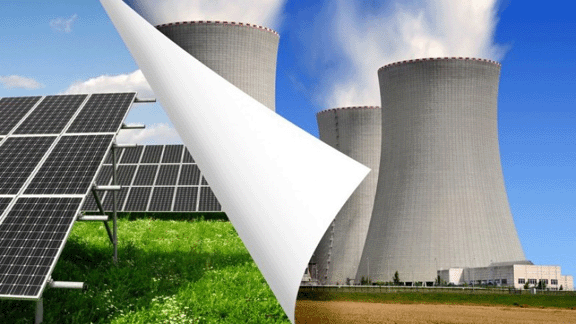 A Fukushima Ghost Town Seeks Rebirth Through Renewable Energy
Devastated by Japanese nuclear plant’s meltdown in 2011, Namie hopes a new hydrogen-fuel facility can generate a turnaround. WSJ, By River Davis, July 12, 2019
NAMIE, Japan—Fukushima prefecture, a place synonymous in many minds with nuclear meltdown, is trying to reinvent itself as a hub for renewable energy.
One symbol is just outside Namie, less than five miles from the nuclear-power plant devastated by an earthquake and tsunami in 2011. At the end of a winding road through miles of barren land, construction is nearing completion on one of the world’s largest hydrogen plants.
The government hopes to show that hydrogen, a hard-to-handle fuel that hasn’t been used for large-scale power generation, can supplement intermittent solar and wind power.
……….. By 2040, Fukushima aims to cover 100% of its energy demand with non-nuclear renewable energy. Since 2011, the prefecture’s generating capacity from renewable energy, excluding large-scale hydropower, has more than quadrupled. More than a gigawatt of solar-energy capacity has been added—the equivalent of more than three million solar panels—while other projects are under way in offshore wind power and geothermal energy……… https://www.wsj.com/articles/a-fukushima-ghost-town-seeks-rebirth-through-renewable-energy-11562923802
Circular flow of 2011 Fukushima cesium through Pacific, back to Japan
July 8, 2019 (Mainichi Japan) TOKYO — Radioactive cesium released into the Pacific Ocean due to the March 2011 meltdowns at Fukushima Daiichi Nuclear Power Station is returning to Japanese shores via a shorter route than expected, according to a joint research initiative.
The findings were revealed by a team from the University of Tsukuba, the Japan Agency for Marine-Earth Science and Technology (JAMSTEC) and Kanazawa University.
Until now, it was thought that cesium from the Tokyo Electric Power Co. (TEPCO)-operated plant would be circulated around the Pacific by subtropical gyre currents for several decades before returning to Japanese waters. But in 2012, a year after the reactor core meltdowns, tests on seawater samples collected by the team showed increased cesium concentrations in East China Sea waters off Japan. Researchers say that the concentrations observed are too low to impact sea life.
The rate increased, peaking in 2014, and a year later high concentrations were also reported in the Sea of Japan. The team believes the cesium is now flowing around the Pacific Ocean again.
It is thought that seawater sank deeply into the sea after its density increased due to cooling by winter winds, causing the cesium to travel on a western-flowing underwater route.
Michio Aoyama, a visiting professor at the University of Tsukuba, said, “That the cesium would come back in such a short time was unexpected. We’ve found a previously unknown route.”
Senior JAMSTEC research scientist Yuichiro Kumamoto said of the project’s potential benefits, “Because it has visualized ocean circulation, the results could be used in the future for predictions on issues such as climate change.”
(Japanese original by Mayumi Nobuta, Science & Environment News Department)
1 This Month
26 September – International Day for the Total Elimination of Nuclear Weapons





PLEASE OPPOSE HR 8255 AND S.3639 – bills would accelerate satellite deployment, with no environmental review or safeguards – https://ncstd5li.quorum.us/campaign/169331/
To see nuclear-related stories in greater depth and intensity – go to https://nuclearinformation.wordpress.com
-
Archives
- September 2026 (291)
- August 2026 (330)
- July 2026 (355)
- June 2026 (287)
- May 2026 (306)
- April 2026 (356)
- March 2026 (251)
- February 2026 (267)
- January 2026 (308)
- December 2025 (358)
- November 2025 (359)
- October 2025 (375)
-
Categories
- 1
- 1 NUCLEAR ISSUES
- business and costs
- climate change
- culture and arts
- ENERGY
- environment
- health
- history
- indigenous issues
- Legal
- marketing of nuclear
- media
- opposition to nuclear
- PERSONAL STORIES
- politics
- politics international
- Religion and ethics
- safety
- secrets,lies and civil liberties
- spinbuster
- technology
- Uranium
- wastes
- weapons and war
- Women
- 2 WORLD
- ACTION
- AFRICA
- Atrocities
- AUSTRALIA
- Christina's notes
- Christina's themes
- culture and arts
- Events
- Fuk 2022
- Fuk 2023
- Fukushima 2017
- Fukushima 2018
- fukushima 2019
- Fukushima 2020
- Fukushima 2021
- general
- global warming
- Humour (God we need it)
- Nuclear
- RARE EARTHS
- Reference
- resources – print
- Resources -audiovicual
- Weekly Newsletter
- World
- World Nuclear
- YouTube
-
RSS
Entries RSS
Comments RSS

