Should Fukushima exclusion zone be widened?
FUKUSHIMA investigators were left “worried” after recording radiation levels 100 times normal, leading them to suggest the exclusion zone should be increased.Express UK , By CALLUM HOARE Jul 4, 2019 | “………… when Chernobyl researcher Yevgen visited as part of Amazon Prime’s “Radioactive Detectives” series, he was left shocked.
The narrator revealed in 2017: “Have the Japanese authorities determined the correct exclusion zone?
“The first big surprise is a completely unguarded borderline.
“Yevgen wants to carry out his first measurements here.
“He has to tell Kenzo that the radiation level exceeds the natural radiation 100 times over.
“The men are worried.”
Kenzo Hashimoto, a Japanese journalist claimed the exclusion zone needed to be increased as a result.
He said: “If the radiation is that high, the authorities should extend the border line even further.
“I don’t know exactly how the survey has been made – it seems very strange to me…….https://www.express.co.uk/news/world/1149129/fukushima-nuclear-disaster-japan-radiation-exclusion-zone-investigation-spt
Breast cancer: a personal story – connection with nuclear radiation is never explored.
 contributed by Kitty 6 July 19 My Boobs Were Busy Breastfeeding My Newborn. Then They Turned On Me.”
The lady worked in South Korea. There are 22 beatup old Nuclear Reactors in South Korea, spewing Tritium and other radionuclides into the small country. Not to mention Fukushima. These factors are never considered, when they write articles like about cancer like this. It is anethema to the Nuclear Security State. The story is tragic. The lady’s ongoing tragedy is not fully explored. A toddler, chemo-therapy while pregnant, advanced inflammatory breast cancer. The story is white-wahsed according to the ongoing ignoraing of Nuclear pollution and cancer, in nuclear countries.
Excerpts from
My Boobs Were Busy Breastfeeding My Newborn. Then They Turned On Me.
m.huffpost.com/us/entry/us_5d1cd4f3e4b0f312567db790
“i was relieved to be able to dismiss my lumps, since I had a very active 2-year-old who I was trying to potty train, an intense full-time job, and was living abroad in Seoul, South Korea, with no family or close friends around other than my husband.”
LATER
Two days later I received a call. The biopsy results were in. It was a metastatic adenocarcinoma. “We think it originated from your breast,” the radiologist said.
“Excuse me,” I asked. “Did you just tell me that I have cancer?” He asked me to come in for a mammogram, but provided no other information. I went into a tailspin. ”
“After receiving my mammogram, the scans came up immediately. I could clearly see a mass in my right breast. This was not a clogged duct. It was breast cancer. How did this happen to me? I wondered. I thought I had done all the right things!”(blaming herself)
AS IF DOING ALL THE RIGHT THINGS MAKES ANY DIFFERENCE NOW THAT 1 IN 8 WOMEN DEVELOP BREAST CANCER
The holistic doctor said the cancer was from having a root canal as a child or, maybe the guilt of having been adopted.
The allopathic doctors, blamed her lactation while pregnant, for the cancer and not catching it. Always blame the victims. Never look at the most carcinogenic substances in the universe that are so abundance in HYPER-NUCLEARIZED industrial states like South Korea, Japan, Russia, France The USA , where there are dozens of radionuclide leaking, reactors in each country.
USA Security Adviser John Bolton denies report of ‘nuclear freeze’ agreement with North Korea
 John Bolton shoots down report of ‘nuclear freeze’ agreement with North Korea John Bolton shoots down report of ‘nuclear freeze’ agreement with North KoreaWhite House adviser dismisses reports of a ‘freeze’ of North Korea’s nuclear weapons arsenal. Politico, By QUINT FORGEY 7/1/19, White House National Security Adviser John Bolton on Monday dismissed reports that the administration is considering agreeing to a “freeze” of North Korea’s nuclear weapons arsenal as opposed to a more comprehensive denuclearization pact.Prior to U.S. President Donald Trump’s meeting Sunday with North Korean leader Kim Jong Un — where Trump became the first sitting commander-in-chief to step into the isolated communist state — the New York Times reported that administration officials have been mulling a deal with Pyongyang to halt production of new nuclear material as a way to kickstart a new round of talks with Kim’s regime. But the head of Trump’s National Security Council slammed the Times story, writing online that “there should be consequences” for its publishing. Bolton did not specify whether it was the Times or whoever its source was that should face those consequences.
“I read this NYT story with curiosity. Neither the NSC staff nor I have discussed or heard of any desire to ‘settle for a nuclear freeze by North Korea,’” Bolton tweeted, describing the report as “a reprehensible attempt by someone to box in the President.”…… The North Korean government has been especially critical of Bolton throughout Trump’s yearlong crusade to broker an arms agreement with Pyongyang, with a foreign ministry spokesman branding the hawkish former U.S. ambassador to the United Nations as a “warmonger” and “defective human product” in May. https://www.politico.eu/article/john-bolton-shoots-down-report-of-nuclear-freeze-agreement-with-north-korea/ |
|
Report that Trump administration is considering accepting North Korea as a nuclear power
New York Times: Trump administration mulling plan that would accept North Korea as a nuclear power, By Devan Cole, CNN July 1, 2019 Washington The Trump administration is mulling a potential deal with North Korea that would accept the country as a nuclear power if it freezes its existing nuclear programs in exchange for the US lifting its “most onerous” sanctions against the country, The New York Times reported Sunday.
The plan would aim to prevent more nuclear weapons from being created in the country, but “it would not, at least in the near future, dismantle any existing weapons, variously estimated at 20 to 60. Nor would it limit the North’s missile capability,” according to the paper.
The Times, which noted that US officials previously said they would never support such a plan, said officials in the administration hope the idea “might create a foundation for a new round of negotiations” with North Korea and noted that the administration’s current goal is still to fully denuclearize the country.
………. As a part of the plan reported by the Times, US negotiators would try to get North Korean negotiators to agree to “expand the definition” of Yongbyon, the country’s main nuclear-fuel production site. Under the potentially new definition of Yongbyon, the site would reach “beyond its physical barriers” to include various facilities around the country, including one where America and South Korea believe the country is producing uranium fuel.
A senior US official involved in North Korean policy told the Times “there was no way to know if North Korea would agree to this,” and noted that in the past, North Korean negotiators “insisted” that only Kim “could define what dismantling Yongbyon meant,” according to the report.
Stephen E. Biegun, the State Department’s special representative for North Korea, told the Times on Sunday that the paper’s account of the administration’s potential deal was “pure speculation” and that his team was “not preparing any new proposal currently,” saying, “What is accurate is not new, and what is new is not accurate.”
White House national security adviser John Bolton also disputed the Times report Monday, tweeting that he read the story “with curiosity.”……….
Former Director of National Intelligence James Clapper told CNN’s John Berman that “the general idea of accepting the current nuclear arsenal, whatever it is, is a good start point.”
“I’ve come around to the position some months ago that perhaps as at least an initial plateau, in the interest of getting something done, it might be worth considering capping what the North Koreans have now and then maybe on a much longer term basis trying, you know, to get them to reduce their nuclear holdings to zero, which I think is going to be very difficult,” Clapper said Monday on CNN’s “New Day.”
Clapper, who served in the Obama administration, said the plan reported by the Times would “require some very complex negotiations” and that it would need a verification regime, which “would be a hard pill for the North Koreans to swallow.”https://edition.cnn.com/2019/07/01/politics/north-korea-nuclear-freeze-trump-administration/index.html
‘Wonderful chemistry’ between Trump and Kim, as nuclear negotiations remain stalled
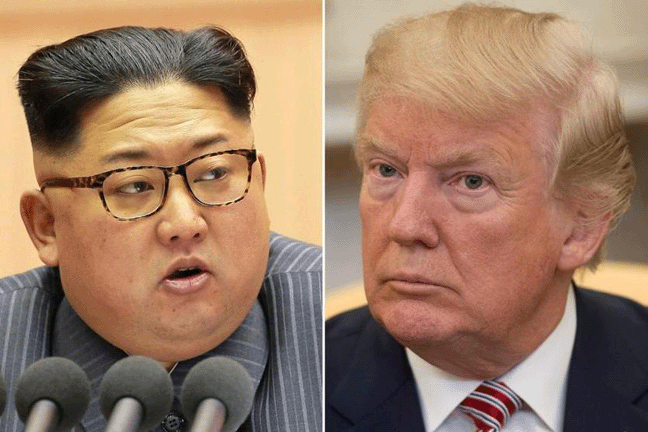 Keeping Up With the Plot of the Trump-Kim Nuclear Show, Bloomberg, By Jon Herskovitz and Youkyung Lee, July 1, 2019, Three meetings between the leaders of the U.S. and North Korea resulted in no concrete plans to end Pyongyang’s atomic ambitions. President Donald Trump and Kim Jong Un have toned down hostile rhetoric since they first shook hands in Singapore in June 2018. They were cordial even after their second summit broke down in Hanoi in February, and took an historic stroll together into North Korea four months later. All the while, Pyongyang’s nuclear program quietly advanced as U.S.-backed sanctions choked its moribund economy. The two countries can’t agree on what the denuclearization of North Korea means and what rewards should be given, if any, in response to Pyongyang’s moves toward disarmament. But Trump has invited Kim to the White House, while a top aide to Kim has touted the “mysteriously wonderful” chemistry between the two leaders.
1. What have they agreed to?
The first summit resulted in a bare-bones declaration that contained four main items: To normalize ties between the U.S. and North Korea, formally end the 1950-53 Korean War, repatriate U.S. war remains and — crucially — “to work toward complete denuclearization of the Korean Peninsula.” But “work toward” is undefined. It’s also unclear whether the U.S. nuclear umbrella over South Korea is included. U.S. Secretary of State Michael Pompeo says that Kim accepted the “final, fully verified denuclearization of North Korea.” North Korea points out the agreement referred to the entire peninsula and insists U.S. weapons must go at the same time, or it would be left vulnerable to attack. A meeting between Kim and Trump within the Demilitarized Zone in June 2019 led to an agreement to resume working-level talks that could iron out details of any deal.
2. What does the U.S. want?
To start, the U.S. wants North Korea to provide an inventory of weapons, facilities and fissile material it has produced. Kim’s regime calls that akin to asking for a “target list.” Further steps would include inspections, closing facilities and destroying weapons, and even surrendering nuclear material, according to proliferation experts. Past talks have faltered on the question of inspections and verification.
3. What does North Korea want?
Kim wants “corresponding measures,” or immediate rewards, for any steps his regime makes. In a televised New Year’s address, Kim threatened to take a “new path” if Washington didn’t relax crippling economic sanctions.
He signaled that any deal might require weakening the U.S.-South Korean alliance, urging Seoul not to resume military exercises with the American side. And he made clear that he believed the denuclearization pledge includes “strategic assets” such as America’s nuclear-capable planes and warships. But his language was less bellicose than past years, possibly reflecting his limited options.
4. What has North Korea offered?
In Hanoi, North Korea offered to shut down parts of its Yongbyon nuclear complex, which has served as the crown jewel of its atomic program, in return for sanctions relief. The aging facility about 60 miles north of Pyongyang was once the main source of its fissile material, turning out roughly enough plutonium each year for one atomic bomb. But North Korea has since turned to uranium enrichment for weapons. Still, Yongbyon remains its main atomic research facility and a complete closure would affect its nuclear program…….. https://www.bloomberg.com/news/articles/2019-07-01/keeping-up-with-plot-of-the-trump-kim-nuclear-show-quicktake
India’s nuclear power programme unlikely to progress. Ocean energy is a better way.
The problem is apparently nervousness about handling liquid Sodium, used as a coolant. If Sodium comes in contact with water it will explode; and the PFBR is being built on the humid coast of Tamil Nadu. The PFBR has always been a project that would go on stream “next year”. The PFBR has to come online, then more FBRs would need to be built, they should then operate for 30-40 years, and only then would begin the coveted ‘Thorium cycle’!
 Why nuclear when India has an ‘ocean’ of energy, https://www.thehindu.com/business/Industry/why-nuclear-when-india-has-an-ocean-of-energy/article28230036.ece
If it is right that nothing can stop an idea whose time has come, it must be true the other way too — nothing can hold back an idea whose time has passed.
Just blow the dust off, you’ll see the writing on the wall: nuclear energy is fast running out of sand, at least in India. And there is something that is waiting to take its place.
India’s 6,780 MW of nuclear power plants contributed to less than 3% of the country’s electricity generation, which will come down as other sources will generate more.
Perhaps India lost its nuclear game in 1970, when it refused to sign – even if with the best of reasons – the Non Proliferation Treaty, which left the country to bootstrap itself into nuclear energy. Only there never was enough strap in the boot to do so.
In the 1950s, the legendary physicist Dr. Homi Bhabha gave the country a roadmap for the development of nuclear energy.
Three-stage programme
In the now-famous ‘three-stage nuclear programme’, the roadmap laid out what needs to be done to eventually use the country’s almost inexhaustible Thorium resources. The first stage would see the creation of a fleet of ‘pressurised heavy water reactors’, which use scarce Uranium to produce some Plutonium. The second stage would see the setting up of several ‘fast breeder reactors’ (FBRs). These FBRs would use a mixture of Plutonium and the reprocessed ‘spent Uranium from the first stage, to produce energy and more Plutonium (hence ‘breeder’), because the Uranium would transmute into Plutonium. Alongside, the reactors would convert some of the Thorium into Uranium-233, which can also be used to produce energy. After 3-4 decades of operation, the FBRs would have produced enough Plutonium for use in the ‘third stage’. In this stage, Uranium-233 would be used in specially-designed reactors to produce energy and convert more Thorium into Uranium-233 —you can keep adding Thorium endlessly.
Seventy years down the line, India is still stuck in the first stage. For the second stage, you need the fast breeder reactors. A Prototype Fast Breeder Reactor (PFBR) of 500 MW capacity, construction of which began way back in 2004, is yet to come on stream.
The problem is apparently nervousness about handling liquid Sodium, used as a coolant. If Sodium comes in contact with water it will explode; and the PFBR is being built on the humid coast of Tamil Nadu. The PFBR has always been a project that would go on stream “next year”. The PFBR has to come online, then more FBRs would need to be built, they should then operate for 30-40 years, and only then would begin the coveted ‘Thorium cycle’! Nor is much capacity coming under the current, ‘first stage’. The 6,700 MW of plants under construction would, some day, add to the existing nuclear capacity of 6,780 MW. The government has sanctioned another 9,000 MW and there is no knowing when work on them will begin. These are the home-grown plants. Of course, thanks to the famous 2005 ‘Indo-U.S. nuclear deal’, there are plans for more projects with imported reactors, but a 2010 Indian ‘nuclear liability’ legislation has scared the foreigners away. With all this, it is difficult to see India’s nuclear capacity going beyond 20,000 MW over the next two decades.
Now, the question is, is nuclear energy worth it all?
There have been three arguments in favour of nuclear enFor Fergy: clean, cheap and can provide electricity 24×7 (base load). Clean it is, assuming that you could take care of the ticklish issue of putting away the highly harmful spent fuel.
But cheap, it no longer is. The average cost of electricity produced by the existing 22 reactors in the country is around ₹2.80 a kWhr, but the new plants, which cost ₹15-20 crore per MW to set up, will produce energy that cannot be sold commercially below at least ₹7 a unit. Nuclear power is pricing itself out of the market. A nuclear power plant takes a decade to come up, who knows where the cost will end up when it begins generation of electricity?
Nuclear plants can provide the ‘base load’ — they give a steady stream of electricity day and night, just like coal or gas plants. Wind and solar power plants produce energy much cheaper, but their power supply is irregular. With gas not available and coal on its way out due to reasons of cost and global warming concerns, nuclear is sometimes regarded as the saviour. But we don’t need that saviour any more; there is a now a better option.
Ocean energy
The seas are literally throbbing with energy. There are at least several sources of energy in the seas. One is the bobbing motion of the waters, or ocean swells — you can place a flat surface on the waters, with a mechanical arm attached to it, and it becomes a pump that can be used to drive water or compressed air through a turbine to produce electricity. Another is by tapping into tides, which flow during one part of the day and ebb in another. You can generate electricity by channelling the tide and place a series of turbines in its path. One more way is to keep turbines on the sea bed at places where there is a current — a river within the sea. Yet another way is to get the waves dash against pistons in, say, a pipe, so as to compress air at the other end. Sea water is dense and heavy, when it moves it can punch hard — and, it never stops moving.
All these methods have been tried in pilot plants in several parts of the world—Brazil, Denmark, U.K., Korea. There are only two commercial plants in the world—in France and Korea—but then ocean energy has engaged the world’s attention.
For sure, ocean energy is costly today.
India’s Gujarat State Power Corporation had a tie-up with U.K.’s Atlantic Resources for a 50 MW tidal project in the Gulf of Kutch, but the project was given up after they discovered they could sell the electricity only at ₹13 a kWhr. But then, even solar cost ₹18 a unit in 2009! When technology improves and scale-effect kicks-in, ocean energy will look real friendly.
Initially, ocean energy would need to be incentivised, as solar was. Where do you find the money for the incentives? By paring allocations to the Department of Atomic Energy, which got ₹13,971 crore for 2019-20.
Also, wind and solar now stand on their own legs and those subsidies could now be given to ocean energy.
Tokyo monitoring USA-North Korea negotiations, hoping that there will be some real improvement
Japan hopes latest Trump-Kim meeting will help get nuclear, abduction talks moving again, Japan Times , 29 June
KYODO, Japan hopes the third meeting between U.S. President Donald Trump and North Korean leader Kim Jong Un on Sunday will reinvigorate stalled denuclearization talks and help resolve the issue of past abductions of Japanese citizens.
“The meeting could serve as an opportunity for North Korea to come out of its shell,” a senior Japanese Foreign Ministry official said.
Trump and Kim held talks in the Demilitarized Zone dividing the two Koreas and agreed to restart denuclearization talks within weeks following the rupture of their last summit in Hanoi in February.
Tokyo is closely monitoring whether the two countries will move forward negotiations on the denuclearization of North Korea and improve their ties, which could help the U.S. government set up a summit between Prime Minister Shinzo Abe and Kim, as the Japanese leader is hoping for……….https://www.japantimes.co.jp/news/2019/06/30/national/japan-hopes-latest-trump-kim-meeting-will-help-get-nuclear-abduction-talks-moving/#.XRkibT8zbGg
No climate change leadership at G20 summit, and Trump is a disruptive disaster
|
The Guardian view of the Osaka G20 summit: bad as he is, Trump is not the only problem, Editorial, Guardian 268 June 19 The climate crisis underlines the need for effective global economic leadership. The US president makes this harder, but so do China and several others.Ever since the G20 of leading global economies was founded, its summits have mostly been convergent occasions, marked by attempts to find common ground and remembered for nothing more unseemly than a bit of jostling among the heads of government to be on the front row of the group photograph. Japan’s prime minister Shinzō Abe clearly takes this traditional view about the G20 summi twhich he will host in Osaka on Friday and Saturday. “We want to make it a meeting that focuses on where we can agree and cooperate rather than highlighting differences,” he said recently.
But there is a balloon-puncturing problem with Mr Abe’s approach, and it answers to the name of Donald Trump. If there is one issue on which this year’s summit clearly ought to be showing global leadership, it is the climate crisis. The subject is indeed on the Osaka agenda but, in spite of efforts by countries including France, there is no prospect of serious or effective action. That is no surprise from a group of nations which almost tripled the subsidies they gave to coal-fired power plants between 2013 and 2017, with China, India and Japan itself leading the way. But it is Mr Trump’s decision to walk away from climate accords and to back fossil fuels that creates the wider permission for these other terrible derelictions. Mr Trump’s disruptions do not end there. The US president uses these gatherings not to build alliances to solve common problems but to knock his adversaries – and sometimes his supposed allies – off their stride. He is not looking for general agreement, which he thinks is for wimps. He is looking for American advantage over friend and foe. That’s the reason why the summit is already overshadowed by the increasingly serious trade war between the United States and China (Mr Trump will have an all-smiles bilateral with Xi Jinping on Saturday). And it is certainly the reason why Mr Trump has used the run-up to Osaka to have a pop at his hosts, whom he claimed would respond to an attack on the US by watching it “on a Sony television”, attacking India for raising tariffs and then, inventing false figures, berating Germany as a “security freeloader”. Since Mr Trump’s Friday schedule involves one-on-ones with Mr Abe, India’s Narendra Modi and Germany’s Angela Merkel, it seems these mind games are part of a deliberate strategy of disruption. This is not a novel conclusion. Mr Trump used the same approach before his recent visit to Britain, when he praised Boris Johnson and attacked Sadiq Khan and the Duchess of Sussex. If Mr Johnson becomes prime minister and Britain were to back off from supporting European opposition to the White House’s Iran strategy, Mr Trump would count this a job well done. Mr Trump’s bullying is also selective. Among the world leaders whom Mr Trump has not attacked in advance – but with whom he will also be meeting in Osaka bilaterals – are Vladimir Putin of Russia, whose country systematically interfered in the 2016 US election, and Mohammed bin Salman of Saudi Arabia, who has just been accused by the United Nations of orchestrating the murder and dismemberment of the opposition journalist Jamal Khashoggi……… https://www.theguardian.com/commentisfree/2019/jun/27/the-guardian-view-of-the-osaka-g20-summit-bad-as-he-is-trump-is-not-the-only-problem |
|
|
Get your fax right: Tepco workers accidentally spark Japan nuclear scare

Court rejects call to revoke approval for nuclear reactor restarts

A third ‘nuclear summit’ between Trump and Kim?
- Officials from North Korea and the United States are holding “informal” talks about a third nuclear summit in the future, South Korea’s president Moon Jae-in said Wednesday, the Wall Street Journal reported.
-
- The Trump administration has held two summits with North Korea in the past year, the first in Singapore in June 2018 and another in Hanoi this past February, neither of which were able to produce a concrete de-nuclearization deal.
- Trump is scheduled to travel to Seoul, South Korea on Saturday after he attends the G-20 summit in Japan, which could present an opportunity for American and North Korean officials to set plans for a third summit.
- Under the Trump administration, the US has pursued far friendlier relations with North Korea than other nations, with Trump even going as far as to frequently praise North Korea’s dictator Kim Jong-un……. . https://www.insider.com/us-north-korea-are-in-talks-for-third-nuclear-summit-2019-6
Hundreds of evacuees and their children continue to suffer from effects of Fukushima nuclear meltdown
‘Fukushima suffering continues’ https://www.churchtimes.co.uk/articles/2019/21-june/news/world/fukushima-suffering-continues 
by HATTIE WILLIAMS, 21 JUNE 2019 Eight years since the disaster, NSKK calls for nuclear-free world EIGHT years after the Fukushima nuclear disaster, hundreds of evacuees and their children continue to suffer from debilitating conditions, Anglican priests told an International Forum for a Nuclear-Free World held in Sendai, Japan, last week.
The Tohoku earthquake, in 2011, triggered a tsunami which caused explosions at the Fukushima Daiichi Nuclear Power Plant, in Okuma, leading to widespread radioactive contamination and serious health and environmental effects (News, 25 March 2011).
The disaster is estimated to have caused the deaths of about 1600 people out of the 300,000 who were evacuated from the area
The forum was organised by the Nippon Sei Ko Kai (NSKK) — the Anglican Communion in Japan — whose General Synod passed a resolution in 2012 calling for an end to nuclear-power plants. A joint statement from the forum, due next month, is expected to encourage churches to join the call for a worldwide ban on nuclear energy, the Anglican News Service reports.
The chair of the forum’s organising committee, Kiyosumi Hasegawa, said: “We have yet to see an end to the damage done to the people and natural environment by the meltdown of TEPCO’s Fukushima Daiichi Nuclear Power Plant.
“This man-made disaster will haunt countless people for years to come. We still see numerous people who wish to go back to their home towns, but are unable to. We also have people who have given up on ever going home.”
The week-long conference at Christ Church Cathedral, Sendai, was attended by bishops, clergy, and lay representatives from each NSKK diocese, as well as representatives from the US Episcopal Church, USPG, the Episcopal Church of the Philippines, the diocese of Taiwan, and the Anglican Church of Korea.
The general secretary of the Sendai Christian relief network Touhoku HELP, Dr Naoya Kawakami, whose church was affected by the tsunami, said: “I have been more than 700 times to meet with more than 180 mothers and about 20 fathers, all of whom have seen abnormalities in their children since 2011. . . Thyroid cancer has been found in more than 273 children, and many mothers are in deep anxiety.”
An NSKK priest, the Revd John Makito Aizawa, said: “Both religiously and ethically, we cannot allow nuclear-power plants to continue running. They produce deadly waste, which we have no way of processing into something safe. More than 100,000 years are necessary for the radiation of such deadly waste to diminish to the level that it was in the original uranium. This alone is a strong enough reason to prohibit nuclear-power plants.”
The partners-in-mission secretary for NSKK, Paul Tolhurst, said: “Driving past the power station and seeing the ghost town around us as the Geiger-counter reading kept going up is something I won’t forget. It was like the town time forgot: they still seem to be living the incident, while the rest of Japan has moved on.”
The forum’s statement is expected to call for a goal of conversion to renewable sources of energy, and set out ways in which a network can be built to take forward denuclearisation.
Trump sent Kim Jong Un an ‘excellent’ letter
North Korea says Trump sent Kim Jong Un an ‘excellent’ letter amid stalled nuclear diplomacy, abc news, June 23, 2019,
The White House confirmed that Trump had sent a letter to Kim.
“Correspondence between the two leaders has been ongoing,” Press Secretary Sarah Sanders said in a statement.
It comes after nuclear talks between the U.S. and North Korea broke down after the failed summit between Kim and Trump in February in Vietnam.
The U.S. is demanding that North Korea abandon its nuclear weapons entirely before international sanctions are lifted. North Korea is seeking a step-by-step approach in which moves toward denuclearization are matched by concessions from the U.S., notably a relaxation of the sanctions.
Kim “said with satisfaction that the letter is of excellent content,” Pyongyang’s Korean Central News Agency reported.
“Appreciating the political judging faculty and extraordinary courage of President Trump, Kim Jong Un said that he would seriously contemplate the interesting content,” the agency said, without elaborating.
South Korea’s presidential office said it sees the exchange of letters between Kim and Trump as a positive development for keeping the momentum for dialogue alive……….
Nuclear negotiations have been at a standstill, but Trump recently told reporters he received a “beautiful” letter from Kim, without revealing what was written. In an interview with TIME magazine last week, Trump said he also received a “birthday letter” from Kim that was delivered by hand a day before. ……..
CT scan service shut following radiation leak
The hospital has closed its services upon the recommendation of Nepal Academy of Science and Technology as a monitoring team from NAST found higher level of radiation in areas around the CT scan room. It has suggested that the hospital adopt protection measures against radiation leakage. The hospital had fixed a new CT scan machine six months ago.
Immediate exposure to high level of radiation will harm blood and skin cells. Effect of radiation on gonads, one of the reproductive organs in a male or female can lead to birth defects in babies, said Dan Bahadur Karki, president of Nepal Radiologist Association.
Skin burns can occur when exposed to higher level of radiation. A long term exposure to radiation could result in cancer and cardiovascular diseases. The early symptoms of sickness from radiation are nausea, vomiting and diarrhoea.
Radiation leakages can occur in hospitals due to defects in X-ray machines or when proper shielding of the X-ray room is not maintained. To prevent radiation leakage lead shielding is necessary, said Buddha R Shah, a senior scientist at Physical Science Laboratory, Faculty of Science, NAST.
The hospital is unsure of resuming the services any time soon as it lacks enough budget for repair and maintenance of the CT scan room. “It costs around 20-25 lakh to maintain the room. We don’t have enough budget. It takes two to three months for any maintenance work at the hospital incurring a cost of above Rs five lakh as the hospital administration has to go through a tender process,” said Kedar Century, director at the hospital………https://thehimalayantimes.com/kathmandu/ct-scan-service-shut-following-radiation-leak/
China’s new solar thermal power plan to reduce carbon dioxide emissions by 350,000 metric tonnes yearly
 Energy Live News 21st June 2019 China’s first 100MW molten salt solar thermal power plant has
successfully hit its maximum power levels. Built by Beijing Shouhang IHW
Resources Saving Technology, the three billion yuan (£345m) project in
Dunhuang uses 12,000 mirrors to concentrate sunlight onto a receiver, which
is then used to heat the molten salt. It is capable of generating 390
million kWh of clean power each year, enough to reduce carbon dioxide
emissions by 350,000 metric tonnes – engineers at the facility say it has
already reached or exceeded its designed values.
1 This Month
26 September – International Day for the Total Elimination of Nuclear Weapons





PLEASE OPPOSE HR 8255 AND S.3639 – bills would accelerate satellite deployment, with no environmental review or safeguards – https://ncstd5li.quorum.us/campaign/169331/
To see nuclear-related stories in greater depth and intensity – go to https://nuclearinformation.wordpress.com
-
Archives
- September 2026 (291)
- August 2026 (330)
- July 2026 (355)
- June 2026 (287)
- May 2026 (306)
- April 2026 (356)
- March 2026 (251)
- February 2026 (267)
- January 2026 (308)
- December 2025 (358)
- November 2025 (359)
- October 2025 (375)
-
Categories
- 1
- 1 NUCLEAR ISSUES
- business and costs
- climate change
- culture and arts
- ENERGY
- environment
- health
- history
- indigenous issues
- Legal
- marketing of nuclear
- media
- opposition to nuclear
- PERSONAL STORIES
- politics
- politics international
- Religion and ethics
- safety
- secrets,lies and civil liberties
- spinbuster
- technology
- Uranium
- wastes
- weapons and war
- Women
- 2 WORLD
- ACTION
- AFRICA
- Atrocities
- AUSTRALIA
- Christina's notes
- Christina's themes
- culture and arts
- Events
- Fuk 2022
- Fuk 2023
- Fukushima 2017
- Fukushima 2018
- fukushima 2019
- Fukushima 2020
- Fukushima 2021
- general
- global warming
- Humour (God we need it)
- Nuclear
- RARE EARTHS
- Reference
- resources – print
- Resources -audiovicual
- Weekly Newsletter
- World
- World Nuclear
- YouTube
-
RSS
Entries RSS
Comments RSS

