KYODO NEWS An earthquake with a magnitude of 6.4 hit Japan’s northeastern prefecture of Fukushima and its surrounding areas on Sunday, but there is no danger of a tsunami, the weather agency said.
The epicenter of the quake, which occurred at around 7:23 p.m. at a depth of about 45 kilometers, was out at sea off the prefecture, the agency said.
There were no immediate reports of major damage or casualties, according to authorities.
No abnormalities were found at nuclear power plants in the region, including both Fukushima Daiichi and Daini, according to their operators.
The quake registered lower 5 on the Japanese seismic intensity scale of 7 in Futaba in Fukushima Prefecture, and Ishinomaki and Watari, both in Miyagi Prefecture, according to the Japan Meteorological Agency.
An official at the agency, speaking at a press conference, cautioned that quakes of similar intensity could hit the region over the following week or so.
The agency first announced the magnitude was 6.2 and the depth of the epicenter was 50 km, but later revised them to 6.4 and 45 km.
Another Japanese boiling water reactor calls its quits and moves to decommission. This the fifth Japanese boiling water reactor in a week pulled from even having hope of restart along with Fukushima Daini 1 through 4. Who says “operating experience” isn’t shrinking for boiling water reactors in USA and around the world?
02 August 2019
Tohoku Electric Power Company has applied to Japan’s Nuclear Regulation Authority (NRA) for approval of its decommissioning plan for unit 1 of the Onagawa nuclear power plant in Miyagi Prefecture. The company announced in October 2018 its decision to scrap the unit as it said required safety upgrades would be too expensive and time-consuming.
Unit 1 of the 524 MWe boiling water reactor (BWR) that began operations in 1984 is of a different design to the other two larger (825 MWe) BWR units there, which began operating in 1995 and 2002, respectively. Tohoku also operates a single 1100 MWe BWR at its Higashidori plant in Aomori Prefecture, which started operation in late 2005. Tohoku plans to restart units 2 and 3 at the Onagawa plant, as well as its Higashidori plant.
Last October, Tohoku said a problem unique to Onagawa 1 is the restricted space within its containment vessel in which to install additional safety equipment, such as fire extinguishing equipment, power supply equipment and alternative water injection pumps. It decided to decommission the unit after taking into account its generating capacity and the number of years it would be able to operate if it were restarted. Onagawa 1 became the tenth operable Japanese reactor to be declared for decommissioning since the March 2011 Fukushima Daiichi accident.
Its decommissioning plan for the unit, which it submitted to the NRA on 29 July, outlines the facilities and equipment to be dismantled and a timetable for completing the work. Decommissioning will take about 34 years and will be carried out in four stages. The first stage, lasting about eight years, will involve preparing the reactor for dismantling (including the removal of all fuel and surveying radioactive contamination), while the second, lasting seven years, will be to dismantle peripheral equipment from the reactor and other major equipment. The third stage, taking about nine years, will involve the demolition of the reactor itself, while the fourth stage, taking about ten years, will see the demolition of all remaining buildings and the release of land for other uses.
During the first stage, all fuel is to be removed from the operation of Onagawa 1. This includes 821 used fuel assemblies stored in unit 1’s storage pool, which will be transferred to unit 3’s storage pool. These assemblies will later be transported for reprocessing, together with 95 used fuel assemblies from unit 1 currently stored at unit 2 and 66 stored at unit 3. There are also 41 unused fuel assemblies stored at unit 1.
A total 60 tonnes of high-level radioactive waste is expected to be generated through the decommissioning of Onagawa 1, together with 740 tonnes of low-level waste and 5340 tonnes of very low-level waste. A further 12,400 tonnes of non-radioactive waste will also be generated through the clearance of the site.
Tohoku said it expects the decommissioning of the unit to cost a total of JPY41.9 billion (USD392 million), with dismantling activities costing JPY30.0 billion and waste disposal accounting for the remainder.
In March 2015, the Ministry of Economy, Trade and Industry’s Agency for Natural Resources and Energy revised the accounting provisions in the Electricity Business Act, whereby electric power companies can now calculate decommissioning costs in instalments of up to 10 years, instead of one-time as previously. This enhanced cost recovery provision was to encourage the decommissioning of older and smaller units.
The Onagawa plant is on Japan’s northeastern coast and was the closest plant to the epicentre of the earthquake and tsunami of 11 March 2011. Although the earthquake knocked out four of the five external power lines, the remaining line provided sufficient power for the plant’s three reactors to be brought to cold shutdown. Onagawa 1 briefly suffered a fire in the non-nuclear turbine building. A mission from the International Atomic Energy Agency in August 2012 concluded the plant had been largely unaffected by the tsunami as it sits on an elevated embankment more than 14 metres above sea level.
Fukushima governor accepts Tepco plan to scrap No. 2 nuclear plant and store spent fuel on site, Japan Times, 31 July 19
KYODO FUKUSHIMA – Fukushima Gov. Masao Uchibori said Tuesday his prefecture will accept a decision by Tokyo Electric Power Company Holdings Inc., or Tepco, to scrap the Fukushima No. 2 nuclear complex, which is located near the No. 1 plant that was crippled in the March 2011 disaster.
In a meeting with Tomoaki Kobayakawa, the president of the utility, the governor also accepted its plan to build an on-site storage facility to store spent nuclear fuel.
The decision means that all 10 nuclear reactors in the northeastern prefecture, including the six at the Fukushima No. 1 complex 12 kilometers from the No. 2 plant, will be scrapped, though the decommissioning work will take decades.
Tepco’s decision to scrap the No. 2 complex, expected to cost around ¥280 billion ($2.6 billion), was formally approved at the company’s board meeting held on Wednesday.
While three of the reactors at the No. 1 complex experienced meltdowns in March 2011, the earthquake and tsunami disaster did not cause serious structural damage to the No. 2 plant…….
Tepco has not picked a final disposal site for the spent fuel from the No. 2 complex, raising concern among local residents that the radioactive nuclear waste may remain stored on-site for a long time.
“The premise is that the nuclear fuel will be transported out of the prefecture. Temporary storage for the time being is unavoidable,” Uchibori said.
He later told reporters Tepco had assured him that the storage facility would not be permanent.
The No. 2 plant currently has around 10,000 assemblies of spent fuel cooling in pools.
The scrapping of the No. 2 plant also means that the central government’s annual subsidies of around ¥1 billion for each of the towns of Naraha and Tomioka that host the facility will eventually be terminated.
Revenue linked to the nuclear plant, from property taxes and in other forms, accounted for 25 percent of Naraha’s total revenue and 40 percent of Tomioka’s.
Japan to scrap remaining nuclear reactors in Fukushima, Aljazeera, 1 Aug 19
Tepco to decommission four more reactors in the Fukushima prefecture, eight years after Japan’s worst nuclear disaster. Tokyo Electric Power Company has announced plans to decommission its Fukushima Daini nuclear plant, located a few kilometres south of the Fukushima Daiichi plant where three reactors melted down after an earthquake and tsunami in 2011.
The decision by Tepco’s board on Wednesday means all 10 nuclear reactors in the northeastern Fukushima prefecture will be decommissioned.
The prefectural government had previously urged the operator to dismantle the Daini plant, saying its existence has hampered reconstruction efforts, according to Kyodo news agency.
The Daini plant, which started its commercial operation in 1982, only narrowly avoided a major accident at the time of the disaster at the Daiichi. …….In April, Japan partially lifted an evacuation order in one of the two hometowns, Okuma, for the first time since the disaster, but many former residents are still reluctant to return.
The other hometown, Futaba, remains off-limits, as are several other towns nearby.
Tepco said it will take more than four decades to dismantle the four reactors at the Daini plant. The estimated cost for dismantling and decontamination will be 280 billion yen ($2.6bn).
Company president Tomoaki Kobayakawa visited Fukushima Governor Masao Uchibori and told him about the decision and the governor asked Kobayakawa to “make safe and steady progress” on the decommissioning.
The utility plans to build an on-site facility to store spent nuclear fuel from the plant, though it has yet to pick a final disposal site for the fuel, Japanese daily The Mainichi reported.
The decommissioning means Japan is left with 33 reactors to generate electricity nationwide, compared with 54 before the disaster.
Voices of Fukushima power plant explosion victims strengthen call to ban nuclear energy
By Rachel Farmer, Anglican Communion News
July 28, 2019
Japanese parish priests shared stories of suffering from victims of the Fukushima nuclear disaster at a May 2019 International Forum for a Nuclear-Free World held in Sendai, Japan. A joint statement from the forum, issued in July 2019, strengthens the call for a worldwide ban on nuclear energy and encourage churches to join in the campaign.
The statement – Affirming the Preciousness of Life, in Order that Life may be Lived – For a World Free of Nuclear Power – noted that “We believe that it is highly important that this issue of nuclear power generation be considered from the perspective of the dignity of life.” The statement went on to point out the dangers of continued radioactive waste production and the connection between nuclear power and nuclear weapons — “two sides of a single coin.” It recommended that “No longer should we continue as a society with the economic priority of reliance upon nuclear power generation.”
The forum, organised by the Nippon Sei Ko Kai (NSKK) – the Anglican Communion in Japan – follows the NSKKs General Synod resolution in 2012 calling for an end to nuclear power plants and activities to help the world go nuclear free.
The disaster in 2011 followed a massive earthquake and tsunami which caused a number of explosions in the town’s coastal nuclear power station and led to widespread radioactive contamination and serious health and environmental effects. The Chair of the forum’s organising committee, Kiyosumi Hasegawa, said: “We have yet to see an end to the damage done to the people and natural environment by the meltdown of TEPCO’s Fukushima Daiichi Nuclear Power Plant. I do think this man-made disaster will haunt countless people for years to come. We still see numerous people who wish to go back to their hometowns but are unable to. We also have people who have given up on ever going home.”
One pastor, Dr Naoya Kawakami, whose church was affected by the tsunami and is the General Secretary of the Sendai Christian Alliance Disaster Relief Network, Touhoku HELP, explained how he had supported sufferers in the aftermath and heard from priests supporting the survivors. He said: “I have been more than 700 times to meet with more than 180 mothers and about 20 fathers, all of whom have seen abnormalities in their children since 2011. . . Thyroid cancer has been found in more than 273 children and many mothers are in deep anxiety.
“The more the situation worsens, the more pastors become aware of their important role. The role is to witness . . . pastors who have stayed in Fukushima with the ‘voiceless survivors’ are showing us the church as the body of Jesus’s resurrection, with wounds and weakness . . . sufferers are usually in voiceless agony and most people never hear them.”
The forum was attended by bishops, clergy and lay representatives from each diocese, together with representatives from the US-based Episcopal Church, USPG, the Episcopal Church of the Philippines, the Diocese of Taiwan, the Anglican Church of Korea, and also ecumenical guests. International experts took part, along with local clergy who shared individual stories from those directly affected by the disaster.
Keynote lecturer Prof Dr Miranda Schreurs, from the Technische Universität München in Germany, launched the forum at Tohoku Diocese’s Cathedral, Sendai Christ Church. The professor currently serves as a member of the Ethic Commission for Safe Energy Supply and significantly influenced Germany’s nuclear free energy policy. Other speakers included the Bishop of Taiwan, David Jun Hsin Lai, and Amos Kim Kisuk from the Anglican Church of Korea.
During the week delegates from outside Japan visited sites and towns near the nuclear power plant. They also visited St John’s Church Isoyama and “Inori no Ie” (House of Prayer) in Shinchi, Fukushima, to offer prayers for all the victims of the disaster.
The NSKK Partners-in-Mission Secretary, Paul Tolhurst, said the visit to Fukushima had brought home the reality of the situation for local people. “Driving past the power station and seeing the ghost town around us as the Geiger counter reading kept going up is something I won’t forget”, he said. “It was like the town time forgot – they still seem to be living the incident, while the rest of Japan has moved on.”
Arguing for an end to nuclear power, NSKK priest John Makito Aizawa said: “Both religiously and ethically, we cannot allow nuclear power plants to continue running. They produce deadly waste, which we have no way of processing into something safe.
“More than 100,000 years are necessary for the radiation of such deadly waste to diminish to the level that it was in the original uranium. This alone is a strong enough reason to prohibit nuclear power plants. Insistence on restarting nuclear power plants seems to come from the insistence on getting more and more money and profit.”
He added: “I am no scientist or engineer of nuclear power generation. I am no expert. Still, as Christians, and to live as humans, I am certain this is an issue we cannot afford to ignore.”
Robots come to the rescue after Fukushima Daiichi nuclear disaster, CBS News, CORRESPONDENTLesley Stahl, Produced by Richard Bonin and Ayesha Siddiqi , 28 July 19
Eight years after a powerful earthquake and tsunami caused a massive nuclear meltdown in the Daiichi Power Plant, Lesley Stahl reports on the unprecedented cleanup effort
More than eight years have passed since a monster earthquake and tsunami struck Northeast Japan and triggered what became, after Chernobyl, the worst nuclear disaster in history at the Fukushima Daiichi Nuclear Power Plant.
As we first reported last fall, when three of the plant’s six reactors melted down, hot fuel turned to molten lava and burned through steel walls and concrete floors. To this day, no one knows exactly where inside the reactor buildings the fuel is. And it is so deadly, no human can go inside to look for it. So the Japanese company that owns the crippled plant has turned to robots.
There are four-legged robots, robots that climb stairs and even robots that can swim into reactors flooded with water. They’re equipped with 3D scanners, sensors and cameras that map the terrain, measure radiation levels and look for the missing fuel.
This is part of a massive clean up that’s expected to cost nearly $200 billion and take decades.
Lesley Stahl: Has anything like this cleanup, in terms of the scope, ever happened before?
Lake Barrett: No, this is a unique situation here. It’s never happened in human history. It’s a challenge we’ve never had before………..
Lesley Stahl: Why not just bury this place? Why not do what they did at Chernobyl? Just cover it up, bury it, and just leave it here all– you know, enclosed?
Lake Barrett: Number one this is right next to the sea. We’re 100 yards from the ocean. We have typhoons here in Japan. This is also a high earthquake zone. And there’s gonna be future earthquakes. So these are unknowns that the Japanese and no one wants to deal with………
Lesley Stahl: How many tons of radioactive waste was developed here?
Lake Barrett: Probably 500 to 1,000 tons in each building.
Lesley Stahl: So how long will it be lethal?
Lake Barrett: It will be lethal for thousands of years.
Lesley Stahl: What we’re talking about really is three meltdowns?
Lake Barrett: Yes. It was truly Hell on Earth.
No one is gonna send a worker in there because they’d be overexposed in just a matter of seconds.”
The meltdowns triggered huge explosions that sent plumes of radioactive debris into the atmosphere, forcing the evacuation of everyone within a 12-mile radius – about 160,000 people in all. Weeks later, TEPCO officials engaged in so-called kowtow diplomacy – allowing townspeople to berate them as they prostrated themselves in apology.
Thousands of workers were sent to the countryside to decontaminate everything touched by radiation including digging up dirt and putting it in bags – lots of bags.
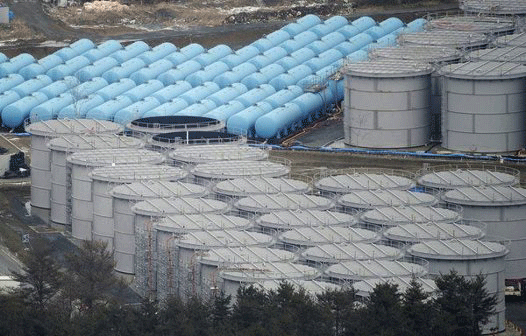
At the plant they’re capturing contaminated groundwater, about 150 tons a day, and storing it in tanks, as far as the eye can see.
Lake Barrett: Water is always the major challenge here. And it’s going to remain a major challenge until the entire cores are removed.
The closer workers get to the reactors, the more protective gear they have to wear, as we discovered………..
In the years since the accident, much of the damage to the building has been repaired.
But it’s still dangerous to spend a lot of time here. We could stay only 15 minutes.
Lesley Stahl: There’s this number I’ve been seeing, 566.
Lake Barrett: Right. That’s telling you the radiation level that we’re in. It’s fairly high here. That’s why we’re gonna be here a short time.
Lesley Stahl: How close are you and I, right this minute, to the core?
Lake Barrett: The– the melted cores are about 70 feet that way.
Lesley Stahl: Seventy from here–
Lake Barrett: From here.
Lesley Stahl: –is the melted core?
Lake Barrett: Correct, that’s right over in here. We don’t know quite where other than it fell down into the floor.
Lesley Stahl: So if you sent a worker in right now to find it, how long would they survive?
Lake Barrett: No one is gonna send a worker in there because they’d be overexposed in just a matter of seconds.
Enter the robots.
Lesley Stahl: This is the robot research center.
Dr. Kuniaki Kawabata: Yes. This is for remote control technology development.
In 2016, the Japanese government opened this $100 million research center near the plant where a new generation of robots is being developed by teams of engineers and scientists from the nation’s top universities and tech companies………
But even with all the high-tech training and know-how, the robots have run into problems. For the early models, it was the intense levels of radiation – that fried their electronics and cameras.
Lake Barrett: Their lifetime was hours. We hoped it would be days, but it was for hours………
when Scorpion went inside, it hit some debris and got stuck after traveling less than 10 feet. ……
Finally, in 2017, the swimming robot [Little Sunfish] made its foray into the heart of the reactor. ………. It beamed back images reveali ng clumps of debris, fuel rods, half-destroyed equipment and murky glimpses of what looks like solidified lava — the first signs, TEPCO officials say, of the missing fuel.
Lake Barrett: These robotic steps so far have been significant steps. But it is only a small step on a very, very long journey.
Lesley Stahl: This is gonna take you said decades with an “S.” How many decades?
Lake Barrett: We don’t know for sure. The goal here is 40– 30– 40 years. You know, I personally think it may be even 50– 60, but it’s–
Fukushima residents look for Olympic PR boost, Kyodo News, By Jim Allen, 29 July 19, – Two softball games and one baseball game in Fukushima next summer may be little more than an 2020 Olympic cameo, but local fans are thrilled to have them, largely in the hopes they will give their prefecture a badly needed public relations boost.
………… Tokyo Olympic organizers have dubbed the games “the Reconstruction Olympics.”
In addition to the games in Fukushima, Miyagi Stadium will be one of the Olympic soccer venues, while all three prefectures will be focal points of the Olympic torch relay — which officially starts in Fukushima.
……….. Even eight years later, Fukushima suffers from the suspicion that food from the prefecture might be contaminated. And locals see the Olympics as an opportunity to show off their region the way they see it. ………
Iwamura said that consumers outside Fukushima have second thoughts about the safety of the food raised there and local farmers cannot get fair value for their products. But he said the Olympics are a golden opportunity to change peoples’ perceptions of Fukushima.
“For us baseball people here, we want to make the baseball and softball games held here a success,” Iwamura said. “If we can be wildly enthusiastic about them and show that to the people coming from abroad, then they will tell others that Fukushima is safe, that the people here are living good lives.”……..
Iwamura expressed optimism for next year and for the future.
More than eight years after one of the worst nuclear disasters in history, towns around Japan’s nuclear power plant struggle to rebuild, 2019 Jul 28, BYBrit McCandless Farmer
The streets are motionless. Items hang untouched on clotheslines, bleached by the sun. A clock shows 2:46, and it always will. More than eight years after an earthquake and tsunami caused a meltdown at a nuclear power plant in Japan’s Fukushima prefecture, surrounding towns are still frozen in time.
“At the moment, there are huge areas that are still ghost towns,” correspondent Lesley Stahl told 60 Minutes Overtime in the video above. “People can come back into some of the areas because they have been decontaminated. But people are afraid to go back home.”
In March 2011, meltdowns at the Fukushima Daiichi nuclear power plant triggered huge explosions that sent plumes of radioactive debris into the atmosphere. Wind then carried that debris, contaminating all the towns in its path. The government evacuated more than 150,000 people.
Today, residents of those towns are reluctant to return, even as the Japanese government works to assure the towns’ safety.
“They’ve sent millions of workers out to literally wipe down rails, power hose leaves on trees, clean the tops of houses, dig up all the topsoil from a tree, a garden bed,” said 60 Minutes associate producer Ayesha Siddiqi. “It’s so detailed. Every single last crevice of the town will be cleaned up somehow.”
A lot of residents have moved homes—and moved on, rebuilding their lives elsewhere. Others are afraid of returning to an area that had been covered with radioactive particles. Still, some people are starting to filter back in.
“This is their home, had always been their home,” Stahl said. “But I don’t know if they’ll ever restore the surrounding towns and have really whole, healthy communities.”
To watch Lesley Stahl’s report on how robots have finally found the reactors’ melted uranium fuel, click here.
Toxic water level at Fukushima plant still not under control, THE ASAHI SHIMBUN, July 28, 2019 Almost six years after Prime Minister Shinzo Abe famously declared the contaminated water problem at the Fukushima No. 1 nuclear plant “under control,” today it remains anything but.
Tokyo Electric Power Co. (TEPCO) continues to face difficulties in dealing with water contaminated with radioactive substances at its crippled plant.
About 18,000 tons of highly contaminated water remain accumulated in reactor buildings and other places.
Abe made the declaration in September 2013 while Tokyo was bidding to win the 2020 Summer Games.
In reality, however, the situation is not under control even now.
In a meeting of the Nuclear Regulation Authority (NRA) in June, one of its members, Nobuhiko Ban, told TEPCO officials, “I want you to show whether you have a prospect (for the reduction of contaminated water) or you have given up.”
The water level did not fall as planned in an area of a basement floor at the No. 3 reactor building for two months. Asked why the level did not drop, TEPCO officials offered only vague explanations in the meeting. Ban made the remark out of irritation.
Highly contaminated water that has accumulated in reactor buildings and turbine buildings is a major concern at the Fukushima plant. In addition to water that was used to cool melted nuclear fuel at the No. 1, No. 2 and No. 3 reactors, groundwater also has flowed into those buildings through cracks.
The concentration of radioactive substances in the highly contaminated water is about 100 million times that of the contaminated water that has been processed and stored in tanks………
Eight years since the nuclear accident occurred, the volume of highly contaminated water in the buildings has fallen to 18,000 tons. TEPCO aims to reduce the volume further to 6,000 tons by the end of fiscal 2020.
However, work to decrease the water has not progressed as expected.
As for the area in the basement of the No. 3 reactor building, it is known that water used to cool melted nuclear fuel is flowing into the area. But why the water level does not drop only in that area is not known.
If the water level in the building remains high, highly contaminated water there could leak into the ground through cracks when the groundwater level outside the building drops. If the leaks occur, the entire effort to decrease the amount of highly contaminated water will be stalled.
The NRA is also requiring TEPCO to take anti-tsunami measures because if a huge tsunami engulfs the buildings again, it could send highly contaminated water pouring into the sea
Atomic minerals zirconium, monazite and thorium are found in abundance along several beaches of the country
The government has prohibited mining of atomic minerals by private entities and will grant operating rights to only state-run companies to “safeguard” strategic interest of the country, according to a gazette notification issued on Saturday.
Atomic minerals zirconium, monazite and thorium are found in abundance along several beaches of the country.
Zircon have potential applications in the strategic, defence and hi-tech sectors as it contains an important strategic element, called hafnium, which is used in the field of atomic energy.
Monazite is a mineral of thorium, uranium and rare earths and it has a high percentage of neodymium which has several hi-tech applications.
Zirconium, hafnium and thorium are very important strategic elements used in different stages of the country’s nuclear power programme, and since monazite and zircon occur in beach sand minerals, any loss or pilferage of these minerals at any stage of mineral handling or processing “shall affect the larger national interest”, the notification said.
“In offshore areas and their strategic importance, it is imperative that the mineral concessions in offshore areas be brought at par with the onshore areas in their treatment and therefore, in order to safeguard the strategic interest of the nation, it is expedient in larger national interest to prohibit the grant of operating rights in terms of any reconnaissance permit, exploration license or production lease of atomic minerals” in any offshore areas to anyone, except a government owned or controlled company, it stated.
“The central government hereby prohibits grant of operating rights in respect of atomic minerals in any offshore areas in the country…to any person, except the government or a government company or a corporation owned or controlled by the government, under the Offshore Areas Mineral (Development and Regulation) Act, 2002,” it said.
The government also “rescinded” any action taken by it earlier in this regard.
GREGORY KULACKI, CHINA PROJECT MANAGER AND SENIOR ANALYST | JULY 24, 2019, Ever since I took this job 17 years ago US colleagues of all political and intellectual persuasions have been telling me that sooner or later China would alter, adjust, amend or qualify the policy that China will never, under any circumstances, use nuclear weapons first. Yesterday, the Chinese Ministry of Defense released a much-anticipated new white paper on China’s national defense policies. Here’s what it says about nuclear weapons:
China is always committed to a nuclear policy of no first use of nuclear weapons at any time and under any circumstances, and not using or threatening to use nuclear weapons against non-nuclear-weapon states or nuclear-weapon-free zones unconditionally. China advocates the ultimate complete prohibition and thorough destruction of nuclear weapons. China does not engage in any nuclear arms race with any other country and keeps its nuclear capabilities at the minimum level required for national security. China pursues a nuclear strategy of self-defense, the goal of which is to maintain national strategic security by deterring other countries from using or threatening to use nuclear weapons against China.
It would be difficult to compose a more emphatic rejection of claims that China’s no first use policy is changing. The statement also indicates it is not Chinese policy to use nuclear weapons first to forestall defeat in a conventional military conflict with the United States. China does not have an “escalate to de-escalate” nuclear strategy.
China is not preparing to fight a nuclear war with United States. It does not have “battlefield” or “tactical” or “non-strategic” nuclear weapons. Chinese nuclear strategists don’t think a nuclear war with the United States is likely to happen. And they seem sure it won’t happen as long as the US president believes China can retaliate if the United States strikes first.
China sees its comparatively modest nuclear modernization program as a means to convince US leaders that a few Chinese ICBMs can survive a US first strike and that these survivors can penetrate US missile defenses. Chinese nuclear planners might be willing to slow or scale back their nuclear modernization efforts if the United States were willing to assure China’s leaders it would never use nuclear weapons first in a military conflict with China. Chinese experts and officials have been asking the United States to offer that assurance for decades. US experts and officials consistently refuse.
In the absence of a no first use commitment from the United States, Chinese nuclear strategists believe continued improvements to their nuclear arsenal are needed to assure China’s leaders their U.S. counterparts won’t take the risk of attacking China with nuclear weapons. Chinese experts know US efforts to develop a working ballistic missile defense system are not going well, but they still feel the need to hedge against continued US investment in the system with incremental improvements in the quality and quantity of China’s small nuclear force.
Given the impassioned attack on constructive US-China relations currently sweeping US elites off their feet, along with the continued proliferation of misinformation about Chinese nuclear capabilities and intentions, many US commentators are likely to brush aside the new white paper’s reiteration of China’s longstanding nuclear no first use policy. It doesn’t fit in the emerging US story about a new Cold War. That’s unfortunate, especially as the US Congress threatens to ramp upa new nuclear arms race its supposed adversary has no intention to run.
Tokyo Electric Power Company Holdings Inc. will decommission the Fukushima No. 2 nuclear plant, its president, Tomoaki Kobayakawa, told Fukushima Gov. Masao Ochibori at a meeting Wednesday.
The facility is the second nuclear plant that the utility company has decided to decommission after accepting it would need to shutter the nearby Fukushima No. 1 plant, which was crippled by the March 2011 earthquake and tsunami disaster in the world’s worst nuclear crisis since Chernobyl.
Tepco’s decision to scrap Fukushima No. 2, which is expected to cost some ¥280 billion ($2.6 billion), will be formally approved at the company’s board meeting later this month if local municipalities accept the plan.
The prefecture has demanded the utility scrap the reactors at Fukushima No. 2, saying their existence would hamper its reconstruction efforts. The plant has been offline since its operations were suspended due to the 2011 disaster.
If the plan goes ahead, all 10 nuclear reactors in the prefecture — four at the No. 2 plant and six at the No. 1 facility — will be scrapped.
It will also leave the utility company with only the Kashiwazaki-Kariwa nuclear plant in Niigata Prefecture and the planned Higashidori nuclear plant in Aomori Prefecture.
Kobayakawa said at the meeting, also attended by the mayors of the two towns — Naraha and Tomioka — that host the plant, that Tepco plans to build a new on-site storage facility for spent nuclear fuel from the reactors at the Fukushima No. 2 plant.
The fuel will be placed in metallic containers and cooled using a dry storage approach, according to the operator.
No decision has been made regarding final disposal of the spent fuel, raising concerns that the radioactive waste may remain on-site for a long time.
The Fukushima No.2 plant currently has around 10,000 assemblies of spent fuel cooling in pools.
Tepco to retire remaining reactors in Fukushima https://asia.nikkei.com/Business/Companies/Tepco-to-retire-remaining-reactors-in-FukushimaDecommissioning is expected to take 40 years and cost $2.5bn SUGURU KURIMOTO, Nikkei staff writer, JULY 20, 2019 TOKYO — Tokyo Electric Power Co. Holdings will scrap the four Fukushima Prefecture reactors that escaped damage in the 2011 earthquake and tsunami, moving to decommission all of the nuclear power plants the public utility owns in the disaster-stricken region.
The shutdown of the Fukushima Daini plant, which is located just 12km away from the Daiichi Plant crippled by fuel meltdowns, will be formally authorized at the company’s board meeting at the end of the month. This marks the first decision by the utility, known as Tepco, to decommission nuclear reactors apart from the Daiichi facilities.
Costs for decommissioning Fukushima Daini are estimated to exceed 270 billion yen ($2.5 billion). While Tepco’s reserves are not enough to cover them, the government adopted new accounting rules allowing operators to spread a large loss from decommissioning over multiple years. The company also believes it has secured enough people with necessary expertise to move forward.
Tepco soon will inform Fukushima Gov. Masao Uchibori of its decision. The utility intends to submit the decommissioning plan to Japan’s Nuclear Regulation Authority by March next year.
The decision means all 10 reactors in Fukushima will be scrapped. The Daini reactors will be decommissioned in roughly 40 years, sharing the same timetable as the Daiichi site. Tepco owns one other nuclear plant, the Kashiwazaki-Kariwa facility in Niigata Prefecture.
The Daini plant, where each reactor produced 1.1 gigawatts of power, served the Tokyo area for about three decades. Japan’s central government sought to restart the complex but faced withering opposition from local residents in Fukushima.
Including the Fukushima Daini facilities, a total of 21 reactors across Japan are now slated for decommissioning. Recent additions include two units at the Ikata plant in Ehime Prefecture and one reactor at the Onagawa facility in Miyagi Prefecture.
“To us as an environmental group, we hope that the environmental damage can stop and that these external [pollution costs] could be internalized in the cost” of products, Ma Jun, a leading Chinese environmentalist and director of the Institute for Public and Environmental Affairs, said in a phone interview.
Ma’s fear is that other regions around the world could suffer a similar fate if they become, like China, the supplier of cheap rare earth elements, with little or no environmental price attached
China has been a major source of rare earth metals used in high-tech products, from smartphones to wind turbines. As cleanup of these mining sites begins, experts argue that global companies that have benefited from access to these metals should help foot the bill.
BY MICHAEL STANDAERT•JULY 2, 2019 The mountains north of the village of Lingbeizhen in southern Jiangxi province no longer echo with the rumble of bulldozers and trucks. New bamboo groves climb the ravines. Tropical pines and navel orange trees grace terraces carved from the mountainsides, covering what was a hive of activity a few years back. Continue reading →




 In addition to the games in Fukushima, Miyagi Stadium will be one of the Olympic soccer venues, while all three prefectures will be focal points of the Olympic torch relay — which officially starts in Fukushima.