Accept Reality: North Korea Will Remain a Nuclear State. U.S. policy toward North Korea always has been one of second-best options. Preparing for a world with North Korea as a nuclear power is a necessity for the future. National Interest by Doug Bandow,11 Aug 19, President Donald Trump has discovered that nations around the world will not readily submit to his will. His administration has increased sanctions on and made military threats against Cuba, Venezuela, Russia, Iran and North Korea. So far, none of them have surrendered to Washington. Only the Democratic People’s Republic has come to the negotiating table.
The president’s willingness to talk with North Korea’s Supreme Leader Kim Jong-un deserves praise, despite complaints from the warmongering Right and partisan Left. However, his demand for instant and complete denuclearization was never realistic.
Alas, negotiations in which the president placed so much hope have ground to a halt. Most recently, North Korean diplomats skipped the ASEAN summit, where Secretary of State Mike Pompeo had expected to meet with North Korean foreign minister Ri Yong-ho. Said Pompeo: “We stand ready to continue our diplomatic conversation with the North Koreans,” but, he added, “I regret that it looks like I’m not going to have an opportunity to do that while I’m here in Bangkok.”
Indeed, the bilateral relationship is deteriorating. The United States and the Republic of Korea are conducting military exercises, despite bitter attacks by Pyongyang. The DPRK is conducting short-range missile tests, embarrassing the Trump administration and unnerving both the ROK and Japan. The president continues to express his confidence in Kim’s commitment to denuclearize, but the former might find that position harder to defend in the face of Democratic Party attacks as the 2020 presidential campaign accelerates.The North is forever unreasonable and obstructionist. That is unlikely to change. But in this case Pyongyang’s position is logical, reflecting the interests of the Kim family regime. After all, Kim is supposed to abandon his leverage in return for vague promises of positive benefits in the future. However, the United States routinely coerces governments on its enemies list, such as Serbia, Afghanistan, Iraq and Libya. Notably, none of those countries had a nuclear deterrent…….
the president should clearly reject belief that the alternative to denuclearization is war. The threat of attack, if credible, might offer negotiating leverage, but also would raise tensions and make the North more likely to preempt military action it believed to be imminent. After all, given United States conventional superiority, the North must use or quickly lose its military capabilities and would be forced to respond almost instantly to any assault by Washington. …..
In reality, these Games are about forgetting the nuclear accident itself and with it “the victims of the nuclear accident”
Refugees are currently to be forced by financial pressure to return to areas that have been evacuated after the 2011 triple disaster, despite still significantly increased levels of radiation, as retired nuclear physicist Hiroaki Koide is pointing out. According to him, the fact that even children or pregnant women have to live with a twenty-fold increased limit for annual radiation exposure (from 1 millisievert per year before and up to 20 mSv after the incident), “is something that cannot be accepted at all”.
The Olympics are being organised “so that people in Japan forget the responsibility of the state for the nuclear accident,”
“What’s really dangerous, is that “the athletes will tell the world that Fukushima is safe”
‘Bad for Fukushima, bad for democracy’, Play the Game, By Andreas Singler, 7 Aug 19
One year before the opening of the Summer Olympics in Tokyo there is considerable resistance to the so-called ‘Reconstruction Games’ in Japan that critics fear will remove focus from the Fukushima disaster and undermine democratic values.
July 24 – one year to go until the opening of the Summer Olympics in Tokyo – may have been a day of joyful anticipation for many who embrace the Olympic Movement. But not all people anticipate this event as cheerfully as the organisers in Japan, a large part of the media and the Government of Prime Minister Shinzo Abe would appreciate. There was and still is much opposition against the hosting of the Olympic and Paralympic Games 2020 in Tokyo. Opponents call it both “bad for democracy” and “bad for Fukushima” – the area hit by a nuclear power plant disaster on 11 March 2011 and a devastating earthquake and tsunami.
For those critics, July 24 was a reason to take to the streets against Tokyo 2020. They had announced a rally for this memorable day followed by a demonstration in Shinjuku, one of the most crowded hubs in Tokyo. A leaflet even suggested that the Olympics could be “given back even a year before”. The protest in Tokyo was part of a so-far unique international gathering of ‘NOlympics’ activists from several countries. For eight days, opponents from Tokyo, Pyeongchang, Rio de Janeiro, Paris and Los Angeles discussed the dark sides of the Olympics with critical scholars and alternative media. A press conference was held at the Foreign Correspondents’ Club of Japan.
The motto ‘the Reconstruction Games’, that the organisers and the Government chose after the 2011 East Japan triple disaster, sounds like sheer mockery, opponents say. Organisers as well as the International Olympic Committee (IOC), including President Thomas Bach, often talk about reconstruction, but hardly ever mention the Fukushima Daiichi nuclear power plant disaster as one of the main reason for the need of such rebuilding. Continue reading →
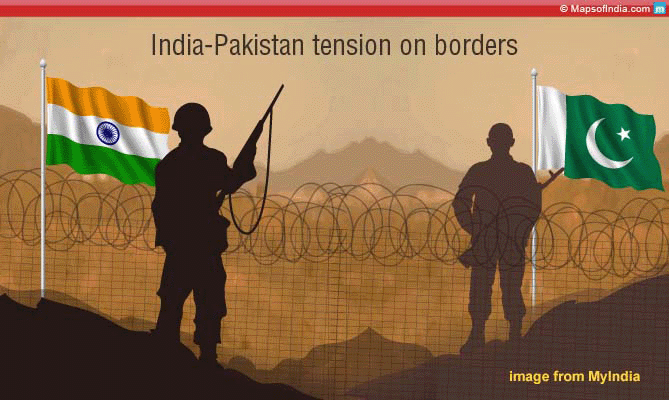
Kashmir crisis: Will nuclear-armed Pakistan go to war with India again? Telegraph UK Ben Farmer, islamabad
8 AUGUST 2019 Pakistan has downgraded diplomatic ties with India and suspended trade with its neighbour as the political row over the disputed territory of Kashmir escalates.
Bad for Fukushima, bad for democracy’, Play the Game, By Andreas Singler, 7 Aug 19″…….Undermining democratic values
Japanologist and literary scholar Donald Keene, who passed away earlier this year aged 96 and who became a Japanese citizen after ‘March 11’ in solidarity with the suffering country, sharply criticised the media for their Olympic coverage of Rio de Janeiro in his Tokyo Shimbun column. Keene mentioned – “as if living in a totalitarian state” – mass media’s nationalistic approach and lack of journalistic distance. “From the very beginning, I was opposed to Tokyo Olympics,” Keene wrote. He was, according to Satoshi Ukai, one of the few public figures in Japan who could still be allowed such a clear-cut opinion. Keene, by birth a US citizen, was a legend among international Japanologists as an annalist, translator and intimate connoisseur of Japan’s golden generation of post-war writers.
“The longer one reflects about Olympics, the bigger the problems appear,” says Ukai. The fact that big celebrations and major disasters both can fuel nationalism and undermine the democratic culture of a country is one of the issues touched upon by US political scientist Jules Boykoff in his lecture on ‘Celebration Capitalism’ during a symposium at Waseda University in Tokyo on 21 July. His theoretical approach that refers on Naomi Klein’s term ‘disaster capitalism’ and covers Olympics in general appears like a blueprint on the conditions in ‘post-Fukushima’ Japan, where there are only a few years between catastrophe and festival event.
A larger number of laws have been adopted in recent years, partly as so-called anti-terrorism measures in the name of Olympic security. Critics call it an attack on the freedom of press, of expression, and of assembly. Those laws, one by one, caused mass protests driven by various social movements. The United Nations Special Rapporteur on Human Rights, Joseph Cannataci, criticised an Anti-Conspiracy Act of 2017 in an open letter to Prime Minister Abe. And in a report to the UN Human Rights Committee, Special Rapporteur David Kaye sounded the alarm over the country’s eroding freedom of the press. It is hardly possible to report freely about sensitive issues of Japanese history such as Japan’s role in World War II, the ‘comfort women’ issue or, yet, about the real situation in Fukushima, Kaye reported. In just a few years, Japan dropped from number 11 in 2010 to 72 in 2018 and 67 in the current ranking of ‘Reporters Without Borders’.
Tepco and three other companies considering joint firm to build nuclear power plant in Aomori, Japan Times, 9 Aug 19,
JIJI Tokyo Electric Power Company Holdings Inc. and three other companies are considering jointly setting up a new firm to construct and manage a planned nuclear power plant in Aomori Prefecture, informed sources said Thursday.
The three partners are Chubu Electric Power Co., Hitachi Ltd. and Toshiba Corp., the sources said.
Under the plan, the new company will build and run a new nuclear plant next to Tohoku Electric Power Co.’s Higashidori nuclear facility, which has been idle since the triple core meltdown at Tepco’s Fukushima No. 1 plant…….
Trump praises ‘very beautiful’ letter from Kim Jong Un amid frozen nuclear talks, tension over military exercises, By CONOR FINNEGAN and ELIZABETH MCLAUGHLIN abc news Aug 9, 2019, President Donald Trump said on Friday that he received another letter from North Korea‘s Kim Jong Un on Thursday amid stalled talks over the regime’s nuclear weapons program and Kim’s recent missile launches.
Trump said the missive was three pages, hand-delivered, “very positive,” and “really beautiful,” speaking to reporters as he left the White House. ……
Paving the Way for a Shift? Evidences from China’s Nuclear Documents, International Policy Digest, Lorenzo Termine, 9 Aug 19, The historical roots of the Chinese nuclear doctrine dates back to the traumatic experiences of the Korean War and the Taiwan Strait crises during the 1950s when the United States, then bound to South Korea and Taiwan, kept on the table a nuclear option against Beijing. After testing their first A-bomb in southern Xinjiang in October 1964, Beijing stated that, given the power of annihilation, “China will not at any time or under any circumstances employ atomic weapons first.” The no first use (NFU) policy is, then, congenitally rooted in China’s nuclear doctrine………
The main concern for the U.S. and its allies in Asia is whether China is modernizing its nuclear arsenal solely to secure a credible and effective second-strike capacity or if it is overhauling its nuclear policy toward a completely new approach. If the above-analyzed documents were meant to pave the way for more meaningful shift away from the traditional Chinese nuclear posture, then, Asia’s security environment would be significantly altered and global peace could be sorely tested. https://intpolicydigest.org/2019/08/09/paving-the-way-for-a-shift-evidences-from-china-s-nuclear-documents/
Official: China buried nuclear waste in Sudan desert, Dabanga Sudan, November 12 – 2015KHARTOUMChina has buried dozens of containers with toxic waste in the desert of Northern Sudan, according to a high-ranking official. The waste was most probably coming from nuclear plants in China.
According to the former director of the Sudan Atomic Energy Commission in Sudan, Mohamed Siddig, 60 containers have been brought to Sudan together with construction materials and machinery for the building of the Merowe Dam (Hamdab Dam) in the Northern part of Sudan. He did not mention the exact year of the import and the date the nuclear waste was disposed. China worked on the dam between 2004 and 2009.
During a conference held by the Sudanese Standards and Metrology Organisation (SSMO) in Khartoum on Tuesday, he disclosed how the Sudanese authorities allowed the import of the waste ‘without inspection’. He told the audience that 40 containers were buried in the desert not far from the Merowe Dam construction site. Another 20 containers were also disposed in the desert, though not buried…..
Mohamed Siddig was responsible for the Sudan Radioactive Waste Management programme that started in 1995, a central radioactive waste management facility was established in Soba near Khartoum. The Atomic Energy Committee is responsible for overseeing the safety in activities that involve the use of atomic energy in Sudan, and promoting the use of nuclear techniques.
Gold miners complain
In 2010, the government was already confronted by complaints of local gold diggers, according to the Sudanese newspaper El Tariq. Several gold workers approached the government complaining about many of the worker suffering from cancer and skin diseases. The Sudan authorities downplayed the questions saying the waste they dug up were remnants from earlier times. However witnesses told El Tariq that 500 sealed barrels were discovered in the El Atmur desert area in River Nile State…….https://www.dabangasudan.org/en/all-news/article/official-china-buried-nuclear-waste-in-sudan-s-desert
Nobu Hanaoka was only 8-months-old when the US dropped Fat Man — a Plutonium bomb — on the Japanese city of Nagasaki on August 9, 1945. Sep 25, 2017 HT Correspondent Hindustan Times, New Delhi
“Does he have all five fingers?” This was a Nagasaki atomic bomb survivor’s first question to the doctor when his son was born.Nobu Hanaoka, 73, says he was relieved when the doctor replied that his son was in perfect health. “I had hoped that the radiation did not affect the child,” Hanaoka told Al Jazeera.
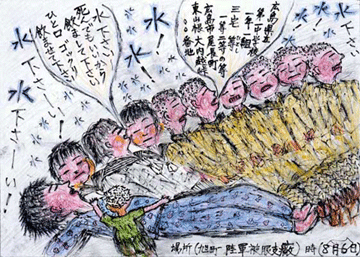
Hanaoka was only eight months old when the US dropped ‘Fat Man’ — a Plutonium bomb — on the Japanese city of Nagasaki on August 9, 1945, killing about 74,000 people. Three days before, ‘Little Boy’ — the first-ever atomic bomb, dropped on Hiroshima — had claimed 140,000 lives.
Hanaoka — clad in a simple, grey coat, has a message for the United States and North Korea as tensions escalate between the two countries over the possibility of a nuclear war.
“This is the kind of weapon that doesn’t just kill. It kills indiscriminately. It kills slowly and painfully.”
“And it shouldn’t be allowed on the surface of the Earth,” the survivor says after a pause.
“We were not even in the city of Nagasaki. We were outside. And yet the radiation that came from the bombing went far beyond the city limits,” Hanaoka said, before explaining the three ways an atomic bomb can kill.
Hanaoka’s mother and sister died due to radiation when he was six, he says, adding that he overheard the doctor telling his father the boy wouldn’t live to see his 10th birthday. “So I knew that I was not going to live long,” Hanaoka says in the video.
The atomic bomb survivor says he was always concerned for his health and feared he was dying when he got a simple cold. He also had survivor’s guilt, a mental condition in which a person feels remorse for surviving a traumatic event when others did not. “Why did my sister and mother, who were wonderful people… beautiful and smart and gentle, and they had to die.”
“And yet, I, who am not unworthy, am still alive?”
“I want all nations to come together and start finding a way of eliminating nuclear weapons altogether,” Hanaoka tells Al Jazeera after warning that there will be millions of casualties if either the US or North Korea is attacked with radioactive weapons.
North Korea’s foreign minister Ri Yong Ho told the United Nations General Assembly last week that targeting the US mainland with its rockets was inevitable after “Mr Evil President” Donald Trump called Pyongyang’s leader a “rocket man” on a suicide mission.
Trump, too, dialled up the rhetoric against North Korea over the weekend, warning Ho that he and its leader Kim Jong Un “won’t be around much longer” as Pyongyang staged a major anti-US rally.
The North had threatened to “sink” Japan into the sea and fired two missiles over the northern island of Hokkaido in the space of less than a month. Pyongyang said this month it had carried out an underground test on a hydrogen bomb estimated to be 16 times the size of the US bomb that destroyed Hiroshima in 1945. It was its sixth and largest nuclear test.
Survivors of Hiroshima-Nagasaki — the only two nuclear attacks in the history of mankind — warned of the threat of atomic weapons in a photo essay by the Time magazine last month. It quoted another survivor Fujio Torikoshi (86) as saying all he wanted was to forget the bombing. “We cannot continue to sacrifice precious lives to warfare. All I can do is pray – earnestly, relentlessly – for world peace.”
Hiroshima atomic bomb: The US nuclear attack that changed history, Aljazeera, 7 Aug 19,
As Japan marks 74th anniversary of world’s first nuclear bomb attack, we examine the events that shaped history. Japan has marked 74 years since a US atomic bomb attack that razed the city of Hiroshima to the ground at the end of World War II.
Around 50,000 people, including representatives from around the world, attended on Tuesday a ceremony held in the Peace Memorial Park near ground zero to honour the memory of the victims of the world’s first nuclear bomb attack.
In a speech, Hiroshima Mayor Kazumi Matsui called on the international community to work towards a world without atomic weapons.
Below we take a look at the events that shaped the course of history.
What happened in Hiroshima?
On August 6, 1945, at about 8:15am Japanese time, the US aircraft Enola Gay dropped an untested uranium-235 gun-assembly bomb nicknamed “Little Boy” over Hiroshima. The devastation was unlike anything in the history of warfare, ushering in the era of weapons of mass destruction.
Hiroshima was immediately flattened. The resulting explosion killed 70,000 people instantly; by December 1945, the death toll had risen to some 140,000. The radius of total destruction was reportedly 1.6km.
“The impact of the bomb was so terrific that practically all living things – human and animal – were literally seared to death by the tremendous heat and pressure set up by the blast,” Tokyo radio said in the aftermath of the explosion, according to a report by The Guardian in August 1945.
“All the dead and injured were burned beyond recognition. Those outdoors were burned to death, while those indoors were killed by the indescribable pressure and heat.”
But the damage did not end there. The radiation released from the explosion caused further suffering. Thousands more died from their injuries, radiation sickness and cancer in the years that followed, bringing the toll closer to 200,000, according to the Department of Energy’s history of the Manhattan Project. …..
The bombings were as questionable back then as they are today. Six out of seven five-star US generals and admirals at the time felt there was no need to drop the bomb because Japanese surrender was imminent. …….
The power of the atomic bomb would usher a change in geopolitics that still reverberates to this day, with several countries currently vying to acquire this technology.
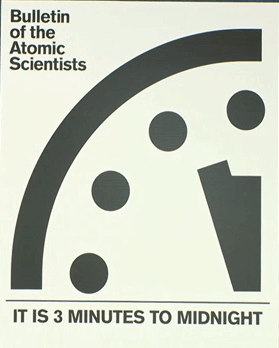
The Doomsday Clock
In 1947, the scientists involved in the Manhattan Project created the Doomsday Clock, which represents the likelihood of a man-made global catastrophe, with midnight symbolising the destruction of civilisation as we know it.
“I think Japan is one country that should work hard to prohibit the use of nuclear weapons, in fact, to get rid of all nuclear weapons because Japan is the only country in the world that suffered from bombing by nuclear device so Japan knows how horrible it is when nuclear weapons are used,” Dr Mahathir was quoted as saying.
Over 70 countries have signed the treaty but ratification has been slow. The treaty needs 50 member nations to formally adopt it in order to be effective but only 25 have done so as of this month.
More importantly, major nuclear arms makers such as the US and China have not signed on. Consequently, countries such as Japan that enjoy protection from the US by virtue of their alliance have similarly deferred from supporting the treaty.
Japan is vicariously dependent on the US’ military might as the Asian country amended its constitution after its WWII defeat to prohibit its armed forces from being deployed offensively.
Dr Mahathir lauded this as a good example for the rest of the world.
“Japan is the only country in the world which has outlawed war, aggressive war, in order to solve problems of conflict between nations. That is a good beginning. Other countries should follow,” he was quoted as saying.
However, the Malaysian PM also noted growing hostilities between Japan and South Korea, and expressed concern that Japan’s constitutional ban on military aggression might not last.
His Japanese counterpart, Shinzo Abe, previously suggested that the constitutional restriction be revisited to clarify the role of his country’s Self-Defence Forces.
Hiroshima mayor pushes Japan to join nuke ban treaty on A-bomb anniv. By Keita Nakamura, KYODO NEWS 5 Aug 19Hiroshima marked the 74th anniversary of its atomic bombing by the United States on Tuesday, with the city’s Mayor Kazumi Matsui putting pressure on the Japanese government to join a U.N. treaty banning nuclear weapons in his peace declaration speech.Attended by representatives from about 90 countries including the United States, the annual memorial ceremony took place at the Peace Memorial Park near Ground Zero
In the annual declaration, Matsui called on the central government to “accede” to the request from “hibakusha,” as atomic bomb survivors are known in Japan, that the U.N. Treaty on the Prohibition of Nuclear Weapons, which was passed in July 2017 with the support of 122 nations, be “signed and ratified.”
Prime Minister Shinzo Abe gave a speech at the ceremony but avoided any reference to the treaty. Japan has refused to participate in the treaty, along with other countries under the U.S. nuclear umbrella, as have the world’s nuclear-weapon states…….
This year, Matsui also demanded that the world leaders “respond to the yearning of civil society for entry into force” of the treaty, and Japanese leaders “manifest the pacifism of the Constitution” by showing leadership toward a nuclear-weapon-free world.
“Around the world today, we see self-centered nationalism in ascendance, tensions heightened by international exclusivity and rivalry, with nuclear disarmament at a standstill,” Matsui warned.
The power of individuals is weak, he said, but added there have been many examples of collective strength achieving desired goals…..
Nagasaki Mayor Tomihisa Taue has said he will also urge the Japanese government to support the treaty at this year’s memorial ceremony to be held Friday in his city, as he has done in each of the past two years.
KYODOm HIROSHIMA – A Japan-U.S. joint research organization opened one of its radiation research facilities in Hiroshima to the public Monday to raise awareness of the effects of radiation on human health, ahead of the anniversary on Tuesday of the atomic bombing of the city.Although the Hiroshima facility will only be open to the public for two days, the Radiation Effects Research Foundation will open another research facility in the city of Nagasaki on Thursday and Friday to coincide with the city’s Aug. 9 A-bomb anniversary.
This marks the 25th annual public opening of the facility in Minami Ward, Hiroshima. It aims to share research content and help the public better understand the health effects of radiation. The research facility has been collecting data from hibakusha since the institute was established in 1975, when it succeeded the research efforts of its predecessor, the Atomic Bomb Casualty Commission.
Some of the exhibition booths explain the risks of radiation, as well as the role of blood. Visitors can also experiment with freezing cells in liquid nitrogen for preservation, which tends to be popular with children when the experiment is successful.
“The (facility was) full of things I didn’t know were there, like health research on second generation hibakusha. Even as a Hiroshima resident, I learned a lot,” said Sanae Yamamoto, a 41-year-old housewife from Asakita Ward in the city who visited the facility with her children.
Kashmir, nexus of conflict between nuclear antagonists India and Pakistan, faces crackdown, plunges into fear, By Douglas Perry | The Oregonian/OregonLive, 5 Aug 19, India and Pakistan have fought two wars and engaged in countless cross-border military skirmishes over Kashmir.
Now India has plunged the mountainous region into fear by revoking Kashmir’s constitutionally mandated “special privileges.” The federal government in Delhi sent in thousands of troops over the weekend, and Kashmiri political leaders have been put under house arrest. Internet service to the area has been cut off or restricted…..
The crackdown did not come as a surprise: The Delhi government ordered tourists out of the Himalayan region last week, warning of a possible terrorist attack.
Kashmir has been claimed by both Hindu-majority India and Muslim-majority Pakistan — and administered by India — since the two countries won their independence shortly after World War II. Great Britain partitioned its colony on the Indian subcontinent in 1947 before pulling out, sparking widespread violence. “Under the partition plan provided by the Indian Independence Act,” the BBC notes, “Kashmir was free to accede to India or Pakistan” — and the region’s maharaja at the time chose India, even though the population is predominantly Muslim. This led to a two-year war between India and Pakistan, with another one erupting in 1965.
Expert says 2020 Tokyo Olympics unsafe due to Fukushima | 60 Minutes
Fukushima: Despite health threats, the Japanese government urges residents to return https://www.express.co.uk/news/world/1161500/fukushima-japanese-government-encourages-residents-returnFAMILIES who fled nuclear meltdown in Fukushima are being urged to return to their homes ahead of the Tokyo Olympics., By DAVID PILDITCH, Aug 4, 2019Alarming levels of radiation up to 20 times higher than official safety targets have been recorded in areas where locals are being encouraged to go back. We found ghost towns eight years after three reactors went into meltdown at Daiichi power plant 140 miles north east of Tokyo in March 2011. Tokyo 2020 is being hailed as the “Reconstruction Olympics” signalling new hope following the earthquake and tsunami that triggered the disaster and left more than 18,000 people dead.
Now evacuees are being urged to return as the global spotlight focuses on the recovery of the region. The government has lifted most evacuation orders and all but a handful of hot spots have been declared safe.
But parents believe their children are in danger, saying officials are downplaying the dangers and safety is compromised in a cynical attempt to convince the world the crisis is over.
Families have accused the government of speeding up their return to showcase safety standards ahead of the Olympics.
We found once-vibrant communities now post apocalyptic wastelands like something from a Hollywood movie after the worst nuclear accident since Chernobyl.
Schools, shopping malls, supermarkets, libraries and petrol stations lie decaying along with thousands of homes. Many are set behind guarded barricades in exclusion areas known officially as “difficult to return to zones”.
Others lie in areas which the government says are safe to live in but whose few residents – wild boar and monkeys – demonstrate signs of mutation. Along roadsides sit giant black bags containing contaminated soil.
In Tomioka, five miles from the power plant, a school sports hall is scattered with footballs left when children fled.
It’s in stark contrast to arenas being built for the £20billion Games. Fukushima is hosting the first event, a softball match on July 22, two days before the opening ceremony.
The Japanese leg of the torch relay starts on March 26 at a soccer training centre 12 miles south of the crippled plant. The J Village, a base for emergency workers, only fully reopened last month.
In Okuma our Geiger counter sounded furiously, recording four microsieverts an hour. The government safety target is 0.23 microsieverts per hour.
It came days after evacuation orders were lifted for parts of the town which had 10,000 residents. The centre remains a no-go zone and just 367 former residents have registered to go back.
Ayako Oga, 46, who suffered a miscarriage, says: “The Olympics are putting lives in danger. The government is forcing people to leave the public homes they have been in. They are putting a heavy burden on people still suffering mentally and financially.”
In Namie, which had 21,000 residents, evacuation orders were lifted in 2017. It is said 800 people returned but we found desolation, only traffic lights working.
The Wild Boar bar last served a drink on disaster day. Owner Sumio Konno, in a group legal action against the government, says his son, who was five, still suffers nosebleeds. “He is sick all the time,” he says. “Every month he needs to go to the doctor.”
Ryohei Kataoka, of the Citizens Nuclear Information Centre, says: “The government’s insistence in lifting evacuation orders where heightened radiation-related health risks undeniably exist, is a campaign to show that Fukushima is ‘back to normal’ and to try to make Japan and the world forget the accident ever happened.”