India’s government ignores opposition as it plans to build spent nuclear fuel storage facility
|
Govt to build KNPP nuke fuel storage despite opposition Anirban Bhaumik, Deccan Herald, DHNS, New Delhi, NOV 20 2019, The Government is set to go ahead with its plan to set up a facility for storing spent fuel of the first and second units of the Kudankulam Nuclear Power Plant (KNPP) in Tamil Nadu – brushing aside opposition by political parties in the state.
Jitendra Singh, Union Minister of State (MoS) in charge of Department of Atomic Energy, on Wednesday informed the Lok Sabha that the designing of the “Away From Reactor” (or AFR) Spent Fuel Storage facility for the first and second units of the KNPP …….
The DMK MPs from Tamil Nadu were not convinced though. “I feel that it is unfair to decide about the necessity of repository considering the quantity of radioactive waste. Any day, an atomic reactor is like a Damocles Sword hanging over you,” Thamizhachi Thangapandian, the MP from Chennai South, said…….. https://www.deccanherald.com/national/govt-to-build-knpp-nuke-fuel-storage-despite-opposition-778172.html
|
|
|
Gizmodo thoroughly debunks the false story of a nuclear explosion in the South China Sea
 No, China Did Not Secretly Detonate A Nuke In The South China Sea To Signal The Start Of WWIII, Gizmodo Tom McKay, Nov 22, 2019, The Chinese government has almost certainly not secretly detonated a tactical nuclear weapon in the South China Sea to send a warning signal to the United States, experts told Gizmodo, regardless of widespread claims to the contrary on social media.
The source of this particular rumour appears to be Hal Turner, a far-right New Jersey radio host and former FBI informant considered a white supremacist by the Anti-Defamation League and the Southern Poverty Law Centre (and who once was sentenced to over nearly three years in prison for calling for the murder of three federal judges). A post on Turner’s website claimed that unidentified “military sources” had said that around 6:22 p.m. ET on Wednesday, a nuclear explosion of some kind 50 meters below the surface of the South China sea had “caused an underwater shock wave of such sudden presence, and of such strength, that the explosion itself ‘had to be between 10 and 20 Kilotons.’” Later, the article on Turner’s website was updated to claim that the uRADMonitor Global Environmental Monitoring Network had detected “significant” radiation readings on the southern coast of China near Zhangjiang and Hong Kong, as well as Taiwan.
Turner speculated that the Chinese government had detonated a nuclear weapon to quietly send a signal to the U.S. government that it was fed up with intervention against Chinese oppression of pro-democracy protests in Hong Kong, the ongoing U.S.-China trade war, or perhaps simply to suggest that World War III was around the corner:
Did China detonate a small, tactical, nuclear device to send a warning to the United States over the US Senate and US House approving the Hong Kong Democracy Act, which China views as an “assault” upon China’s internal affairs?
Has China had enough of US “freedom of navigation” exercises in the South China Sea?
Is China feeling the sting of economic downturn from its Trade War with the USA, and are they “upping-the-ante” signalling actual war?
This is normally the kind of thing that reasonable people would simply ignore. But thanks in part to a series of tweets from an account using the official-sounding handle “IndoPacific_SCS_Info” and others, Turner’s claims gathered the attention of thousands on Twitter. [Numerous Twitter examples given]
It should come as no surprise that this is hot bullshit. For one, the uRADMonitor site itself pegs the supposedly gigantic radiation spike at 0.24 microsieverts per hour. That’s about the same as in South India, parts of the southwestern U.S., and Mexico—and it is an absolutely negligible amount of radiation. For comparison, the World Nuclear Association estimates the global average of naturally occurring background radiation at 0.17-0.39 microsieverts per hour, according to Reuters. If one were exposed to 0.24 microsieverts per hour, that would equate to around 2,100 microsieverts a year, or just over two millisieverts. The U.S. defines the upper boundary of safe occupational exposure at 50 millisieverts per year.
One university radiation safety specialist, who spoke anonymously with Gizmodo because they were not authorised to talk to the media, confirmed that the supposedly ominous uRADMonitor readings appeared to reflect normal background radiation levels and called the claims “unsupported wild-arse speculation.” (That specialist also warned that uRADMonitor was not a reliable source.) Readings of airborne radioactive particles posted on the Environmental Protection Agency’s RadNet Honolulu page, as well as the Institute for Information Design Japan’s Japan Radiation Map, also seemed to show nothing out of the ordinary (other than elevated levels in the area of the 2011 Fukushima Daiichi nuclear disaster).
That’s generously assuming that those readings even matter in the context of a covert underwater Chinese nuclear explosion, which Gizmodo has it on good authority they don’t
Gizmodo spoke with Robert Rosner, a former Department of Energy scientist and current University of Chicago theoretical physicist who chairs the Bulletin of the Atomic Scientists’ Science and Security Board. Rosner laughed at the idea that anyone would be able to identify an underwater nuclear test from ground-based detectors, or that anyone would be stupid enough to conduct such a test in the South China Sea.
“I would be amazed if there had been an event that somebody would then identify as an event based on a radioactive signature,” Rosner told Gizmodo via phone. “That’s unbelievably unlikely.”
Rosner added that the primary way of detecting such an event would be seismic; the first underwater nuclear tests in the world, the 23-kiloton Baker nuke at Bikini Atoll in 1945, set off seismographs the world over. There’s been no such indication that any kind of similar event happened on Wednesday……..
In addition to security concerns, Rosner said, the region is also monitored for seismic events because of “really deadly tsunamis” like the 2004 Indian Ocean earthquake and tsunami. Rosner said that a 10-20 kiloton blast would “definitely be notable” on that scale, noting that the nuclear bombs dropped on Hiroshima and Nagasaki were of similar magnitude.
In other words: You should not believe a racist radio host who says completely unremarkable background radiation readings are evidence that China is about to start World War III……..https://www.gizmodo.com.au/2019/11/no-china-did-not-secretly-detonate-a-nuke-in-the-south-china-sea-to-signal-the-start-of-wwiii/
China’s $2.5bn renewables investment in Inner Mongolia
|
China’s nuclear power company plans $2.5bn renewables investment in Inner Mongolia http://www.globalconstructionreview.com/news/chinas-nuclear-power-company-plans-25bn-renewables/, 22 November 2019 | By GCR Staff
China General Nuclear Power Group (CGN) is preparing to invest $2.5bn in renewables generation capacity in its northern province of Inner Mongolia, including a 1GW solar facility and a 2GW wind farm, according to a report in PV Magazine. The investment aims to capitalise on the climate of the region, which combines strong and steady winds with up to 3,400 hours of sunshine a year. CGN was founded in 1994 to operate nuclear power plants, but has since built up a domestic portfolio of renewable assets, including 9.1GW of wind capacity and 1.7GW of solar. The wind turbines are to be installed near the city of Ulanchabu, which will also make the turbines. Administrative work will be carried out in the first half of next year with construction scheduled to begin in August and complete in 2021. The Inner Mongolia Solar Energy Industry Association says the transmission lines required to bring the electricity from the sparsely populated north have already been built. At the beginning of this year, the State Power Investment Corporation (Spic), one of China’s top five energy generators, announced plans to build a 6GW windfarm close to China’s border with Mongolia. Spic announced that is has received planning approval for its project from the Ulanqab Municipal Development of Inner Mongolia. If it goes ahead, it would install turbines across an area of 3,800 square kilometres, roughly the same size as the UK county of Suffolk, at a construction cost of about $6.8bn. |
|
|
To Make the Olympics Look Good Japanese Government Wants Evacuees To Return To Fukushima

While Japan might want to make the Olympics look good, – internationally the IAEA , nuclear nations and global nuclear industries want the Olympics to make the nuclear industry look good!
|
Japanese Government Wants Evacuees To Return To Fukushima In Time To Make Olympics Look Good, Dead Spin Dvora Meyers, 3/08/19 One of the few things that the Olympics do well, aside from putting cities in significant debt that can take decades to pay off, is symbolism. It was on display last year in Pyeongchang when the North and South Korean delegations marched into the opening ceremonies for the Winter Olympics, and if the Japanese government has its way, 2020 will bring its own moment of symbolic healing. The Tokyo 2020 organizing committee has embraced symbolism—as well as the traditional cost overruns—and have dubbed their Games the “Reconstruction Olympics.” The “reconstruction” they’re referring to is the effort to rebuild the part of the country that was devastated by the 2011 earthquake, tsunami, and subsequent Fukushima nuclear reactor meltdown. More than 16,000 people were killed in the disaster and approximately 160,000 people evacuated the region, with the Japanese government providing subsidies and assistance to those who fled. To prove that the region is well on its way to recovery, the Tokyo Olympic organizing committee announced that the baseball and softball competitions would be held in Fukushima, a move that the IOC approved. To add another does of symbolism to this, the Olympic torch relay will begin in Fukushima, too. In 2017, when the venues for baseball and softball were announced, Aileen Mioko-Smith, an activist with Green Action Japan, noted, “It’s fine for athletes and spectators to go to Fukushima for a couple of days to compete, but the Japanese government is using this to claim that everything is back to normal and that the evacuees should go back to their homes.” ……. The Japanese government has already ended subsidies for those “voluntarily” evacuated, meaning that they weren’t in the immediate evacuation zone but left because they lived in Fukushima prefecture and were worried about the radiation levels and the environmental fallout. One of those evacuees, Kazuko Nihei, told Agence France Presse that she refuses to return to Fukushima City with her daughters even though she’s enduring financial hardship since the government ended her housing subsidy. The reason she refuses to return is because she’s concerned about long term health impacts. The government is only offering screenings for thyroid cancer, but Nihei wants a “comprehensive annual health check” for the returnees. The Japanese government insists that it is safe to return, but as the article notes, they’ve moved the goalposts a bit when it comes to acceptable radiation levels:
The Japanese government plans to end all financial assistance to evacuees in 2021, which will mark a decade since the earthquake, tsunami, and nuclear meltdown. Noriko Matsumoto, another evacuee, is critical of the government for eliminating subsidies while at the same time spending a lot of money to prepare the area for the Games. “I think there are other things that should be done before hosting the Olympics,” she said. While her comment is perhaps a specific reaction to bringing Olympic events to a region still reeling from a natural and nuclear disaster, in it you can detect a more universal criticism of the Olympics that has been repeated by activists all over the world—Why are we spending money on the Olympics when we have much more important ways to spend our limited resources?…..https://deadspin.com/japanese-government-wants-evacuees-to-return-to-fukushi-1833156282?utm_medium=sharefromsite&utm_source=deadspin_twitter&utm_campaign=top |
|
Taiwan govt to give $2.55 billion to Orchid Island in nuclear waste compensation

 Orchid Island to get NT$2.55 billion in nuclear waste compensation, Focus Taiwan, (By Flor Wang, Elaine Hou, Lu Tai-cheng Taipei, Nov. 22 (CNA) The government will pay NT$2.55 billion (US$83.6 million) to Orchid Island residents to compensate them for infringing on their rights by maintaining a nuclear waste storage facility there over the past five decades, President Tsai Ing-wen (蔡英文) announced Friday.
Tsai announced the compensation at a news conference in Taitung and hailed the move as reflecting the goal of the current government to pursue transitional justice for indigenous tribes based on fact-finding efforts.
“Evidence we collected showed that the then-government decided to build a nuke waste storage in reserved lands for the Yami people on Orchid Island without their previous knowledge or agreement,” Tsai said.
She described the payment as a step toward compensating Orchid Island and its people, but said there was still a lot to do to “correct our past errors.”
The decision to position the facility to handle low- and medium-level nuclear waste from Taiwan’s nuclear power plants on Orchid Island was made in 1974 and it began receiving shipments in 1982.
The process has long been recognized as deceptive, with a report titled “Orchid Island: Taiwan’s Nuclear Dumpsite” in the newsletter Nuclear Monitor in 1993 detailing how residents were led to believe a cannery was being built.
The Executive Yuan brought up historical documents showing that former President Chiang Ching-kuo (蔣經國) and Premier Sun Yun-suan (孫運璿) went ahead with the decision to build the facility without informing the local Yami people in advance.
Since residents realized in the late 1980s what was actually on the site, they have feared it would contaminate the food chain and force them off the island and also led protests against nuclear power……http://m.focustaiwan.tw/news/aipl/201911220023.aspx
Problematic question of Fukushima food at the Olympic Games
Japan grapples with serving Fukushima food at Olympics, Channel News Asia, 20 Nov 19, FUKUSHIMA: For years, Japan’s government has sought to convince consumers that food from Fukushima is safe despite the nuclear disaster. But will it serve the region’s produce at the Tokyo Olympics?
It’s a thorny subject for the authorities. They pitched the Games in part as a chance to showcase the recovery of areas affected by the 2011 tsunami and nuclear disaster.
Government officials tout strict checks on food from the region as evidence that the produce is completely safe, but it remains unclear whether athletes and sports teams from around the world will be convinced.
In the Fukushima region, producers are keen to see their products served at the Olympic village and have submitted a bid to the organisers.
“The Fukushima region has put forward food from 187 producers and is second only to Hokkaido when it comes to meeting the specified criteria in terms of range of products,” said Shigeyuki Honma, assistant director general of the local government’s agriculture and forestry planning division.
“Fukushima wants to serve athletes its rice, its fruits, beef and vegetables. But the committee still has to decide.”……
the figures have only gone some way to reassuring foreign officials: numerous countries including China, South Korea, and the United States maintain restrictions on the import of some or all produce from Fukushima.
South Korea, which is currently locked in a dispute with Japan over wartime issues, has been vocal about its concerns ahead of the Olympics, even raising the possibility of bringing in its own kitchen and food.
“We have requested the Olympic organisers to provide objective data verified by an independent third body,” the South Korean Sports and Olympic Committee said in a statement earlier this year.
“Since Japan repeatedly said its food from Fukushima is safe, we have demanded they provide statistics and data to back up their claims,” an official with the committee told AFP.
The position underlines a long-running problem for Japan: while it points to its extensive, government-mandated checks as proof of safety, many abroad feel the government is not an objective arbiter……..
The International Olympic Committee said it was still weighing how to handle the matter.
“Food menus and catering companies for the Olympic Village are under discussion and have yet to be defined,” a spokesman told AFP.
The Tokyo 2020 organisers said promoting areas affected by the 2011 disaster remains a key goal…….
Environmentalists say Fukushima water too radioactive to release
Officials from the Ministry of Economy, Trade and Industry addressed a government committee Monday, and said that the health risk associated with releasing water that absorbed radionuclides in the aftermath of the March 2011 nuclear accident would be “small.”
During the hearing, the officials said that releasing the water over the course of one year would cause exposure amounting to a miniscule fraction of the radiation that humans are naturally exposed to annually.
The officials said that storage facilities are already close to capacity, with over 1 million tons of contaminated water being stored in steel tanks on the site in northeast Japan. Tokyo Electric Power Company (TEPCO), the operator of the Fukushima plant, estimates that with around 120 tons of ground water leaking into the basement levels of the three reactors that suffered meltdowns as a result of the 2011 earthquake and tsunami, the storage tanks will reach capacity in the summer of 2022.
Contamination questions
TEPCO and the government have long believed that the best way to dispose of the water is to simply release it into the ocean. They claimed until this year that contaminated water had been cleansed by a so-called advanced liquid processing system to the point that virtually all the radionuclides had been reduced to “non-detect” levels.
Leaked TEPCO documents, however, show that varying amounts of 62 radionuclides — including strontium, iodine, cesium and cobalt — have not been removed from the water.
The company has also been criticized for refusing to permit independent organizations to test the water that is being stored at the site.
Nevertheless, environmentalists fear that preparations are under way to release the water into the environment.
“Even a year ago, when the first report on options for disposing the treated water was presented to the committee, it seemed clear to me even then that the preferred option was to release it into the ocean,” said Azby Brown, the lead researcher for Tokyo-based nuclear monitoring organization Safecast Japan. Other options included evaporation and burying the water.
“My take on this is that they have already reached a decision and that all these discussions now on the options are purely theater.”
Calls for added storage capacity
Safecast, Greenpeace and other environmental organizations have called for the company to build more tanks on the site. Additionally, when the area within the plant perimeter is full, they advocate building more storage on adjacent farmland that can no longer be used because it is too highly contaminated.
Brown said TEPCO officials ruled that option out on the grounds that they want to limit the tanks to the existing site.
“Honestly, I don’t see much evidence of genuine consideration of the other options,” he said.
Others are more optimistic that the government and TEPCO will eventually conclude that it would be too damaging to their reputations to dump the water into the Pacific.
“They do seem to be coming back to this option regularly, but once you start to look at the logistics of it, very quickly it’s clear that it’s virtually impossible,” said Hideyuki Ban, co-director of the Citizens’ Nuclear Information Center.
We do not know the levels of radionuclides in the water they say has been treated, but the best guess we have is that levels of tritium are at about 1 million becquerels per liter,” he said.
“The government has set a level of 60,000 becquerels per liter as the target before the water is released, but TEPCO says they want to get it down to 1,500 becquerels.”
“To do that is going to take a long time, and then every tank of water that was going to be released would have to be tested to make sure that it meets those standards,” Ban said. “We think that they would be better off just deciding to keep storing the water for the next 30 years.”
The best of bad options?
TEPCO said that a final decision on how to dispose of the water will be made by the government after all the available options have been taken into consideration.
But a company official told DW that time is running out for a decision to be made.
“In three years, the capacity that we are adding at the site at the moment will be used up and there is nowhere else to build tanks,” he said. “We have a three-year window for the government to decide on a policy and a course of action.”
South Korea’s safety concerns about Fukushima water release
 South Korea Nuclear Regulator Wants Information on Radioactive Fukushima Water Release, By Reuters, 20 Nov. SEOUL — Japan’s reluctance to disclose information about the release of radioactive water from its damaged Fukushima nuclear plant is hampering neighboring countries’ efforts to minimize the impact, the head of South Korea’s nuclear safety agency said on Wednesday.
Since the 2011 earthquake and tsunami caused a meltdown at some of the reactors the Fukushima plant, owner Tokyo Electric Power Co (Tepco) has been storing radioactive water in tanks at the site from the cooling pipes used to keep the fuel cores from melting. The utility will run out of space for the water in 2022.
Japan has not yet decided how to deal with the contaminated water, but its environment minister said in September that radioactive water would have to be released from the site into the Pacific Ocean.
“We have been raising Japan’s radioactive water issue to the international community to minimize the impact … but as Japan hasn’t disclosed any specific plan and process we would need more details to run simulations and study,” Uhm Jae-sik, chairman of the Nuclear Safety and Security Commission, told Reuters.
In addition to the Fukushima crisis, safety concerns about nuclear energy have increased in South Korea following a 2012 scandal over the supply of faulty reactors parts with forged documents, prompting a series of shutdowns of nuclear reactors.
South Korea, the world’s fifth-largest user of nuclear power, targets a long-term phase out of atomic power to allay public concerns.
“Regardless of the government’s energy policy change, our primary goal is ensuring the safety of nuclear power,” Uhm said.
South Korea operates 25 nuclear reactors, which generate about a third of the country’s total electricity. Of the 25 reactors, 10 are offline for maintenance, according to the website of Korea Hydro & Nuclear Power.
(Reporting By Jane Chung; Editing by Christian Schmollinger) https://www.nytimes.com/reuters/2019/11/20/world/asia/20reuters-southkorea-nuclear.html
Japan nuclear plant safety costs increase 5-fold over 6 years to 5.4 trillion yen

21 new plants to help transform Fukushima into a renewable energy hub

Chefs to join Team South Korea in Tokyo Olympics
 President of Korean Sports and Olympic Committee Lee Kee-heung
November 5, 2019
Chefs and food ingredients will accompany the South Korean team and delegation traveling to the 2020 Tokyo Olympics next year. The chefs will prepare food for the South Koreans using homegrown ingredients for the duration of the Games.
Korean Sports and Olympic Committee (KSOC) President Lee Kee-heung, also a member of the International Olympic Committee, unveiled the measures to allay fears over food safety which were raised after Japan announced it would use food products from Fukushima, a region hit hard by a 2011 tsunami and an ensuing meltdown at the nuclear power plant there.
“The KSOC is planning to expand the meal station for Korean athletes during the games to address the food safety issue,” he wrote in a recent written interview with The Korea Times. “Korean food has superb nutritional value and we believe it will help the athletes perform at their best. We will also deliver lunch boxes to the stadiums so our athletes can focus on getting medals,” Lee said.
Earlier, the Japanese Olympic Committee said it would serve athletes food made using ingredients from Fukushima, a region in which water and soil are feared to remain contaminated with radioactivity following the meltdown. South Korea banned rice and vegetable imports from the region immediately after the incident.
The Tokyo Olympics is not the first international sports event where the KSOC has dispatched chefs to prepare meals for athletes. During the 2012 London Olympics, the KSOC sent chefs and nutritionists from the national training center to cook for Korean athletes and staff who craved food from home.
Food safety is among other touchy issues at the Olympics.
The “Rising Sun” flag, a symbol for many in Asia of Japanese colonialism, is another pre-Olympics issue that some South Koreans find concerning. The issue has been raised by Seoul since September after relations with Japan deteriorated following it imposing trade restrictions on certain exports to Korea. In response, Japan said use of the flag does not violate the Japanese Constitution.
Lee said the KSOC has been working to make an Asian alliance to push Japan to not fly it.
“During the 24th Association of the National Olympic Committee (ANOC) General Assembly in Qatar earlier this year, I met with other Asian state representatives and discussed ways to address the issue together. On this issue, our effort to change Japan’s policy will continue and with the support of the government,” he said. ANOC has an annual meeting, and this year’s congress took place in Doha.
Joint Korea team
Lee said he was cautiously optimistic about fielding a joint team between the two Koreas for the Tokyo Olympics, saying the KSOC has continued to talk with the North.
However, another high-level official, who didn’t want to disclose his name because of the sensitivity of the issue, said a joint team may be a distant dream. “Considering what’s going on in inter-Korean relations, it’s difficult to move on a joint team,” he said. He had taken part in negotiations with the North in the past.
A joint team for the 2020 Olympics was agreed in November 2018 at inter-Korean talks held in Gaesong in the North. That year, President Moon Jae-in and North Korean leader Kim Jong-un held three summits.
The governments of the two Koreas agreed to form unified teams in female basketball, female hockey, judo and rowing. “The IOC approved this under one condition ― that is the unified teams would start from qualifying matches,” the anonymous official said.
For all sports but basketball, qualifying matches are already underway. “Basketball qualifying matches will begin at the end of the year. Yet, if things go the way it goes now, unifying a basketball team will be out of the question,” he said. But, he added hopes remain in judo. “In judo, individual athletes compete for qualification. We can consider making a joint team with qualified athletes.”
However, the political situation will hold full sway over the joint team and the current circumstances are not very promising.
Last week, North Korean leader Kim Jong-un ordered the removal of all South Korean-built facilities at Mount Geumgang, including a hotel. North Korea’s aggressive treatment of South Korean football players during their World Cup qualifying game also cast a shadow on the prospects for a joint team.
Despite this, there is still hope for a possible peace gesture during the Olympics.
The official said a joint march at the opening ceremony could still happen. “This has been done several times now, so we could continue to do it.”
North and South Korean athletes have marched together at international sports events 11 times so far. The most recent being the 2018 PyeongChang Winter Olympics in South Korea ― the Koreas also fielded a joint women’s ice hockey team.
In addition to creating the joint team, the two Koreas also agreed to submit a joint bid to co-host the 2032 Summer Olympics, and President Lee said they have a very good chance.
“The Korean Peninsula can be a symbol of peace which will be something we can take advantage of in our campaign for the Olympics,” Lee said, noting that South Korea will host the next ANOC General Assembly. “This will be also a good opportunity to show the sports community that the Koreas are qualified to host the Olympics.”
As an IOC member representing Korea, Lee is at the center of sports diplomacy.
“Now, Korea has two IOC representatives, which has elevated its standing in global sports.” Korea’s sports diplomacy had its heyday in the 2000s when it had three IOC representatives, but in 2017, the number went down to one, raising concern that its standing had weakened.”
Lee viewed the PyeongChang Winter Olympics as demonstrating Korea’s success in sports diplomacy. “This helped Korea get two IOC representatives.”
100th National Sports Festival
With regard to the centennial of the National Sports Festival, Lee said he was saddened by the decreasing public interest. “It will be my job to revamp the festival so that it will recover its lost popularity with bigger public interest and participation.”
The festival started out as an act of resistance to colonial Japan in 1920. In the first year, only baseball was played but other sports were added over the century. This year saw 47 sports including trials of two new ones.
Over the century, the festival served as an incubator for world-class athletes. Figure-skater Kim Yu-na competed in the festival as did Swimmer Park Tae-hwan. The festival has also contributed to developing the infrastructure for Korean sports.
Born in 1955, Lee’s background has been in business, not sports. His first step into the world of sports was with the Federation of the Modern Pentathlon where he served as vice president in 2000. Between 2004 and 2009, he was the president of the Korea Canoe Federation, followed by the Korea Swimming Federation between 2010 and 2016..
He headed the athlete’s team in the 2010 Asian Games in Guangzhou in China and 2012 London Summer Olympics.
As negotiation deadline nears, tension between Kim Jong Un and Donald Trump
Trump, Kim at odds as deadline looms in nuclear talks, Glen Carey and Jihye Lee, Bloomberg, November 18, 2019
The bonhomie between President Donald Trump and North Korean leader Kim Jong Un is nearing a key deadline showing new signs of strain.
Trump urged Kim over the weekend to “act quickly” to get a nuclear deal done, suggesting the two leaders could meet again “soon.” His comments came hours after North Korea ruled out nuclear talks without a policy change by the U.S. and reported on a military drill observed by Kim himself.
Veteran North Korea nuclear adviser, Kim Kye Gwan, told Trump that Pyongyang will no longer give him “things to boast about,” the state’s official KCNA news agency on Monday quoted him as saying. He added North Korea is no longer interested in talks that the U.S. “uses to buy time.”
Trump and Kim Jong Un, who have previously displayed what Pyongyang calls “mysteriously wonderful chemistry,” appear to be going in different directions as the clock ticks down. Kim has given Trump until the end of the year to ease up on sanctions or risk him taking a “new path,” meaning a possible escalation of military tensions during the U.S. presidential campaign…….
After more than a year of talks and three Trump-Kim meetings, the two sides remain divided on issues from sanctions relief to disarmament. Even though North Korea hasn’t taken any major steps to give up its weapons, Kim has won concessions from Trump that include canceling some U.S.-South Korean joint military drills that have drawn Pyongyang’s anger.
North Korea hasn’t explained what Kim intends to do on his “new path,” although the regime has often referred to his decision to halt tests of nuclear bombs and intercontinental ballistic missiles two years ago. In May, North Korea resumed tests of shorter-range ballistic missiles.,,,,,,,
The North Korea warning about U.S. nuclear talks came despite the U.S.’s decision to suspend another round of military drills with South Korea. Defense Secretary Mark Esper said on the sidelines of a regional security conference that Washington and Seoul had “jointly decided to postpone this month’s combined flying training event” after “close consultation and careful consideration.”
Pyongyang last week blamed U.S.-South Korean military drills “as a main factor of screwing up tensions.”
Japan’s METI says it’s safe to dump radioactive water from Fukushima nuclear disaster into ocean
The industry ministry said Monday it would be safe to release water contaminated by the Fukushima nuclear disaster into the ocean, stressing that on an annual basis the amount of radiation measured near the release point would be very small compared to levels to which humans are naturally exposed.
Discharging the water into the Pacific Ocean over the course of a year would amount to between just one-1,600th and one-40,000th of the radiation to which humans are naturally exposed, the Economy, Trade and Industry Ministry, or METI, told a government subcommittee on the issue.
Water used to cool the melted-down cores and groundwater from close to the damaged plant contain some radioactive materials, and are currently being collected and stored in tanks on the plant grounds.
But space is running out fast, and the government is exploring ways to deal with the waste water — which already totals more than 1 million tons with the volume increasing by more than 100 tons every day.
According to an estimate performed by the ministry, annual radiation levels near the release point after a release would be between 0.052 and 0.62 microsievert at sea, and 1.3 microsieverts in the atmosphere, compared with the 2,100 microsieverts that humans come into contact with each year in daily life.
One member of the subcommittee called on the ministry to provide detailed data showing the impact of different conditions such as ocean currents and weather.
Another member requested more information on the amount of radiation that people will be exposed to internally, depending on how much fish and seaweed they consume.
The waste water is currently being treated using an advanced liquid processing system referred to as ALPS, though the system does not remove tritium and has been found to leave small amounts of other radioactive materials.
The tanks storing the water are expected to become full by the summer of 2022, according to Tokyo Electric Power Company Holdings Inc., the operator of the Fukushima No. 1 nuclear power plant.
The plant was damaged by a magnitude 9.0 earthquake and ensuing tsunami on March 11, 2011.
While government officials stress the safety of releasing the waste water, local fishermen are opposed to discharging it into the ocean due to worries that it would cause reputational damage and impact their livelihoods.
South Korea has also expressed concern over the environmental impact.
In September, Japanese and South Korean officials traded barbs over the issue at a meeting of the International Atomic Energy Agency in Vienna.
A nuclear expert from the IAEA said in 2018 that a controlled discharge of such contaminated water “is something which is applied in many nuclear facilities, so it is not something that is new.”
The plight of Fukushima nuclear workers getting leukaemia
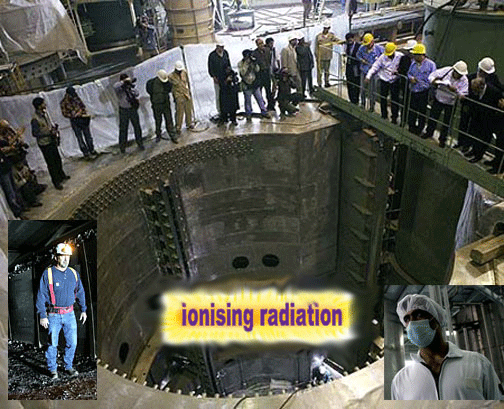 Fukushima Workers Battle Leukemia – and Bureaucracy Unseen Japan Fukushima Workers Battle Leukemia – and Bureaucracy Unseen Japan
by Hiro Ugaya, November 13, 2019 The March 2011 tsunami, and the subsequent meltdown of three reactors at the Fukushima nuclear power plant, has had a devastating impact on Japan. Eight years later, and most journalists – in Japan and abroad – have forgotten about the story. But for many, the struggle continues.
This is especially true of workers who helped assist in the cleanup effort at Fukushima. Some Fukushima workers have contracted severe diseases – including cancer and leukemia – since their work concluded. The government of Japan has even certified that some cases are a result of recovery work. But workers who are fighting for their lives also find themselves fighting the system. Tokyo Electric (TEPCO), which led the recovery effort, refuses to admit any connection between the cleanup work and subsequent diseases in workers. And many insurance companies are pointing to the fine print in private insurance contracts stating they don’t cover accidents at nuclear facilities. Unseen Japan has been pleased to partner with photojournalist Hiro Ugaya (烏賀陽弘道) to translate his interviews with evacuees and former evacuees, and to document the ongoing struggle of the victims of this tragedy. We previously published Hiro’s interview with a mother in the city of Minamisoma. In this installment, we share the first part of Hiro’s interview with Mr. Ikeda (pseudonym), a Fukushima nuclear reactor cleanup volunteer who now finds himself fighting two uphill battles. Translation from an article originally published on Note.mu. Translation by Jay, Editor/Publisher, Unseen Japan. All photos used with permission of Hiro Ugaya.) Ikeda’s StoryFor this installment of the Fukushima Report, I visited Northern Kyushu City in Fukuoka prefecture. I departed from Tokyo and flew west, in the direction opposite Fukushima. I went to Fukuoka, which is quite far from Fukushima. That’s where the leukemia-stricken Ikeda Kazuya (age 44; pseudonym) has lived since participating in the Daichi Nuclear Reactor reconstruction efforts. I had visited Ikeda once in 2017 to hear his story. Among all my interviews here in the Fukushima Report, it’s the one that’s reverberated the loudest. Mr. Ikeda volunteered to participate in the restoration work at the Fukushima Daiichi nuclear power plant. By trade, he’s an independent welder. In March 2011, when so many people died due to the tsunami, he looked at the report of the death of a small child and thought, “I need to do something useful for Tohoku” [Editor: the region of Japan hit by the tsunami]. He asked permission from his boss and threw himself into the reconstruction effort. The interior of the heavy machinery room of Reactor 4 butts up against the nuclear fuel rod pool. But in 2013, Mr. Ikeda came down with leukemia. Mr. Ikeda is one of the first cancer patients that the country recognizes as a work-related accident connected to the Fukushima Daiichi nuclear power plant. Two Fukushima workers contracted leukemia (bone marrow cancer), and one contracted thyroid cancer. The first case of leukemia was recognized in October 2015. The second was recognized in August 2016. The third person, who had thyroid cancer, was certified in December 2016. As of May 2019, there are six patients in the country whose cases have been recognized as occupational accidents caused by work at the Fukushima Daiichi nuclear power plant. To tell the truth, I was quite surprised that the country recognized them as occupational accidents. Judging from the history of pollution diseases, such as Minamata disease and Itai-itai disease, I predicted the government would probably prevaricate and not admit a causal relationship. But the government admitted it readily (employing a lot of rhetoric, of course, such as “This is not an admission of a scientific, causal relationship”). From a global and historical perspective, the admission is rare. In the Three Mile Island nuclear accident (1979) in the US, more than 2000 lawsuits have been filed, but no relationship between health damage and exposure has been admitted in even a single case. The state government naturally won’t admit it, and the courts don’t either. Due to this admission, the assertion that “the radiation leakage from the Fukushima Daiichi nuclear accident is mild enough not to damage health” fell apart. In the Chernobyl nuclear accident in the former Soviet Union, the first to suffer serious harm were the so-called “Liquidators,” the firefighters and soldiers who were the first responders. Nearly 5,000 people died. Naturally, people who are close to radiation-intensive sites will become seriously ill. The same phenomenon occurred in the Fukushima Daiichi nuclear power plant accident. While the case was recognized as a workplace injury, Mr. Ikeda filed a lawsuit against Tokyo Electric (TEPCO), which ran the restoration project. That’s because TEPCO doesn’t “recognize a causal relationship between Mr. Ikeda’s leukemia and exposure to radiation at the Fukushima Daiichi nuclear power plant.” I’ve long found it mysterious that not a single TV station, weekly newspaper, web media or other news outlet has done an article on those like Mr. Ikeda who contracted deadly diseases from the nuclear reactor recovery work. Since the government’s announcement certifying them as workplace injuries, there’s been dead silence. Those affected can’t be heard in their own voices. ……. Mr. Ikeda pointed out something important. People who work in nuclear facilities such as nuclear power plants are not covered by private insurance, even if they have an accident or get sick. It’s in the so-called “disclaimer.” If People who engaged in the dangerous work of recovering the nuclear power plant post-meltdown have been left naked and defenseless. And few people notice it. Even insurance companies don’t care. I want to fix this abnormality…… (Interview: -) There are six people, including yourself, who have been certified as workplace accidents due to cancer or death from overwork in the recovery work of the Fukushima Daiichi nuclear power plant accident. Any contact from them? No, none. I’ve caught sight of the wife of one of the Fukushima workers who died from overwork (karoshi) at rallies in Tokyo. It seems that TEPCO employees and primary subcontractors who got sick will receive 30 million yen [around USD $274,000]. But in return, they can’t sue. That’s what my lawyer emphasized at trial. But that offer doesn’t extend to us (second-tier subcontractors). The owner who hired me also had business owner insurance. Just in case we have an industrial accident. However, we found out later that it wasn’t valid in nuclear facilities, such as nuclear power plants. The insurance companies say it’s too dangerous a place to cover via employer insurance. And yet TEPCO denies responsibility for my leukemia. That’s what you’re contesting in court. That’s right. They’re denying everything. They say it was too low of a dose to bear any relationship. In the previous trial, TEPCO says I developed leukemia due to smoking, drinking, and a vegetable deficiency. That took me aback (laughs). They talk to us like we’re alcoholics…… What evidence is TEPCO presenting to refute you? Search for the stories of scholars who kowtow to the government, you’ll find it (laughs). Who’s providing testimony, besides you? There are various people I think. TEPCO won’t recognize the causal relationship between your leukemia and radiation exposure, correct? If they did, it’ll become a serious obstacle to future nuclear power policy. I was the first person certified, and there’ve been a number since. So there has to be a causal relationship, right? What total dose did you receive? A total of 19.8 millisieverts. Others received more. TEPCO is terrible. It’d be better if they just copped to it. “Others Will End Up Like Me”Why do you think TEPCO should admit responsibility? When this happens to someone else, this won’t be any guarantee, but it’ll give them peace of mind, you know? I mean, it’s not like you can tell people, “Don’t help with recovery efforts.” Other industries offer insurance – who’s going to guarantee workers who enter a nuclear facility if the employer’s primary insurance won’t? That’s what I want to tell people. Fukushima workers who entered the facility had no idea their employer’s primary insurance wouldn’t cover it……. https://unseenjapan.com/fukushima-workers-leukemia-bureaucracy/ |
|
China General Nuclear Power Group to invest $2.5 billion into a huge solar project – plus 2 GW of wind turbines
China’s nuclear operator to develop 1 GW solar field https://www.pv-magazine.com/2019/11/15/chinas-nuclear-operator-to-develop-1-gw-solar-field/
China General Nuclear Power Group is reportedly preparing to invest almost $2.5 billion into a huge solar project – plus 2 GW of wind turbines – in the autonomous province of Inner Mongolia. Local authorities say the massive project will be complete in 2021.
NOVEMBER 15, 2019 VINCENT SHAW Sources in Beijing have told pv magazine the state-owned China General Nuclear Power Group (CGN) is preparing to invest RMB17 billion ($2.43 billion) in renewables generation capacity in northern China, including 1 GW of solar panels.
The nuclear power company is also planning 2 GW of onshore wind capacity, with all the facilities to be built in the Inner Mongolian city of Ulanchabu.
The authorities in Ulanchabu say compliance reviews and administrative procedures will be carried out in the first half of next year with construction due to start on the massive renewables project by August, ready for completion in 2021.
Having been founded in 1994 in Guangdong province to operate China’s first nuclear power station – the Daya Bay plant – CGN has long since diversified into solar and wind power. The company claims to operate a 4.4 GW solar portfolio and 12.7 GW of wind facilities across all provinces of its homeland after funding more than 300 clean energy projects. The nuclear company also claims to have a 13.4 GW overseas renewable energy project pipeline.
The autonomous region of Inner Mongolia boasts excellent sunshine resources and the Inner Mongolia Solar Energy Industry Association said the construction of ultra-high voltage transmission lines in the province has enabled the authorities to set a curtailment target of near zero for solar electricity, and of 10% for wind power.
1 This Month
26 September – International Day for the Total Elimination of Nuclear Weapons





PLEASE OPPOSE HR 8255 AND S.3639 – bills would accelerate satellite deployment, with no environmental review or safeguards – https://ncstd5li.quorum.us/campaign/169331/
To see nuclear-related stories in greater depth and intensity – go to https://nuclearinformation.wordpress.com
-
Archives
- September 2026 (290)
- August 2026 (330)
- July 2026 (355)
- June 2026 (287)
- May 2026 (306)
- April 2026 (356)
- March 2026 (251)
- February 2026 (267)
- January 2026 (308)
- December 2025 (358)
- November 2025 (359)
- October 2025 (375)
-
Categories
- 1
- 1 NUCLEAR ISSUES
- business and costs
- climate change
- culture and arts
- ENERGY
- environment
- health
- history
- indigenous issues
- Legal
- marketing of nuclear
- media
- opposition to nuclear
- PERSONAL STORIES
- politics
- politics international
- Religion and ethics
- safety
- secrets,lies and civil liberties
- spinbuster
- technology
- Uranium
- wastes
- weapons and war
- Women
- 2 WORLD
- ACTION
- AFRICA
- Atrocities
- AUSTRALIA
- Christina's notes
- Christina's themes
- culture and arts
- Events
- Fuk 2022
- Fuk 2023
- Fukushima 2017
- Fukushima 2018
- fukushima 2019
- Fukushima 2020
- Fukushima 2021
- general
- global warming
- Humour (God we need it)
- Nuclear
- RARE EARTHS
- Reference
- resources – print
- Resources -audiovicual
- Weekly Newsletter
- World
- World Nuclear
- YouTube
-
RSS
Entries RSS
Comments RSS

