Fukushima Prefecture has over 9 million bags of nuclear waste
|
Over 9 million bags of nuclear cleanup waste piled up across Fukushima Pref. https://mainichi.jp/english/articles/20151210/p2a/00m/0na/020000c?fbclid=IwAR0UFZrUByjuHKdFb8dE7o4p_WjADFuYZBGw-5NUrbUklXe_8buwbOifmaA The number of bags of waste from decontamination efforts around the stricken Fukushima No. 1 nuclear plant reached a little under 9.16 million as of the end of September according to Fukushima Prefecture and the Environment Ministry. The 1-cubic-meter bags are found at some 114,700 interim storage or decontamination sites across the prefecture. In the town of Tomioka — covered by a nuclear disaster evacuation order — mounds of bags have grown so tall that they obscure the power shovels used to move and stack the waste, the black balls covering every sliver of landscape. The bags of waste are typically stacked four layer high, with a fifth layer of uncontaminated soil laid on top to block radiation. Waterproof sheets are also used to stop rainwater from getting into the bags and becoming contaminated. Negotiations with the towns of Okuma and Futaba — both under evacuation orders — to establish mid-term waste storage facilities there have been hard-going, and the start of construction is nowhere in sight.December 10, 2015 (Mainichi Japan) |
2 nuclear reactors in Fukui Prefecture to be shut down
Kansai Electric Power Co. will spend ¥118.7 billion to dismantle the Nos. 1 and 2 units at the Oi nuclear power plant, with work expected to wrap up in the fiscal year ending March 2049.
The units, which each have an output capacity of more than 1 million kilowatts, are the most powerful reactors to be approved for decommissioning by the Nuclear Regulation Authority since a magnitude 9.0 earthquake and subsequent tsunami caused a meltdown at the Fukushima No. 1 plant in March 2011.
Following the disaster, the government placed a 40-year limit on the lifespan of reactors in the country, with a possible 20-year extension if strict safety standards are met.
As both units came online in 1979 and were approaching the 40-year limit, Kansai Electric had a choice of applying for the extension or scrapping them.
In December 2017, the utility announced it would scrap the aging reactors, citing the high cost of implementing additional safety measures. Kansai Electric submitted the decommissioning plan to the authority in November 2018.
The plant’s Nos. 3 and 4 units came online in 1991 and 1993, respectively, and are currently active.
Around 23,000 tons of low-level radioactive waste will be remain following the dismantling process, according to the plan, along with another 13,200 tons of nonradioactive waste.
The plan does not state where the waste will be stored.
Water shortages to hit 1.9 billion people as glaciers melt
1.9 billion people at risk from mountain water shortages, study shows https://www.theguardian.com/environment/2019/dec/09/billion-people-risk-water-supply-rising-demand-global-heating-mountain-ecosystem
Rising demand and climate crisis threaten entire mountain ecosystem, say scientists, Jonathan Watts Global environment editor, @jonathanwatts, Tue 10 Dec 2019 A quarter of the world’s population are at risk of water supply problems as mountain glaciers, snow-packs and alpine lakes are run down by global heating and rising demand, according to an international study.
The first inventory of high-altitude sources finds the Indus is the most important and vulnerable “water tower” due to run-off from the Karakoram, Hindu Kush, Ladakh, and Himalayan mountain ranges, which flow downstream to a densely populated and intensively irrigated basin in Pakistan, India, China and Afghanistan.
The authors warn this vast water tower – a term they use to describe the role of water storage and supply that mountain ranges play to sustain environmental and human water demands downstream – is unlikely to sustain growing pressure by the middle of the century when temperatures are projected to rise by 1.9C (35.4F), rainfall to increase by less than 2%, but the population to grow by 50% and generate eight times more GDP.
Strains are apparent elsewhere in the water tower index, which quantifies the volume of water in 78 mountain ranges based on precipitation, snow cover, glacier ice storage, lakes and rivers. This was then compared with the drawdown by communities, industries and farms in the lower reaches of the main river basins.
The study by 32 scientists, which was published in the Nature journal on Monday, confirms Asian river basins face the greatest demands but shows pressures are also rising on other continents.
“It’s not just happening far away in the Himalayas but in Europe and the United States, places not usually thought to be reliant on mountains for people or the economy,” said one of the authors, Bethan Davies, of Royal Holloway University.
“We always knew the Indus was important, but it was surprising how the Rhône and Rhine have risen in importance, along with the Fraser and Columbia.”
The study says 1.9 billion people and half of the world’s biodiversity hotspots could be negatively affected by the decline of natural water towers, which store water in winter and release it slowly over the summer.
This buffering capacity is weakening as glaciers lose mass and snow-melt dynamics are disrupted by temperatures that are rising faster at high altitude than the global average.
“Climate change threatens the entire mountain ecosystem,” the report concludes. “Immediate action is required to safeguard the future of the world’s most important and vulnerable water towers.”
As well as local conservation efforts, the authors say international action to reduce carbon emissions is the best way to safeguard water towers.
Citing recent research by the UN Intergovernmental Panel on Climate Change, Davies said 75% of high-altitude snow and ice would be retained if global warming could be kept within 1.5C. However, 80% would be lost by 2100 if the world continued on a path of business as usual.
The status of Japan’s nuclear policy and future prospects
|
Tohoku reactor restart: What is the state of Japan’s nuclear policy? Japan Times, BY ERIC JOHNSTON 9 Dec 19, OSAKA – In late November, the Nuclear Regulation Authority (NRA) gave the green light for restarting the No. 2 reactor at Tohoku Electric Power Co.’s Onagawa plant in Miyagi Prefecture, which had been damaged in the March 11, 2011, earthquake and tsunami. The announcement once again put the spotlight on the country’s nuclear power policy, not only in Tohoku but nationwide.
Why did the Onagawa restart attract so much attention?
While the Onagawa plant is actually the second damaged on 3/11, after the Tokai No. 2 power station in Ibaraki Prefecture, to pass the NRA’s new safety regulations for nuclear power plants prepared after the disaster, it happens to be the nuclear plant closest to the epicenter of the magnitude 9 quake that struck off the Tohoku coast that day. The Onagawa facility is located near Ishinomaki, which received extensive damage and much domestic and international media attention after the tsunami claimed the lives of 74 Okawa Elementary School students. In addition, the Onagawa reactor, which was flooded on 3/11, is the first boiling water reactor to have its restart application approved by the NRA. There are three kinds of nuclear reactors in operation in Japan: 14 pressured water reactors (PWRs), four advanced boiling water reactors (ABWRs) and 13 boiling water reactors (BWRs), which are the same kind as those at the Fukushima No. 1 plant destroyed by the 3/11 quake and tsunami. The PWRs are considered more technologically stable than the other kinds, and have a better ability to contain radiation. Now that the NRA has greenlighted Onagawa’s restart, does that mean it will happen anytime soon? That depends on a number of factors. The Onagawa plant is not ready to be fired up tomorrow. It must first complete the installation of various anti-disaster measures, including a 29-meter-high, 800-meter-long seawall along the Pacific coast to guard against tsunami as high as 23.1 meters. That will not be completed until sometime in fiscal 2020, which begins April 1. Furthermore, various local governments, including Ishinomaki and Miyagi Prefecture, will have to give their consent to the restart. That could involve long, drawn out negotiations between the utility and local residents and politicians. It’s also probable that lawyers and local citizens opposed to a restart will seek a court injunction to halt the move based on safety concerns. If a court approves an injunction, that will create further delays. How many other nuclear power plants are there and what are their statuses? As of this month, there are nine reactors officially in operation. Four belong to Kansai Electric Power Co. (Kepco), which provides electricity mainly to Kyoto, Osaka, Nara, Hyogo, Shiga and Wakayama prefectures. Another four belong to Kyushu Electric Power Co. One of Shikoku Electric Power Co.’s reactors at its Ikata plant is also operating……. What about the future for nuclear power in Japan? The government’s long-term energy policy for 2030 calls for nuclear power to make up around 20 to 22 percent of the nation’s energy mix, and it is pushing hard for the restart of as many idled reactors as possible. By then, the plan calls for renewable energy to account for 22 to 24 percent of the mix, LNG to make up 27 percent, coal 26 percent and oil 3 percent. But the obstacles to restarting, or continuing to operate, nuclear plants in the coming years are vast. In addition to local opposition that could delay restarts for months or years, costing the utilities money, they include such issues as the economics of running reactors past 40 years, for which the utilities must first spend money to upgrade their facilities in order to meet new NRA standards regarding reactors older than four decades. While Kepco has secured permission to operate three reactors already over 40 years old for another two decades at the most, other utilities with reactors currently more than 30 years old — such as Tepco’s Kashiwazaki-Kariwa No. 1 reactor (34 years old) — will have to decide within a few years whether it’s worth the investment of money and time to apply for a two-decade extension or whether it’s cheaper to decommission. A second problem has to do with spent nuclear fuel generated by the restarted reactors. Tokyo is making efforts to find local governments able and willing to have a midterm spent fuel storage facility built in their backyard, and has agreed to offer financial incentives for anyone willing to accept a facility. No luck so far. Meanwhile, in Fukui Prefecture, which has the largest concentration of reactors (13 commercial reactors plus the Monju experimental fast-breeder reactor) in the nation, Gov. Tatsuji Sugimoto is insisting that such storage facilities be built outside the prefecture. His position could lead to other prefectures hosting nuclear power plants to take a firmer stance with utilities and the central government over what to do with spent nuclear fuel when they come seeking local consent for their own restart plans. https://www.japantimes.co.jp/news/2019/12/09/reference/japan-nuclear-power-onagawa-reactor-restart/#.Xe6m4egzbIU |
|
Radiation- high levels near start of Japan’s 2020 Olympic Torch Relay
 Nuclear Radiation Hot Spots Found At Starting Point Of Japan’s 2020 Olympic Torch Relay https://www.gizmodo.com.au/2019/12/nuclear-radiation-hot-spots-found-at-starting-point-of-japans-2020-olympic-torch-relay/, George Dvorsky, Dec 5, 2019, High levels of radiation have been detected near Japan’s J-Village, a sports facility and the starting point of the upcoming Olympic torch relay, according to Greenpeace. The discovery was made by surveyors with Greenpeace Japan, which warns that monitoring and decontamination efforts in Fukushima are inadequate.
Radiation levels as high as 71 microsieverts per hour were found on the surface near J-Village in northeastern Japan, according to a Greenpeace press release issued Wednesday. This level of radiation is hundreds of times greater than what’s stipulated in Japan’s decontamination guidelines, prompting Greenpeace Japan to demand that the Japanese government conduct regular radiation monitoring and decontamination of regions affected by the 2011 Fukushima nuclear disaster.
J-Village National Training Centre is in Fukushima prefecture, which is located 20 kilometres from the damaged nuclear power plant. This sports facility will be the starting point of the Tokyo 2020 Olympic Torch Relay, which is scheduled to begin on March 26, 2020. That J-Village was chosen as the starting point for the relay is by design, as the Japanese government is promoting the games as the “reconstruction Olympics.” The Olympics will begin on July 24, 2020 in Tokyo, some 239 kilometres from the damaged reactors.
|
J-Village recently underwent renovations, and the facility was used to host the Argentina team during the Rugby World Cup held just a few weeks ago, according to Reuters. And as the Guardian reports, the facility served as a “logistics hub” for crews working to manage and decommission the damaged reactors. The readings were made over a two-hour period on October 26 by Greenpeace’s Nuclear Monitoring & Radiation Protection Advisors. High levels of radiation were detected along the boundary of the parking lot and a forest next to J-Village, reports Sankei Shimbun. Readings at ground level were as high as 71 microsieverts, which is 308.7 times more than the nationally accepted 0.23 microsieverts per hour—the standard for decontamination—and 1,775 times the level prior to the Fukushima disaster, according to Greenpeace. Continue reading |
South Korea taking measures to ensure that its Olympic team gets radiation-free food
 South Korea team to bring radiation detectors to Tokyo Olympics over ‘contamination fears’, Independent 4 Dec 19,
Committee claim food may be compromised despite lifting of Fukushima-related restrictions, Ju-min Park,
Japan has posted data to show the country is safe from Fukushima radiation and many countries have lifted Fukushima-related food restrictions.
The Korea Sports & Olympic Committee (Ksoc) plans to ship red pepper paste, a key ingredient in Korean dishes, and other foods, and check for radiation in meat and vegetables that can only be sourced locally due to stringent quarantine rules, a Ksoc meals plan report shows.
Apparently, ingredients and food will be transported from South Korea as much as possible, possibly including canned food,” Shin Dong-keun, a ruling Democratic Party member of the parliamentary sports committee who was recently briefed by Ksoc, told Reuters in an interview.
“For this Olympic games, food is our team’s main focus so they can provide safe meals for the athletes to erase radiation worries, as opposed to in the past, food was meant to play the supplementary role of helping with their morale.”
Ksoc plans to arrange local Korean restaurants to prepare meals for baseball and softball players competing in Fukushima, as shipping boxed lunches from Tokyo is not feasible, it said in the “2020 Tokyo Summer Olympics Meals Support Centre Plan”.
“These Korean restaurants should only handle food confirmed as radiation free.”…….
Radiation Hot Spots
Greenpeace said on Wednesday that radiation hot spots have been found at the J-Village sports facility in Fukushima where the Tokyo 2020 Olympic torch relay will begin.
South Korea has stepped up demands for a Japanese response to concerns food produced in the Fukushima area and nearby sea could be contaminated by radiation from the Fukushima plant…….
The official said South Korea was preparing a separate meals plan due to concerns from the public and politicians over food safety, unlike the United States and Australia whose athletes will mainly eat food provided by the host country, Japan. ……
The South Korean Olympic committee plan to purchase radiation detecting equipment by February and station an inspector at its own cafeteria in Tokyo during the games to check contamination levels, according to the Ksoc report.
The budget for the Tokyo Olympics meals service is earmarked at 1.7 billion won (£1.2bn), which includes twice the amount of money for buying and shipping ingredients than previous games, according to the committee. https://www.independent.co.uk/news/world/asia/tokyo-2020-olympics-south-korea-radiation-fukushima-nuclear-disaster-a9232291.html
Safety concerns linger although Onagawa reactor cleared to restart

Nuclear watchdog approves restart of Onagawa reactor in Miyagi hit by 3/11 tsunami

Russia’s nuclear company Rosatom in financial trouble trying to fund nuclear project in Turkey

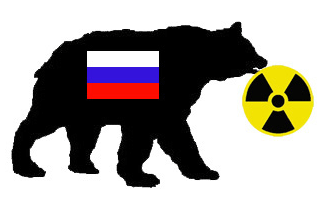 Turkey’s first nuclear plant delayed by funding problems – energy expert https://ahvalnews.com/turkey-energy/turkeys-first-nuclear-plant-delayed-funding-problems-energy-expert, Nov 30 2019 Turkey’s first nuclear plant delayed by funding problems – energy expert https://ahvalnews.com/turkey-energy/turkeys-first-nuclear-plant-delayed-funding-problems-energy-expert, Nov 30 2019
Completion of Turkey’s first nuclear power station is likely to be delayed as the Russian company building it is struggling to secure funding, former diplomat and Bosphorus Energy Club head Mehmet Öğütçü told Turkish daily Sözcü. A small part of the plant in Akkuyu, southern Turkey, may be opened for political reasons in 2023, the centenary of the founding of the Turkish Republic, Öğütçü said. But Russian state-owned Rosatom is having difficulties financing the project, which is expected to cost between $20 billion and $25 billion, he said, adding that Western companies were avoiding Akkuyu over concerns about nuclear armament. A Turkish consortium pulled out of the project last year, citing a failure to reach commercial terms with Rosatom, which owns a 51 percent stake in the project. A report by the main opposition Republican People’s Party this month criticised the terms of the government’s deal with Rosatom, which has been guaranteed a price of 12.35 U.S. cents per kilowatt hour in a 15-year power purchase agreement. |
|
Thorny topic of Fukushima food at the 2020 Olympics
It’s a thorny subject for the authorities. They pitched the Olympics in part as a chance to showcase the recovery of areas affected by the 2011 earthquake, tsunami and nuclear disaster.
Government officials tout strict checks on food from the prefecture as evidence the produce is completely safe, but it remains unclear whether athletes and sports teams from around the world will be convinced.
In Fukushima, producers are keen to see their products served in the Olympic Village and have submitted a bid to the organizers………
It’s a thorny subject for the authorities. They pitched the Olympics in part as a chance to showcase the recovery of areas affected by the 2011 earthquake, tsunami and nuclear disaster.
Government officials tout strict checks on food from the prefecture as evidence the produce is completely safe, but it remains unclear whether athletes and sports teams from around the world will be convinced.
In Fukushima, producers are keen to see their products served in the Olympic Village and have submitted a bid to the organizers.
But the figures have only gone some way to reassuring foreign officials: Numerous countries including China, South Korea and the U.S. maintain restrictions on the import of some or all produce from Fukushima.
South Korea, currently locked in a dispute with Japan over wartime issues, has been vocal about its concerns ahead of the Olympics, even raising the possibility of bringing in its own kitchen and food.
“We have requested the Olympic organizers to provide objective data verified by an independent third body,” the South Korean Sports and Olympic Committee said in a statement earlier this year.
“Since Japan repeatedly said its food from Fukushima is safe, we have demanded they provide statistics and data to back up their claims,” an official with the committee said.
The position underlines a long-running problem for Japan: While it points to its extensive, government-mandated checks as proof of safety, many abroad feel the government is not an objective arbiter…….
The International Olympic Committee has said it is still weighing how to handle the matter……. https://www.japantimes.co.jp/news/2019/11/26/national/fukushima-food-olympics-tokyo-2020/#.Xd7rfugzbIU
Onagawa nuclear plant to get approval for restart
 Nuclear watchdog approves restart of Onagawa reactor in Miyagi hit by 3/11 tsunami, Japan Times KYODO, STAFF REPORT. NOV 27, 2019
The No. 2 unit of Tohoku Electric Power Co.’s Onagawa plant in Miyagi Prefecture received the green light after the addition of disaster prevention measures, including a towering seawall that is nearing completion.
The approval, given in a unanimous vote, was the first to be secured by the operator under the revised standards. The reactor is only the second of those damaged in the March 2011 calamity to clear the Nuclear Regulation Authority’s new safety regulations, after the Tokai No. 2 power station in Ibaraki Prefecture.
Before the reactor can be restarted, the plant, which straddles the town of Onagawa and the city of Ishinomaki, still needs to finish installing anti-disaster measures, which are expected to be completed in fiscal 2020, and receive consent from the local governments.
Tohoku Electric expects to spend ¥340 billion ($3.1 billion) on the measures, the bulk of that being spent the seawall — which will run along 800 meters of Pacific coast and rise 29 meters above sea level to guard against tsunami as high as 23.1 meters. In the March 2011 disaster, parts of the basement floors of Onagawa’s No. 2 unit were flooded.
Costs for enhanced safety measures have ballooned and are expected to swell further with the construction of facilities to be used in the event of a terrorist attack, also required under the new safety standards.
The Onagawa plant is the closest nuclear plant to the epicenter of the magnitude 9.0 quake that struck northeastern Japan on March 11, 2011, and heavy shaking triggered an automatic shutdown of its three reactors……..
Onagawa’s approval will be formalized following a roughly one-month period where the NRA will accept comments from the public. During the meeting Wednesday, NRA Commissioner Shinsuke Yamanaka said the safety of the plant’s structural design had been reviewed carefully, in consideration that the Tohoku region has been hit by big earthquakes in the past. ……..
“I think there’s sufficient electricity without nuclear power,” said housewife Chisato Uno, 69. “Taking into account our children and grandchildren, no nuclear power is better.”….https://www.japantimes.co.jp/news/2019/11/27/national/nuclear-watchdog-restart-reactor-march-2011-tsunami/#.Xd7b2-gzbIU
Further debunking of the conspiracy nonsense about a nuclear explosion in the South China Sea
 A nuclear detonation in the South China Sea? No, more Twitter conspiracy nonsense, Bulletin of the Atomic Scientists, By Matt Field, November 25, 2019 The Twitter account @IndoPac_Info pushes out news at a relentless pace; it’s a seemingly good feed to follow for those interested in military issues in Asia. By Friday afternoon last week, the account had posted dozens of tweets over a 36-hour-or-so period linking to stories from outlets such as Reuters and Foreign Policy on topics ranging from US naval activity in contested waters to Pentagon drone policy. Oh yeah, and then there was the one about a nuclear detonation in the South China Sea.
The big news that China had perhaps exploded a tactical nuclear weapon in the ocean originated with a man labeled by the Southern Poverty Law Center as a former federal convict, white supremacist, and FBI informant named Hal Turner. Turner posted the story on his website and touted the supposed scoop further on his nighttime AM radio show, attributing the information to military sources. On Friday, a Pentagon spokesperson called Turner’s article “silly fiction.” And the man behind @IndoPac_Info himself—he describes himself as a Spanish man living in Vietnam—now seems to agree. “Without further evidence or independent corroboration of Hal Turner’s article, it may not be credible at this point,” he tweeted. “Apologies.”
A laudable course correction, no doubt, but it came after one of @IndoPac_Info’s tweets on the Turner story was retweeted almost 2,000 times. And in an age when online disinformation campaigns like the Russian government effort to sway the 2016 US presidential election are a major feature of public discourse, it’s an open question: Could an online conspiracy theory about nuclear weapons gain traction and have a real-world impact?
The @IndoPac_Info account helped give Turner traction, but as far as impact goes, the radio host’s nuclear story failed to launch, in part because it was so easily debunked.
The idea that a 10 to 20 kiloton explosion, possibly a nuclear one, could have occurred in the busy and contested South China Sea and not been widely observed was laughable to Bulletin of the Atomic Scientists’ Science and Security Board chair Bob Rosner. The physicist and former director of the Argonne National Laboratory told Gizmodo, “There is so much surveillance that it would be stunning if no one had noticed that.”……..
Despite Turner’s serious dearth of credibility, he was able to piggyback on @IndoPac_Info’s. That account, after all, is followed, by journalists, academics, and others from reputable organizations like Reuters and the University of Pennsylvania. Indeed, the @IndoPac_Info account user was concerned that he’d helped promote Turner’s wild story. “I was not aware of his record,” he said.
“A follower sent me his story and I went with it.” https://thebulletin.org/2019/11/a-nuclear-detonation-in-the-south-china-sea-no-more-twitter-conspiracy-nonsense/
Pope Francis calls for a ‘world without nuclear weapons’ during Nagasaki visit


109 Fukui officials received money in Kansai Electric gift scandal

Undersea survey for new nuke plant deferred due to protests in western Japan
When will the Japanese government and big utilities ever learn? Aren’t three meltdowns at Fukushima Daiichi enough to teach them that there is NO future in building new nukes!
 A planned construction site for the Kaminoseki nuclear power station is seen in the foreground, while Iwaishima Island lies in the background, in the town of Kaminoseki, Yamaguchi Prefecture, on May 29, 2019.
November 15, 2019
SHUNAN, Yamaguchi — An undersea boring survey for the construction of a nuclear power plant on a planned land reclamation site off Kaminoseki, Yamaguchi Prefecture, has been deferred due to protests by local residents opposing the project.
Chugoku Electric Power Co. had originally planned to start the survey on Nov. 14 in waters off Kaminoseki in western Japan, and complete it by Jan. 30 next year. However, daily protests by anti-nuclear power residents aboard fishing boats and inclement weather had delayed measurements and other preparation work, prompting the power company to postpone the survey.
The Hiroshima-based utility intends to study whether there are active faults in the area by drilling the seabed to a depth of about 60 meters. The survey falls under preparations for safety screening accompanying construction of the Kaminoseki nuclear plant under new regulatory standards for nuclear complexes introduced in the wake of the 2011 Fukushima nuclear disaster. The Yamaguchi Prefectural Government had granted permission for the boring survey on Oct. 31.
The power company plans to start boring after ensuring safety in the area. Residents, meanwhile, say they will continue their protests.
https://mainichi.jp/english/articles/20191115/p2a/00m/0na/010000c
1 This Month
26 September – International Day for the Total Elimination of Nuclear Weapons





PLEASE OPPOSE HR 8255 AND S.3639 – bills would accelerate satellite deployment, with no environmental review or safeguards – https://ncstd5li.quorum.us/campaign/169331/
To see nuclear-related stories in greater depth and intensity – go to https://nuclearinformation.wordpress.com
-
Archives
- September 2026 (281)
- August 2026 (330)
- July 2026 (355)
- June 2026 (287)
- May 2026 (306)
- April 2026 (356)
- March 2026 (251)
- February 2026 (267)
- January 2026 (308)
- December 2025 (358)
- November 2025 (359)
- October 2025 (375)
-
Categories
- 1
- 1 NUCLEAR ISSUES
- business and costs
- climate change
- culture and arts
- ENERGY
- environment
- health
- history
- indigenous issues
- Legal
- marketing of nuclear
- media
- opposition to nuclear
- PERSONAL STORIES
- politics
- politics international
- Religion and ethics
- safety
- secrets,lies and civil liberties
- spinbuster
- technology
- Uranium
- wastes
- weapons and war
- Women
- 2 WORLD
- ACTION
- AFRICA
- Atrocities
- AUSTRALIA
- Christina's notes
- Christina's themes
- culture and arts
- Events
- Fuk 2022
- Fuk 2023
- Fukushima 2017
- Fukushima 2018
- fukushima 2019
- Fukushima 2020
- Fukushima 2021
- general
- global warming
- Humour (God we need it)
- Nuclear
- RARE EARTHS
- Reference
- resources – print
- Resources -audiovicual
- Weekly Newsletter
- World
- World Nuclear
- YouTube
-
RSS
Entries RSS
Comments RSS

