Further delay in removal of spent nuclear fuel at Fukushima No. 1
  Removal of spent nuclear fuel at Fukushima No. 1 delayed up to five years https://www.japantimes.co.jp/news/2019/12/27/national/spent-nuclear-fuel-fukushima-daiichi-delay/#.XgZtU0czbIU KYODO, DEC 27, 2019 Removal of spent nuclear fuel at Fukushima No. 1 delayed up to five years https://www.japantimes.co.jp/news/2019/12/27/national/spent-nuclear-fuel-fukushima-daiichi-delay/#.XgZtU0czbIU KYODO, DEC 27, 2019
The government decided Friday to delay the removal of spent fuel from the Fukushima No. 1 nuclear power plant’s Nos. 1 and 2 reactors by up to five years, casting doubt on whether it can stick to its time frame for dismantling the crippled complex.
The process of removing the spent fuel from the units’ pools had previously been scheduled to begin in fiscal 2023. In its latest decommissioning plan, the government said the plant’s operator, Tokyo Electric Power Company Holdings Inc., will not begin the roughly two-year process at the No. 1 unit at least until fiscal 2027 and may wait until fiscal 2028. Work at the No. 2 unit is now slated to start between fiscal 2024 and fiscal 2026, it said. The delay is necessary to take further safety precautions, such as the construction of an enclosure around the No. 1 unit to prevent the spread of radioactive dust and the decontamination of the No. 2 unit, the government said. It is the fourth time it has revised its schedule for removing the spent fuel rods. It’s a very difficult process and it’s hard to know what to expect. The most important thing is the safety of the workers and the surrounding area,” industry minister Hiroshi Kajiyama told a news conference. The government set a new goal of finishing the removal of the 4,741 spent fuel rods across all six of the plant’s reactors by fiscal 2031. Tepco has started the process at the No. 3 unit and already finished at the No. 4 unit, which was off-line for regular maintenance at the time of the disaster. A schedule has yet to be set for the Nos. 5 and 6 reactors. While the government maintained its overarching time frame of finishing the decommissioning of the plant 30 to 40 years from the 2011 crisis triggered by a magnitude 9.0 earthquake and tsunami, there may be further delays. The government said it will begin removing fuel debris in fiscal 2021 from the three reactors that experienced core meltdowns, starting with the No. 2 unit. The process, considered the most difficult part of the decommissioning plan, will involve using a robot arm to initially remove small amounts of debris, and later take out larger amounts. The government also said it will aim to reduce the pace at which contaminated water at the plant increases. Water for cooling the melted cores, mixed with underground water, amounts to around 170 tons per day. That number will be reduced to 100 tons by 2025, it said. The water is being treated to remove the most radioactive materials and stored in tanks on the plant’s grounds, but already more than 1 million tons have been collected and space is expected to run out by the summer of 2022. |
|
Kim Jong Un refers to North Korea being ‘prepared’ for war, hinting at nuclear capabilities
|
Kim Jong Un stresses nuclear capabilities during meeting https://www.dailynk.com/english/kim-jong-un-stresses-nuclear-capabilities-during-meeting/The Third Expanded Meeting of the Central Military Commission was held on Sunday, according to Rodong Shinmun, By Lee Sang Yong, 2019.12.27 North Korean leader Kim Jong Un recently presided over an expanded meeting of the Central Military Commission of the Workers’ Party of Korea (WPK). At the meeting, Kim made references to readying North Korea’s nuclear capabilities for war, Daily NK has learned.
Although Kim did not explicitly say so, his remarks on “launchers,” the reorganization of the military, as well as his emphasis on self-reliant defense capabilities, can all be seen as a roundabout reference to the country’s nuclear capabilities. NO EXPLICIT MENTION OF NUCLEAR CAPABILITIES AT MEETING At the meeting, Kim stressed that rockets (missiles) and artillery capabilities should be strengthened, according to a high-ranking North Korean source speaking to Daily NK on Monday. These are the “decisions on organizational matters” alluded to in the North Korean media, which were also presumably the main issues of the meeting. “They say that Kim Jong Un issued a direct order calling for the reinforcement of military divisions where relevant to rocket and artillery capabilities,” a source in North Korea told Daily NK. “This essentially translates to an order to improve every aspect related to the strengthening of rocket and artillery capabilities, and can be seen as very relevant to ensuring nuclear weapons are battle-ready.” ”There was no explicit mention of nuclear weapons, but those present understood the order to mean that Kim Jong Un should be able to launch whatever he makes up his mind to launch, should he decide to do so,” continued the source. “Thus, whether it’s rockets or weapons of mass destruction, we must be prepared for every possibility.” In this context, “rocket” is a catch-all term that refers to both short-range and long-range missiles. Since Kim Jong Un came into power, North Korea has invested in the operational capabilities of various missiles, such that a dedicated branch was formed, called the Strategic Rocket Forces (currently Strategic Forces Command). The Strategic Forces Command reportedly consists of three divisions: the Scud missile division, the Rodong missile division, and the Musudan missile division. The announcement that there is to be a new division in addition to these three can be read as a move to create a separate division for strategic weapons, including intercontinental ballistic missiles (ICBM) like the Hwasong-15. A MOVE TOWARD MORE CONFRONTATION WITH SOUTH KOREA? North Korea also recently conducted a series of tests at the Sohae Satellite Launch Site in Dongchang-ri, Cholsan County in North Pyongan Province. The tests involved a new solid-fuel engine for its ICBMs as well as a stability test. This has led to speculation over whether this is an indicator of North Korea’s determination to construct a system with the ability to stealthily launch both short- and long-range missiles at any hour of the day. “It’s been made clear that North Korean rockets must be shown as a force to be contended with,” said a source. “Apparently there was considerable emphasis on the sanctions against North Korea, and the fact that the military must take the lead in developing a self-reliant defense system.” “The order to strengthen artillery capabilities seems to indicate that they’re more interested in a confrontation with South Korea, rather than dialogue,” continued the source. “Given the emphasis on being prepared for every possibility in a fight, it seems they will continue to conduct tests with the aim of improving the relevant technologies.” On Sunday, the Korean Central News Agency (KCNA) reported that North Korean leader Kim Jong Un had presided over the Third Expanded Meeting of the Seventh WPK Central Military Commission and discussed issues pertaining to the strengthening of “self-reliant defense capabilities.” This meeting is presumed to have taken place on Saturday, given that top military officials assembled in Pyongyang on Friday morning. *Translated by Violet Kim Please direct any comments or questions about this article to dailynkenglish@uni-media.net. |
|
No to nuclear: Japan wants reactors phased out, post-Fukushima
Japan is less reliant on atomic energy, but concerns are growing about its return to climate-damaging fossil fuels.
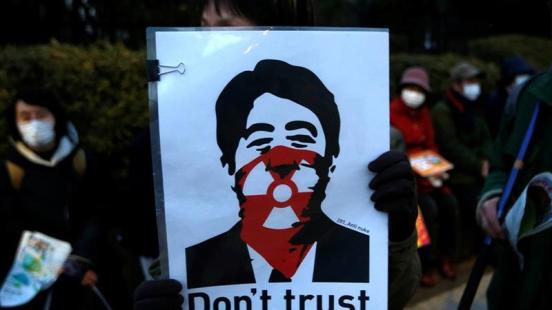 Japan’s anti-nuclear movement grew rapidly after the Fukushima disaster. Experts doubt that the country’s nuclear plants will ever generate the same levels of energy as they once did.
December 20, 2019
Tokyo, Japan – At the end of a decade in which northeastern Japan was devastated by a tsunami that triggered a nuclear disaster at Fukushima, atomic energy looks unlikely to make a comeback.
In the nearly nine years following the world’s worst nuclear accident since Chernobyl, the country’s reliance on atomic power for electricity generation has plummeted to between 3 and 5 percent from about 30 percent before the disaster, according to the Tokyo-based Citizens’ Nuclear Information Center.
And despite a period of uncertainty in the immediate aftermath of the meltdowns triggered when Fukushima’s cooling systems were overwhelmed by the tsunami created by the magnitude 9.0 undersea earthquake, the world’s third-largest economy has shown it can function with radically less nuclear power.
The public mood turned dramatically after Fukushima and the national trauma that ensued and combined with the increasing costs from aligning ageing plants with stringent post-disaster safety requirements, it is unlikely the nuclear industry will return to previous levels, according to experts, even as the government envisions nuclear power accounting for about 20-22 percent of electricity generation in 2030.
“It is obvious that it is very difficult to meet this target,” said Hajime Matsukubo, secretary-general of the Citizens’ Nuclear Information Center.
And while experts say while the anti-nuclear movement may seem to have quietened down, anti-nuclear feeling is firmly entrenched.
‘They say no’
“Japanese people’s sentiment (has) changed after Fukushima Daiichi and it is continuing until now,” said Matsukubo, whose non-profit organisation was established in 1975 by concerned atomic scientists to gather and publicise nuclear information and raise public awareness on the industry.
He said that even if people appear not as focused, if they are asked pointedly if they agree with nuclear power: “They say no.”
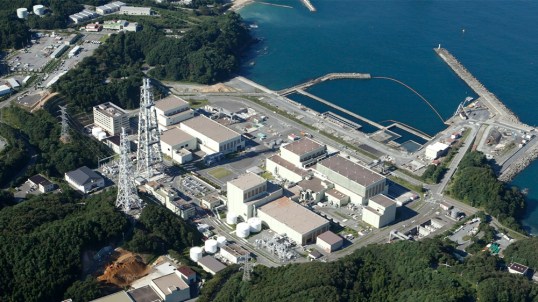 The Onagawa Nuclear Power Plant avoided the disaster at Fukushima, two-and-a-half hours’ drive south, and the government has said its No 2 reactor could be up-and-running by late next year
Before Fukushima, Japan had 54 operational reactors and for a brief time in the accident’s aftermath, not a single one was in operation. So far, nine have been restarted and authorities are considering the cases of a dozen more, according to Ministry of Economy, Trade and Industry figures. A further 24 are either under decommissioning or lined up for it.
Late last month, regulators gave initial approval for the restart of a reactor at the facility closest to the epicentre of the March 2011 quake. The No 2 reactor at the Onagawa nuclear plant could be running again late next year if further conditions are met. Onagawa was damaged in the double disaster, where the tsunami wave rose as high as 13 metres, but avoided Fukushima’s catastrophic meltdowns.
Japan imports nearly all its crude oil and natural gas. Underscoring such dependency, Prime Minister Shinzo Abe told a nationally televised news conference in 2016 that the nation could not “do without” nuclear power.
But Shinjiro Koizumi, minister for the environment and nuclear issues and the son of anti-nuclear former prime minister Junichiro Koizumi, said after his appointment in September that the country needed to wean itself off the atom.
“We will be doomed if we let nuclear accidents recur,” he said, according to Kyodo News.
Safety costs
Japan’s mass-circulation newspaper Mainichi Shimbun in an editorial after the Onagawa decision cited the newspaper’s own research that found 11 top power suppliers had spent in excess of 5 trillion yen ($45.7bn) on nuclear safety since Fukushima.
“As costs balloon, it is becoming increasingly difficult, even absurd, for the government and power companies to maintain the argument that nuclear power is ‘cheap’,” the editorial said.
“The more thoroughly safe the plants become, the more time and money is needed,” it continued. “We must ask, then: is it realistic to press on with the safety upgrade and reactor restart policy? We cannot dispel our suspicions that the answer is, in fact, ‘no’.”
Japan has clearly shown it can function on less nuclear-generated power, but the shift has come at a cost: an increasing reliance on fossil-fuel alternatives such as coal, oil and natural gas. And with concerns over climate change intensifying, that is drawing international attention.
“I’m very much aware of the challenges of Fukushima to the Japanese electrical sector,” said Paul Simpson, CEO of London-based non-profit CDP, which runs a global disclosure system that aids investors, companies and local governments in managing their environmental footprint.
Simpson, speaking at a forum on decarbonisation in Tokyo last month, stressed that coal was simply no longer an option and countries still using it must search for alternatives, citing Germany’s plan for no new coal use by 2040.
Alternative energies
“Japan needs to find a transition pathway from this, and I know this is challenging,” he said. “But coal is socially unacceptable … from a climate-risk perspective but also from an air pollution perspective.”
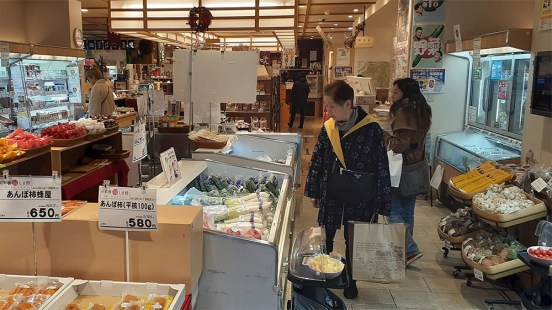 Customers browse in a Tokyo shop that specialises in products from Fukushima
According to Matsukubo, about 30 percent of Japan’s electricity generation comes from coal and 43 percent from natural gas. And the country has moved to build new coal-fired power plants since Fukushima.
“It’s disastrous,” Matsukobo said, stressing that Japan needs to move to renewable sources of energy; an area in which Simpson also pointed out Japan is lagging, even though the government has promised to increase the country’s use of renewables by 2030.
There was always some ambivalence about atomic energy in Japan – the only country to suffer a nuclear weapon attack when the United States dropped bombs on the cities of Hiroshima and Nagasaki in the closing days of World War II.
Pope Francis, visiting Japan in November, surprised no one when he condemned nuclear weapons. But the pontiff, the first to venture to the country since 1981, went so far as to suggest that nuclear energy itself was a problem.
“I have a personal opinion: I wouldn’t use nuclear energy until it is totally safe to use,” the leader of the world’s 1.3 billion Roman Catholics said in comments to reporters during his flight back to Rome from Tokyo, Kyodo reported.
Ramping down
Alexander Brown, who has studied the anti-nuclear protest movement in Japan, said that because Japan had supported atomic power for so long, there was a sense of inertia despite post-Fukushima opposition, ageing infrastructure and the remote chance of new reactors getting the green light.
“There’s a sort of built-in time limit to how long the industry as a whole can continue,” said Brown, currently a Japan Society for the Promotion of Science international research fellow at Japan Women’s University.
He also emphasised, however, that Japan’s turn against nuclear energy had also coincided with a key change in its domestic economy; less industrially robust and therefore not as hungry for energy as before.
“Why have the lights stayed on,” Brown asked rhetorically. “One is, yes, increased fossil fuel use, but another is there’s just less demand than there was in the peak time of manufacturing onshore in Japan.”
Brown calls that an “uncomfortable truth” for much of Japan’s ruling establishment – including the prime minister and his eponymous “Abenomics” economic revitalisation programme – which clings to a belief in a model of vigorous growth.
“And I think one of the amazing things when I look at the anti-nuclear movement, to me, was it was full of people looking at what are other ways that we can live,” he said.
“How can we embrace other values other than high consumption, high pollution, extreme overwork and look at things like de-growth economics.”
Toshiba warns it may not continue as ‘going concern‘

Tepco (once again) saying they will put a giant cover over Fukushima No.1 reactor

|
Fukushima Daiichi No.1 reactor to be covered, https://www3.nhk.or.jp/nhkworld/en/news/20191220_12/ The operator of the damaged Fukushima Daiichi nuclear power plant says it will install a giant cover over one of the reactors that underwent a nuclear meltdown as part of its dismantling process.Tokyo Electric Power Company announced the decision on Thursday regarding the No.1 reactor building, which was affected by the 2011 earthquake and tsunami.
The covering will measure 65 meters high, 65 meters long and 50 meters wide. Its ceiling will have cranes that can be used to remove debris. The reactor’s fuel storage pool still holds 392 nuclear fuel units. As part of their removal process, TEPCO is clearing scattered debris from the building. TEPCO says that by installing the cover, it aims to lower the risks of radioactive dust spreading outside during the debris removal process. It added that the device will also prevent rainwater from getting into the reactor building, thereby helping to reduce the volume of newly contaminated water. TEPCO says it cannot tell when the device will be completed, as it is still in the process of making a detailed construction plan. |
|
Kyrgyzstan bans uranium, thorium mining

Above – radioactive tailings mountain in Central Asia
|
Kyrgyzstan bans uranium, thorium mining http://www.xinhuanet.com/english/2019-12/16/c_138635832.htm 2019-12-16 BISHKEK, Dec. 16 (Xinhua) –– President of Kyrgyzstan Sooronbai Jeenbekov signed a decree banning the mining of uranium and thorium deposits in the Central Asian country, his press service reported on Monday.The law, aimed at ensuring radiation and environmental safety, prohibits geological exploration and development of uranium and thorium deposits in Kyrgyzstan, as well as dumping and transfer of the material, the report said.
Meanwhile, the import of raw materials and waste containing the two radioactive substances is not allowed by law, it said. Earlier this year, protests arose against the development of uranium deposits after reports that exploration work had begun in the Kyzyl-Ompol area in the Issyk-Kul region. |
|
The Japanese want to phase out nuclear power
|
No to nuclear: Japan wants reactors phased out, post-Fukushima
Japan is less reliant on atomic energy, but concerns are growing about its return to climate-damaging fossil fuels. Aljazeera, by Kelly Olsen -20 Dec 19, Tokyo, Japan – At the end of a decade in which northeastern Japan was devastated by a tsunami that triggered a nuclear disaster at Fukushima, atomic energy looks unlikely to make a comeback. In the nearly nine years following the world’s worst nuclear accident since Chernobyl, the country’s reliance on atomic power for electricity generation has plummeted to between 3 and 5 percent from about 30 percent before the disaster, according to the Tokyo-based Citizens’ Nuclear Information Center. And despite a period of uncertainty in the immediate aftermath of the meltdowns triggered when Fukushima’s cooling systems were overwhelmed by the tsunami created by the magnitude 9.0 undersea earthquake, the world’s third-largest economy has shown it can function with radically less nuclear power. The public mood turned dramatically after Fukushima and the national trauma that ensued and combined with the increasing costs from aligning ageing plants with stringent post-disaster safety requirements, it is unlikely the nuclear industry will return to previous levels, according to experts, even as the government envisions nuclear power accounting for about 20-22 percent of electricity generation in 2030. “It is obvious that it is very difficult to meet this target,” said Hajime Matsukubo, secretary-general of the Citizens’ Nuclear Information Center. And while experts say while the anti-nuclear movement may seem to have quietened down, anti-nuclear feeling is firmly entrenched. ‘They say no’“Japanese people’s sentiment (has) changed after Fukushima Daiichi and it is continuing until now,” said Matsukubo, whose non-profit organisation was established in 1975 by concerned atomic scientists to gather and publicise nuclear information and raise public awareness on the industry. He said that even if people appear not as focused, if they are asked pointedly if they agree with nuclear power: “They say no.” Before Fukushima, Japan had 54 operational reactors and for a brief time in the accident’s aftermath, not a single one was in operation. So far, nine have been restarted and authorities are considering the cases of a dozen more, according to Ministry of Economy, Trade and Industry figures. A further 24 are either under decommissioning or lined up for it….. Safety costsJapan’s mass-circulation newspaper Mainichi Shimbun in an editorial after the Onagawa decision cited the newspaper’s own research that found 11 top power suppliers had spent in excess of 5 trillion yen ($45.7bn) on nuclear safety since Fukushima. “As costs balloon, it is becoming increasingly difficult, even absurd, for the government and power companies to maintain the argument that nuclear power is ‘cheap’,” the editorial said…….. “There’s a sort of built-in time limit to how long the industry as a whole can continue,” said Alexander Brown, currently a Japan Society for the Promotion of Science international research fellow at Japan Women’s University. He also emphasised, however, that Japan’s turn against nuclear energy had also coincided with a key change in its domestic economy; less industrially robust and therefore not as hungry for energy as before. “Why have the lights stayed on,” Brown asked rhetorically. “One is, yes, increased fossil fuel use, but another is there’s just less demand than there was in the peak time of manufacturing onshore in Japan.” Brown calls that an “uncomfortable truth” for much of Japan’s ruling establishment – including the prime minister and his eponymous “Abenomics” economic revitalisation programme – which clings to a belief in a model of vigorous growth. “And I think one of the amazing things when I look at the anti-nuclear movement, to me, was it was full of people looking at what are other ways that we can live,” he said. “How can we embrace other values other than high consumption, high pollution, extreme overwork and look at things like de-growth economics.” https://www.aljazeera.com/news/2019/12/japanese-turn-nuclear-decade-wrought-fukushima-191220000003532.html |
|
Safety costs increase for Tokai No. 2 nuclear plant
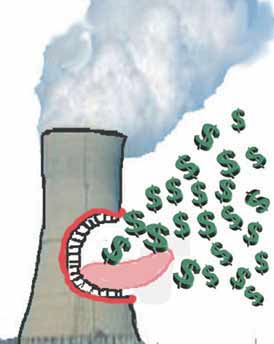 Contractors want 70 billion yen more for safety at nuclear plant http://www.asahi.com/ajw/articles/AJ201912170067.html By TAKASHI ICHIDA/ Senior Staff Writer, December 17, 2019 TOKAI, Ibaraki Prefecture–-Costs to safeguard the Tokai No. 2 nuclear plant here will run at least 70 billion yen ($642 million) more than the plant operator’s estimate, raising the likelihood that consumers will get stuck covering the difference through their power bills.
Japan Atomic Power Co. (JAPC) is seeking to restart the plant, idled since the 2011 Fukushima nuclear disaster, as soon as possible to secure much-needed revenue by selling power from it to electric utilities.
The plant operator has been negotiating with leading general contractors over the cost of work to increase safety at the single-reactor plant along the coast of Ibaraki Prefecture. It aims to ink contracts for the work by March 2020. But the difference over the cost between the two sides has rarely narrowed.
Construction of a 20-meter-tall seawall and an emergency facility to protect the plant from possible tsunami and other natural disasters are among the protective measures scheduled.
In October 2018, the Nuclear Regulation Authority approved the plan to implement the measures under more stringent regulations that went into force in July 2013 after the triple meltdown at the Fukushima No. 1 nuclear plant.
JAPC estimated that the project would cost 174 billion yen, according to officials at some construction companies.
Six major general contractors–Kajima Corp., Taisei Corp., Obayashi Corp., Shimizu Corp., Hazama Ando Corp. and Penta-Ocean Construction Co.–were asked to give quotes for each portion of the project. Only one company will be chosen for each portion.
Their quotes, all submitted by around November 2018, pegged the overall cost at least 250 billion yen more than JAPC envisaged.
The plant operator is also required to build a facility to respond to a possible terror attack, estimated at costing 61 billion yen, bringing the overall cost to protect the plant to more than 300 billion yen.
The ballooning price tag is blamed on a spike in the cost of civil engineering materials, machine tools and workers, according to officials familiar with the matter.
The plant operator urged contractors to rethink their estimates, but they refused, maintaining that the higher price was inevitable in order to complete the project on time.
With JAPC’s self-imposed March deadline to conclude contracts fast approaching, industry analysts say the operator will likely give in to the contractors’ demands.
In October, five regional electric utilities, including Tokyo Electric Power Co. and Tohoku Electric Power Co., which used to purchase electricity from JAPC, announced they would increase financial support to the company to 350 billion yen from the 300 billion yen they pledged in March.
The rise is attributed to a surge in the costs for the seawall and emergency facility.
JAPC and the six contractors declined to comment when asked by The Asahi Shimbun to provide more details of specific cost overruns.
Japan’s major electric power companies usually directly select individual contractors for projects and do not open contracts for bidding.
Under such contracts, disparities between estimates and final costs rarely emerge.
An official at one of the power companies who is familiar with the matter called the 70 billion yen cost overrun “extremely unusual.”
JAPC maintains that its initial 174 billion yen estimate is more than adequate for contractors to complete the work.
But an official at one of the construction companies accused the power company of low-balling the amount needed for the project.
An official close to a utility financially supporting JAPC said the operator should have contractors compete for each project segment and require them to submit estimates.
The Tokai No. 2 nuclear plant started operations in 1978. The Nuclear Regulation Authority authorized a 20-year extension on the reactor’s life in November 2018.
Fukushima Unit 3 Spent Fuel Damage Identified
Fukushima Unit 3 Spent Fuel Damage Identified, Simply Info [excellent photos], December 16, 2019
TEPCO has identified twelve fuel assemblies with damaged lifting handles. Further damage can not be identified at this point as the assemblies are still in the fuel racks in the spent fuel pool. The location of the newer 6 damaged assemblies are from the location where the fuel handling crane and a concrete hatch fell into the pool…. http://www.simplyinfo.org/?p=17842
USA rejects North Korea’s ‘hostile’ deadline over nuclear talks
|
Top US diplomat rejects North Korea’s ‘hostile’ deadline over nuclear talks and says Washington will not bow to Pyongyang’s ominous threat of a ‘Christmas Gift’ provocation,
By ROSS IBBETSON FOR MAILONLINE and AFP 17 Dec 19, A senior US diplomat has today slammed North Korea for making ‘hostile demands’ over nuclear talks and warned Kim Jong-un against his planned ‘Christmas Gift’ provocation. US special representative Stephen Biegun told reporters in Seoul that Washington would not bow to Pyongyang’s increasingly strident demands for concessions by 2020. ‘Let me be absolutely clear: The United States does not have a deadline. We are fully aware of the strong potential for North Korea to conduct a major provocation in the days ahead,’ Biegun said. ‘To say the least, such an action will be most unhelpful in achieving lasting peace on the Korean Peninsula.’….. Pyongyang has said that if Washington fails to make it an acceptable offer, it will adopt a so far unspecified ‘new way’. It has carried out a series of static tests at its Sohae rocket facility this month, after a number of weapons launches in recent weeks, some of them described as ballistic missiles by Japan and others – which Pyongyang is banned from testing under UN sanctions……Pyongyang has said that if Washington fails to make it an acceptable offer, it will adopt a so far unspecified ‘new way’. It has carried out a series of static tests at its Sohae rocket facility this month, after a number of weapons launches in recent weeks, some of them described as ballistic missiles by Japan and others – which Pyongyang is banned from testing under UN sanctions…https://www.dailymail.co.uk/news/article-7797205/Top-diplomat-rejects-North-Koreas-deadline-says-Washington-not-bow-threats.html |
|
|
Tohoku reactor restart: What is the state of Japan’s nuclear policy?
Their contempt for the Japanese’ public’s will and the health and well being of people, animals, plants, oceans, rivers, lakes, genetic pools and the economies of the northern hemisphere is appalling. Abe, LDP, nuke industry, anyone that’s pro-nuke.’
 Members of the government’s expert panel inspect Tohoku Electric Power Co.’s Onagawa nuclear power plant in Miyagi Prefecture in April.
Dec 9, 2019
OSAKA – In late November, the Nuclear Regulation Authority (NRA) gave the green light for restarting the No. 2 reactor at Tohoku Electric Power Co.’s Onagawa plant in Miyagi Prefecture, which had been damaged in the March 11, 2011, earthquake and tsunami. The announcement once again put the spotlight on the country’s nuclear power policy, not only in Tohoku but nationwide.
Why did the Onagawa restart attract so much attention?
While the Onagawa plant is actually the second damaged on 3/11, after the Tokai No. 2 power station in Ibaraki Prefecture, to pass the NRA’s new safety regulations for nuclear power plants prepared after the disaster, it happens to be the nuclear plant closest to the epicenter of the magnitude 9 quake that struck off the Tohoku coast that day.
The Onagawa facility is located near Ishinomaki, which received extensive damage and much domestic and international media attention after the tsunami claimed the lives of 74 Okawa Elementary School students.
In addition, the Onagawa reactor, which was flooded on 3/11, is the first boiling water reactor to have its restart application approved by the NRA.
There are three kinds of nuclear reactors in operation in Japan: 14 pressured water reactors (PWRs), four advanced boiling water reactors (ABWRs) and 13 boiling water reactors (BWRs), which are the same kind as those at the Fukushima No. 1 plant destroyed by the 3/11 quake and tsunami. The PWRs are considered more technologically stable than the other kinds, and have a better ability to contain radiation.
Now that the NRA has greenlighted Onagawa’s restart, does that mean it will happen anytime soon?
That depends on a number of factors. The Onagawa plant is not ready to be fired up tomorrow. It must first complete the installation of various anti-disaster measures, including a 29-meter-high, 800-meter-long seawall along the Pacific coast to guard against tsunami as high as 23.1 meters. That will not be completed until sometime in fiscal 2020, which begins April 1.
Furthermore, various local governments, including Ishinomaki and Miyagi Prefecture, will have to give their consent to the restart. That could involve long, drawn out negotiations between the utility and local residents and politicians. It’s also probable that lawyers and local citizens opposed to a restart will seek a court injunction to halt the move based on safety concerns. If a court approves an injunction, that will create further delays.
How many other nuclear power plants are there and what are their statuses?
As of this month, there are nine reactors officially in operation. Four belong to Kansai Electric Power Co. (Kepco), which provides electricity mainly to Kyoto, Osaka, Nara, Hyogo, Shiga and Wakayama prefectures. Another four belong to Kyushu Electric Power Co. One of Shikoku Electric Power Co.’s reactors at its Ikata plant is also operating.
Another six reactors have made improvements to meet the new, post-3/11 quake safety standards and have received NRA approval to restart. These include two reactors at Tokyo Electric Power Company Holdings’ Kashiwazaki-Kariwa plant in Niigata Prefecture, two of the four reactors at Kepco’s Takahama plant (the other two are in operation) in Fukui Prefecture, one reactor at Kepco’s Mihama plant (the other two have been decommissioned), also in Fukui Prefecture, and one reactor at Japan Atomic Power Co.’s Tokai No. 2 plant in Ibaraki Prefecture. The other reactor at the facility has been decommissioned.
Nearly a dozen reactors are now in the process of undergoing safety reviews and will have to upgrade their facilities to meet tougher NRA standards for disaster preparedness, and then, if they receive approval to restart, will go through the process of obtaining local consent.
These include reactors in Hokkaido, Aomori, Shizuoka, Ishikawa, Fukui and Shimane prefectures.
Finally, another nine reactors have not applied to be restarted under the new regulations, and 24 reactors, including all six Fukushima No. 1 plant reactors and all four Fukushima No. 2 plant reactors, as well as four of Kepco’s 11 reactors in Fukui Prefecture, are being decommissioned.
How much electricity does nuclear power provide?
Figures vary, sometimes greatly, depending on how many plants in operation were shut down for inspection during a particular year. The latest figures from the Ministry of Economy, Trade and Industry’s Agency for Natural Resources show that in 2017, nuclear power provided 3.1 percent of Japan’s electricity. The Institute for Sustainable Energy Policies, a nonprofit research institute, estimates that based on its own surveys of utilities, nuclear provided 4.7 percent of Japan’s electricity last year.
What about the future for nuclear power in Japan?
The government’s long-term energy policy for 2030 calls for nuclear power to make up around 20 to 22 percent of the nation’s energy mix, and it is pushing hard for the restart of as many idled reactors as possible. By then, the plan calls for renewable energy to account for 22 to 24 percent of the mix, LNG to make up 27 percent, coal 26 percent and oil 3 percent.
But the obstacles to restarting, or continuing to operate, nuclear plants in the coming years are vast. In addition to local opposition that could delay restarts for months or years, costing the utilities money, they include such issues as the economics of running reactors past 40 years, for which the utilities must first spend money to upgrade their facilities in order to meet new NRA standards regarding reactors older than four decades.
While Kepco has secured permission to operate three reactors already over 40 years old for another two decades at the most, other utilities with reactors currently more than 30 years old — such as Tepco’s Kashiwazaki-Kariwa No. 1 reactor (34 years old) — will have to decide within a few years whether it’s worth the investment of money and time to apply for a two-decade extension or whether it’s cheaper to decommission.
A second problem has to do with spent nuclear fuel generated by the restarted reactors.
Tokyo is making efforts to find local governments able and willing to have a midterm spent fuel storage facility built in their backyard, and has agreed to offer financial incentives for anyone willing to accept a facility. No luck so far. Meanwhile, in Fukui Prefecture, which has the largest concentration of reactors (13 commercial reactors plus the Monju experimental fast-breeder reactor) in the nation, Gov. Tatsuji Sugimoto is insisting that such storage facilities be built outside the prefecture. His position could lead to other prefectures hosting nuclear power plants to take a firmer stance with utilities and the central government over what to do with spent nuclear fuel when they come seeking local consent for their own restart plans.
Analysis of decontamination of irradiated soil of Fukushima area
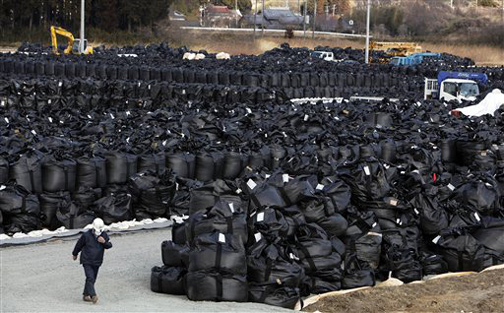
Fukushima: Lessons learned from an extraordinary case of soil decontamination https://www.sciencedaily.com/releases/2019/12/191212081926.htm
- Source:
- European Geosciences Union
- Summary:
- Following the accident at the Fukushima nuclear power plant in March 2011, the Japanese authorities decided to carry out major decontamination works in the affected area, which covers more than 9,000 km2. On Dec. 12, 2019, with most of this work having been completed, researchers provided an overview of the decontamination strategies used and their effectiveness.
- On December 12, 2019, with most of this work having been completed, the scientific journal SOIL of the European Geosciences Union (EGU) is publishing a synthesis of approximately sixty scientific publications that together provide an overview of the decontamination strategies used and their effectiveness, with a focus on radiocesium. This work is the result of an international collaboration led by Olivier Evrard, researcher at the Laboratoire des Sciences du Climat et de l’Environnement [Laboratory of Climate and Environmental Sciences] (LSCE — CEA/CNRS/UVSQ, Université Paris Saclay).
Soil decontamination, which began in 2013 following the accident at the Fukushima Dai-ichi nuclear power plant, has now been nearly completed in the priority areas identified1. Indeed, areas that are difficult to access have not yet been decontaminated, such as the municipalities located in the immediate vicinity of the nuclear power plant. Olivier Evrard, a researcher at the Laboratory of Climate and Environmental Sciences and coordinator of the study (CEA/CNRS/UVSQ), in collaboration with Patrick Laceby of Alberta Environment and Parks (Canada) and Atsushi Nakao of Kyoto Prefecture University (Japan), compiled the results of approximately sixty scientific studies published on the topic.
This synthesis focuses mainly on the fate of radioactive cesium in the environment because this radioisotope was emitted in large quantities during the accident, contaminating an area of more than 9,000 km2. In addition, since one of the cesium isotopes (137Cs) has a half-life of 30 years, it constitutes the highest risk to the local population in the medium and long term, as it can be estimated that in the absence of decontamination it will remain in the environment for around three centuries.
“The feedback on decontamination processes following the Fukushima nuclear accident is unprecedented,” according to Olivier Evrard, “because it is the first time that such a major clean-up effort has been made following a nuclear accident. The Fukushima accident gives us valuable insights into the effectiveness of decontamination techniques, particularly for removing cesium from the environment.”
- This analysis provides new scientific lessons on decontamination strategies and techniques implemented in the municipalities affected by the radioactive fallout from the Fukushima accident. This synthesis indicates that removing the surface layer of the soil to a thickness of 5 cm, the main method used by the Japanese authorities to clean up cultivated land, has reduced cesium concentrations by about 80% in treated areas. Nevertheless, the removal of the uppermost part of the topsoil, which has proved effective in treating cultivated land, has cost the Japanese state about €24 billion. This technique generates a significant amount of waste, which is difficult to treat, to transport and to store for several decades in the vicinity of the power plant, a step that is necessary before it is shipped to final disposal sites located outside Fukushima prefecture by 2050. By early 2019, Fukushima’s decontamination efforts had generated about 20 million cubic metres of waste.
Decontamination activities have mainly targeted agricultural landscapes and residential areas. The review points out that the forests have not been cleaned up — because of the difficulty and very high costs that these operations2 would represent — as they cover 75% of the surface area located within the radioactive fallout zone. These forests constitute a potential long-term reservoir of radiocesium, which can be redistributed across landscapes as a result of soil erosion, landslides and floods, particularly during typhoons that can affect the region between July and October. Atsushi Nakao, co-author of the publication, stresses the importance of continuing to monitor the transfer of radioactive contamination at the scale of coastal watersheds that drain the most contaminated part of the radioactive fallout zone. This monitoring will help scientists understand the fate of residual radiocesium in the environment in order to detect possible recontamination of the remediated areas due to flooding or intense erosion events in the forests.
The analysis recommends further research on:
- the issues associated with the recultivation of decontaminated agricultural land3,
- the monitoring of the contribution of radioactive contamination from forests to the rivers that flow across the region,
- and the return of inhabitants and their reappropriation of the territory after evacuation and decontamination.
This research will be the subject of a Franco-Japanese and multidisciplinary international research project, MITATE (Irradiation Measurement Human Tolerance viA Environmental Tolerance), led by the CNRS in collaboration with various French (including the CEA) and Japanese organizations, which will start on January 1, 2020 for an initial period of 5 years.
Complementary approaches
This research is complementary to the project to develop bio- and eco-technological methods for the rational remediation of effluents and soils, in support of a post-accident agricultural rehabilitation strategy (DEMETERRES), led by the CEA, and conducted in partnership with INRA and CIRAD Montpellier.
Decontamination techniques
- In cultivated areas within the special decontamination zone, the surface layer of the soil was removed to a depth of 5 cm and replaced with a new “soil” made of crushed granite available locally. In areas further from the plant, substances known to fix or substitute for radiocesium (potassium fertilizers, zeolite powders) have been applied to the soil.
- As far as woodland areas are concerned, only those that were within 20 metres of the houses were treated (cutting branches and collecting litter).
- Residential areas were also cleaned (ditch cleaning, roof and gutter cleaning, etc.), and (vegetable) gardens were treated as cultivated areas.
1 In Fukushima prefecture and the surrounding prefectures, the decision to decontaminate the landscapes affected by the radioactive fallout was made in November 2011 for 11 districts that were evacuated after the accident (special decontamination zone — SDZ — 1,117 km2) and for 40 districts affected by lower, but still significant levels of radioactivity and that had not been evacuated in 2011 (areas of intensive monitoring of the contamination — ICA, 7836 km2). 2 128 billion euros according to one of the studies appearing in the review to be published on 12 December 2019 in SOIL. 3 Relating to soil fertility and the transfer of radiocesium from the soil to plants, for example.
The study was conducted by Olivier Evrard (Laboratoire des Sciences du Climat et de l’Environnement (LSCE/IPSL), Unité Mixte de Recherche 8212 (CEA/CNRS/UVSQ), Université Paris-Saclay), J. Patrick Laceby (Environmental Monitoring and Science Division (EMSD), Alberta Environment and Parks (AEP)), and Atsushi Nakao (Graduate School of Life and Environmental Sciences, Kyoto Prefectural University).
How India’s Kudankulam Nuclear Power Plant (KNPP) got hacked
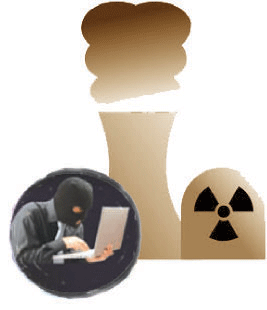 How a nuclear plant got hacked, Plugging nuclear plants into the internet makes them vulnerable targets for nation-state attack. By J.M. Porup, Senior Writer, CSO December 9, 2019 If you think attacking civilian infrastructure is a war crime, you’d be right, but spies from countries around the world are fighting a silent, dirty war to pre-position themselves on civilian infrastructure — like energy-producing civilian nuclear plants — to be able to commit sabotage during a moment of geopolitical tension.
What follows is an explanation of how India’s Kudankulam Nuclear Power Plant (KNPP) got hacked — and how it could have been easily avoided.
The KNPP hack The news came to light, as it so often does these days, on Twitter. Pukhraj Singh (@RungRage), a “noted cyber intelligence specialist” who was “instrumental in setting up of the cyber-warfare operations centre of the National Technical Research Organisation (NTRO),” according to The New Indian Express, tweeted: “So, it’s public now. Domain controller-level access Kudankulam Nuclear Power Plant. The government was notified way back. Extremely mission-critical targets were hit,” noting in a quote tweet that he was aware of the attack as early as September 7, 2019, calling it a “causus belli” (an attack sufficiently grave to provoke a war).
In a later tweet, Singh clarified that he did not discover the malware himself. A third party “contacted me & I notified National Cyber Security Coordinator on Sep 4 (date is crucial). The 3rd party then shared the IoCs with the NCSC’s office over the proceeding days. Kaspersky reported it later, called it DTrack.”
At first the Nuclear Power Plant Corporation of India (NPCI) denied it. In a press release they decried “false information” on social media and insisted the KNPP nuclear power plant is “stand alone and not connected to outside cyber network and internet” and that “any cyber attack on the Nuclear
Power Plant Control System is not possible.”
Then they backtracked. On October 30, the NPCI confirmed that malware was in fact discovered on their systems, and that CERT-India first noticed the attack on September 4, 2019. In their statement, they claimed the infected PC was connected to the administrative network, which they say is “isolated from the critical internal network.”
“Investigation also confirms that the plant systems are not affected,” their statement concludes.
Power Plant Control System is not possible.”
Then they backtracked. On October 30, the NPCI confirmed that malware was in fact discovered on their systems, and that CERT-India first noticed the attack on September 4, 2019. In their statement, they claimed the infected PC was connected to the administrative network, which they say is “isolated from the critical internal network.”
“Investigation also confirms that the plant systems are not affected,” their statement concludes.
A targeted attack
Contrary to some initial reporting, the malware appears to have been targeted specifically at the KNPP facility, according to researchers at CyberBit. Reverse-engineering of the malware sample revealed hard-coded administrator credentials for KNPP’s networks (username: /user:KKNPP\\administrator password: su.controller5kk) as well as RFC 1918 IP addresses (172.22.22.156, 10.2.114.1, 172.22.22.5, 10.2.4.1, 10.38.1.35), which are by definition not internet-routable.
That means it is highly likely the attacker previously broke into KNPP networks, scanned for NAT’ed devices, stole admin credentials, and then incorporated those details into this new malware, a second-stage payload designed for deeper and more thorough reconnaissance of KNPP’s networks.
“This was a very targeted attack on just this plant,” Hod Gavriel, a malware analyst at CyberBit, tells CSO. “Probably this was the second stage of an attack.”
The malware discovered, however, did not include Stuxnet-like functionality to destroy any of KNPP’s systems. “This phase was only for collection of information, it wasn’t sabotageware,” Gavriel says. ….. https://www.csoonline.com/article/3488816/how-a-nuclear-plant-got-hacked.html
North Korea conducts second test at satellite site, to ‘bolster nuclear deterrent’
San Francisco Chronicle, Simon Denyer, The Washington Post Dec. 14, 2019 TOKYO – North Korea announced on Saturday it had conducted another test at a satellite launch station near the Chinese border, saying the unspecified test would help bolster the country’s nuclear deterrent.The test was conducted Friday evening, and was the second in less than a week at the Sohae Satellite Launching Station in Tongchang-ri, a site near the Chinese border that has been used to test rocket engines and launch satellites into space in the past…… (subscribers only) https://www.sfchronicle.com/news/article/North-Korea-conducts-second-test-at-satellite-14906516.php
Spent mixed-oxide (MOX) fuel to be removed from Ikata nuclear reactor
|
Shikoku Electric to remove fuel from Ikata nuclear reactor, a first since MOX work began in 1997, HTTPS://WWW.JAPANTIMES.CO.JP/NEWS/2019/12/13/NATIONAL/SHIKOKU-ELECTRIC-REMOVE-MOX-FUEL-FROM-IKATA-REACTOR/#.XFPOTUGZBIU , EHIME PREF. – Shikoku Electric Power Co. said Thursday that it will suspend operations of the No. 3 reactor at its Ikata nuclear power plant on Dec. 26 for routine checkups and remove spent mixed-oxide (MOX) fuel from the reactor.This will mark the first removal of used MOX fuel, a blend of plutonium extracted from spent nuclear fuel and uranium, from any commercial nuclear power plant in Japan since an initiative on plu-thermal power generation using the mixed fuel was announced in 1997, according to the Shikoku utility.
The government and power firms are promoting plu-thermal power generation as part of the nuclear fuel cycle featuring the extraction of plutonium from spent nuclear fuel for reuse. In 2010, Shikoku Electric started plu-thermal power generation using 16 MOX fuel assemblies at the No. 3 reactor at the Ikata plant in Ehime Prefecture. The company plans to remove all of them during the reactor checkups through April 27 and will consider reusing the spent MOX fuel, which will likely be stored at the power plant for a while due to the lack of reprocessing facilities. |
|
|
1 This Month
26 September – International Day for the Total Elimination of Nuclear Weapons





PLEASE OPPOSE HR 8255 AND S.3639 – bills would accelerate satellite deployment, with no environmental review or safeguards – https://ncstd5li.quorum.us/campaign/169331/
To see nuclear-related stories in greater depth and intensity – go to https://nuclearinformation.wordpress.com
-
Archives
- September 2026 (281)
- August 2026 (330)
- July 2026 (355)
- June 2026 (287)
- May 2026 (306)
- April 2026 (356)
- March 2026 (251)
- February 2026 (267)
- January 2026 (308)
- December 2025 (358)
- November 2025 (359)
- October 2025 (375)
-
Categories
- 1
- 1 NUCLEAR ISSUES
- business and costs
- climate change
- culture and arts
- ENERGY
- environment
- health
- history
- indigenous issues
- Legal
- marketing of nuclear
- media
- opposition to nuclear
- PERSONAL STORIES
- politics
- politics international
- Religion and ethics
- safety
- secrets,lies and civil liberties
- spinbuster
- technology
- Uranium
- wastes
- weapons and war
- Women
- 2 WORLD
- ACTION
- AFRICA
- Atrocities
- AUSTRALIA
- Christina's notes
- Christina's themes
- culture and arts
- Events
- Fuk 2022
- Fuk 2023
- Fukushima 2017
- Fukushima 2018
- fukushima 2019
- Fukushima 2020
- Fukushima 2021
- general
- global warming
- Humour (God we need it)
- Nuclear
- RARE EARTHS
- Reference
- resources – print
- Resources -audiovicual
- Weekly Newsletter
- World
- World Nuclear
- YouTube
-
RSS
Entries RSS
Comments RSS

