Regulator demands TEPCO clarify responsibilities
July 10, 2020
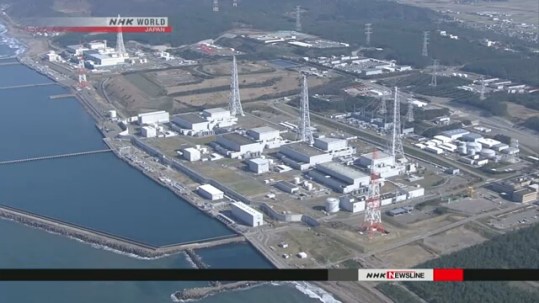
Japan’s nuclear regulator has demanded Tokyo Electric Power Company clarify the responsibilities of its president in the event of a nuclear accident.
Three years ago, the Nuclear Regulation Authority endorsed safety measures at TEPCO’s two nuclear reactors at the Kashiwazaki-Kariwa plant in Niigata Prefecture.
The regulator then requested that the company lay out its policies for preventing another nuclear accident in the plant security rulebook. The company had several years earlier been at the heart of the 2011 Fukushima Daiichi nuclear disaster.
On Thursday, TEPCO officials told the regulator that they would include a clause stipulating that the president be quickly informed of any risk with the potential to lead to an accident. The clause also stipulates that the president address the issue, regardless of whether the risk has been confirmed or not.
The officials also said records related to such issues would be kept for five years.
But the regulation authority says the storage period should be longer. It also says the responsibilities of the president should be laid out more specifically.
They are also demanding written opinions from law experts on the matter. Tokyo Electric says it will reconsider these measures.
Regulators want TEPCO to be as specific in its safety measures as possible, after the company rejected a report warning of the possible impact of a massive tsunami before the 2011 Fukushima Daiichi nuclear disaster.
The complexities and pitfalls of citizen science
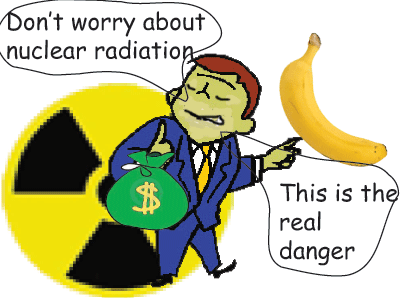
One such tactic, which was witnessed after Fukushima, occurred through the reframing of radiation risks as simplistic and natural, unrelated to the specific risks associated with Fukushima. For instance, the government distributed pamphlets that explained that radiation naturally exists in our food, ch as the potassium levels present in bananas.
Yet such information is irrelevant to the hazards of internalizing fission products from a nuclear power plant. While bananas have naturally occurring potassium, it would require eating around 20 million bananas to get radiation poisoning. On the other hand, each radionuclide released during nuclear meltdown events like Fukushima possesses specific biological signatures and presents particular risks when inhaled or ingested.
Being Clear-Eyed About Citizen Science in the Age of COVID-19, Sapiens MAXIME POLLERI / 15 JUL 2020
“……..there are inherent political complexities involved when citizens or nongovernmental organizations step in and claim expertise in areas typically reserved for state agencies and experts. Like those entities, citizen science has its own potential pitfalls.
For one, corporate polluters or state agencies can potentially exploit citizen science, delegating the monitoring of contamination to the victims of a disaster. For instance, by the end of this year, Japan’s Nuclear Regulation Agency plans to remove 80 percent of radiation monitoring posts in Fukushima, arguing that the radiation levels in many areas have stabilized themselves—owing also in part to the presence and efficiency of monitoring networks provided by citizens. This decision has been controversial, since problems of radioactive contamination persist in Fukushima. For instance, one of the main radioactive pollutants, Cesium-137, has a long lifespan and can emit radiation for nearly 300 years.
Retiring these posts will force citizen scientists to take on the burden of monitoring, shifting liability for ensuring safe living conditions onto the shoulders of the nuclear victims. In addition, the growing impact of citizen science can lead to reduced public expenditure, minimal government intervention, and risk privatization, meaning that risk becomes individual and private. Too much delegation to citizens runs the risk of creating societies where individuals have to take care of themselves in increasingly polluted environments, while interpreting complex data about controversial environmental dangers. And not every community can afford to purchase expensive monitoring devices or test food in a consistent manner.
Citizen scientists also risk reproducing forms of ignorance around certain hazards. n post-Fukushima Japan, what is meant by the “science” of citizen science is often synonymous with a tracking and monitoring agenda, where individuals resort to the very same technologies and knowledge forms used by states, nuclear lobbies, or radiological protection agencies.
Yet many anthropologists and historians have argued that what we know (and don’t know) about the extent of radiation hazards and dangers was embedded in a culture of secrecy, denial, and propaganda that was shaped by the nuclear arms race of the Cold War. Considerations over international security and political stability were often prioritized over the safety of workers or citizens who had been exposed to radiation. As a result, some of the negative effects of radiation were downplayed through different tactics.
One such tactic, which was witnessed after Fukushima, occurred through the reframing of radiation risks as simplistic and natural, unrelated to the specific risks associated with Fukushima. For instance, the government distributed pamphlets that explained that radiation naturally exists in our food, ch as the potassium levels present in bananas.
Yet such information is irrelevant to the hazards of internalizing fission products from a nuclear power plant. While bananas have naturally occurring potassium, it would require eating around 20 million bananas to get radiation poisoning. On the other hand, each radionuclide released during nuclear meltdown events like Fukushima possesses specific biological signatures and presents particular risks when inhaled or ingested. During my fieldwork in Fukushima, I witnessed that this legacy of misinformation was carried on by some citizens who unwittingly replicated these propagandist forms of knowledge by making similar naturalistic or overly simplistic comparisons.
As citizen science efforts grow, it is also critical to consider to what extent citizen involvement might put individuals at risk of adverse health effects. This is a tricky question when one considers that certain members of the population, like children, are more sensitive to radiation than others. In Fukushima, some Japanese parents have understandably opted to evacuate rather than rely on citizen science, arguing that doing so would expose their children to unacceptable levels of radiation and that forcing children to be responsible for their own safety is unethical.
Citizen scientists are hardly homogeneous groups, as mothers, farmers, and urban citizens do not experience hazards and recovery in the same way. In that regard, factors such as gender, employment, and social class strongly influence why people enter citizen science, how science is mobilized, and how data about a controversial hazard ends up being interpreted. For instance, people like Natsuo have used the results gathered by citizen science to highlight the dangers of living in Fukushima, while other citizen science organizations help bring people back to their beloved region. These conflicts can result in even more fragmented communities and conflicts within and around citizen science. ……
In Japanese, two words—shiru and wakaru—can be used for the verb “knowing.” Shiru means “to find out” or “to learn.” It implies a process of acquisition of knowledge and information. Wakaru, on the other hand, is closer to “understanding this knowledge.” Shiru comes before wakaru, and in a way, one can know but not necessarily understand. Wakaru consequently shows a greater and more personal level of comprehension often based on a given context.
For Masayuki, state institutional experts possessed shiru, but not wakaru. Having been directly affected by radioactive contamination, Masayuki strongly believed that the inhabitants of a place, the jūmin (literally, the people who resided) were best suited to manage their life in a post-Fukushima Japan. https://www.sapiens.org/culture/fukushima-citizen-science/
Citizen science and Fukushima radiation
An anthropologist explores the network of citizen monitoring capabilities that developed after the Fukushima nuclear disaster in Japan in 2011 for what they might teach all of us about such strategies for the covonavirus pandemic. Sapiens MAXIME POLLERI / 15 JUL 2020 “…………… The earthquake and subsequent tsunami led to core meltdowns within some of the Fukushima power plant’s nuclear reactors. This malfunction, along with other technical incidents, resulted in the atmospheric release of radioactive pollutants, which spread predominantly over the northeastern part of Japan, forcing a widespread evacuation of Fukushima residents. By March 12, the area around the power plant had been evacuated; those living and working within 20 kilometers of the radius of the plant were forced to relocate. In the days, weeks, and months following this disaster, uncertainty around the scale and extent of contamination grew swiftly—much like what we see occurring throughout the world during the COVID-19 pandemic.
Most notably, the public grew increasingly concerned about the legitimacy of institutional experts’ ability to control and explain the risks of residual radioactivity, while citizens like Natsuo were unable to get adequate information through traditional media venues. Initially, data about radioactive contamination came sporadically and was often explained in hard-to-understand metrics by scientists who were cherry-picked by the state to send reassuring messages to citizens.
Moreover, radioactive contamination was later found to be present in some food products and in school yards where children had been playing that lay beyond the official zone of evacuation. Over the ensuing months and years, the public lost confidence in the state’s response and began to take matters into their own hands, mobilizing expert practices of their own. Widespread grassroot actions led to citizen science networks in which people tracked radiation in their environment, organized learning workshops on radiation dangers, and tested food for contamination, often through local organizations or individual households.
As an anthropologist who conducted fieldwork on the Fukushima nuclear disaster between 2015 and 2017, I came to realize that citizen science can rise up to fill in the gaps of state responses toward crises, for better or for worse. As we’ve seen play out throughout the COVID-19 pandemic in various parts of the world, governance and leadership have often been confusing, mismatched, and at times utterly misleading. The case of Fukushima offers lessons about both the promises and pitfalls of citizen science and how civil society is playing an increasingly important role in managing various disasters, catastrophes, and crises.
The Geiger counter of Masayuki was not silent for long before it began to emit the distinctive “clicking” sound associated with radiation monitoring devices. The “click” grew louder in intensity as we located a hot spot, an area where the level of radiation is significantly higher than elsewhere. Masayuki dutifully noted the number provided by the device before leaving to search for another hot spot. We were standing in the Japanese village of Iitate, situated in the prefecture of Fukushima. It was common at this time for citizens to own their own Geiger counters—often purchased off the internet using international donations or made at home as DIY devices—to measure the level of radiation around them.
When I first came to this rural village in the spring of 2016, more than five years had passed since the nuclear disaster. The forced evacuation of citizens from Fukushima and the surrounding areas had proved short-lived; by 2012, the Japanese state had already embraced a policy of repatriation to irradiated areas like Iitate village, which is where I met Masayuki and citizens like him in 2016. ……….
While happy to be back in their beloved region, many residents were critical of the state radiation-monitoring networks that were supposed to provide them with adequate information to allow them to live safely in the village. Indeed, state data on radiation was often provided through fixed monitoring in precise locations or through an average radiation level taken in the village. This kind of information was not practical enough for residents, who wanted to know the specific radiation levels behind their houses or in their rice paddy fields.
Likewise, official depictions of radiation levels through clear-cut chromatic zones did little to offer the citizens reassurance. As a result of the perceived limitation of state measures, residents quickly decided to track radiation themselves as a means to keep the map of their village relevant—often finding contamination that was not evident from state mapping. In the house of one farmer, I witnessed homemade models that exhibited a 3D topography of Iitate’s geographical landscape. These models had been made using 3D printers, and the level of radiation had been monitored by the citizens themselves.
In particular, the local knowledge of the geography of Iitate helped citizens to attain a level of precision that far exceeded that of the government map. Citizens soon learned that radiation doses could be higher at the bottom of a hill than farther upslope or that the woods behind one’s home, having trapped radiation, might impact the radiation level inside houses. These practices helped strengthen a community that had previously felt helpless in the face of an imperceptible radiation threat. Geiger counters became the ears and eyes of citizens like Masayuki, enabling them to make sense of and gain some semblance of control over a hazard that cannot be registered by the senses.
After the Chernobyl nuclear disaster in 1986, one of the main sources of radiation exposure stemmed from consumption of food products such as milk or wild mushrooms that had been contaminated by radioactive fallout. In an effort to make sure that this did not happen in Japan, the government took on the task of testing the food produced in Fukushima, implementing a limit to the allowable amount of radioactivity in food products.
Within months after the meltdowns, the government assured the public of the safety of its food products, encouraging citizens to consume foods sold at public fairs and other public events. However, citizens of Fukushima also consume food harvested from streams, forests, home gardens, and mountain areas—where state monitoring was largely absent or insufficient.
Again, citizens mobilized to fill in the gaps in food testing: With the help of public donations, citizen scientists were able to purchase scintillation detectors, which are used to measure radioactive contaminants in foodstuff. Such testing enabled citizens to gain an understanding of the types of foods most prone to radioactive contamination, such as mushrooms, green leafy vegetables, citrus, sea cucumber, and seaweeds. This in turn helped people avoid eating the most risky foods. Together with state monitoring, such citizen science practices resulted in lower consumption of contaminated foods.
While such examples demonstrate the power and potential of citizen science, there are inherent political complexities involved when citizens or nongovernmental organizations step in and claim expertise in areas typically reserved for state agencies and experts. Like those entities, citizen science has its own potential pitfalls…….. https://www.sapiens.org/culture/fukushima-citizen-science/
Japanese bishops’ anti-nuclear power book available in English
Japanese bishops’ anti-nuclear power book available in English, Crux, Catholic News Service, Jul 12, 2020 TOKYO — An English version of a book by Japan’s bishops appealing for the abolition of nuclear power is now available for free on the internet, reported ucanews.com.
Abolition of Nuclear Power: An Appeal from the Catholic Church in Japan is available as a PDF file on the website of the Catholic Bishops’ Conference of Japan.
The bishops wrote the book after Japan’s Fukushima Daiichi Nuclear Power Station suffered a serious accident including a meltdown after a 2011 earthquake and tsunami.
Nuclear power is essentially incompatible with the image of the earth as a symbiotic society, which Pope Francis shows in his encyclical “Laudato Si’,” the bishops say.
- The bishops concluded that nuclear power generation should be immediately abolished in the face of the insoluble dangers it presents, including widespread health damage to children.
They worked with researchers in various fields to explore the damage caused by the Fukushima accident, the technical and sociological limitations of nuclear power production, and ethical and theological considerations concerning it.
They said they believe that Japan, having suffered such a severe nuclear accident, has a responsibility to inform the world of the reality of the damage and to appeal for the abolition of nuclear power generation……..Once a severe accident occurs, they argue, nuclear power generation destroys the environment over a wide area for generations and damages the right to life and livelihood……. https://cruxnow.com/church-in-asia/2020/07/japanese-bishops-anti-nuclear-power-book-available-in-english/
Rally opposes proposal for Fukushima wastewater
|
Rally opposes proposal for Fukushima wastewater https://www3.nhk.or.jp/nhkworld/en/news/20200713_04/ 13 July 20, Dozens of young people in Japan’s Fukushima Prefecture have rallied against a government panel’s proposal on how to dispose of radioactive wastewater stored at the crippled Daiichi nuclear power plant.About 50 people, including fisheries workers, marched through Koriyama City on Sunday. The demonstration was organized by a group of Fukushima residents in their 20s and 30s, who said detrimental rumors about the prefecture may circulate if the wastewater is disposed of improperly. Group representative Sato Taiga said a survey shows that most respondents do not know about the issue. He added that he hopes the group’s activities will raise awareness among people, including the younger generation. Water used to cool molten nuclear fuel from the 2011 accident at the plant has most of the radioactive materials removed before being stored in tanks. But the treated water still contains tritium and some other radioactive substances. The amount stored has reached some 1.2 million tons. The plant’s operator, Tokyo Electric Power Company, expects to reach capacity around the summer of 2022. In February, a government panel compiled a report that says a realistic solution is releasing the wastewater into the sea or air after diluting it in compliance with environmental and other standards. The government is in the process of hearing opinions from local governments and relevant organizations before making its final decision on how to dispose of the treated water. |
|
UK Ministers losing enthusiasm for small nuclear reactors developed with China
DBD, a Cheshire-based engineering firm, was working with China’s Institute of Nuclear and New Energy Technology to build a fleet of gas-cooled small reactors, and had hoped to win government funds. However, ministers have awarded £10m each to three rival projects — including an experimental plan for a fusion reactor. A version of the DBD reactor has already been built in China. DBD declined to comment……. (subscribers only) https://www.thetimes.co.uk/article/ministers-cool-on-chinese-nuclear-reactors-k2m8j76qf
Movement in Japan to suspend Olympic Games
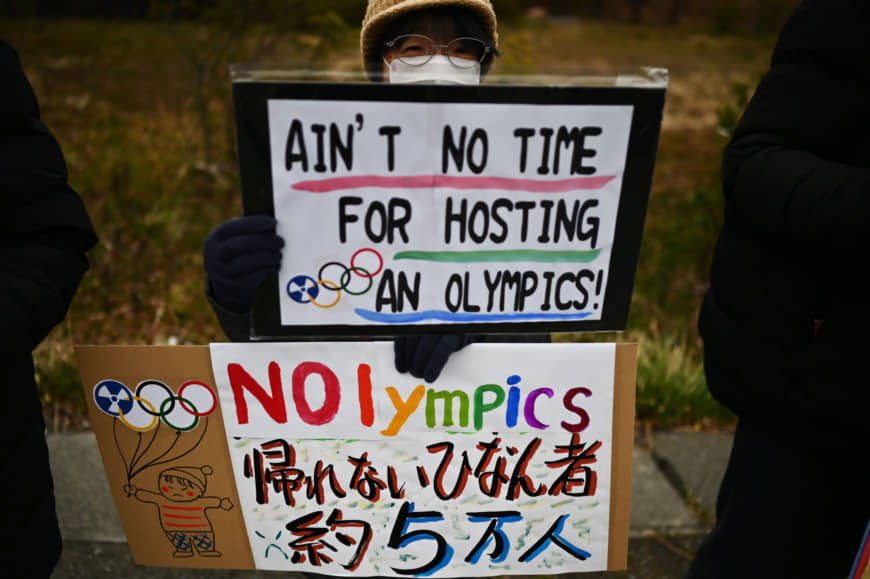
(FILES) This file photo taken on February 29, 2020 shows a protester holding placards during a demonstration against the Olympics, Prime Minister Shinzo Abe and nuclear energy, near the “J-Village” which will host the start of the Olympic torch relay in Naraha, Fukushima prefecture. – The Olympic torch relay that begins in Japan this month will start from Fukushima, emphasising what the government dubs the “Recovery Olympics”, but not everyone in the region will be cheering. (Photo by CHARLY TRIBALLEAU / AFP) / TO GO WITH nuclear-Fukushima-Oly-2020-JPN-Japan,FOCUS by Karyn NISHIMURA
Increasing voices in Japan for the cancellation of the Tokyo Olympics https://wordpress.com/read/feeds/2663585/posts/2804625668
On 7th June Mr Yukio Hatoyama, former Prime Minister of Japan, addressed me a message, expressing his views on the Tokyo Olympics : ”I always thought that instead of spending money on the Tokyo Olympics, the state should use these funds for the decontamination of the affected areas and to compensate the Fukushima nuclear disaster victims.“
He has expressed deep sympathy for the athletes placed in unbearable uncertainties preparing for the postponed Olympics. He urges that the sooner the decision the better for the athletes, since we all know that the Corona pandemic will oblige the Tokyo Olympic Games to be cancelled.
This message has given rise to reactions both in Japan and abroad.As an example,I am sharing with you a mail sent to me by a Japanese living in Germany.
In addition to the Covid-19 crisis, Japan is being cruelly assailed by natural disasters, unprecedented rainfalls and subsequent floods and landslides among others.
Japan faces a national crisis.
With warmest and highest regards,
Mitsuhei Murata
(Former Japanese Ambassador to Switzerland)
——– Forwarded Message ——–Dear Dr Alex Dear Dr Jörg Schmid;
cc: Mr Mitsuhei Murata, Mr Etsuji Watanabe
Recently I have acquired interesting information from Mr Mitsuhei Murata, former Japanese Ambassador to Switzerland, and Mr Etsuji Watanabe, a member of the ACSIR (Association for Citizens and Scientists Concerned about Internal Radiation Exposures), who are two of the leading lights in the anti-nuclear movements in Japan, that there is increasing support within the Japanese society for the complete cancellation, rather than postponement of the Tokyo Olympic Games.
On 7th June Mr Yukio Hatoyama, former Prime Minister of Japan, wrote to Mr Mitsuhei Murata, expressing his views on the Tokyo Olympics : ”I always thought that instead of spending money on the Tokyo Olympics, the state should use these funds for the decontamination of the affected areas and to compensate the Fukushima nuclear disaster victims.“
Subsequently Mr Murata wrote to Mr Thomas Bach, President of the IOC in order to convey this important message :
Dear President Thomas Bach,
Please allow me to inform you of a message a sent to me yesterday from former Japanese Prime Minister Yukio Hatoyama.
He has expressed deep sympathy for the athletes placed in unbearable uncertainties preparing for the postponed Olympics. He urges that the sooner the decision the better for the athletes, since we all know that the Corona pandemic will oblige the Tokyo Olympic Games to be cancelled.
In a press interview article published in January 2016,he made public his plea to consecrate maximum efforts to bringing Fukushima under control.
He has proven himself to be far-sighted. His vision for the future is in conformity with the dawning new world.
With highest and warmest regards,
Mitsuhei Murata
(Former Japanese Ambassador to Switzerland)
Mr Etsuji Watanabe told me that an overwhelming number of anti-nuclear activists are calling for the immediate cancellation of the Olympics. There will be demonstrations on 24th July, on which the 2020 Tokyo Olympic games were to commence, in Kyoto, Osaka and Tokyo. They will be demanding to stop the Olympic Games.
Best regards,
Rie
90 Coronavirus cases among India’s nuclear workers, most at Rooppur Nuclear Power Plant
Rooppur Nuclear Power Plant: Rising infections among workers, Daily Star, Ahmed Humayun Kabir Topu, 10 July 20, More and more workers of different sub-contracting firms at Rooppur Nuclear Power Plant in Ishwardi upazila are getting infected with the novel coronavirus.
Upazila Health Officer Dr AFM Asma Khatun said 103 people in the upazila have been diagnosed with the virus till July 6. Of them, around 90 workers were infected with Covid-19 in the last three days. The majority of the workers who tested positive for coronavirus work at Paharpur Cooling Tower Ltd, a sub-contracting firm of the Rooppur project.
The number of Covid-19 patients has increased as over 800 employees of the sub-contracting firms at the plant gave samples to the labs of different government and private institutions for Covid-19 testing in the last few days, said the doctor, adding that the number of infected workers is increasing every day.
Most of the Covid-19 patients are the workers of Paharpur Cooling Tower Ltd, a sub-contracting firm of the plant, said Dr Asma Khatun, adding that the authorities of different sub-contracting firms at Rooppur Nuclear Power Plant have collected samples of several hundred workers and sent those to the lab of a private institution in Dhaka for coronavirus testing but they are yet to get copy of the test reports from the private institution. …… https://www.thedailystar.net/city/news/rooppur-nuclear-power-plant-rising-infections-among-workers-1927965
Fukushima nuclear waste decision also a human rights issue
Fukushima nuclear waste decision also a human rights issue https://english.kyodonews.net/news/2020/07/1145e5b3970f-opinion-fukushima-nuclear-waste-decision-also-a-human-rights-issue.html
By Baskut Tuncak, KYODO NEWS – In a matter of weeks, the government of Japan will have the opportunity to demonstrate to the world how much it values protecting human rights and the environment and to meet its international obligations.
In the aftermath of the Fukushima Daiichi nuclear disaster, myself and other U.N. special rapporteurs consistently raised concerns about the approaches taken by the government of Japan. We have been concerned that raising of “acceptable limits” of radiation exposure to urge resettlement violated the government’s human rights obligations to children.
We have been concerned of the possible exploitation of migrants and the poor for radioactive decontamination work. Our most recent concern is how the government used the COVID-19 crisis to dramatically accelerate its timeline for deciding whether to dump radioactive wastewater accumulating at Fukushima Daiichi in the ocean.
Setting aside the duties incumbent on Japan to consult and protect under international law, it saddens me to think that a country that has suffered the horrors of being the only country on which not one but two nuclear bombs were dropped during war, would continue on a such a path in dealing with the radioactive aftermath of the Fukushima Daiichi disaster.
Releasing the toxic wastewater collected from the Fukushima nuclear plant would be, without question, a terrible blow to the livelihood of local fishermen. Regardless of the health and environmental risks, the reputational damage would be irreparable, an invisible and permanent scar upon local seafood. No amount of money can replace the loss of culture and dignity that accompany this traditional way of life for these communities.
The communities of Fukushima, so devastated by the tragic events of March 11, 2011, have in recent weeks expressed their concerns and opposition to the discharge of the contaminated water into their environment. It is their human right to an environment that allows for living a life in dignity, to enjoy their culture, and to not be exposed deliberately to additional radioactive contamination. Those rights should be fully respected and not be disregarded by the government in Tokyo.
The discharge of nuclear waste to the ocean could damage Japan’s international relations. Neighboring countries are already concerned about the release of large volumes of radioactive tritium and other contaminants in the wastewater.
Japan has a duty under international law to prevent transboundary environmental harm. More specifically, under the London Convention, Japan has an obligation to take precaution with the respect to the dumping of waste in the ocean. Given the scientific uncertainty of the health and environmental impacts of exposure to low-level radiation, the disposal of this wastewater would be completely inconsistent with the spirit, if not the letter, of this law.
ndigenous peoples have an internationally recognized right to free, prior and informed consent. This includes the disposal of waste in their waters and actions that may contaminate their food. No matter how small the Japanese government believes this contamination will be of their water and food, there is an unquestionable obligation to consult with potentially affected indigenous peoples that it has not met.
The Japanese government has not, and cannot, assure itself of meaningful consultations as required under international human rights law during the current pandemic. There is no justification for such a dramatically accelerated timeline for decision making during the covid-19 crisis. Japan has the physical space to store wastewater for many years.
I have reported annually to the U.N. Human Rights Council for the past six years. Whether the topic was on child rights or worker’s rights, in nearly each and every one of those discussion at the United Nations, the situation of Fukushima Daiichi is raised by concerned observers for the world to hear. Intervening organizations have pleaded year-after-year for the Japanese government to extend an invitation to visit so I can offer recommendations to improve the situation. I regret that my mandate is coming to an end without such an opportunity despite my repeated requests to visit and assess the situation.
The disaster of 2011 cannot be undone. However, Japan still has an opportunity to minimize the damage. In my view, there are grave risks to the livelihoods of fishermen in Japan and also to its international reputation. Again, I urge the Japanese government to think twice about its legacy: as a true champion of human rights and the environment, or not.
(Baskut Tuncak has served as U.N. special rapporteur on the implications for human rights of the environmentally sound management and disposal of hazardous substances and wastes since 2014.)
Britain’s nuclear future in trouble, aging reactors, and not enough money without China’s help
Britain’s Nuclear Future Uncertain as Relations With China Fray, https://business.financialpost.com/pmn/business-pmn/britains-nuclear-future-uncertain-as-relations-with-china-fray Rachel Morison and William Mathis, Bloomberg) 8 July 20, — Britain’s fraying relationship with China has the potential to undo a decade of mixed efforts to keep nuclear power flowing as an aging generation of plants drop out of service.
Once the heart of the U.K.’s energy plans, nuclear has been sidelined by spiraling costs and cheaper renewables. It also finds itself at the center of a diplomatic row spanning trade and human rights that threatens to undermine how the sector is financed.
Relations between China and the U.K. have been strained as the row over Huawei Technologies Co. intensified. When sweeping new national security laws were introduced in Hong Kong Prime Minister Boris Johnson offered its citizens the right to live and work in Britain.
China warned the U.K. Monday it’ll face “consequences” if it chooses to be a “hostile partner” after it emerged the government is planning to phase out the company’s equipment in the U.K.’s 5G telecommunications networks.
For nuclear, the sticking point has become the once-feted relationship with China General Nuclear Power Corp. that’s supposed to deliver the next generation of large nuclear plants. That link has come into sharp focus as the U.K. scrambles to find a funding model for projects that aren’t getting any cheaper.
Without CGN, its money and its technology, the U.K. will be left with a huge funding gap that other investors don’t seem willing to fill. It’ll also leave the country’s nuclear plans in disarray.
Equity funding for nuclear power stations is very difficult for private actors,” said Rob Gross, director of the U.K. Energy Research Centre. The risks are significant, timescales long and individual projects are very large. That’s why governments have always played a role in nuclear power, he said.
CGN’s involvement in Britain’s nuclear industry started in 2016 when a deal was signed with Electricite de France SA to cooperate on a trio of reactors totaling 8.7 gigawatts starting with Hinkley Point C in southwest England.
Nuclear remains important for the British government but it’s becoming increasingly pushed to the margins of energy policy as cheaper wind and solar have taken center stage.
Nuclear power has traditionally been seen as a low-carbon way of supplementing renewables — and as such a key part of the future energy mix envisioned in a net zero world.
Losing nuclear power probably wouldn’t pose a threat to the U.K.’s ability to generate enough power. The gap could be filled by gas, batteries or small modular reactors that can provide back-up to renewable energy and keep the lights on.
The sector is also important to the country as a way of building a large, skilled workforce and creating a supply chain using British companies.
False Starts
In 2017, ministers envisioned building 18 gigawatts of new projects but one by one each project folded, unable to negotiate the financing, leaving just EDF and CGN.
The government’s offer in 2018 to Hitachi to take a third of the equity at the Wylfa nuclear project wasn’t enough to keep the company interested.
How best to finance the technology, which costs billions, has become the latest hump in the road for policymakers. The Hinkley Point reactors – expected to start producing power by 2025 – have been hit by delays and cost overruns.
“The precise funding model for nuclear is up to the government to decide,” an EDF spokesman said.
That project will now cost as much as 22.5 billion pounds ($28.1 billion), taking into account inflation, and the guaranteed price of power is significantly higher than the latest round of offshore wind projects. Sizewell-C, still in the planning process, is slated to cost 20 billion pounds.
EDF is struggling and can’t afford to finance Sizewell on its own. The utility has cut costs and jobs, and pared investments setting out a plan to divest at least 10 billion euros of assets from 2015 to 2020 to help fund its share of Hinkley Point.
* CGN’s investment is in the planning and development stage only for Sizewell whereas it is involved in the construction of Hinkley.
The industry favors paying for the massive projects through a Regulated Asset Base model, a proven success on other infrastructure projects. The previous Conservative government was thought to back the financing option but the idea looks to be losing traction.
“If the Chinese pull out, then Sizewell will still go ahead but EDF will be unable to take on another major project,” Elchin Mammadov, a Bloomberg Intelligence analyst, said “So, Bradwell will be dead or put on hold for another decade.”
The debate has gone quiet following a consultation on the RAB model which closed in October.
RAB likely wouldn’t transfer enough risk from the project’s backers — EDF and CGN. The government would have to offer some kinds of guarantee on the project in order to get private investors to finance it.
One option would be for the government to take either a majority or minority stake in Sizewell C..
I wouldn’t be surprised if what is adopted is either a model with many of the characteristics of RAB, or potentially consideration of a more direct stake. This is about reducing the cost of capital.” said Tom Greatrex, chief executive officer of the Nuclear Industry Association.
But despite the long delays, there’s no indication that the government’s made up its mind how it will proceed.
“We are currently considering responses to inform the best approach to the financing of future nuclear projects,” a spokesperson for the Department for Business, Energy & Industrial Strategy said.
As much as 80% of electricity will be produced from low carbon sources by 2030, according to scenarios modeled by the U.K.’s Committee on Climate Change.
“With all but one of the nuclear fleet set to retire by 2030, and uncertainty over the scale of the new build program, it is likely that more electricity from renewable sources will be needed,” said Jonathan Marshall, head of analysis at the Energy and Climate Intelligence Unit.
No economic benefit in nuclear power for India
 NMIMS-FPJ webinar: Nuclear energy not for countries looking at economic development, https://www.freepressjournal.in/fpj-initiatives/nmims-fpj-webinar-nuclear-energy-not-for-countries-looking-at-economic-developmentBy FPJ Web Desk 1 July 20, If India is looking at development by increasing power consumption, it is essential that it opts for cheaper forms of energy, stated nuclear expert M V Ramana, at a webinar ‘The future of nuclear energy’. He stressed that in such a case nuclear is not the right choice. Ramana is Director of the Liu Institute for Global Issues at the School of Public Policy and Global Affairs, University of British Columbia.
Speaking at the third session of a series ‘The future of energy’ organised by NMIMS-FPJ in association with Tata Power, Ramana said, “If you were looking at (economic) development by providing power to hundreds of villages that do not have power, then nuclear energy is a very bad choice. For development, you need cheap energy but you have (nuclear energy which is) an expensive form of energy.”
He revealed today it costs somewhere between USD 10-15 billion to build a nuclear power plant. However, the power produced by this plant is at the cost of USD 100 per MW hour. This is three times higher the cost of solar and wind energy, he added. “Solar and wind energy today are selling at USD 30-35 per megawatt hour (MWh).” After including storage costs and other costs, solar and wind energy continues to be cheaper and will cost over USD 50 per MWh.
He went on to add while nuclear plants are complicated, the fast breeder reactor is a lot more complex. Countries like the United States, Germany, the United Kingdom, others had fast breeder reactors programmes, which they gave up. “For historical and sociological reasons, India has said it is a very important part of our programme and pours in a lot of resources into that. Even if you are supporting nuclear energy, this is not the technology that you should be focussing on,” he advised. https://www.freepressjournal.in/fpj-initiatives/nmims-fpj-webinar-nuclear-energy-not-for-countries-looking-at-economic-development
Fukushima radioactive reference layer found in Northern glaciers as they thaw

 Terrawatch: unearthing snow’s ‘Fukushima layer’ https://www.theguardian.com/science/2020/jun/30/terrawatch-unearthing-snows-fukushima-layer
Chinese glaciologists have found the freeze-thaw process has concentrated discharge from the disaster Kate Ravilious, @katerav Wed 1 Jul 2020 The Fukushima nuclear accident has added a distinctive signature to snow and ice across the northern hemisphere, new research published in Environmental Research Letters shows. Triggered by the Tōhoku earthquake and tsunami off the coast of Japan on 11 March 2011, the disaster resulted in a month-long discharge of radioactive material into the atmosphere, ocean and soil.Feiteng Wang from the Tian Shan glaciological station in Lanzhou, China, and colleagues collected snow samples in 2011 and 2018 from a number of glaciers (spanning a distance of more than 1,200 miles (2,000km) in north-western China. They expected the Fukushima signature to have faded away by 2018, but to their surprise the freeze-thaw processing had made it more concentrated, creating a strong and lasting reference layer in the ice.
Many reference layers from the last 50 years (such as the Chernobyl nuclear disaster) have melted away in recent warming events, making it difficult to date the upper layers of ice cores. “Reference layers are crucial and a prerequisite for telling the story of the ice core,” says co-author Jing Ming. “The Fukushima layer will be useful for dating ice in one or two decades when the snow transforms to ice,” he adds.
Many experts question Trump’s claim on China’s nuclear weapons buildup
- When negotiators from the United States and Russia met in Vienna last week to discuss renewing the last major nuclear arms control treaty that still exists between the two countries, American officials surprised their counterparts with a classified briefing on new and threatening nuclear capabilities — not Russia’s, but China’s.
….. Many outside experts question whether China’s buildup — assessed as bringing greater capability more than greater numbers — is as fast, or as threatening, as the Trump administration insists.
The United States conducted more nuclear tests during the Cold War than the rest of the world combined. Over decades of experimentation, and more than 1,000 tests, its bomb designers learned many tricks of extreme miniaturization as well as how to endow their creations with colossal destructive force. Compared with the atomic bomb that leveled Hiroshima, the nation’s first explosive test of a hydrogen bomb, in 1954, produced a blast 1,000 times as powerful.
Because of that history, many nuclear experts now argue that if Mr. Trump begins a new wave of global testing, it would aid American rivals more than the United States.
For years, some Republicans have urged preparations for a test and poured money into the effort. One instrument now being prepared for the Nevada complex costs $800 million; it would test the behavior of plutonium.
Today, Republicans are still urging more upgrades and speedups, including at the Nevada complex. This month, Senator Tom Cotton, Republican of Arkansas, offered an amendment to a defense bill that would add at least $10 million to “carry out projects related to reducing the time required to execute a nuclear test.”
Top Democrats in the House told the Pentagon and the Energy Department in a recent letter that the idea of a renewal in nuclear testing was “unfathomable,” as well as “shortsighted and dangerous.”
But Mr. Billingslea thinks he succeeded in getting the Russians to think about what is happening in China, not in the Nevada desert. During his meeting last week, the Russians were taking copious notes on China’s buildup, while reviewing classified slides. He insists they want to sit down and talk more later in the summer.
They will do so without the Chinese….https://www.nytimes.com/2020/06/30/us/politics/trump-russia-china-nuclear.html
Is South Korea’s nuclear industry a model for others to follow?
 Jim Green, Nuclear Monitor #844, 25 May 2017, https://www.wiseinternational.org/nuclear-monitor/844/south-koreas-nuclear-industry-model-others-follow
As the nuclear power crisis has unfolded in recent months ‒ engulfing major nuclear companies and utilities in the US, Japan and France ‒ South Korea’s nuclear industry has been held up as a model for others to follow. US nuclear lobbyist Michael Shellenberger, for example, explains ‘why Korea won’: “Korea is winning the global competition to build new nuclear plants against China and Russia despite being a fraction of the size, at just 50 million people, and energy-poor. It has done so through focus: standard design, standard construction of plants, standard operation and standard regulation.”1
But South Korea’s nuclear industry is scandal-plagued, it hasn’t won any bids to build reactors overseas since 2009, and it is more than a stretch to describe it as “world class” as nuclear advocate Rod Adams would have you believe.2 Public and political support has been in freefall over the past five years because of the Fukushima disaster and a domestic nuclear corruption scandal (see the following article in this issue of the Nuclear Monitor). In the coming years, nuclear power’s contribution to domestic electricity supply is likely to decline and there is little likelihood that an export industry will flourish. Moreover, with public support for the nuclear industry in freefall, the government has little hope of achieving its aim of securing a site for a high-level nuclear waste repository by 2028.
Korea Times noted on April 21 that every major candidate in South Korea’s presidential election promised to stop building new nuclear reactors and to close down older ones.3 The winner of the May 9 presidential election, Moon Jae-in, who stood as the candidate of the Democratic Party of Korea, is a former human rights lawyer. World Nuclear News reported that Moon was one of seven presidential candidates who signed an agreement in March for a “common policy” to phase out nuclear power.4 During the election campaign, Moon said he would scrap plans for new reactors ‒ including Shin Kori units 5 and 6 ‒ while immediately closing the Wolsong-1 reactor.4 (In February 2017, the Seoul Administrative Court ordered the Nuclear Safety and Security Commission to cancel its decision to extend the lifespan of Wolsong-1 because legal procedures had not been followed in the decision-making process.) Moon also said he would block lifespan extensions for the older reactors at the Kori plant5 ‒ the four Kori reactors were grid-connected between 1977 and 1985. Continue reading
North Korea to ‘counter nuclear with nuclear’ against US
|
North Korea to ‘counter nuclear with nuclear’ against US https://www.9news.com.au/world/north-korea-to-counter-nuclear-with-nuclear-against-us/f1da3676-8adb-4056-9245-363b039406e9
By Inga Neilsen, Jun 26, 2020 North Korea has claimed it is prepared to use nuclear weapons in response to “hostile policy” by the US, according to an official government report.
The Democratic People’s Republic of Korea (DPRK) issued a report by the Ministry of Foreign Affairs Institute for Disarmament and Peace, which said the country had no choice but to counter “nuclear with nuclear.”
“In order to eliminate the nuclear threats from the US, the DPRK government made all possible efforts either through dialogue or in resort to the international law, but all ended in vain,” the report read.
“The option left was only one, and that was to counter nuclear with nuclear.”
The report, released on state run media on the 70th anniversary of the start of the Korean War, said the socialist state will continue to bolster its power to “to contain the persistent nuclear threats from the US.”
The Trump administration and Kim Jong Un’s regime embarked on a series of talks in an attempt to stop North Korea’s nuclear ambitions, but did not reach a binding agreement.
North Korea responses by firing short-range missile tests which blew up an inter-Korean liaison office, cutting communication lines with South Korea.
The option left was only one, and that was to counter nuclear with nuclear.”
South Korean President Moon Jae-in, speaking at a ceremony to honour veterans of the Korean War, urged North Korea to seek peace.
“We will continuously search for routes that are mutually beneficial for both Koreas through peace,” he said.
“Before speaking of unification, I hope that we can become friendly neighbours first.”
|
|
1 This Month
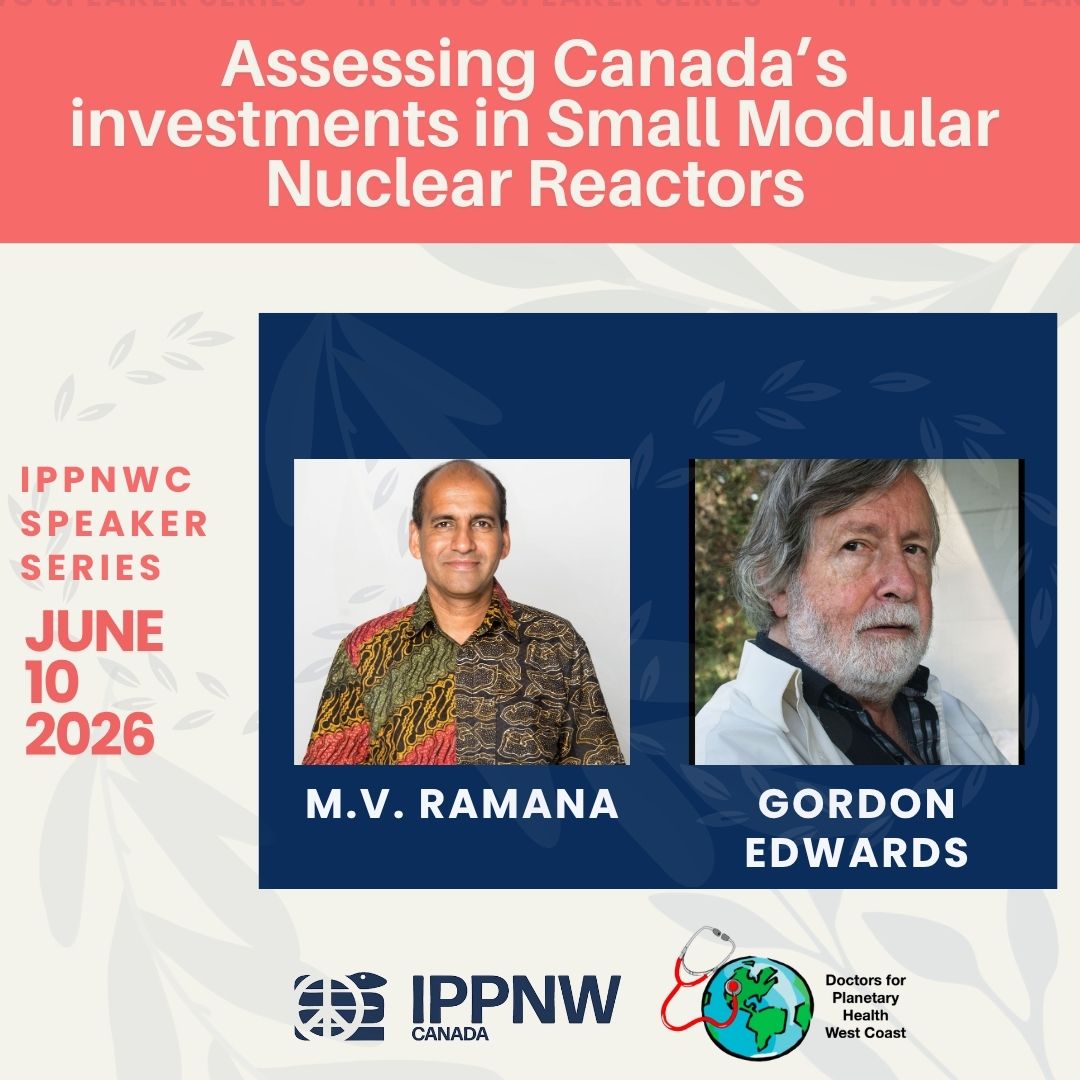
10 June – Assessing Canada’s Investments in Small Modular Nuclear Reactors – https://zoom.us/meeting/register/IiqHA5feRhaEBycOLNTJlA#/registration


Cuba Is Not a Failed State – It Is a Besieged State
PETITION: “Global Appeal to Endorse Palestinian Right of Return of Refugees”
To see nuclear-related stories in greater depth and intensity – go to https://nuclearinformation.wordpress.com
-
Archives
- June 2026 (89)
- May 2026 (306)
- April 2026 (356)
- March 2026 (251)
- February 2026 (268)
- January 2026 (308)
- December 2025 (358)
- November 2025 (359)
- October 2025 (376)
- September 2025 (257)
- August 2025 (319)
- July 2025 (230)
-
Categories
- 1
- 1 NUCLEAR ISSUES
- business and costs
- climate change
- culture and arts
- ENERGY
- environment
- health
- history
- indigenous issues
- Legal
- marketing of nuclear
- media
- opposition to nuclear
- PERSONAL STORIES
- politics
- politics international
- Religion and ethics
- safety
- secrets,lies and civil liberties
- spinbuster
- technology
- Uranium
- wastes
- weapons and war
- Women
- 2 WORLD
- ACTION
- AFRICA
- Atrocities
- AUSTRALIA
- Christina's notes
- Christina's themes
- culture and arts
- Events
- Fuk 2022
- Fuk 2023
- Fukushima 2017
- Fukushima 2018
- fukushima 2019
- Fukushima 2020
- Fukushima 2021
- general
- global warming
- Humour (God we need it)
- Nuclear
- RARE EARTHS
- Reference
- resources – print
- Resources -audiovicual
- Weekly Newsletter
- World
- World Nuclear
- YouTube
-
RSS
Entries RSS
Comments RSS
 nuclear-news