90 Coronavirus cases among India’s nuclear workers, most at Rooppur Nuclear Power Plant
Rooppur Nuclear Power Plant: Rising infections among workers, Daily Star, Ahmed Humayun Kabir Topu, 10 July 20, More and more workers of different sub-contracting firms at Rooppur Nuclear Power Plant in Ishwardi upazila are getting infected with the novel coronavirus.
Upazila Health Officer Dr AFM Asma Khatun said 103 people in the upazila have been diagnosed with the virus till July 6. Of them, around 90 workers were infected with Covid-19 in the last three days. The majority of the workers who tested positive for coronavirus work at Paharpur Cooling Tower Ltd, a sub-contracting firm of the Rooppur project.
The number of Covid-19 patients has increased as over 800 employees of the sub-contracting firms at the plant gave samples to the labs of different government and private institutions for Covid-19 testing in the last few days, said the doctor, adding that the number of infected workers is increasing every day.
Most of the Covid-19 patients are the workers of Paharpur Cooling Tower Ltd, a sub-contracting firm of the plant, said Dr Asma Khatun, adding that the authorities of different sub-contracting firms at Rooppur Nuclear Power Plant have collected samples of several hundred workers and sent those to the lab of a private institution in Dhaka for coronavirus testing but they are yet to get copy of the test reports from the private institution. …… https://www.thedailystar.net/city/news/rooppur-nuclear-power-plant-rising-infections-among-workers-1927965
Fukushima nuclear waste decision also a human rights issue
Fukushima nuclear waste decision also a human rights issue https://english.kyodonews.net/news/2020/07/1145e5b3970f-opinion-fukushima-nuclear-waste-decision-also-a-human-rights-issue.html
By Baskut Tuncak, KYODO NEWS – In a matter of weeks, the government of Japan will have the opportunity to demonstrate to the world how much it values protecting human rights and the environment and to meet its international obligations.
In the aftermath of the Fukushima Daiichi nuclear disaster, myself and other U.N. special rapporteurs consistently raised concerns about the approaches taken by the government of Japan. We have been concerned that raising of “acceptable limits” of radiation exposure to urge resettlement violated the government’s human rights obligations to children.
We have been concerned of the possible exploitation of migrants and the poor for radioactive decontamination work. Our most recent concern is how the government used the COVID-19 crisis to dramatically accelerate its timeline for deciding whether to dump radioactive wastewater accumulating at Fukushima Daiichi in the ocean.
Setting aside the duties incumbent on Japan to consult and protect under international law, it saddens me to think that a country that has suffered the horrors of being the only country on which not one but two nuclear bombs were dropped during war, would continue on a such a path in dealing with the radioactive aftermath of the Fukushima Daiichi disaster.
Releasing the toxic wastewater collected from the Fukushima nuclear plant would be, without question, a terrible blow to the livelihood of local fishermen. Regardless of the health and environmental risks, the reputational damage would be irreparable, an invisible and permanent scar upon local seafood. No amount of money can replace the loss of culture and dignity that accompany this traditional way of life for these communities.
The communities of Fukushima, so devastated by the tragic events of March 11, 2011, have in recent weeks expressed their concerns and opposition to the discharge of the contaminated water into their environment. It is their human right to an environment that allows for living a life in dignity, to enjoy their culture, and to not be exposed deliberately to additional radioactive contamination. Those rights should be fully respected and not be disregarded by the government in Tokyo.
The discharge of nuclear waste to the ocean could damage Japan’s international relations. Neighboring countries are already concerned about the release of large volumes of radioactive tritium and other contaminants in the wastewater.
Japan has a duty under international law to prevent transboundary environmental harm. More specifically, under the London Convention, Japan has an obligation to take precaution with the respect to the dumping of waste in the ocean. Given the scientific uncertainty of the health and environmental impacts of exposure to low-level radiation, the disposal of this wastewater would be completely inconsistent with the spirit, if not the letter, of this law.
ndigenous peoples have an internationally recognized right to free, prior and informed consent. This includes the disposal of waste in their waters and actions that may contaminate their food. No matter how small the Japanese government believes this contamination will be of their water and food, there is an unquestionable obligation to consult with potentially affected indigenous peoples that it has not met.
The Japanese government has not, and cannot, assure itself of meaningful consultations as required under international human rights law during the current pandemic. There is no justification for such a dramatically accelerated timeline for decision making during the covid-19 crisis. Japan has the physical space to store wastewater for many years.
I have reported annually to the U.N. Human Rights Council for the past six years. Whether the topic was on child rights or worker’s rights, in nearly each and every one of those discussion at the United Nations, the situation of Fukushima Daiichi is raised by concerned observers for the world to hear. Intervening organizations have pleaded year-after-year for the Japanese government to extend an invitation to visit so I can offer recommendations to improve the situation. I regret that my mandate is coming to an end without such an opportunity despite my repeated requests to visit and assess the situation.
The disaster of 2011 cannot be undone. However, Japan still has an opportunity to minimize the damage. In my view, there are grave risks to the livelihoods of fishermen in Japan and also to its international reputation. Again, I urge the Japanese government to think twice about its legacy: as a true champion of human rights and the environment, or not.
(Baskut Tuncak has served as U.N. special rapporteur on the implications for human rights of the environmentally sound management and disposal of hazardous substances and wastes since 2014.)
Britain’s nuclear future in trouble, aging reactors, and not enough money without China’s help
Britain’s Nuclear Future Uncertain as Relations With China Fray, https://business.financialpost.com/pmn/business-pmn/britains-nuclear-future-uncertain-as-relations-with-china-fray Rachel Morison and William Mathis, Bloomberg) 8 July 20, — Britain’s fraying relationship with China has the potential to undo a decade of mixed efforts to keep nuclear power flowing as an aging generation of plants drop out of service.
Once the heart of the U.K.’s energy plans, nuclear has been sidelined by spiraling costs and cheaper renewables. It also finds itself at the center of a diplomatic row spanning trade and human rights that threatens to undermine how the sector is financed.
Relations between China and the U.K. have been strained as the row over Huawei Technologies Co. intensified. When sweeping new national security laws were introduced in Hong Kong Prime Minister Boris Johnson offered its citizens the right to live and work in Britain.
China warned the U.K. Monday it’ll face “consequences” if it chooses to be a “hostile partner” after it emerged the government is planning to phase out the company’s equipment in the U.K.’s 5G telecommunications networks.
For nuclear, the sticking point has become the once-feted relationship with China General Nuclear Power Corp. that’s supposed to deliver the next generation of large nuclear plants. That link has come into sharp focus as the U.K. scrambles to find a funding model for projects that aren’t getting any cheaper.
Without CGN, its money and its technology, the U.K. will be left with a huge funding gap that other investors don’t seem willing to fill. It’ll also leave the country’s nuclear plans in disarray.
Equity funding for nuclear power stations is very difficult for private actors,” said Rob Gross, director of the U.K. Energy Research Centre. The risks are significant, timescales long and individual projects are very large. That’s why governments have always played a role in nuclear power, he said.
CGN’s involvement in Britain’s nuclear industry started in 2016 when a deal was signed with Electricite de France SA to cooperate on a trio of reactors totaling 8.7 gigawatts starting with Hinkley Point C in southwest England.
Nuclear remains important for the British government but it’s becoming increasingly pushed to the margins of energy policy as cheaper wind and solar have taken center stage.
Nuclear power has traditionally been seen as a low-carbon way of supplementing renewables — and as such a key part of the future energy mix envisioned in a net zero world.
Losing nuclear power probably wouldn’t pose a threat to the U.K.’s ability to generate enough power. The gap could be filled by gas, batteries or small modular reactors that can provide back-up to renewable energy and keep the lights on.
The sector is also important to the country as a way of building a large, skilled workforce and creating a supply chain using British companies.
False Starts
In 2017, ministers envisioned building 18 gigawatts of new projects but one by one each project folded, unable to negotiate the financing, leaving just EDF and CGN.
The government’s offer in 2018 to Hitachi to take a third of the equity at the Wylfa nuclear project wasn’t enough to keep the company interested.
How best to finance the technology, which costs billions, has become the latest hump in the road for policymakers. The Hinkley Point reactors – expected to start producing power by 2025 – have been hit by delays and cost overruns.
“The precise funding model for nuclear is up to the government to decide,” an EDF spokesman said.
That project will now cost as much as 22.5 billion pounds ($28.1 billion), taking into account inflation, and the guaranteed price of power is significantly higher than the latest round of offshore wind projects. Sizewell-C, still in the planning process, is slated to cost 20 billion pounds.
EDF is struggling and can’t afford to finance Sizewell on its own. The utility has cut costs and jobs, and pared investments setting out a plan to divest at least 10 billion euros of assets from 2015 to 2020 to help fund its share of Hinkley Point.
* CGN’s investment is in the planning and development stage only for Sizewell whereas it is involved in the construction of Hinkley.
The industry favors paying for the massive projects through a Regulated Asset Base model, a proven success on other infrastructure projects. The previous Conservative government was thought to back the financing option but the idea looks to be losing traction.
“If the Chinese pull out, then Sizewell will still go ahead but EDF will be unable to take on another major project,” Elchin Mammadov, a Bloomberg Intelligence analyst, said “So, Bradwell will be dead or put on hold for another decade.”
The debate has gone quiet following a consultation on the RAB model which closed in October.
RAB likely wouldn’t transfer enough risk from the project’s backers — EDF and CGN. The government would have to offer some kinds of guarantee on the project in order to get private investors to finance it.
One option would be for the government to take either a majority or minority stake in Sizewell C..
I wouldn’t be surprised if what is adopted is either a model with many of the characteristics of RAB, or potentially consideration of a more direct stake. This is about reducing the cost of capital.” said Tom Greatrex, chief executive officer of the Nuclear Industry Association.
But despite the long delays, there’s no indication that the government’s made up its mind how it will proceed.
“We are currently considering responses to inform the best approach to the financing of future nuclear projects,” a spokesperson for the Department for Business, Energy & Industrial Strategy said.
As much as 80% of electricity will be produced from low carbon sources by 2030, according to scenarios modeled by the U.K.’s Committee on Climate Change.
“With all but one of the nuclear fleet set to retire by 2030, and uncertainty over the scale of the new build program, it is likely that more electricity from renewable sources will be needed,” said Jonathan Marshall, head of analysis at the Energy and Climate Intelligence Unit.
No economic benefit in nuclear power for India
 NMIMS-FPJ webinar: Nuclear energy not for countries looking at economic development, https://www.freepressjournal.in/fpj-initiatives/nmims-fpj-webinar-nuclear-energy-not-for-countries-looking-at-economic-developmentBy FPJ Web Desk 1 July 20, If India is looking at development by increasing power consumption, it is essential that it opts for cheaper forms of energy, stated nuclear expert M V Ramana, at a webinar ‘The future of nuclear energy’. He stressed that in such a case nuclear is not the right choice. Ramana is Director of the Liu Institute for Global Issues at the School of Public Policy and Global Affairs, University of British Columbia.
Speaking at the third session of a series ‘The future of energy’ organised by NMIMS-FPJ in association with Tata Power, Ramana said, “If you were looking at (economic) development by providing power to hundreds of villages that do not have power, then nuclear energy is a very bad choice. For development, you need cheap energy but you have (nuclear energy which is) an expensive form of energy.”
He revealed today it costs somewhere between USD 10-15 billion to build a nuclear power plant. However, the power produced by this plant is at the cost of USD 100 per MW hour. This is three times higher the cost of solar and wind energy, he added. “Solar and wind energy today are selling at USD 30-35 per megawatt hour (MWh).” After including storage costs and other costs, solar and wind energy continues to be cheaper and will cost over USD 50 per MWh.
He went on to add while nuclear plants are complicated, the fast breeder reactor is a lot more complex. Countries like the United States, Germany, the United Kingdom, others had fast breeder reactors programmes, which they gave up. “For historical and sociological reasons, India has said it is a very important part of our programme and pours in a lot of resources into that. Even if you are supporting nuclear energy, this is not the technology that you should be focussing on,” he advised. https://www.freepressjournal.in/fpj-initiatives/nmims-fpj-webinar-nuclear-energy-not-for-countries-looking-at-economic-development
Fukushima radioactive reference layer found in Northern glaciers as they thaw

 Terrawatch: unearthing snow’s ‘Fukushima layer’ https://www.theguardian.com/science/2020/jun/30/terrawatch-unearthing-snows-fukushima-layer
Chinese glaciologists have found the freeze-thaw process has concentrated discharge from the disaster Kate Ravilious, @katerav Wed 1 Jul 2020 The Fukushima nuclear accident has added a distinctive signature to snow and ice across the northern hemisphere, new research published in Environmental Research Letters shows. Triggered by the Tōhoku earthquake and tsunami off the coast of Japan on 11 March 2011, the disaster resulted in a month-long discharge of radioactive material into the atmosphere, ocean and soil.Feiteng Wang from the Tian Shan glaciological station in Lanzhou, China, and colleagues collected snow samples in 2011 and 2018 from a number of glaciers (spanning a distance of more than 1,200 miles (2,000km) in north-western China. They expected the Fukushima signature to have faded away by 2018, but to their surprise the freeze-thaw processing had made it more concentrated, creating a strong and lasting reference layer in the ice.
Many reference layers from the last 50 years (such as the Chernobyl nuclear disaster) have melted away in recent warming events, making it difficult to date the upper layers of ice cores. “Reference layers are crucial and a prerequisite for telling the story of the ice core,” says co-author Jing Ming. “The Fukushima layer will be useful for dating ice in one or two decades when the snow transforms to ice,” he adds.
Many experts question Trump’s claim on China’s nuclear weapons buildup
- When negotiators from the United States and Russia met in Vienna last week to discuss renewing the last major nuclear arms control treaty that still exists between the two countries, American officials surprised their counterparts with a classified briefing on new and threatening nuclear capabilities — not Russia’s, but China’s.
….. Many outside experts question whether China’s buildup — assessed as bringing greater capability more than greater numbers — is as fast, or as threatening, as the Trump administration insists.
The United States conducted more nuclear tests during the Cold War than the rest of the world combined. Over decades of experimentation, and more than 1,000 tests, its bomb designers learned many tricks of extreme miniaturization as well as how to endow their creations with colossal destructive force. Compared with the atomic bomb that leveled Hiroshima, the nation’s first explosive test of a hydrogen bomb, in 1954, produced a blast 1,000 times as powerful.
Because of that history, many nuclear experts now argue that if Mr. Trump begins a new wave of global testing, it would aid American rivals more than the United States.
For years, some Republicans have urged preparations for a test and poured money into the effort. One instrument now being prepared for the Nevada complex costs $800 million; it would test the behavior of plutonium.
Today, Republicans are still urging more upgrades and speedups, including at the Nevada complex. This month, Senator Tom Cotton, Republican of Arkansas, offered an amendment to a defense bill that would add at least $10 million to “carry out projects related to reducing the time required to execute a nuclear test.”
Top Democrats in the House told the Pentagon and the Energy Department in a recent letter that the idea of a renewal in nuclear testing was “unfathomable,” as well as “shortsighted and dangerous.”
But Mr. Billingslea thinks he succeeded in getting the Russians to think about what is happening in China, not in the Nevada desert. During his meeting last week, the Russians were taking copious notes on China’s buildup, while reviewing classified slides. He insists they want to sit down and talk more later in the summer.
They will do so without the Chinese….https://www.nytimes.com/2020/06/30/us/politics/trump-russia-china-nuclear.html
Is South Korea’s nuclear industry a model for others to follow?
 Jim Green, Nuclear Monitor #844, 25 May 2017, https://www.wiseinternational.org/nuclear-monitor/844/south-koreas-nuclear-industry-model-others-follow
As the nuclear power crisis has unfolded in recent months ‒ engulfing major nuclear companies and utilities in the US, Japan and France ‒ South Korea’s nuclear industry has been held up as a model for others to follow. US nuclear lobbyist Michael Shellenberger, for example, explains ‘why Korea won’: “Korea is winning the global competition to build new nuclear plants against China and Russia despite being a fraction of the size, at just 50 million people, and energy-poor. It has done so through focus: standard design, standard construction of plants, standard operation and standard regulation.”1
But South Korea’s nuclear industry is scandal-plagued, it hasn’t won any bids to build reactors overseas since 2009, and it is more than a stretch to describe it as “world class” as nuclear advocate Rod Adams would have you believe.2 Public and political support has been in freefall over the past five years because of the Fukushima disaster and a domestic nuclear corruption scandal (see the following article in this issue of the Nuclear Monitor). In the coming years, nuclear power’s contribution to domestic electricity supply is likely to decline and there is little likelihood that an export industry will flourish. Moreover, with public support for the nuclear industry in freefall, the government has little hope of achieving its aim of securing a site for a high-level nuclear waste repository by 2028.
Korea Times noted on April 21 that every major candidate in South Korea’s presidential election promised to stop building new nuclear reactors and to close down older ones.3 The winner of the May 9 presidential election, Moon Jae-in, who stood as the candidate of the Democratic Party of Korea, is a former human rights lawyer. World Nuclear News reported that Moon was one of seven presidential candidates who signed an agreement in March for a “common policy” to phase out nuclear power.4 During the election campaign, Moon said he would scrap plans for new reactors ‒ including Shin Kori units 5 and 6 ‒ while immediately closing the Wolsong-1 reactor.4 (In February 2017, the Seoul Administrative Court ordered the Nuclear Safety and Security Commission to cancel its decision to extend the lifespan of Wolsong-1 because legal procedures had not been followed in the decision-making process.) Moon also said he would block lifespan extensions for the older reactors at the Kori plant5 ‒ the four Kori reactors were grid-connected between 1977 and 1985. Continue reading
North Korea to ‘counter nuclear with nuclear’ against US
|
North Korea to ‘counter nuclear with nuclear’ against US https://www.9news.com.au/world/north-korea-to-counter-nuclear-with-nuclear-against-us/f1da3676-8adb-4056-9245-363b039406e9
By Inga Neilsen, Jun 26, 2020 North Korea has claimed it is prepared to use nuclear weapons in response to “hostile policy” by the US, according to an official government report.
The Democratic People’s Republic of Korea (DPRK) issued a report by the Ministry of Foreign Affairs Institute for Disarmament and Peace, which said the country had no choice but to counter “nuclear with nuclear.”
“In order to eliminate the nuclear threats from the US, the DPRK government made all possible efforts either through dialogue or in resort to the international law, but all ended in vain,” the report read.
“The option left was only one, and that was to counter nuclear with nuclear.”
The report, released on state run media on the 70th anniversary of the start of the Korean War, said the socialist state will continue to bolster its power to “to contain the persistent nuclear threats from the US.”
The Trump administration and Kim Jong Un’s regime embarked on a series of talks in an attempt to stop North Korea’s nuclear ambitions, but did not reach a binding agreement.
North Korea responses by firing short-range missile tests which blew up an inter-Korean liaison office, cutting communication lines with South Korea.
The option left was only one, and that was to counter nuclear with nuclear.”
South Korean President Moon Jae-in, speaking at a ceremony to honour veterans of the Korean War, urged North Korea to seek peace.
“We will continuously search for routes that are mutually beneficial for both Koreas through peace,” he said.
“Before speaking of unification, I hope that we can become friendly neighbours first.”
|
|
Testing for radiation in Fukushima – the continued anxiety
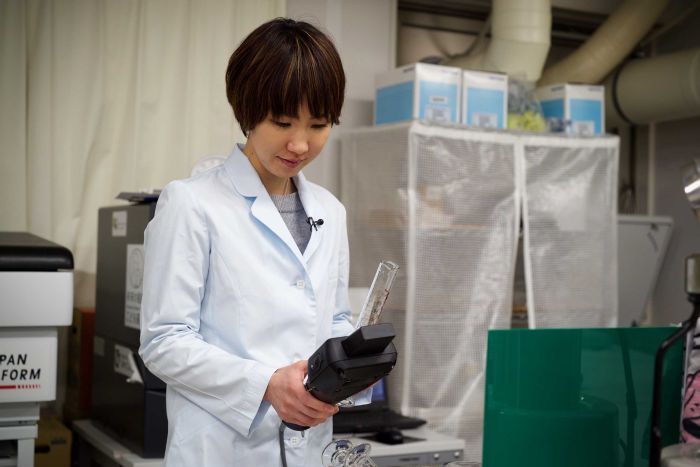
Nine years on, Fukushima’s mental health fallout lingers
As radiation from the Fukushima nuclear accident subsides, a damaging social and psychological legacy continues, Wired
Iida, who is 35, forbids her children from entering the sea or into forests. She agonises over which foods to buy. But no matter what she does, she can’t completely protect her children from radiation. It even lurks in their urine.
“Maybe he’s being exposed through the school lunch,” she says, puzzling over why her nine-year-old son’s urine showed two-and-a-half times the concentration of caesium that hers did, when she takes such care shopping. “Or maybe it’s from the soil outside where he plays. Or is it because children have a faster metabolism, so he flushes more out? We don’t know.”
Iida is a public relations officer at Tarachine, a citizens’ lab in Fukushima, Japan, that tests for radioactive contamination released from the 2011 accident at the Fukushima Daiichi nuclear plant. Agricultural produce grown in the area is subject to government and supermarket testing, but Tarachine wants to provide people with an option to test anything, from foraged mushrooms to dust from their home. Iida tests anything unknown before feeding it to her four children. Recently, she threw out some rice she received as a present after finding its level of contamination – although 80 times lower than the government limit – unacceptably high. “My husband considered eating it ourselves, but it’s too much to cook two batches of rice for every meal. In the end we fed it to some seagulls.”
Tarachine is one of several citizen labs founded in the wake of the Tōhoku earthquake and tsunami on March 11, 2011, which obliterated a swathe of the country’s northwest coast and killed more than 18,000 people. The wave knocked out cooling systems at the Fukushima Daiichi nuclear plant, triggering a meltdown in three of the reactor cores and hydrogen explosions that sprayed radionuclides across the Fukushima prefecture. More than 160,000 people were forced to evacuate. A government decontamination programme has allowed evacuation orders to be lifted in many municipalities, but one zone is still off limits, with only short visits permitted.
Driven by a desire to find out precisely how much radiation there was in the environment and where, a group of volunteers launched Tarachine in Iwaki, a coastal city that escaped the worst of the radioactive plume and was not evacuated, through a crowdfunding campaign in November 2011. It is now registered as a non-profit organisation, and runs on donations.
In a windowless room controlled for temperature and humidity and dotted with screens showing graphs, two women sort and label samples, either collected by staff or sent in by the public: soil from back gardens, candied grasshoppers, seawater. In the beginning, mothers sent in litres of breastmilk. Tarachine initially charged a tenth of what a university lab would charge to make the testing accessible to as many people as possible; last year, they made it free.
To test for caesium-137, the main long-term contaminant released from the plant, staff finely chop samples and put them inside a gamma counter, a cylindrical grey machine that looks like a centrifuge. Tarachine’s machines are more accurate than the more commonly accessible measuring tools: at some public monitoring posts, shoppers can simply place their produce on top of a device to get a reading, but this can be heavily skewed by background radiation (waving a Geiger counter over food won’t give an accurate reading for the same reason). Tarachine tries to get as precise readings as possible; the lab’s machines give results to one decimal place, and they try to block out excess background radiation by placing bottles of water around the machines.
Measuring for strontium, a type of less penetrative beta radiation, is even more complicated: the food has to first be roasted to ash before being mixed with an acid and sifted. The whole process takes two to three days. Tarachine received training and advice from university radiation labs around the country, but the volunteers had to experiment with everyday food items that scientists had never tested. “There was no recipe like ‘Roast the leaf for two hours at so-and-so Celsius’, you know?” says Iida. “If it’s too burnt it’s no good. We also had to experiment with types of acid and how much of the acid to add.”
Japanese government standards for radiation are some of the most stringent in the world: the upper limit of radioactive caesium in food such as meat and vegetables is 100 becquerels per kilogram, compared with 1,250 in the European Union and 1,200 in the US (the becquerel unit measures how much ionizing radiation is released due to radioactive decay). Many supermarkets adhere to a tighter limit, proudly advertising that their produce contains less than 40 becquerels, or as few as 10. Tarachine aims for just 1 becquerel.
“How I think about it is, how much radiation was there in local rice before the accident? It was about 0.01 becquerel. So that’s what I want the standard to be,” says Iida. Continue reading
Across Asia-Pacific, trust in govts rose, except in Japan

June 22, 2020
People’s trust in the governments of the Asia-Pacific rose, following a global pattern, except for Japan, according to the Edelman Trust Barometer Spring Update.
Trust in the government rose in China, India and South Korea, but declined by 5 points in Japan to 38 per cent, in Edelman’s Trust Barometer Spring Update report.
“The outlier in Asia, and indeed the world, is Japan,” noted Mr Stephen Kehoe, president and chief executive officer of Edelman’s Asia Pacific operations.
“Forced to reckon with early global attention due to the cruise ship stranded in the port of Yokohama, Japan appears to have learned few lessons from this crisis, or indeed, in the nine years since Fukushima,” he said in an article on Edelman’s website, referring to the coronavirus-hit Diamond Princess stranded in Yokohoma in February, with 3,700 people and crew on board. In the end, slightly over 700 people were found to be infected while 13 died, earning the government criticism for the delay in handling those infected.
“This, perhaps combined with the delayed decision to impose a state of emergency and subsequent reported missteps in the distribution of personal protective equipment, has resulted in a near-total collapse of confidence by the Japanese in their government to handle the ongoing crisis,” he added.
The March 2011 triple disaster in Fukushima of a tsunami, earthquake and an accident at the Daiichi nuclear power plant left more than 20,000 people dead or missing.
Japanese Prime Minister Shinzo Abe has been rapped for his handling of the coronavirus situation. A poll by public broadcaster NHK from May showed his approval rating had dropped to 37 per cent while another poll by Mainichi Shimbun showed his approval rating was only 27 per cent.
Elsewhere in Asia, people showed more trust in their governments, with the level in China up five points to 95 per cent, India (up 6 points to 87 per cent), and South Korea (up 16 points to 67 per cent).
Those surveyed also showed a high tolerance of government surveillance for public safety. The level in China was 30 points ahead of the global average (at 61 per cent), while in India it was 17 points over, and in South Korea, it was in line with the global average.
“Japan’s appetite for surveillance is the lowest in our sample at 44 per cent, continuing to reflect long-held beliefs around constitutional freedom, which date back to the aftermath of World War II,” noted Mr Kehoe.
https://www.straitstimes.com/asia/across-asia-pacific-trust-in-govts-rose-except-in-japan
It’s Not Techno-Angst That’s Driving East Asia to Abandon Nuclear Power
In the East Asian democracies, nuclear energy is tied to an increasingly unpopular political and economic model.
 Workers at the Fukushima Daiichi nuclear power plant pose for portraits on Feb. 23, 2016, in Okuma, Japan.
June 17, 2020
Western discussions about nuclear energy in East Asia usually start with the Fukushima disaster and end with efforts to address climate change. But anti-nuclear sentiment in Asia looks nothing like that in the West, where it was birthed during the Jane Fonda era and is still based on long-debunked claims about the intrinsic dangers of accidents and nuclear waste. The techno-angst and apocalyptic fears that have always animated Western environmentalism are largely foreign to Asian discussions of nuclear energy, climate change, and similar environmental concerns.The techno-angst and apocalyptic fears that have always animated Western environmentalism are largely foreign to Asian discussions of nuclear energy and climate change. After all, following the 2011 earthquake and tsunami in Japan that led to a meltdown at the Fukushima Daiichi nuclear plant, it was Germany—not Japan—that immediately decided to permanently phase out nuclear power, even if it meant that its carbon emissions would rise.
Japan, South Korea, and Taiwan may nonetheless take a decisive turn against nuclear power. The reasons have little to do with public fears of nuclear energy but are tied to long-standing demands for political and economic reform. That’s because the nuclear industry in each of these three countries is tied to a highly contested political and economic model that the reformers are pressing to change.
In April, the anti-nuclear Democratic Party of Korea swept to the most dominating electoral victory in South Korean history. In January, Taiwan’s reform-minded Democratic Progressive Party, which has proposed phasing out the country’s nuclear power stations, also won by a landslide. Meanwhile, both Japanese Prime Minister Shinzo Abe and his ruling Liberal Democratic Party (LDP), the country’s last major pro-nuclear party, face worsening poll numbers as a major election approaches in 2021.
The proximate causes of these political shifts have little to do with nuclear or environmental policies. South Korean President Moon Jae-in’s smashing victory followed his exemplary management of the national response to the COVID-19 pandemic. In Taiwan, it was China’s brutal crackdown on dissent in Hong Kong that heavily tipped the scales in favor of the Democratic Progressive Party, which has taken a far more defiant position on relations with China than its main rival, the Kuomintang. Japan’s LDP is languishing in the polls because of its failure to revitalize the country’s long-stagnant economy, a task made all the more challenging by the pandemic.
Dig a little deeper, however, and the same underlying political dynamics have undermined support for nuclear energy. In all three nations, the nuclear power sector has become closely identified with long-entrenched political parties and the power of state bureaucracies and industry groups over economic life. Fukushima undoubtedly amplified anti-nuclear sentiment in the region, but opposition to nuclear power has been a proxy for political and economic reform for decades.
In all three nations, state-led nuclear energy development took place during prolonged periods of political dominance by conservative parties with strong ties to industry and business interests. In the aftermath of the Chinese Civil War in the 1940s and the Korean War in the 1950s, respectively, South Korea and Taiwan were led by authoritarian governments that focused on economic development while severely restricting political freedoms. South Korea only held its first free elections in 1988; Taiwan followed in 1992. While Japan has conducted democratic elections since the 1950s, the LPD has maintained nearly continuous control.
The nuclear industries of Taiwan, South Korea, and Japan are thus the product of authoritarian or de facto one-party states, where the ruling party passed control over the energy sector (and many other parts of the economy) to state-owned corporations, government-issued monopolies, or quasi-cartels of favored companies. State-owned Taiwan Power Company controlled Taiwan’s power sector until the electricity market became more liberalized after 1995. In South Korea, the government-operated Korea Electric Power Corporation still holds a monopoly on power generation and grid infrastructure; one of its subsidiaries, Korea Hydro and Nuclear Power, operates all nuclear reactors. In Japan, the power sector consists of 10 regional monopolies that operate in close coordination with the powerful Ministry of Economy, Trade, and Industry.
And just as the nuclear establishment was part and parcel of postwar economic planning by what were effectively one-party states, opposition to that establishment has become a cause for those who demand political and economic reform.
Evolving nuclear policies in East Asia reflect a changing balance of power that is likely to persist. In Taiwan, the conservative Kuomintang’s aging demographic base and support for closer ties with mainland China now appears out of touch with a younger electorate increasingly distrustful of China and hostile to reunification. In South Korea, demographic shifts and evolving public opinion have favored reforms on issues ranging from diplomacy with North Korea to checks on powerful corporations. In both South Korea and Taiwan, successful responses to the COVID-19 pandemic have boosted the credibility of reformist leaders.
Even as the nuclear issue is taken up by reform parties, public support for nuclear energy remains strong in South Korea and Taiwan, and has been growing again in Japan.The political situation in Japan, by contrast, is more uncertain. With the pandemic set to erase the LDP’s recent successes in controlling the national debt and boost the economy, the party also faces a leadership transition when Abe steps down after his current term as prime minster, as he must according to LDP rules. But anti-nuclear opposition parties remain weak and have almost no record of winning national elections, let alone governing—an enormous disadvantage at a moment when the economy is struggling, China has reemerged as the region’s dominant power, and the public health crisis is far from over.
Even as the nuclear issue is taken up by reform parties, public support for nuclear energy remains strong in South Korea and Taiwan, and has been growing again in Japan. In Taiwan, 59 percent of voters supported a 2018 referendum to retain the nation’s nuclear power stations. In South Korea, support for nuclear energy dipped in the wake of Fukushima but has since rebounded to around 70 percent. Opinion in Japan remains divided, but support has slowly rebounded since the Fukushima accident.
FAIR exposes the false claims about China and COVID-19
 Debunking Trump and Corporate Media’s WHO/China Coverup Conspiracy Theories FAIR
The Trump administration suspended funding to WHO in April—the UN’s primary infectious disease–fighting body—accusing it of “severely mismanaging and covering up the spread of the coronavirus,” and of taking China’s allegedly deceptive claims about its handling of Covid-19 at “face value.” But corporate media had already been boosting these same talking points.
The Wall Street Journal’s “The World Health Organization Draws Flak for Coronavirus Response” (2/12/20) effectively accused WHO of being “too deferential to China in its handling of the new virus,” and criticized WHO Director-General Tedros Ghebreyesus for “bending to Beijing” after lauding China’s unquestionably effective swift quarantine of 60 million people, and for declaring that “China is actually setting a new standard for outbreak response” and identifying the virus in “record time.” The Journal further expounded the conspiracy theory of a seemingly omnipotent China having WHO under its thumb:
Over its decades of battling epidemics, the WHO has rarely had to deal with an entity as politically and economically powerful as China today. It can’t afford to alienate the country’s leadership, whose clout and financial largess it aims to attract to global health causes. It needs Beijing’s cooperation in preventing a full-blown pandemic—and this may not be the last time. China is the source of many emerging pathogens, which jump from animals to humans in its teeming live markets and can cause deadly epidemics.
According to the Journal’s logic, when WHO praises China for an effective response containing Covid-19 and giving the rest of the world ample time to take health precautions, it is “compromising its own epidemic response standards, eroding its global authority, and sending the wrong message to other countries that might face future epidemics.” When Dr. Bruce Aylward—a Canadian medical expert with 30 years of experience combating polio, Ebola and other global health emergencies—concluded that he “didn’t see anything that suggested manipulation of numbers,” after leading a team of experts visiting China for WHO, that can’t be an accurate observation. For corporate journalists, it can only be because he was duped by the devious Chinese government “underreporting both total cases and deaths it’s suffered from the disease” (Bloomberg, 4/1/20).
The Journal flimsily explained that China wields such formidable control over the WHO because China is a “future source of funds and a partner with which to tackle the biggest global health problems,” and not as a “current donor.” That would be because a cursory examination of WHO’s funding would reveal that the US donated more than 10 times more money to WHO ($893 million) than China ($86 million), despite the US having almost $200 million in arrears before suspending payments (Axios, 4/15/20).
Neither does the Journal explain how or why WHO could possibly withhold information from Western nations even if it wanted to, when its leadership is stacked with Americans and Europeans, and 15 US officials were embedded with the WHO in Geneva, given that the US is the most “politically and economically powerful” nation on Earth. This makes the Trump administration’s declaration of the US terminating its membership in WHO after threats to permanently cut funding especially egregious.
Nor can the Journal explain the source of China’s fearsome influence over independent and prestigious medical journals like Nature (5/4/20), Science (3/28/20) and the Lancet (3/7/20), which also credited the effectiveness and transparency of China’s response for saving thousands of lives (CGTN, 5/1/20, 5/10/20). Does China’s mysterious and awe-inspiring influence extend over Western medical journals as well?
When Foreign Policy (5/12/20) reported on the exclusive scoop of a leaked dataset of coronavirus cases and deaths from the Chinese military’s National University of Defense Technology, it confirmed that the leaked information “matches” the publicly available numbers the Chinese government posts online—which poses an inconvenience to those spouting conspiracy theories of a Chinese government coverup. Corporate media accounts of Chinese deception and fake statistics also fail to explain how the Chinese government possesses the fantastical ability to deceive governments and independent medical experts around the world, even if it wanted to. As FAIR’s Jim Naureckas (4/2/20) pointed out earlier:
The reality is that it’s very hard to hide an epidemic. Stopping a virus requires identifying and isolating cases of infection, and if you pretend to have done so when you really haven’t, the uncaught cases will grow exponentially. Maintaining a hidden set of real statistics and another set for show would require the secret collusion of China’s 2 million doctors and 3 million nurses—the kind of improbable cooperation that gives conspiracy theories a bad name…. If China is merely pretending to have the coronavirus under control, the pathogen will rapidly surge as people resume interacting with their communities. Once international travel is restored, it will be quite obvious which countries do and don’t have effective management of Covid-19.
Countries revising their figures upon receiving new information is to be expected, and is not necessarily evidence of deceit, as plenty of nations besides China revise their data upwards. Yet only China is singled out as being exceptionally deceptive. For example, in the same week New York revised its death toll upwards by nearly 3,800, China’s adding almost 1,300 dead to its Wuhan data was presented as a possible coverup (Politico, 4/14/20; Guardian, 4/17/20). The Moon of Alabama blog (4/1/20) explained some of the complexities in reporting numbers during a pandemic in real-time:
Does one include co-morbids or not in the count? What about casualties of a car accident that also test positive for Covid-19 when they die? What about those who died with Covid-19 symptoms but could not be tested for lack of test kits? Are the tests really working reliably?… What about asymptomatic cases that test positive. Are these false positives, or do these people really have the virus? One can only know that by testing them a month later for antibodies………
this manipulation of public opinion by the US government and corporate media appears to be working. According to a recent Ipsos survey, more than 30% of Americans have witnessed someone blaming Asian people for the coronavirus pandemic (even though new research indicates that travel from New York City was the primary source of the US outbreak, with New York’s outbreak originating in Europe). Pew Research (4/21/20) found that around two-thirds of Americans have an unfavorable view of China, which is the most negative rating for the country since Pew began asking the question in 2005. This suggests that public opinion has been turned against China, despite it being the first to detect the virus, alert the world and provide a model for containing it.https://fair.org/home/debunking-trump-and-corporate-medias-who-china-coverup-conspiracy-theories/
Explaining the India-China conflict
|
Nuclear powers, a disputed border and an uneasy truce: Explaining the India-China conflict A border clash between the two nuclear armed neighbors has drawn the world’s gaze to a disputed region in the Himalayas NBC News, June 20, 2020, By Saphora Smith High up in the Himalayas, Indian and Chinese armed forces warily eye each other across a disputed border region that has become the scene of a tense standoff between the two nuclear powers. The conflict in the remote Galwan Valley that spans their shared border sparked into life Monday with the killing of 20 Indian soldiers, the first reported deaths in 45 years. China has not disclosed whether its forces suffered any casualties, according to a report in its state-run newspaper, the Global Times. The deaths have drawn the world’s gaze to a region that the two most populous countries have been contesting for decades. The implications go far beyond the lonely snowcapped mountains of this geopolitically complex region.
………Thousands of troops have been camped either side of the Galwan Valley, in the mountainous region of Ladakh, for weeks.
The tense standoff started in early May, when Indian officials said Chinese soldiers crossed the boundary in Ladakh at three different points, erecting tents and guard posts and ignoring verbal warnings to leave, according to The Associated Press. That triggered shouting matches, stone-throwing and even fistfights between the two sides, much of it replayed on television news channels and social media, the news agency reported……. Among the reasons raised by analysts include China’s objection to India’s construction of a road through the Galwan Valley connecting the region to an airstrip, New Delhi’s increasing close alliance with Washington, and Beijing’s support for Pakistan in its dispute with India over the Kashmir region. ……… https://www.nbcnews.com/news/world/nuclear-powers-disputed-border-uneasy-truce-explaining-india-china-conflict-n1231310 |
|
|
Environmental problems, and legal holdup for Russia’s $20 billion nuclear power project in Turkey
Russia’s $20 billion nuclear power project located in Mersin on Turkey’s Mediterranean coast has long come under fire over safety and environmental concerns, including claims of large cracks in the concrete foundations due to loose and unstable ground in the area.
Officials broke ground on the Akkuyu power plant in 2018, which is set to be Turkey’s first nuclear power station and is due to come online in 2023 – the 100th anniversary of the Republic of Turkey.
But engineers and workers began ringing alarm bells over a potential nuclear disaster soon after its inception, and a group of NGOs filed a lawsuit with a Turkish court demanding for construction to be halted…….
A Turkish court in the southern province of Mersin ruled on Friday to accept a request by the NGOs for relevant ministries and the National Security Council (MGK) to be able to intervene in the project, Cumhuriyet newspaper reported.
The court said the case would be reported to the MGK, which has no obligation to intervene in construction, but may now choose to do so. Lawyers involved in the case hd also said that the Russian power power plant could pose a national security threat to Turkey.
The court also gave the green light to a request by the NGOs for the involvement of a number of Turkish ministries in the case, including the Health Ministry, the Treasury and Finance Ministry, as well as the Food, Agriculture and Livestock Ministry.
How this latest development will play out in the ambitious Russian-Turkish joint-venture remains to be seen. But it arrives at a time of ongoing tensions between Ankara and Moscow over Idlib province in northwest Syria, where the two countries back opposing sides……https://ahvalnews.com/nuclear-energy/turkeys-russian-nuclear-power-project-hits-legal-hurdle
COVID-19 sheds doubts on Tokyo Olympics 2021
 When a year is not long enough to ensure Tokyo Olympics’ hustle-and-bustle, Indian Express, by Shivani Naik | Mumbai June 19, 2020 The prevalent situation in the world with a Covid-vaccine still not firmed up and the virus erupting like a rash, puts an almighty question mark on the deferred dates of the Olympic Games. When a year is not long enough to ensure Tokyo Olympics’ hustle-and-bustle, Indian Express, by Shivani Naik | Mumbai June 19, 2020 The prevalent situation in the world with a Covid-vaccine still not firmed up and the virus erupting like a rash, puts an almighty question mark on the deferred dates of the Olympic Games.
The Olympics is scheduled to open on July 23, 2021. The Paralympics follow on August 24. …….
Sport’s most joyous party – the Olympics, now tiptoes towards its scheduled Tokyo date. For, imagine an Olympic athletes’ village with 10,500 residents and at least the same number of officials and support staff. With the world trooping in from every distant part of the globe, the enormity of troubleshooting needed to pull off the gigantic Olympics amidst this pandemic becomes ominously clear. More than a year from a postponed Tokyo Games scheduled for July-August 2021, murmurs have started about another deferral…….. While IOC chief Thomas Bach has categorically said no Plan B exists and Japanese premier Shinzo Abe has stated that 2021 is the only option, the prevalent situation in the world with a vaccine still not firmed up and the virus erupting like a rash, puts an almighty question mark on even the deferred dates of the Games. While athletes have been urged to carry on their preparations keeping July 23, 2021 as the target, a realistic assessment throws up doubts, which puts the spotlight on the March 2021 deadline to determine if the Games can take off as promised……. “It is hard to imagine the Olympics proceeding without the virus under control throughout the world, or that some countries do not participate based on some criteria that suggests COVID-19 is not under control in a country. Ultimately, the assessment would have to be based on whether a healthy athletes’ village can be maintained… an athletes’ village is akin to the cruise ship difficulties seen during COVID-19,” ……… https://indianexpress.com/article/sports/sport-others/tokyo-olympics-2021-year-not-long-enough-covid-19-6463952/ |
|
1 This Month
Chernobyl: The Lost Tapes – A good documentary on Chernobyl on SBS available On Demand for the next 3 weeks– https://www.sbs.com.au/ondemand/tv-program/chernobyl-the-lost-tapes/2352741955560

of the week–London Campaign for Nuclear Disarmament

Tell the Ukrainian Government to Drop Prosecution of Peace Activist Yurii Sheliazhenko
To see nuclear-related stories in greater depth and intensity – go to https://nuclearinformation.wordpress.com
-
Archives
- April 2026 (152)
- March 2026 (251)
- February 2026 (268)
- January 2026 (308)
- December 2025 (358)
- November 2025 (359)
- October 2025 (376)
- September 2025 (257)
- August 2025 (319)
- July 2025 (230)
- June 2025 (348)
- May 2025 (261)
-
Categories
- 1
- 1 NUCLEAR ISSUES
- business and costs
- climate change
- culture and arts
- ENERGY
- environment
- health
- history
- indigenous issues
- Legal
- marketing of nuclear
- media
- opposition to nuclear
- PERSONAL STORIES
- politics
- politics international
- Religion and ethics
- safety
- secrets,lies and civil liberties
- spinbuster
- technology
- Uranium
- wastes
- weapons and war
- Women
- 2 WORLD
- ACTION
- AFRICA
- Atrocities
- AUSTRALIA
- Christina's notes
- Christina's themes
- culture and arts
- Events
- Fuk 2022
- Fuk 2023
- Fukushima 2017
- Fukushima 2018
- fukushima 2019
- Fukushima 2020
- Fukushima 2021
- general
- global warming
- Humour (God we need it)
- Nuclear
- RARE EARTHS
- Reference
- resources – print
- Resources -audiovicual
- Weekly Newsletter
- World
- World Nuclear
- YouTube
-
RSS
Entries RSS
Comments RSS
 nuclear-news