There are 15 nuclear power plants in Fukui Prefecture.
By Akihiko Tamai
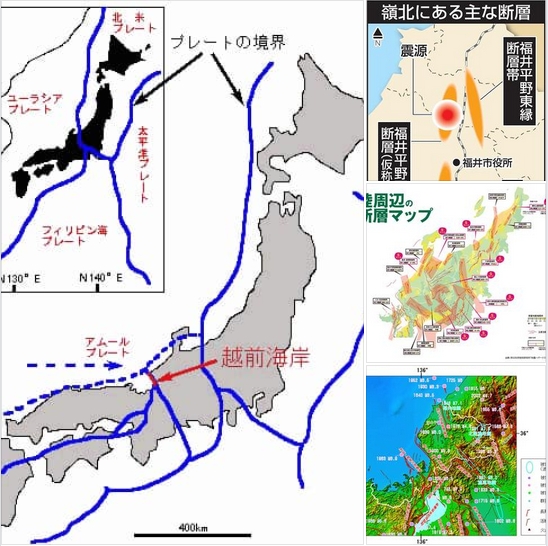
Fukui SEISMIC INTENSITY 5 weak epicenter, fault expert, chain warning ′′ it can be connected to a big earthquake ′′
According to Professor Taku Okamoto (Earthquake) of fukui college of technology, there is a fault in the hirano part of the epicenter of the earthquake that observed the maximum SEISMIC INTENSITY OF 5 in Fukui Prefecture on the morning of September 4th It was possible to wake up In the future, if the earthquake of magnitude (M) 5 0 class is frequent, it is a chain with the surrounding fault, and it is pointed out that ′′ it can be connected to a big earthquake like the kumamoto earthquake 5
According to Professor Okamoto, the next wave that does not appear if it is not a fault-specific structure near the epicenter of this time is observed in the past earthquake, and in the west rim of fukui hirano, it is a fault that penetrates the confluence of the kuzuryu and hinogawa to the north It is said that there is a.
According to the Japan Meteorological Agency, this earthquake is a ′′ reverse fault type ′′ that is pushed from both sides and moves in the upper and lower direction. Professor Okamoto points out that the fault of the fukui hirano west rim may have caused the fault of the estimated fault and epicenter.
The Epicenter of this time is about 5 km away from the fukui hirano fault belt, which caused the fukui earthquake on June 28, 1948, and it is not directly related. Also, the earthquake of 4 or more seismic intensity that epicenter the north of the north of the north of the north of the north of the north of the north of the
The current situation is close to the earthquake of the shaking aftershocks, but in the future, if there is a similar earthquake as this time, there is a sabae fault in the south, so it is pointed out that ′′ chain leads to a big earthquake On Top of that, ′′ I need to carefully look at the progression of aftershocks activities for 1 OR 2 weeks
The earthquake is also called ′′ emergency earthquake breaking news is not in time In the future of aftershocks, I’m calling ′′ if you feel the tremor, I want you to lower your posture and take action to protect your head (Fukui Shimbun September 5)
Tokyo Olympics will be most costly Summer Games, Oxford study shows

In this June 3, the Olympic rings float in the water at sunset in the Odaiba section in Tokyo.
September 4, 2020
TOKYO
The Tokyo Olympics are already the most expensive Summer Games on record with costs set to go higher, a wide-ranging study from Britain’s University of Oxford indicates.
The Tokyo cost overrun already exceeds 200%, lead author Bent Flyvbjerg explained in an interview with The Associated Press. This is even before several billion more dollars are added on from the one-year delay from the COVID-19 pandemic.
Flyvbjerg is an economist at Oxford’s Said Business School. His entire study is available here, and it’s set to be published on Sept. 15 in the journal “Environment and Planning A: Economy and Space.” It’s titled “Regression to the Tail: Why the Olympics Blow Up.”
Tokyo, postponed until July 23, 2021, is only a small part of the focus. The study — the third in a series following editions 2012 and 2016 — looks at Olympic costs since 1960 and finds they keep increasing despite claims by the International Olympic Committee that costs are being cut.
Flyvbjerg cites many reasons for the rising costs and cost overruns, and offers solutions for the IOC. The vast majority of costs are picked up by governments with the IOC contributing only a small portion.
“The Olympics offer the highest level of risk a city can take on,” Flyvbjerg told AP. “The trend cannot continue. No city will want to do this because it’s just too expensive, putting themselves into a debt that most cities cannot afford.”
In his paper, Flyvbjerg cites Los Angeles Mayor Eric Garcetti, whose city is to hold the 2028 Olympics following Paris in 2024.
“Most cities, unless you have a government that’s willing to go into debt or pay the subsidy of what this costs, most cities will never say ‘yes’ to the Olympics again unless they find the right model,” he quotes Garcetti as saying.
By the right model, Garcetti means lower costs.
Tracking Olympic costs is difficult, a dense maze of overlap and debate. Politicians and organizers always argue over what are — and what are not — Olympic expenses.
Flyvbjerg writes: “Unfortunately, Olympics officials and hosts often misinform about the costs and cost overruns of the Games. … We therefore cannot count on organizers, the IOC, and governments to provide us with reliable information about the real costs, cost overruns, and cost risks of the Olympic Games.”
Flyvbjerg looks only at costs to operate the games — the operating costs and capital costs — the cost to build sports venues. He leaves out a third category, which is usually many times larger: renovating roads, building airports, and what he calls “sprucing up projects,” which also fall to taxpayers.
“Our estimates are conservative because there are lots of costs that are hidden that we can’t get into,” Flyvbjerg said. “And there are lots of costs we decided not to include because it’s too complex. We include the things we can get the most reliable numbers for and we do it in the same way for each city that we study.”
He also excludes the cost of debt, and the future cost of running sports venues after the Olympics leave, and inflation.
According to the Oxford numbers. Tokyo’s spending is at $15.84 billion, already surpassing the 2012 London Olympics, which were the most expensive summer games to date at $14.95 billion. He expects several billion more from the cost of the one-year delay.
Tokyo organizers say officially they are spending $12.6 billion. However, a national auditor says the actual costs are twice that high, made up of some expenses that the Oxford study omits because they are not constant between different Olympics.
Tokyo said the cost would be $7.3 billion when it won the bid in 2013.
“They (IOC) obviously don’t like our results, but it’s very difficult to counter a piece of rigorous research like this,” Flyvbjerg said. “And they haven’t done that, and they can’t do that. Our research is a problem for them.”
In an email to Associated Press, the IOC said it had not seen the latest Oxford study and declined to comment.It referenced another study by Mainz and Sorbonne universities.
This study also found Olympic cost overruns but said they were in line with other large-scale projects. Flyvbjerg’s study finds they are not.
Flyvbjerg said he has been in touch on and off with the IOC and had sent a colleague to an IOC workshop. He said a major reason for the rising costs is that the IOC does not pay for them. He also cited rising security costs, and moving the games around the world. He calls this the “Eternal Beginner Syndrome” with new host cities starting basically from scratch.
He’s said the IOC has tried recently to rein in costs, but the effort is “too little, too late.”
“They (IOC) define the specs but don’t pay for them,”Flyvbjerg said. “This is pretty similar to you and I giving the specs for a house that we are going to live in, but we don’t have to pay for it. How do you think we’d spend? We’d gold-plate it. This is what has happened over time.”
Flyvbjerg said he’s relish a chance to sit and talk with IOC President Thomas Bach. He calls himself a fan of the Olympics.
“It’s not that the IOC hasn’t been willing to talk, or I am not willing to talk,”he said. “We certainly are. We have communicated in writing to keep the IOC informed. But yes, we would like to sit down with Thomas Bach.”
https://japantoday.com/category/sports/oxford-study-tokyo-olympics-are-most-costly-summer-games
Nuclear waste disposal is a matter of environmental concern
Aug 31, 2020
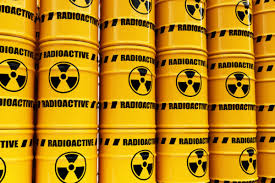
It has been reported that the town of Suttsu in Hokkaido is considering applying for a two-year “literature research” into the possibility of storing high-level radioactive nuclear waste. A maximum of ¥2 billion in subsidies will be granted by the central government.
“The future of the town is financially precarious,” said Haruo Kataoka, the mayor of Suttsu, in an interview.
But the money that is thought to revive the town cannot reverse what the nuclear waste is likely to cause.
It is, in my opinion, never a financial issue, but a matter of environmental concern.
What is in question here is high-level radioactive nuclear waste, which can be dangerous for at least 200,000 years and therefore must be handled with the utmost care. It is indeed a problem that any country with nuclear power plants needs to address, however thorny it is. Any indiscreet decision is deemed extremely irresponsible and profoundly unethical.
“Financially precarious,” I must stress, is by no means comparable to environmentally threatening. Besides, it is specifically stated in a Hokkaido ordinance that nuclear waste is hardly acceptable in the prefecture.
Before a final disposal site is selected, or even before an application for research is submitted, the scientific facts ought to be thoroughly understood and the residents properly informed.
The span of recorded history is merely 5,000 years, while 200,000 years is far beyond human experience and comprehension. We certainly cannot live to see what is going to become of the nuclear waste, but I believe that we do not want to leave the thorny problem unaddressed to haunt our future generations.
Jive Sun
Sapporo
Fukushima’s citizen radiation testers still on the job.
Fukushima Has Turned These Grandparents Into Avid Radiation Testers, NPR, Kat Lonsdorf (@lilkat_bigworld) September 11, 2020 Takenori Kobayashi lugs a garbage bag full of soil across a parking lot to an unmarked office. His wife, Tomoko, holds the door to a tiny work space with lab equipment and computers set up. On the edge of Fukushima’s former nuclear exclusion zone, this is the place the couple likes to call their “grandma and grandpa lab.”
A handful of other residents help run the lab, and throughout the years, experts from nearby universities have come to teach them all about the different equipment and radiation science.
“All the grandparents here are radiation professionals now,” Takenori, 71, says with a smile……..
Effective nuclear arms control engagement with China – the View from Beijing
Carnegie–Tsinghua Center for Global Policy 11 Sept 20, Effective nuclear arms control engagement with China will likely require confidence-building measures by the United States and greater support from the international community.
The United States will have to keep its public voice down while offering China concrete proposals to address the two countries’ asymmetric capabilities. If they’re to be taken seriously, these proposals should show a willingness by the United States to limit its own capabilities, particularly in areas of U.S. superiority such as air- and sea-launched missile systems and space-based capabilities.
Given China’s deep skepticism and outsider status in the arms control arena, engagement will require transparency and time to build confidence. One valuable starting point could be a reset of fundamental terms: China may be more eager to discuss “strategic ability” than “arms control.” Identifying cooperative measures for nuclear risk reduction would be a useful topic for initial discussions.
Opposition in Kamoenai to hosting nuclear waste dump
|
Second site in Hokkaido considers hosting nuclear waste dump, Japan Times, SAPPORO/SUTTSU, HOKKAIDO – The village of Kamoenai in Hokkaido is considering hosting a final disposal facility for high-level radioactive waste, it was learned Friday.The village is looking at applying for a literature survey, the first of three stages in the research process to select the location of a final disposal facility for high-level radioactive waste from nuclear power plants.
Kamoenai is the second municipality in the nation to be contemplating the process since the government published details of areas it considered suitable for nuclear waste disposal in its Nationwide Map of Scientific Features for Geological Disposal in 2017. The town of Suttsu, also in Hokkaido, was the first municipality to do so……. The village, which is located in western Hokkaido and had a population of 823 as of the end of August, faces the Sea of Japan and neighbors the village of Tomari, which hosts a nuclear power plant run by Hokkaido Electric Power Co. The plant is currently offline. According to the government map, almost all of Kamoenai except for some southern areas is unsuitable for waste disposal. Procedures to select a host for a final disposal site are conducted in three stages, comprising the “literary” survey, a “preliminary” investigation and a “detailed” investigation. A municipality undergoing a literature survey can receive subsidies of up to ¥2 billion from the central government. Meanwhile, many residents of Suttsu, Hokkaido, another municipality that is considering applying for a literature survey, voiced opposition to the plan Thursday at a briefing session organized by the municipal government. The meeting was the fourth of its kind for Suttsu residents. The first such session was held on Monday. At Thursday’s meeting, which was opened to the press, Suttsu Mayor Haruo Kataoka explained the reasons for considering applying for a literature survey. Some 260 residents attended the session, which lasted for over three hours from 6:30 p.m. Participating residents voiced concerns that the move would lead to harmful rumors about the town, and that if the town received subsidies from the government as a result of applying for the literature survey, it would have no choice but to become a final disposal site. Some said that detailed discussions should be held after the mayoral election in the town next year……. In talks with reporters after the meeting, Kataoka rejected the idea of holding a local referendum on the matter, saying, “It will divide the town residents.” According to the town, the first briefing session on Monday was cut short due to technical issues, such as not having reserved enough time for questions from residents. Therefore, the town government plans to hold an additional session within this month for participants that attended the Monday meeting. https://www.japantimes.co.jp/news/2020/09/11/national/hokkaido-village-nuclear-waste/ |
|
The United States and its allies must learn how to live safely with a nuclear North Korea
On North Korea, Carnegie Endowment for International Peace,Toby Dalton, Co-director and Senior Fellow Nuclear Policy Program, 9 Sep 20,
The United States and its allies must learn how to live safely with a nuclear North
Three practical goals should inform a new U.S. policy toward North Korea:
- Prevent crises that could lead to war
- Cap North Korea’s arsenal of nuclear and long-range missiles and prevent their export
- Buffer the alliances with Japan and South Korea against likely North Korean provocations
Additional objectives—for instance, preventing illicit trafficking and improving human rights—are important but ultimately secondary. Though desirable, regime change is too risky and uncertain to pursue, as recent experiences in Iraq and Libya suggest.
Accomplishing these three goals will require new negotiations just to establish rules of the road. North Korean demands are bound to be distasteful, but the costs of a negotiated agreement would be far less than those incurred through war or through increased military deployments in East Asia and the construction of a more extensive missile defense shield.
The costs of a negotiated agreement would be far less than those incurred through war.
Reaching a deal will involve helping North Korea overcome its suspicious, hard-nosed attitude. But an even greater challenge will be changing how Washington thinks about detecting and addressing the Kim regime’s possible cheating on a deal……… https://carnegieendowment.org/2020/09/09/on-north-korea-pub-82524
The impediments to India’s nuclear power dream
India’s Ambitious Nuclear Power Plan – And What’s Getting in Its Way, The country has an ambitious three-stage nuclear power production plan. The Diplomat, By Niharika Tagotra, September 09, 2020 As India embarked on its commercial nuclear power production in 1969, its nuclear power program was conceived to be a closed fuel cycle, to be achieved in three sequential stages. These stages feed into each other in such a way that the spent fuel generated from one stage of the cycle is reprocessed and used in the next stage of the cycle to produce power. This kind of a closed fuel cycle was designed to breed fuel and to minimize generation of nuclear waste. The stage at which India is currently at in its nuclear power production cycle will be a major determinant of the future of nuclear power in India.
Additionally, the nuclear power sector in India has witnessed its share of controversies and protests over issues of land ownership, location, as well as the safety and security of power plants in the event of natural or man-made disasters. These have also contributed to the time and cost overruns of India’s nuclear power projects. Another very important contributing factor to the state of nuclear energy in India has been the global retrenchment in the sector following the Fukushima Daiichi nuclear disaster of 2011. That event led to a situation where countries rolled back significantly on their nuclear power programs and global nuclear majors like Areva and Westinghouse declared bankruptcy………… https://thediplomat.com/2020/09/indias-ambitious-nuclear-power-plan-and-whats-getting-in-its-way/
South Korea’s nuclear reactors affected by Typhoon Haishen: 2 reactors stopped
|
Typhoon Haishen interrupts operations of nuclear reactors on southeast coast, http://www.koreaherald.com/view.php?ud=20200907000785, By Yonhap Sept 7, 2020 South Korea’s state-run nuclear plant operator said Monday that the operations of two of its reactors on the country’s southeastern coast were interrupted due to Typhoon Haishen, which is currently passing the country.
“The turbines were automatically stopped due to a malfunction in the reactors’ cable facilities due to the typhoon,” the Korea Hydro & Nuclear Power Co., which operates Wolsong Nuclear Power Plant, said in a statement. There has been no radiation exposure or other safety issues despite the disruptions at the No. 2 and No. 3 reactors, it added. “We plan to carry out more investigation and take necessary measures,” the company said. Typhoon Haishen, the season’s 10th typhoon, has brought the country under its influence with heavy rains and strong winds, the weather agency said. The Korea Meteorological Administration (KMA) said the typhoon arrived some 30 kilometers southwest of Ulsan at around 9 a.m., slightly changing its course westward. It was forecast to escape to waters northeast of Gangneung, Gangwon Province, at around 2 p.m. (Yonhap)
|
|
|
India and China both have a nuclear no-first-use policy- nuclear war between them is less likely
India–China border dispute: the curious incident of a nuclear dog that didn’t bark, Bulletin of the Atomic Scientists, By Ramesh Thakur, Manpreet Sethi, September 7, 2020 On June 15, nuclear-armed China and India fought with fists, rocks, and clubs along the world’s longest un-demarcated and contested boundary. Twenty Indian soldiers were killed; Indian estimates put the Chinese dead at around 40. The two countries remain in a state of military standoff.
Like the case of the dog that didn’t bark, which interested the great fictional detective Sherlock Holmes, the nuclear dimension of the recent border clashes was conspicuous by its invisibility. This may be in part because of the nuclear no-first-use policy expressed in the official nuclear doctrines of both countries. At a time when geopolitical tensions are high in several potential nuclear theaters, the nuclear arms control architecture is crumbling, and a new nuclear arms race is revving, there is a critical need to look for ideas that can prevent potential crises from escalating. Other nuclear powers can learn from China’s and India’s nuclear policies.
The normalization of nuclear threats. Over the last few years, leaders of many of the nuclear weapons states have taken to nuclear bluster. After the outbreak of the Ukraine crisis and annexation of Crimea in 2014, facing hostile Western criticism, Russian President Vladimir Putin pointedly remarked, “Russia is one of the most powerful nuclear nations”—a subtle but clear nuclear warning to the West. In July 2016, asked in Parliament if she would be prepared to authorize a nuclear strike that could kill 100,000 people, British Prime Minister Theresa May unwaveringly answered, “Yes.” And who can forget the tit-for-tat exchange of belligerent rhetoric by US President Donald Trump and North Korean leader Kim Jong-un in 2017 before the blossoming of their bromance in 2018?
In February 2019, after an attack on Indian paramilitary forces at Pulwama led to a clash between the air forces of India and Pakistan, Pakistan’s Prime Minister Imran Khan warned of the possibility of a nuclear war. Indian Prime Minister Narendra Modi, caught in the heat of an election campaign, responded that India’s nukes were not reserved for celebrating the fireworks festival of Diwali. After India revoked Kashmir’s autonomous status that August, Khan reiterated that nuclear war was a real risk. His foreign minister repeated the warning in Geneva later that same year.
This rhetoric, besides being dangerous, has given rise to another problem. The more the leaders of the nuclear armed states revalidate the role of nuclear weapons in their national security, the more they embolden calls of nuclear weapons acquisition in other countries like Germany, Japan, South Korea and Australia.
China and India’s nuclear reticence. This is where China and India, in the midst of a military crisis, provide a striking contrast. Neither side has drawn attention to its nuclear weapons in the 2020 border clashes. Nor have many analysts across the globe expressed alarm that the prolonged state of disquiet between the two could spiral out of control into a nuclear exchange……….
China, India, and no first use. An important dimension, however, that has been underestimated in explaining the two countries’ apparent nuclear sobriety is the similarity in their approach to nuclear weapons and deterrence.
They are the only two of the nine nuclear armed states with the stated commitment to a no-first-use policy, and the force postures to match. …….
In 2014, China and India called for negotiations on a no-first-use convention among the world’s nuclear powers. It might be time for the United States and other countries to give it a serious look. Indeed, the China–India border standoff demonstrates the practical utility of a nuclear policy centered on no-first-use and merits wider international attention. https://thebulletin.org/2020/09/india-china-border-dispute-the-curious-incident-of-a-nuclear-dog-that-didnt-bark/
Central Asia’s toxic nuclear legacy
 According to Kyrgyz official data, the gamma radiation on tailings pit surfaces are within 17-60 mR/hr; however, in the damaged areas, radiation levels reach 400-500 mR/hr. An exposure to 100 mSv a year (a millisievert, mSv, is equal to 100 milliroentgens, mR) or 10,000 mR is the point where an increase in cancer is clearly evident. At 400-500 mR/hr this would be achieved in 20-25 hours, or just one day. Radionuclides and heavy metals from these tailing pits and dumps are seeping into the surface and groundwater, polluting water and farmland and increasing the risk of cancer for local people.
Birth anomalies are an additional indicator of environmental radioactive contamination. A study by the Institute of Medical Problems showed that the incidence of birth defects in Mailuu-Suu was three times higher than in the country’s second largest city of Osh. Studies have correlated birth defects to the distance of the parents’ residences from radioactive waste sites. Polluted water is the major factor causing the development of congenital malformations, according to research by the Institute of Medical Problems.
Mailuu-Suu: Cleaning up Central Asia’s toxic uranium legacy https://www.thethirdpole.net/2020/09/02/mailuu-suu-cleaning-up-central-asias-toxic-uranium-legacy/
Countries must set aside territorial disputes and work together to clean up radioactive waste seeping into rivers and farmland in the Ferghana Valley – causing an environmental and health catastrophe for people living in the region Janyl Madykova, September 2, 2020 Political tensions between countries in Central Asia have intensified since the collapse of the Soviet Union. Along with border conflicts and water disputes, problems have arisen from residual radioactive waste located in the Kyrgyz town of Mailuu-Suu in the Ferghana Valley, which has caused widespread pollution of river and farmland, and led to major impacts on the health and economy of people in Kyrgyzstan and Uzbekistan.
Industrial-scale uranium mining began in Mailuu-Suu during the Soviet era in 1946 and lasted until 1968. Uranium ore from Europe and China was also processed in Mailuu-Suu during this time.
As a result, the small town of 24,000 people is now surrounded by about 3 million cubic metres of uranium waste left in 23 tailings pits and 13 dumps. These sites have contaminated the Mailuu-Suu river, a major tributary of the Syr Darya which flows through Kyrgyzstan and into Uzbekistan, carrying radioactive waste into the densely populated Ferghana Valley.
The biggest problem is that earthquakes, landslides and heavy rainfall events have intensified in recent years, destroying uranium tailing storage sites along the river and mountain slopes, contaminating surrounding areas. A number of international organisations have worked to prevent further disasters in Mailuu-Suu. The World Bank has allocated more than USD 11 million to clean up uranium tailings. The European Commission launched an initiative in 2015 to remediate the most dangerous sites in Kyrgyzstan, Tajikistan and Uzbekistan.
However, the pollution remains, and Central Asian countries must cooperate to prevent further environmental disasters in the Ferghana Valley, as well as mitigate economic damage and resolve political issues.
A town built on radioactive waste
According to the state surveys there are 92 radioactive and toxic storage facilities across Kyrgyzstan today. The most dangerous of these are the Mailuu-Suu uranium sites, because of numerous hazards threatening the tailing pits. Were these tailing pits destabilised, they would have potentially catastrophic environmental consequences for Kyrgyzstan and the neighbouring countries of Uzbekistan and Kazakhstan, with the radioactive waste contaminating the river as well as the soil and irrigated farmland surrounding it.
Uranium was first discovered in the region in 1933, and within 20 years 10,000 tonnes of uranium oxide was extracted in Mailuu-Suu. Residual radioactive waste in southern Kyrgyzstan currently poses a major environmental threat to the densely populated parts of the Ferghana Valley, home to about 14 million people.
Landslides are the major risk. There are more than 200 landslide-prone locations around Mailuu-Suu. There was little such threat in the 1940s, but landslide activity has intensified since 1954 due to increased rainfall. Landslides in Mailuu-Suu occurred several times in 1988, 1992 and 2002, damaging infrastructure and altering water flow. The most dangerous landslide is Koi-Tash, which happened in 2017 and could block the riverbed and spread radioactive contamination down the river.
The 1950s saw one of the most salient examples of the danger posed by vulnerable waste dumps. In April 1958, as a result of rainfall and high seismic activity, an alluvial dam collapsed into tailings pit #7 in Mailuu-Suu, pushing more than 400,000 cubic metres of radioactive waste into the Mailuu-Suu river, which then spread 30-40 km downstream in irrigated farmland in Uzbekistan. The effects of this disaster have lasted to this day, with the radioactive contamination of the river and surrounding soil and vegetation causing major health problems and fatalities. Such disasters also heighten tensions between the regional states. Continue reading
The dangerous and deadly toll of uranium mining, on Indian communities

Child with cerebral palsy, in uraniummining region Dungridih village. Jaduguda, photo by Subhrajit Sen.
[Photos] Suffering in the town powering India’s nuclear dreams. Mongabay, BY SUBHRAJIT SEN ON 4 SEPTEMBER 2020
- Uranium is a vital mineral for India’s ambitious nuclear power programme. Out of the seven states with uranium reserves, Jharkhand and Andhra Pradesh have currently operating mines.
- In Jharkhand’s Jaduguda region, which has India’s oldest uranium mines, local communities narrate stories of suffering due to degrading health and the environment. The government, however, denies any ill-impact of uranium mining on people.
- The Indian government is aiming to increase uranium exploration and mining.
- This photo essay features images taken between 2016-2019 of residents of villages around uranium mines in Jharkhand. Some of these photos contain sensitive content.
Anamika Oraom, 16, of village Dungridih, around a kilometre away from Narwa Pahar uranium mine in Jharkhand, wants to study. But she cannot, owing to severe headaches that come up periodically, triggered by a malignant tumour on her face. Sanjay Gope, 18, cannot walk and is confined to his wheelchair. Haradhan Gope, 20, can study, walk, talk, but owing to a physical deformity, his head is much smaller in proportion to his body.
There are many more, young and old, in the village Bango, adjacent to Jaduguda uranium mine in Jharkhand, whose lives and death highlight the ill-effects of uranium mining, say the villagers.
Uranium is a naturally occurring radioactive mineral and is vital to India’s nuclear power programme. At present (till August 31, 2020), India’s installed nuclear power capacity is 6780 megawatts (MW). The country aims to produce 40,000 MW of nuclear power by 2030.
The Uranium Corporation of India Limited (UCIL) is involved in the mining and processing uranium ore in the country. According to the UCIL, mining operations at Jaduguda began in 1967, and it is India’s first uranium mine.
In the 25-kilometre radius of Jaduguda, there are other uranium deposits at Bhatin, Narwa Pahar, Turamdih, Banduhurang, Mohuldih, and Bagjata. While UCIL claims that Jaduguda mine has created a large skill base for uranium mining and the mining industry, local communities point out that their lives and land have changed irreversibly.
The villagers complain that the hills surrounding Jaduguda, dug up to create ‘tailing ponds,’ have proven to be a severe health hazard. A tailing pond is an area where leftover material is stored after the excavated ore is treated to extract uranium. Communities argue that these ponds have led to groundwater and river contamination.
Namita Soren of village Dungridih said, “This radioactive element has become a part of our daily life.”
“Children are born with physical disabilities or people with cancer. But our sorrow doesn’t end there,” said Soren who had three miscarriages before giving birth to a child born with physical deformities.
Ghanshyam Birulee, the co-founder of the Jharkhandi Organisation Against Radiation (JOAR), said that villagers earlier marked certain forest areas as ‘cursed’ – a woman passing through the area was believed be affected by an evil gaze and suffer a miscarriage or people would feel dizzy. These areas coincided with the forest spaces around tailing ponds. In cultural translation, the regions surrounding tailing ponds became infested with ‘evil spirits.’ But as the people became more aware, they connected their misery to the mining operations.
A 2003 study by Tata Institute of Social Sciences emphasised that 18 percent of women in the region suffered miscarriages/stillbirth between 1998 and 2003, 30 percent reported some sort of problem in conception, and most women complained of fatigue and weakness.
When asked the reason for opposing the UCIL’s mining project, Birulee said, “Before mining started, people never used to have diseases like these – children were not handicapped, women were not suffering from miscarriages, people didn’t have tuberculosis or cancer. People had ordinary illnesses, cold and cough, that got cured by traditional medicines. But today, even the doctors are not able to diagnose diseases. It all emerged after uranium mining started.”
India has uranium reserves in Rajasthan, Jharkhand, Chhattisgarh, Meghalaya, Telangana, Andhra Pradesh, and Karnataka. It is currently operating mines in Jharkhand and Andhra Pradesh. The country has a detailed plan to become self-sufficient in uranium production by achieving a nearly ten-fold rise by 2031-32, including expansion from existing mines and opening new mines. However, to augment supply until then, it has signed a long-term contract with Uzbekistan (in 2019) to supply 1,100 metric tons of natural uranium ore concentrates during 2022 -2026. Similar agreements have been signed with overseas suppliers from various other countries like Canada, Kazakhstan, and France to supply uranium ore.
No help from the government or politicians
Birulee feels that the political class is aware of the problem but that has not translated into safeguarding villagers’ lives. “Whoever is elected from here – legislator or parliamentarian – has never raised our issue about radiation either in the state legislature or parliament. If they raise our issue, I am sure the government will take some action to resolve people’s issues,” said Birulee.
In March 2020, Bharatiya Janata Party leader Rajiv Pratap Rudy asked Prime Minister Narendra Modi in Lok Sabha about public health hazards due to India’s uranium mines.
Rudy asked whether the central government has reports of hazardous activities like radioactive slurry being stored in the open, causing health hazards to people residing in adjacent areas of uranium mines in the country, and, if so, the action taken on it.
While replying to the question, Minister of State for Personnel, Public Grievances and Pensions and Prime Minister’s Office, Jitendra Singh, refuted any such impact. ………..
Birulee reflects on the opposing conditions that he has witnessed. For him, it is impossible to leave behind his land, livelihood, and traditions. But for people close to the mines and tailing ponds, “the only solution is that from this region – from this radiation zone – people should be rehabilitated to a safer place. Else they’ll be surrounded by the same problems.”
Local livelihood options impacted
The people note that displacement and then deforestation for uranium mining robbed them of their land and livelihood, and later cursed them with health impacts.
Though the company and those in power deny any ill-impact on local ecology and livelihood, locals alleged that small-scale production of bidis is also hampered due to the low quality of tendu leaves. They suspect that the trees have been exposed to contaminated groundwater.
Villagers said that with expansion of mining large tracts of sal, sarjom, and teak trees are being wiped out. The trees are essential for the communities’ sacred rituals and traditional activities.
Ashish Birulee, photojournalist and member of JOAR, said that the route for transporting uranium ore is the same used by the public. He says the resulting pollution from the dust has a long-term impact on health and ecology.
Ashish adds that the mining company cannot ignore the most significant factor – the experience of people living in this area. “The experience of people is nothing less than any study or research. It can’t be denied. UCIL is not ready to admit that there are problems. It is because if it admits it would have to compensate people. Peoples’ experience shows that before 1967 there were no such issues, but it started after mining took off. If you look at the population of Jaduguda, there are a lot of people with disabilities. But if you go about 15 kilometres away, there are no such problems.”
“As far as a solution is concerned, once you start mining at any place, there is no solution. The company will mine here till the uranium ore exists. It has a lease for 45-50 years and after mining is over here, it will move to a new mine and extract resources. But the mining waste will be left here,” said Ashish. …… https://india.mongabay.com/2020/09/photos-suffering-in-the-town-powering-indias-nuclear-dreams/
South Korea adviser calls for ‘six-party security summit’ to discuss North Korea nuclear issue
Moon’s adviser calls for ‘six-party security summit’ to discuss N.K. nuclear issue, Korea Herald, By Yonhap, 4 Sept 20, SEOUL (Yonhap) —A special security adviser to President Moon Jae-in on Friday suggested reviving the six-party talks on North Korea’s nuclear program in the form of a six-way summit, saying the issue is not a matter only between Washington and Pyongyang.
Moon Chung-in, special adviser for diplomatic and security affairs, made the remark during a security forum hosted by the Korea Institute for National Unification, stressing the importance of a “top-down approach” in efforts to resolve the issue.
“We need to revise the six-party talks that we failed in the past and we need to hold a ‘six-party security summit’ so that the leaders can discuss the issue of security and come up with an agreement on common security,” he said.
North Korea’s nuclear activity still a ‘serious concern’: UN watchdog
Nuclear activities in North Korea remain a cause for “serious concern,” and the rogue totalitarian state continues to enrich uranium, which could be used in an atomic weapon, the UN’s watchdog said in a recent report.
The activities by the country are in “clear violation of relevant UN Security Council resolutions,” the International Atomic Energy Agency wrote in the report that was released Tuesday.
The report also notes that what was once the heart of the country’s nuclear program, the Yongbyon site, has likely been shut down since 2018 — and that no plutonium has been produced there in the past year.
Nuclear activities in North Korea remain a cause for “serious concern,” and the rogue totalitarian state continues to enrich uranium, which could be used in an atomic weapon, the UN’s watchdog said in a recent report.
The activities by the country are in “clear violation of relevant UN Security Council resolutions,” the International Atomic Energy Agency wrote in the report that was released Tuesday.
The report also notes that what was once the heart of the country’s nuclear program, the Yongbyon site, has likely been shut down since 2018 — and that no plutonium has been produced there in the past year.
Still, the information it’s able to get about the program is “declining” because the agency’s been locked out of the hermit nation.
“Knowledge of the DPRK’s nuclear program is limited and, as further nuclear activities take place in the country, this knowledge is declining,” the report states.
ICAN chief: Japan sabotaging nuclear disarmament
 Beatrice Fihn, Executive Director of the International Campaign to Abolish Nuclear Weapons, or ICAN, spoke to NHK about the possible game changers in the drive to get rid of the weapons of mass destruction.
Aug. 15, 2020
Hiroshima and Nagasaki in southwestern Japan are the only two cities to have suffered attacks using nuclear weapons. For people around the country, the anniversary month of August is a time to remember the tens of thousands of lives erased in the twin flashes in 1945, as well as the countless others affected by the subsequent radiation.
Fihn’s organization won the Nobel Peace Prize in 2017 for its efforts to bring people to the negotiating table to pledge to work toward nuclear disarmament. The adoption of the Treaty on the Prohibition of Nuclear Weapons at the United Nations was a step forward, in which ICAN played a major role.
Fihn says the next few months are crucial, as her team has given itself until the end of the year to get enough signatures to put the treaty into effect. Just this month, Ireland, Nigeria, Niue, and Saint Kitts and Nevis have signed up, bringing the total number on board to 44.
“We always aimed that we would be getting 50 in 2020.” She says. “And obviously COVID-19 has slowed down some processes, but we still think that there’s a really good chance that we can get the 50 ratifications needed this year. So we’re working very very hard on this.”
What about Japan?
But Japan remains one of the countries that’s yet to sign the treaty. Prime Minister Abe Shinzo has said every year at the memorial ceremonies that it’s Japan’s mission to, “realize a world without nuclear weapons.”
But Fihn wonders why the commitment hasn’t been backed up by action. “There is no leadership right now on nuclear disarmament from Japan’s side — rather the opposite,” she says. “Japan is going backwards as well and undermining its own resolutions that it’s supported for a long time ago, weakening language and documents.”
 Japanese Prime Minister Abe Shinzo made another pledge this year that the country would commit to achieving a world without nuclear weapons.
“That’s very serious. And I think that’s an insult to the survivors — to the hibakusha,” Fihn says. “We really know the Japanese people want the government to sign the treaty.”
“It’s very often that we look at nuclear armed states as the problem, but we have to recognize that the nuclear-allied states, like Japan for example, are protecting them. They are standing in a circle around them and protecting nuclear weapons. Until those countries stop doing that, it’s going to be very hard to convince the nuclear armed states.”
“How am I going to convince North Korea, the United States and Russia to disarm, if Japan cannot say that nuclear weapons should be illegal?”
Nuclear war ‘like the coronavirus’
Fihn says the coronavirus pandemic is proof that a global emergency could happen anytime. “Health experts have warned about this, and they have been preparing, thinking about it,” she says. “Yet people have been surprised that it happened. It’s the same thing with nuclear weapons. We don’t know when, we don’t know how exactly, but experts say it’s going to happen.”
She warns that nuclear weapons will be far more lethal than the coronavirus. “What we have to do with nuclear weapons — there’s no mitigating it once it happens.” she says. “When we feel the consequences, when the bombs are starting to fall on cities again, then it’s going to be too late to prevent it.”
Nuclear weapons don’t protect us
Fihn says the ongoing pandemic further highlights why governments should be investing in people, not weapons. “This pandemic has shown us where the threats to our security are and how we can’t absorb these things with nuclear weapons,” she says. “Nuclear armed states spend 73 billion dollars on nuclear weapons. Just imagine how many ventilators, doctors, nurses ICU, beds we can have… how many vaccinations we could develop.”
Listen to the hibakusha
She credits atomic bomb survivors for helping spread the message of a nuclear-free world. But she says their time is running out: “Given that it’s probably one of the last milestones where we will still have survivors who are able to speak about it in the first person. I really do think that it’s up to us to use this moment as much as possible to share their stories.”
For the first time, ICAN organized online tours of the Hiroshima and Nagasaki atomic bomb museums this year.
Fihn ended our interview with a message for the hibakusha. “Thank you for doing the incredibly difficult work of sharing your very traumatic experiences so that we can survive, and we can prevent it from happening again,” she says. “ICAN and the millions of people that support us are pledging to take action. We are going to honor the hibakusha, not through words, but through action to eliminate nuclear weapons.”
1 This Month
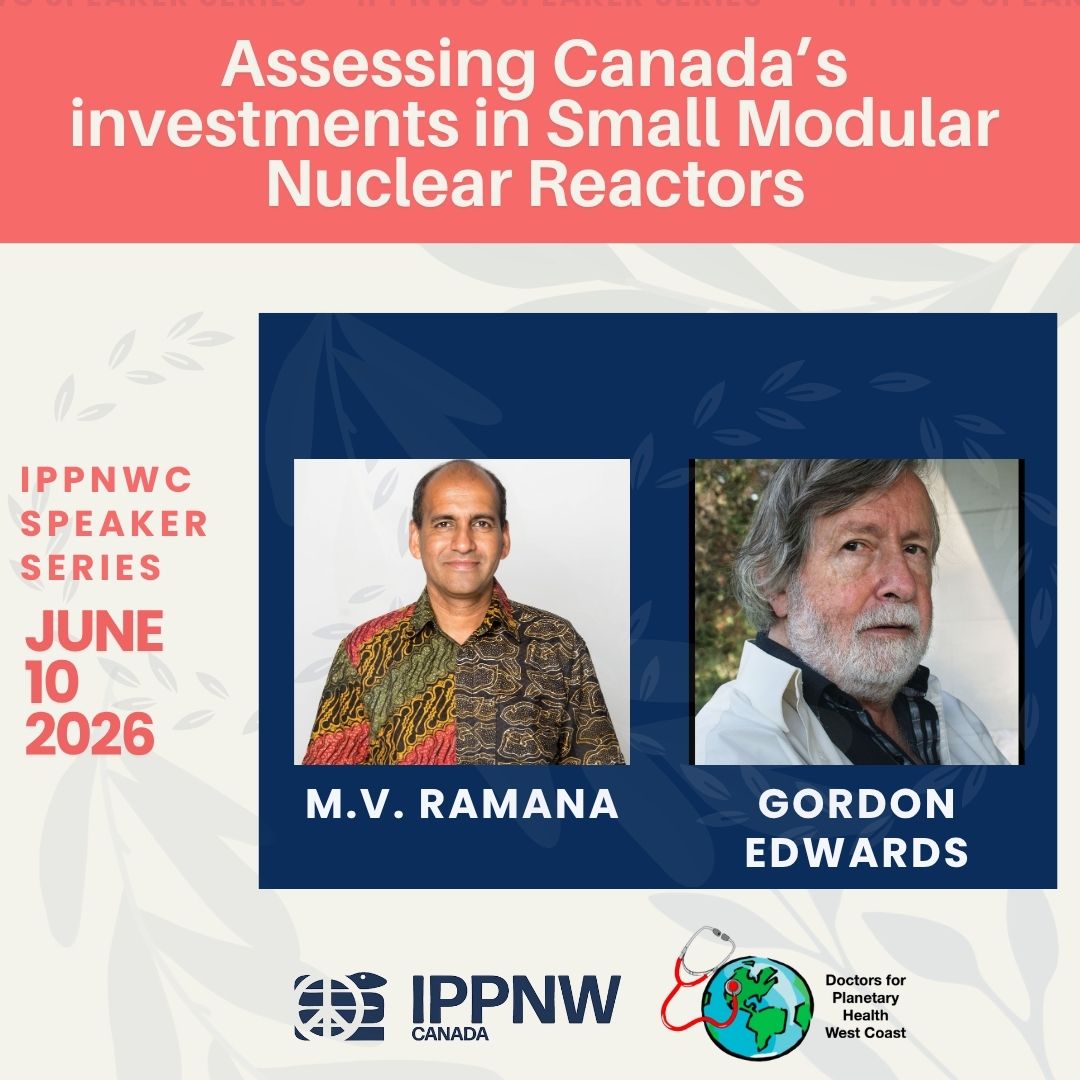
10 June – Assessing Canada’s Investments in Small Modular Nuclear Reactors – https://zoom.us/meeting/register/IiqHA5feRhaEBycOLNTJlA#/registration


Cuba Is Not a Failed State – It Is a Besieged State
PETITION: “Global Appeal to Endorse Palestinian Right of Return of Refugees”
To see nuclear-related stories in greater depth and intensity – go to https://nuclearinformation.wordpress.com
-
Archives
- June 2026 (89)
- May 2026 (306)
- April 2026 (356)
- March 2026 (251)
- February 2026 (268)
- January 2026 (308)
- December 2025 (358)
- November 2025 (359)
- October 2025 (376)
- September 2025 (257)
- August 2025 (319)
- July 2025 (230)
-
Categories
- 1
- 1 NUCLEAR ISSUES
- business and costs
- climate change
- culture and arts
- ENERGY
- environment
- health
- history
- indigenous issues
- Legal
- marketing of nuclear
- media
- opposition to nuclear
- PERSONAL STORIES
- politics
- politics international
- Religion and ethics
- safety
- secrets,lies and civil liberties
- spinbuster
- technology
- Uranium
- wastes
- weapons and war
- Women
- 2 WORLD
- ACTION
- AFRICA
- Atrocities
- AUSTRALIA
- Christina's notes
- Christina's themes
- culture and arts
- Events
- Fuk 2022
- Fuk 2023
- Fukushima 2017
- Fukushima 2018
- fukushima 2019
- Fukushima 2020
- Fukushima 2021
- general
- global warming
- Humour (God we need it)
- Nuclear
- RARE EARTHS
- Reference
- resources – print
- Resources -audiovicual
- Weekly Newsletter
- World
- World Nuclear
- YouTube
-
RSS
Entries RSS
Comments RSS
 nuclear-news