Fukushima and freedom of expression
September 23, 2020
According to Asahi, guides welcoming visitors to the disaster museum, which opened on September 20 in Futaba, have no right to criticize either TEPCo or the government. The 29 guides are victims of the disaster or trained people. Each guided tour lasts one hour and is paid 3,500 yen.
During the trainings that took place this summer, the distributed manual stated that one should avoid “criticizing or defaming certain organizations, people or other facilities”. And if a visitor asks the guide about their feelings about TEPCo’s responsibility, the answer should be evasive and the visitor referred to museum staff. Each guide must also put his words in writing and submit it to the museum management who corrects it. And if they ever criticize an organization, their presentation will be immediately stopped and they will never be able to be a guide in that museum again.
Some guides took offense: as victims, they should be able to criticize TEPCo and the government, which are responsible for the nuclear disaster. Another guide saw their script corrected after mentioning this responsibility. Yet official investigative reports pointed to the responsibility of TEPCo and the government. Not being able to mention it in a museum dedicated to the nuclear disaster is scandalous.
Ironically, Le Canard Enchaîné published an article that same day on the dismissal of an IRSN researcher who was working on the consequences of the Fukushima disaster and who did not agree to have her work censored by his hierarchy. In response, ACRO left the Research Orientation Committee (COR) of this Institute. The resignation letter is on the association’s website and reproduced below.
According to Le Canard Enchaîné, the direct superior of Christine Fassert, the licensed researcher, “wanted to impose changes, even censor words and sentences [of] an article,” in order to “avoid criticism of post-management. accident of the Japanese government, and the civilian nuclear sector in general “, and” to minimize and relativize the risk related to radiation exposure “.
This event is very disturbing because it shows that IRSN is unwilling to accept research results that challenge its prejudices. And when you’re in charge of nuclear safety, it’s particularly serious. He is not the only person to have suffered the rigidity of this institute, but it is the first time that it has led to a dismissal, which is scandalous.
We have already emphasized, twice, in July 2018 and March 2019, the originality of the work of Christine Fassert, socio-anthropologist, risk specialist at IRSN, who worked on trust, as part of the Shinrai project. in partnership with Sciences Po and Tôkyô Tech University. In Japan, as in France, she went, with her Japanese colleagues, to meet all the protagonists and interviewed both officials and independent experts, as can be seen in this presentation (copy).
At IRSN, we prefer to focus on people who show that it is possible to live in contaminated areas. And the dominant paradigm is that we must avoid evacuating and bringing evacuees back as quickly as possible, bypassing the UN directives on internally displaced persons which guarantee them protection, the right to choose between return and resettlement, as well as their full participation in decisions (see our 2016 report: Fukushima, return to abnormal?). It is also obvious in the European research programs in which IRSN participates, where the reduction of uncertainties in the modeling of radioactive fallout should make it possible to avoid unnecessary evacuation of populations (see page 58 of this presentation, for example) , while the faults in the modeling in Fukushima also led to not evacuating people who should have been! This is the case for the contaminated territories which extend up to forty kilometers to the Northwest. The evacuation order did not arrive until April 22, 2011, when the disaster began on March 11, 2011.
In practice, IRSN did not hesitate to work on and highlight an unscrupulous researcher, as we reported in January 2019, but who said what the institute wanted to hear. This is also the object of the Fukushima “dialogues” supported by IRSN shown in the web documentary “Kotoba” (which means “word” and not “dialogue”): no radioactive waste, no sick, no residents who don’t want to come in… Just a few small worries, but in twelve “dialogues”, everything is settled! The results of these dialogues by IRSN are a distressing list of banalities. This is worrying for post-accident management in the event of an accident in France.
Christine Fassert, for her part, also went to meet people who have left and who do not want to return, giving visibility to a category of populations that everyone wants to ignore, although it is the most numerous. The project also examined the pitfalls of an essentially “reassuring” communication on radiological risk, the difficulty of the role of radiation protection experts in direct contact with the public, the tension between a government policy of evacuations and returns devised by Tokoite elites and the implementation of these directives by the mayors in the region of Fukushima… Only subjects which did not fall within the narrow framework of what was expected. So, it was the frame or her!
Resignation message sent on September 18, 2020 to COR members:
Madame President,
Following the dismissal of an IRSN researcher, I would like to resign from COR. If the IRSN is not able to accept unique voices internally, it cannot open up to society.
In its opinion on the post-accident, the COR stressed, for the “populations and governance” section: “The WG thinks that it would be important to conduct research on this subject taking into account the opinions of all categories. population. Self-evacuees escape official monitoring in Japan and most of the studies and research in which IRSN participates. The experience feedback cannot be limited to the population who wish to remain in place or return, which is not very representative of all the populations affected by a serious nuclear accident. IRSN would benefit from broadening the scope of its studies and research or from moving closer to other programs involving all the people affected by the disaster, including those who do not wish to stay or return. “
In the event of a nuclear accident in France, IRSN will not be able to choose from among the affected populations. The participation of all stakeholders will be necessary. The licensed researcher is precisely the only person at the institute who was interested in all categories of the population, the “dialogues” program having selected only people in agreement with the dominant paradigm at IRSN.
I have already had the opportunity several times, within the COR, to question and alert IRSN researchers on the freedom to publish and communicate, to no avail. The COR has never agreed to discuss it.
Since the beginning of COR, I have worked for more openness and to take into account the demands of society. I have participated in almost all GTs and chaired two of them. But I fear that all this work has been in vain and that IRSN is not ready to open up sincerely. Under these conditions, I see no other solution than to resign from COR.
Yours truly,
David Boilley
TEPCO’s fitness to operate nuke reactors still open to question
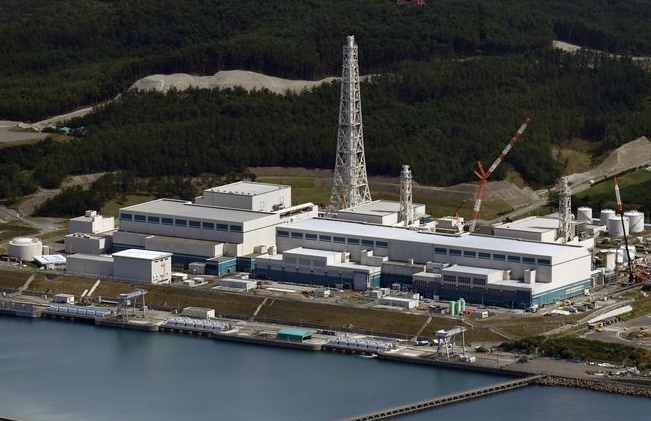
From left, the No. 5 to No. 7 reactors of the Kashiwazaki-Kariwa nuclear power plant in Niigata Prefecture
September 24, 2020
The Nuclear Regulation Authority has effectively endorsed Tokyo Electric Power Co.’s fitness to operate nuclear reactors in its safety screening of the utility’s plans to restart the No. 6 and No. 7 reactors at the Kashiwazaki-Kariwa nuclear power plant in Niigata Prefecture.
The nuclear watchdog’s endorsement, based on new legally binding safety rules the utility drafted and pledged to follow, has opened the door for the operator of the crippled Fukushima No. 1 nuclear power plant to start running reactors again.
But TEPCO’s actions concerning safety, the decommissioning of the destroyed Fukushima reactors and compensation for victims of the catastrophic accident have created a deep sense of distrust that is hard to brush off. The NRA’s decision is open to question.
Three years ago, when it cleared the No. 6 and No. 7 reactors under the tougher new reactor safety standards established in response to the Fukushima disaster, the NRA placed great importance on TEPCO’s “fitness” to run reactors.
This has led the utility to incorporate seven new principles into its safety code. They include the company’s commitment to carry through the decommissioning of the Fukushima No. 1 nuclear plant and hold its president responsible for reactor safety as well as its pledge not to put economic efficiency before safety.
The safety code is legally binding, with a violation potentially provoking an order to suspend operations.
This time, the NRA has examined TEPCO’s seven commitments and acknowledged that they are specific enough to allow the watchdog to identify and punish any violations.
But the seven principles still contain vague elements. It is difficult not to wonder whether they will effectively enable the NRA to monitor and check TEPCO’s operations for violations.
TEPCO, for example, has promised to follow through with the payment of compensation to victims of the Fukushima calamity. In fact, however, the company has rejected many proposed compensation agreements with local residents.
As for decommissioning the stricken plant, the company has left entirely to the government the vital challenge of disposing of radiation-contaminated water being generated by the plant.
These actions of the firm appear to be at odds with the safety code. What does the NRA think about them?
The real question is whether TEPCO’s basic attitude has really changed.
Asahi Shimbun editorials have questioned the company’s reliability to operate nuclear plants safely because it has failed to demonstrate the safety awareness and commitment required for the operator of a nuclear power plant.
TEPCO, for example, failed to report accurately the fact that an important facility at the Kashiwazaki-Kariwa plant does not have sufficient earthquake resistance.
It also avoided publishing voluntarily the fact that contaminated water from the Fukushima plant contains various radioactive materials whose levels are well above the safety standards after treatment. All these facts raised doubts about the firm’s ethical integrity.
Unless the utility changes its culture and behavior, it will be unable to win local support for its plans to restart the reactors.
TEPCO, as the operator of the Fukushima plant, has the responsibility to put the priority on decommissioning the reactors and paying compensation to people who have suffered from the accident.
It is doubtful whether the company will be able to operate reactors safely while grappling with the colossal challenge of decommissioning the plant, a process that will continue for decades.
There are legitimate concerns that the company could be unable to secure sufficient human and other resources for its efforts to ensure the safety of the Kashiwazaki-Kariwa plant.
Instead of sticking to its business strategy, which is focused on restoring its financial health by restarting the reactors at the plant in Niigata Prefecture so that it can bear the huge cost of decommissioning and compensation payments, TEPCO should start exploring carving out a viable future without nuclear power generation for itself.
As the utility’s virtual leading shareholder, the government should urge the firm to reconsider its business strategy.
Japan Struggles to Secure Radioactive Nuclear Waste Dump Sites
A small, aging town grapples with the financial lure of storing radioactive waste underground.
Japan’s worsening depopulation crisis is crippling the public finances of regional towns. Now one small town has made national headlines after expressing interest in storing radioactive nuclear waste underground in a last ditch effort to save itself from impending bankruptcy.
The small town of Suttsu in Hokkaido, the northernmost main island of Japan, has a population of just under 3,000 people. It’s the first local municipality to volunteer for the permanent storage site of highly radioactive nuclear waste and nuclear spent fuel. Suttsu Mayor Kataoka Haruo says the town has no more than 10 years left to find new sources of income after struggling with a slump in sales of seafood due to the global coronavirus pandemic.
Kataoka says there is an impending sense of crisis unless an urgent financial boost in the form of a government grant can be secured. He has called on local residents not to dismiss the idea of applying for the phase one “literature survey” without weighing the ways the grant could be spent — in contrast to the harsh reality of town funds running dry in 10 years’ time.
In Japan there are more than 2,500 containers of nuclear waste being stored in limbo without a permanent disposal site. Currently, the waste is stored temporarily in Aomori prefecture in northwest Japan at the Japan Nuclear Waste Storage Management Center. According to the Ministry of Economy, Trade, and Industry there are also approximately 19,000 tons of spent nuclear fuel stored at each nuclear power plant.
Nuclear waste projects immense heat and it needs to be cooled through exposure to air for between 30 to 50 years before it can be transferred and stored underground. However, it takes roughly 1,000 years to 100,000 years for radiation intensity to drop to safe levels.
The 2011 Fukushima nuclear disaster left long-lasting trauma further exasperating Japan’s already vexed relationship with nuclear energy as a resource deficient nation. The aftermath of the disaster and the slow road to recovery prompted many people to object to nuclear waste storage not only on geographic grounds but also out of strong emotional opposition.
Hokkaido has built a global reputation for its high quality dairy, agricultural products, and seafood. Nuclear waste storage, and the negative publicity that would follow, could jeopardize those industries.
With the proposal, local residents in Sutsu have been placed in a difficult situation, weighing up the health of their children and future generations against the town’s financial prospects and viable funding opportunities.
In August, Kataoka said he would not apply for phase one without the understanding of the general public. Last week, Kataoka held a local briefing session aiming to deepen local understanding and consent. But after discussing the damage to the town’s reputation and the possible conflict with a previous ordinance against accepting nuclear waste set by a radioactive waste research facility created in Hokkaido in 2000, Kataoka indicated the application for phase one would likely be delayed.
In 2000 the government enacted the Final Disposal Law, which outlined criteria for electing a permanent storage site. A three-stage investigation process sets out excavation to be deeper than 300 meters below ground and in doing so a survey of volcanoes, active fault lines, and underground rock must be performed in addition to installing an underground survey facility. It’s estimated that steps one through to three will take approximately 20 years in total.
In 2017 the government released a scientific map of Japan, pinpointing towns with suitable geographic conditions to host final disposal sites. If the application and survey are approved successfully, towns are eligible for grants up to 2 billion yen (around $19 million at current exchange rates) from the central government and another 7 billion yen if stage two goes ahead. In 2002 The Nuclear Waste Management of Japan (NUMO) launched an open call for local municipalities to consider applying for an initial investigation stage without success. Three years after the release of the map, NUMO has attempted to garner public support by hosting over 100 local discussion meetings all over Japan. Suttsu was the first town to express interest in phase one out of 900 local municipalities.
The final nuclear waste site is expected to make room underground for 40,000 barrels requiring six to 10 square kilometers — the equivalent of 214 Tokyo Dome Stadiums — to a tune of 3.9 trillion yen.
The government is currently formulating a “nuclear fuel cycle policy,” which aims to reduce the amount of nuclear waste generated by encouraging the recycling and reuse of spent fuel. But one major criticism of Japan’s nuclear power policy is the lack of a comprehensive strategy. The two year period for a “literature survey” has been touted as an opportunity for Japan to seriously consider the cleanup of nuclear power.
Near to flaspoint – disputes between India, Pakistan,China
 Tensions between 3 nuclear-armed powers are rising toward the boiling point ABBY POKRAKA, RESPONSIBLE STATECRAFT Tensions between 3 nuclear-armed powers are rising toward the boiling point ABBY POKRAKA, RESPONSIBLE STATECRAFT
SEP 30, 2020,
For decades, India and Pakistan have clashed over Kashmir, the mountainous region both countries claim. But to make matters more complicated, China has a stake in the area, too. The Aksai Chin region — located between Kashmir and Tibet — is under Chinese control and has been a source of conflict between India and China since 1962.
The borderlands between these three nuclear-armed states is increasingly a flashpoint for conflict. The international community ignores these growing challenges at its peril and should be looking for ways to help manage potential crises in the region. And while the United States can play a role, in this particular instance, direct US involvement is probably not the best way forward…………. China was drawn into a dispute between India and Pakistan when India revoked Kashmir’s autonomy in August 2019 and wanted to incorporate parts of “Xinjiang and Tibet into its Ladakh union territory,” which China believes violates its dominion due to its occupation of Tibet. It appears that over the last year the situation in Kashmir has not gotten better. ……It seems clear that after decades of poor relations, the tensions in this part of the world may reach a boiling point. Finding a solution to these half-century conflicts seems daunting, but it is necessary. While many nations have fought throughout history, a conflict between nuclear-armed states carries an unbearable risk of escalation. To start, these countries can take small steps to stabilise the security of the region and pave the way for better relations. Starting a dialogue, bilateral or trilateral, can improve communication in the longer term, which can help reduce the likelihood of conflict. Establishing crisis communications was an important step the United States and the Soviet Union took in the wake of the Cuban Missile Crisis, and de-escalation practices the two countries implemented in the early 1960s remained in place through the end of the Cold War. A third party could help facilitate regional discussions. Given its history in the region, the United States might have seemed like a good option for such facilitation, but that is not the case at this time……. This week, President Trump took aim at China before the United Nations, blaming it for the global COVID pandemic. At this point, there is no reason China would see the United States as a desirable mediator for any regional conflict…… friction among China, India, and Pakistan continues to grow. The only way to diffuse the tension and prevent destructive escalation is through diplomacy. Other countries need to step up and work to reduce the hostilities. Make no mistake, a large-scale, regional conflict among nuclear-armed states would have global consequences. https://www.businessinsider.com.au/httpsresponsiblestatecraftorg20200925india-china-pakistan-three-nuclear-powers-hurtling-towards-the-boiling-point-2020-9 |
|
Offshore wind energy to replace more than half of the nation’s generation capacity by 2050
Japan’s offshore wind backers see clean heir to coal and nuclear, Japan Times, BY AYA TAKADA, BLOOMBERG, Sep 30, 2020
Offshore wind power in Japan will be able to replace more than half of the nation’s generation capacity forecast to retire by midcentury, according to an industry group promoting its developments.
The capacity of Japan’s offshore wind farms could total 90 gigawatts by 2050, equivalent to 60 percent of the fossil fuel and nuclear facilities expected to be closed by that time according to Shigehito Nakamura, a managing director of the Japan Wind Power Association.
Japan is seeking cleaner ways to feed its energy-hungry but resource-scarce economy, the world’s biggest after the U.S. and China. It’s reliance on fossil fuels faces resistance over climate change concerns, while its massive nuclear fleet is at risk of being abandoned due to widespread opposition to the technology following the 2011 Fukushima disaster.
The 90 gigawatts target for offshore wind is ambitious. The association expects that wind power, including onshore facilities, could account for one-third of the nation’s total power generation in 2050. Capacity in the U.K., the world’s top operator of the technology, is currently about 10.4 gigawatts.
Offshore wind, which the government is seeking to deploy in greater numbers in the coming years, could help replace facilities built during Japan’s economic boom from the 1960s to the 1980s. Those are now due for retirement at an average pace of 5 gigawatts a year over the next few decades, the association estimates.
Kimio Yamaka, a director at the Energy Strategy Institute in Tokyo, said offshore wind is a realistic option for new capacity as the government plans to reduce the share of coal power in the country’s generation to 26 percent by 2030, from 32 percent in the year to March 2019, while replacing or expanding nuclear plants is unlikely. ….
The Economy, Trade and Industry Ministry has started reviewing this target as it prepares to revise the plan next year. METI estimates that offshore wind projects can run at 95 percent utilization, a much higher level of reliability than onshore renewables.
The government plans to hold its first auction for fixed-foundation offshore wind projects in November. Winners will be announced around summer 2021 after the feasibility and economics of the proposed projects are assessed, according to Juntaro Shimizu, the director at the renewable energy division of METI……https://www.japantimes.co.jp/news/2020/09/30/business/corporate-business/offshore-wind-coal-nuclear-energy/
Reduced water level poses a problem for North Korea’s nuclear reactor, if it’s restarted
|
Reservoir dam near N. Korea’s nuclear complex breached: think tank https://en.yna.co.kr/view/AEN20200926002900320
September 26, 2020 SEOUL, Sept. 26 (Yonhap) — A reservoir dam near North Korea’s Yongbyon nuclear complex has been breached, a U.S. think tank has said, citing recent satellite imagery.
The reduced water level has left the two pump houses servicing the reactors “high and dry,” with the water level above the dam down significantly and the intake cisterns exposed, said 38 North, which specializes in North Korea. “The inability to maintain a stable reservoir level … poses a potential problem for continuous reactor operations” if the 5-megawatt nuclear reactor is restarted or the Experimental Light Water Reactor is brought online, 38 North said, citing satellite imagery of Yongbyon complex on Sept. 21. The complex is home to the 5-megawatt nuclear reactor that was the source of weapons-grade plutonium for North Korea. Pyongyang can harvest one nuclear bomb worth of plutonium by reprocessing spent fuel rods from the reactor. The U.S. website said there are no observable indications that the 5-megawatt nuclear reactor is operating or that the Experimental Light Water Reactor has been started. |
|
Satellite imagery shows North Korea’s Yongbyon Nuclear Center is drying off after breaching of overflow dam
 North Korea’s Yongbyon Nuclear Center: Drying Off, 38 NORTH BY: PETER MAKOWSKY, FRANK PABIAN, JACK LIU AND JENNY TOWN, SEPTEMBER 25, 2020 EXCELLENT SATELLITE IMAGERY
Commercial satellite imagery of the Yongbyon Nuclear Scientific Research Center from September 21 reveals minimal damage to the buildings throughout the complex, but notable damage along the river. Moreover, the breaching of the overflow dam, which regulates the water level of the river adjacent to the reactor area, raises a more serious concern about the ability to maintain a steady reservoir of water for the reactors when they may be operating in the future.
Additionally, substantial grain drying activities are observed throughout the complex and nearby town. While this is a common occurrence during the harvest season, the scale of what is taking place is well beyond what has been observed in previous years.
Reactor Area
There are no observable indications that the 5 MWe reactor is operating or that the Experimental Light Water Reactor (ELWR) has been started. Some vehicles are present around the 5 MWe reactor area, but this has become fairly common over the past year.
The typhoons, which recently impacted North Korea’s west coast, have once again shown the vulnerability of the reactors to seasonal flooding. This is despite the numerous measures taken to protect the site, including dredging along the riverbank to build up the embankments.
The eastern end of the reservoir dam has been breached, resulting in a dramatically lower water level behind the dam, a sharp contrast with the previously reported flooding. The reduced water level has left the two pumphouses servicing the reactors “high and dry,” with the water level above the dam down significantly and the intake cisterns exposed.
The inability to maintain a stable reservoir level, regardless of weather conditions, poses a potential problem for continuous reactor operations if the 5 MWe reactor is restarted or the ELWR is brought online.
Uranium Enrichment Plant (UEP)
At the Uranium Enrichment Plant, what appeared to be work on the cooling units in July to repair, replace or remove old units seems to have been suspended as post-typhoon clean up and repairs and harvest-related activities are currently underway.
Construction and clean-up on the nearby causeway and bridge continues. It appears that sections of the two man-made islands and channels that were damaged from previous flooding are undergoing repairs……. https://www.38north.org/2020/09/yongbyon092520/
Indonesia: strong objections to nuclear and “new” fossil fuel technologies being called ”green” energy
 Tug of war: Stakeholders clash over nuclear, fossil fuel addition to green energy bill Norman Harsono, The Jakarta Post Jakarta / Fri, September 25, 2020 Green energy businesses and watchdogs are up in arms over the House of Representatives’ decision to add nuclear and “new” fossil fuel technologies into a landmark green energy bill. Industry players have issued statements and held public hearings with lawmakers over the past two weeks to protest such an addition in the long-awaited New and Renewables Energy (EBT) bill, which promises legal certainty and incentives for listed industries. Nuclear energy, liquefied coal and coal gas – the latter product being pioneered by state-owned coal miner PT Bukit Asam – are all categorized as “new” but not “renewable” in the draft bill, a copy of which was obtained by The Jakarta Post.
Energy authority clears TEPCO to restart Niigata’s Kashiwazaki-Kariwa nuclear plant
It is the largest nuclear generating station in the world by net electrical power rating. There are seven units, all lined up along the coast line. Numbering starts at Unit 1 with the south-most unit through Unit 4, then there is a large green space in between Unit 4 and 7, then it continues with Units 6 and 5, the newest of the reactors.
The plant is owned and operated by Tokyo Electric Power Company (TEPCO), same company which owns the Fukushima Daiichi nuclear plant where the nuclear disaster is still ongoing since March 2011.
The Kashiwazaki-Kariwa Nuclear Power Plant is a large, modern (housing the world’s first ABWR) nuclear power plant on a 4.2-square-kilometer (1,000-acre) site including land in the towns of Kashiwazaki and Kariwa in Niigata Prefecture, Japan on the coast of the Sea of Japan, from where it gets cooling water.
It was approximately 19 km (12 mi) from the epicenter of the second-strongest earthquake to occur at a nuclear plant, the Mw 6.6 July 2007 Chūetsu offshore earthquake.
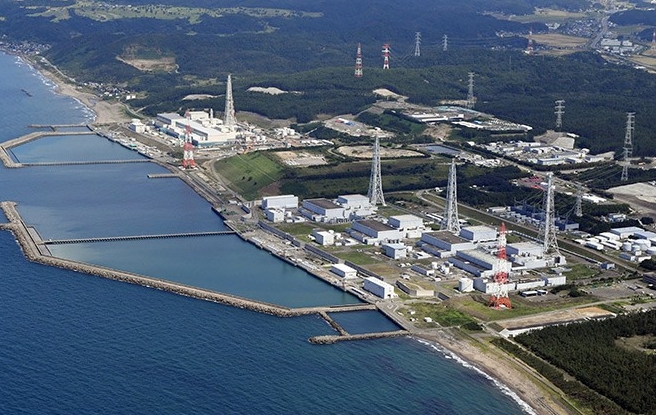
Tokyo Electric Power Co.’s Kashiwazaki-Kariwa nuclear complex in Niigata Prefecture
September 23, 2020
Tokyo Electric Power Co. cleared a major regulatory hurdle toward restarting a nuclear power plant in Niigata Prefecture, but the utility’s bid to resume its operations still hangs in the balance of a series of political approvals.
The government’s nuclear watchdog concluded Sept. 23 that the utility is fit to operate the plant, based on new legally binding safety rules TEPCO drafted and pledged to follow. If TEPCO is found to be in breach of those regulations, it could be ordered to halt the plant’s operations.
The Nuclear Regulation Authority’s green light now shifts the focus over to whether local governments will agree in the coming months to restart the Kashiwazaki-Kariwa plant.
TEPCO is keen to get the plant back up and running. It has been financially reeling from the closure of its nuclear plants in Fukushima Prefecture following the triple meltdown at the Fukushima No. 1 nuclear plant in 2011 triggered by the earthquake and tsunami disaster.
The company plans to bring the No. 6 and No. 7 reactors back online at the Kashiwazaki-Kariwa nuclear complex, which is among the world’s largest nuclear plants.
The two reactors each boast 1.35 gigawatts in output capacity. They are the newest of the seven reactors there, first put into service between 1996 and 1997.
TEPCO has not revealed specific plans yet on what to do with the older five reactors.
In 2017, the NRA cleared the No. 6 and No. 7 reactors under the tougher new reactor regulations established in 2013 in response to the Fukushima nuclear disaster.
It also closely scrutinized the operator’s ability to run the Niigata Prefecture plant safely, given its history as the entity responsible for the nation’s most serious nuclear accident.
After several rounds of meetings with top TEPCO managers, the NRA managed to hold the utility’s feet to the fire enough to make it pledge, in writing, to abide by a new seven-point safety code for the Kashiwazaki-Kariwa plant.
The creation of the new code, which is legally binding, is meant to hold the company accountable for safety measures at the facility.
“As the top executive, the president of TEPCO will take responsibility for the safety of nuclear power,” one of the points reads. “TEPCO will not put the facility’s economic performance above its safety,” reads another.
The company promised to abide by the points set out in writing during the NRA’s examination of its safety regulations.
TEPCO also vowed to set up a system where the president is directly briefed on risks to the nuclear complex, including the likelihood of earthquakes more powerful than what the plant is designed to withstand. It must also draft safeguard measures to deal with those kinds of earthquakes and confirm whether precautionary steps are in place.
The utility additionally pledged to promptly release public records on the decision-making process concerning crucial matters related to nuclear safety, and to preserve the documents until the facility is decommissioned.
TEPCO plans to complete its work to reinforce the safety of the No. 7 reactor in December. It has not set a definite deadline for similar work for the No. 6 reactor.
To restart the Kashiwazki-Kariwa plant, TEPCO needs to obtain consent from local governments, including the Niigata prefectural government.
The prefectural government is studying the plant’s safety through a panel of experts, which is reviewing whether evacuation plans are adequate and the health impact on residents from the Fukushima nuclear disaster.
Niigata Governor Hideyo Hanazumi said he will not decide on the restart until the panel completes its review.
The nuclear complex suffered damage, including from fire at an electric transformer, when an earthquake it deemed able to withstand hit in 2007.
Much at stake in picking a final nuclear waste disposal site
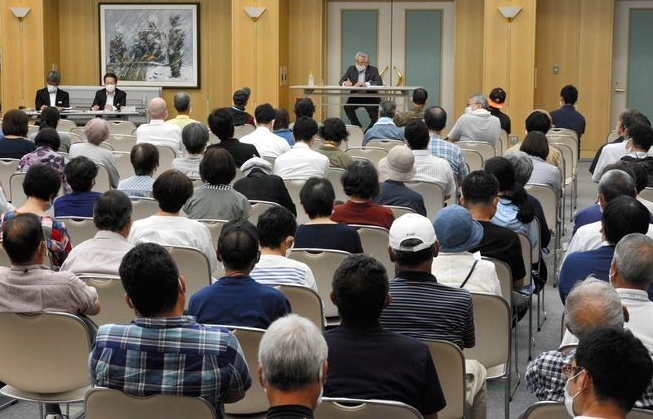
Local residents attend a meeting held Sept. 10 by the town government of Suttsu, Hokkaido, to explain plans to host a final disposal site for nuclear waste.
September 22, 2020
Two local communities in Hokkaido are considering pitching themselves as candidates for the site for final disposal of highly radioactive waste from nuclear power plants.
Last month, the mayor of Suttsu in the northernmost main island said the municipal government is thinking to apply for the first stage of the three-stage process of selecting the site for the nation’s final repository for nuclear waste.
During this period, past records about natural disasters and geological conditions for the candidate area are examined. Town authorities are holding meetings with local residents to explain its intentions.
In Kamoenai, a village also in Hokkaido, the local chamber of commerce and industry submitted a petition to the local assembly to consider an application for the process. The issue was discussed at an assembly committee. However, the assembly decided to postpone making a decision after further discussion.
Both communities are located close to the Tomari nuclear power plant operated by Hokkaido Electric Power Co. and struggling with common rural problems such as a dwindling population and industrial and economic stagnation.
The law decrees that when the first stage of the selection process starts, the municipality that is picked will receive up to 2 billion yen ($19.1 million) in state subsidies for two years.
But the Ministry of Economy, Trade and Industry and the Nuclear Waste Management Organization of Japan (NUMO), which are in charge of the selection process, have promised it will not move to the second stage if the prefectural governor or local mayor voices an objection.
Hokkaido Governor Naomichi Suzuki has already expressed his opposition.
A huge amount of spent nuclear fuel has been produced by nuclear plants in Japan, and it needs to be stored and disposed of somewhere in this country.
This policy challenge requires a solid consensus among a broad range of people, including residents of cities who have been beneficiaries of electricity generated at nuclear plants.
The two Hokkaido municipalities’ moves to consider applying for the first stage of the selection process should be taken as an opportunity for national debate on the issue.
The first step should be to establish a system for local communities to discuss the issue thoroughly from a broad perspective.
It is crucial to prevent bitter, acrimonious divisions in local communities between supporters and opponents.
The central government and other parties involved need to provide whatever information is needed from a fair and neutral position to help create an environment for healthy, in-depth debate.
There is also a crucial need to fix the problems with the current plan to build a final repository for radioactive waste.
Under the plan, which is based on the assumption that a nuclear fuel recycling system will eventually be established, the repository will be used to store waste to be left after spent nuclear fuel is reprocessed to recover and recycle plutonium and uranium.
But there is no prospect for the establishment of such a recycling system which would allow for disposing only of the waste from reprocessing and recycling.
Eventually, Japan, like most other countries with nuclear power plants, will be forced to map out plans for “direct disposal,” or disposing of spent fuel from nuclear reactors in underground repositories.
The central government has not changed its policy of maintaining nuclear power generation as a major power source. If nuclear reactors keep operating, they will continue producing spent fuel.
The government will find it difficult to win local support for the planned repository unless it makes clear what kind of and how much radioactive material will be stored at the site.
Many local governments are facing a fiscal crunch partly because of the impact of the COVID-19 pandemic.
Hokkaido Governor Suzuki has taken a dim view of the financial incentive offered to encourage local governments to apply for the first stage of the selection process, criticizing the proposed subsidies as “a wad of cash used as a powerful carrot.”
It takes tens of thousands of years for the radioactivity of spent nuclear fuel to decline to sufficiently safe levels.
Trying to stem local opposition by dangling temporary subsidies could create a serious problem for the future in the communities.
It is vital to ensure that the repository plan will secure a long-term policy commitment to the development of the local communities and ensure benefits for the entire areas.
Japan’s nuclear regulator approves restart of Kashiwazaki-Kariwa plant, but still hurdles to overcome

The Nuclear Regulation Authority’s green light now shifts the focus over to whether local governments will agree in the coming months to restart the
TEPCO is keen to get the plant back up and running. It has been financially reeling from the closure of its nuclear plants in Fukushima Prefecture following the triple meltdown at the Fukushima No. 1 nuclear plant in 2011 triggered by the earthquake and tsunami disaster.
The company plans to bring the No. 6 and No. 7 reactors back online at the Kashiwazaki-Kariwa nuclear complex, which is among the world’s largest nuclear plants.
The two reactors each boast 1.35 gigawatts in output capacity. They are the newest of the seven reactors there, first put into service between 1996 and 1997.
TEPCO has not revealed specific plans yet on what to do with the older five reactors……..http://www.asahi.com/ajw/articles/13753076
It’s important to dispel three persistent myths about China’s nuclear weapons
 THE DANGEROUS MYTHS ABOUT CHINA’S NUCLEAR WEAPONS, War on the Rocks, DAVID LOGAN, SEPTEMBER 18, 2020
……….While the Cold War superpowers engaged in arms racing, China committed to building a “lean and effective” force. Since obtaining a nuclear weapons capability, China has publicly claimed a categorical no-first-use policy and has asserted that “China does not engage in any nuclear arms race with any other country and keeps its nuclear capabilities at the minimum level required for national security.”
Misplaced Attention: The Real Risks of Beijing’s Nukes
Misplaced Attention: The Real Risks of Beijing’s Nukes………..
Addressing the Risks
These myths can exacerbate dangerous nuclear dynamics between China and the United States. The belief that China’s no-first-use policy is a sham increases the risk of Washington misidentifying a Chinese signal of resolve as preparations for a nuclear strike………
The myths can also hobble efforts to address more legitimate risks. Many of these risks, particularly those rooted in different perceptions, could be mitigated through formal dialogue. Beijing and Washington can share and refine understandings about escalation dynamics or their aims in a crisis or conflict. But misperception and miscommunication, sometimes rooted in the very myths discussed above, can make it difficult carry out such dialogues…………
Perhaps most significantly, a misguided focus on the myths could, perversely, make those myths realities. ……….
fixating on poorly sourced or unfounded claims makes any dialogue both less likely to occur and less effective if it does happen. There are enough real concerns about China’s nuclear modernization that need to be addressed without being distracted by myths. https://warontherocks.com/2020/09/the-dangerous-myths-about-chinas-nuclear-weapons/

Japanese government dangles financial carrot to persuade reluctant communities to take nuclear wastess
 But there is no prospect for the establishment of such a recycling system which would allow for disposing only of the
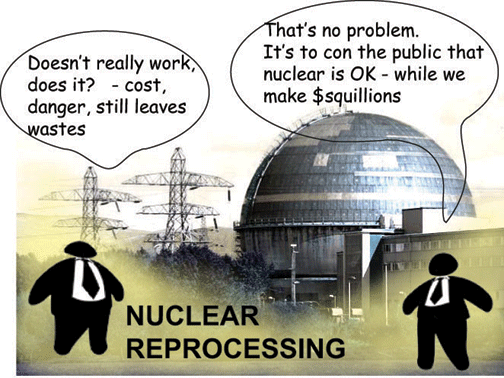 waste from reprocessing and recycling.
Eventually, Japan, like most other countries with nuclear power plants, will be forced to map out plans for “direct disposal,” or disposing of spent fuel from nuclear reactors in underground repositories.
Hokkaido Governor Suzuki has taken a dim view of the financial incentive offered to encourage local governments to apply for the first stage of the selection process, criticizing the proposed subsidies as “a wad of cash used as a powerful carrot.”
|
EDITORIAL: Much at stake in picking a final nuclear waste disposal site, http://www.asahi.com/ajw/articles/13749856 21 Sept 20, Two local communities in Hokkaido are considering pitching themselves as candidates for the site for final disposal of highly radioactive waste from nuclear power plants.Last month, the mayor of Suttsu in the northernmost main island said the municipal government is thinking to apply for the first stage of the three-stage process of selecting the site for the nation’s final repository for nuclear waste. During this period, past records about natural disasters and geological conditions for the candidate area are examined. Town authorities are holding meetings with local residents to explain its intentions. In Kamoenai, a village also in Hokkaido, the local chamber of commerce and industry submitted a petition to the local assembly to consider an application for the process. The issue was discussed at an assembly committee. However, the assembly decided to postpone making a decision after further discussion. Both communities are located close to the Tomari nuclear power plant operated by Hokkaido Electric Power Co. and struggling with common rural problems such as a dwindling population and industrial and economic stagnation. The law decrees that when the first stage of the selection process starts, the municipality that is picked will receive up to 2 billion yen ($19.1 million) in state subsidies for two years. But the Ministry of Economy, Trade and Industry and the Nuclear Waste Management Organization of Japan (NUMO), which are in charge of the selection process, have promised it will not move to the second stage if the prefectural governor or local mayor voices an objection. Hokkaido Governor Naomichi Suzuki has already expressed his opposition. A huge amount of spent nuclear fuel has been produced by nuclear plants in Japan, and it needs to be stored and disposed of somewhere in this country. This policy challenge requires a solid consensus among a broad range of people, including residents of cities who have been beneficiaries of electricity generated at nuclear plants. The two Hokkaido municipalities’ moves to consider applying for the first stage of the selection process should be taken as an opportunity for national debate on the issue. The first step should be to establish a system for local communities to discuss the issue thoroughly from a broad perspective. It is crucial to prevent bitter, acrimonious divisions in local communities between supporters and opponents. The central government and other parties involved need to provide whatever information is needed from a fair and neutral position to help create an environment for healthy, in-depth debate. There is also a crucial need to fix the problems with the current plan to build a final repository for radioactive waste. Under the plan, which is based on the assumption that a nuclear fuel recycling system will eventually be established, the repository will be used to store waste to be left after spent nuclear fuel is reprocessed to recover and recycle plutonium and uranium. But there is no prospect for the establishment of such a recycling system which would allow for disposing only of the waste from reprocessing and recycling. Eventually, Japan, like most other countries with nuclear power plants, will be forced to map out plans for “direct disposal,” or disposing of spent fuel from nuclear reactors in underground repositories. The central government has not changed its policy of maintaining nuclear power generation as a major power source. If nuclear reactors keep operating, they will continue producing spent fuel. The government will find it difficult to win local support for the planned repository unless it makes clear what kind of and how much radioactive material will be stored at the site. Many local governments are facing a fiscal crunch partly because of the impact of the COVID-19 pandemic. Hokkaido Governor Suzuki has taken a dim view of the financial incentive offered to encourage local governments to apply for the first stage of the selection process, criticizing the proposed subsidies as “a wad of cash used as a powerful carrot.” It takes tens of thousands of years for the radioactivity of spent nuclear fuel to decline to sufficiently safe levels. Trying to stem local opposition by dangling temporary subsidies could create a serious problem for the future in the communities. It is vital to ensure that the repository plan will secure a long-term policy commitment to the development of the local communities and ensure benefits for the entire areas. September 22, 2020 |
|
Tsunami risk for nuclear reactors on coastlines of India and Pakistan
Nuclear plants in Arabian Sea face tsunami risk https://phys.org/news/2020-09-nuclear-arabian-sea-tsunami.html, by SciDev.Net, 21 Sep 20, A major tsunami in the northern Arabian Sea could severely impact the coastlines of India and Pakistan, which are studded with sensitive installations including several nuclear plants, says the author of a new study.
“A magnitude 9 earthquake is a possibility in the Makran subduction zone and consequent high tsunami waves,” says C.P. Rajendran, lead author of the study, which was published this September in Pure and Applied Geophysics.
“Our study is a step towards understanding the tsunami hazards of the northern Arabian Sea,” says Rajendran. “The entire northern Arabian Sea region, with its critical facilities, including nuclear power stations, needs to take this danger into consideration in hazard perceptions.”
Atomic power stations functioning along the Arabian Sea include Tarapur (1,400 megawatts) in India’s Maharashtra state, Kaiga (being expanded to 2,200 megawatts) in Karnataka state and Karachi in Pakistan (also being expanded to 2,200 megawatts). A mega nuclear power plant coming up at Jaitapur, Maharashtra will generate 9,900 megawatts, while another project at Mithi Virdi in Gujarat may be shelved because of public opposition.
Nuclear power plants are located along coasts because their enormous cooling needs can be taken care of easily and cheaply by making using abundant seawater.
“Siting nuclear reactors in areas prone to natural disasters is not very wise,” says M.V. Ramana, Simons Chair in Disarmament, Global and Human Security and Director, Liu Institute for Global Issues, University of British Columbia, tells SciDev.Net. “In principle, one could add safety systems to lower the risk of accidents—a very high sea wall, for instance. Such safety systems, however, add to the cost of nuclear plants and make them even more uncompetitive when compared with other ways of generating electricity.”
“All nuclear plants can be subject to severe accidents due to purely internal causes, but natural disasters like earthquakes, tsunamis, hurricanes, and storm surges make accidents more likely because they cause stresses on the reactor that could lead to some failures while simultaneously disabling one or more safety systems,” says Ramana, who has worked extensively on nuclear energy.
Rajendran and his team embarked on the study after noticing that, compared to peninsular India’s eastern coast, tsunami hazards on the west coast were under-recognized. This despite the 8.1 magnitude earthquake that occurred in the Makran subduction zone in 1945.
The study relies on historical reports of a major disturbance that struck the coast of western India in 1524 that was recorded by a Portuguese fleet off Dabhol and the Gulf of Cambay, and corroborated by geological evidence and radiocarbon dating of seashells transported inland which are preserved in a dune complex at Kelshi village near Dabhol.
Modeling carried out by the team produced results suggesting that the high impact in Kelshi could have been generated by a magnitude 9 earthquake sourced in the Makran subduction zone during the 1508 —1681 period, says Rajendran. Subduction zones occur where one tectonic plate slides over another, releasing seismic energy.
As per radiocarbon dating of the shells, the inundation may have occurred during 1432—1681 and overlaps the historical reports of major sea disturbances in 1524 that were recorded by a Portuguese fleet of 14 ships led by Vasco da Gama, the man who discovered the sea-route between India and Europe.
A future mega-tsunami originating in the Makran subduction zone could not only devastate the coasts of Iran, Pakistan and Oman but also the west coast of India, says Rajendran, adding that alternate offshore quake sources are yet to be identified in the Arabian Sea.
The larger Indian Ocean features another tectonically active tsunamigenic source—in the Andaman-Sumatra region where the devastating 2004 Asian tsunami occurred. “The next tsunami, after our experience in 2004, will likely be on the west coast,” says Rajendran.
The 2004 tsunami claimed more than 250,000 lives and devastated the beaches of Indonesia, Thailand and Sri Lanka, and claimed lives as far away as Yemen, Somalia and South Africa. Significantly, an atomic power plant at Kalpakkam, on the coast of India’s south-eastern, Tamil Nadu state, was flooded.
Earlier studies, such as the one published in 2013 in Geophysical Research Letters, have indicated that tsunamis, similar in magnitude to the one caused by the 2004 Sumatra earthquake, could occur at the Makran subduction zone where the Arabian plate is subducting beneath the Eurasian plate by about 1.5 inches per year.
According to the 2013 study, the Makran is a wide-potential seismogenic zone that may be capable of generating a very significant (greater than 8.5 in magnitude) tsunamigenic earthquake that poses risks to the coastlines of Pakistan, Iran, Oman, and India.
Vinod Menon, a founder member of India’s National Disaster Management Authority tells SciDev.Net that the new study “raises pertinent questions on the seismic and tsunamigenic risks from a potential rupture of the Makran subduction zone.”
“The tsunami risk and vulnerability of the west coast has not received adequate attention in spite of a history of occurrence in the past as curated by the authors as well as previous studies,” says Menon, who adds that it is worth noting that there are far more sensitive installations around the northern Arabian Sea than in the Andaman-Sumatra region.
Ramana says that such studies serve as a warning against the risks and costs of setting up nuclear power plants in seismically vulnerable areas. “A decade after the 2011 disaster in Fukushima, the prefecture retains radioactive hotspots and the cost of clean-up has been variously estimated to range between US$20 billion and US$600 billion.”
U.S. general says that North Korea has a ”small” number of nuclear weapons (over 70?)
|
N. Korea has ‘small number’ of nuclear weapons: US general, Korea Herald, By Yonhap, Sept 18, 2020 WASHINGTON — North Korea has a “small number” of nuclear weapons, the vice chairman of the US Joint Chiefs of Staff said Thursday, although that number was not defined. Air Force Gen. John Hyten told a virtual forum that the specific numbers were “classified” and in many ways hard to understand. “But a small number is a confident characterization of nuclear capabilities that can threaten their neighbors or the United States,” he said in a symposium hosted by the National Defense University’s Center for the Study of Weapons of Mass Destruction. Hyten offered no further explanation of what he meant by “a small number.” The US has never officially discussed its assessment of North Korea’s nuclear capabilities, but the communist state is widely estimated to possess more than 70 nuclear warheads. In its latest annual report,” North Korean Tactics,” published in July, the US Army said the North is “estimated” to possess 2,500 to 5,000 tons of chemical weapons. With regard to its nuclear arsenal, however, the report simply states “estimates for North Korean nuclear weapons range from 20 to 60 bombs, with the capability to produce six new devices each year.” North Korea has conducted six nuclear tests, between October 2006 and September 2017. Hyten’s remark follows a recently renewed controversy, at least in Seoul, over Pyongyang’s nuclear capabilities. In his latest book, “Rage,” Washington Post journalist Bob Woodward discusses a US response to a North Korean attack that he says could include the use of up to 80 nuclear weapons……….. http://www.koreaherald.com/view.php?ud=20200918000129 |
|
1 This Month
Chernobyl: The Lost Tapes – A good documentary on Chernobyl on SBS available On Demand for the next 3 weeks– https://www.sbs.com.au/ondemand/tv-program/chernobyl-the-lost-tapes/2352741955560

of the week–London Campaign for Nuclear Disarmament

Tell the Ukrainian Government to Drop Prosecution of Peace Activist Yurii Sheliazhenko
To see nuclear-related stories in greater depth and intensity – go to https://nuclearinformation.wordpress.com
-
Archives
- April 2026 (152)
- March 2026 (251)
- February 2026 (268)
- January 2026 (308)
- December 2025 (358)
- November 2025 (359)
- October 2025 (376)
- September 2025 (257)
- August 2025 (319)
- July 2025 (230)
- June 2025 (348)
- May 2025 (261)
-
Categories
- 1
- 1 NUCLEAR ISSUES
- business and costs
- climate change
- culture and arts
- ENERGY
- environment
- health
- history
- indigenous issues
- Legal
- marketing of nuclear
- media
- opposition to nuclear
- PERSONAL STORIES
- politics
- politics international
- Religion and ethics
- safety
- secrets,lies and civil liberties
- spinbuster
- technology
- Uranium
- wastes
- weapons and war
- Women
- 2 WORLD
- ACTION
- AFRICA
- Atrocities
- AUSTRALIA
- Christina's notes
- Christina's themes
- culture and arts
- Events
- Fuk 2022
- Fuk 2023
- Fukushima 2017
- Fukushima 2018
- fukushima 2019
- Fukushima 2020
- Fukushima 2021
- general
- global warming
- Humour (God we need it)
- Nuclear
- RARE EARTHS
- Reference
- resources – print
- Resources -audiovicual
- Weekly Newsletter
- World
- World Nuclear
- YouTube
-
RSS
Entries RSS
Comments RSS
 nuclear-news