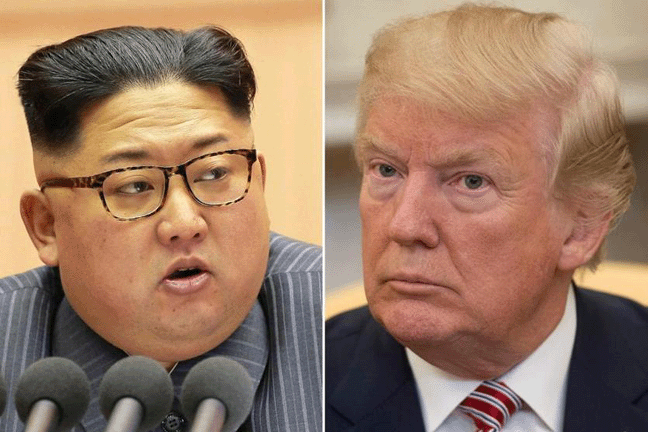
North Korea sees nuclear weapons as key to its survival, https://www.cbsnews.com/news/nukes-not-

North Korean leader Kim Jong Un provides guidance on a nuclear weapons program in this undated photo released by North Korea’s Korean Central News Agency (KCNA) in Pyongyang September 3, 2017. KCNA via REUTERS
alliances-seen-by-north-korea-as-guarantor-of-survival/ BY KATIANA KRAWCHENKO FEBRUARY 22, 2019 CBS NEWSNorth Korean leader Kim Jong Un sees nuclear weapons, not alliances, as the “ultimate guarantor” of survival, according to former top CIA analyst Jung Pak, who joined CBS News chief Washington correspondent Major Garrett for lunch on this week’s episode of “The Takeout.”That, she told Garrett, complicates the question of what “denuclearization” ultimately means, particularly ahead of President Trump’s summit with Kim beginning next Wednesday.
“The first summit produced very little in terms of how we were going to move toward North Korea denuclearization,” Pak said, adding that Kim has been “developing all of the ingredients for this recipe of mating the nuclear weapon on top of the ballistic missile that is shown to be able to fly across the world, to hit virtually any spot, frankly.”
Kim has been intent on showing us his capabilities, and he’s also been pretty clear about his intentions. He’s not going to unilaterally disarm, he said — unless the U.S., and frankly, the world give up its nuclear weapons.”
Trump administration officials say they do not know if North Korea has made the choice yet to denuclearize, but they’re engaged in these talks because they believe in the possibility.
President Trump himself has asserted that if North Korea does achieve verifiable “denuclearization,” which he simultaneously said he is now in “no rush” to achieve, the country could become a “tremendous economic power” due to their “unbelievable location” tucked in next to Russia, China and South Korea.
Pak believes “there is something to be said” for that point. But the North also sees its location as a real vulnerability, she told Garrett.
“They’re surrounded by the second, third and eleventh largest economies, and the only thing that sets them apart, and the only thing that makes them relevant is nuclear weapons.”
February 23, 2019
Posted by Christina Macpherson |
North Korea, politics international, weapons and war |
Leave a comment
 Denuclearization of the Korean Peninsula begins with a peace declaration, Bulletin of the Atomic Scientists, By David Kim, February 14, 2019
 During his State of the Union address, President Donald Trump
announced that he will meet with North Korean leader Kim Jong-un at the end of the month to continue a “historic push” for peace on the Korean Peninsula. If one statement stood out from Trump on North Korea, it’s that “much work remains to be done” to achieve complete, verifiable, and irreversible denuclearization on the Korean Peninsula.
Last year’s summit in Singapore between Trump and Kim was historic not for what it achieved on denuclearization, but for what it signaled to the world: Both countries, through the top-down, personality-driven diplomacy of their leaders, are ready to transform their relationship by seeking permanent peace on the Korean Peninsula. The central question moving forward isn’t whether Kim is willing to give up his nuclear weapons; rather it’s whether the United States and North Korea can transform their relationship to a point where Kim and his elites begin to believe their regime can survive without nuclear weapons. More than any other measure, an end-of-war declaration between the two countries would represent the beginning of this transformation. As the State Department’s special representative for North Korea, Stephen Beigun, said in a speechat Stanford University, “President Trump is ready to end this war. It is over. It is done.” Both sides appear ready to make that statement a reality.
Denuclearization is a long-term goal. While some Trump administration officials have suggested otherwise, complete denuclearization isn’t a realistic short- or medium-term goal. After the Singapore summit, President Trump tweeted that North Korea no longer poses a “nuclear threat.” In fact, experts believe that tweet is a decade or more away from being true. It now seems that Trump may have adjusted his views on this point. In a recent tweet, Trump said he looks forward to “advancing the cause of peace” at the next summit in Vietnam, suggesting he accepts that peace and a new relationship should undergird any real denuclearization agreement with North Korea.
Trump should understand that by agreeing to a peace declaration with the North, he won’t necessarily speed up the denuclearization timeline; rather, he’d be laying the foundation for a formal peace regime, an institutional set-up to allow both the United States and North Korea to work toward that goal. At Stanford, Biegun said the United States is prepared to take parallel steps with North Korea by “simultaneously look[ing] for ways to advance a more stable and peaceful, and ultimately, a more legal peace regime on the Korean Peninsula,” one that can “advance denuclearization.” This is a much more subtle formulation than the previous all-or-nothing approach taken by many US policymakers, the idea that North Korea had to abandon all its weapons first before the United States took any steps such as sanctions relief.
Kim wants an end to the Korean War. Ever since the days of Kim’s grandfather Kim Il Sung’s regime, North Korea has sought a formal peace regime ending the Korean War. The country has repeatedly raised its strong desire for an end-of-war declaration as the next step towards permanent peace. A report on the regime’s state-run news agency, for instance, stated last year “that the issue of the end-of-war declaration should have been resolved a half a century ago.” Trump appears to agree. He reportedly told Kim in Singapore that he’d sign a declaration. Such a peace declaration may serve as a preliminary security guarantee, or litmus test, to see how serious Kim is about denuclearizing.
Unlike a formal peace treaty, an end-of-war declaration, or peace declaration, is a legally non-binding instrument. Getting to a declaration won’t involve difficult negotiations. The document, rather, would represent a symbolic end to a war that has actually been over since 1953. Without abandoning the goal of a peace treaty, Trump could use a declaration to signal to Kim that the United States is serious about negotiating with his regime. As some experts also point out, an end-of-war declaration could be a “game changer” for North Korea because it could help “neutralize the hardliners” within Kim’s regime, creating the breathing space to allow further progress towards denuclearization. It would also counteract the frequent propaganda narrative in North Korea of foreign encroachment………. https://thebulletin.org/2019/02/denuclearization-of-the-korean-peninsula-begins-with-a-peace-declaration/?utm_source=Bulletin%20Newsletter&utm_medium=iContact%20email&utm_campaign=PeaceDeclaration_02152019
February 23, 2019
Posted by Christina Macpherson |
North Korea, politics international, South Korea |
Leave a comment
Closing nuclear facility on table as US-NKorea summit nears, BY ERIC TALMADGE News and Observer, ASSOCIATED PRESS, FEBRUARY 22, 2019 TOKYO
The future of a key North Korean nuclear facility is on the table as leader Kim Jong Un and President Donald Trump prepare to meet in Vietnam next week.
The Yongbyon Nuclear Scientific Research Center, the heart of the North’s nuclear development and research, is Kim’s biggest carrot as he tries to win security guarantees and free his country from the U.S.-backed trade sanctions that are hobbling its economy.
The North Korean leader has suggested he’s ready to talk about closing the facility, capping the amount of fissile material it produces or possibly allowing international inspections. Trump, meanwhile, says he is going into the summit in no hurry to push the North to denuclearize, as long as Kim isn’t conducting nuclear or missile tests.
But time may be of the essence.
As talks drag on, North Korea is believed to have produced enough weapons-grade nuclear fuel to make an estimated half a dozen or so more bombs in 2018 alone.
Here’s the latest on what’s going on at Yongbyon and why it’s so important:
HEDGED BETS
The North has taken steps to disable or dismantle some nuclear and missile facilities since the first Trump-Kim summit last June in Singapore but it has also been hedging its bets.
Using open-source satellite imagery of the Yongbyon complex, a team of experts led by Siegfried Hecker, a former director of the Los Alamos National Laboratory who has visited the Yongbyon facility several times, estimate the North made enough weapons-grade material to boost its stockpile from an estimated 30 nuclear weapons at the end of 2017 to 35-37 by the end of last year.
“North Korea unsurprisingly continued to operate and, in some cases, expand the nuclear weapons complex infrastructure,” they wrote in a report published this month by the Stanford Center for International Security and Cooperation.
The authors note that Kim isn’t violating any agreements with Trump or shocking any military strategists by building up the North’s stockpile — that’s to be expected in an arms negotiation process. But the stepped up activity underscores how important it is for Washington to push for a deal on Yongbyon……..https://www.newsobserver.com/news/business/article226619924.html
February 23, 2019
Posted by Christina Macpherson |
North Korea, politics international, USA, weapons and war |
Leave a comment
North Korea won’t give up nuclear weapons, former diplomat says, Thomas Maresca, USA TODAY Feb. 19, 2019 SEOUL – North Korea has no intention of giving up its nuclear weapons, a former North Korean diplomat warned ahead of next week’s summit between President Donald Trump and Kim Jong Un.
“No money in the world will convince North Korea to give up its nuclear weapons,” said Thae Yong Ho, Pyongyang’s former deputy ambassador to the United Kingdom, at a news briefing here Tuesday.
Thae fled his post in 2016 and is the highest-ranking North Korean diplomat to defect to South Korea.
The former diplomat said North Korea has been following a long-term strategy to pressure the United States to offer a peace agreement and begin lifting sanctions while not requiring that Pyongyang fully denuclearize.
He said Kim has followed the path of Pakistan, a de facto nuclear state which argued the military threat posed by nuclear-armed India justified the need for its own weapons.
“North Korea’s policy was to escalate the crisis of war to justify its nuclear weapons,” Thae said.
He said that Trump unwittingly played into the hands of Kim, by threatening to “totally destroy” North Korea at a 2017 speech to the U.N. General Assembly speech.
Raising the real possibility of war was “a real strategic mistake,” Thae said, claiming there was never a genuine threat of conflict between the U.S. and North Korea. “I believe, unfortunately President Trump fell into this trap.”…….https://www.usatoday.com/story/news/world/2019/02/19/north-korea-wont-give-up-nuclear-weapons-ahead-trump-kim-summit/2913031002/
February 21, 2019
Posted by Christina Macpherson |
North Korea, weapons and war |
Leave a comment
|
Kim Ready to Accept Nuclear-Plant Inspections, South Korea Says, Bloomberg, By Youkyung Lee, February 16, 2019,
· South Korea presidential adviser sees Trump path to compromise
· Trump says ‘I’m in no rush for speed’ in talks with Kim regime
North Korean leader Kim Jong Un was ready to accept the dismantlement and inspection of a high-profile nuclear plant, a South Korean presidential adviser said, suggesting a possible point of compromise in upcoming talks with President Donald Trump.
Moon Chung-in, a special adviser for foreign affairs and national security, said in an interview Friday that the verified destruction of the regime’s Yongbyon nuclear complex was an achievable goal during Trump’s planned Feb. 27-28 summit with Kim. Moon said it was his “understanding” that South Korean President Moon Jae-in got Kim’s personal assurance on that when they met in Pyongyang in September.
………..Moon Chung-in said the U.S. should agree to allow economic projects between the two Koreas to proceed in exchange for inspections of Yongbyon — something the U.S. has so far been reluctant to do. Kim has railed against the international sanctions regime choking his moribund economy and called for resuming the projects, including a industrial park and a mountain resort.
“Those will be doable,” Moon Chung-in said. Such an exchange would advance talks, “without undermining the overall sanctions regime by the UN Security Council, yet giving some kind of incentives to North Korea in a way the U.S. can come up with some sort of compromise,” he said.
Moon Chung-in, a strong advocate of South Korea rapprochement with North Korea, said the success of the Hanoi summit hinges on how North Korea proceeds with its nuclear arms program. Satellite-imagery analysis and leaked American intelligence suggest that North Korea has been churning out rockets and warheads as quickly as ever.
If North Korea continues to produce nuclear materials even after the Hanoi summit, I would say that’s the most important indicator that the Hanoi summit failed,” Moon Chung-in said. https://www.bloomberg.com/news/articles/2019-02-15/kim-ready-to-accept-inspection-of-nuclear-plant-adviser-says
|
|
February 16, 2019
Posted by Christina Macpherson |
North Korea, politics international, South Korea |
Leave a comment
 Central to the meeting in Vietnam is what the U.S. might offer Kim in return for concrete steps to relinquish his nuclear arsenal, WSJ, By Andrew Jeong andTimothy W. Martin, Feb. 8, 2019 SEOUL—The U.S. special envoy for North Korea concluded three days of nuclear-disarmament talks in Pyongyang ahead of the second summit between President Trump and North Korean leader Kim Jong
 Un, scheduled for this month in Vietnam, expressing confidence that “real progress” was possible if both sides remain committed…….
(subscribers only)
https://www.wsj.com/articles/u-s-envoy-voices-optimism-ahead-of-north-korea-nuclear-summit-11549684347
February 11, 2019
Posted by Christina Macpherson |
North Korea, politics international, USA |
Leave a comment
North Korea trying to keep its nuclear missiles safe from US strikes, says UN report, Guardian, Justin McCurry and agencies,5 Feb 2019
Measures said to include using civilian facilities to make and test missiles North Korea is trying to ensure its nuclear and ballistic missile capabilities are safe from US military strikes, a UN report has said, as officials from both countries prepared to meet to discuss a second summit between
Donald Trump and Kim Jong-un.Trump is expected to meet the
North Korean leader, possibly in Vietnam, at the end of the month to discuss measures that would lead to Pyongyang giving up its nuclear weapons in return for US security guarantees and other assurances.
But the report, seen by Reuters on Monday, suggested the regime was doing everything possible to protect its nuclear and missile programmes.
In the confidential report, recently submitted to UN security council members, sanctions monitors said they had “found evidence of a consistent trend on the part of [North Korea] to disperse its assembly, storage and testing locations”…….. https://www.theguardian.com/world/2019/feb/05/north-korea-trying-to-keep-its-nuclear-missiles-safe-from-us-strikes-says-un-report
February 7, 2019
Posted by Christina Macpherson |
North Korea, weapons and war |
Leave a comment
Does Russia Have a Plan to Solve the North Korea Nuclear Crisis? https://nationalinterest.org/blog/buzz/does-russia-have-plan-solve-north-korea-nuclear-crisis-43022 2 Feb 19, Some think so. by Stratfor Worldview
What Happened: The Russian government reportedly made a secret proposal to North Korea in the fall of 2018 to construct a nuclear power plant in the country in exchange for North Korea dismantling its nuclear weapons and ballistic missiles, The Washington Post reported Jan. 29, citing unnamed U.S. officials. The Russian envoy to North Korea, meanwhile, denied the report.
Why It Matters: Russia’s alleged offer would imply attempts to insert itself into the negotiation process over North Korea’s nuclear program. U.S. President Donald Trump is slated to hold a second summit with North Korean leader Kim Jong Un in late February.
Background: Kim placed a significant emphasis on rectifying North Korea’s electricity problems during his New Year’s speech. Meanwhile, Russian Deputy Foreign Minister Igor Morgulov received a delegation from North Korea’s Foreign Ministry in Moscow on Jan. 29.
February 4, 2019
Posted by Christina Macpherson |
North Korea, politics international, Russia |
Leave a comment
SMH, By John Hudson and Ellen Nakashima, 30 January 2019 Washington: Russian officials made a secret proposal to North Korea last northern fall aimed at resolving deadlocked negotiations with the Trump administration over its nuclear weapons program, said US officials familiar with the discussions.
In exchange for dismantling its nuclear weapons and ballistic missiles, Moscow offered the country a nuclear power plant.
The Russian offer, which intelligence officials became aware of in late 2018, marks a new attempt by Moscow to intervene in the high-stakes nuclear talks as it reasserts itself into a string of geopolitical flash points from the Middle East to South Asia to Latin America. Its latest bid is expected to unsettle Chinese and US officials wary of granting Moscow an economic foothold on the Korean Peninsula.
As a part of the deal, the Russian government would operate the plant and transfer all byproducts and waste back to Russia, reducing the risk that North Korea uses the power plant to build nuclear weapons while providing the impoverished country a new energy source……. https://www.smh.com.au/world/north-america/russia-secretly-offered-north-korea-a-nuclear-power-plant-officials-20190130-p50ufz.html
January 31, 2019
Posted by Christina Macpherson |
North Korea, politics international, Russia |
Leave a comment
Hampton Sides, author of a new book about a turning point in the Korea war, explores the state of the Koreas and Trump’s forthcoming visit. Interview, Bloomberg, By Tobin Harshaw, January 28, 2019,
“……It is a cliche that the so-called police action in Korea from 1950 to 1952 is America’s “forgotten war.” But, like most cliches, there is a lot of truth to it. American ignorance about the Korean War is a shame, and not only because it devalues the sacrifices of those who fought in it. With North Korea’s nuclear arsenal now threatening the U.S. mainland (not to mention Hawaii, Japan and the folks on the southern end of the peninsula), and President Donald Trump and Kim Jong Un set to meet again next month, a little historical perspective might be helpful.
………. HS: Be mindful of the fact that North Korea’s fear and loathing of the U.S., however warped it seems, does have legitimate historical roots. During the Korean War, the U.S. bombed that country back to the Stone Age: Every building, every bridge, every village. The stated goal was to not leave a single brick standing upon another brick. That air campaign was gratuitous and cruel. We killed hundreds of thousands of civilians. We’re a country that has a habit of bombing people and then wondering why those people hate us. As we parse the madness that is the Kim regime, we should always keep in mind that this underlying history of “terror from above” figures into that madness.
Kim strikes many as a lunatic, but his nuclear strategy has actually been quite rational and effective in achieving his goals. So coaxing him to give up his nukes will take some extremely creative and forceful negotiating. The Hermit Kingdom desperately needs many, many things from the outside world — food, medicines, capital, technology, expertise and so on, and Kim knows this. A big question is whether he would really allow his own people to benefit in any meaningful way from the flow of goods and amenities that a removal of sanctions would usher in. Another question is whether he’d actually allow outside experts to come in and closely monitor his regime’s nuclear compliance. Caveats aside, we can only hope the talks continue. I’m highly skeptical of Trump’s much-avowed skills as a deal-maker, but a deal is certainly in the interest of the whole wide world.
……….. HS: It was repeatedly said during the 2016 campaign that Douglas MacArthur is Trump’s “favorite general.” I don’t get the sense that Trump reads history — or anything else, for that matter — but it’s a telling detail. Because with Douglas MacArthur you had a grandiose and vainglorious autocrat who had surrounded himself with sycophants and yes-men. He was a colorful and interesting character — in narrative terms, a gift that keeps on giving. But he was a thoroughgoing narcissist. It was said that he didn’t have a staff; he had a court. He didn’t want to hear inconvenient information. He didn’t like experts — he was the expert. He was in love with the vertical pronoun. It was all about him.This sounds extremely familiar to me.
………. Of course, Korea should never have been divided in the first place — drawing that line created one of the great geopolitical tragedies of modern times. Many thousands of families were torn apart and never allowed to see each other again. Historically speaking, there’s no difference between northern and southern Korea. It’s one country, one language, one culture, one people.
Or at least it was. After more than 70 years of living apart, a reunification, if by some miracle it ever happened, would be a wrenching and doubtless violent process. It’s not clear how a brainwashed and traumatized people from an impoverished police state integrates into the dynamic capitalist society that is modern South Korea. Still, I believe it’s destined to happen one day.https://www.bloomberg.com/opinion/articles/2019-01-27/korean-war-in-current-events-from-the-1950s-to-a-nuclear-north
January 29, 2019
Posted by Christina Macpherson |
history, North Korea, politics international, USA |
Leave a comment
 While Kim plays to Trump’s ego, he builds his nuclear arsenal, CNN, By Samantha Vinograd, January 20, 2019 “……..When President Donald Trump met Kim Jong Un in June 2018, they came to a vague agreement that North Korea would work toward the denuclearization of the Korean Peninsula. But, as Vice President Mike Pence stated last week, North Korea has failed to take concrete steps toward giving up its nuclear weapons, and it still represents a serious nuclear threat.
January 21, 2019
Posted by Christina Macpherson |
North Korea, politics international |
1 Comment
Straits Times, WASHINGTON (REUTERS) 18 Jan 19, – A top North Korean nuclear envoy met President Donald Trump at the White House after holding talks with Secretary of State Mike Pompeo on Friday (Jan 18) in a diplomatic flurry aimed at laying the groundwork for a second US-North Korea summit.
The visit of Kim Yong Chol, Pyongyang’s lead negotiator with the United States and a hardline former spy chief, marked a rare sign of potential movement in a denuclearisation effort that has stalled since a landmark meeting between Trump and North Korean leader Kim Jong Un in Singapore last year.
Kim Yong Chol and Pompeo, with tight smiles, posed together for photographs at a Washington hotel before holding about 45 minutes of talks that could help determine whether the two sides can make headway.
After that meeting, the White House said Trump hosted Kim Yong Chol in the Oval Office to “discuss relations between the two countries and continued progress on North Korea’s final, fully verified denuclearisation.”
There has been no indication of any narrowing of differences over US demands that North Korea abandon a nuclear weapons programme that threatens the United States or over Pyongyang’s demand for a lifting of punishing sanctions.
Hours before Kim Yong Chol’s arrival on Thursday, Trump – who declared after the Singapore summit in June that the nuclear threat posed by North Korea was over – unveiled a revamped US missile defence strategy that singled out the country as an ongoing and “extraordinary threat.”
The State Department said after Friday’s meeting that Pompeo had a “good discussion” with Kim Yong Chol “on efforts to make progress on commitments President Trump and Chairman Kim Jong Un made at their summit in Singapore.”
But it provided no specifics.
The high-level visit could yield an announcement of plans for a second summit. Both Trump and Kim have expressed an interest in arranging but some US-based analysts say it would be premature due to the lack of obvious progress so far………. https://www.straitstimes.com/world/united-states/north-korea-envoy-in-us-for-talks-with-secretary-of-states-mike-pompeo-possibly
January 19, 2019
Posted by Christina Macpherson |
North Korea, politics international, USA |
Leave a comment
Can America Live with a Nuclear North Korea? National Interest, January 11, 2019 MilitaryTechnologyWorldICBM
Question: Can America live with an atomic North Korea, and could any presidential administration openly admit it can? The answer: Yes it can, and no it couldn’t.
Forcibly disarming Pyongyang could and probably would involve sacrificing thousands of American and Korean lives. Here’s a crude yardstick. The Korean War, a conventional conflict to preserve an independent South Korea, cost the United States some 37,000 military lives. Many more service folk suffered wounds. Thirty-seven thousand. That’s more than fivefold the combined American military death toll from the Afghanistan and Iraq wars since 9/11. And that leaves aside countless more Korean military and civilian lives expended fighting to the current standstill along the inter-Korean border.
It’s hard to see how war could be waged more cheaply than it was in 1950-1953 when the principal combatants, not to mention North Korea’s ally China and neighbor Russia, all boast nuclear weapons to accompany formidable conventional forces. And Washington must not delude itself into thinking air and sea power can do the job alone, any more than aviators and mariners repulsed the North Korean invasion in 1950. It took land forces back then—and today, in all likelihood, ground combat would be required to destroy the dug-in North Korean nuclear complex.
Any military strategy worth the name would demand that U.S. Army and Marine forces again seize and control ground—allowing them the leisure to ferret out underground facilities and armaments.
In short, a new Korean War would not be a come-and-go affair. Such a forecast is solidly grounded in the classics of strategy. For instance, Admiral J. C. Wylie points out that the proper goal of military strategy is to impose control on the foe. Aircraft and missiles flit by overhead while ships remain offshore. Though formidable, their presence is too intermittent to qualify as control. That being the case, he pronounces the soldier slogging through mud the “ultimate determinant” of who emerges the victor. The soldier goes and stays. “He is control,” proclaims Wylie. No control, no strategic success.
Or as the historian T. R. Fehrenbach
puts it regarding the Korean War: “you may fly over a land forever; you may bomb it, atomize it, pulverize it and wipe it clean of life—but if you desire to defend it, protect it and keep it for civilization, you must do this on the ground, the way the Roman legions did, by putting your young men in the mud.” Wylie says much the same thing when he observes that— aviators’ and rocketeers’ assumptions notwithstanding—the ability to destroy something from aloft does not equate to controlling it.
January 14, 2019
Posted by Christina Macpherson |
North Korea, politics international, USA |
Leave a comment