Japanese public opinion might result in aborting the global “nuclear renaissance”
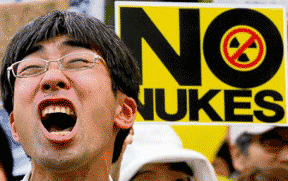 Could these angry, scattered voices from below congeal to topple Japan’s entire energy policy, or even abort the global turn to nuclear power?
photograph Kim Kyung Hoon, Reuters
The sun sets on Japan’s nuclear age, Irish Tims, 26 May 11, DAVID McNEILL, NUCLEAR FALLOUT: The meltdown at the Fukushima nuclear plant has grave implications for Japan’s planned atomic energy expansion, and also its long-term economic growth
IN A CITY where mass demonstrations are rare and generally tame, Tokyo has seen at least four in the past month, all against nuclear power. Thousands of people have marched past the headquarters of Tokyo Electric Power (Tepco) shouting slogans at the executives they hold responsible for the world’s worst atomic crisis since Chernobyl. Continue reading
Fukushima nuclear plant might now be used as a temporary nuclear waste dump
As the sites are for intermediary use, the nation is still searching for a deep underground storage site for the waste, according to the World Nuclear Association…

Fukushima set to become Nuclear waste graveyard Bloomberg / Tokyo May 27, 2011, Japan’s atomic energy specialists are discussing a plan to make the Fukushima Daiichi nuclear plant a storage site for radioactive waste from the crippled station run by Tokyo Electric Power Co.The Atomic Energy Society of Japan is studying the proposal, which would cost tens of billions of dollars, Muneo Morokuzu, a professor of energy and environmental public policy at the University of Tokyo, said in an interview yesterday. The society makes policy recommendations to the government. Continue reading
Unprecedented criticism of Tokyo Electric Power Company
The IAEA’s 10-day visit, which began on Monday, coincides with mounting criticism of the operator of the Fukushima Daiichi plant, as it becomes clear that the damage caused by the March 11earthquake and tsunami was far worse than initially thought. Its findings could have a significant impact on public attitudes toward both the plant’s operator and the Japanese government, and are certain to attract the interest of other countries with nuclear power plants.
Tepco’s handling of Japan’s nuclear crisis under severe scrutiny, The International Atomic Energy Agency’s visit to Japan this week coincides with unprecedented criticism of the Tokyo Electric Power Company’s handling of Japan’s nuclear crisis following the March 11 earthquake. CSMonitor.com, By Justin McCurry, May 26, 2011 Ichinoseki, Japan Continue reading
Japan’s nuclear lobby still promoting nuclear power
 The sun sets on Japan’s nuclear age, The Irish Times -DAVID McNEILL, May 27, 2011 “……..Japan’s largest business lobby, the Keidanren, has made its position very clear. Chairman Hiromasa Yonekura this month demanded that Kan rescind his decision on Hamaoka, which he called “extralegal” and a “political performance”. With Japanese businesses already struggling to compete with mighty China, the nation cannot afford to ditch nuclear power, he warned.For that reason, many analysts say that Kan’s more recent pronouncements are rhetoric designed to appease angry voters. Continue reading
“Allowable” radiation levels for children in Japan and the anger of parents
“Do you really care about our children’s health?” one parent shouted. “Why have you acted so late?” said another. Among other concerns: isn’t radiation still raining down on Fukushima? Shouldn’t the entire school building be decontaminated? The entire city? Can we trust you?
Angry Parents in Japan Confront Government Over Radiation Levels, NYTimes.com,By HIROKO TABUCHI, May 25, 2011 FUKUSHIMA CITY, Japan — The accusations flew on Wednesday at the local school board meeting, packed with parents worried and angry about radiation levels in this city at the heart of Japan’s nuclear crisis. Continue reading
Japanese buying Geiger counters, don’t trust govt information on radiation
 Demand for personal Geiger counters soars in Japan, Reuters, By Chiaki Kawase, TOKYO May 25, 2011 – With a nuclear plant just 240 km (150 miles) north of Tokyo still leaking radiation, demand for personal Geiger counters has skyrocketed in the Japanese capital and manufacturers are struggling to keep up with the demand…..With many people unsure of who to trust for their information, some buy Geiger counters to check for themselves……
plant operator Tokyo Electric Power Company (Tepco) confirmed on Tuesday that the fuel rods at three reactors at the plant had melted down. Radioactive traces exceeding national safety standards have been found in various foods grown in areas around the plant as well as in tap water in places as far away as Tokyo, keeping residents on edge.
“I don’t think that the information you got are the real information in Japan. That’s the problem,” said restaurant chef Bruno Menard, noting that a French company he had checked with that morning for radiation levels had said levels were very high around Fukushima.
“Especially when it’s raining we have to be concerned.”….Demand for personal Geiger counters soars in Japan | Reuters
Thousands of tons of radioactive water to be stored somehow at Fukushima
 Facility for tainted water almost full, New storage sites needed at Fukushima No. 1 Japan Times, May 24, 2011 Kyodo A nuclear waste disposal facility being used to store radioactive water from the crippled Fukushima No. 1 power plant will soon be full, Tokyo Electric Power Co. officials said Monday. The operator, known as Tepco, plans to suspend the extraction operation until mid-June once the facility becomes filled and until a new water treatment facility begins operating. Continue reading
 Japanese parents angry over radiation levels for children
 Japanese ire over radiation limit for kids. Herald Sun AAP , May 23, 2011 FURIOUS parents at the centre of Japan’s atomic crisis and hundreds of their supporters rallied in Tokyo today against revised nuclear safety standards in schools they say are putting children at risk.
Japanese children can now be exposed to 20 times the radiation that was permissible before the March 11 tsunami caused a meltdown at the Fukushima nuclear plant, sparking the world’s worst nuclear crisis since Chernobyl. Around 400 protesters, many from areas around the stricken plant, flocked to the education and science ministry to demand a rethink on the new limit, which allows exposure of up to 20 millisieverts a year.
A group of Fukushima residents submitted a letter for the education minister demanding the ministry do all it can to lower radiation levels at schools and offer financial support.
Protest organisers said the radiation limit for playgrounds was about six times as much as the 0.6 microsievert-per-hour legal maximum under which under-18s are allowed to work…….The nuclear crisis remains unresolved and tens of thousands of people are still unable to return to homes, farms and businesses in a 20-kilometre zone around the radiation-spewing plant.
More than 20 elementary and junior high schools within 30 kilometres have been forced to close since the accident, affecting some 5000 pupils, the Yomiuri daily newspaper reported today….http://www.heraldsun.com.au/news/breaking-news/japanese-ire-over-radiation-limit-for-kids/story-e6frf7jx-1226061484710
Japanese rice contaminated with plutonium
|
Media Silent About Plutonium Contamination of Japanese Rice, Global Tech, 23 May 11
|
|
The Japanese Business Press reported on May 14 that a rice field more than 50 kilometers away from the Fukushima nuclear plant has tested for high levels of deadly plutonium. A “certain food manufacturing company” conducted the independent test that reported data different from data the Japanese government released, according to a translation of the news article
The corporate media outside of Japan did not mention the test or the increased radiation affecting the staple crop. Since the start of the disaster, the corporate media has parroted statements from TEPCO and the Japanese government in its coverage of the worst nuclear catastrophe since Chernobyl. In addition, the corporate media has all but ignored extremely high levels of nuclear radioactive contamination recently detected in Japan. “The latest joint US and Japan survey shows extremely high levels of nuclear radioactive contamination, with radiation levels higher than Chernobyl evacuation limits, now span over 800 kilometers in Japan,” writes Alexander Higgins
The total area contaminated with radiation from the Fukushima No. 1 nuclear power plant is estimated at about 800 square kilometers, or about 40 percent the size of Tokyo, according to a radiation map created by the science ministry and U.S. Department of Energy,” reports Asahi. “The report uses the same level of contamination (555,000 becquerels or higher of cesium-137) that was used to issue compulsory evacuation orders in the Chernobyl nuclear accident in 1986.” It is not likely the corporate media missed the news. Asahi has alliances with the International Herald Tribune, which is owned by the New York Times. According to the map about 800 square kilometers are contaminated with accumulated cesium-137 of 600,000 becquerels or higher per square mete
|
More radiation leakage from Fukushima nuclear power plant
 Japan reports more radiation leakage TOKYO, May 22 (UPI) –– At least 250 tons of radioactive water spilled into the Pacific Ocean from Japan’s earthquake-damaged Fukushima nuclear power plant, officials said.
The Tokyo Electric Power Co. said the radiated water leaked for 41 hours beginning May 10 from the No. 3 reactor at the site, where four of six reactors were damaged in the magnitude-9 earthquake and ensuing tsunami, Kyodo News reported. At a Sunday news conference in Tokyo, utility spokesman Junichi Matsumoto told reporters Tepco has drafted plans to install a water-circulation system to cool the spent-fuel pools at the plant by the end of July, The Wall Street Journal reported.
Since the disaster, officials have scrambled to prevent the radioactive cores from overheating and releasing catastrophic radiation clouds. As of Sunday, part of the stop-gap measures still involved the use of fire hoses to pump water into the reactors, the Journal said. Matsumoto acknowledged radioactive vapor can still be seen “depending on the weather and wind direction of the day,” the Journal said……Japan reports more radiation leakage – UPI.com
Staggering financial costs of Fukushima continue to rise
 it is clear that holes not only exist in the reactors at Fukushima but also in plans to bring the crisis under control……the issue of who is left holding the bag for the many costs associated with decontamination of the plant and surrounding facilities as well as rebuilding the dozens of communities wiped out by the tsunami. The amounts are staggering. Bank of America Corp.’s Merrill Lynch estimates TEPCO may face claims of 11 trillion yen ($136 billion).
Report From Tokyo: Left Holding the Bag,H UFFINGTON POST, David Wagner, 23 May, 11, Each week that passes here brings new revelations about the unstable nature of the nuclear facility at Fukushima as a result of the earthquake and tsunami on March 11th. Most recently, it has been confirmed by Tokyo Electric Power (TEPCO) that units #1, #2 and #3 at the Daiichi Fukushima plant all have substantial contaminated water in the basements of each reactor building, reinforcing the suspicion that the containment vessels are damaged as they are not holding the water. This creates additional challenges for TEPCO as it tries to set up a continuous cooling system that will eliminate the threat of radiation leaks into the environment. Continue reading
Solar panels plan for all new buildings in Japan
 Japan ‘plans solar panels for all new buildings’, Google News, (AFP) – 23 May 11TOKYO — Japan is considering a plan that would make it compulsory for all new buildings and houses to come fitted with solar panels by 2030, a business daily said Sunday.The plan, expected to be unveiled at the upcoming G8 Summit in France, aims to show Japan’s resolve to encourage technological innovation and promote the wider use of renewable energy, the Nikkei daily said……
AFP: Japan ‘plans solar panels for all new buildings’
Hamaoka nuclear plant – seawater in reactor core, radiation in farmland
Seawater enters reactor core at nuclear plant, Oman Observer, Sat, 21 May 2011 TOKYO — Some five tons of seawater is estimated to have entered a reactor core at the Hamaoka nuclear power station in central Japan, the operator said on Thursday. That followed the discovery of an estimated 400 tons of seawater that has inundated the main steam condenser at reactor 5 of the Hamaoka nuclear plant in Shizuoka prefecture, south-west of Tokyo.
Chubu Electric Power Co, which runs the plant, found the 400 tons of seawater while shutting down the reactor as requested by the government. Chubu Electric officials said their assessment of the purity of water inside the pressure vessel showed some 5 tons of seawater came from the condenser. The utility will not decommission the reactor. Instead, it will dilute and desalinate the seawater to prevent any corrosion inside the reactor as salt causes corrosion…….
The plant is run by Tokyo Electric Power Co (TEPCO). On Saturday, after Chubu Electric started to put the Hamaoka plant in a stable state known as cold shutdown, it discovered seawater in the reactor core, Jiji said. Meanwhile, local officials in the prefecture of Miyagi said on Thursday they had found high levels of radioactive substances in a sample of pasture grass.
Local government officials detected 1,530 becquerels of radioactive caesium per kilogram in a sample collected a week ago from a farm run by the town of Marumori, some 60 kilometres north of the Fukushima plant. — DPA… Seawater enters reactor core at nuclear plant | Oman Observer
Agonising decisions over animals left in Fukushima prefecture
 As the no-go zone spreads, ever more farmers are being forced to make agonising decisions over whether to move their livestock to safe areas and incur huge costs, slaughter their animals or — perhaps the most unacceptable option — leave them to their fate.
 Agony for Japan livestock farmers in nuclear crisis, By Shingo Ito (AFP) – GoogleNews, 20 May 11, FUKUSHIMA CITY, Japan — As more people are forced to leave their homes around the stricken Fukushima nuclear plant, anger is growing in a farming community forced to make the agonising decision whether to slaughter livestock or face ruin. Continue reading
Why Japan’s nuclear hierarchy cannot be trusted about Fukushima disaster
 Virtually any nuclear engineer connected with the industry he or she supports cannot be fully trusted right now to give us the full truth about Fukushima because the truth is simply too damaging to the nuclear industry and they know it. The attitude that the industry has, as well as the ugly reality that this same energy is tied to the economy which supports full on capitalism, must be scaled back Tokuhiro advised.
 Interview with Akira Tokuhiro, Nuclear Engineer: Fukushima and the Mass Media HUFFINGTON POST, Vivian Norris, 19 May, “Only the mass media can put the kind of pressure on TEPCO and the Japanese government to bring about major change. This will cost at least 10 billion dollars if not 20-30 billion to clean up. It will take at least 10 years if not 20 and roughly 10,000 people working on the cleanup. The nuclear business is global. This needs an international effort to clean up Fukushima.”
— Nuclear Engineer Akira Tokuhiro
In an email today, Japanese born, U.S.-educated nuclear engineering professor Tokuhiro wrote the following: Continue reading
-
Archives
- October 2026 (111)
- September 2026 (339)
- August 2026 (330)
- July 2026 (355)
- June 2026 (287)
- May 2026 (306)
- April 2026 (356)
- March 2026 (251)
- February 2026 (267)
- January 2026 (308)
- December 2025 (358)
- November 2025 (359)
-
Categories
- 1
- 1 NUCLEAR ISSUES
- business and costs
- climate change
- culture and arts
- ENERGY
- environment
- health
- history
- indigenous issues
- Legal
- marketing of nuclear
- media
- opposition to nuclear
- PERSONAL STORIES
- politics
- politics international
- Religion and ethics
- safety
- secrets,lies and civil liberties
- spinbuster
- technology
- Uranium
- wastes
- weapons and war
- Women
- 2 WORLD
- ACTION
- AFRICA
- Atrocities
- AUSTRALIA
- Christina's notes
- Christina's themes
- culture and arts
- Events
- Fuk 2022
- Fuk 2023
- Fukushima 2017
- Fukushima 2018
- fukushima 2019
- Fukushima 2020
- Fukushima 2021
- general
- global warming
- Humour (God we need it)
- Nuclear
- RARE EARTHS
- Reference
- resources – print
- Resources -audiovicual
- Weekly Newsletter
- World
- World Nuclear
- YouTube
-
RSS
Entries RSS
Comments RSS

