Japan can shut down all nuclear power by 2012
“With only 11 out of 54 reactors online at the height of summer and little impact to daily life, Japan has already proven that by conserving energy it does not need nuclear power”,
Permanent Nuclear Shutdown in Japan Possible by 2012: Report, September 12, 2011 Tokyo- (PanOrient News) Japan can switch off all nuclear plants permanently by 2012 and still achieve both economic recovery and its CO2 reduction goals, according to a new Greenpeace report.
Released today, the Advanced Energy Revolution report for Japan, shows how energy efficiency and rapid deployment of renewable technology can provide all the power Japan needs. Continue reading
The psychological fallout from Fukushima’s continuing radiation
Low-level radiation is an invisible threat that breaks DNA strands with results that do not become apparent for years or decades. Though the vast majority of people remain completely unaffected throughout their lives, others develop cancer. Not knowing who will be affected and when is deeply unsettling….
Twenty years after the 1986 reactor explosion in Chernobyl, the World Health Organisation said psychological distress was the largest public health problem unleashed by the accident…
the radiation “creates a slow, creeping, invisible pressure” that can lead to prolonged depression.
 Fukushima disaster: it’s not over yet Six months after the multiple meltdowns at the Fukushima Daiichi nuclear plant, the streets have been cleared but the psychological damage remains “…...Jonathan Watts, guardian.co.uk, Sept 9 11, ”……..Reiko went on to describe how everything had changed in the wake of the nuclear accident in Fukushima the previous month. Daily life felt like science fiction. She always wore a mask and carried an umbrella to protect against black rain. Every conversation was about the state of the reactors. In the supermarket, where she used to shop for fresh produce, she now looked for cooked food – “the older, the safer now”. She expressed fears for her son, anger at the government and deep distrust of the reassuring voices she was hearing in the traditional media. “We are misinformed. We are misinformed,” she repeated. “Our problem is in society. We have to fight against it. And it seems as hard as the fight against those reactors.” Continue reading
Economic pain of Japan’s nuclear disaster
Six Months: Counting the Cost, WSJ, By Yoree Koh, 11 Sept 11, The March 11 disasters have taken a heavy toll on Japan, in every conceivable way. In other posts, JRT looks at the impact on survivors’ lives and challenges for the future. Below is an update on the aftermath of the earthquake, tsunami and nuclear crisis as seen in the simplest of measures – numbers……..
Nuclear Effect:
23 – number of times the government ordered bans on distribution of certain produce from select prefectures due to radiation contamination as of Sept. 10, according to the Ministry of Health.
26 – the number of different types of food items, including vegetables, fish and beef, at various points banned from distribution due to radioactive contamination, as named in orders released by the Ministry of Health as of Sept. 10.
380 tons – the amount of beef from cattle suspected of being fed rice straw with high concentrations of radioactive cesium the government purchased, according to the Nikkei business daily…..
Y120,000 – maximum monthly compensation Tokyo Power Electric Co. is to pay each evacuee between March and August for the anguish they suffered because they had to flee from their homes.
Y112.2 billion – total compensation Tepco has paid on a provisional basis to evacuees, farmers, companies and others affected by the accident as of Aug. 30……..http://blogs.wsj.com/japanrealtime/2011/09/11/six-months-counting-the-cost/
Fukushima radiation into sea at least 3 times greater than previously estimated
 Sea radiation ‘3 times higher than thought’, The Yomiuri Shimbun, 10 Sept 11, The total amount of radioactive substances released into the sea as a result of the crisis at the Fukushima No. 1 nuclear power plant is believed to have been three times the initial estimate by the plant’s operator, according to the Japan Atomic Energy Agency.
A team led by senior researcher Takuya Kobayashi estimated the actual quantity at 15,000 terabecquerels, including substances in polluted water and substances released into the air that eventually fell into the sea. Tera means one trillion.
The figure is more than triple the estimate by Tokyo Electric Power Co. Also, the new estimate does not include cesium-134, meaning the actual total could be even larger. The research team will announce its findings at a conference of the Atomic Energy Society of Japan scheduled to start in Kitakyushu on Sept. 19….. http://www.yomiuri.co.jp/dy/national/T110909005415.htm
Former Japanese Prime Minister insisted on emergency action at Fukushima
 Former Japan PM ‘prevented nuclear plant pullout’, Google News, (AFP) – 9 Sept 11, TOKYO — Former premier Naoto Kan prevented the operator of a stricken Japanese nuclear plant from abandoning it after the March tsunami and forced its older employees onto the frontline, a newspaper reported Friday.
People who were then in senior government positions have said executives at Tokyo Electric Power Company (TEPCO) sought to withdraw from the Fukushima Daiichi plant on March 15 after it had been hit by a series of explosions. Continue reading
Uncertain future as radiation leak continues from Fukushima nuclear plant
Fukushima Radiation expert says outcome of nuke crisis hard to predict, warns of further dangers, Paul Langley’s Nuclear History Blog(Mainichi Japan) September 9,2011 http://mdn.mainichi.jp/perspectives/news/20110909p2a00m0na016000c.html by Hiroaki Koide “.……. At present, I believe that there is a possibility that massive amounts of radioactive materials will be released into the environment again. Continue reading
Japan’s nuclear refugees – six months later
Six Months: The Nuclear Refugees, WSJ, 9 Sept 11, Since becoming self-appointed “nuclear refugees” in early July, Minako Ishigooka and her 14-month-old son have been living in a single room in a hostel in Naha, the prefectural seat of the southern island chain of Okinawa.
Just a few blocks away, the city’s main commercial strip is bustling with vacationers, but Ms. Ishigoooka’s days are spent on mundane tasks like making meals for her son and taking him out for walks. After he goes down for the night, she sits at the inn’s communal computer until 2 a.m. to gather news about radiation on Twitter.
She and her son have been to the beach only once but that doesn’t bother her. “At least here, I can let him play outside,” the 35-year-old mother from Tokyo says.
Fears of flare-ups in the nuclear situation or worries about radiation contamination of food have driven some residents of cities hundreds of kilometers from the disaster-struck Fukushima Daiichi plant to seek new homes. Many of them are mothers with young children like Ms. Ishigooka — the group most vulnerable to the potential effects of radiation……
One thing that makes the life rewarding for the nuclear refugees is the warm welcome from the local residents. Ms. Tatsuno says the nuclear evacuees have one thing in common with the Okinawans, who have long felt they were made to shoulder the burden of hosting U.S. bases to protect the entire nation: Deep mistrust of the government in Tokyo.
“They understand that whenever the government uses the word ‘safe’, you have to take it with a pinch of salt,” she says…. http://blogs.wsj.com/japanrealtime/2011/09/09/six-months-the-nuclear-refugees/
Japanese govt admits that it underestimated Fukushima radiation
Japan’s former Prime Ministers fears on Fukushima – a ‘national disaster’
Unsafe radiation levels in Kanto region, beyond Fukushima
The story also alludes to the strength of alternative information networks in the wake of the March crisis – after announcing her daughter’s test results on Twitter, the mother’s number of followers jumped from a number of close acquaintances to 700 people asking for details and advice about how to have their own children tested…..
While airborne radiation has lessened as emissions from the Fukushima Daiichi plant have decreased, there are concerns across the Kanto region of radioactive buildup in the soil….
Readings in one area of Saitama were over 900,000 Bq – a level greater than that which resulted in forced relocation after Chernobyl
 Contamination Outside Fukushima, JapanFocus, Sep. 04, 2011 Matthew Penney The extent of radioactive contamination in Fukushima Prefecture is at the center of important debates as some scientists, NGOs, and citizen’s groups argue that the Japanese government has not gone far enough in dealing with the fallout from the Fukushima Daiichi accident and has deliberately downplayed the potential health effects of radiation. With so much attention focused on Fukushima, however, there has been less consideration of the impact of the crisis, ongoing since March 11, on other parts of Japan. Continue reading
People can stay in Japanese town, but avoid the radiation outdoors
 —as long as residents don’t spend too long outside, and avoid spots such as parks and forests, where radioactive elements tend to gather. Radioactive cesium has a tendency to bind to earth, and flow along with silt in water.
 In One Japanese City, Hot Spots to Avoid, Government Advises Residents of Contaminated Town to Stay—but Keep Clear of Places With Radiation Risk, WSJ, 3 Sept. By PHRED DVORAK, DATE, Japan—This sprawling city, 35 miles away from the crippled Fukushima Daiichi reactors, is leading the next phase of Japan’s struggles with radiation: deciding how to handle populations in contaminated communities where the level isn’t high enough to justify evacuation. Continue reading
New Japanese PM committed to phasing out nuclear power
New Japan PM targets nuclear power, New York Times / September 3, 2011 TOKYO – Japan’s new prime minister, Yoshihiko Noda, promised yesterday to keep Japan on its path of phasing out nuclear power, saying it was “unrealistic’’ to build any reactors in the wake of the Fukushima nuclear crisis or extend those at the end of their life spans……
In his inaugural address yesterday, Noda said he was committed to phasing out nuclear power, a path set by Kan. But Noda also stressed that reducing Japan’s dependence on nuclear power would be a gradual process and that reactors that have fallen idle over safety fears since the accident at the Fukushima Daiichi Nuclear Power Plant would be restarted, albeit after stringent checks and gaining the understanding of local communities.
“To build new reactors is unrealistic, and we will decommission reactors at the end of their life spans,’’ he said. “But it is also impossible to immediately reduce our dependence to zero,’’ he said… http://www.boston.com/news/world/asia/articles/2011/09/03/new_japanese_prime_minister_vows_to_continue_phasing_out_nuclear_power/
Fukushima radiation resulting in forced depopulation of area
Fukushima forced depopulation, Japanese plead world aid (video) – National Human Rights | Examiner.com Deborah Dupre, Human Rights Examiner, August 22, 2011
Fukushima genocide, forced depopulation
After “off-scale” radiation contamination at Fukushima was reported in early August, this weekend extremely excessive radiation contamination around Fukushima reported by the Ministry of Science and Education is forcing the Japanese government toward what New York Times termed “long-term depopulation” with an announcement making the area officially uninhabitable for decades, as Japanese people, including radiation refugees, plead for global help to survive human right to health violations experienced since March when Japan’s ever worsening nuclear power plant catastrophe began…. http://www.examiner.com/human-rights-in-national/fukushima-forced-depopulation-japanese-plead-world-aid-video
Solar feed-in tariff law in Japan will stimulate business
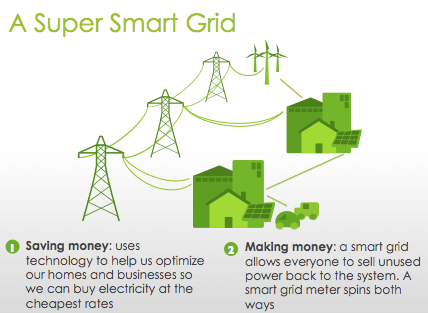 new business opportunities within industries that offer products and services related to the generation of electricity using renewable energy sources, ranging from solar panels and wind turbines to equipment and systems for smart grids.
Feed-in tariff law a boon to renewable energy markets , asahi.com2 Sept 11, Japan’s new clean energy bill offers a tantalizing business bonanza and companies are scrambling to find an edge.The so-called feed-in tariff on renewable energy passed by the Diet on Aug. 26 requires utilities to purchase wind, solar and geothermal energy from households and businesses at above-market rates Continue reading
Children given overdose of diagnostic radioactive substance
X-ray technician overdosed children with radioactive agent ,The Yomiuri Shimbun, 1 Sept, KOFU–-A local hospital said Thursday one of its radiographers had deliberately administered higher-than-recommended amounts of a radioactive substance during examinations of 84 children suffering from kidney ailments since 1999. Continue reading
-
Archives
- October 2026 (104)
- September 2026 (339)
- August 2026 (330)
- July 2026 (355)
- June 2026 (287)
- May 2026 (306)
- April 2026 (356)
- March 2026 (251)
- February 2026 (267)
- January 2026 (308)
- December 2025 (358)
- November 2025 (359)
-
Categories
- 1
- 1 NUCLEAR ISSUES
- business and costs
- climate change
- culture and arts
- ENERGY
- environment
- health
- history
- indigenous issues
- Legal
- marketing of nuclear
- media
- opposition to nuclear
- PERSONAL STORIES
- politics
- politics international
- Religion and ethics
- safety
- secrets,lies and civil liberties
- spinbuster
- technology
- Uranium
- wastes
- weapons and war
- Women
- 2 WORLD
- ACTION
- AFRICA
- Atrocities
- AUSTRALIA
- Christina's notes
- Christina's themes
- culture and arts
- Events
- Fuk 2022
- Fuk 2023
- Fukushima 2017
- Fukushima 2018
- fukushima 2019
- Fukushima 2020
- Fukushima 2021
- general
- global warming
- Humour (God we need it)
- Nuclear
- RARE EARTHS
- Reference
- resources – print
- Resources -audiovicual
- Weekly Newsletter
- World
- World Nuclear
- YouTube
-
RSS
Entries RSS
Comments RSS

