Kaminoseki village election a pointer to nuclear power’s future in Japan
With the national government feeble and divided, the future of nuclear power now is being shaped more in communities where reactors are located or planned.

 Nuclear Power Drives Japan Village Election, Mayor Who Has Backed Reactor Plan Faces Anti-Nuke Challenger, WSJ, By JAMES SIMMS, 22 Sept 11 KAMINOSEKI, Japan—This small fishing village has become the next front in Japan’s battle over nuclear power, with an anti-nuke protester threatening to oust the pro-nuke mayor in an election Sunday.
At stake: the fate of a long-planned reactor for which ground-breaking is supposed to take place next year.
More broadly, the defeat of a mayor whose economic development strategy has centered around a controversial power plant could fuel the country’s increasingly influential anti-nuclear movement. Continue reading
Typhoon and Fukushima’s leaking radioactive water
Typhoon Roke Hits Japan on Track for Leaking Nuclear Power Plant, SF Gate, Tsuyoshi Inajima and Yuriy Humber, September 20, 2011 (Bloomberg) — Typhoon Roke brought evacuation orders, downpours and fears of floods to southern Japan today as it began to traverse the country on a course towards the crippled Fukushima Dai-Ichi nuclear plant……….. Continue reading
Nuclear power plant company a victim of cyber attacks
 Japanese defence contractor Mitsubishi Heavy Industries, which builds submarines, missiles and nuclear power plants, is the first publicly named victim….
Nuclear plant and missile maker Mitsubishi breached in latest cyber attacks, Security Watchdog, 21 Sept 11, Security experts at Trend Micro have uncovered another large-scale, co-ordinated campaign of targeted attacks, this time focused on compromising data at a series of defence industry companies including Mitsubishi Heavy Industries in Japan. Continue reading
Renewable energy prospects:Japan’s nuclear heirarchy failing to convince.
The nuclear village and its hired guns in the academic and administrative and political sectors have worked together to craft a mechanism through which compensation will almost inevitably be torn out of the public budget as well as the pockets of utility ratepayers.
Creating a Solar Belt in East Japan: The Energy Future, Japan Focus , Son Masayoshi with an introduction by Andrew DeWit, 19 Sept 11 Introduction “……..In fact, the fight over Japan’s energy options is not at all ended. The nuclear village’s effort to portray Fukushima as merely a setback has failed in the face of the facts, of course. Continue reading
TEPCO hides information from Japan’s govt nuclear agancy
 Head of nuclear watchdog criticizes TEPCO over blacked-out documents, Paul Langley’s Nuclear History Blog, 19 Sept 11 The head of a government nuclear watchdog has criticized Tokyo Electric Power Co. (TEPCO) for not being transparent enough, after it submitted documents earlier this month that were mostly blacked out. Continue reading
… Are nuclear power plants actually cheap while natural energy is expensive?
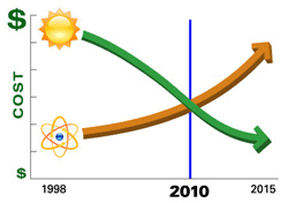 Creating a Solar Belt in East Japan: The Energy Future, Japan Focus , Son Masayoshi with an introduction by Andrew DeWit, 19 Sept 11 ”……… Are nuclear power plants actually cheap while natural energy is expensive? From the standpoint of practical, economical logic, solar power and natural energy are expensive. I had always believed that nuclear power was the most inexpensive way of producing power, at 5-6 yen per kilowatt-hour; therefore we have to use nuclear power and construct new plants. I am sure that many people thought the same.
But is this really true? According to figures listed on an application for approval of the nuclear power plant installation, its unit cost is 15-20 yen. This is the actual data; the pre-accident cost. Continue reading
People’s continued fight to shut down Japan’s nuclear industry
“The government and TEPCO need to admit to the crime they’ve committed. Then they need to work on making amends. This accident was not a natural disaster. It was caused by humans,” mayor, Tamotsu Baba, said……
even though Congressman Takano isn’t getting much support in the Japanese government for his campaign to shut down the country’s nuclear power plants, he is getting more attention from the public, and for now, that’s good enough, as he wants to mostly spread the word on a grassroots level, beyond his community and beyond the Tohoku region…..
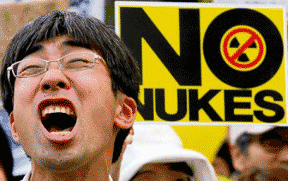 Fighting for a radiation- free Japan, Aj Jazeera, D. Parvaz 16 Sep 2011 Communities in the Tohoku region are struggling for information, decontamination and a say in future policies…. The radiation contamination has created a pristine post-apocalyptic postcard, a place where no one is allowed to live and farmers are forbidden from growing anything. It will be years before the full extent of damage to area residents and ecosystem alike will be known…..” Continue reading
Radiation danger in mushrooms in Japan
 Radiation fears, shipment bans, weigh heavily on mushroom pickers, growers, Mainichi Daily News, 17 Sept 11, The ban on wild mushroom shipments from 43 Fukushima Prefecture municipalities announced on Sept. 15, paired with widespread radiation fears, is discouraging pickers from their usual mushroom-hunting trips into the woods.
The ban came after wild mushrooms containing cesium beyond the legal limit of 500 becquerels per kilogram were found in the prefecture. Tawny milkcap mushrooms containing cesium over the legal limit, meanwhile, have also been found in Takahagi, Ibaraki Prefecture, endangering mushroom-picking in that region as well.
In the town of Tanagura in Fukushima, tawny milkcap mushrooms picked this month were found to contain 28,000 becquerels of cesium, or 56 times the legal limit. The town is famous for matsutake mushroom hunting between the end of September and late October each year….. http://mdn.mainichi.jp/mdnnews/news/20110916p2a00m0na012000c.html
Japan’s nuclear crisis making young Japanese more thoughtful
 young people in Japan have significantly shifted their focus from material gain to altruism….
Previously, the key purpose for finding a career had been to earn money …..respondents said that their views had also changed about nuclear power
Nuclear incidents cause shift in values among young Japanese, Inside Japan Tours, 15th September 2011 A new survey reveals that the earthquake and nuclear disaster that beset Japan earlier this year has led to a shift in attitudes among the country’s young citizens. Continue reading
Roundup of news on severity of Fukushima radiation fallout
 VIDEO http://www.globalresearch.ca/index.php?context=va&aid=26546: New Radiation Releases: Governments Underreported Severity of Fukushima Massive New Radiation Releases Possible from Fukushima … Especially If Melted Core
 Getting rid of Fukushima’s nuclear reactors a tortuous and dangerous task
Tepco also needs to find ways to prevent any new nuclear reaction, which could happen if the fuel is not adequately cooled during the entire process…
 Japan Atomic Energy Body Sees Technical Hurdles Ahead, WSJ, By MITSURU OBE, 14 Sept 11, TOKYO—Japan’s efforts to safely dismantle the stricken Fukushima Daiichi nuclear complex is expected to be fraught with technical challenges and take more than a decade to complete, the government’s Atomic Energy Commission said Wednesday.
Removing the fuel from the spent-fuel pools and the reactors is vital to ensuring there will be no radiation leakage from the quake-ravaged facility. Experts fear that their structures might have been weakened by the heat and radiation from the damaged fuel and the large amount of seawater that was poured into them as an emergency measure to cool down the fuel. Continue reading
Tomioka a nuclear ghost town
Inside Japan’s nuclear ghost zone, By David ShukmanEnvironment & science correspondent, BBC News 13 sept 11, As David Shukman enters the exclusion zone, he finds cattle that have starved to death. Nothing stirs in the empty heart of Tomioka, a community of 16,000 now reduced to the eerie status of a ghost town after the nuclear disaster at Fukushima. Continue reading
Offshore wind turbines for Japan’s Fukushima coast
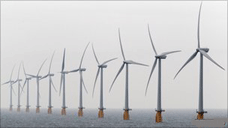 Japan plans floating wind power for Fukushima coast, By Yoko Kubota, TOKYO | Tue Sep 13, 2011 (Reuters) – Japan will join the race to develop floating wind turbines to use in deepwater off its tsunami-stricken northern Pacific coast as it rethinks energy sources after the Fukushima nuclear disaster. It aims to outpace the leaders in the sector in Europe, trade ministry official Masanori Sato said on Tuesday…..
In the next five years, Japan plans to spend 10 to 20 billion yen to install six or more floating turbines off the northeast coast. It will work with firms including Mitsubishi Heavy Industries and Fuji Heavy Industries, Sato said.
Globally, Norway leads the way on floating turbines with a 2009 pilot project while other countries including Britain and Portugal have studied the technology….http://www.reuters.com/article/2011/09/13/us-japan-wind-idUSTRE78C41M20110913
World waits for Fukushima nuclear plant to be brought under control
 “The whole world is waiting for Japan to bring the nuclear accident under control,” said Japan’s new prime minister, Yoshihiko Noda, last Thursday when he visited the plant
6 months into Japan’s cleanup, radiation a major worry, By Craig Dale, CBC News Sep 12, 2011 “……Decontamination The Japanese government is now conducting extensive aerial surveys, from the northeast to the central part of the country, to track the spread of radiation from Fukushima Daiichi. Continue reading
Anxiety in city on border of Fukushima’s no-go zone
Japan city on border of nuclear no-go zone fights for survival, By Antoni Slodkowski, Editing by Tomasz Janowski and Jonathan Thatcher, MINAMI SOMA, Japan Sep 11, 2011 (Reuters) – A line dividing the no-go zone around the Fukushima nuclear plant and the area deemed safe from radiation cuts right across this coastal city but the “good” part is starting to look very much like the ghost town on the other side.
Six months after a magnitude 9.0 earthquake unleashed a deadly tsunami that triggered meltdowns and radiation leaks at the Tokyo Electric Power’s complex, Minami Soma, a city just a half an hour’s drive away, struggles to stay alive. Continue reading
-
Archives
- October 2026 (104)
- September 2026 (339)
- August 2026 (330)
- July 2026 (355)
- June 2026 (287)
- May 2026 (306)
- April 2026 (356)
- March 2026 (251)
- February 2026 (267)
- January 2026 (308)
- December 2025 (358)
- November 2025 (359)
-
Categories
- 1
- 1 NUCLEAR ISSUES
- business and costs
- climate change
- culture and arts
- ENERGY
- environment
- health
- history
- indigenous issues
- Legal
- marketing of nuclear
- media
- opposition to nuclear
- PERSONAL STORIES
- politics
- politics international
- Religion and ethics
- safety
- secrets,lies and civil liberties
- spinbuster
- technology
- Uranium
- wastes
- weapons and war
- Women
- 2 WORLD
- ACTION
- AFRICA
- Atrocities
- AUSTRALIA
- Christina's notes
- Christina's themes
- culture and arts
- Events
- Fuk 2022
- Fuk 2023
- Fukushima 2017
- Fukushima 2018
- fukushima 2019
- Fukushima 2020
- Fukushima 2021
- general
- global warming
- Humour (God we need it)
- Nuclear
- RARE EARTHS
- Reference
- resources – print
- Resources -audiovicual
- Weekly Newsletter
- World
- World Nuclear
- YouTube
-
RSS
Entries RSS
Comments RSS

