Independent inquiry: did earthquake first damage Fukushima’s nuclear reactors?
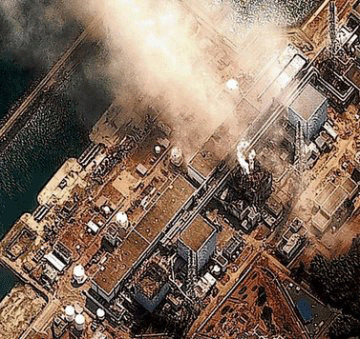 The panel includes legal, nuclear and medical experts. Seismologist Katsuhiko Ishibashi has long warned of tsunami risks in the earthquake-prone country where all 54 nuclear reactors are built on the coastline. Engineer Mitsuhiko Tanaka designed nuclear reactors at Babcock-Hitachi K.K. and has suggested the March quake damaged the Fukushima reactors before the tsunami.
New probe to cut deeper in Japan nuclear crisis17 JAN 2012 3 News New Zealand, By Mari Yamaguchi

http://www.3news.co.nz/New-probe-to-cut-deeper-in-Japan-nuclear-crisis/tabid/417/articleID/239500/Default.aspx A newly formed investigative panel on Japan’s nuclear disaster will use its subpoena powers wisely and cut deeper into the accident than the government’s probe, according to the leader of the independent commission.
The panel appointed by parliament last month has gained attention here because its 10 members include outspoken critics of Japan’s nuclear policy who long ago questioned the seismic risks to the country’s 54 nuclear reactors.
It is expected to examine the extent to which the 9.0-magnitude earthquake contributed to the crisis at the Fukushima Dai-ichi power plant, as well as the ensuing tsunami and radiation alert system. Continue reading
Japan to pass landmark renewable energy law
Renewable Energy Boom About to Start in Japan, Oil Price.com By Energy Digital, 17 January 2012 Japan’s Parliament readies approval of an energy bill that will spark ‘explosive growth’ in renewable solar and wind
Solar and wind companies, set your sails for Japan! The country is about to pass a landmark bill into law that will see “explosive growth” in both solar and wind energy investment according to Prime Minister Naoto Kan. The bill is designed to reduce Japan’s dependence on nuclear power, which accounts for roughly 30 percent of the country’s energy generation. Japanese lawmakers are readying to sign the bill into law by the end of August.
The bill has been developed and promoted by Prime Minister Kan himself, and seeks not only to move away from nuclear dependence, but also break the energy monopoly held by the country’s 10 major utilities.
The legislation calls for installed renewable energy capacity to rise by at least 20 percent of the country’s total power by the early 2020s.
The bill will require utilities to purchase power from outside providers, such as cooperatives and private companies. The rule aims to promote the use of alternative energy sources, which currently only make up 9 percent of Japan’s total electricity supply….. http://oilprice.com/Alternative-Energy/Renewable-Energy/Renewable-Energy-Boom-About-To-Start-In-Japan.html
Community struggle to get a referendum on nuclear power in Japan
Civic group battles to get support for referendums on nuclear power in Tokyo, Osaka. Mainichi Daily News, 11 Jan 12, A civic group has been fighting an uphill battle to collect enough signatures for petitions to hold referendums in Tokyo and Osaka on whether Japan should continue to rely on nuclear power despite the ongoing crisis at the Fukushima No. 1 Nuclear Power Plant. Continue reading
Fukushima radiation cleanup might cause environmental damage
Ten months after the nuclear disaster, trust in the authorities is nearly non-existent. Without it, Japan’s government risks the biggest cleanup fiasco of all: a decontamination effort that carries huge financial and environmental costs but still fails to convince Fukushima residents that their homes, farms, and forests are safe once again.
Fukushima nuclear cleanup could create its own environmental disaster
Decontaminating the Fukushima region to remove radioactive particles will not be possible without removing large amounts of soil, leaves and plants Winifred Bird for Yale Environment 360, part of the Guardian Environment Network guardian.co.uk, 9 January 2012 Following the nuclear disaster at Chernobyl 25 years ago, the Soviet government chose long-term evacuation over extensive decontamination; as a result, the plants and animals near Chernobyl inhabit an environment that is both largely devoid of humans and severely contaminated by radioactive fallout.
The meltdown last March of three nuclear reactors at the Fukushima Daiichi nuclear power plant in Japan also contaminated large areas of farmland and forests, albeit not as severely or extensively as at Chernobyl. But lacking land for resettlement and facing public outrage over the accident, the Japanese government has chosen a very different path, embarking on a decontamination effort of unprecedented scale.
Beginning this month, at least 1,000 sq km of land — much of it forest and farms — will be cleaned up as workers power-spray buildings, scrape soil off fields, and remove fallen leaves and undergrowth from woods near houses. The goal is to make all of Fukushima livable again. But as scientists, engineers, and ordinary residents begin this massive task, they face the possibility that their efforts will create new environmental problems in direct proportion to their success in remediating the radioactive contamination. Continue reading
Japanese towns Okuma, Futaba to disappear because of nuclear radiation
many spots in the two towns where annual levels of exposure to radiation would be 100 millisieverts or higher. This is at least five times higher than the level deemed safe for human habitation.
 2 towns at risk of disappearing / Okuma, Futaba face uncertain future due to nearby crippled N-plant Yasushi Kaneko / Daily Yomiuri 9 Jan 12, How will the government help the estimated 25,000 people who lived in areas where residency likely will be prohibited for an extended period due to the crisis at the Fukushima No. 1 nuclear power plant?
In particular, Okuma and Futaba towns in Fukushima Prefecture will face extreme hardship because most of their residential areas fall in those areas. The crippled nuclear plant is located in the two towns. Continue reading
Japan: taxpayers to take on nuclear costs, companies to keep profits?
Fukushima exposes contradictions / Nuclear crisis prompts govt to rethink private companies’ operation of N-plants Hiroshi Ikematsu / Yomiuri Shimbun, 7 Jan 12
The government’s moves to overhaul the state’s nuclear policy were prompted by serious contradictions discovered in that policy, as a result of the nuclear crisis at the Fukushima No. 1 nuclear power plant.
Although the Law on Compensation for Nuclear Damage stipulates that electric companies have unlimited liability in the case of accidents, the government had no choice but to support Tokyo Electric Power Co.’s efforts to pay compensation for damage caused by the Fukushima crisis. Therefore, the government plans to overhaul the law, including a review of utilities’ unlimited liability.
If it does so, however, entrusting utility companies with the operation of cost-efficient nuclear power plants, the companies may just siphon off profits and push the risk of accidents onto the
state……. http://www.yomiuri.co.jp/dy/national/T120106005620.htm
Corruption to continue in Japan’s nuclear industry?
the official who ordered the cover-up of the data is now responsible for working out safety measures at nuclear plants
 Cover-up of estimated costs to dispose of radioactive waste raises serious questions, Mainichi Daily News, By Tadashi Kobayashi, Kenji Shimizu and Seiichi Ota, Mainichi Shimbun 2 Jan 2012, Revelations that officials from the Agency for Natural Resources and Energy concealed the estimated costs of disposing of spent nuclear fuel highlights the distorted logic of government officials who stick to reprocessing radioactive waste even by lying.
The cover-up is essentially similar to a case in which some high-ranking government officials hid a 2002 Russian diplomatic document in which Moscow offered to accept spent nuclear fuel from Japan, in that both helped promote the reprocessing of radioactive waste at a plant in Rokkasho, Aomori Prefecture. Continue reading
74% of Japanese want to close nuclear power, but govt tied to nuclear industry
 Japanese Don’t Want a Nuclear Future: The Ticker, Bloomberg, William Pesek, 5 Jan “……..In a June Asahi newspaper poll, 74 percent favored Japan over time decommissioning all 54 reactors. Actions by the government, reinforced by Prime MinisterYoshihiko Noda‘s press conference today, suggest the opposite is afoot. Japanese want a nuclear-free future, and yet the government is back to coddling the power industry.
Why the disconnect? Japan’s nuclear-industrial complex is every bit as powerful as the nexus of business and the military in the U.S. There’s just too much money involved, and Japan’s “nuclear village” is circling the wagons. The moment Noda’s predecessor, Naoto Kan, announced plans to rein in the industry’s incestuous ties with government bureaucrats, his premiership was over. Continue reading
Japan’s nuclear power industry gave money to nuclear regulators
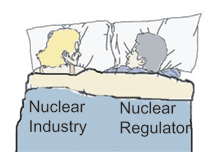
Nuclear safety panel given donations, 9 News 2 Jan 12, Almost one-third of commissioners and examiners at Japan’s nuclear safety commission received donations from the country’s nuclear power industry, the Asahi Shimbun reported on Sunday.
The daily said the governmental commission’s neutrality could be brought into question at a time when the safety of nuclear reactors in Japan was in doubt after a March 11 earthquake and tsunami disaster…..

Two of the organisation’s five permanent commissioners and 22 of its 84 outside examiners received donations from companies and industrial organisations related to nuclear power, in five years to March 2011, Asahi said.
The donations totalled about Y85 million ($1.08 million), the daily said. Of them, 11 received donations from nuclear reactor manufacturers and, or, power utilities and nuclear fuel companies which are examined by the commission, Asahi said.
The commission is authorised to guide the state and power utilities from a neutral position.
Haruki Madarame, chairman of the commissioners, received four million yen from Mitsubishi Heavy Industries between 2006 and 2009 when he was a professor at the University of Tokyo before assuming the commission’s post last April, Asahi said….. http://news.ninemsn.com.au/world/8397277/nuclear-safety-panel-given-donations
Ionising radiation and thyroid cancer
 Vital Signs: Thyroid questions answered. The Daily Progress January 01, 2012 The terrible earthquake in Japan, and the resulting nuclear meltdowns, again have placed thyroid cancer in the news. There is a very close link between radiation exposure and thyroid cancer, and it is likely that Japan will see a sharp increase in aggressive thyroid cancers in the coming years, as was the case in Russia after the Chernobyl disaster in 1986.
Here in the United States, there was an increase in thyroid cancer following the nuclear testing in the 1950s in the Southwest. Though we have ceased such open-air testing, there are still numerous ways to be exposed to radiation, such as by receiving radiation therapy for cancer. And there is also a natural incidence of thyroid cancer unrelated to radiation exposure.
January is Thyroid Awareness Month, so it’s an apt time to discuss the thyroid, thyroid cancer and other thyroid conditions……. There are aggressive forms of thyroid cancer unrelated to radiation exposure, but they are very rare and typically occur in older males…. http://www2.dailyprogress.com/lifestyles/2012/jan/01/vital-signs-thyroid-questions-answered-ar-1575329/
As radioactivity lingers, most of Japan’s evacuees not returning home
 “We can’t go home even if we want to, out of consideration for our children,”
More than half of nuclear radiation zone evacuees in Japan have yet to return home, The Australian Eye, By Nigel Shelbourne, December 31, 2011 FUKUSHIMA, Japan _ Fifty-four percent of evacuees from areas between 20 and 30 kilometers (12.5 and 18.6 miles) of the Fukushima No. 1 nuclear power plant in Japan have yet to return home, three months after the government lifted its emergency evacuation preparation zones. Continue reading
Japan’s nuclear industry is a black hole of criminal corruption.
 When asked what were the major differences between the yakuza and TEPCO the same Senator paused for a minute. “The primary difference between TEPCO and the yakuza is they have different corporate logos.” He explained, “They both are essentially criminal organizations that place profits above the safety and welfare of the residents where they operate; they both exploit their workers
 The Yakuza and the Nuclear Mafia: Nationalization Looms for TEPCO Atlantic Wire, JAKE ADELSTEIN, 31 Dec 11, Tokyo Electric Power Company (TEPCO), the monolithic corporation that controls all electric power in Greater Tokyo, and runs the Fukushima Daichii nuclear plant that experienced a triple meltdown following the March 11 earthquake, is on the brink of nationalization according to Japanese government sources.
The official reason is that the firm may not be able to handle the massive compensation payments it owes to victims of the meltdown without going bankrupt.
Unofficially, the firm has such long-standing ties to anti-social forces, including the yakuza—that some members of the Diet, Japan’s national legislature, feel the firm is beyond salvation and needs to be taken over and cleaned up. A Japanese Senator with the Liberal Democratic Party stated on background, “TEPCO’s involvement with anti-social forces and their inability to filter them out of the work-place is a national security issue. It is one reason that increasingly in the Diet we are talking de facto nationalization of the company. Nuclear energy shouldn’t be in the hands of the yakuza. They’re gamblers and an intelligent person doesn’t want them to have atomic dice to play with.”
In June we reported that yakuza were working at the Fukushima nuclear power plant as cleanup crews and manual labor, but the post-meltdown yakuza ties were only the tip of the iceberg. This month, a new book was published, Yakuza and The Nuclear Industry: Diary of An Undercover Reporter Working at the Fukushima Plant (ヤクザと原発-福島第一潜入記-鈴木-智彦) in which a former yakuza fan magazine editor Tomohiko Suzuki reports on the nuclear business-industrial-political and media complex in Japan known as the “nuclear mafia” and Japan’s actual mafia: the yakuza. The book is already generating controversy and renewed examination of Japan’s “dark empire” and its ties to the underworld. It presents more solid pieces of evidence that Japan’s nuclear industry is a black hole of criminal malfeasance, incompetence, and corruption. Continue reading
Tepco’s history of crookedness culminated in Fukushima nuclear disaster
The containment vessel was never designed to withstand an earthquake. Reactor one is 40 years old, it should have been shut down ten years ago. What was the Japanese government thinking when they gave them firm permission to extend the reactor life for another ten years? And that TEPCO had the audacity to ask, should tell you how close their ties are to the Japanese government.”
TEPCO: Will Someone Turn Off the Lights?JAKE ADELSTEIN AND STEPHANIE NAKAJIMA JUN 28, 2011 “……..The meltdown began on March 11, the day a 9.0 magnitude earthquake devastated Japan. For the first day, TEPCO strongly denied any problems at the plant but by March 12, reactor one had already melted down. Each subsequent day brings more news of radiation leaking from the plant and mistakes, cover-ups, and corporate malfeasance by TEPCO. Slowly voices within and outside the Japanese government are beginning to suggest that it’s time to dismantle the company and put their nuclear plants under government supervision; books highly critical of the firmare becoming best sellers.
TEPCO has become a symbol of everything that is wrong with the nation of Japan: cronyism, collusion, gentrification, corruption, weak regulation, and entropy. Despite being in the spotlight for the worst nuclear disaster since Chernobyl, TEPCO continues to engage in questionable labor practices, and has escaped bankruptcy in closed-door meetings with politicians, and through denying culpability has shifted part of the reparations burden onto taxpayers – deeds which testify to the extent to which TEPCO still has plenty of political power, if not as much nuclear power…… Continue reading
Fukushima hospitals cut services as funds dry up
Fukushima hospitals in financial strife / Services being cut as medical facilities’ losses top 12 billion yen due to nuclear crisis Joji Takagai / Yomiuri Shimbun 31 Dec 11, FUKUSHIMA–-Hospitals in Fukushima Prefecture are facing financial strain–and cutting services–due to the ongoing impact of the crisis at Tokyo Electric Power Co.’s Fukushima No. 1 nuclear power plant. Continue reading
Japan’s mothers using social media to pursue concerns about radiation
 Can Web-savvy activist moms change Japan? Times of India AP | Dec 29, 2011 TOKYO: Japan’s nuclear crisis has turned Mizuho Nakayama into one of a small but growing number of internet-savvy activist moms.
Worried about her 2-year-old son and distrustful of government and TV reports that seemed to play down radiation risks, she scoured the Web for information and started connecting with other mothers through Twitter and Facebook, many using social media for the first time. Continue reading
-
Archives
- October 2026 (91)
- September 2026 (339)
- August 2026 (330)
- July 2026 (355)
- June 2026 (287)
- May 2026 (306)
- April 2026 (356)
- March 2026 (251)
- February 2026 (267)
- January 2026 (308)
- December 2025 (358)
- November 2025 (359)
-
Categories
- 1
- 1 NUCLEAR ISSUES
- business and costs
- climate change
- culture and arts
- ENERGY
- environment
- health
- history
- indigenous issues
- Legal
- marketing of nuclear
- media
- opposition to nuclear
- PERSONAL STORIES
- politics
- politics international
- Religion and ethics
- safety
- secrets,lies and civil liberties
- spinbuster
- technology
- Uranium
- wastes
- weapons and war
- Women
- 2 WORLD
- ACTION
- AFRICA
- Atrocities
- AUSTRALIA
- Christina's notes
- Christina's themes
- culture and arts
- Events
- Fuk 2022
- Fuk 2023
- Fukushima 2017
- Fukushima 2018
- fukushima 2019
- Fukushima 2020
- Fukushima 2021
- general
- global warming
- Humour (God we need it)
- Nuclear
- RARE EARTHS
- Reference
- resources – print
- Resources -audiovicual
- Weekly Newsletter
- World
- World Nuclear
- YouTube
-
RSS
Entries RSS
Comments RSS

