Jan’s govt suggests nationalising Tepco, at least temporarily
Tepco asked to consider temporary state control, BBC News 27 Dec 11 Tokyo Electric Power Company (Tepco), which operates Japan’s disaster-hit nuclear plant, has been asked to consider temporary state control. Energy minister Yukio Edano suggested it as one possible way to try to strengthen its financial position. Continue reading
Tepco asks Japan’s government for additional 6 billion pounds
Japan‘s biggest utility, known as Tepco, faces costs of trillions of yen for compensation and cleanup, and the Japanese government agreed only two months ago to provide £7bn through a bailout fund. Continue reading
New report on the continuing nuclear disaster at Fukushima
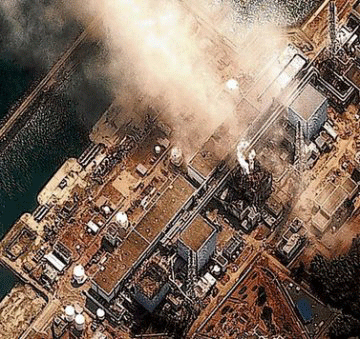 Nuclear disaster response failed: report 9 News Dec 26 2011 Yuri Kageyama Japan’s response to the nuclear crisis that followed the March 11 tsunami was confused and riddled with problems, a report revealed on Monday. The response included an erroneous assumption that an emergency cooling system was working and a delay in disclosing dangerous radiation leaks.
The disturbing picture of harried and bumbling workers and government officials scrambling to respond to the problems at Fukushima Dai-ichi nuclear power plant was depicted in the report detailing a government investigation……
Sadder still was how the government dallied in relaying information to the public, such as using evasive language to avoid admitting serious meltdowns at the reactors, the report said.
The government also delayed disclosure of radiation data in the area, unnecessarily exposing entire towns to radiation when they could have evacuated, the report found.
The government recommended changes so utilities will respond properly to serious accidents.
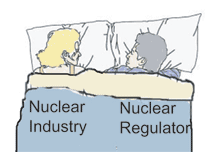
It recommended separating the nuclear regulators from the unit that promotes atomic energy, echoing frequent criticism since the disaster, which left 20,000 people dead or missing.
Japan’s nuclear regulators were in the same ministry that promotes the industry, but they will be moved to the environment ministry next year to ensure more independence.
The report acknowledged people were still living in fear of radiation spewed into the air and water, as well as radiation in the food they eat. Thousands have been forced to evacuate and have suffered monetary damage from radiation contamination, it said.
“The nuclear disaster is far from over,” the report said.
http://news.ninemsn.com.au/world/8395190/japan-probe-finds-nuclear-disaster-respons
The continuing human cost of Fukushima’s continuing radiation
Enduring the nuclear winter, Irish Times, 26 Dec 11“……..More than 100,000 people have been displaced due to radiation around Fukushima Prefecture, home to the crippled Daiichi nuclear plant. Those who stay keep children indoors for much of the day. Others, such as single mother Kanako Nishitaka from Fukushima City, have fled in an attempt to find normality in a different part of the country.
“My daughter is smaller and closer to the ground, so she absorbed more radiation,” she says. “They found caesium in her body. I was told it was about the same amount as people exposed to nuclear bomb tests. When I told my son we were moving, he cried his eyes out because he
didn’t want to leave his friends.”
Many doubt the immediate area around the plant will ever again be habitable. The Daiichi plant will become an unwanted monument to Japan’s nuclear ambitions for years to come, while the cost of dismantling its reactors and supporting its victims will haunt future
governments…….” http://www.irishtimes.com/newspaper/features/2011/1227/1224309514995.html
78% of Japanese do not believe that Fukushima nuclear plant crisis is over
78 percent of poll participants did not accept Noda’s announcement this month of the effective end of the accident at the Fukushima Daiichi nuclear plant,

 Japan PM’s public support plunges Channel Asia News 26 December 2011 TOKYO: Support for Japan’s primeminister plunged in December as voters lost faith in his leadership, amid party turmoil and criticism over his handling of the nuclear crisis, a poll said Monday. Continue reading
Japan taking a moral position about the unsafety of India’s nuclear plants!
Japan likely to speak out on N-plants’ safety during talks with India The Pioneer, 22 DECEMBER 2011 SANDHYA SHARMA | NEW DELHI Japan will voice concerns over the safety of nuclear plants with India as two Prime Ministers Manmohan Singh and his Japanese counterpart Yoshihiko Noda are set to meet in New Delhi next week for the 6th Annual Summit between the two leaders.
The two sides will enhance the cooperation in nuclear sector despite the Fukushima disaster that rocked Tokyo last year….. even less than a year to the Fukushima Daiichi nuclear accident, Japan is recommencing steps it hopes will lead to exports of commercial nuclear technology to counties like India and Vietnam. This resumption comes even as Japan itself is scaling back the use of nuclear energy
at home.
Japan’s ruling Democratic Party is promoting nuclear technology exports as a pillar of its economic growth strategy. The earthquake in March with ensuing accident at the Fukushima Daiichi power plant led to a suspension of negotiations with India toward accords on the
transfer of nuclear energy technology.
New Delhi on the other hand is facing the flack from the locals over the commencement of the Kudankulam nuclear plant which is a joint Indo-Russian collaboration project following the Fukushima disaster….http://dailypioneer.com/nation/29789-japan-likely-to-speak-out-on-n-plants-safety-during-talks-with-india.html
Japan trying to sell nuclear technology to India
India, Japan PMs to meet today, N-trade tops agenda Times of India, Sachin Parashar, TNN | Dec 27, 2011, NEW DELHI: Despite the Japanese Parliament, Diet, clearing Japan’s civil nuclear cooperation with four other countries allowing it to resume its supply of nuclear reactors, India remains uncertain about the resumption of its own negotiations for such cooperation with Tokyo.
Ahead of Japanese PM Yoshihiko Noda’s visit to India on Tuesday for the 6th annual India-Japan summit, officials said the issue would be taken up in Noda’s meeting with his counterpart Manmohan Singh, but added that it was not possible to say what the outcome would be…..http://timesofindia.indiatimes.com/india/India-Japan-PMs-to-meet-today-N-trade-tops-agenda/articleshow/11261201.cms
Fukushima radiation in Japan’s mushrooms and forests
 Radiation fears spread to forest industry SHIROISHI, Mainichi Daily News, 26 Dec 11 Miyagi –– Radiation fears stemming from the ongoing crisis at the Fukushima No. 1 Nuclear Power Plant and radiation monitoring activities are raising concern among people handling trees to grow mushrooms and make charcoal.
Forest workers are very concerned about any potential fallout from the nuclear crisis because they have to independently monitor radiation before applying to the plant operator, Tokyo Electric Power Co. (TEPCO), for compensation, unlike farmers and fishermen who have
standing in law.
Decontamination work in the mountains is said to be much more difficult than on flat land Continue reading
Victims of low level radiation wain legal cases in Japan
 The 1986 nuclear accident at Chernobyl in Ukraine deepened the understanding of internal exposure. When thyroid cancer surged among children there, it was traced to contaminated cows’ milk they had consumed. ..
Since 2006, about 300 hibakusha [in Japan] have won in 30 class-action suits nationwide. In many, judges ruled “early entrants” should also get benefits. In effect, this was the first official acknowledgment that internal exposure could cause health problems, given that these people weren’t exposed to the blasts, but to later fallout.
Discovery of radiation in autumn rice crops from Fukushima has put people on alert. …..
Extended low-level exposure might actually be more hazardous than a one-time blast if a brief, high dose just kills cells, whereas internal exposure could damage them even at low levels, ultimately causing cancer.

 Past Haunts Tally of Japan’s Nuke Crisis, WSJ By YUKA HAYASHI, 23 Dec 11 KASHIWA, Japan—The struggle to understand the health consequences of the Fukushima Daiichi nuclear meltdown carries an eerie echo of Japan’s past: The nation is still debating who is a victim of the atomic bombs that destroyed Hiroshima and Nagasaki in World War II.
On Wednesday, in the latest in a series of high-profile lawsuits, four of five people who were exposed to radiation from the bombings—but weren’t present at the actual blasts—won official recognition as victims. Until recent years, Japan held that only people who experienced the actual blasts at close range were victims, because secondary radiation posed negligible danger.
This debate resonates today because many potential victims of the Fukushima disaster will have received only secondary radiation, for instance from eating tainted food or inhaling dust. Continue reading
Mothers are turning out to be a threat to the nuclear industry’s future
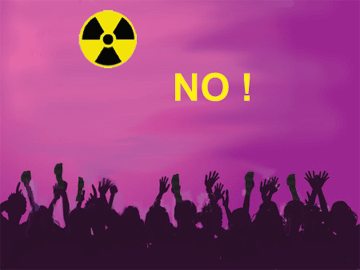 The leadership of women in civic movements is also unprecedented. Mothers have been leading the demonstrations, with many of them coming out for the first time to gain sympathy and support for their campaign to prevent exposing children to the dangers of radiation…..
Mothers Rise Against Nuclear Power , IPS News, By Suvendrini Kakuchi TOKYO, Dec 22, 2011 – Japan’s nuclear power industry, which once ignored opposition, now finds its existence threatened by women angered by official opaqueness on radiation from the Fukushima Daiichi nuclear plant after it was struck by an earthquake- driven tsunami on Mar. 11.
“Mothers are at the forefront of various grassroots movements that are working together to stop the operation of all nuclear plants in Japan from 2012,” Aileen Miyoko Smith, head of Green Action, a non- governmental organisation (NGO) that promotes renewable energy told IPS. Continue reading
Japan’s coverup of public health risk from radioactive fallout
Public health fallout from Japanese quake, CMAJ, Lauren Vogel, 22 Dec 11, A “culture of coverup” and inadequate cleanup efforts have combined to leave Japanese people exposed to “unconscionable” health risks nine months after last year’s meltdown of nuclear reactors at the Fukushima Dai-ichi power plant, health experts say.
Although the Japanese government has declared the plant virtually stable, some experts are calling for evacuation of people from a wider area, which they say is contaminated with radioactive fallout.
They’re also calling for the Japanese government to reinstate internationally-approved radiation exposure limits for members of the public and are slagging government officials for “extreme lack of transparent, timely and comprehensive communication.” Continue reading
“cold shutdown” – incorrect words to hide the truth on Fukushima
News of a “cold shutdown” sounds like a PR smokescreen.
Redefining “Cold shutdown” doesn’t hide the truth about Fukushima Greenpeace, by Justin McKeating – December 20, 2011 The Japanese authorities stated last Friday that Fukushima is in a state of “cold shutdown. This is not true. At first glance, the announcement that the stricken nuclear reactors are now “stable” sounds like some rare good news from the disaster zone. Not at all. As we all know, first impressions can be deceptive.
The industry definition of “cold shutdown” means that the temperature inside a nuclear reactor has stabilized below 95℃ from the hellish temperatures of the nuclear fission process. In the case of Fukushima, this suggests the crisis is over. Nothing could be further from the truth.
In fact, the Japanese authorities have cheated by redefining “cold shutdown” to suit the situation at Fukushima. Continue reading
Japanese taxpayers to take over Tepco Electric Power Company
 Japan to take over two thirds stake in Tepco: report (Reuters) by Nobuhiro Kubo and James Topham; Editing by Edwina Gibbs, 21 Dec 11– The Japanese government plans to take a stake of more than two-thirds in Tokyo Electric Power Co (9501.T) in a de facto nationalization of the operator of the crippled Fukushima nuclear power plant, the Yomiuri newspaper said on Wednesday. Continue reading
Nationalise Fukushima nuclear plant – to get to the truth- says Japan’s former Prime Minister
Hatoyama: Nationalize Fukushima N-plant The Yomiuri Shimbun, 18 Dec 11 Only by bringing the Fukushima No. 1 nuclear power plant into government hands can scientists thoroughly discover what caused the nuclear crisis, former Prime Minister Yukio Hatoyama says in an article published in the Dec. 15 issue of the British science journal Nature.
In the two-page article coauthored by Hatoyama and Tomoyuki Taira, a fellow Democratic Party of Japan member of the House of Representatives, Hatoyama said the Fukushima plant “must be nationalized so that information can be gathered openly.”
“A special science council should be created to help scientists from various disciplines to work together on the analyses,” he said. “Through such a council, the technologies needed for decommissioning and decontamination…can be developed.”
It is extremely rare for a major science journal to carry an article written by a former prime minister as a cover story, according to an official of Nature Japan.
In the article, Hatoyama criticizes Tokyo Electric Power Co., the operator of the crippled plant, for disclosing only limited information to Diet committees. He also hints at the possibility of recriticality at the plant and says there is still much about the crisis that needs clarification, including the state of the molten fuel within the nuclear reactors.
Hatoyama also says that he and Taira obtained data on samples of contaminated water TEPCO obtained from the basement of the plant’s No. 1 reactor and asked an outside research institute to reanalyze them…. http://www.yomiuri.co.jp/dy/national/T111215005428.htm
Working at Fukushima nuclear plant likely to be a death sentence?
Government was likely avoiding the huge task of evacuating major cities like Iwaki and Fukushima.
He also expressed concern for those working to recover the plant. He said: “Working at Fukushima is equivalent to being given an order to die”…..
Fukushima nuclear shutdown: ‘No progress is being made’ ZDNet By Hana Stewart-Smith | December 16, 2011, Summary: The Japanese government says that troubled nuclear plant
Fukushima is under control. But an undercover journalist suggests that no progress is being made towards recovery.
The Japanese government announced publicly today that the troubled Fukushima plant is now under control, having achieved a ‘cold shutdown‘….This is reassuring news for the public after the reactor sprung a leak earlier this month, pouring out an estimated 45 tonnes
of radioactive water, which may have reached the sea….
However, freelance journalist Tomohiko Suzuki, who worked undercover at Fukushima for over a month, disputed this news. Suzuki spoke to reporters at a Foreign Correspondents’ Club of Japan conference yesterday, telling a very different story to the one officially given
by the Government. Continue reading
-
Archives
- October 2026 (91)
- September 2026 (339)
- August 2026 (330)
- July 2026 (355)
- June 2026 (287)
- May 2026 (306)
- April 2026 (356)
- March 2026 (251)
- February 2026 (267)
- January 2026 (308)
- December 2025 (358)
- November 2025 (359)
-
Categories
- 1
- 1 NUCLEAR ISSUES
- business and costs
- climate change
- culture and arts
- ENERGY
- environment
- health
- history
- indigenous issues
- Legal
- marketing of nuclear
- media
- opposition to nuclear
- PERSONAL STORIES
- politics
- politics international
- Religion and ethics
- safety
- secrets,lies and civil liberties
- spinbuster
- technology
- Uranium
- wastes
- weapons and war
- Women
- 2 WORLD
- ACTION
- AFRICA
- Atrocities
- AUSTRALIA
- Christina's notes
- Christina's themes
- culture and arts
- Events
- Fuk 2022
- Fuk 2023
- Fukushima 2017
- Fukushima 2018
- fukushima 2019
- Fukushima 2020
- Fukushima 2021
- general
- global warming
- Humour (God we need it)
- Nuclear
- RARE EARTHS
- Reference
- resources – print
- Resources -audiovicual
- Weekly Newsletter
- World
- World Nuclear
- YouTube
-
RSS
Entries RSS
Comments RSS

