Radioactive cesium contamination in Japan
 Fukushima Nuclear Crisis Update for February 28th – March 1st, 2012, Greenpeace by Christine McCann – March 2, 2012 “……..Contamination (Includes Economic Impact and Human Exposure) A study by the Meteorological Research Institute estimates that 40,000 trillion (or 40 quadrillion) Becquerels of radioactive cesium were released as a result of the Fukushima Daiichi nuclear disaster last March. That amount is two times what scientists originally estimated.
Consumers are expressing concern about cesium contamination in rice, in light of a government decision to relax new rules about contamination levels of planting soil after local farmers exerted pressure on the government to do so. In December, the Ministry of Agriculture, Forestry, and Fisheries ruled that rice could not be planted in land where cesium exceeding 100 Bq/kg was discovered last year. However, it now says that rice may be planted in land where cesium measures between 100 Bq/kg and 500 Bq/kg, provided that the land is decontaminated and every bag of rice is tested. Many residents remain unconvinced that the rice will be safe for consumption. The chair of a national consumer advocacy association noted, “There have already been cases of rice with contamination over the government limit being shipped, even though it was promised that it wouldn’t happen. Won’t some sneak through this time as well?….” http://www.greenpeace.org/international/en/news/Blogs/nuclear-reaction/fukushima-nuclear-crisis-update-for-february-/blog/39340/
Current status of Fukushima’s nuclear reactors
Fukushima Nuclear Crisis Update for February 28th – March 1st, 2012, Greenpeace by Christine McCann – March 2, 2012“”…..Reactor Status The Fukushima Daiichi plant chief, Takeshi Takahashi, admitted this week that the plant is fragile, and its reactors remain highly vulnerable to ongoing earthquakes and the risk of a tsunami. “I have to admit that it’s still rather fragile. Even though the plant has achieved what we call cold-shutdown conditions, it still causes problems that must be improved,” Takahashi said.
TEPCO is continuing to struggle with how to handle large amounts of radioactive water, the byproduct of keeping nuclear fuel in the crippled Fukushima Daiichi reactors cool. The utility is pumping several hundred thousand gallons of water into the reactors each day; the water then becomes contaminated. Experts estimate that 10,000 tons of radioactive water leak from the reactors each month; in January and February alone, 28 new leaks were discovered. TEPCO says it will take at least six years to repair the leaks, and approximately 25 years to remove the fuel. Storage of the radioactive water is becoming an increasingly urgent issue. TEPCO currently has space to store 165,000 tons; 125,000 tons are already being stored. The utility has destroyed nearby forests to create room for more storage containers.
TEPCO announced that Quince II, a Japanese-made robot, has discovered radiation levels measuring 220 millisieverts per hour in reactor #2 at the Fukushima Daiichi plant. The robot, which was designed by researchers at the Chiba Institute of Technology, was created to explore the interior of the Fukushima Daiichi nuclear reactors, where radiation levels remain too high for humans to enter. http://www.greenpeace.org/international/en/news/Blogs/nuclear-reaction/fukushima-nuclear-crisis-update-for-february-/blog/39340/
Humans can’t enter. Robot finds high radiation in Fukushima No.2 reactor
 Robot detects high radiation levels at Fukushima Daiichi plant, Mainichi Daily News, 29 Feb 12, TOKYO (Kyodo) –– A remotely operated robot has detected high radiation levels of up to 220 millisieverts per hour at the crippled Fukushima Daiichi nuclear power plant’s No. 2 reactor building, plant operator Tokyo Electric Power Co. said Tuesday.
The Japanese-made Quince 2 robot, which began checking radiation levels on Monday, was exposed to 153 millisieverts of radiation in just less than three hours of operation, according to the utility.
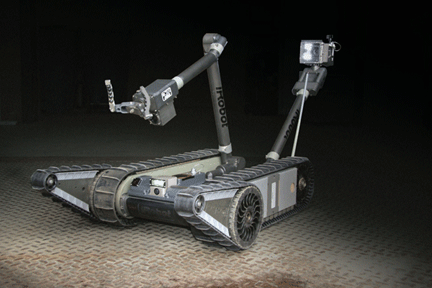
“It is difficult for a human being to go inside and do work,” a Tokyo Electric official said of conditions inside the reactor building, adding that the humidity inside is also high at around 70 percent…. http://mdn.mainichi.jp/mdnnews/news/20120229p2g00m0dm056000c.html
Japan has no solution to disposing of its nuclear wastes
The country is yet to build a final disposal site for nuclear fuel.
Meanwhile, Katsutaka Idogawa, mayor of the town of Futaba in Fukushima Prefecture, which hosts the troubled Daiichi plant, criticized the panel for drafting a new atomic energy policy platform before an investigation into the cause of the nuclear crisis is concluded…..
 Panel calls for study on direct disposal of spent nuclear fuel, Mainichi Daily News, 29 Feb 12, Nothing is decided yet but TEPCO told the press at its Tokyo headquarters Wednesday morning that this is one option TEPCO officials are considering to use at the tsunami-stricken Fukushima Dai-ichi nuclear power plant in Okuma town in Fukushima Prefecture, northeastern Japan.
TOKYO (Kyodo) — A government panel commissioned to compile the country’s basic atomic energy policy said in its draft nuclear power platform Tuesday that Japan should study the possibility of burying spent nuclear fuel deep underground, instead of the current disposal
method of reprocessing spent fuel. Continue reading
Danger continues at Fukushima nuclear plant
Employees usually work for about two to three hours at a time, but in some areas, including highly contaminated Unit 3, they can stay only a few minutes…..
“We were just lucky that Japan was able to avoid the worst-case scenario. But
there is no guarantee this kind of luck will prevail next time.”
Japan nuclear plant still fragile: chief, SMH, February 29, 2012, Japan’s tsunami-hit Fukushima power plant remains fragile nearly a year after it suffered multiple meltdowns, its chief says, with makeshift equipment – some mended with tape – keeping crucial systems
running. Continue reading
Evacuation of Tokyo considered during Fukushima nuclear disaster
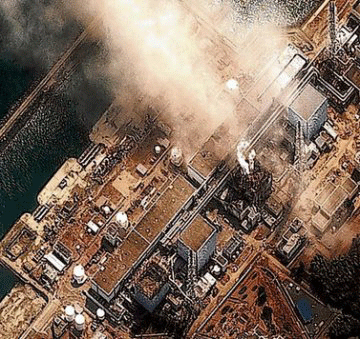 Nuclear Crisis Set Off Fears Over Tokyo, Report Says, NYT, By MARTIN FACKLER, February 27, 2012 TOKYO — In the darkest moments of last year’s nuclear accident, Japanese leaders did not know the actual extent of damage at the plant and secretly considered the possibility of evacuating Tokyo, even as they tried to play down the risks in public, an independent investigation into the accident disclosed on Monday.
The investigation by the Rebuild Japan Initiative Foundation, a new private policy organization, offered one of the most vivid accounts yet of how Japan teetered on the edge of an even larger nuclear crisis than the one that engulfed the Fukushima Daiichi Nuclear Power Plant. A team of 30 university professors, lawyers and journalists spent more than six months on the inquiry into Japan’s response to the triple meltdown at the plant, which followed a massive earthquake and tsunami last March 11 that shut down the plant’s cooling systems……. http://www.nytimes.com/2012/02/28/world/asia/japan-considered-tokyo-evacuation-during-the-nuclear-crisis-report-says.html
Mayors of 3 major cities want a switch away from nuclear power
Japan cities press utility to switch from nuclear, Feb 27, 2012
* Mayors say no utility should depend on single energy source
* Only two of 54 reactors on stream a year after nuclear disaster
By Risa Maeda TOKYO, Feb 27 (Reuters) – Three of Japan’s major cities called for Kansai Electric Power Co, its second largest nuclear generator, to draw up a plan to switch to other energy sources nearly a year after the country suffered the world’s worst nuclear accident in 25 years.
The mayors of Osaka, Kobe and Kyoto, home to a total of 5.7 million people, on Monday submitted questions on prospects for alternative energy supplies and price incentives to curb demand…..
Radiation around Fukushima still at uinhabitable levels
 Radiation still high around Fukushima No. 1 http://www.japantimes.co.jp/text/nn20120226a5.html Japan Times, , Feb. 26, 2012, Kyodo High levels of radiation, including a rate of 470 millisieverts per year at one location, have been detected in municipalities near the Fukushima No. 1 nuclear power plant, according to an interim Environment Ministry report. A survey conducted from Nov. 7 to Jan. 16 showed that the readings topped 50 millisieverts on an annual basis — a level deemed uninhabitable under a proposed new classification — in many spots north-northwest of the crippled power station. Continue reading
Japan banking on non-viable reprocessing, because it has nowhere to put nuclear wastes
the government has delegated the task of dealing with waste to the private sector, so there is no central decision-maker
 “Why does the government stick to the very costly recycle policy? That is because if they give it up, they should explain where a final repository will be located,”
Beyond Fukushima Japan faces deeper nuclear concerns, Vancouver Sun, By RISA MAEDA, Reuters February 24, 2012 TOKYO“…..A DECENT BURIAL With Japan’s recycling efforts running so far behind the required pace
to deal with the waste problem, Japan needs to find another resting place for its waste, away from nuclear power plants, which are typically located on the coast.
But unlike France and the United States, the world’s biggest atomic power generators, Japan does not have much in the way of geologically stable and empty landscapes in which to bury nuclear waste for centuries. Given its population density is 10 times higher than the United States and almost three times higher than France, Japan faces a “not in my backyard” problem like no other big nuclear-power nation. Continue reading
Nuclear reprocessing not a viable option for Japan
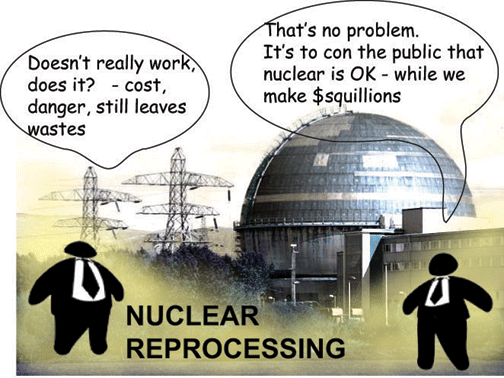 Fast-breeder said realistic no more, Japan Times, 25 Feb 12, Kyodo A panel of experts reviewing the nuclear fuel cycle policy in light of the Fukushima crisis has agreed that while a fast-breeder reactor has advantages, from a technology viewpoint it can’t be considered a realistic option for the next 20 to 30 years. The nuclear fuel policy involves reprocessing spent fuel to produce plutonium that can be reused to produce electricity.
The subcommittee of the Japan Atomic Energy Commission said in a draft document summarizing its discussions that two viable options during the next few decades would be to not reprocess spent nuclear fuel, and to recycle plutonium-uranium mixed oxide fuel, or MOX fuel.
The former option is called the “once-through” cycle, in which uranium fuel is used in nuclear reactors just one time and disposed of by burying it in the ground. In the latter option, MOX fuel is manufactured from plutonium recovered from spent nuclear fuel and used
in ordinary reactors. Continue reading
Japan’s nuclear recycling plant, a probable failure
“an 80 to 90 percent chance of the [nuclear recycling] plant being a failure”
even if Rokkasho gets up and running, two problems remain: it alone cannot recycle enough fuel to stop the waste mounting up, and there is still the issue of burying the vitrified waste permanently in a crowded, quake-prone country.
Beyond Fukushima Japan faces deeper nuclear concerns, Vancouver Sun, By RISA MAEDA, Reuters February 24, 2012 TOKYO – On a hillside in northern Japan, wind turbines slice through the cold air, mocking efforts at a nearby industrial complex to shore up the future of the demoralised nuclear power industry.
The wind-power farm at Rokkasho has sprung up close to Japan’s first nuclear reprocessing plant, a Lego-like complex of windowless buildings and steel towers, which was supposed to have started up 15 years ago but is only now nearing completion.
Dogged by persistent technical problems, it is designed to recycle spent nuclear fuel and partly address a glaring weakness in Japan’s bid to restore confidence in the industry, shredded last year when a quake and tsunami wrecked the Fukushima Daiichi power station to the south, triggering radioactive leaks and mass evacuations.
But the Rokkasho project is too little, too late, according to critics who say Japan is running so short of nuclear-waste storage that the entire industry risks shutdown within the next two decades unless a solution is found.
“You don’t build a house without a toilet,” said Jitsuro Terashima, president of the Japan Research Institute think tank and member of an expert panel advising the national government on energy policy after the Fukushima disaster….
Long-term storage of highly radioactive waste is a problem common to all nuclear-powered nations, including the United States, but experts say Japan’s unstable geology and densely populated terrain mean that its challenges are far bigger. Continue reading
55,000 Osaka residents want plebiscite on nuclear power
 Hashimoto’s opposition a big hurdle in Osaka nuclear plebiscite drive, Japan Times, By ERIC JOHNSTON Staff writer, 24 Feb 12, OSAKA — Efforts by a citizens’ group to hold a plebiscite in Osaka on the future of nuclear power hit a major stumbling block when Mayor Toru Hashimoto formally announced his opposition to the plan this week.
Earlier this month, the group pushing for a plebiscite to allow residents to vote on whether to abolish local atomic power plants submitted a petition with the signatures of more than 55,000 Osaka residents eligible to vote. The total is more than the number required to force the municipal assembly to vote on whether to hold the referendum. Continue reading
73,000 square metres of concrete to cover Fukushima seabed radiation
 Tepco to cement Fukushima seabed to stem
  radiation Times Live, Sapa-AFP | 22 February, 2012 The operator of Japan’s tsunami-crippled nuclear plant is to cover a large swathe of seabed near the battered reactors with cement in a bid to halt the spread of radiation, the company said Wednesday.
A clay-cement compound will be laid over 73,000 square metres (785,000 square feet) of the floor of the Pacific in front of the Fukushima Daiichi plant on the nation’s northeast coast, said Tokyo Electric Power Co. (TEPCO).
The area is equivalent to around 10 football pitches. “This is meant to prevent further contamination of the ocean… as sample tests have shown a relatively high concentration of radioactive substances in the sea soil in the bay,” a company spokeswoman said….
Contaminated water from the plant leaked into the sea and radioactive particles concentrated on the seabed. Scientists fear ocean currents could pollute areas further afield.
The cover will be 60 centimetres (24 inches) thick, with 10 centimetres expected to be eaten away by seawater every 50 years, the TEPCO official said. http://www.timeslive.co.za/world/2012/02/22/tepco-to-cement-fukushima-seabed-to-stem-radiation
Report on a tour of Fukushima
Into Fukushima’s no-man’s land Calgary Herald, Agence France-Presse February 21, 2012 FUKUSHIMA DAIICHI – Every two minutes on the bus ride through the ghost towns surrounding Japan’s Fukushima Daiichi nuclear plant, a company guide in a white protective suit holds up a display showing the radiation level. And it is rising. Continue reading
Plight, and flight, of Fukushima’s farming communities
anti-nuclear activists and parents who are continuing to lobby for better protection standards for children in Fukushima insist they will not be satisfied until the government takes steps to evacuate the entire younger generation to fully safe areas.
More than 100,000 people, mostly younger people, have left Fukushima to escape radiation contamination. ….The mass migration is bound to affect agriculture production
Trust Deficit – Worst Fallout of Fukushima, By Suvendrini Kakuchi TOKYO, Feb 22, 2012 (IPS) “……..The past few months have seen the government scrambling to regain public trust with food grown in Fukushima and the neighbouring areas by scraping away contaminated top soil from local farms. Continue reading
1 This Month





PLEASE OPPOSE HR 8255 AND S.3639 – bills would accelerate satellite deployment, with no environmental review or safeguards – https://ncstd5li.quorum.us/campaign/169331/
To see nuclear-related stories in greater depth and intensity – go to https://nuclearinformation.wordpress.com
-
Archives
- October 2026 (91)
- September 2026 (339)
- August 2026 (330)
- July 2026 (355)
- June 2026 (287)
- May 2026 (306)
- April 2026 (356)
- March 2026 (251)
- February 2026 (267)
- January 2026 (308)
- December 2025 (358)
- November 2025 (359)
-
Categories
- 1
- 1 NUCLEAR ISSUES
- business and costs
- climate change
- culture and arts
- ENERGY
- environment
- health
- history
- indigenous issues
- Legal
- marketing of nuclear
- media
- opposition to nuclear
- PERSONAL STORIES
- politics
- politics international
- Religion and ethics
- safety
- secrets,lies and civil liberties
- spinbuster
- technology
- Uranium
- wastes
- weapons and war
- Women
- 2 WORLD
- ACTION
- AFRICA
- Atrocities
- AUSTRALIA
- Christina's notes
- Christina's themes
- culture and arts
- Events
- Fuk 2022
- Fuk 2023
- Fukushima 2017
- Fukushima 2018
- fukushima 2019
- Fukushima 2020
- Fukushima 2021
- general
- global warming
- Humour (God we need it)
- Nuclear
- RARE EARTHS
- Reference
- resources – print
- Resources -audiovicual
- Weekly Newsletter
- World
- World Nuclear
- YouTube
-
RSS
Entries RSS
Comments RSS

