Japan postponing decision on restarting nuclear reactors

 Japan holds off on decision to restart reactors
* PM wants Fukushima accident taken into account on safety standard
* Safety concerns run deep, local govts want new measures
By Risa Maeda, TOKYO, April 3 (Reuters) – Japan needs more time to decide whether to restart two offline nuclear reactors, the trade minister said on Tuesday, as concerns about a summer power crunch vie with safety worries in the wake of last year’s Fukushima crisis.
Prime Minister Yoshihiko Noda will not make any immediate decision on a restart date, Continue reading
84% of Japanese do not believe in safety of Japan’s nuclear reactors
84 percent say government stress tests for nuclear plant restarts inadequate: survey Mainichi Daily News 2 April 12, Despite the Nuclear Safety Commission (NSC) of Japan’s conclusion that the idled Oi Nuclear Power Plant clears safety standards required for resuming operations, 84 percent of the public do not believe that the government’s safety tests are sufficient, a Mainichi opinion poll has found… Continue reading
Japan struggling with the idea of nuclear regulation independent of nuclear promotion
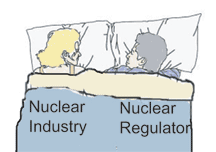 ‘Obviously, having promoters and regulators under the same roof is not desirable’
Previous investigations into the Fukushima accident have found evidence of lax supervision by NISA, cozy relations with utilities and delays in upgrading safety measures.
Japan’s new nuclear regulatory agency delayed Bloomberg, By MARI YAMAGUCHI 2 April 12, Japan’s government has failed to create a revamped nuclear regulatory agency by the promised date, April 1, amid political infighting, raising questions about its commitment to bolstering oversight in the wake of last year’s nuclear crisis. Continue reading
Cover-up of Fukushima radiation, in Japan and beyond
the core problem is that all of the world’s nuclear agencies are wholly captured by the nuclear industry … as are virtually all of the supposedly independent health agencies.
 Fukushima Radiation Plume Hit Southern and Central California, Global Research. 30 March 12, The Journal Environmental Science and Technology reports in a new study that the Fukushima radiation plume contacted North America at California “with greatest exposure in central and southern California”, and that Southern California had 2,500 Bq/kg of iodine-131 in seaweed … over 500% higher than other tests in the U.S. and Canada:
Projected paths of the radioactive atmospheric plume emanating from the Fukushima reactors, best described as airborne particles or aerosols for 131I, 137Cs, and 35S, and subsequent atmospheric monitoring showed it coming in contact with the North American continent at California, with greatest exposure in central and southern California. Government monitoring sites in Anaheim (southern California) recorded peak airborne concentrations of 131I at 1.9 pCi m−3
Anaheim is where Disneyland is located……. In addition, radioactive debris is starting to wash up on the Pacific Coast. And because the Japanese are burning radioactive materials instead of disposing of them, radioactive rain-outs will continue for some time … even on the Pacific Coast. Continue reading
Nuclear industry dead at home, but Japan tries to sell it abroad
 Japanese May Invest in U.K. Nuclear, WSJ, By SELINA WILLIAMS, 30 March 12 “……-RWE and E.ON are now seeking to sell their U.K. nuclear joint venture vehicle, named Horizon, that has two sites for new atomic power stations–at Wylfa in Wales and Oldbury in Gloucestershire in central England, as well as grid connections and around 130 employees,
including technical specialists, engineers, and project development specialists….
Japanese nuclear companies such as reactor vendors Hitachi and Toshiba Corp. and nuclear developers Mitsubishi Heavy Industries are seen by many in the nuclear industry as the most likely buyers.
Stymied at home following the Fukushima nuclear disaster last March, these companies are actively seeking new markets elsewhere and the U.K. could be a good base for expansion plans in Europe. “You could see a strong Japanese team coming in–there’s not going to
be building in Japan for the forseeable future, so growth for them can only come out of exports,” said George Borovas, a nuclear lawyer and partner at Pillsbury law firm that specializes in the energy sector…..
Stumping up the billions of pounds investment required to build a new reactor, coupled with the long lead times of construction as well as the cost overruns seen at other similar projects pose a huge challenge for any company seeking the finance, especially now in these
credit-strapped times.
More accurate picture of Fukushima radiation with new camera
 New Camera Sees Japan’s Radiation Threats Innovation News Daily 30 March 2012 One year after Japan’s nuclear disaster, the invisible threat of radiation still lurks around homes and businesses near the Fukushima Dai-ichi power plant. Now, a new camera based on Japanese space technology has allowed humans to see the radioactive contamination around the nuclear plant’s emergency evacuation zone.
Such camera technology works by detecting radioactive particles that give off gamma rays — the highest-energy form of light in the universe. The Japan Aerospace Exploration Agency (JAXA) originally developed the technology for an upcoming X-ray observation satellite, called ASTRO-H, but successfully adapted the camera to spot Earthly radiation threats such as Cesium 137 and Cesium 134.
The camera’s wide 180-degree vision showed radioactive particles spread across the ground and on rooftops of the village in the Fukushima Prefecture during a field test Feb. 11. Its results proved more accurate and capable of capturing a broader snapshot of the
radioactive zone than existing cameras…. http://www.space.com/15113-camera-sees-japan-radiation.html
Japan’s complicated plan to let some Fukushima residents return home
Even if residents are allowed to eventually return they will continue to live under the shadow of the devastated Daiichi plant, where its a huge and costly cleanup is expected to take several decades.
Japan to lift entry ban on some Fukushima cities TOKYO, (Reporting by Shinichi Saoshiro; Editing by Daniel Magnowski), Mar 30, 2012 (Reuters) – Japan said on Friday it would lift entry bans on some cities in Fukushima prefecture that had been designated no-go zones due to their proximity to a nuclear power plant crippled by a powerful earthquake and tsunami last March….
… This follows their declaration in December that the Daiichi plant was in cold shutdown and under control after months of cleanup efforts, signalling it was ready to move to a longer-term phase to eventually decommission the plant. Continue reading
Japanese govt losing credibility, as Fukushima not anywhere near safe
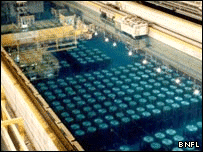 The spent fuel rods stored at the No. 4 reactor pose a particular threat, experts say, because they lie unprotected outside the unit’s containment vessel. Tokyo Electric has been racing to fortify the crumpled outer shell of the reactor, and to keep the tank fed with water. But should a problem also arise with cooling the spent fuel, the plant could run the risk of another colossal radiation leak, experts say.
“The plant is still in a precarious state,”
Japan Admits Nuclear Plant Still Poses Dangers By HIROKO TABUCHI NYT, March 29, 2012, TOKYO — The damage to the core of at least one of the meltdown-stricken reactors at Fukushima could be far worse than previously thought, raising fresh concerns over the plant’s stability and gravely complicating the post-disaster cleanup, a recent internal investigation has shown.
The results of the inquiry, released this week by the operator of the Fukushima Daiichi Nuclear Power Plant, also cast doubt over the Japanese government’s declaration three months ago that the ravaged site is now under control. Continue reading
$billions needed from Japanese government to save Tepco from bankruptcy
TEPCO seeks new billions from Japan CNN March 29, 2012 –
*Tokyo Electric Power Co. is asking the Japanese government for about $22 billion
*The company is reeling from the Fukushima Daiichi nuclear disaster
* Analysts say it the accident may cost up to 10 trillion yen ($120 billion)
Tokyo – Japan’s largest utility asked the government for 1 trillion yen ($12 billion) in fresh capital Thursday to stay solvent as it faces enormous compensation costs for the Fukushima Daiichi nuclear disaster.
The Tokyo Electric Power Co. is also seeking another 800 billion yen ($10 billion) from a government fund to help it compensate people affected by the Fukushima Daiichi accident, including the estimated 100,000-plus people displaced. It has already requested more than 1.7 trillion yen from that fund…. http://edition.cnn.com/2012/03/29/world/asia/japan-tepco/
Japan’s Trade Minister backs energy conservation, and shift from nuclear power
Unlikely Hand Flips Japan’s Power Switch Trade Minister Breaks With Predecessors to Back Energy Conservation, Guide Shift From Nuclear WSJ, March 29, 2012, By MITSURU OBE And PHRED DVORAK, TOKYO—Japan’s shift away from nuclear power, prompted by last year’s Fukushima disaster, is being shepherded by an unlikely proponent: the trade minister. Yukio Edano says the country has to adjust to a new era of energy conservation, in contrast to his predecessors at the
powerful Ministry of Economy, Trade and Industry, who were anxious to keep Japan’s export-led economy chugging along on a plentiful supply of power. Continue reading
Wind energy for Japan, as nuclear energy shuts down
Floating Windmills in Japan Help Wind Down Nuclear Power: Energy Bloomberg, By Chisaki Watanabe – Mar 29, 2012 Japan is preparing to bolt turbines onto barges and build the world’s largest commercial power plant using floating windmills, tackling the engineering challenges of an unproven technology to cut its reliance on atomic energy. Continue reading
Radiation so high, even robots cannot approach Fukushima No. 1 nuclear reactor
 Reactor 2 radiation too high for access March 29, 2012 73 sieverts laid to low water; level will even cripple robots By MINORU MATSUTANI Radiation inside the reactor 2 containment vessel at the Fukushima No. 1 nuclear plant has reached a lethal 73 sieverts per hour and any attempt to send robots in to accurately gauge the situation will require them to have greater resistance than currently available, experts said Wednesday.
Exposure to 73 sieverts for a minute would cause nausea and seven minutes would cause death within amonth, Tokyo Electric Power Co. said.
The experts said the high radiation level is due to the shallow level of coolant water — 60 cm — in the containment vessel, which Tepco said in January was believed to be 4 meters deep. Tepco has only peeked inside the reactor 2 containment vessel. It has few clues as to the status of reactors 1 and 3, which also suffered meltdowns, because
there is no access to their insides.
The utility said the radiation level in the reactor 2 containment vessel is too high for robots, endoscopes and other devices to function properly. Spokesman Junichi Matsumoto said it will be necessary to develop devices resistant to high radiation.
High radiation can damage the circuitry of computer chips and degrade camera-captured images. For example, a series of Quince tracked robots designed to gather data inside reactors can properly function for only two or three hours during exposure to 73 sieverts, said Eiji Koyanagi, chief developer and vice director of the Future Robotics Technology
Center of Chiba Institute of Technology. That is unlikely to be enough for them to move around and collect
video data and water samples, reactor experts said. ”Two or three hours would be too short. At least five or six hours would be necessary,” said Tsuyoshi Misawa, a reactor physics and engineering professor at Kyoto University’s Research Reactor Institute.
The high radiation level can be explained by the low water level. Water acts to block radiation. ”The shallowness of the water level is a surprise . . . the radiation level is awfully high,” Misawa said. While the water temperature is considered in a safe zone at about 50 degrees, it is unknown if the melted fuel is fully submerged, but Tepco said in November that computer simulations suggested the height of the melted fuel in reactor 2′s containment vessel is probably 20 to
40 cm, Tepco spokeswoman Ai Tanaka said.
Tepco has inserted an endoscope and a radiation meter, but not a robot, in the containment vessel. It is way too early to know how long Tepco will need to operate robots in the vessel because it is unknown what the devices will have to do, Tanaka said.
According to experts, even though high radiation in the containment vessel means additional trouble, it is not expected to further delay the decommissioning the three crippled reactors, a process Tepco said will take 40 years.
The experts noted, however, that removing the melted nuclear fuel from the bottom of the containment vessels will be extremely difficult….
Tepco has not been able to gauge the water depths and radiation levels of the containment vessels for reactors 1 and 3, as, unlike unit 2, there is no access. http://www.japantimes.co.jp/text/nn20120329a1.html
Fukushima nuclear plant is far from safe
Still critical: radiation levels at Fukushima can kill in minutes Latest readings from tsunami-stricken nuclear plant overturn claims that reactors have been made safe The Independent, DAVID MCNEILL TOKYO THURSDAY 29 MARCH 2012 A lethal level of radiation has been detected inside one of the reactors at the Fukushima nuclear power plant, throwing fresh doubts over the operator’s claims that the disabled complex is under control. Continue reading
In Japan, radiation being tactfully left out of school textbooks
without the appropriate study materials, how well … Japan’s school children will understand how their lives have been and will continue to be impacted by the nuclear disaster is unknown.
 Japanese textbooks whitewashing nuclear disaster Asian Correspondent By Anna Watanabe Mar 29, 2012 There are many of things Japan has done in the past that it tries to erase from public memory by downplaying their events in school textbooks: the Nanking Massacre, medical testing on POWs during WWII, comfort women and territorial disputes.
But all these are atrocities that have happened outside of Japan, to other nationalities and they occurred generations ago. As inexcusable as it is to claim their non-existence, the logic is somehow more understandable.
But now Japan is trying to rewrite its own, modern-history. Continue reading
Alarming news about the state of Fukushima’s nuclear reactors today
 Very high radiation, little water in Japan reactor, Sydney Morning Herald, MARI YAMAGUCHI, March 28, 2012 One of Japan’s crippled nuclear reactors still has fatally high radiation levels and much less water to cool it than officials had estimated, according to an internal examination that renews doubts about the plant’s stability.
A tool equipped with a tiny video camera, a thermometer, a dosimeter and a water gauge was used to assess damage inside the No. 2 reactor’s containment chamber for the second time since the tsunami swept into the Fukushima Dai-ichi plant a year ago.
The data collected Tuesday showed the damage from the disaster is so severe, the plant operator will have to develop special equipment and technology to tolerate the harsh environment and decommission the plant, a process expected to last decades. The other two reactors that had meltdowns could be in even worse shape. The No. 2 reactor is the
only one officials have been able to closely examine so far.
Tuesday’s examination with an industrial endoscope detected radiation levels up to 10 times the fatal dose inside the chamber. Plant officials previously said more than half of the melted fuel has breached the core and dropped to the floor of the primary containment vessel, some of it splashing against the wall or the floor.
Particles from melted fuel have probably sent radiation levels up to a dangerously high 70 sieverts per hour inside the container, said Junichi Matsumoto, spokesman for Tokyo Electric Power Co. The figure far exceeds the highest level previously detected, 10 sieverts per hour, which was detected around an exhaust duct shared by No. 1 and 2 units last year.
“It’s extremely high,” he said, adding that an endoscope would last only 14 hours in those conditions. “We have to develop equipment that can tolerate high radiation” when locating and removing melted fuel during the decommissioning.
The probe also found that the containment vessel _ a beaker-shaped container enclosing the core _ had cooling water up to only 60 centimeters (2 feet) from the bottom, far below the 10 meters (yards) estimated when the government declared the plant stable in December.
The plant is continuing to pump water into the reactor……
The exact conditions of the other two reactors, where hydrogen explosions damaged their buildings, are still unknown. Simulations have indicated that more fuel inside No. 1 has breached the core than the other two, but radiation at No. 3 remains the highest.
The high radiation levels inside the No. 2 reactor’s chamber mean it’s inaccessible to the workers, but parts of the reactor building are accessible for a few minutes at a time _ with the workers wearing full protection…. http://news.smh.com.au/breaking-news-technology/very-high-radiation-little-water-in-japan-reactor-20120328-1vxxz.html
1 This Month





PLEASE OPPOSE HR 8255 AND S.3639 – bills would accelerate satellite deployment, with no environmental review or safeguards – https://ncstd5li.quorum.us/campaign/169331/
To see nuclear-related stories in greater depth and intensity – go to https://nuclearinformation.wordpress.com
-
Archives
- October 2026 (91)
- September 2026 (339)
- August 2026 (330)
- July 2026 (355)
- June 2026 (287)
- May 2026 (306)
- April 2026 (356)
- March 2026 (251)
- February 2026 (267)
- January 2026 (308)
- December 2025 (358)
- November 2025 (359)
-
Categories
- 1
- 1 NUCLEAR ISSUES
- business and costs
- climate change
- culture and arts
- ENERGY
- environment
- health
- history
- indigenous issues
- Legal
- marketing of nuclear
- media
- opposition to nuclear
- PERSONAL STORIES
- politics
- politics international
- Religion and ethics
- safety
- secrets,lies and civil liberties
- spinbuster
- technology
- Uranium
- wastes
- weapons and war
- Women
- 2 WORLD
- ACTION
- AFRICA
- Atrocities
- AUSTRALIA
- Christina's notes
- Christina's themes
- culture and arts
- Events
- Fuk 2022
- Fuk 2023
- Fukushima 2017
- Fukushima 2018
- fukushima 2019
- Fukushima 2020
- Fukushima 2021
- general
- global warming
- Humour (God we need it)
- Nuclear
- RARE EARTHS
- Reference
- resources – print
- Resources -audiovicual
- Weekly Newsletter
- World
- World Nuclear
- YouTube
-
RSS
Entries RSS
Comments RSS

