Japan buckles down to energy conservation -its last nuclear reactor to shut down in May
Japan shuts down its next-to-last nuclear reactor, Seattle Times, By ERIC TALMADGE, 26 Mar 12 Another Japanese nuclear reactor was taken off line for maintenance on Monday, leaving the country with only one of its 54 reactors operational following last year’s devastating earthquake and tsunami..with concerns over nuclear safety high following the
Fukushima crisis, none of the reactors that have been shut down for checks, and none that were already off line at the time of the disaster, have been allowed to restart.
The last reactor, on the northern island of Hokkaido, will be shut down in May. The timing for when any reactors will be restarted remains unclear…. Prime Minister Yoshihiko Noda has promised to reduce Japan’s reliance on nuclear power over time and plans to lay out a new energy policy by the summer.
In the meantime, Japan has temporarily turned to oil and coal generation plants to make up for the shortfall, and businesses have been required to reduce electricity use to help with conservation efforts.http://seattletimes.nwsource.com/html/businesstechnology/2017843195_apasjapannuclear.html
Japan’s secretive nuclear culture will prevent investigation of Fukushima radiation cover-up
 “It sounds, it looks…like a major cover up,”
However, Escobar says, it is unlikely Japanese authorities will ever investigate the case – “everyone will bow and nothing will be solved.” And the reason is in what Escobar calls the “cultural element”. “Japan is really ritualistic and secretive society.”
 VIDEO Mystery of lost Fukushima radiation emails ‘a major cover-up’ http://www.rt.com/news/japan-fukushima-email-deleted-285/ 23 March, 2012 The Fukushima Prefecture government apparently deleted emails with reports on data vital to safely evacuate people from that area, according to fresh appeared revelations. But as Pepe Escobar told RT, it is unlikely Japan will investigate. Continue reading
Disappearance of Fukushima radiation data in March 2011

 Fukushima Pref. deleted 5 days of radiation dispersion data just after meltdowns Mainichi Daily News, 23 March 12 The Fukushima Prefectural Government revealed on March 21 that it deleted five days of early radiation dispersion data almost entirely unread in the wake of the meltdowns at the Fukushima No. 1 nuclear plant.
The data from the System for Prediction of Environmental Emergency Dose Information (SPEEDI) — intended to predict the spread of radioactive contamination, information vital for issuing evacuation advisories — was emailed to the prefectural government by the
Ministry of Education, Culture, Sports, Science and Technology.
According to the prefecture’s disaster countermeasure office, just after the March 2011 quake and tsunami, its dedicated SPEEDI terminal was unable to receive data due to effects of the disasters. Therefore, prefectural officials asked the Nuclear Safety Technology Center, which operates SPEEDI, to send data via email on March 12, 2011 — one
day into the nuclear crisis. The Nuclear Safety Technology Center thensent the data hourly starting at 11:54 p.m. that day.
The Fukushima Prefectural Government, however, deleted all the data it received from March 12 to about 9 a.m. March 16….. http://mdn.mainichi.jp/mdnnews/news/20120322p2a00m0na012000c.html
Appeal of electric car damaged by connection with nuclear power
 Is nuclear power damaging electric car image? The Green Car Website, 23 Mar 12, As Japan’s government prepares to restart dozens of nuclear power plants, idled since the Fukushima disaster last year, there is concern that electric cars could become tainted by their association with nuclear generation. Continue reading
Osaka’s mayor wants electricity utility to go nuclear free
Utility Faces Call to Halt Nuclear Power Use In Japan, WSJ, By TOKO SEKIGUCHI, 20 March 12, “…….Now, the brazen mayor of Japan’s western metropolis of Osaka is trying to get the country’s second largest utility to go nuclear-free—a challenge to the national government’s attempts to restart reactors that make up a third of Japan’s electricity-generation capacity amid public concerns over the safety of nuclear energy.
Osaka Mayor Toru Hashimoto is considering a proposal to use the city’s standing as Kansai Electric Co.’s largest customer and stockholder to call on the regional power provider to abandon its use of nuclear power at a shareholders’ meeting in June….. Continue reading
Fukushima cancer toll – years later, especially for nuclear clean-up workers
One group particularly at risk of health harm is the large and growing number of workers required to help control, shut down and clean up the damaged nuclear plants.
On average, the contracted day labourers receive two- to three-times the radiation dose of a regular worker but are not included in utility statistics. And there is no compulsory, centralised system for tracking cumulative radiation exposure or health outcomes of these workers.
Fukushima radiation toll will continue for generations Despite claims that Japan’s Fukushima meltdown caused no deaths, in fact the true health costs of Fukushima’s radiation leaks won’t be known for decades. Independent Australia 18 March 12, Professor Tilman Ruff reports. A year can be a long time in politics. But for the radioactive particles released from Fukushima’s damaged nuclear reactor, a year is just a moment in their life of hundreds or thousands of years.
So, what is the radiological situation at Fukushima one year after the disaster? the extensively damaged plants are still unstable and highly radioactive. This has restricted access and clean-up efforts, which will need to go on for many decades.
Though Japanese authorities declared they’d achieved a “cold shutdown” in December, an arbitrary definition was used: coolant water temperature was less than boiling, pressure inside the reactors was not raised, and the release of radioactive materials from the first layer of containment was below a specified level. But it didn’t mean the nuclear reaction inside the reactors had been stably shut down…. Continue reading
Japanese kids learn about radiation
“Still, there are many children who think nuclear energy is necessary but that’s probably because their parents or relatives have had nuclear-related jobs,”
Third of Fukushima kids got first radiation lessons from disaster: poll Japan Times, 19 March, Kyodo FUKUSHIMA — About a third of the 225 youngsters who were evacuated from around the Fukushima No. 1 nuclear plant last March but still reside in the prefecture say the disaster made them aware of radiation dangers for the first time, a new survey says. Continue reading
Radioactive isotopes in ocean plankton, from Fukushiam
follow-up studies will be necessary because the radioactive cesium is likely to have accumulated in fish that eat plankton, the team said
In the latest survey, the team also found cesium-134 — which has a two-year half-life — in plankton at the same levels as cesium-137, whose half-life is three decades.
Cesium found in plankton almost 375 miles from Fukushima nuclear plant, Boston Herald, By The Yomiuri Shimbun http://news.bostonherald.com/news/international/asia_pacific/view/20120318cesium found_in_plankton_almost_375_miles_from_fukushima_nuclear_plant/srvc=home&position=recent,March 18, 2012 – TOKYO — Radioactive cesium believed to have been released during the crisis at the Fukushima No. 1 nuclear power plant in Japan following last year’s major earthquake has been found in plankton about 600 kilometers (nearly 375 miles) east of the facility, according to a Japan-U.S. joint research team. Continue reading
3 categories of compensation payments for Japan’s nuclear evacuees
Japanese government panel urges compensation for nuclear evacuees (includes video) http://news.bostonherald.com/news/international/asia_pacific/view/20120318japanese_government_panel_urges_compensation_for_nuclear_evacuees/srvc=home&position=recent By The Yomiuri Shimbun , March 18, 2012 TOKYO – Residents who will be unable to return to areas around the crippled Fukushima No. 1 nuclear power plant for at least five years should be paid 6 million yen (US$71,813) each as compensation for their mental suffering, a Japanese government panel has decided. Continue reading
Japan’s former P.M. insisted on workers staying to prevent Fukushima total meltdown
“If the workers abandoned the plant, all the reactors and fuel rods in the fuel pools would have melted down, causing many times more fall-out than Chernobyl. “I called the TEPCO president and told him a withdrawal was unthinkable “

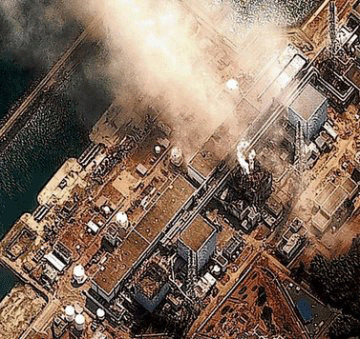 Ex-PM reveals meltdowns almost crippled Japan Mark Willacy, ABC South West Radio March 15, 2012 A year on from the meltdowns at the Fukushima nuclear plant, Japan’s prime minister at the time has told the ABC that the disaster came close to crippling the nation, with the evacuation of tens of millions from Tokyo a real possibility.
In an exclusive interview on ABC’s 7.30, Naoto Kan said the loss of the world’s biggest metropolis would have been like losing a war, leaving Japan without a political and economic capital. He has also confirmed that he confronted the operator TEPCO and rejected its request for its workers to abandon the crippled plant. Continue reading
Luckily, Japan’s latest earthquake and tsunami were smaller
Magnitude 6.8 earthquake strikes Japanese coast, tsunami wave hits coast THE AUSTRALIAN, BY: BY SHINGO ITO IN TOKYO From: AFP March 14, 2012 A small tsunami wave has hit Japan’s northeastern coastline, officials say, after a strong earthquake rocked the region a year on from the country’s worst post-war natural disaster. Continue reading
Japanese do not trust the government about Fukushima radiation
 83% of Fukushima residents and 73% countrywide felt ‘greatly’ or ‘somewhat’ worried about radioactive contamination. More importantly, 70% of people in the three disaster hit prefectures , and 71% people countrywide , felt that government was “hiding” information.
This background of mistrust and deception, coming on top of enormous suffering, haunts the island nation, and especially the 350,000 people, who are living in camps unable to go back home to Fukushima.
Debris, radiation fear, mistrust still piling up Times of India, Subodh Varma, TNN | Mar 12, It is one year since the Great Eastern Japan Earthquake generated a tsunami that ripped apart the north-eastern sea-coast of Japan leaving over 20,000 people dead and the Fukushima nuclear power plant damaged. The triple disaster is estimated to have caused losses worth $235 billion according to World Bank.
Pictures circulated worldwide by visiting journalists show spectacular scenes of the massive clean up operation launched by the government of Japan. But the reality is numbingly grim. Goshi Honoso , Japan’s environment minister speaking at a routine press conference on February 21, urged local governments to help in cleaning up the debris left behind in Iwate, Miyagi and Fukushima prefectures, the three areas which bore the brunt of the tsunami, reports Kyodo news agency.
Then, he revealed jaw dropping numbers: an estimated 22.53 million tonnes of debris was created by the tsunami . Of this, only 1.18 million tonnes, that is, about 5% has been disposed of.The rest of it is simply bulldozed and piled into giant heaps, some as high as 20 meters high. ….
Across Japan thousands protest against nuclear power
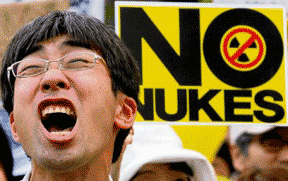 Antinuclear protests held across Japan on anniversary of disaster, Mainichi Daily News, http://mdn.mainichi.jp/mdnnews/news/20120312p2g00m0dm069000c.html 12 March 12, TOKYO (Kyodo) — Antinuclear protesters took to the streets in Tokyo and elsewhere in Japan on Sunday, the one-year anniversary of the massive earthquake and tsunami which triggered the nuclear crisis at the Fukushima Daiichi power plant.
Near the head office of Tokyo Electric Power Co., the operator of the crippled Fukushima complex, demonstrators called for the country to abandon nuclear power generation and restore Fukushima Prefecture, where more than 100,000 residents were forced to relocate.
Some 16,000 people attended an antinuclear gathering in the city of Koriyama in Fukushima and rallied in the city, calling for scrapping all nuclear reactors in Japan. The country has 54 commercial nuclear reactors, which provided a third of Japan’s electric power prior to the Fukushima plant disaster.
In Shizuoka Prefecture in central Japan, about 1,100 people gathered to call for scrapping Chubu Electric Power Co.’s nuclear reactors at its Hamaoka power plant. Those reactors were halted last May after then prime minister Naoto Kan asked the utility to suspend their operation due to concern about a powerful quake in that area of Shizuoka Prefecture.
About 1,200 people including members of antinuclear citizens’ groups marched in the city of Tsuruga, Fukui Prefecture, which hosts the prototype fast-breeder reactor Monju and Kansai Electric Power Co.’s nuclear reactors.
They voiced objection to restarting two of the reactors at Kansai Electric’s Oi power plant in the prefecture after the country’s nuclear safety agency approved results of safety tests conducted on the reactors idled for a regular checkup and left a final decision on whether to restart them to the government of Prime Minister Yoshihiko Noda.
“What we need to do, after witnessing how tragic Tokyo Electric’s Fukushima Daiichi nuclear plant accident is, is to build a society which does not rely on nuclear plants,” said Fujio Yamamoto, who leads a group which organized the protest.
Similar protests were also held in other prefectures which host nuclear power plants or related facilities, including Saga and Aomori.
In the cities of Hiroshima and Nagasaki, atomic bomb survivors took part in antinuclear protests and urged the country to stop relying on nuclear power.
Safecast helps Japanese people to learn about radiation
Even if nuclear science and the impact of a nuclear meltdown on human health were simple to understand (and they are not), there is still the rather uneasy fact of dealing with a daily foe: invisible, odourless radiation.
Working with Safecast , which crowdsources radiation readings gathered by volunteers, and combines it with data from other outfits to give a clearer picture of what’s going on, Saito wanted people to be able to determine what was safe for them based on fact, not paranoia or nuclear industry propaganda.
 Japan’s radiation: Ignorance isn’t bliss Feeling that officials aren’t doing enough, everyone, farmer to housewife, is learning about radiation contamination. Aljazeera, D. Parvaz 10 Mar 2012 Iitate Village, Japan – Second-generation farmer Muneo Kano has not been able to tend to his cattle or grow crops since the Daiichi nuclear power plant contaminated land, air and sea after being damaged by last year’s earthquake and tsunami.
He had his 11 cows scanned for radiation and sold them to another farm outside the radiation area. Kano’s own seven-hectare farm is 45km from the nuclear site, and the soil has been deemed too contaminated for farming.
And Kano has had to learn all about radiation and soil fast – he now tracks and maps radiation dips and spikes on an iPad, and has a series of maps he consults to check what authorities say about farms in the area.
Soil samples tested in Iitate still contain ten times the acceptable levels of the radioactive isotope Caesium-137 for agricultural soil, and the government has yet to remove the top layers of contaminated soil and wash the streets…. Continue reading
The mental health effects of the nuclear accident at Fukushima
they live in fear of the invisible threat in their midst. …. there is agreement that the Fukushima case is unprecedented.
conflicting information has left them confused and fearful about the future.
“We’re being treated like lab rats. The authorities should have told us as soon as they knew the reactors had melted down and helped us leave immediately
Fukushima residents plagued by health fears of nuclear threat in their midst A year after the power plant’s triple meltdown, conflicting official information leaves families confused and fearful for their future, Justin McCurry in Fukushima guardian.co.uk, 9 March 2012 The noise levels soar inside Fukushima city’s youth centre gymnasium as dozens of nursery school children are let loose on bouncy castles and pits filled with plastic balls.
The handful of teachers and volunteers on duty are in forgiving mood: for the past year, the Fukushima nuclear accident has robbed these children of the simple freedom to run around.
Instead, anxious parents and teachers have confined them to their homes and classrooms, while scientists debate the possible effects of prolonged exposure to low-level radiation on their health. Continue reading
1 This Month





PLEASE OPPOSE HR 8255 AND S.3639 – bills would accelerate satellite deployment, with no environmental review or safeguards – https://ncstd5li.quorum.us/campaign/169331/
To see nuclear-related stories in greater depth and intensity – go to https://nuclearinformation.wordpress.com
-
Archives
- October 2026 (91)
- September 2026 (339)
- August 2026 (330)
- July 2026 (355)
- June 2026 (287)
- May 2026 (306)
- April 2026 (356)
- March 2026 (251)
- February 2026 (267)
- January 2026 (308)
- December 2025 (358)
- November 2025 (359)
-
Categories
- 1
- 1 NUCLEAR ISSUES
- business and costs
- climate change
- culture and arts
- ENERGY
- environment
- health
- history
- indigenous issues
- Legal
- marketing of nuclear
- media
- opposition to nuclear
- PERSONAL STORIES
- politics
- politics international
- Religion and ethics
- safety
- secrets,lies and civil liberties
- spinbuster
- technology
- Uranium
- wastes
- weapons and war
- Women
- 2 WORLD
- ACTION
- AFRICA
- Atrocities
- AUSTRALIA
- Christina's notes
- Christina's themes
- culture and arts
- Events
- Fuk 2022
- Fuk 2023
- Fukushima 2017
- Fukushima 2018
- fukushima 2019
- Fukushima 2020
- Fukushima 2021
- general
- global warming
- Humour (God we need it)
- Nuclear
- RARE EARTHS
- Reference
- resources – print
- Resources -audiovicual
- Weekly Newsletter
- World
- World Nuclear
- YouTube
-
RSS
Entries RSS
Comments RSS

