Radiation in Japan’s foodstuffs – the invisible hazard
Unlike harmful iodine 131, which disappears in matter of days, caesium 137 has a “half-life” of 30 years and lingers even longer.
Radioactive discharge from the crippled power station fell directly on crops and vegetables, and worked its way into the food chain when fish or animals in affected areas consumed contaminated plants.
Japan’s invisible enemy within TOKYO, Malaysian Insider, June 2 — Before March 11, 2011, procuring food for an average Japanese household was a pretty straight-forward affair.
Following long-established traditions, a housewife — it is, still, almost always a woman in charge — did her best to ensure that every product brought to the table could be traced to Japanese soil or waters. This, it was widely held, was the best way to avoid eating fish, meat
or produce tainted with dangerous contaminants. Chinese imports were to be avoided whenever possible.
The accident at the Fukushima nuclear power plant, unleashed by a devastating earthquake and tsunami, shattered this age-old faith in the purity of Japanese produce. Continue reading
Perilous state of spent nuclear fuel rods pool at Fukushima reactor No. 4
The worries gained new traction in recent days after the operator of the plant, Tokyo Electric Power Co., or TEPCO, said it had found a slight bulge in one of the walls of the reactor building
questions about whether Japan’s all-out effort to convince its citizens that nuclear
power is safe kept the authorities from exploring other – and some say safer – options for storing used fuel rods.
Radioactive waste at Fukushima threatens second nuclear catastrophe
http://www.watoday.com.au/environment/radioactive-waste-at-fukushima-threatens-second-nuclear-catastrophe-20120527 1zcxu.html#ixzz1wgpRdAiv Hiroko Tabuchi, Matthew Wald May 28, 2012 TOKYO: What passes for normal at the Fukushima Daiichi nuclear plant today would have caused shudders among even the most sanguine of experts before an earthquake and tsunami set off the world’s second most serious nuclear crisis after Chernobyl.
Fourteen months after the accident, a pool brimming with used fuel rods and filled with vast quantities of radioactive caesium still sits on the top floor of a heavily damaged building, covered only with plastic.
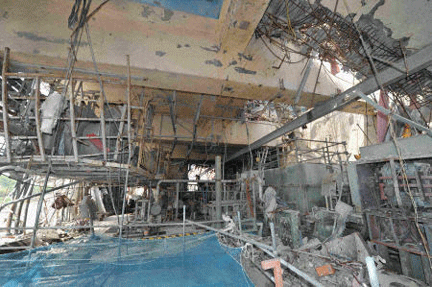
The public’s fears about the pool have grown in recent months as some scientists have warned that it has the most potential for setting off a new catastrophe. The three nuclear reactors that suffered meltdowns are in a more stable state, but frequent quakes continue to rattle the
region.
The worries gained new traction in recent days after the operator of the plant, Tokyo Electric Power Co., or TEPCO, said it had found a slight bulge in one of the walls of the reactor building, stoking fears over the building’s safety. Continue reading
Japanese protest against restart of nuclear reactors
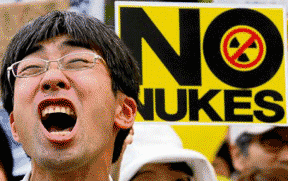 Japanese protest over planned restart of nuclear reactors Reuters TOKYO Jun 1, 2012 – Hundreds of Japanese anti-nuclear protesters gathered outside the prime minister’s office on Friday, beating drums and chanting slogans against the planned restart of reactors a year after the world’s worst nuclear disaster in 25 years.
“We oppose restarts,” the crowd of about 1,000, which stretched for around 200 meters down the block, shouted in the peaceful demonstration. Public mistrust of nuclear power has grown since the earthquake and tsunami on March 11 last year triggered the worst nuclear disaster since Chernobyl….. http://www.reuters.com/article/2012/06/01/us-japan-nuclear-protest-idUSBRE8500OE20120601
Japan – 37 tons of deadly plutonium, and planning to produce more
 Other countries, including the United States, have scaled back the separation of plutonium because it is a proliferation concern and is more expensive than other alternatives, including long-term storage of spent fuel.
Fuel reprocessing remains unreliable and it is questionable whether it is a viable way of reducing Japan’s massive amounts of spent fuel rods
Japan’s plutonium stockpile — most of which is stored in France and Britain — has swelled despite Tokyo’s promise to international regulators not to produce a plutonium surplus.

 Japan to make more plutonium despite big stockpile, Fox News June 01, 2012 Associated Press TOKYO – Last year’s tsunami disaster in Japan clouded the nation’s nuclear future, idled its reactors and rendered its huge stockpile of plutonium useless for now. So, the industry’s plan to produce even more has raised a red flag.
Nuclear industry officials say they hope to start producing a half-ton of plutonium within months, in addition to the more than 35 tons Japan already has stored around the world. That’s even though all the reactors that might use it are either inoperable or offline while the country rethinks its nuclear policy after the tsunami-generated Fukushima crisis. Continue reading
America’s CIA helped to ‘con’ the Japanese public into accepting nuclear power
the media mogul worked with the CIA to promote nuclear power.
Mr. Shoriki, backed by the CIA, used his influence to publish articles in the Yomiuri that extolled the virtues of nuclear power
 Japan’s Nuclear Industry: The CIA Link, WSJ, By Eleanor Warnock, June 1, 2012, “…….In the 15 months since the crisis at Fukushima Daiichi, Japan’s relationship with nuclear power has changed dramatically……. all 50 of its plants remain offline. Restarting reactors — a step the government says is necessary to support the economy — is proving to be politically tricky as a skeptical public questions the safety of atomic energy.
Rewind almost 60 years and the government had a similar problem: how to persuade the public to support its ambition to become a nuclear nation only nine years after the U.S. dropped atomic bombs on Hiroshima and Nagasaki?
According to one Japanese university professor, that ambition was achieved with help from an unlikely source: the CIA. Tetsuo Arima, a researcher at Waseda University in Tokyo, told JRT he discovered in the U.S. National Archives a trove of declassified CIA files that
showed how one man, Matsutaro Shoriki, was instrumental in jumpstarting Japan’s nascent nuclear industry. Continue reading
Majority of Japanese firms want abandonment of nuclear power
Critics accuse utilities of exaggerating potential power shortages in order to win public support to restart off-line reactors
70 percent of firms are prepared to cooperate on power saving to the same degree as last summer
 Three-quarters of Japanese firms oppose nuclear power, Chicago Tribune, by Tetsushi Kajimoto, TOKYO (Reuters) 25 May 12- Nearly three-quarters of Japanese companies support abandoning nuclear power after last year’s Fukushima disaster, although a majority set the condition that alternative energy resources must be secured, a Reuters poll showed on Friday.
The poll offers fresh evidence of the deep public distrust of nuclear
power, Continue reading
Radiation released right after Fukushima accident was much more than first estimated
Fukushima radiation higher than first estimated, By Kevin Krolicki TOKYO May 24 (Reuters) – The radiation released in the first days of the Fukushima nuclear disaster was almost 2-1/2 times the amount first estimated by Japanese safety regulators, the operator of the crippled plant said in a report released on Thursday. Continue reading
Nuclear fuel rods at Fukushima’s reactor no. 4 – highly dangerous
The workers are like Samurai warriors, they’re like suicide workers. They know they are getting huge amounts of radiation going to the site. They can only go in, seconds to minutes, at a time doing work and then the next batch has to come in.
Chernobyl had a half a million workers who worked minutes at a time. Here we have a situation much worse than Chernobyl simply because we have basically five reactors that could go up. One reactor setting off the next reactor, that’s a huge amount of radiation, over ten times the radiation inventory found in Chernobyl.
“People don’t realize that the Fukushima reactor (Number 4) is on a knife’s edge; it’s near the tipping point.
 includes videos and audio http://deathby1000papercuts.com/2012/05/large-crack-on-south-wall-of-fukushima-nuclear-reactor-number-four-photo/ Large
  Crack on South Wall of Fukushima Nuclear Reactor Number Four? DBKP. May 20, 2012 By LBG1 We could have adisaster much worse, many times worse than Chernobyl.” Dr. Michio Kaku on the precarious state of the spent fuel rods in the severely damaged Fukushima nuclear reactor Unit Number Four building Continue reading
Severe radiation risk at Fukushima’s nuclear reactor Unit 4
 Concerns focus on Fukushima unit stability TOKYO, May 23 (UPI) — Whether a pool where spent fuel is stored at Japan’s Fukushima nuclear plant could withstand another strong earthquake has become a source of growing concern.
The concerns among activists, experts and politicians focus on Unit 4, which contains most of the plant’s spent fuel not stored in dry, hardened storage casks, Stars and Stripes reported Wednesday.
After the 9-magnitude earthquake and tsunami, an investigative report by the Rebuild Japan Initiative Foundation, an independent think tank started to investigate the causes of the plant disaster, cited among risks a loss of cooling water in Unit 4.
If left exposed, the spent fuel could heat and melt, releasing a huge amount of radiation.
The plant’s operator, Tokyo Electric Power Co., has said on its Web site Unit 4 is sound and the building could withstand an earthquake of the magnitude of the March 11, 2011, temblor.
But public trust in Tepco remains low, Stars and Stripes said, and calls for more efforts to empty and secure Unit 4 continue in Japan and beyond…… http://www.upi.com/Top_News/World-News/2012/05/23/Concerns-focus-on-Fukushima-unit-stability/UPI-67051337797686/#ixzz1vpwgvulJ
Fukushima workers at risk of cancer
Fukushima 1 workers risk cancer, Voice of Russia, May 24, 2012 About 170 people who worked at the Japanese nuclear power plant “Fukushima-1”, received doses of radiation, which have increased their risk of cancer according to reports published on Wednesday covering the results of studies conducted by experts of the Scientific Committee of the UN….
http://english.ruvr.ru/2012_05_24/75768400/
Infants in some areas at risk of thyroid cancer from Fukushima radiation
 Infants in Namie were thought to have received thyroid radiation doses of 100-200 mSv, it added. The thyroid is the most exposed organ as radioactive iodine concentrates there and children are deemed especially vulnerable.
The report did not deal with radiation exposure suffered by emergencyworkers or people closest to the disaster site……
WHO releases mixed Fukushima radiation report Money Control , May 23, 2012 By Stephanie Nebehay GENEVA (Reuters) – Spikes in radiation caused by the Fukushima nuclear disaster were below cancer-causing levels in almost all of Japan, but infants in one town appear to be at a higher risk of developing thyroid cancer, the World Health Organization said on Wednesday. Continue reading
Confusion in estimating Fukushima radiation
TEPCO estimate sees more radiation than NISA’s, The Yomiuri Shimbun, 24 May 12 Tokyo Electric Power Co. has estimated the total amount of radioactive substances discharged from its Fukushima No. 1 nuclear power plant measured 760,000 terabecquerels, 1.6 times the estimate released by the Economy, Trade and Industry Ministry’s Nuclear and Industrial Safety Agency in February. Continue reading
Japanese industry plans to cope well with a nuclear free summer
 Many big companies in the region have said they can manage with power saving steps, and some experts said voluntary steps would probably suffice to shrink the supply-demand gap given growing awareness of energy saving measures.
Japan seeks 15 pct summer power savings in west, May 18, 2012
 * Japan avoids mandatory power use limits for summer
* Critics doubt utilities’ shortage forecasts
By Yoko Kubota TOKYO, May 18 (Reuters) – Japan urged at least 15 percent power cuts in its urban-industrial west this summer from 2010 levels to cope with shortages after all nuclear reactors shut down, but stopped short of the mandatory cuts seen in the east last year. The government said on Friday that it aimed to avoid rolling blackouts in the region – home to many manufacturers including struggling electronics giants Panasonic Corp and Sharp Corp – although it needed to prepare just in case. Last summer, the government imposed mandatory usage cuts of 15 percent on customers of Fukushima plant operator Tokyo Electric Power and Tohoku Electric in the east of the country. Neither will face numerical targets this summer as they are expected to meet demand by firing up thermal plants. Continue reading
Political, economic, pressure on Japan to restart nuclear reactors, despite community opposition
How Close Is Japan to Pushing the “On” Button on Reactors? WSJ, By Mitsuru Obe and Phred Dvorak, May 18, 2012, Prime Minister Yoshihiko Noda said Thursday the government’s “close” to a decision on whether to restart two nuclear reactors in western Japan — the first pair in line to switch back on after last year’s terrible accident in Fukushima.
So what’s the controversial decision going to be and where does it stand? JRT expects it’ll be a “yes,” but the pressures against restarting are so great that the order to bring
them back online could be delayed for months — possibly after peak electricity demand in the summer. Here’s our attempt to cut through the obscure, politically charged process….. Continue reading
Research report – low level radiation IS a cancer causer

 Studies of the Mortality of Atomic Bomb Survivors, Report 14, 1950–2003: http://www rrjournal.org/doi/pdf/10.1667/RR2629.1 An Overview of Cancer and Noncancer Diseases
1 This Month





PLEASE OPPOSE HR 8255 AND S.3639 – bills would accelerate satellite deployment, with no environmental review or safeguards – https://ncstd5li.quorum.us/campaign/169331/
To see nuclear-related stories in greater depth and intensity – go to https://nuclearinformation.wordpress.com
-
Archives
- October 2026 (81)
- September 2026 (339)
- August 2026 (330)
- July 2026 (355)
- June 2026 (287)
- May 2026 (306)
- April 2026 (356)
- March 2026 (251)
- February 2026 (267)
- January 2026 (308)
- December 2025 (358)
- November 2025 (359)
-
Categories
- 1
- 1 NUCLEAR ISSUES
- business and costs
- climate change
- culture and arts
- ENERGY
- environment
- health
- history
- indigenous issues
- Legal
- marketing of nuclear
- media
- opposition to nuclear
- PERSONAL STORIES
- politics
- politics international
- Religion and ethics
- safety
- secrets,lies and civil liberties
- spinbuster
- technology
- Uranium
- wastes
- weapons and war
- Women
- 2 WORLD
- ACTION
- AFRICA
- Atrocities
- AUSTRALIA
- Christina's notes
- Christina's themes
- culture and arts
- Events
- Fuk 2022
- Fuk 2023
- Fukushima 2017
- Fukushima 2018
- fukushima 2019
- Fukushima 2020
- Fukushima 2021
- general
- global warming
- Humour (God we need it)
- Nuclear
- RARE EARTHS
- Reference
- resources – print
- Resources -audiovicual
- Weekly Newsletter
- World
- World Nuclear
- YouTube
-
RSS
Entries RSS
Comments RSS

