Japan’s secrecy over the true extent of Fukushima radiation
Japan Used Claims of Inaccuracy To Divert Release of Critical Radioactive Material at Fukushima Nuclear Plant, Spy Ghana 12 June 12, Japanese officials have failed to justify why it took them over a month to disclose large-scale releases of radioactive material in mid-March at the crippled Fukushima Daiichi nuclear power plant. Continue reading
Proposed nuclear reactor restarts in Japan – ‘woefully unprepared for accidents’
critics say the offsite center in Oi is woefully unprepared for a severe accident on the scale of Fukushima.
Fukushima Watch: Japan Gets ‘Feudal’ on Reactor Restarts By Chester Dawson and Mitsuru Obe, WSJ, June 12, 2012 As the Japanese government moves full steam ahead with plans to bring back online the first nuclear reactors since last year’s crisis in Fukushima, the town of Oi is preparing to roll out the futons for a pair of long-term visiting V.I.P.s from Tokyo. The two high-ranking government officials are being sent to the rural seaside town as part of a promise made last month by nuclear disaster minister Goshi Hosono, in order to pave the way for restarts of Oi’s No. 3 and No. 4 reactors—a controversial decision amid widespread public anxiety about nuclear safety. Continue reading
World Health Organisation dancing to nuclear lobby’s tune on Fukushima radiation?
 Dr. Caldicott says the WHO only focuses on
 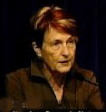 thyroid cancer and ignores all other cancers and other radiation related diseases.
“There is a substantially increased incidence of thyroid tumors among exposed children, up to 50 percent of those tested by ultrasound. But instead of biopsying these tumors, they are ‘following’ them, i.e. doing nothing, which means they are
not being diagnosed and many of these children are therefore destined to die, because almost certainly
many of the tumors will be malignant,” …. She is far from alone in her views.
The Fukushima Battleground Over Science, By Aron Lamm, Epoch Times, 8 June 12, More than a year after the Fukushima nuclear incident, there is still much disagreement about many aspects of its actual consequences. A recent example is a report by the World Health Organization, which estimates radiation doses and cancer risks in the wake of the disaster.
Its findings are being criticized by other medical professionals who use different assumptions and different science, and accuse the WHO of downplaying the gravity of the health risks for people living in the affected area…… Continue reading
Decommissioning is far cheaper than radioactive fallout cleanup!
1. The TEPCO Gang controlled Labor Middlemen are also making a killing off this Trillion Dollar Eco-Disaster, by providing disposable labors like the original 50 responders whose records seem to have vanished, while making BIG money for TEPCO… See: http://is.gd/Ljj4Ff
2. Regarding the highly radioactive material itself:
I wonder if any of the Japanese Leaders are asking (on or off the record), what happened to all the highly radioactive materials that are now missing from Fukushima and what they are doing to recover them ASAP. Since it is true that that TEPCO is using GANG supplied labor then it must be worrisome that much of this highly radioactive material may have been stolen to be later sold to terrorist organizations because of it’s dirty weapon potential for BIG money! I hope some future terrorist dirty explosion does not contain Fukushima radioactive debris, as it will give the phrase “Made in Japan” a new meaning!
A comment from Capt D on http://www.washingtonpost.com/blogs/ezra-klein/post/how-hard-is-it-to-dismantle-150-nuclear-reactors-europes-about-to-find-out/2012/06/09/gJQA2EH0PV_blog.html
Fukushima radiation worse than we’ve been told
The meltdown at Fukushima is releasing far more radiation into the atmosphere [than the Nagasaki A bomb] and if unit 4 were to tumble, it would have the same effect as 1,100 A-bombs….. much more radiation than we’ve been led to believe has made its way to the American shores.
Fukushima forum: Dr. John Apsley says U.S. is feeling the effects of radiation, Donna Anderson Coast to Coast Radio Examiner 10 June 12, Dr. John Apsley appeared on the Fukushima forum on Coast to Coast AM on Saturday, June 9, 2012 .
For more than 30 years Dr. Apsley , author of “Fukushima Meltdown & Modern Radiation: Protecting Ourselves and Our Future Generations ” has specialized in cell regeneration and accelerated wound repair. He appeared on the show to deliver his findings on the effects of
Fukushima radioactive fall-out on the Japanese people, as well as Americans. Continue reading
Japanese government ‘in the pocket of the nuclear industry’ will restart reactors
“By ignoring them and continuing his reckless push to restart Ohi, prime minister Noda is compromising the health and safety of millions, and showing just how deep his government is in the pocket of the nuclear industry,”

U-turn on nuclear as Japan PM decides: ‘We can’t do without it’ Scotsman.com 9 June 2012 Japan’s prime minister has ruled that two mothballed nuclear reactors in the west of the country must be restarted to protect jobs and ensure the “survival of society”, risking a backlash amid safety fears more than a year after the Fukushima disaster. Continue reading
Japan’s re-opened nuclear plants will not be safe until after 2015
Filtered vents that could substantially reduce radiation leaks in case of an accident ; a radiation-free crisis management building; and fences to block debris washed up by a tsunami won’t be ready until 2015. This means the plant, as well as plant workers and residents, won’t be fully protected from radiation leaks in case of a Fukushima-class crisis…
Japan readies for reopening of nuclear reactors amid safety concerns, guardian.co.uk, 8 June 2012 Prime minister Yoshihiko Noda assures citizens’ safety and says reactors must be restarted to boost economy… Prime minister Yoshihiko Noda said the government has taken ample safety measures to ensure the two reactors in western Japan would not leak radiation ifan earthquake or tsunami as severe as last year’s should strike them. Continue reading
Japan mulling over energy options for the future
A key element in the national dialogue will be the future energy mix for Japan to 2030. Three advisory committees – to METI, Environment and Cabinet – have been consulted and the government is ready to put out three options for public consultation
The government appears to have got the message that the public want more choice in their energy supply.
It will be interesting to see what happens when they let the public have their say.
 Japan’s energy dilemma: a renewables embrace?, Climate Spectator, 8 Jun 2012. Gwen Andrews “……..modeling by the Institute of Energy Economics of Japan demonstrates the immensely difficult choices the country is facing……
The announcement of the restarts may be twinned with another announcement, of a ‘national dialogue’ on future energy policy. Japan reviews its energy policy plan every three years, with the last review completed in June 2010. The events of ‘3/11’, as the Japanese call the tsunami disaster, has brought forward a fierce debate on where the
country goes from here.
The debate is notable in that it is front page news, Continue reading
Fukushima nuclear disaster remains a problem for the whole world
324 Civic organizations from all over the world have submitted a petition called “An Urgent Request for UN Intervention to Stabilize the Fukushima Unit 4 Spent Nuclear Fuel”, Mr. Murata said noting that those organizations are also demanding a moratorium on Japan’s nuclear reactors.
”the nuclear village and nuclear dictatorship is exposed, and public opinion and their movements are strong.”Nuclear village is a term for the Japanese distorted social structure in which the pronuclear politicians, scholars and companies have more power than those who are skeptical of nuclear energy. Anti-nuclear protests have been ignored for more than 40 years.
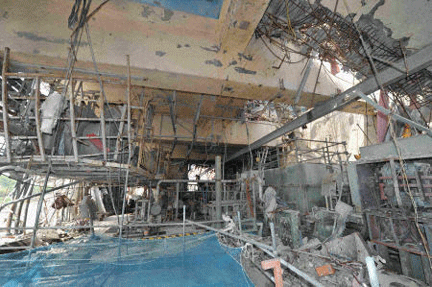 Fukushima Reactor Global Security Issue: Japanese Former Diplomat http://www.panorientnews.com/en/news.php?k=1784, June 7, 2012 Tokyo- (PanOrient News)The Fukushima Daiichi Nuclear Plant Number 4 reactor presents a security problem for the entire world, Mitsuhei Murata, Japan’s former ambassador to Switzerland said.
Fukushima Daiichi plants are “not under control at all… and the situation with nuclear reactors in Japan is like vehicles being driven without a license,” Mr. Murata told a news conference at the foreign correspondents’ club of Japan on June 5. Continue reading
Japanese lawmakers plan for new nuclear regulatory body
Opposition wins on nuke watchdog, Japan Times, Kyodo 7 June 12, The administration will effectively accept a plan proposed by opposition parties to set up an independent “nuclear regulatory commission,” lawmakers said following talks between ruling and opposition parties to explore amending a bill to create a new nuclear regulatory agency. Continue reading
Japan’s energy future could be nuclear free
Japan considers nuclear-free future Options require big boost for renewable energy sources. Nature, David Cyranoski 06 June 2012 It’s official: nuclear power will have a much smaller role in Japan’s energy future than was once thought. Since the meltdowns and gas explosions at the Fukushima Daiichi nuclear power station in March 2011, all of Japan’s remaining reactors have been shut down for inspections and maintenance.
Last week the government offered a glimpse of their future, and that of the country’s nuclear power in general, when it published an outline of four ways to satisfy Japan’s future energy demands. One scenario recommends using a market mechanism to determine the nuclear contribution. Under the other three, nuclear power would supply at most one-quarter of Japan’s energy by 2030 — and in one case, none at all. Continue reading
Enthusiasm for solar power in Japan
The recent rush by home owners to cover their roofs with panels and companies to build “mega solar” farms have made solar cells a hot commodity.
“We are almost at grid parity here. Think of what would happen if Japan allows things to run their natural course and solar reaches grid parity
That all of Japan’s 50 nuclear reactors lie dormant amid public concern in the wake of Fukushima is an added boost for solar power
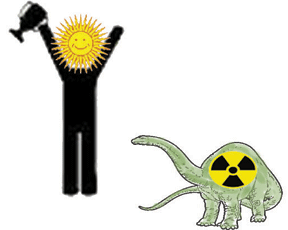 Solar makers bet on Japan nuclear crisis being a game-changer
* Solar power firms to get boost from feed-in tariff
* Foreign players looking to grab slice of Japan’s solar market
* Companies say FIT will encourage economies of scale
* Public faith in nuclear power still in tatters after Fukushima
By Shinichi Saoshiro TOKYO, June 5 (Reuters) – Solar power firms are betting that the nuclear crisis in Japan will become a game-changer for renewable energy in the world’s third largest economy, with new foreign entrants such as Canadian Solar looking to go toe-to-toe there with some of the biggest utilities in Asia.
They will be given a big helping hand next month when the government introduces a generous subsidy for renewable energy via a so-called feed-in tariff (FIT), in a bid to encourage alternative energy sources, which currently only generate about 1 percent of power in Japan.
The FIT, which excludes large hydro-electric schemes, will require utilities to buy electricity generated by renewable sources such as solar, wind and geothermal heat at a premium for 20 years. Continue reading
A year after Fukushima disaster, and Japanese are growing even more opposed to nuclear power
“It is clear from surveys that the majority of the people think that we can survive this summer by conserving energy and transferring electricity among regions,”
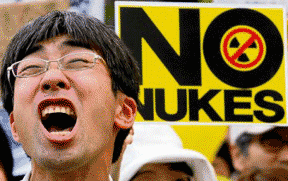 Japanese more opposed to nuclear power a year after the tsunami, LA Times, 5 June 12, As Japanese authorities this week ponder whether to resume producing nuclear energy, a poll shows that opposition to nuclear power is strong and growing more than a year after the earthquake, tsunami and nuclear catastrophe that killed 20,000 and contaminated a broad swath of farmland.
Seventy percent of Japanese surveyed by the Washington-based Pew Research Center said they wanted nuclear power reduced or eliminated, while a year ago the nation was nearly evenly divided on the subject, with 44% urging a phaseout and 46% backing continued generation. Continue reading
New crisis dividing Japanese – dealing with radioactive debris
 Japan’s Latest Nuclear Crisis: Getting Rid of the Radioactive Debris, The Atlantic, JUN 4 2012, A plan to disperse the waste to incineration facilities across the country, meant to instill national unity, is doing the opposite, and further delaying Japan’s ability to move beyond Fukushima. KITA KYUSHU, Japan — Disposing the more than 20 million tons of rubble caused by the March 11 earthquake and tsunami is proving to be a difficult problem for Japan, not least because much of the rubble has been irradiated by the Fukushima nuclear disaster. The government’s plan — to destroy 4 million tons of potentially radioactive earthquake debris in garbage incinerators around the country — is dividing the nation and further delaying the country’s ability to put Fukushima behind it. Continue reading
Japan’s “wide area incineration” plan to manage radioactive debris
 Japan’s Latest Nuclear Crisis: Getting Rid of the Radioactive Debris The Atlantic, JUN 4 2012“.……While the government insists on the necessity of removing rubble from the earthquake region as quickly as possible, critics point out that the government plan calls for 80 percent of the debris to be burned locally, and say that transporting only 20 percent of the feared waste to incinerators around the country makes little sense. After all, if the goal is to remove debris from the area, why is the vast majority of it staying there? Continue reading
1 This Month





PLEASE OPPOSE HR 8255 AND S.3639 – bills would accelerate satellite deployment, with no environmental review or safeguards – https://ncstd5li.quorum.us/campaign/169331/
To see nuclear-related stories in greater depth and intensity – go to https://nuclearinformation.wordpress.com
-
Archives
- October 2026 (81)
- September 2026 (339)
- August 2026 (330)
- July 2026 (355)
- June 2026 (287)
- May 2026 (306)
- April 2026 (356)
- March 2026 (251)
- February 2026 (267)
- January 2026 (308)
- December 2025 (358)
- November 2025 (359)
-
Categories
- 1
- 1 NUCLEAR ISSUES
- business and costs
- climate change
- culture and arts
- ENERGY
- environment
- health
- history
- indigenous issues
- Legal
- marketing of nuclear
- media
- opposition to nuclear
- PERSONAL STORIES
- politics
- politics international
- Religion and ethics
- safety
- secrets,lies and civil liberties
- spinbuster
- technology
- Uranium
- wastes
- weapons and war
- Women
- 2 WORLD
- ACTION
- AFRICA
- Atrocities
- AUSTRALIA
- Christina's notes
- Christina's themes
- culture and arts
- Events
- Fuk 2022
- Fuk 2023
- Fukushima 2017
- Fukushima 2018
- fukushima 2019
- Fukushima 2020
- Fukushima 2021
- general
- global warming
- Humour (God we need it)
- Nuclear
- RARE EARTHS
- Reference
- resources – print
- Resources -audiovicual
- Weekly Newsletter
- World
- World Nuclear
- YouTube
-
RSS
Entries RSS
Comments RSS

