Japan’s nuclear authority did not pass on information on Fukushima radiation
 The information was passed to the Nuclear and Industrial Safety Agency (NISA) and the science and technology ministry by Japan’s Foreign Ministry but neither agency passed it to the prime minister’s office, which was overseeing the evacuations.
 thousands fled in the same direction as the radioactive material was drifting.
 People fled towards Fukushima radiation Stuff.co.nz, 20 June 12 Japanese authorities failed to disclose US data about the spread of radiation spewing from a crippled nuclear plant last year, leaving some evacuees fleeing in the same direction as the radioactive emissions.
News that Japan’s nuclear watchdog and the science and technology ministry sat on the information collected by US military aircraft – another sign of the chaos at the time – is likely to add to mistrust of nuclear power just days after the government approved the restart
of two idled reactors…
.. US military aircraft gathered radiation data from March 17-19 over a 45km radius and found that people in an area about 25km northwest of the plant – where some people were moving – were exposed to the annual permissible level of radiation within eight hours, Japanese media said.
The information was passed to the Nuclear and Industrial Safety Agency (NISA) and the science and technology ministry by Japan’s Foreign Ministry but neither agency passed it to the prime minister’s office, which was overseeing the evacuations. Continue reading
Uncertainty about the restart of Japan’s other nuclear reactors,
 Uncertain prospects loom for post-Oi reactors, Masayuki Takata / Yomiuri Shimbun 17 June 12, Now that the government has decided to reactivate the Nos. 3 and 4 reactors at the Oi nuclear power plant in Fukui Prefecture, attention has turned to which will be next among the nation’s other 48 idle reactors….
Which reactor will be reactivated next is expected to be left up to a new nuclear regulatory commission to be established in August at the earliest. However, there are no clear prospects for restarting more reactors because it has not been decided how the new organization will
confirm their safety.
At a press conference held Saturday after the four-minister meeting, Economy, Trade and Industry Minister Yukio Edano said the Cabinet would not decide on reactivating the 48 reactors.
“The new regulatory organization will make its own decisions [regarding the safety of the reactors] independently” from the government, Edano said. It is unclear, however, to what extent the nuclear regulatory commission will take the current safety standards into consideration when making its assessments. Continue reading
Majority of Japanese oppose restart of 2 Oi nuclear reactors
Opinion polls consistently show more than half of Japanese are opposed to nuclear power,
In the communities surrounding Oi, only 38% of residents support the restart of the reactors, the NHK survey found…..
Nuclear-Restart Plans Divide Japan Tokyo Aims to Get Economy Back on Track, but Local Leaders, Some Residents Oppose Atomic Power, WSJ. By MITSURU OBE And CHESTER DAWSON, June 17, 2012, TOKYO—Japan ordered a pair of reactors back online for the first time since last year’s nuclear accident, but the chaos and confusion surrounding the decision highlight how unready the country may still be to restart its atomic-energy engine….
.. the restart decision comes a month ahead of deliberations over a new energy plan, which could call for scrapping nuclear power for good. And the restarts would come a few months before the setup of a new Japanese nuclear regulator, which will craft new safety guidelines and is expected to take a harder line on vetting reactors. Continue reading
6.5 million petition against restarting Japan’s nuclear reactors
On Friday, Japan’s Nobel literature prize laureate Kenzaburo Oe visited the prime minister’s office and handed the signatures of 6.5 million opposed to the continued use of nuclear reactors.
Japan orders nuclear restart amid protests, Business Recorder, 16 JUNE 2012 TOKYO: Japan ordered nuclear reactors back online on Saturday, defying public sentiment against atomic power following last year’s meltdowns at Fukushima sparked by a huge quake-tsunami disaster. Continue reading
Opposition to Japan’s nuclear power restart, from 73 Japanese Mayors
n Saturday, thousands of demonstrators in Tokyo and other cities and towns voiced their criticism of the prime minister’s declaration that the Ohi plant is safe.
Earlier this month, about 1,300 people from Fukushima Prefecture filed a criminal complaint against Tokyo Electric Power Co. Chairman Tsunehisa Katsumata and 32 other… accusing them of professional negligence resulting in death and injury.
Japanese Mayors Protest Restart of Nuclear Power Plant, TOKYO, Japan, June 17, 2012 (ENS) – A group of Japanese local government elected officials is protesting the decision of Prime Minister Yoshihiko Noda’s government to restart a nuclear power plant…
… Under the banner Mayors for a Nuclear Power Free Japan, the group of 73 serving and retired mayors held a news conference Sunday to protest the plan to put the Ohi plant back online. Continue reading
Extremely high radiation found by robots, above Fukushima Reactor No.2
 High Radiation Detected On Floor Above Crippled Fukushima Reactor http://www.rttnews.com/1907046/high-radiation-detected-on-floor-above-crippled-fukushima- 6/15/2012 (RTTNews) – Extremely high level of radiation has been detected on a floor just above the No.2 reactor at the crippled Fukushima nuclear power plant in Japan, the plant operator said on Thursday The Tokyo Electric Power Company (Tepco) said a reading of 880 millisieverts per hour of radiation was detected on the fifth floor, which is 4.5 meters above the reactor containment vessel. The reading was taken by a robotwhich the company deployed in the reactor building on Wednesday.
Tepco suspects that radioactive substances leaked from the No.2 reactor moved through the location. It could not find the exact route the radioactive substances moved even after analyzing the images taken by the robot, Japanese media reported.
The No.2 reactor is believed to have released the largest amount of radioactive substances during the Fukushima nuclear accident caused by the disastrous earthquake and the massive tsunami it unleashed on Japan’s north-east on March 11, 2011. But the overall route they took has not been determined. Residents in 20 kilometer radius of the stricken plant had been evacuated following the accident, the second biggest after Chernobil.
Tepco needs to find and repair the damaged parts of the reactor to recover melted nuclear fuel before starting to decommission the reactor. But it says high radiation often stops workers from entering the building.
Chief temple priest of Fukui Prefecture speaks out against nuclear reactor restarts
 The myth about the safety of nuclear energy did not collapse with the Fukushima accident. It had already collapsed when nuclear plants were forced on isolated villages in various parts of Japan because there was the understanding that those plants were dangerous facilities that could not be built close to major urban centers.
Tetsuen Nakajima: Japan must thoroughly re-examine nuclear energy policy THE ASAHI SHIMBUN 16 June 12, When I was a student, I was only interested in literature and the arts. Then in 1963, a friend took me to a peace march against nuclear weapons.
There I met a hibakusha who had been exposed to radiation after the dropping of the atomic bomb on Hiroshima. Continue reading
Japan’s new nuclear regulatory body might allow prolonging life of old reactors
The legislation, however, swiftly came under fire for appearing to weaken the government’s commitment to decommissioning reactors after 40 years in operation
the new regulatory commission could revise a rule limiting the life of reactors to 40 years in principle.
“Does this reflect the sentiment of the citizens, who are seeking an exit from nuclear power?”
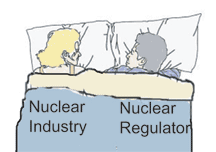 Japan to get new atomic regulatory body within three months By Linda Sieg, TOKYO Jun 15, 2012 (Reuters) – Japan will set up a new nuclear regulator around September under a law approved by parliament’s lower house on Friday after months of delay as part of a drive to improve safety and restore public trust after the worst atomic disaster since Chernobyl.
The 2011 Fukushima disaster cast a harsh spotlight on the cozy ties between regulators, politicians and utilities – known as Japan’s “nuclear village” – that experts say were a major factor in the failure to avert the crisis triggered when a huge earthquake and tsunami devastated the plant, causing meltdowns. Continue reading
Japan’s nuclear hosting towns addicted to the drug of nuclear subsidies
Genkai’s dependence on nuclear subsidies to fund 34% of its budget is the highest among the municipalities hosting nuclear plants, only matched by the town of Futaba next to the Fukushima Daiichi plant, according to a survey by the Yomiuri newspaper released in May.
Radiation levels in Futaba are so high that the government doesn’t expect the town to be habitable for decades.
Nuclear-related money “is like a drug: you get addicted once you receive it,”
Fukushima Watch: Looking for New Nuclear Revenue — A Spent Fuel Tax?, WSJ, By Mari Iwata, 15 June 12, The town of Genkai on Japan’s western island of Kyushu is one of many in this country whose livelihood depends on the nuclear reactors it hosts. Since those reactors have been shut down for nearly six months, with no restart in sight, the town is proposing another way of squeezing revenue from the power plant: tax it. That at least was the idea proposed by Hideo Kishimoto, Genkai’s mayor, in a municipal parliament session on Monday. One specific suggestion: a tax on the storage of the Genkai plant’s spent nuclear fuel rods.
“We can’t avoid a future drop in revenue, so we have to think of new taxes in order to maintain services for residents,” Mr. Kishimoto was quoted as saying in local media. Genkai’s revenue problem is acute. Continue reading
Inadequacy of Fukushima radiation tests – to avoid “uneasiness”
 Fukushima Prefecture asked university to stop radiation dose tests soon after disaster, The Mainichi, 14 June 12, The Fukushima Prefectural Government asked a research team from Hirosaki University to stop conducting internal radiation exposure tests on prefectural residents after the outbreak of the Fukushima nuclear disaster on the grounds that the tests were “stirring uneasiness,” it has been learned. Continue reading
Fukushima Daiichi – a global disaster still only in its infancy
There is every reason to suspect that the vital information about the full extent of the nuclear disaster in Japan is still being kept from the public; that the life-threatening damage to Japan’s nuclear infrastructure does not end with Fukushima #1.
The Fukushima Debacle is Only in Its Infancy The growing realization that the worst of the Fukushima debacle lies in the future rather than in the past puts in sharp relief the pertinence of Einstein’s observation.
 Fukushima Daiichi: From Nuclear Power Plant to Nuclear Weapon Global Research, by Prof. Anthony Hall , 13 June 12, “Our world is faced with a crisis that has never before been envisaged in its whole existence… The unleashed power of the atom has changed everything save our modes of thinking, and thus we drift towards unparalleled catastrophe.” Albert Einstein, Bulletin of the Atomic Scientists, May, 1946
Albert Einstein’s Warning and the Ominous Fate of Fukushima Daiichi
As the bad news gradually spreads that the debacle at Fukushima nuclear power plant #1 is becoming more perilous rather than less so, the words of Albert Einstein come to mind. Recall that the legendary physicist, Einstein, helped to set in motion the Manhattan Project whose personnel designed and built the first atomic bombs dropped on Hiroshima and Nagasaki in 1945…..
Albert Einstein worried that human ways of thinking could not be made to adapt to the changes brought to the world by the tapping the enormous energy sources emanating from the molecular constitution of inner space.
Japan as Laboratory Continue reading
Drones to monitor Japan’s ionising radiation.
Japan to develop drones to monitor radiation http://www.brisbanetimes.com.au/technology/sci-tech/japan-to-develop-drones-to-monitor-radiation-20120613-208zs.html#ixzz1xnWor9LB June 13, 2012 Japan’s atomic energy authority and the country’s space agency has announced a joint project to develop a drone to measure radioactivity in the environment after last year’s nuclear disaster. Japan has been forced to invent or improve systems for measuring radioactive contamination Continue reading
Shareholder meetings could be the next impediment to restarting Japan’s nuclear power industry
Fukushima Watch: Next Nuclear Battleground — Utilities’ Shareholder Meetings, WSJ, June 13, 2012, By Mitsuru Obe With the government inching closer to restarting the first nuclear reactors since last year’s Fukushima Daiichi nuclear disaster, a new battleground between Japan’s pro- and anti-nuclear camps is emerging: the annual shareholder meetings of the country’s big power companies in June.
Japan’s four biggest utilities hold their shareholder meetings on June 27. The meeting that’s drawing a lot of attention these days is that of Kansai Electric Power Co., which relied on
nuclear plants to supply around half of its electricity, and operates the Oi nuclear plant, whose No. 3 and 4 reactors are first in line to restart. Kansai Electric supplies energy to the region around the city of Osaka, Japan’s third-biggest metropolis and the utility’s largest shareholder, with 8.92% of outstanding shares.
And Osaka has submitted proposals to Kansai Electric that it exit nuclear power and separate
its power-generation operations from distribution and transmission — or control of the electricity grid. Continue reading
Charge nuclear officials under criminal law, say Fukushima residents
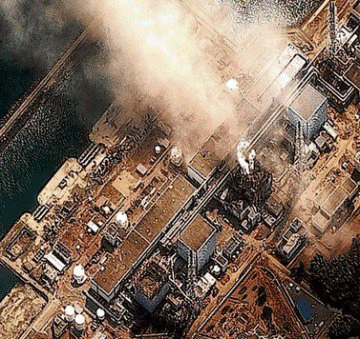 Fukushima residents call for criminal charges against nuclear officials http://articles.cnn.com/2012-06-11/asia/world_asia_japan-nuclear-complaint_1_fukushima-daiichi-nuclear-plant-fukushima-residents-tepco?_s=PM:ASIA June 11, 2012|By Kyung Lah, CNN The executives of the Japanese utility that owns the stricken Fukushima Daiichi nuclear plant and a number of the country’s government officials should go to jail, according to a complaint filed by more than 1,000 local residents on Monday.
A total of 1,324 people lodged the unusual criminal complaint with the Fukushima prosecutor’s office, naming Tsunehisa Katsumata, the chairman of Tokyo Electric Power Co. (TEPCO) and 32 others.
The complaint argues that the 33 TEPCO executives and government officials are responsible for causing the nuclear disaster that followed the March 11 earthquake and tsunami and exposing the people of Fukushima to radiation.
Disinformation to Japanese public on the relative costs of nuclear and renewable energy
Weapons of Disinformation The most common item in this process of manipulating the public discussion in favor of a vested interest has been the publishing of studies and reports by private “scientific” institutes. These papers by so-called “energy experts” are disguised as objective scientific assessments of the current situation and future developments…. their sole purpose is to convince the public and industrial and political leaders who might not have enough subject knowledge to notice the bias.
Japan: Ignorance and/or Dishonesty of “Energy Experts”, Clean Technica, JUNE 11, 2012 BY THOMAS Currently, the main focus is on the struggle about whether or not to restart two nuclear reactors at the Ōi Nuclear Power Plant, which has a combined capacity of 2.2 GW of electric power.
Those forces in favor of a nuclear comeback proclaim that there would be no alternative to a restart. According to them, reactivating two nuclear reactors is the only way to ensure the stability of the power grid in the Kansai region, Japan’s second-largest industrial area.
In order to convince the public, industry leaders and the government of this so-called existential necessity, the so-called “nuclear village” bombards the discussion with doomsday scenarios about how dangerous blackouts are – how they risk lives and the economy — as well as trying to reestablish the perception that nuclear power would be the cheapest form of electricity generation.
Considering that the so-called “nuclear village” of Japan finds itself in the unfamiliar situation of an uphill battle to regain trust and favorable public opinion, it is trying everything it can to change the odds in its favor once again. Continue reading
1 This Month





PLEASE OPPOSE HR 8255 AND S.3639 – bills would accelerate satellite deployment, with no environmental review or safeguards – https://ncstd5li.quorum.us/campaign/169331/
To see nuclear-related stories in greater depth and intensity – go to https://nuclearinformation.wordpress.com
-
Archives
- October 2026 (81)
- September 2026 (339)
- August 2026 (330)
- July 2026 (355)
- June 2026 (287)
- May 2026 (306)
- April 2026 (356)
- March 2026 (251)
- February 2026 (267)
- January 2026 (308)
- December 2025 (358)
- November 2025 (359)
-
Categories
- 1
- 1 NUCLEAR ISSUES
- business and costs
- climate change
- culture and arts
- ENERGY
- environment
- health
- history
- indigenous issues
- Legal
- marketing of nuclear
- media
- opposition to nuclear
- PERSONAL STORIES
- politics
- politics international
- Religion and ethics
- safety
- secrets,lies and civil liberties
- spinbuster
- technology
- Uranium
- wastes
- weapons and war
- Women
- 2 WORLD
- ACTION
- AFRICA
- Atrocities
- AUSTRALIA
- Christina's notes
- Christina's themes
- culture and arts
- Events
- Fuk 2022
- Fuk 2023
- Fukushima 2017
- Fukushima 2018
- fukushima 2019
- Fukushima 2020
- Fukushima 2021
- general
- global warming
- Humour (God we need it)
- Nuclear
- RARE EARTHS
- Reference
- resources – print
- Resources -audiovicual
- Weekly Newsletter
- World
- World Nuclear
- YouTube
-
RSS
Entries RSS
Comments RSS

