Japan’s utilities meetings: shareholders demand end to nuclear power
Utility shareholders meet / Nuclear power decried; TEPCO’s de facto nationalization OK’d The Yomiuri Shimbun, 28 June 12 De facto nationalization of Tokyo Electric Power Co., which will receive a capital injection of 1 trillion yen in public funds, was approved at its regular general shareholders meeting Wednesday in Tokyo.
TEPCO and eight other power utilities that own nuclear power plants held their annual shareholders meetings across the nation on the day, with shareholders demanding the companies ensure management transparency and give up nuclear power. Continue reading
Japan’s TEPCO nationalised, will restart another nuclear power plant
Tepco’s New Chief Sees No Plan B To Revive Profitability Bloomberg, By Tsuyoshi Inajima and Yuji Okada – Jun 27, 2012 Tokyo Electric Power Co. (9501), owner of the crippled Fukushima reactors, is committed to restarting another nuclear plant next year that is the world’s largest and itself was damaged in a 2007 earthquake.
Bringing the Kashiwazaki Kariwa power station online, even though it sets up the state-controlled utility for further conflicts with a nuclear-weary public, is part of “Plan A,” President Naomi Hirose, 59, said in an interview. The plan refers to a 10-year business
reconstruction that handed control of the power company known as Tepco to Japan’s government. Continue reading
Legal action not an option for vast majority of Fukushima’s nuclear victims
Victims and lawyers in Japan say the dearth of nuclear-related suits reflects both a national mindset — a distaste for confrontation — and a stunted judicial system that doesn’t allow for class-action cases or punitive damages. Japanese speak of the court system as more likely to deliver frustration than vengeance, and jobless evacuees who urgentlyneed money have little appetite for long trials with uncertain outcomes.
Without the threat of legal action, ……”the state and companies can take advantage of victims.”

 Nuclear redress will never approximate losses, By CHICO HARLAN, The Washington Post, 26 June 12, It was 15 months ago that the Fukushima No. 1 nuclear plant suffered three meltdowns and contaminated a broad circle of countryside and left hundreds of thousands of people without homes, jobs or both. But for all the damage and despair it wrought, the disaster so far has unfolded without one conventional element: a widespread and contentious legal fight by those who say they should be compensated for their losses.
Victims of the worst nuclear crisis in a quarter-century have filed roughly 20 lawsuits against Tokyo Electric Power Co., according to the utility. That compares with the several hundred suits filed against BP within weeks of the 2010 Gulf oil spill, including the near-finalized settlement of a class-action suit that will pay 120,000 plaintiffs upward of $7.8 billion. BP also paid out some $6.2 billion to victims via a neutral claims settlement process, administered by a lawyer appointed by the Obama administration. Continue reading
Dangerous to restart Japan’s nuclear reactors, warn seismologists
 Seismic modelling by Japan’s nuclear regulator did not properly take into account active fault lines near the Ohi plant, Katsuhiko Ishibashi, a seismologist at Kobe University, told reporters.
“Instead of making standards more strict, they both represent a severe setback in safety standards.”
Seismologists warn Japan against nuclear restart http://af.reuters.com/article/energyOilNews/idAFL3E8HQ43L20120626 TOKYO, June 26 (Reuters) – Two prominent seismologists said on Tuesday that Japan is ignoring the safety lessons of last year’s Fukushima crisis and warned against restarting two reactors next month. Continue reading
High radiation levels in Fukushima fish
Fukushima fish still hard to stomach http://www.radioaustralia.net.au/international/2012-06-25/fukushima-fish-still-hard-to-stomach/967258, 26 June 2012 Japanese fishermen are facing a struggle for their livelihoods.An ABC report shows that many fish caught in the oceans around Fukushima contain dangerous levels of radioactive material. Continue reading
Rain and mud bring radioactivity to areas in Tokyo park
 Radiation hotspots found in Tokyo park, June 26, 2012, THE ASAHI SHIMBUN Radiation levels exceeding official standards have been detected at a park in Tokyo, after a metropolitan government inspection carried out under pressure from the Japanese Communist Party.
The Tokyo metropolitan government said June 25 that it had detected a maximum radiation reading of 1.22 microsieverts per hour at Mizumoto Park in Katsushika Ward. Officials took readings at two points in the shrubbery in the parking areas. Both readings exceeded the central government standard for decontamination of 1 microsievert per hour above background radiation. The metropolitan government said it will decontaminate the area.
The cause of the high radiation levels is still being investigated, but officials say both spots are likely places where rainwater and mud build up….. http://ajw.asahi.com/article/0311disaster/fukushima/AJ201206260057
Japanese utility shareholders meetings – local governments will demand nuclear power shutdown
Local governments to demand change at utility shareholders’ meetings, June 26, 2012 THE ASAHI SHIMBUN Long seen as “silent” shareholders, local governments are expected to demand bold reforms, such as abolishing nuclear power plants, at the general shareholders’ meetings of electric utilities.
But they may not have enough voting power to force big changes in the industry. All 10 of Japan’s regional electric power companies, except for Okinawa Electric Power Co., are scheduled to hold their shareholders’ meetings on June 27.
At Kansai Electric Power Co.’s meeting, Osaka Mayor Toru Hashimoto is set to propose “the abolition of all of its nuclear power plants as soon as possible” in company’s articles of incorporation. The city of Osaka is the largest shareholder of Kansai Electric, with a 9.37-percent stake in terms of voting rights……
http://ajw.asahi.com/article/0311disaster/fukushima/AJ201206260079
Thousands protest in Japan and beyond, against restart of nuclear reactors
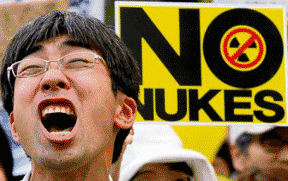 Protests in Japan Over Nuclear Plant Restarts, By Jack Phillips Epoch Times 24 June 12, Tens of thousands of Japanese people took to the streets over the weekend in Tokyo and Osaka to protest the government’s plan to restart two reactors in Fukui Prefecture—the first restarts since all nuclear facilities were shut for inspection after last year’s tsunami-triggered and nuclear disaster.
“The government’s decision (to reactivate the Oi reactors) is folly. We should not leave it to the next generation to solve the energy issue,” a 42-year-old woman from the city of Kofu told the Japan Times, and was joined by 45,000 other people at a rally in Tokyo Friday…..
“They are trying to scare us by saying power supplies may run out even if the reactors are restarted,” one protester was quoted as saying….. There were also protests at Japanese consulates on Pacific Coast and in the U.S. cities of San Francisco, and Portland, Oregon .http://www.theepochtimes.com/n2/world/protests-in-japan-over-nuclear-plant-restarts-256329.html
Typhoons, tornadoes, threaten crippled Fukushima nuclear plant
Fukushima plant faces typhoon summer with added tornado threat, Fuel Fix June 22, 2012 Tokyo Electric Power Co. (9501)’s crippled Fukushima nuclear plant faces its second typhoon season since the March 11 disaster last year, raising the risk of further radiation leaks if storms thrash exposed pools of uranium fuel rods or tanks holding contaminated water. Continue reading
Restart of nuclear reactors in Oi, Japan, killing the tourism industry
the distinction of being selected as the first town with reactors designated for restart has put a damper on the town’s ambitions to diversify its economy by becoming more of a tourism resort.
A survey released May 31 by national broadcaster NHK found 81% of people in the towns bordering Oi think the nuclear plant there may suffer a Fukushima-type disaster.
Japan’s Nuclear Restarts Worry Tourism Industry WSJ, By CHESTER, DAWSON, 22 June 12 OI, Japan—The Sodegahama public beach draws thousands of swimmers and sunbathers who flock each summer to the sheltered cove at the tip of a rural peninsula in Fukui prefecture. At one end of the arc of sand is a popular campground with a pair of historic bronze cannons dating from 1854. At the other lies a tree-covered hill shielding the view of four nuclear reactor domes 1,000 feet (several hundred meters) away.
As the Japanese government has moved to restart nuclear reactors for the first time since last year’s disaster in Fukushima, this seaside town, which depends on the plant for jobs and subsidies, is wary about of the impact on another major source of revenue: tourism….. Continue reading
Nuclear reprocessing is not the answer to Japan’s mounting radioactive wastes
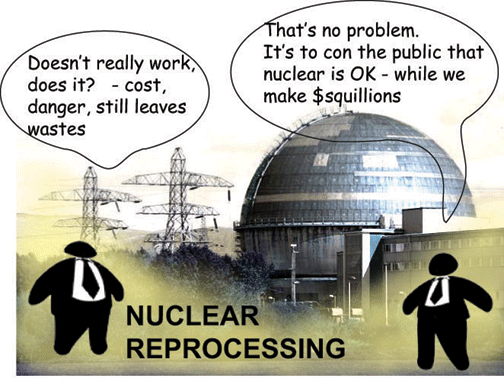 The amount of spent fuel stored at power stations has continued to surge, standing at around 14,200 tons across 17 facilities as of last September, including the wrecked Fukushima No. 1 nuclear plant.
Japan Nuclear Fuel Ltd.’s storage facilities are already almost full and contained a total of 2,800 tons as of February, while several power stations are expected to reach maximum capacity over the next three years if their currently idled reactors are restarted, industry
sources said.
 Policy of recycling all spent nuclear fuel may be axed, Japan Times, 22 June 12, Kyodo, Jiji The Japan Atomic Energy Commission has proposed both reprocessing and directly disposing of spent nuclear fuel if Japan’s atomic energy reliance is cut to 15 percent, a departure from the current policy of total reprocessing…
.. The changed tack comes as massive amounts of spent fuel are accumulating at nuclear plants nationwide and as decades-long efforts to activate reprocessing facilities remain mired
in technical difficulties, sources said. Continue reading
20,000 anti-nuclear protestors rally outside Japanese PM’s home
Japan protest over nuclear restart (Google News, 23 June 12, AFP) TOKYO — About 20,000 people gathered in front of Japanese Prime Minister Yoshihiko Noda’s residence in Tokyo late Friday to protest his decision to restart two nuclear reactors.
“No to the restart!” shouted the protestors, who were led by investigative journalist Satoshi Kamata and Nobel Prize-winning author Kenzaburo Oe, who started an anti-nuclear petition that has so far gathered more than 7.5 million signatures… Japan protest over nuclear restart
Japanese government’s snide move towards nuclear weapons
Japan’s nuclear ambition, Tokyo has only to strike out controversial phrase Korea Times, 23 June 12, The world has long regarded Japan as a virtual nuclear power. On Wednesday, Tokyo took its first step toward becoming a “real” one.
The upper house of Japan’s Diet passed an amendment to the country’s Atomic Energy Basic Law to allow the use of nuclear power for “national security,” according to the Tokyo Shimbun. The addition of these controversial words was made so furtively that not only the
Japanese public but even many Lower House lawmakers didn’t know about
it, other reports say.
Despite denials from the Japanese government, there should be little doubt about Tokyo’s intention — nuclear armament. The stealthy way the Japanese parliament handled the matter proves it. Continue reading
Referendums in Japan about nuclear power?
Fukushima Watch: Japan Mulls Referendum on Nuclear Power, WSJ, By Mitsuru Obe, June 22, 2012, Do Japanese want nuclear power? Why not find out in a referendum? That’s what proponents of putting the nuclear question to the people are saying, pointing out that similar polls have been held in the United States, Germany, Italy, Switzerland and Sweden. Trade and industry minister Yukio Edano is one prominent proponent. Even before
his ruling Democratic Party of Japan came to power, ……As industry minister, Mr. Edano
oversees Japan’s power industry…
.. Unlike public opinion polls, referendums are supposed to be preceded by a period of intense public discussion. In Japan, a national referendum is required only for constitutional amendments. Such ballots can be called on other issues, but their verdicts have no binding power. Continue reading
Fukushima nuclear power to be replaced by big solar energy plant
 Mixed Greens: Big solar to replace Fukushima nuclear, REneweconomy, By Sophie Vorrath 21 June 2012, Toshiba Corp has announced that it will begin building solar plants with a total generating capacity of 100MW on its northeastern coastline – the region that last year was devastated by an earthquake and tsunami, which then triggered a nuclear disaster – making it the biggest solar project in Japan.
Reuters reports that the Japanese electronics conglomerate will spend around ¥30 billion ($379.6 million) to build several large-scale solar plants in Minami Soma – located around 25km from the crippled Fukushima nuclear plant. Continue reading
1 This Month


Read the Public Inquiry Report, the Commissioners’ report, Surrendering Australia: The AUKUS Deception is available to download for free at aukuspublicinquiry.com. Or just watch the replay of the National Press Club Luncheon.



19 November – Webinar – The Reality of Reprocessing
Time: 11:00 AM Pacific Time (US & Canada) / 2:00 PM Eastern / 7:00 PM UK / 8:00 PM CET
Register for the Zoom Event Here



Shut down the radiation-damaged Heysham nuclear reactors now
To see nuclear-related stories in greater depth and intensity – go to https://nuclearinformation.wordpress.com

Say No to NASA’s Reckless Nuclear Reactor on the Moon
Say No to NASA’s Reckless Nuclear Reactor on the Moon
-
Archives
- November 2026 (109)
- October 2026 (302)
- September 2026 (339)
- August 2026 (330)
- July 2026 (355)
- June 2026 (287)
- May 2026 (306)
- April 2026 (356)
- March 2026 (251)
- February 2026 (267)
- January 2026 (308)
- December 2025 (358)
-
Categories
- 1
- 1 NUCLEAR ISSUES
- business and costs
- climate change
- culture and arts
- ENERGY
- environment
- health
- history
- indigenous issues
- Legal
- marketing of nuclear
- media
- opposition to nuclear
- PERSONAL STORIES
- politics
- politics international
- Religion and ethics
- safety
- secrets,lies and civil liberties
- spinbuster
- technology
- Uranium
- wastes
- weapons and war
- Women
- 2 WORLD
- ACTION
- AFRICA
- Atrocities
- AUSTRALIA
- Christina's notes
- Christina's themes
- culture and arts
- Events
- Fuk 2022
- Fuk 2023
- Fukushima 2017
- Fukushima 2018
- fukushima 2019
- Fukushima 2020
- Fukushima 2021
- general
- global warming
- Humour (God we need it)
- Nuclear
- RARE EARTHS
- Reference
- resources – print
- Resources -audiovicual
- Weekly Newsletter
- World
- World Nuclear
- YouTube
-
RSS
Entries RSS
Comments RSS

