Fukushima water dumping plan triggers fresh anger from South Korea
As water-dumping moves advance, S. Koreans seek firm regional stance, http://global.chinadaily.com.cn/a/202208/09/WS62f1be52a310fd2b29e7119d.html By YANG HAN in Hong Kong |2022-08-09
Japan’s plan to dump radioactive wastewater from the stricken Fukushima nuclear power plant will endanger the lives of people in the Asia-Pacific region, say experts who want to see stepped-up efforts against the ocean disposal from the countries most at risk.
South Koreans have been among those expressing their opposition to the plan, and voices have again been raised after Japan moved a step closer to implementing its planned discharge of the nuclear-contaminated water from next year, following the recent approval of the plan’s details by the nation’s nuclear regulator.
“The discharge of wastewater from Fukushima is an act of contaminating the Pacific Ocean as well as the sea area of South Korea,” said Ahn Jae-hun, energy and climate change director at the Korea Federation for Environment Movement, an advocacy group in Seoul.
“Many people in South Korea believe that Japan’s discharge of the Fukushima wastewater is a wrong policy that threatens the safety of both the sea and humans,” Ahn told China Daily.
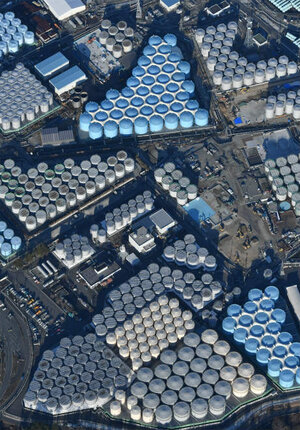
Last month, Japan’s nuclear regulator approved the plan to discharge wastewater into the Pacific Ocean from the Fukushima Daiichi power plant, after it built up a huge amount of radiation-tainted water. The water has been collected and stored in tanks following efforts to cool down the reactors after an earthquake and tsunami struck Japan in 2011.
The dumping plan has drawn fierce opposition from government officials and civic groups in South Korea, one of the world’s major consumers of seafood.
On Aug 1, South Korea’s Minister of Oceans and Fisheries Cho Seunghwan said the government is considering whether to take the issue to the International Tribunal for the Law of the Sea, Yonhap News Agency reported. Cho said the government’s primary plan is to prevent Japan from releasing the contaminated water. “We do not accept the release plan”, he said.
Ahn said radioactive materials can generate long-term effects and it remains unclear how they will affect the marine ecosystem.
Though the South Korean government is considering taking the issue to the international tribunal, Ahn said it will be difficult to quantify the potential damage.
South Korea has said it will conduct a thorough analysis and revision of the impact of Japan’s plan, but the government has not received enough data from Japan to conduct such research, South Korea’s Hankyoreh newspaper reported in June.
After Japan’s nuclear regulator approved the Fukushima discharge plan, South Korean President Yoon Suk-yeol said Tokyo needs to transparently explain and gain consent from neighboring countries before releasing the contaminated water.
Potential impact
Shaun Burnie, a senior nuclear specialist with Greenpeace Germany, said the environmental group is concerned about the potential impact of the water’s release on the wider Asia-Pacific region.
The level of exposure depends on multiple variables including the concentration in seawater and how quickly it concentrates, disperses and dilutes, forms of life, and the type of radionuclide released and how that disperses or concentrates as it moves through the environment, Burnie said.
“The concentrations are of direct relevance to those who may consume them, including marine species like fish and, ultimately, humans,” Burnie told China Daily.
Noting that the Fukushima contaminated water issue comes under the United Nations Convention on the Law of the Sea as it is a form of pollution to international waters, Burnie said there are strong grounds for individual countries to file a legal challenge against Japan’s plan.
Ahn said joint expressions of opposition in the region could force the Japanese government to choose a safe method to deal with the wastewater instead of dumping it into the sea. China is also among the neighboring countries that have voiced opposition to the Fukushima discharge plan.
Hiroshima marks 77th anniversary of atomic bombing amid nuclear threat

By Reito Kaneko Kyodo News. 6 Aug 22, Hiroshima marked the 77th anniversary of its atomic bombing by the United States on Saturday, amid heightened concern in Japan and elsewhere over repeated Russian threats to resort to nuclear weapons amid the war in Ukraine.
Mayor Kazumi Matsui cautioned in a Peace Declaration at a memorial ceremony in the western city that even as civilian lives are being lost in the Russian aggression, reliance on nuclear deterrence is gaining momentum around the world.
“We must immediately render all nuclear buttons meaningless,” he said.
U.N. Secretary General Antonio Guterres was also present at the annual ceremony at the Peace Memorial Park near ground zero, becoming the first U.N. chief to attend since his predecessor Ban Ki Moon in 2010.
Prime Minister Fumio Kishida, who represents a constituency in Hiroshima, decried in his remarks the apparently declining momentum toward a world without nuclear weapons, calling on humanity not to repeat the tragedy of using nuclear weapons……………………………..
The combined number of officially recognized survivors of the two nuclear attacks, known as hibakusha, stood at 118,935 as of March, down 8,820 from a year earlier, the Ministry of Health, Labor and Welfare said. Their average age was 84.53. https://english.kyodonews.net/news/2022/08/5ad7cbefa68e-hiroshima-marks-77th-anniv-of-atomic-bombing-amid-nuclear-threat.html
Resumption of Mihama Nuclear Power Plant Unit 3 delayed due to leakage of water containing radioactive materials, Kansai Electric Power Co.

August 3, 2022
Kansai Electric Power Co. (KEPCO) announced on August 3 that it would postpone the resumption of power dispatch for the Mihama Unit 3 reactor (Fukui Prefecture), which is undergoing routine inspections and was scheduled to restart on August 12. This is due to a leak of water containing trace amounts of radioactive materials in the reactor’s auxiliary building, which has necessitated an investigation into the cause and restoration work. The resumption date has not yet been determined.
According to KEPCO, the leak was discovered during a routine inspection on the morning of January 1, near a device in the auxiliary reactor building that prevents primary cooling water from leaking outside. The amount of leaked water is estimated to be approximately 7 tons. The company claims that the water did not leak outside the building and that there is no environmental impact or radiation exposure to workers.
KEPCO, Yagi, Mori, and 3 others “appropriate for prosecution” by the Public Prosecutor’s Examination Board

Aug. 1, 2022
On August 1, the Osaka Second Public Prosecutors’ Office (Prosecutor’s Office) announced its decision to “consider indicting” former KEPCO Chairman Makoto Yagi (72), former Chairman Shosuke Mori (81), and former President Shigeki Iwane (69), all of whom had been accused of special breach of trust under the Companies Act, but were not charged by the Special Investigation Department of the Osaka District Public Prosecutors Office. The Special Investigation Department reopened the case.
The Special Investigation Department will reopen the investigation and, in principle, make a new decision within three months as to whether or not they are criminally responsible. Even if the indictment is not filed again, if the Public Prosecutor’s Office issues a second “appropriate for prosecution” resolution, the lawyer designated to act as prosecutor will be forced to prosecute the case.
In January, a citizens’ group, “Association to Prosecute KEPCO’s Illegal Refund of Nuclear Power Plant Money,” filed a review with the Public Prosecutor’s Office, appealing against the action taken by the Special Investigation Department.
A tax investigation by KEPCO led to the discovery that since 2019, 83 successive executives of KEPCO had received a total of approximately 370 million yen worth of money and goods from a former assistant director of Takahama Town in Fukui Prefecture, where the Takahama nuclear power plant is located (he died in 2007). It was also discovered that Yagi and Mori took the initiative to compensate 18 former executives with a total of approximately 260 million yen in the form of commissioned remuneration for a portion of the executives’ remuneration that had been reduced due to deteriorating business performance after the Great East Japan Earthquake.
The citizens’ group filed criminal charges against Yagi, Mori, and nine others, but in November 2009, the Special Investigation Department dropped all nine charges, finding no evidence of willful intent to cause damage to KEPCO. The prosecutors’ committee voted to “drop the indictment” against six of the nine except for Yagi and Mori. Ryo Numata and Yukina Furukawa
https://mainichi.jp/articles/20220801/k00/00m/040/062000c?fbclid=IwAR31eI65WQN2p6QhS-aNRYiZM7MookQGcsuQI6FrojStiS_3pINB4ep0_jE
Nuclear Weapons Policies of Japan and South Korea Challenged

July 31, 2022
By Jaya Ramachandran
GENEVA (IDN) — The Basel Peace Office, in cooperation with other civil society organisations, has challenged the nuclear weapons policies of Japan and South Korea in the UN Human Rights Council, maintaining that these violate the Right to Life, a right enshrined in Article 6 of the International Covenant on Civil and Political Rights (ICCPR).
The two East Asian countries’ nuclear strategies have been called into question in reports submitted on July 14 as part of the Universal Periodic Review (UPR) of the obligations of Japan, South Korea and 12 other countries under human rights treaties. (See Submission on Japan and Submission on South Korea).
The submissions, presented at a time when Russia has made nuclear threats to the US and NATO if they intervene in the Russian invasion of Ukraine, underline the need to address the risks of nuclear deterrence policies. Besides, Russia is not the only country that possesses nuclear weapons and/or maintains options to initiate nuclear war.
“In times of high tensions involving nuclear-armed and/or allied states, plans and preparations for the use of nuclear weapons elevate the risk of nuclear war, which would be a humanitarian catastrophe, severely violating the rights of current and future generations,” says Alyn Ware, Director of the Basel Peace Office. “Compliance with the Right to Life with respect to nuclear weapons is, therefore, an urgent matter, impacting the rights of all humanity.”
In 2018 the UN Human Rights Committee affirmed that the threat or use of nuclear weapons is incompatible with the Right to Life, and that States parties to the ICCPR have obligations to refrain from developing, acquiring, stockpiling and using them. They must also destroy existing stockpiles and pursue negotiations in good faith to achieve global nuclear disarmament.
But both Japan and South Korea are engaged in extended nuclear deterrence policies which involve the threat or use of US nuclear weapons on their behalf in an armed conflict. Both have also supported the option of first use of nuclear weapons on their behalf, even when the United States has been trying to step back from such a policy.
The Basel Peace Office and other civil society organisations argue that the extended nuclear deterrence policies of Japan and South Korea violate their human rights obligations, as is their lack of support for negotiations for comprehensive, global nuclear disarmament.
The submissions make several recommendations of policies the governments could take to conform to the Right to Life. These include adopting no-first-use policies and taking measures to phase out the role of nuclear weapons in their security doctrines.
This they could do by establishing a Northeast Asia Nuclear-Weapon-Free Zone and urging at the ongoing Non-Proliferation Treaty (NPT) Review Conference an agreement on the global elimination of nuclear weapons by 2045, the 75th anniversary of the NPT.
The submissions are not solely critical of the two governments. They also applaud Japan and South Korea for the positive steps taken. South Kora, in particular, has deployed sports diplomacy (the 2018 Winter Olympics peace initiative) and other diplomatic efforts to rebuild dialogue and agreement with North Korea on a process for peace and denuclearization of the Korean Peninsula.
If the UN Human Rights Council decides to pick up on the challenges and recommendations in the submissions, and direct these to Japan and South Korea, the two countries are required to respond.
Similar submissions were made over the past two years to the Human Rights Council and other UN human rights bodies with regard to the nuclear policies of Russia, the USA, France, Canada, Denmark, Iceland, North Korea, Netherlands and the United Kingdom (see Nuclear weapons and the UN human rights bodies).
At that time, the issues were not taken up in earnest by the relevant bodies. However, it is hoped that the increased threat of nuclear war arising from the Ukraine conflict might stimulate the Human Rights Council to make this a much higher priority for the current review cycles. [IDN-InDepthNews — 31 July 2022]
Kishida to call for nuke-free world in historic address at U.N. treaty conference

July 31, 2022
In a year in which nuclear disarmament hopes have been dented by not-so-subtle references by Russia to its own arsenal following its invasion of Ukraine, Prime Minister Fumio Kishida is set to make history as the first Japanese leader to address the United Nations’ nuclear nonproliferation treaty review conference, which begins in New York on Monday.
Kishida, who represents a district in Hiroshima, is expected to call for a world without nuclear weapons and for greater transparency among nuclear powers regarding their stockpiles and capabilities. His message will refer to Japan’s experience as the only country to have been attacked with an atomic bomb. The leader will also stress that all countries should neither use nuclear weapons nor threaten to use them.
Speaking to reporters in Tokyo on Friday, the prime minister said it was important to link the treaty’s ideals with current geopolitical realities.
“The debate on nuclear disarmament is atrophying,” Kishida said, and he announced he would present a plan at the conference that would hopefully serve as a roadmap toward reaching a world without nuclear weapons.
The prime minister sees Japan’s role at the nearly monthlong conference, which will focus on keeping the buildup of nuclear weapons under control, as one of helping to bridge the differences between nuclear powers and nonnuclear states. Kishida is hoping to promote talks between China and the United States on nuclear disarmament and arms control. He’s also expected to call on the international community to work toward North Korea’s denuclearization.
In addition, Kishida will attend a side meeting of foreign ministers of 12 nonnuclear states that make up the Non-Proliferation and Disarmament Initiative (NPDI).
Co-founded by Japan and nine other nations in September 2010, the NPDI works within the framework of the Treaty on the Non-Proliferation of Nuclear Weapons (NPT) on steps to increase transparency efforts on nuclear disarmament.
But the last NPT review conference in 2015 ended in failure. And the establishment of a separate treaty banning nuclear weapons is supported by nonnuclear weapons states frustrated with the lack of progress at the NPT toward the disarmament goal. In that context, reaching a final agreement among the 191 NPDI member states will be a challenge.
Long-held objectives
The NPT entered into force in 1970 with the objective of preventing the buildup of nuclear weapons and related technology. It also supported the peaceful use of nuclear energy, and had the goal of eventually achieving complete disarmament. Treaty signatories include five declared nuclear weapons states — United States, China, the United Kingdom, France, and Russia — all of which are permanent members of the U.N. Security Council.
The Stockholm International Peace Research Institute estimates there were 12,705 nuclear warheads in existence worldwide as of January, of which about 9,440 were in military stockpiles available for potential use. An estimated 3,732 warheads were deployed with missiles and aircraft, and around 2,000 — nearly all of which belonged to Russia or the U.S. — were kept in a state of high operational alert. China had 350 warheads, Pakistan had 165 and India had 160.
India and Pakistan, which have declared their nuclear weapons programs, have not joined the NPT. Israel maintains a policy of strategic ambiguity on its nuclear weapons’ program and has not joined either, although it reportedly has 90 warheads. North Korea, believed to have at least 20 nuclear warheads, withdrew from the pact in 2003.
The tenth review conference is expected to consider a number of issues: universality of the Treaty; nuclear disarmament, including specific practical measures; nuclear non-proliferation, including the promoting and strengthening of safeguards; measures to advance the peaceful use of nuclear energy, safety and security; regional disarmament and non-proliferation.
NPT member states meet every five years, with this year’s conference having been postponed since 2020 due to the pandemic.
A shift in focus?
The 2015 conference failed to produce a substantial outcome due to differences over a proposal to establish a zone free of weapons of mass destruction in the Middle East. The U.S. criticized the Arab League over the lack of progress, while Egypt and Russia blamed the U.S., the U.K., and Canada.
Differences over a deadline for the process and individual requirements for reaching that goal sunk the deal, which would commit 27 Arab League members and observers, plus Iran and Israel, to ban nuclear weapons. Discussions on the issue may resume this year, but it’s likely that the Middle East will take a back seat amid Russia’s invasion of Ukraine.
“We have to deal openly and honestly with threats to the treaty, in particular the effects of Russia’s invasion of Ukraine and its reckless behaviors that impact each of the treaty’s central tenets. I have no doubt that Russia’s actions will affect the climate at the conference,” said Adam Scheinman, U.S. special representative of the President for Nuclear Nonproliferation, at a news conference on July 26.
Marianne Hanson, an international security and arms control expert at the University of Queensland, said that one way conference participants could deal with fears about nuclear warfare in Ukraine is to issue “no first use” statements. But she is pessimistic about that coming to fruition.
“Members should issue no first-use statements — China is the only one of the treaty’s nuclear weapons’ states to do so. It would be a concession that would please the nonnuclear weapons’ states. But former U.S. President Barack Obama’s attempt to issue a no first use statement was halted by Japanese and South Korean objections. I don’t expect we will see any more NFU statements at this conference,” she said. The two U.S. allies were concerned such a statement would lead to a weakening of the nuclear deterrence provided by the U.S.
Japanese lawmakers and citizens will also be watching to see how NPT members handle the Russia issue and the role the prime minister and leader of the Liberal Democratic Party will play at the conference.
“Russia has threatened to use nuclear weapons against Ukraine. It’s important to forge a path toward agreement (on the principle of no first use) after the joint statement is confirmed — an agreement that includes Russia,” Natsuo Yamaguchi, head of the LDP’s junior coalition partner Komeito, said at a news conference July 26. “I hope that Prime Minister Kishida will play a leading role in this process.”
‘Rival’ treaties
Another main issue the NPT conference will have to deal with is how to reach agreement in the context of the newer United Nations Treaty on the Prohibition of Nuclear Weapons (TPNW), a separate agreement which went into force in January 2021.
Member states of the 2021 treaty have agreed to not develop, test, produce, acquire, possess, stockpile, use or threaten to use nuclear weapons. The treaty prohibits the deployment of nuclear weapons on national territory and the provision of assistance to any state in the conduct of prohibited activities. Sixty-six states have ratified the treaty so far, while another 23 have signed but not ratified it. All, however, are nonnuclear states.
The nuclear power states all refused to join the prohibition treaty, calling it incompatible with the current security environment realities.
“As a final step on the long path to eventual nuclear disarmament, the world will need a verifiable, enforceable treaty, one that is consistent with security conditions in the world and helps generate the security necessary to prevent war,” Scheinman said. “That’s not how I would characterize the TPNW. We’ll either have an NPT-based system for reducing nuclear risks or we’ll have no treaty-based system at all,” he added.
Japan’s position on the TPNW is that, while it is an important step toward the eventual elimination of nuclear weapons, it is weakened by the fact that no nuclear weapons state is a member. Given the current international situation and Japan’s reliance on the U.S. nuclear security umbrella, Tokyo believes a more realistic approach like the NPT, which includes nuclear weapons states, is still needed.
Hanson noted, however, that while nuclear weapons states have only derided the TPNW, the fact that members met in June for the first time since the treaty went into force might push them to tone down their remarks about it at the NPT review conference.
While none of the nuclear weapons states were at the June meeting, NATO allies Norway, Germany, Belgium and the Netherlands, as well as Australia, participated as observers.
“I suspect that the nuclear weapons states, especially the U.S., the U.K. and France, will acknowledge that the TPNW exists and that it is ‘useful,’ even though they’ll continue to prioritize the NPT. But at least that would be better than the previous hostile statements about it,” Hanson said.
https://www.japantimes.co.jp/news/2022/07/31/national/nuclear-conference-kishida-speech/
Loss of Cooling Function Accident at Rokkesho Reprocessing Plant – High Level Radioactive Liquid Waste at Risk

July 31, 2022
On July 2, a serious accident of loss of cooling function occurred at the Rokkasho Reprocessing Plant. As a result, cooling of high-level radioactive liquid waste (2.6 m3) stored in “Feed solution tank B” in the preliminary stage of crow solidification was interrupted for eight hours. This liquid waste is dangerous because it generates heat for a long period of time, and if the cooling function is lost, the liquid waste is expected to boil and evaporate in 24 hours and cause a hydrogen explosion in 280 hours.

The cause was an accidental closing of a dividing valve. The valve in question is located near the coils that cool the high-level radioactive liquid waste. When the cooling function of the internal loop is lost, the emergency response is to connect hoses from outside to inject cooling water and close this partition valve. Loss of cooling function is assumed to be caused by a major earthquake or aircraft collision, and the work will be carried out in a great hurry.
Locked with metal chains and padlocks


According to the press conference materials of the nuclear fuel company, the valve was closed by mistake, so a metal chain was wrapped around the valve and padlocked so that it could not be closed easily. However, where will the master key of the padlock be kept at the site where many things may have fallen down in a major earthquake? What will you do if you cannot find the key? Where will you find the cutter to cut the metal chain when the padlock does not open?
I must say that metal chains and padlocks are the worst possible response to a minute-by-minute cooling function restoration operation. According to NFI, similar locks and additional work will be implemented at 539 locations in the vitrification building by the end of July, and at 2,500 locations throughout the plant by the end of the year. The cooling function is placed in a very dangerous situation. It is only a matter of using paper-based seals that can be cut by hand.
Those who thought of metal chains and padlocks are those who do not know what to expect in a serious accident. Furthermore, it is a “countermeasure that was done in a rush. A calm Phase 3 response is necessary to deal with a serious accident. JNFL’s post-accident response is completely in Phase 4, making a series of mistakes and “digging its own grave. JNFL should quickly move to Phase 3 and reset the metal chain and padlock measures.
Confusion at the site due to multiple drawings?
Although JNFL attributes the cause of the accident to human error in misidentifying the dividing valve, it is possible that the piping drawings and the actual piping were different. The reason to suspect this is the 2019 and 2020 applications.
This is because the hose connections and shut-off valves have been renumbered, some numbers have disappeared from the drawings, some new connections have been added, and there are two connections with the same number that cannot be distinguished.
For safety reasons, changing the numbers is not a good idea. If it were to be changed, it would require a lot of corrective work and would be a source of human error.


Pick up the numbers on the 2019 and 2020 drawings in order: numbers 1-8 are the same, but number 9 in 2019 is gone and number 10 is number 9 in 2020; number 12 has two locations in 2019 and both are number 11 in 2020; number 13 in 2019 is 2020. In 2019, there are two locations with number 12, and in 2020 both are number 11; number 13 in 2019 is replaced by number 12 in 2020; numbers 15, 16, and 25 in 2019 are gone and number 14 is created where it was not in 2019.

KDDI’s major communications outage was a “mix-up in the operations manual. The operator who was doing maintenance on the router was working according to the manual. The work was not too difficult. But the reason for the mistake was that the manual they were referring to was an older version.”
At the reprocessing plant where the loss of cooling function accident occurred, the drawings and on-site confirmation are also urgently needed.
Also, which department at NFI approved the safety measures for the construction of System A that caused the accident? We do not even know if the Regulatory Commission approved them. I am shocked at the unbelievable response to the construction of a very dangerous facility.
The reprocessing process is a very dangerous and complicated process that must be carried out steadily, but JNFL has repeatedly responded to incidents of this magnitude in a panicked and erroneous manner. It has become clear that JNFL’s attitude toward safety is problematic and that they have not accumulated any experience. As a business operator, I cannot entrust JNFL with reprocessing.
<Reference.
Drawings for 2019 and 2020
2020/4/28 examination material pdf000309774
https://www.nsr.go.jp/disclosure/law_new/REP/180000013.html
2019/3/8 examination material pdf000264093
https://www.nsr.go.jp/disclosure/law_new/REP/180000009.html
Material on evaporation and drying
Examination Meeting on the Conformity of Nuclear Fuel Facilities, etc. to New Regulation Criteria
https://www.nsr.go.jp/activity/regulation/tekigousei/nuclear_facilities/index.html
FY 2015 Review Meeting on Conformity of Nuclear Fuel Facilities, etc. to New Regulation Criteria
https://warp.da.ndl.go.jp/info:ndljp/pid/11275007/www.nsr.go.jp/disclosure/committee/yuushikisya/tekigousei/nuclear_facilities/ h27fy/index.html
Handout for the 65th Meeting June 29, 2015
Document 2
https://warp.da.ndl.go.jp/info:ndljp/pid/11275007/www.nsr.go.jp/data/000112379.pdf
89th Session December 21, 2015 (2015)
https://warp.da.ndl.go.jp/info:ndljp/pid/11275007/www.nsr.go.jp/disclosure/committee/yuushikisya/tekigousei/nuclear_facilities/ 00000060.html
Handout 2(1)
https://warp.da.ndl.go.jp/info:ndljp/pid/11275007/www.nsr.go.jp/data/000134166.pdf
10 years after nationalization, Tepco still faces mounting challenges

July 31, 2022
Sunday marked the 10th anniversary since Tokyo Electric Power Company Holdings Inc. was effectively nationalized after the devastating triple-meltdown nuclear crisis at the Fukushima No. 1 power plant.
Tepco has struggled to rebuild its business while attempting to restore its reputation and compensate for its role in the disaster that immediately followed the Great East Japan Earthquake of March 11, 2011. However, more competition, a string of scandals and other problems have prevented the restart of its nuclear power plants — a key to rebuilding the company — resulting in sluggish performance.
Recently, the soaring cost of oil due to the Russia-Ukraine war has taken its toll, further exacerbating uncertainties in its restructuring roadmap.
In 2012, the Japanese government placed Tepco under its control by injecting about ¥1 trillion into the firm through the Nuclear Damage Liability Facilitation Fund to prevent the utility from bankruptcy and facilitate compensation efforts.
The total cost of the nuclear accident, which includes compensation, decommissioning and decontamination, is expected to be around ¥21.5 trillion ($161.3 billion), of which ¥15.9 trillion will be paid by Tepco.
Tepco, which shifted to a holding company structure in 2016 to improve management efficiency, announced a reconstruction plan in 2021 and aims to secure ¥500 billion annually for compensation and decommissioning costs. It also targets annual profits of around ¥450 billion after fiscal 2030.
But for fiscal 2021, the utility’s net profit plunged to ¥5.6 billion from ¥180.8 billion the previous year, as it saw a drop in electricity sales due to intensified competition and was hit by higher fuel costs from liquefied natural gas (LNG) and coal.
In September, the fuel cost adjustment system, which allows higher fuel costs to be added to rates, will reach its limit, putting further pressure on the company’s operations. Tepco has not disclosed its outlook for this fiscal year.
Its major hope is to restart reactors at the Kashiwazaki-Kariwa nuclear power plant in Niigata Prefecture, as firing up one reactor is expected to improve earnings by about ¥50 billion. Yet the plant has been hit by a series of scandals, including inadequate anti-terrorism measures. The Nuclear Regulatory Authority, Japan’s nuclear watchdog, has issued a de facto ban on the plant’s operation.
Although Tomoaki Kobayakawa, Tepco president and CEO, claims that “we are working on nuclear reform with the restoration of trust from the community and society as our top priority,” restarting the plant will not be easy.
The stock price is also an obstacle to denationalization. The government hopes to cover the ¥4 trillion cost of decontamination efforts with the proceeds from the sale of Tepco shares. However, the closing share price on Friday was ¥523, far from the ¥1,500 needed to secure the cost.
As its attempt to reconstruct the firm has not proceeded as expected, Tecpo has repeatedly postponed its decision to denationalize.
A government official said that Tepco “was allowed to continue to exist by fulfilling its responsibility to Fukushima, in order to make steady progress in dealing with the accident.”
To steadily continue taking care of tasks related to the Fukushima nuclear disaster, Tepco will need to improve its business performance through strengthening its retail business by enhancing its services. The utility is also aiming to increase its corporate value by focusing on renewable energy.
Fukushima Prefecture seeks government help in preventing reputational damage to its marine products
Local officials from Fukushima Prefecture on Wednesday called on the
central government to take measures to prevent reputational damage to
marine products, a day after giving their approval to the construction of
facilities to release treated water from the crippled Fukushima nuclear
power plant into the ocean.
The mayors of the two towns hosting the
Fukushima Daiichi plant, Okuma and Futaba, and Fukushima Gov. Masao
Uchibori made the request during a meeting with Economy, Trade and Industry
Minister Koichi Hagiuda in Tokyo.
Mainichi 3rd Aug 2022
https://mainichi.jp/english/articles/20220803/p2g/00m/0na/033000c
Construction begins at Fukushima plant for water release
The construction of facilities needed for a planned release of treated radioactive wastewater into the sea next year from the damaged Fukushima nuclear power plant has begun despite opposition from the local fishing community
abc news, by MARI YAMAGUCHI Associated Press, August 04, 2022, TOKYO — The construction of facilities needed for a planned release of treated radioactive wastewater into the sea next year from the damaged Fukushima nuclear power plant began Thursday despite opposition from the local fishing community.
Plant workers started construction of a pipeline to transport the wastewater from hillside storage tanks to a coastal facility before its planned release next year, according to the plant operator, Tokyo Electric Power Company Holdings.
The digging of an undersea tunnel was also to begin later Thursday.
Construction at the Fukushima Daiichi plant follows the Nuclear Regulation Authority’s formal approval last month of a detailed wastewater discharge plan that TEPCO submitted in December.
The government announced last year a decision to release the wastewater as a necessary step for the plant’s ongoing decommissioning…………………..
Local fishing communities and neighboring countries have raised concerns about potential health hazards from the radioactive wastewater and the reputation damage to local produce, and oppose the release.
Scientists say the impact of long-term, low-dose exposure to not only tritium but also other isotopes on the environment and humans are still unknown and that a release is premature.
The contaminated water is being stored in about 1,000 tanks that require much space in the plant complex. Officials say they must be removed so that facilities can be built for its decommissioning. The tanks are expected to reach their capacity of 1.37 million tons in autumn of 2023…………………….
TEPCO and the government have obtained approval from the heads of the plant’s host towns, Futaba and Okuma, for the construction, but local residents and the fishing community remain opposed and could still delay the process. The current plan calls for a gradual release of treated water to begin next spring in a process that will take decades………………..
A US airman who rescued film of A-bomb horrors is honoured at last
Guardian, Rory Carroll, @rorycarroll72, Sun 31 Jul 2022
Cameraman Daniel McGovern copied footage of Hiroshima and Nagasaki devastation to ensure lessons were learned
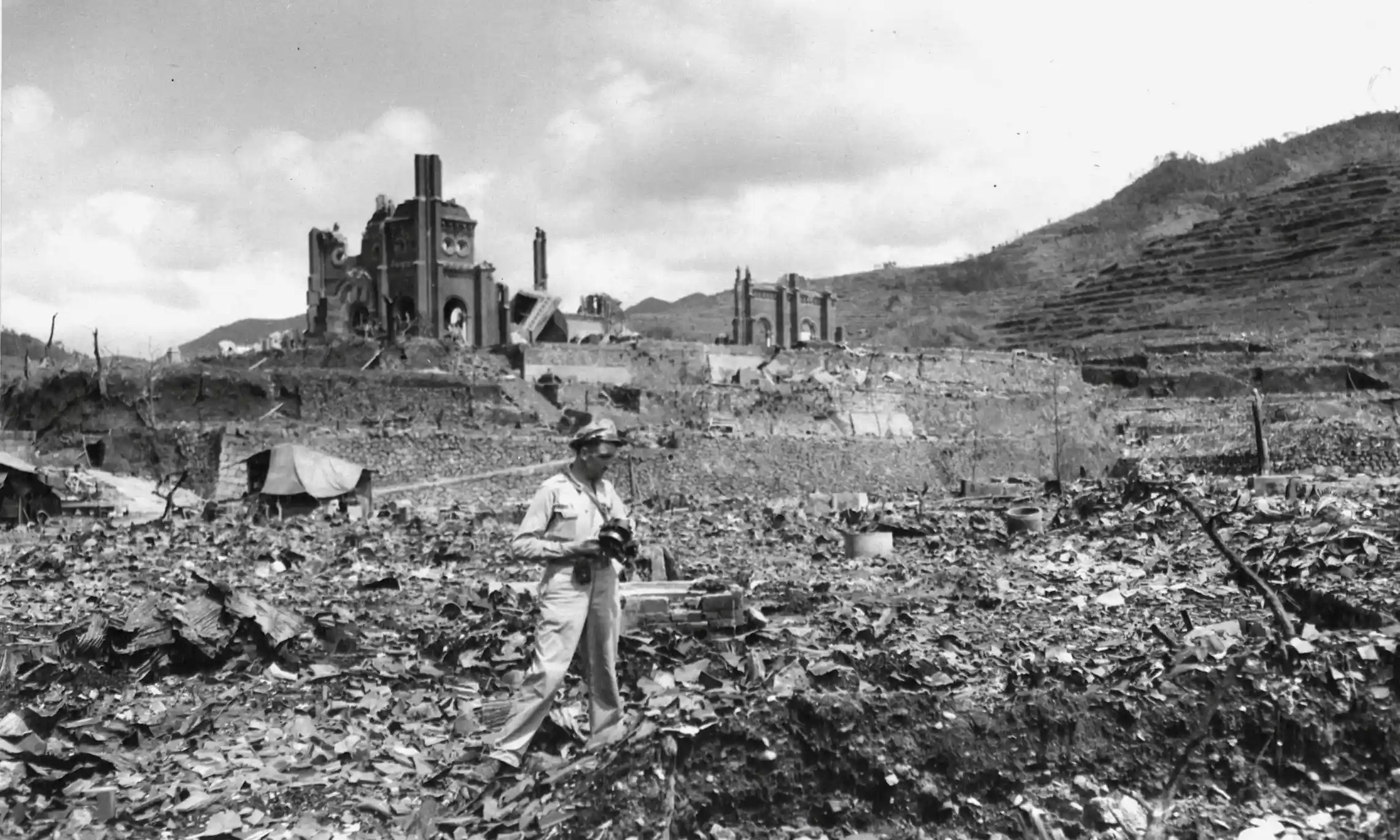
The photograph shows devastation in Nagasaki after the atomic bomb: a scorched wilderness where there was once a city. At its centre stands a lone man with a camera.
It was 9 September 1945 and Lt Daniel McGovern, a US Army Air Force cameraman, was documenting ground zero, the point directly below the bomb’s detonation four weeks earlier. Few would recognise McGovern, but the vision of apocalypse is familiar from documentary footage of Hiroshima and Nagasaki at the end of the second world war.
The footage will be shown again this week and next for the 77th anniversaries of the atomic bombings that obliterated the Japanese cities and showed the reality of nuclear war: blasted landscapes, burnt skeletons, radiation sickness.
But those haunting images might not exist were it not for McGovern. As part of the US Strategic Bombing Survey – which studied the impact of bombing – McGovern supervised Japanese and American camera crews in Hiroshima and Nagasaki. Back in the US, he saved the footage from suppression by making secret copies.
Only now, decades later, has his full story emerged. Joe McCabe, a journalist from McGovern’s native County Monaghan in Ireland, has pieced together his remarkable life in a biography, Rebels to Reels, published earlier this month after 20 years of research, including interviews with McGovern before his death in 2005………………………………………………….
The fields around Nagasaki were bleached white and the city looked as if a “massive anvil” had flattened it, he later told McCabe. At a ruined school he filmed the bodies of children amid piles of skulls. “Hundreds of kids had been sucked out through the windows. We were always finding bones.”
He filmed harrowing scenes at overwhelmed hospitals, including the agony of a 16-year-old boy named Sumiteru Taniguchi. “His whole back just looked like a bowl of bubbling tomatoes.”
Other patients had rashes, hair loss and bleeding from the nose and mouth – a mysterious malady later identified as radiation sickness.
McGovern also captured the phenomenon of people who had been atomised yet left shadows caused by radiant heat. The two atomic bombs are estimated to have killed more than 200,000 people.
McGovern’s teams amassed 100,000ft of colour footage and enlisted the help of a Japanese newsreel service, Nippon Eigasha, which had 26,000ft of black-and-white footage, much shot before the Americans had arrived. The Irishman helped edit the Japanese footage into a documentary called Effects of the Atomic Bomb on Hiroshima and Nagasaki, and planned to turn the colour footage into another one.
Authorities in Washington, however, classified the material as secret in 1946. “They didn’t want the American public seeing the horrors,” McGovern said. He discreetly made copies at the Pentagon. He stored one set at an air force motion picture depository in Dayton, Ohio, and kept another set himself.
Years passed – McGovern witnessed rocket tests and debunked theories of aliens at Roswell as “a load of crap” – and then in 1967 a US Congressional committee that included Robert Kennedy asked to see the atomic bomb footage. The material had been declassified but no one could find the originals. McGovern, by now a lieutenant colonel, directed the authorities to his copies.
In 1970 the general public got its first glimpse of some of the footage. It had been incorporated into a film called Hiroshima Nagasaki – August 1945 that premiered at New York’s Museum of Modern Art.
The auditorium was packed. At the end, no one made a sound. https://www.theguardian.com/world/2022/jul/31/us-airman-daniel-mcgovern-cameraman-hiroshima-nagasaki
Nuclear Weapons Policies of Japan and South Korea Challenged
By Jaya Ramachandran, GENEVA (IDN)31 July 22, — The Basel Peace Office, in cooperation with other civil society organisations, has challenged the nuclear weapons policies of Japan and South Korea in the UN Human Rights Council, maintaining that these violate the Right to Life, a right enshrined in Article 6 of the International Covenant on Civil and Political Rights (ICCPR).
The two East Asian countries’ nuclear strategies have been called into question in reports submitted on July 14 as part of the Universal Periodic Review (UPR) of the obligations of Japan, South Korea and 12 other countries under human rights treaties. (See Submission on Japan and Submission on South Korea).
The submissions, presented at a time when Russia has made nuclear threats to the US and NATO if they intervene in the Russian invasion of Ukraine, underline the need to address the risks of nuclear deterrence policies. Besides, Russia is not the only country that possesses nuclear weapons and/or maintains options to initiate nuclear war………………
both Japan and South Korea are engaged in extended nuclear deterrence policies which involve the threat or use of US nuclear weapons on their behalf in an armed conflict. Both have also supported the option of first use of nuclear weapons on their behalf, even when the United States has been trying to step back from such a policy.
The Basel Peace Office and other civil society organisations argue that the extended nuclear deterrence policies of Japan and South Korea violate their human rights obligations, as is their lack of support for negotiations for comprehensive, global nuclear disarmament.
The submissions make several recommendations of policies the governments could take to conform to the Right to Life. These include adopting no-first-use policies and taking measures to phase out the role of nuclear weapons in their security doctrines.
This they could do by establishing a Northeast Asia Nuclear-Weapon-Free Zone and urging at the ongoing Non-Proliferation Treaty (NPT) Review Conference an agreement on the global elimination of nuclear weapons by 2045, the 75th anniversary of the NPT………………………..
more https://www.indepthnews.net/index.php/armaments/nuclear-weapons/5487-nuclear-weapons-policies-of-japan-and-south-korea-challenged
Kishida to call for nuke-free world in historic address at U.N. treaty conference
Japan Times, BY ERIC JOHNSTON, 31 July 22,
In a year in which nuclear disarmament hopes have been dented by not-so-subtle references by Russia to its own arsenal following its invasion of Ukraine, Prime Minister Fumio Kishida is set to make history as the first Japanese leader to address the United Nations’ nuclear nonproliferation treaty review conference, which begins in New York on Monday.
Kishida, who represents a district in Hiroshima, is expected to call for a world without nuclear weapons and for greater transparency among nuclear powers regarding their stockpiles and capabilities. His message will refer to Japan’s experience as the only country to have been attacked with an atomic bomb. The leader will also stress that all countries should neither use nuclear weapons nor threaten to use them.
Speaking to reporters in Tokyo on Friday, the prime minister said it was important to link the treaty’s ideals with current geopolitical realities.
“The debate on nuclear disarmament is atrophying,” Kishida said, and he announced he would present a plan at the conference that would hopefully serve as a roadmap toward reaching a world without nuclear weapons.
The prime minister sees Japan’s role at the nearly monthlong conference, which will focus on keeping the buildup of nuclear weapons under control, as one of helping to bridge the differences between nuclear powers and nonnuclear states. Kishida is hoping to promote talks between China and the United States on nuclear disarmament and arms control. He’s also expected to call on the international community to work toward North Korea’s denuclearization………………………….
more https://www.japantimes.co.jp/news/2022/07/31/national/nuclear-conference-kishida-speech/
JNFL to consider delaying completion of spent fuel reprocessing plant
26th postponement of the commissioning of the Rokkashô-mura nuclear reprocessing plant in Japan. It should have started in 1997…

July 29, 2022
At a press conference on July 29, Naohiro Masuda, president of JNFL, which is constructing a spent nuclear fuel reprocessing plant in Rokkasho Village, said that the plant’s target completion date, which is approximately two months away, “has reached a point where we have to consider postponing it. JNFL is considering the postponement of the construction of the Rokkasho Nuclear Power Plant.
JNFL has set the target completion date of the spent fuel reprocessing plant it is constructing in Rokkasho Village for the first half of this fiscal year, by September of this year.
At a regular press conference held on September 29, JNFL President Masuda stated, “Next week we will have less than two months to complete the plant, so we would like to consider the future outlook based on the status of the examination. We have reached a point where we need to consider postponing the project,” he said, indicating that he would consider postponing the project.
President Masuda cited as reasons for the postponement the ongoing Nuclear Regulatory Commission’s review of safety measures and other work that are prerequisites for completion, as well as the fact that the amount of work has increased from the original plan and that the plan needs to be carefully examined in order to proceed safely.
Regarding the time frame if the project is postponed, he stated, “I don’t think it will be something that will take two or three years,” but he also indicated that it is not expected to last more than a few months.
The reprocessing plant was originally planned to be completed in 1997, 25 years ago, but has been postponed 25 times due to repeated problems.
The reopening of the uranium enrichment plant has been postponed.
JNFL announced on April 29 that the plant in Rokkasho, which manufactures enriched uranium needed to produce nuclear fuel for use in nuclear power plants, will resume operation in February of next year, instead of September of this year, based on the status of safety measures and other factors. JNFL announced on April 29 that the resumption of operations at the Rokkasho uranium enrichment plant, which is located in Rokkasho Village, has been changed to February next year.
The uranium enrichment plant in Rokkasho is the only commercial facility in Japan that produces enriched uranium, which is necessary for nuclear fuel used in nuclear power plants. The plant has been out of operation since September 201 7 in order to conduct safety work to comply with the new national regulatory standards.
JNFL announced on the 29th that it had changed the date of resumption of operation to February next year, citing delays in the safety work.
[President apologizes for trouble with reprocessed liquid waste.
Naohiro Masuda, president of JNFL, apologized for the trouble at the spent nuclear fuel reprocessing plant in Rokkasho village, saying, “I would like to express my deepest apologies for causing great concern to the local community.
At the Rokkasho Reprocessing Plant, the cooling system for one of the tanks storing high-level radioactive liquid waste stopped functioning for about eight hours on the second of this month.
At the beginning of the press conference on March 29, JNFL President Masuda stated, “I would like to express my deepest apologies for causing so much concern to the local community. I am very sorry.
JNFL has stated that one of the two lines circulating water to cool the tank was under construction, and that a worker who was instructed to close the valve on that line may have inadvertently closed the valve on the line that was still in operation. The company claims that this is the case.
Regarding measures to prevent recurrence, President Masuda explained that valves that affect the cooling function are physically locked so that they cannot be operated, and that when safety-related equipment is placed in one line for construction or other reasons, monitoring is strengthened more than usual.
He added, “We will thoroughly implement measures to prevent recurrence and continue to place the highest priority on safety.
https://www3.nhk.or.jp/lnews/aomori/20220729/6080016788.html?fbclid=IwAR0J114Ufuu1EDQ3nl_NeXdxMclco4QjbKnxyoI87ry9B0Ff_d0Btawxkig
Nuclear Industry Association of Japan (NIAJ) proposes that “new and additional nuclear power plants and rebuilding of nuclear power plants should be clearly stated in national plans

July 22, 2022
On July 22, the Japan Atomic Energy Industries Association (JAEA), an association of companies involved in nuclear power generation, released a proposal calling for the construction of new nuclear power plants and their replacement (rebuilding). The association said this is the first time it has issued such a proposal. The association calls for new nuclear power plants to be built or rebuilt to maintain the nuclear power supply chain.
Public distrust of nuclear power plants has been deep-rooted in the wake of the accident at TEPCO’s Fukushima Daiichi Nuclear Power Station. The government has stated that it “does not envision” new or rebuilt reactors at this time, and a freeze on nuclear power plants continues in Japan.
However, the crisis in Ukraine has led to…
https://www.asahi.com/articles/ASQ7Q6FMPQ7QULFA00G.html?fbclid=IwAR15C-Y5Sa1q9Ix65ZQ3PZpe3Oo7o3ZEnoTISCxBrTj-NzMO5nQ6xPsAhQQ
1 This Month

of the week – Shut Down Drone Warfare!


Tell the Ukrainian Government to Drop Prosecution of Peace Activist Yurii Sheliazhenko

Petition to revoke the licensing of the Near Surface Nuclear Disposal Facility (NSDF) at Chalk River. https://www.ourcommons.ca/petitions/en/Petition/Details?Petition=e-7247
To see nuclear-related stories in greater depth and intensity – go to https://nuclearinformation.wordpress.com
-
Archives
- April 2026 (103)
- March 2026 (251)
- February 2026 (268)
- January 2026 (308)
- December 2025 (358)
- November 2025 (359)
- October 2025 (376)
- September 2025 (257)
- August 2025 (319)
- July 2025 (230)
- June 2025 (348)
- May 2025 (261)
-
Categories
- 1
- 1 NUCLEAR ISSUES
- business and costs
- climate change
- culture and arts
- ENERGY
- environment
- health
- history
- indigenous issues
- Legal
- marketing of nuclear
- media
- opposition to nuclear
- PERSONAL STORIES
- politics
- politics international
- Religion and ethics
- safety
- secrets,lies and civil liberties
- spinbuster
- technology
- Uranium
- wastes
- weapons and war
- Women
- 2 WORLD
- ACTION
- AFRICA
- Atrocities
- AUSTRALIA
- Christina's notes
- Christina's themes
- culture and arts
- Events
- Fuk 2022
- Fuk 2023
- Fukushima 2017
- Fukushima 2018
- fukushima 2019
- Fukushima 2020
- Fukushima 2021
- general
- global warming
- Humour (God we need it)
- Nuclear
- RARE EARTHS
- Reference
- resources – print
- Resources -audiovicual
- Weekly Newsletter
- World
- World Nuclear
- YouTube
-
RSS
Entries RSS
Comments RSS
 nuclear-news