140,000 signatures “against” extending the operational period and rebuilding nuclear power plants submitted to the government “Reducing dependence on nuclear power plants is the voice of the people.

Toshi Kamata speaks in front of approximately 140,000 signatures opposing the promotion of nuclear power plants in Chiyoda Ward, Tokyo, on April 2.
December 2, 2022
On December 2, the “Sayonara 10 Million People Action Committee,” a citizens’ group, submitted 140,463 signatures to the Ministry of Economy, Trade, and Industry (METI) demanding the withdrawal of the nuclear power promotion measures being considered by the Kishida administration, including the extension of the operating period of nuclear power plants, which is stipulated to be “40 years in principle and 60 years maximum,” and the reconstruction (replacement) of nuclear power plants that are scheduled to be decommissioned. The signatures were submitted to the Ministry of Economy, Trade and Industry (METI) in late October.
The signatures had been collected by the Executive Committee since late October. On the same day, a rally was held in the National Diet building, where reportage writer Toshi Kamata, representative of the callers, said, “The people’s voice in the wake of the TEPCO’s Fukushima Daiichi nuclear power plant accident is to reduce dependence on nuclear power as much as possible. These are angry signatures asking what they are thinking,” he explained, handing the signatures to a METI official on the spot.
During the exchange of opinions following the submission of the signatures, participants voiced their opinions, such as “We should hold public hearings and listen to the public before reaching a conclusion,” but the METI official merely stated, “We will consider public comments at an appropriate time.
Regarding the proposal to rebuild a nuclear power plant that has been decided to be decommissioned with a next-generation nuclear power plant, the METI side said, “Instead of decommissioning the plant, we will build one. Whether or not they will be built on the exact site has not yet been determined,” the ministry said, declining to elaborate.
The government aims to decide on a policy to utilize nuclear power plants at the end of the year and submit a bill to amend related laws to the Diet next year. (Nozomi Masui)
https://www.tokyo-np.co.jp/article/217564?fbclid=IwAR3_igZhYVZS84Y2FGrwmzbgO0okOf0-NcGLmeIPJMGLw9hLBSTussbThn0
Ministry’s action plan drops nuclear policies set after 3/11
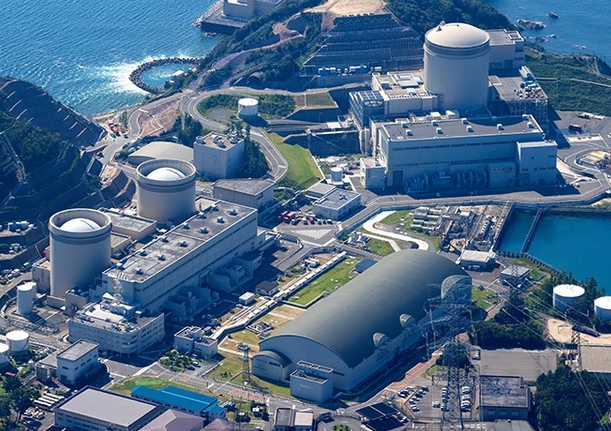
Local officials want new reactors to replace the two retired units at the front of Kansai Electric Power Co.’s Mihama nuclear plant in Fukui Prefecture.
November 29, 2022
The industry ministry proposed building new nuclear reactors to replace retired ones and effectively extending their operating lives beyond 60 years, a reversal of policies set after the 2011 Fukushima nuclear disaster.
The proposals were presented to the ministry’s advisory council, the Nuclear Energy Subcommittee, at a meeting on Nov. 28 as a draft action plan for the Kishida administration’s slogan to “make maximum use of nuclear energy.”
Although many subcommittee members endorsed the proposals, some members said not enough time was spent on discussing such a major change in energy policy.
Prime Minister Fumio Kishida in August issued a directive to a special government panel tasked with decarbonizing Japan to review the current nuclear energy policy.
The government has maintained that “for now,” it does not expect construction of new nuclear plants or a replacement of any reactor.
Because of opposition expected from local governments, the plan also did not propose building nuclear plants in areas that have never hosted such facilities or adding new reactors to existing plants.
But under the action plan, the Ministry of Economy, Trade and Industry states that construction of new reactors “will begin with those replacing retired ones,” giving utilities the green light to build reactors to take the place of those being decommissioned.
The ministry is also seeking “advanced light water reactors” as replacement units, expecting them to start operating in the 2030s. They will each come with an estimated price tag of at least 500 billion yen ($3.57 billion).
Such reactors have enhanced safety features and are an extension of current nuclear technologies, the ministry said.
The action plan also pushes for a system that will effectively extend the life cycle of reactors beyond the maximum of 60 years set under rules adopted after the 2011 triple meltdown.
It suggests that often lengthy periods when reactors are offline for examinations by the Nuclear Regulation Authority on whether they meet standards for restarts be excluded from the 60-year limit.
In addition, the time frame should not include periods when reactor operations are suspended because of lawsuits, the ministry said.
Under those proposals, a reactor that has been idle for 10 years for those reasons could operate for up to 70 years since it first went into service.
The proposed exclusions from the 60-year limit have been criticized as “taking the teeth from” the rigorous reactor regulations set in 2013.
One subcommittee member said the exclusions are “akin to ditching the lessons learned from the Fukushima accident.”
The action plan also called for a new system to provide grants to local governments that promote the use of recycled nuclear fuel at facilities in their jurisdictions.
This is meant to give some leverage to the nation’s trouble-plagued nuclear fuel cycle policy.
Although the action plan represents a sweeping policy change, it does not directly deal with a slew of challenges that have remained unsolved for decades.
For example, it is unclear when the nuclear fuel reprocessing plant under construction in Rokkasho, Aomori Prefecture, a key component in the nuclear fuel cycle program, will go into operations.
Under the program, plutonium retrieved from spent nuclear fuel from across Japan will be recycled as fuel for use at nuclear plants.
The completion date of the reprocessing plant has been pushed back 26 times so far. Around 14 trillion yen has been invested in the project.
Another big headache for the central government is securing a final disposal site for highly radioactive nuclear waste from nuclear power plants across the country.
Two small municipalities in Hokkaido have shown an interest in hosting such a storage facility in exchange for generous grants.
But the Hokkaido governor is opposed to the plan. And no other local governments in Japan have come forward as potential final disposal sites.
The ministry’s action plan did not list any specific proposals to resolve these issues. It merely said: “The state should bolster efforts to gain the understanding” of the public to the nuclear policy.
Plaintiffs claim that the wide-area evacuation plan is ineffective.

November 28, 2022
On November 28, a lawsuit filed by residents of the Onagawa Nuclear Power Plant seeking an injunction against the restart of the No. 2 reactor at Tohoku Electric Power Company’s Onagawa Nuclear Power Plant was concluded. The verdict will be handed down in May next year.
On the 28th, the plaintiffs made their final statements in oral arguments at the Sendai District Court. The plaintiffs again argued that the “wide-area evacuation plan” formulated by the prefectural government and others is ineffective because it does not include specific details about the inspection sites that would be set up along evacuation routes in the event of an accident to check residents’ radiation exposure, including the securing of personnel and materials and equipment.
Mr. Nobuo Hara, leader of the plaintiffs: “How ineffective is the wide-area evacuation plan?
Mr. Nobuo Hara, leader of the plaintiffs’ group: “We have shown how ineffective the wide-area evacuation plan is. The most realistic way to stop the restart of nuclear power plants is to obtain a ruling that nuclear power plants must not be restarted under the evacuation plan. It is the firm belief of the plaintiffs that such a ruling will be reached.”

The trial will conclude on May 28, and the verdict will be handed down on May 24 next year. Tohoku Electric Power aims to restart the Onagawa Unit 2 reactor in February 2024.

Japan studies plan to extend life of 60-year-old nuclear plants

Nov 28, 2022
Japan will consider keeping some nuclear reactors operating beyond a current 60-year limit as the country focuses increasingly on atomic power as a solution to an ongoing squeeze on energy supply.
Officials are studying a plan to exclude periods when reactors were offline from an existing limit on their lifespan, which would allow some facilities to operate for longer, according to a document released Monday by a trade ministry panel. Reactors are often halted for years to allow the nation’s nuclear watchdog to perform inspections, or as a result of legal challenges.
Following the 2011 Fukushima nuclear disaster, which was triggered by a massive earthquake and tsunami, Japan introduced stricter safety standards limiting the operation of nuclear reactors to 40 years in principle.
But operation for an additional 20 years is possible if safety upgrades are made and a reactor passes screening by regulators.
The proposal to allow operations beyond the 60-year limit comes as Japan’s public and government shift back in favor of nuclear power, despite experiencing one of the worst atomic meltdown disasters. The import-dependent country has this year grappled with more expensive fossil fuel prices as a result of Russia’s war in Ukraine, along with a weak yen, and seen its stretched power grid put under severe pressure.
The government has repeatedly asked people to take steps to limit their electricity consumption, by using fewer appliances or cutting back on heating.
In August, Prime Minister Fumio Kishida said the government will explore developing and constructing new reactors, and that it will also aim to restart seven more idled reactors from next summer.
The trade ministry proposals also call for new, next-generation nuclear reactors to be built at sites where existing units will be decommissioned.
Japanese manufacturers have announced plans to develop next-generation reactors this year. Mitsubishi Heavy Industries is jointly developing an advanced light water reactor with four other Japanese power producers, while a venture between Hitachi and General Electric is also reported to be developing a new reactor model.
https://www.japantimes.co.jp/news/2022/11/28/national/nuclear-plant-extension/
Expert panel full of proponents of nuclear power plants to discuss direction on March 28th, extending operation period and developing next-generation models, rushing to conclusion on “Prime Minister’s directive.

Basic policy subcommittee discusses extending the operational period of nuclear power plants in Kasumigaseki, Tokyo.
November 27, 2022
The Ministry of Economy, Trade, and Industry (METI) will present its direction on measures to utilize nuclear power plants, including the extension of the operating period of nuclear power plants, which is stipulated as “40 years in principle, with a maximum of 60 years,” and the development and construction of next-generation nuclear power plants, at the “Nuclear Energy Subcommittee,” a meeting of experts on November 28. Discussions will reach their final stage about three months after Prime Minister Fumio Kishida ordered the committee to study the issue in August. However, the committee did not solicit opinions from the public before reaching a conclusion, and its deliberations were noticeably more hasty than past energy policy debates. (The discussion has been held in a very slow pace compared to past energy policy debates.)
◆Draft government policy at several subcommittee meetings
Of the 21 members of the Atomic Energy Subcommittee, which discusses nuclear energy policy, only two, including Hajime Matsukubo, executive director of the NPO Nuclear Data and Information Office, have made negative statements about nuclear power at recent meetings. In the discussion on extending the operating period, many committee members called for removing the maximum 60-year limit, and at the meeting on March 28, METI is expected to push for a proposal to exclude from the number of years of operation the period during which a nuclear power plant is shut down to undergo a review before it can be restarted, without removing the limit in consideration of public outcry.
The contents of the Nuclear Energy Subcommittee’s deliberations will be discussed by the Basic Policy Subcommittee, which brings together expert panels on energy policy, and the conclusions of the subcommittee will serve as a draft of the government policy.
At the meeting on March 15, Ms. Chisato Murakami, an advisor on consumer affairs, commented, “The use of nuclear power plants will not directly lead to an end to the tight power supply and demand situation. I would like to propose that we take time to deepen the national debate.” She objected to the way the discussion was proceeding, but no other opinions were expressed calling for a reconsideration.
The subcommittee has met twice so far. The committee is expected to hold one or two more meetings before the end of the year to reach a conclusion, after which public comments will be sought.
◆Energy Basic Plan to be discussed 17 times and opinions solicited via the Internet
The previous energy policy discussions were different.
In the discussion of the “Sixth Basic Energy Plan,” a medium- to long-term guideline for energy policy formulated last October, subcommittee meetings were held 17 times over a period of 10 months. In addition, an opinion box was set up on the website during the discussions in order to listen to the opinions of the public at large. The opinions received were submitted as materials to each of the subcommittee meetings for consideration. In total, about 640 opinions were collected, with about 300 calling for a nuclear power phase-out, while about 80 supported the promotion of nuclear power.
At that time, members of the subcommittee expressed the opinion that extending the operational period of nuclear power plants and building new plants were necessary to realize a decarbonized society by 2050, but this was not explicitly stated in the basic plan. The policy of “reducing dependence on nuclear power plants as much as possible,” which came to be stated after the Fukushima accident, was also maintained.
◆Ministry of Economy, Trade, and Industry (METI) official: “The directive to reach a conclusion by the end of the year cannot take too much time.
The government has been stressing the use of nuclear power plants against the backdrop of the recent tight power supply and demand and soaring fuel prices. However, the development of next-generation nuclear power plants, for example, will take a long time and will not be a quick fix, so there is no need to reach a hasty conclusion. Even after Murakami pointed out this contradiction at the subcommittee meeting, a METI official told the interviewer, “We cannot take too much time because [Prime Minister Kishida] has instructed us to reach a conclusion by the end of the year. We will come up with a direction as soon as possible.
Mr. Matsukubo commented, “This is a heavy-handed way of proceeding, not listening to the public and having the Council of Eminent Persons decide what the government wants to do. The government’s policy of making nuclear power a given may narrow the scope for the introduction of renewable energies in the future.
https://www.tokyo-np.co.jp/article/216285?fbclid=IwAR1q4FkmUf5IMHwP2VfT5TG3LA6wvwN1V1CU7vRueWSFSkMq6upQHAuxkG4
Tohoku Electric Applies for 32.94% Increase in Electricity Rates for Households, Effective Next April

President Higuchi announces application to raise electricity rates for households.
November 24, 2022
On November 24, Tohoku Electric Power applied to the government for a 32.94% average increase in regulated electricity rates for households. This is the first time since February 2013 that the company has applied for a price increase to revise basic rates and electricity unit prices. The increase is the third largest in history. The free electricity rates for households, which do not require government approval, will also be raised by an average of 7.69%, both of which are scheduled to go into effect on April 1 next year. This is the first time that a major electric power company has applied for a price hike due to soaring fuel costs caused by Russia’s invasion of Ukraine and other factors.
At a press conference held in Sendai City on April 24, President Kojiro Higuchi said, “The current electricity revenues will not be sufficient to cover fixed costs, and if this situation continues, we will not be able to procure fuel stably or invest sufficiently in power facilities. We are deeply sorry that we are applying for a large price increase, but we hope you will understand.
The regulated rates will increase both the basic rate and the unit price of electricity. The amount of electricity used is divided into three levels, and the more electricity is used, the larger the increase. In the case of the model case (contract type: “metered electric light B,” contract current: 30 amperes, electricity consumption: 260 kWh), the monthly fee will increase by 2,717 yen to 11,282 yen.
The total cost of fuel, labor, and other costs calculated for the application averaged 2.1636 trillion yen over the 23-25 year period, an increase of 1.4 times the 1.5067 trillion yen from 13-15, the basis for the current rate setting. Rising fuel costs and the cost of procuring electricity through markets and other means account for most of this increase.
The restart of Onagawa Nuclear Power Plant Unit 2 (Onagawa Town, Miyagi Prefecture, and Ishinomaki City), scheduled for February 2012, was also factored into the cost calculation. The plant will be able to reduce the amount of fuel it buys, which will lead to an annual cost reduction of about 100 billion yen, and Higuchi said that the price increase will be curbed by about 5%.
In order to compress the price increase, the plan also included 115.9 billion yen in management efficiency improvements. In addition to the initiatives already undertaken, such as more efficient fuel procurement, the company will reduce the number of employees by curtailing new hiring and extend the periodic inspection cycle of thermal power plants.
The METI’s expert panel will review the application. In Tohoku Electric’s previous application, the actual price increase was reduced after discussions on whether the calculation of the total cost was appropriate.
The average increase in free rates for households is smaller than the regulated rates because the system was changed in December to reflect fuel price fluctuations without a cap, based on the fuel cost adjustment system.
President Higuchi’s Painful Decision to Ensure a Stable Supply
The following is a question-and-answer session with Tohoku Electric Power President Kojiro Higuchi, who announced the application for an increase in electricity rates for households.
-The increase will place a heavy burden on households.
With not only electricity rates but also prices rising, it is distressing to see the increase. I hope you understand that this is a difficult decision to make in order to ensure a stable supply of electricity.
-How do you plan to improve management efficiency?
We will reduce repair costs by extending the inspection cycle for thermal power plants and reduce fuel costs by reducing spot procurement as much as possible. In terms of personnel reduction, we will consider consolidating our sales offices.
We have already reduced executive compensation by up to 20% linked to performance and voluntarily returned up to 10% of corporate rates.
-Other major electric power companies are also planning to apply for price increases.
The biggest difference between us and other companies is the two earthquakes that occurred off the coast of Fukushima Prefecture last year and this year. (The biggest difference between us and other companies is the two earthquakes off the coast of Fukushima Prefecture last year and this year, which knocked out power (from several thermal power plants) and increased the cost of restoration.
-The deregulation of the electric power industry was supposed to lower electricity prices through competition.
However, the unexpected rise in fuel costs, such as this one, cannot be absorbed through friendly competition among power providers. Tohoku Electric is expensive, but new power companies are not cheap, and we believe that we are now in a state of emergency.
https://kahoku.news/articles/20221124khn000028.html?fbclid=IwAR2eR9Xvf8z8dHCRnRuz1G-1YCLcMlSnk2HTMs6rZzN8vy5eRV-ATnDwbOE
JNFL’s application for examination of a nuclear fuel reprocessing plant was criticized by the Regulatory Commission for “lacking a sense of urgency”

JNFL Senior Managing Executive Officer Rei Sudo (left) and others explain at the Nuclear Regulation Authority’s review meeting in Minato-ku, Tokyo.
November 22, 2022
JNFL found multiple errors in the seismic calculation results of the application it submitted to the Nuclear Regulation Authority during the examination required for the operation of its reprocessing plant for spent nuclear fuel from nuclear power plants in Rokkasho Village, Aomori Prefecture. The errors were discovered when the Nuclear Regulation Commission pointed them out to JNFL. Even two years after the application was submitted, NNFL continues to reveal its inadequacies, and there is no prospect that the review will be completed.
The errors were in the results of seismic calculations for the cooling tower fire detectors, which NNFL submitted on November 8 in the form of an amendment to its application. According to NNFL, when the results of the seismic calculations were transcribed into the application, incorrect values were entered in several places. Although the documents were checked before submission, the mistake was not noticed. The cause of the error has not been disclosed, saying that it is under investigation. The correction will be corrected and resubmitted in the future.
According to the secretariat of the regulatory commission, the error in the calculation results was so simple that a person with expert knowledge would be able to recognize it at a glance.
At the review meeting held on March 15, the person in charge at the secretariat of the regulatory commission commented, “In the review of facility design, making a mistake in numerical values is a definite and serious problem,” and “It is the most rudimentary of rudiments. Why don’t they notice it? Why don’t they realize this? They have no sense of crisis at all. Rei Sudo, executive vice president of Nenryo, who is in charge of handling the review, simply stated, “This is something that really shouldn’t happen. We take this very seriously.
The reprocessing plant, a core facility under the government’s nuclear fuel cycle policy, met the new regulatory standards for basic accident countermeasures in July 2020, and in December of the same year, JNFL applied for a review of detailed facility designs and construction plans. However, there has been no significant progress since the application stage due to inadequate explanations from NNFL.
In September of this year, NNFL announced for the 26th time that it was postponing the completion of the plant due to the difficulties encountered in the review process. The company plans to announce the next target date for completion by the end of this year, but the examination process will inevitably become even more difficult due to the discovery of numerical errors. (Kenta Onozawa)
https://www.tokyo-np.co.jp/article/215291?fbclid=IwAR3axQXraZ9FR1wgBWFW97VsXYaz7LEtnmRwhAa8f6fSsxczwS8WNBpIdY4
Japan’s changing nuclear energy policy
No matter the policy, public trust for nuclear energy is unlikely to be restored

Nov 16, 2022
On Aug. 24, at the newly established GX (Green Transformation) Implementation Council chaired by Prime Minister Fumio Kishida, the Japanese government announced a new nuclear energy policy.
The framework for this new policy consists of three key points: maximize the use of existing nuclear power plants through an accelerated restart and extension of their operation period; develop and build advanced next-generation reactors; and develop conditions suitable for the use of nuclear energy, including back-end support.
The most contentious of these is the second point: the development and construction of advanced next-generation reactors. Since the Fukushima nuclear disaster, previous Japanese government policy has made no mention of building new power plants, so it is being seen as a major policy change. What explains this policy change and is it really feasible?
The most significant influence on the new policy is surely the 2050 Carbon Neutral policy. At present, Japan has only nine nuclear reactors in operation. In fiscal 2020, nuclear power generation accounted for only around 7% of the country’s total power generation. According to an estimate by Hajime Matsukubo, secretary-general of the Citizens’ Nuclear Information Center, achieving the government’s goal of raising this percentage to 20%-22% by fiscal 2030 will require around 26-33 operational nuclear reactors.
If the target ratio of nuclear power generation for fiscal 2050 is also set at around 20%, then around 37-50 operational reactors will be required. If new power plants are not constructed, by fiscal 2050 there will be three reactors with a 40-year service life and 23 reactors with a 60-year service life. If the Japanese government wants to keep the ratio of nuclear power generation at the stated level, then it will need around 20-40 new reactors.
Other factors cited as reasons for this shift in nuclear energy policy include soaring electric power prices due to the Ukrainian crisis and a desire to decrease dependency on fossil fuels. Whatever the reasons for the policy change may be, the government should explain them more clearly.
First, the policy mentions accelerating the restart and extending the operation period of existing nuclear power plants. However, the outlook for achieving this is unclear. Restarting nuclear power plants requires permission from the Nuclear Regulation Authority (NRA) and the agreement of local communities. Plants could also be forced to close due to legal actions such as injunctions, so there is still uncertainty.
With regard to operating period (service life), proposals — led primarily by the Ministry of Economy, Trade and Industry — have been made for the abolishment of the 40-year operating period regulation. But even with this regulation removed, the safety of all plants must ultimately be reviewed by the NAC. If the government is to observe its policy of placing top priority on safety, then it cannot influence NRA safety inspections.
In terms of constructing of new reactors, construction costs for advanced light water reactors — seen as the most practical — are already skyrocketing in the United States and Europe. In the case of small modular reactors, the second most anticipated type, almost all overseas projects are facing setbacks, delays and they have yet to be successfully constructed.
Above all, the biggest questions are these. Can nuclear power maintain competitiveness in a deregulated market? And are any power companies willing to place orders despite the investment risks? The answers are unknown.
The global situation also leaves little cause for optimism. According to the World Nuclear Industry Status Report 2022, the global ratio of nuclear power generation peaked in 1996 at 17.5% and has since gradually declined, falling to below 10% for the first time in 40 years, at 9.8% in 2021. At the same time, the ratio of renewable energy (wind and solar power) reached 10.2% in 2021, exceeding the ratio of nuclear power generation for the first time in history. In terms of future growth, it is quite likely that nuclear power generation’s contribution to combating climate change will decrease. In addition, the recent Ukrainian crisis has also highlighted the risks posed by nuclear power plants in the event of war. The future of nuclear energy at the global level hardly seems bright.
There are also numerous issues to be resolved before we can even begin speaking about a shift in policy. While the decision has already been made to allow contaminated water from the Fukushima No. 1 nuclear power plant to be released into the ocean, the agreement of local fishermen has yet to be obtained. There is also no prospect of removing the melted fuel debris from the reactor in the foreseeable future. Still today there are more than 30,000 refugees who are unable to return to their homes and many court cases for compensation are still ongoing. In short, the Fukushima nuclear disaster is not over yet.
Moreover, cleanup for the nuclear energy policy that the government has pursued over the past 50 years remains unresolved. Nuclear waste problems (including spent nuclear fuel) and the decommissioning of old reactors remain as issues, regardless of the future direction for nuclear power plants. A review of the nuclear fuel cycle policy that has left the country with massive amounts of plutonium is also necessary and inevitable.
Last but not least, there is the issue of public trust in nuclear energy — trust that was lost as a result of the Fukushima nuclear disaster and has not been regained. Looking at this policy change, there is no trace of sufficient validation or discussion. Until a process is established for developing polices with a solid factual basis and then making policy decisions through dialogue with the public, public trust in nuclear energy policy is unlikely to be restored any time soon.
Tatsujiro Suzuki is a professor and vice director at the Research Center for Nuclear Weapons Abolition, Nagasaki University. © 2022, The Diplomat
https://www.japantimes.co.jp/opinion/2022/11/16/commentary/japan-commentary/japan-nuclear-power/
Machinery manufacturer Nippon Steel Works subsidiary confirms 449 cases of fraud, including falsification of inspection resultsNippon Steel Works subsidiary confirms 449 cases of fraud, including falsification of inspection results
Machinery manufacturer Japan Steel Works announced that its subsidiary in Muroran, Hokkaido, Japan, repeatedly falsified or fabricated the inspection results of its products, and that a total of 449 irregularities were identified. These included products for nuclear power plants.

November 14, 2022
Machinery manufacturer Nippon Steel Works, Ltd. announced that its subsidiary in Muroran City, Hokkaido, Japan, has repeatedly falsified or fabricated inspection results for its products, and that a total of 449 cases of fraud have been confirmed. The company apologizes and says it will consider disciplinary action against those involved.
After an internal report uncovered irregularities in the rewriting of inspection data for parts at Muroran-based subsidiary Nippon Steel M&E, Nippon Steel established a special investigation committee made up of outside lawyers in May of this year, and has been conducting an investigation.
The company released a report summarizing the results of the investigation on April 14, stating that 449 cases of falsification and fabrication were confirmed.
The subsidiary is a major manufacturer of products used in nuclear power plants, and 20 of the fraudulent products were related to nuclear power plants.
In addition, the company has stated that none of the products involved are used in Japan for nuclear power plants.
The report also pointed out the causes of the irregularities, including a dysfunctional management system and a lack of awareness of compliance.
President Matsuo said, “We are deeply sorry for the inappropriate behavior in nuclear power products.
In response to the investigation report, Toshio Matsuo, president of Nippon Steel Corporation, issued a comment saying, “I would like to express my deepest apologies again for the inconvenience and concern we have caused you.
The report also stated, “We take the fact of the failure of the self-cleansing function and the recommendations of the special investigation committee very seriously and sincerely, and we will work to reform our systems and culture to prevent recurrence and restore confidence in our company. We are committed to reforming our systems and culture to prevent recurrence and restore trust in our company.
https://www3.nhk.or.jp/news/html/20221114/k10013891391000.html?fbclid=IwAR1jlq0dwOU2zoAmESiIxWfCogc1FQ2ikxgf0mxhLXi852vZYNKcQyF_b4o
Japan’s new nuclear energy policy- is it really feasible?
On August 24, 2022, at the newly established GX (Green Transformation)
Implementation Council chaired by Prime Minister Kishida Fumio, the
Japanese government announced a new nuclear energy policy.
The framework
for this new policy consists of three key points: maximize the use of
existing nuclear power plants through an accelerated restart and extension
of their operation period; develop and build advanced next-generation
reactors; and develop conditions suitable for the use of nuclear energy,
including back-end support.
The most contentious of these is the second
point: the development and construction of advanced next-generation
reactors. Since the Fukushima nuclear disaster, previous Japanese
government policy has made no mention of building new power plants, so it
is being seen as a major policy change. What explains this policy change,
and is it really feasible?
The Diplomat 14th Nov 2022
https://thediplomat.com/2022/11/japans-changing-nuclear-energy-policy/
Japan looks to finalize nuclear reactor service extension by year-end

This Feb. 13, 2021 photo taken from a Mainichi Shimbun helicopter shows the Fukushima Daiichi nuclear power plant in Fukushima Prefectur
November 8, 2022
TOKYO (Kyodo) — Japan’s industry ministry is considering extending the lifespan of nuclear reactors to beyond the current 60 years with ambitions to finalize the plan by the end of the year, in a bid to cut carbon emissions and ensure stable energy supplies threatened by Russia’s war in Ukraine, sources familiar with the matter said Tuesday.
The Ministry of Economy, Trade and Industry is looking to extend the number of years nuclear power stations can remain open by considering screening periods, necessary for stricter plant safety operations, as separate from the total service life, which could allow nuclear reactors to operate for longer. During safety checks, the nuclear plants are not operational.
A ministry panel is set to discuss extending the service life of the nuclear power stations in such a way as a main scenario among other options, with plans to finalize their decision by the end of the year, the sources said.
Under the current safety rules, the Nuclear Regulation Authority limits nuclear reactors’ service period to 40 years in principle. If approved by the regulatory body however, the period can be extended by up to 20 years.
The panel will also look at scrapping the 60-year lifespan, as well as maintaining the current rules as two alternative options, in case the proposal is found not to be viable.
Prime Minister Fumio Kishida said in August that Japan will push ahead with the use of nuclear power, citing the plan as an option to achieve net-zero emissions and secure a stable electricity supply.
Japan relies heavily on fossil fuel imports for power generation, with its energy self-sufficiency rate standing at 12.1 percent as of fiscal 2019, lower than many other developed countries.
Nuclear power plant operators must pass the tougher regulations to restart their reactors after a nationwide halt which occurred after the Fukushima nuclear disaster of March 11, 2011, which was caused by a massive earthquake and tsunami. Only a handful of reactors in Japan have since resumed operations, while the public remains concerned over their safety.
Some utilities face prolonged screening processes by the NRA. More than nine years have passed since the safety examinations of Hokkaido Electric Power Co.’s Tomari nuclear power plant began, for example.
The electric power industry has urged more than 60 years of service will be safe provided appropriate maintenance operations are guaranteed.
The safety watchdog proposed earlier this month that the safety of nuclear plants aged 30 years or older, regardless of whether a reactor lifespan is extended, be checked at least once a decade to obtain approval for their continued operation.
https://mainichi.jp/english/articles/20221108/p2g/00m/0bu/042000c
In Suttsu, Japan, residents don’t want nuclear waste
At a time when Japan announces the restart of seventeen nuclear reactors by 2023, the question
of the management of radioactive waste arises. In Suttsu, a landfill project is under study, to the great despair of the inhabitants. “We don’t want our village to become a village of garbage cans”, protest Kazuyuki
Tsuchiya and his wife, Kyoko.
This couple in their seventies runs an inn in Suttsu, located on the island of Hokkaido, in northern Japan. Composed of 78% forest, this village of 2,800 souls, landlocked between mountains and the seaside, is picturesque.
It is here that a nuclear waste storage project has been taking shape since 2020 . The only ones to have applied to the Radioactive Waste Management Company (Numo), created by the Ministry of Economy, Trade and Industry.
Ouest France 3rd Nov 2022
NRA risks losing its reputation as neutral nuclear watchdog body

Members of the Nuclear Regulation Authority hold a meeting Nov. 2 in Tokyo’s Minato Ward.
November 5, 2022
The Nuclear Regulation Authority (NRA) has started working on legal revisions to effectively eliminate the limit on the operational life span of nuclear reactors.
The NRA appears to be responding to growing calls for the “revival” of nuclear power generation within the government and the business community. The NRA was set up as a highly independent nuclear safety watchdog in line with lessons gleaned from the 2011 Fukushima nuclear disaster. It should not forget its original mission.
The legal life span of a nuclear reactor is 40 years in principle but can be extended to 60 years at a maximum.
But the Ministry of Economy, Trade and Industry (METI), acting at Prime Minister Fumio Kishida’s behest, has proposed increasing the life span of reactors. Acting in tandem with the government’s move, the NRA instructed its Secretariat, a government agency, to review the current rules.
In a recent meeting on this issue, the NRA Secretariat presented a proposal which would require reactors that have been in service for 30 years to undergo inspections for signs of degradation at intervals of 10 years or less to win permission for continued operation. As long as they keep passing these periodical inspections, they can run beyond the 60-year limit.
The NRA is expected to work out, possibly by the end of the year, an outline of a draft revision of the Nuclear Reactor Regulation Law for the extended operations of nuclear plants.
The 40-year cap was a rule established under a bipartisan agreement reached through Diet debate that focused on the bitter lessons from the triple meltdown at the Fukushima No. 1 nuclear power plant in 2011. This rule, along with the suspension of new construction and expansion of nuclear power plants, played an important role in reducing the nation’s dependence on atomic energy, a policy goal adopted by the government. The rule must not be changed without national debate after only 10 years.
The NRA argues that whether to extend the legal life of reactors is a policy decision concerning the use of nuclear power that is outside its mandate. That means the NRA’s mandate is to ensure proper regulations of nuclear power generation according to the government’s policy.
At a glance, this position appears to be based on the principle of the separation of nuclear safety regulation from the government’s policy to promote nuclear power generation. But it is, in effect, regulation in line with promotion.
Nuclear power plants inevitably wear down over time. There are many plant parts that were not designed to be replaced. As the initial design philosophy for reactors has become outdated, the risk of unexpected problems and malfunctions increases. The 40-year rule was partly aimed at avoiding such unclear and unpredictable risks.
Extended life spans will inevitably increase the burden of inspections and raise the cost of electricity generated by aging reactors due to costs incurred by taking the necessary measures to pass inspections. This also raises questions about whether extended operations of reactors will make economic sense.
The NRA claims the regulations for reactors that have run for 30 years or longer would become “far more rigorous than now” under the proposed change. Some NRA experts have said the new system should make it harder for older reactors to pass inspections. Others have pointed out the importance of responding to the risks posed by natural disasters like earthquakes, tsunami and volcanic eruptions.
But the specifics of the new regulations and operational rules remain unclear. The ongoing policy debate on the issue, clearly driven by arguments for promoting nuclear power, raises doubts about whether the government could develop a new regulatory system that can win the support of the residents and administrations of host communities and the public as a whole.
To prevent another nuclear tragedy, it is vital for the NRA to remain solidly committed to maintaining its independence. Serious doubt about its independence would deliver a huge blow to its credibility with society.
If its independence is undermined, the NRA might be unable to resist future political pressure for relaxing the safety regulations or safety inspections of aged and risky reactors.
The NRA must realize that the situation poses a critical test of its commitment to its core mission as the nuclear safety watchdog.
Nuclear waste: from Bure in the Meuse, France to Japan, opponents of the burial unite
In Bure, in the Meuse, the Cigéo project for the burial of long-lived nuclear waste has been recognized as being of public utility. Opponents are calling on the Japanese to mobilize against a similar project on the island of Hokkaido.

Opponents of the Bure nuclear waste burial project have lent their support to the inhabitants of Suttsu, Japan, where a similar project is under study.
Ouest-France Alan LE BLOA. Published on 03/11/2022
On the borders of the Meuse and Haute-Marne regions, the Cigéo project for a nuclear waste burial center in Bure has been declared to be in the public interest. The decree, published on Friday, July 8, authorizes the National Agency for Radioactive Waste Management (Andra) to acquire the land needed for the surface installations, as well as the land located above the galleries. This means about 3,500 hectares, which can be expropriated if necessary.
85,000 m3 of radioactive waste
The aim of the project is to bury 85,000 cubic meters of long-lived high-level and intermediate-level radioactive waste from France’s nuclear power plants 500 meters underground by at least 2080. This decisive step, since the launch of research on site twenty years ago, has rekindled tensions. Some thirty associations and residents have filed an appeal with the Council of State to challenge the decision. A message relayed to Japan
On September 16, EELV and LFI parliamentarians gave their political support to the opponents’ action… which is becoming international. In a message relayed to Japan, they have, in fact, sent their support to the inhabitants of the village of Suttsu, opposed to the project of burying radioactive waste in the subsoil of the island of Hokkaido, in the north of the archipelago. The burial projects “are devastating for our territories and represent economic brakes for their future. No one wants to live next to a radioactive repository. The promises of development are lies intended to make the projects acceptable”, they write, condemning “the lack of transparency of the authorities”.
In the meantime, in Bure, an observatory for the health of local residents is being set up. Its objective? To monitor the physical and psychological health of residents within a 25 km (6,000 people in 180 municipalities) and 50 km (340,000 people in 679 municipalities) perimeter. Some 900 people, selected at random, are to be interviewed to assess their health.
Nuclear waste: in Japan, a sensitive project in an earthquake-prone region
On the island of Hokkaido, a contested project plans to bury 19,000 tons of radioactive waste 300 m underground. In a region subject to the risk of earthquakes.

Yugo Ono, geologist and professor emeritus at the University of Hokkaido, considers that it is risky to bury radioactive waste in an area subject to seismic movements.
Ouest-France Johann FLEURI. Published on 03/11/2022 at 06h30
On the island of Hokkaido, Numo is carrying out stage 1 of the investigation, which began in 2020. The radioactive waste management company is studying the location, soils, seismic history of the area and calculating budgets. Residents and the city council will be asked to vote on whether to proceed with the project and move to Phase 2. The vote, scheduled for November, has been postponed.
Stored for over a thousand years
The 19,000 tons of nuclear waste that could eventually be buried on site, between 300 m and 3 km below the surface of the ground, are extracts of liquid waste, which after several treatments, remain highly radioactive and must be stored for more than a thousand years, to no longer present a danger to humans. The burial project, the first of its kind in the archipelago, consists of placing them in stainless steel tubes, so that they can be stored as vitrified waste. Numo plans to store 40,000 of these containers underground.
Soil and water table
An underground project that seems risky in a country subject to earthquakes. At Numo, we believe that “the degree of danger is under control”. In the event of a major earthquake, “the containers will follow the movement of the earth”. But Yugo Ono, a geologist and professor emeritus at Hokkaido University, does not share this opinion. “Buried, the waste could pollute the soil and groundwater in the event of a strong earthquake,” he says.
Risks
“The geology of the region, composed of volcanic rocks, is unsuitable for such a project, says the scientist. The soil is very affected by seismic activity. In the case of a major earthquake in Suttsu, “the radioactivity will spread into the water table,” he says. The waste would be stored at a depth of 300 meters, while “seismic activity can be felt up to 10 kilometers down.” Under pressure, the expert is certain: “The tanks will break.”
Another method
Rather than burial, “the only method of storing radioactive waste for Japan today is in steel containers, covered with 2 meters of concrete, within the walls of nuclear power plants. According to Yugo Uno, “this is the safest method, which we master best and it is not so expensive”. But this system requires that the containers be changed every fifty years at the most because the steel will be attacked by radioactivity. “Every twenty years would be better for maximum safety.”
1 This Month



26 September – International Day for the Total Elimination of Nuclear Weapons


PLEASE OPPOSE HR 8255 AND S.3639 – bills would accelerate satellite deployment, with no environmental review or safeguards – https://ncstd5li.quorum.us/campaign/169331/
To see nuclear-related stories in greater depth and intensity – go to https://nuclearinformation.wordpress.com
-
Archives
- September 2026 (233)
- August 2026 (330)
- July 2026 (355)
- June 2026 (287)
- May 2026 (306)
- April 2026 (356)
- March 2026 (251)
- February 2026 (267)
- January 2026 (308)
- December 2025 (358)
- November 2025 (359)
- October 2025 (375)
-
Categories
- 1
- 1 NUCLEAR ISSUES
- business and costs
- climate change
- culture and arts
- ENERGY
- environment
- health
- history
- indigenous issues
- Legal
- marketing of nuclear
- media
- opposition to nuclear
- PERSONAL STORIES
- politics
- politics international
- Religion and ethics
- safety
- secrets,lies and civil liberties
- spinbuster
- technology
- Uranium
- wastes
- weapons and war
- Women
- 2 WORLD
- ACTION
- AFRICA
- Atrocities
- AUSTRALIA
- Christina's notes
- Christina's themes
- culture and arts
- Events
- Fuk 2022
- Fuk 2023
- Fukushima 2017
- Fukushima 2018
- fukushima 2019
- Fukushima 2020
- Fukushima 2021
- general
- global warming
- Humour (God we need it)
- Nuclear
- RARE EARTHS
- Reference
- resources – print
- Resources -audiovicual
- Weekly Newsletter
- World
- World Nuclear
- YouTube
-
RSS
Entries RSS
Comments RSS
 nuclear-news