Deterioration of Fukushima’s spent nuclear fuel pool No 4
Fukushima Worker: Concrete reinforcement of Spent Fuel Pool No. 4 is terribly deteriorating… now in a “dangerous state” — Cooling system stopped working, men helicoptered in http://enenews.com/fukushima-worker-concrete-reinforcement-of-spent-fuel-pool-no-4-is-terribly-deteriorating-in-a-dangerous-state
December 11th, 2012
Source: Iwakami Yasumi, Japanese journalist
 Translation: Fukushima Diary
Date: Dec. 11, 2012
On December 11, 2012, Japanese journalist Iwakami Yasumi received this email from Mitsuhei Murata, former Japanese ambassador to Switzerland
I received this message on 12/9/2012.
The pump of the SFP in reactor4 had been having the spotty trouble, but it went out of order on 12/8/2012 at the end.
Nuclear workers were collected for emergency to replace the pump but it takes more 2~3 days to fix they say. (Extra workers were brought by helicopter even at night.)
According to a nuclear worker collected for emergency, the concrete to reinforce the SFP is terribly deteriorating to be in the “dangerous state”.
[…] a former executive manager of a major company commented this, which is very insightful.
“My fear has come into the truth. If it was merely the problem of the pump, it wouldn’t be such an issue but if the base to support SFP4 has some damage where we can’t see, the situation is much more serious.” […]
Ambassador Murata: “I sent this email to all the chief editors of national newspaper companies, NHK and influential people of major mass media but they all ignored it. I was shocked. I called the manager of disaster headquarter of Fukushima prefectural government but he didn’t know that. It seems like they didn’t report it to Fukushima local government. ”
South Korea’s and Japan’s nuclear operators – not to be trusted
Now, South Korea wants to develop uranium enrichment technology in violation of its commitments under the 1992 Joint Declaration on the Denuclearization of the Korean Peninsula.
South Korea has no legitimate need for enrichment technology (there is ample global enrichment capacity) and there are serious proliferation concerns as enrichment provides a direct route to nuclear weapons material in the form of highly-enriched uranium…..
Japan’s plutonium program demonstrably fans regional proliferation tensions.
How can we trust nuclear, if we can’t trust its operators? The Punch, by Jim Green 13 DEC “……Widespread safety breaches and proliferation concerns in North Asia are recent manifestations of the problem. In May, fiveengineers were charged with covering up a potentially dangerous power failure at South Korea’s Kori-I reactor which led to a rapid rise in the reactor core temperature. The accident occurred because of a failure to follow safety procedures. A manager decided to conceal theincident and to delete records, despite a legal obligation to notify the Nuclear Safety and Security Commission.
In October, authorities temporarily shut down two reactors at separateSouth Korean nuclear plants after system malfunctions. Continue reading
Conflict of interest in Japanese scientists on International Commission on Radiological Protection (ICRP)
The doctor on the parliamentary panel, Hisako Sakiyama, is outraged about utility funding for Japan’s ICRP members. She fears that radiation standards are being set leniently to limit costly evacuations.
“The assertion of the utilities became the rule. That’s ethically unacceptable. People’s health is at stake,” she says. “The view was twisted so it came out as though there is no clear evidence of the risks, or that we simply don’t know.”
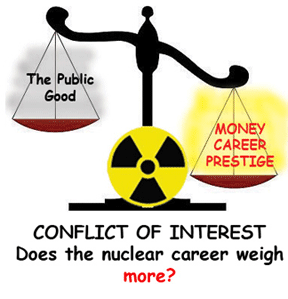 Japanese Radiation Regulators Admit Conflict of Interest, Laboratory Equipment, 12 Dec 12 Yuri Kageyama Influential scientists who help set Japan’s radiation exposure limits have for years had trips paid for by the country’s nuclear plant operators to attend overseas meetings of the world’s top academic group on radiation safety.
The potential conflict of interest is revealed in one sentence buried in a 600-page parliamentary investigation into last year’s Fukushima Dai-Ichi nuclear power plant disaster and pointed out to The Associated Press by a medical doctor on the 10-person investigation
panel.
Some of these same scientists have consistently given optimistic assessments about the health risks of radiation, interviews with the scientists and government documents show. Their pivotal role in setting policy after the March 2011 tsunami and ensuing nuclear meltdowns meant the difference between schoolchildren playing outside or indoors and families staying or evacuating their homes.
One leading scientist, Ohtsura Niwa, acknowledged that the electricity industry pays for flights and hotels to go to meetings of the International Commission on Radiological Protection, and for overseas members visiting Japan……… Continue reading
4 non-earthquake reasons to worry about Fukushima nuclear reactor no 4
 4 reasons why we must be worried about reactor4 “other than earthquake” http://fukushima-diary.com/2012/12/column-4-reasons-why-we-must-be-worried-about-reactor4-other-than-earthquake/ by Iori Mochizuki December 11th, 2012 · Now the biggest risk of Japan is reactor4.
However, we are only supposed to be worried about an “earthquake” to seriously damage the SFP of reactor4. Is this true ? No, it is not enough. We are missing 4 important facts.
1. It’s already deteriorating.
About one hour ago, Fukushima Diary reported the coolant system of SFP4 was stopped from 12/8 to 12/11. [Link] It is not known if the M7.4 of 12/7 affected.
Because of the warning, Tepco reinforced SFP4 by building a concrete base to support from the bottom of the pool.
However, if Mr. Murata is all correct, the concrete base is deteriorating, and the damage is on-going somewhere we can’t see. In that case, that would be really difficult to replace the concrete base anymore and all we could do is just to see it become unable to support the pool horizontally.
2. Ground is weakened. Continue reading
New solar fabric will light up your clothes
Japan researchers invent solar-cell fabric, Herald Sun, From: AAP December 12, 2012 CLOTHES that could literally light up your life were unveiled Tuesday by Japanese researchers who said their solar-cell fabric would eventually let wearers harvest energy on the go. Continue reading
In Japan’s elections, nuclear power is THE issue
Nuclear power ‘major issue’ in Japan poll SBS World News, 11 DEC 2012, SOURCE: KATESTOWELL, SBS Opinion polls have suggested the LDP is on course to return to government as the biggest party, but not with an outright majority.(AAP)
The future of nuclear power is shaping up as the major issue on voters’ minds ahead of national elections in Japan this week. … Continue reading
Japan workers organise for a nuclear free society
 It’s Labor’s Turn! – Workers’ Committee to Aim for Nuclear Free Society Established http://labornetjp.blogspot.com.au/2012/12/its-labors-turn-workers-committee-to.html “Civil society is active in no nukes movement, but it’s our turn now to mobilize workers and unions,” HASEGAWA Takehisa, president of Japan Construction and Transport Industry Workers Solidarity Union, said on Nov. 20 in Tokyo. “We have long made effort to protect our jobs and livelihoods, but as we are threatened even for our existence by nuclear plants, we must protect our lives and safety. No life, no job. We would build solidarity with those who are deprived of decent work and living due to dangerous work in radioactive environment.” The committee formed by seven unions plans to hold a simultaneous actions in March and movie screening of a documentary on people of Futaba. Some 60 attended the meeting held for establishment of the committee and listened to KAIDO Yuichi, lawyer, who spoke of the basic law on nuclear free society. (By M)
Multiple radiation symptoms in Japanese fronm areas around Fukushima
Newspaper: Door-to-door surveys revealed clusters of Fukushima residents with persistent nose bleeds, diarrhea — Fallout refugees talk about bizarre rashes, high fevers, more http://enenews.com/newspaper-fukushima-fallout-refugees-talk-about-bizarre-rashes-high-fevers-blood-noses-is-it-too-late-to-evacuate
December 8th, 2012
Kids exposed to radiation had rash, bloody nose, fever, etc., and brave mothers moved them to Okinawa. theage.com.au/world/escape-t…
7 Dec 12
Source: The Age (Australia)
Author: Jane Barraclough
Date: December 6, 2011 (Update: Please note report is from 2011)
As radiation hot spots emerge in Tokyo and nuclear contamination plagues the country, some Japanese are fleeing to the Okinawa island chain to avoid the fallout from Fukushima. But is it too late?
[…] 30 other refugees [in Okinawa] from around the mainland — mostly mothers with young children — share the same anxieties. They talk about bizarre rashes, high fevers, blood noses and government and industry failures “they can never forgive”.
[…] door-to-door surveying in non-evacuated areas 60 kilometres from the plant revealed clusters of residents with persistent nose bleeding and diarrhoea. The same symptoms were also found among Tokyo residents.
Hiroshima survivor Dr Shuntaro Hida, who runs a non-profit hospital for Chernobyl and Hiroshima atomic bomb victims, assessed 50 patients at a one-off clinic in the middle of the year.
“People presented with purple spots, nose bleeding, high fevers, diarrhoea, aching bones, and extreme fatigue, ” he says. […]
After seeing patients at the clinic with multiple radiation symptoms, Hida is concerned about radiation in Tokyo. […]
Exploitation of workers at Fukushima nuclear plant
Asahi: Fukushima workers report exploitation — Told to be like kamikaze — Large numbers leaving — “I wonder if we can raise children” http://enenews.com/asahi-fukushima-workers-report-exploitation-told-to-be-like-kamikaze-large-numbers-leaving-i-wonder-if-we-can-raise-children
December 9th, 2012
Title: Worker wants new government to secure safety at Fukushima plant
Source: AJW by The Asahi Shimbun
Author: Miki Aoki and Toshio Tada
Date: December 09, 2012
A man in his 50s hopes that a new government to be formed after the Dec. 16 Lower House election will protect the health of workers like himself at the stricken Fukushima No. 1 nuclear plant […]
The man said workers at the Fukushima No. 1 plant are being exploited. […]
“Many people work without seeing a doctor because they fear they might be told not to come anymore from the next day,” he said. “It is a distortion caused by the layers of subcontractors involved. I want the government to protect us.” […] Continue reading
USA bullying Japan into keeping nuclear power
On 22 September the Tokyo Shimbun newspaper reported that the US Government had demanded that no cabinet decision endorsing the strategy be made. Other newspapers reported that the US Government was pressuring Japan to abandon its nuclear phase out aspirations.
More recently a series of statements by former senior US officials and advisors suggests a concerted campaign could be underway to intimidate the Japanese Government
 whatever the outcome [of Japan’s election], Japan is undergoing a historic shift in its energy policy. The Japanese people need international support in this process, but they don’t need to be bullied.
 Why America Wants A Nuclear Japan, New Matilda, 7 Dec 12 In the wake of the Fukushima disaster, most Japanese voters want the country’s nuclear power plants to be permanently closed down – but the US has other ideas, writes Philip White
On 14 September this year, one and a half years after the Fukushima Daiichi nuclear accident, the Japanese Government released an unprecedented document.
The “Innovative Energy and Environment Strategy”, the culmination of a year-long policy review process, set the previously unthinkable target of zero nuclear energy by the end of the 2030s. In resolving to phase out nuclear energy, the Japanese Government did what it had never done before in the energy policy field: it allowed itself to be influenced
by the will of the people.
The backlash was immediate. Business groups banded together to condemn the strategy, governors of prefectures hosting nuclear facilities expressed concern about the future of these facilities and, perhaps equally significant, the governments of France, the UK and the United States communicated their displeasure. In the face of this onslaught the government went weak at the knees and failed to give the strategy formal cabinet endorsement…… Continue reading
Data on Fukushima workers’ radiation exposure
TEPCO releases worker radiation exposure data to WHO, Enformable.com. 6 Dec 12 TEPCO released data related to the radiation exposure doses documented for Fukushima Daiichi emergency workers which it had submitted to the World Health Organization (WHO).
The data showed the youngest workers were in their teens, while the oldest was 84 years old. One of the teenagers was exposed to 56.89 mSv. Most of the workers are in their 40s. 26 workers are over the age of 70.
TEPCO Worker Ages……
The highest radiation dose recorded was 678.8 mSv. The highest dose recorded by a worker in their 20s was 477.01 mSv…..
Distribution of Thyroid Doses based on measured value of I-131 (Thyroid equivalent dose from Cs not included in data)……
There are still over 600 workers unaccounted for in the most recent data, TEPCO did not release any details as to why they were unable to track down the missing workers……..
Source: TEPCO
Source: JiJi Press
Read more at http://enformable.com/2012/12/tepco-releases-worker-radiation-exposure-data-to-who/#les31YbP4ZC0Kk2S.99
Role of scientists paid to minimise risks of nuclear radiation
Outrage as AP exposes Japan scientists taking money from nuke industry — But we usually only fly coach so it’s OK — Radiation standards ‘twisted’ after 3/11 to limit evacuations http://enenews.com/just-in-outrage-as-ap-exposes-japan-scientists-taking-money-from-nuclear-industry-doctor-radiation-standards-were-twisted-to-limit-evacuations-after-311-the-excuse-we-usually-only-fly-coDecember 6th, 2012
Title: AP Exclusive: Japan scientists took utility money – The Denver Post
Source: AP
Author: YURI KAGEYAMA
Date: Dec 6, 2012
Influential Japanese scientists who help set national radiation exposure limits have for years had trips paid for by the country’s nuclear plant operators […]
The potential conflict of interest is revealed in one sentence buried in a 600-page parliamentary investigation into last year’s Fukushima Dai-Ichi nuclear power plant disaster and pointed out to The Associated Press by a medical doctor on the 10-person investigation panel. […]
Some of these same scientists have consistently given optimistic assessments about the health risks of radiation, interviews with the scientists and government documents show. Continue reading
Tsuruga nuclear power plant may be sitting on an active earthquake fault
Regulator does not ‘rule out’ crush zone at Tsuruga nuclear plant as
active fault, Daily Yomuiri, 4 Dec 12 TSURUGA, Fukui (Jiji Press)–A nuclear regulator has not ruled out the possibility a crush zone under the Tsuruga nuclear power plant is an active fault, the presence of which would prevent restarting one of the plant’s reactors.
At a news conference Sunday after a second day of on-site surveys at the plant, Kunihiko Shimazaki, acting chairman of the Nuclear Regulation Authority, said inspectors found stratum deformation above the crush zone D-1, which runs directly underneath the plant’s No. 2 reactor building. The results of the survey, conducted by Shimazaki and four other
experts commissioned by the authority, will be evaluated at a meeting next week.
If D-1 is judged to be an active fault, the regulatory group will prevent Japan Atomic Power Co., the plant’s operator, from restarting the No. 2 reactor….. http://www.yomiuri.co.jp/dy/national/T121203003485.htm
Chaos in Japan Restoration Party as leader backtracks on abolishing nuclear power
 Ishihara nuke flip-flop puts party in crisis Japan Times , 2 Dec 12 By ERIC JOHNSTON
Staff writer OSAKA — With the kickoff of the Dec. 16 Lower House election campaign
just one day away, Nippon Ishin no Kai (Japan Restoration Party) is in chaos after party leader Shintaro Ishihara declared Friday that he would revise a promise to abolish nuclear power by the 2030s. The
 former Tokyo governor’s declaration is adding to a growing sense in
and outside the party that the decision to merge with Osaka Mayor Toru
Hashimoto’s party was a mistake. Continue reading
Ishihara now ambivalent about nuclear power, and considers nuclear weapons for japan
Pro-nuclear Ishihara already wants to rewrite party platform
http://ajw.asahi.com/article/behind_news/politics/AJ201212010053
December 01, 2012 THE ASAHI SHIMBUN
Japan Restoration Party leader Shintaro Ishihara on Nov. 30 suggested
he will rewrite the party’s day-old campaign promises for the Dec. 16
Lower House election to better reflect his pro-nuclear stance.
In a debate among the chiefs of 11 political parties at the Japan National Press Club, Ishihara was asked about his party’s platform that said “nuclear power generation at existing reactors would fade out by the 2030s.”
Ishihara, a former Tokyo governor, suggested that he will review the platform that he and acting leader Toru Hashimoto, the popular Osaka mayor, announced just the previous day.
He said the party will “think about” stopping some nuclear reactors through simulations. Continue reading
1 This Month





PLEASE OPPOSE HR 8255 AND S.3639 – bills would accelerate satellite deployment, with no environmental review or safeguards – https://ncstd5li.quorum.us/campaign/169331/
To see nuclear-related stories in greater depth and intensity – go to https://nuclearinformation.wordpress.com
-
Archives
- October 2026 (74)
- September 2026 (339)
- August 2026 (330)
- July 2026 (355)
- June 2026 (287)
- May 2026 (306)
- April 2026 (356)
- March 2026 (251)
- February 2026 (267)
- January 2026 (308)
- December 2025 (358)
- November 2025 (359)
-
Categories
- 1
- 1 NUCLEAR ISSUES
- business and costs
- climate change
- culture and arts
- ENERGY
- environment
- health
- history
- indigenous issues
- Legal
- marketing of nuclear
- media
- opposition to nuclear
- PERSONAL STORIES
- politics
- politics international
- Religion and ethics
- safety
- secrets,lies and civil liberties
- spinbuster
- technology
- Uranium
- wastes
- weapons and war
- Women
- 2 WORLD
- ACTION
- AFRICA
- Atrocities
- AUSTRALIA
- Christina's notes
- Christina's themes
- culture and arts
- Events
- Fuk 2022
- Fuk 2023
- Fukushima 2017
- Fukushima 2018
- fukushima 2019
- Fukushima 2020
- Fukushima 2021
- general
- global warming
- Humour (God we need it)
- Nuclear
- RARE EARTHS
- Reference
- resources – print
- Resources -audiovicual
- Weekly Newsletter
- World
- World Nuclear
- YouTube
-
RSS
Entries RSS
Comments RSS

