A ticking time bomb – Fukushima nuclear reactors
Kaku: Fukushima reactors “a ticking time bomb” — “Catastrophe beyond comprehension” if major pipe break or quake (VIDEO) http://enenews.com/kaku-fukushima-reactors-like-ticking-time-bomb-catastrophe-beyond-comprehension-major-pipe-break-quake-video
December 17th, 2012 at
Full broadcast here
Title: Radioactively Hot Show (Re-broadcast with Dr. Michio Kaku)
Source: SOAPBOX #106
Date: December 7, 2012
The reactor is still like a ticking time bomb. If you have a secondary earthquake, another pipe break, evacuation of workers, the accident starts up all over again.
Realize that we have 5 reactors in various states of degradation in the area. The accident is not over by any means. The accident could start up all over again if there’s a secondary earthquake or another pipe break. In a worst case scenario, if there is a major pipe break or secondary earthquake, they would have to evacuate the workers and because the pumps are not working at the site, it means that you have to manually, manually, insert the water over the reactors and without the workers you would be in free fall. At that point with an evacuation of all the workers, water levels would begin to drop, the reactors would then start to melt again and we would breach containment — that is the release of uncontrolled amounts of radiation in to the environment. And that is a catastrophe beyond comprehension.
Full broadcast here
No early return to nuclear energy, for Japan
Japan Shifts to LNG Dependency from Nuclear, Eyes US Fuel, Energy Tribune, December 17, 2012 Liquefied Natural Gas (LNG) purchase, a post-Fukushima item in Japan’s imports list that sent country’s foreign trade figures to their first deficit in 38 years in 2011, will continue dominating the country’s energy near future, as officials confirm that they are in LNG trade talks with the U.S., not a traditional supplier. Qatar and Australia seem to be maintaining their top supply positions to the Japan with new deals, the country’s Nuclear Policy Unit has said.
Before the devastating earthquake and subsequent tsunami on May 11, 2011, Japan was planning to increase nuclear power’s share in its energy bucket to 50 percent as of 2030, from 26 percent at the time.
Today, the revised plans vary from zero to a maximum 25 percent of nuclear, the Nuclear Policy Unit Cabinet Secretariat Yoshinori Tanaka told journalists in Tokyo on Dec. 13.
Along with purchases from Qatar and Australia, the country is looking to buy LNG from the U.S., he also revealed. However, other officials have stated that the U.S. is primarily considering meeting its domestic demand first.
A new Japanese strategy document prioritizes renewables, but such projects will take time to fill the significant energy gap in Asia’s second largest economy.
Japan, which was once energy self-sufficient, this year and in 2011 bought large amounts of LNG, along with coal and oil, to meet the gap that emerged after the closure of its nuclear facilities, the assistant press secretary of the Japanese Foreign Ministry, Masaru Sato, told the Hürriyet Daily News……
The country’s newly founded Nuclear Regulation Authority, a governmental body focusing exclusively on nuclear safety, will start inspecting nuclear plants to restart operations only in June 2013, showing that a nuclear comeback is also not on the agenda in the immediate short term…..http://www.energytribune.com/68237/japan-shifts-to-lng-dependency-from-nuclear-eyes-us-fuel
100% of Fukushima white rockfish had cesium levels, November-December
 Cesium measured from 100% of Fukushima white rockfish in November and December http://fukushima-diary.com/2012/12/cesium-measured-from-100-of-fukushima-white-rockfish-in-november-and-december/
by Mochizuki December 17th, 2012
On 9/9/2012, Fukushima Diary reported white rockfish (Shiromebaru) tends to accumulate cesium. http://fukushima-diary.com/2012/09/85-of-fukushima-rockfish-exceeds-safety-limit-in-cesium/
According to Fukushima prefectural government, high level of cesium was measured from 100% (19 of 19) of the samples taken in November and December from offshore Fukushima. 84% (16/19) of them exceeded the government’s safety limit of 100Bq/Kg.
The highest reading was 1,731 Bq/Kg (11/30/2012), the second highest reading was 1,225 Bq/Kg (12/8/2012).
Japan: political win for the nuclear Mafia
Far Right Dinosaur Party Wins Japan Elections http://rense.com/general95/farright.html By Richard Wilcox 12-16-12 Looking over the results on the TV here in Japan, the far right CIA created and sustained “Liberal Democratic Party” (LDP) which ruled Japan since WWII is back in power, BIG TIME. They won almost all the seats. The only other parties to win numerous seats are almost or just as far right and as pathologically fueled by power.
All of these parties are captured by the Nuclear Mafia and fiercely devoted to the continuation of nuclear power, if not the development of nuclear weapons to boot. Don’t ask me why the Japanese vote for these nuts and if you ask folks, “why?” they like a certain candidate, they are at a loss to give a reason and smile with embarrassment.

I guess the LDP pay off certain voting sectors with construction projects and kickbacks since they have a pile of stolen money hiddenaway.
Of course, the system is rigged so that only big money candidates can get enough votes. Also, culturally, Japanese tend to support the utmost superficial and glib politicians in a battle of form over substance. Same as USA! Japanese have forgotten about the nuclear disaster thanks to media manipulation so there has been no referendum on nuclear policy.
There are intelligent and sincere political parties and candidates in Japan but they get no-head way, because they are too principled and lack the funds, and the system is set up to block their progress (sounds like USA again, aka Ron Paul). Only the most cheeky and shameless people ascend to power.
Any of the mildly progressive or anti-nuclear power parties took a few pitiful token seats, which are probably in the restroom of theParliament building– the toilet seats.
Look for some of Japan’s nuclear power plants to start up next year, fast and furious, devil take the hindmost. To paraphrase the punk rock band the Sex Pistols: Never Mind The Earthquakes.
Nuclear energy’s friend Liberal Democratic Party wins in Japan elections
The anti-nuclear Tomorrow Party – formed just three weeks ago _captured just nine seats, according to NHK. Party head Yukiko Kada said she was very disappointed to see LDP, the original promoter of Japan’s nuclear energy policy making a big comeback.
Japan Elections 2012: LDP Wins Majority In Parliamentary Elections HUFFINGTON POST, By MALCOLM FOSTER 12/16/12 TOKYO — Japan’s conservative Liberal Democratic Party returned to power in a landslide election victory Sunday after three years in opposition, according to unofficial results,….
The victory means that the hawkish former Prime Minister Shinzo Abe will get a second chance to lead the nation
after a one-year stint in 2006-2007. He would be Japan’s seventh prime minister in six-and-a-half years.
In the first election since the March 11, 2011, earthquake, tsunami and nuclear disasters, atomic energy ended up not being a major election issue even though polls show about 80 percent of Japanese want to phase out nuclear power…….
LDP, the most pro-nuclear power party, had 118 seats before the election. A new, staunchly anti-nuclear power party won just nine seats, according to NHK.
In the end, economic concerns won out, said Kazuhisa Kawakami, a political science professor at Meiji Gakuin University.
“We need to prioritize the economy, especially since we are an island nation,” he said. “We’re not like Germany. We can’t just get energy from other countries in a pinch.”….. Continue reading
Health effects of Fukushima radiation were minimised by World Health Organisation
 Last month, the German branch of the international physicians’ group sent a letter to WHO Director General Margaret Chan, calling for a substantial expansion of medical research on the health effects of the Fukushima disaster. The branch also sought the early establishment of a comprehensive registry of residents in Fukushima who are estimated to have been exposed to radiation of more than 1 millisievert following the triple meltdowns.
WHO downplayed health effects of nuclear crisis on Fukushima residents : German physician
http://www.japantimes.co.jp/text/nn20121216a4.html?utm source=feedburner&utm_medium=feed&utm_campaign=Feed%3A+japantimes+%28The+Japan+Times%3A+All+Stories%29 Jiji BERLIN — A German doctor and member of a Nobel Peace Prize-winning physicians’ group has criticized a World Health Organization report on the Fukushima nuclear catastrophe for underestimating its impact on human health.
In a research paper, Alex Rosen said the WHO report, published in May this year on estimated radiation doses received by residents near the crippled Fukushima No. 1 nuclear plant, was compiled mainly by officials related to the International Atomic Energy Agency, which promotes the use of atomic energy for peaceful purposes.

Rosen, a member of International Physicians for the Prevention of Nuclear War, called for an independent assessment based on solid scientific methodology that would examine the health impacts from radioactive fallout released after the Fukushima No. 1 complex suffered three core meltdowns in March 2011. Continue reading
Japan imprisons professor who opposes radiation management
Radioactive contamination has not been properly dealt with at all, and the contamination is being spread through the circulation of food and other goods. In the midst of this situation, the government lies about “insufficient electricity” to try to continue using nuclear power plants. This is nothing but insanity.
Every day I look at my students and wonder what sort of world they will live in when these 20-year-olds turn forty like me
 Unjust Arrest of a Professor Opposing Debris Incineration in Osaka http://fukushimavoice-eng.blogspot.com.au/2012/12/unjust-arrest-of-professor-opposing.html Below this background information is a letter from Masaki Shimoji, a university associate professor who has been unfairly detained since his sudden arrest on December 9, 2012. The arrest occurred
  because he walked through the Japan Railways Osaka station on October 17, 2012.
Professor Shimoji and others are opposing the “areawide management of the disaster debris” measure, which intended to spread, incinerate and bury harmful substances in the disaster debris all over Japan that should not be incinerated, such as radioactive material and asbestos. Osaka-city is trying to begin regular incineration and burial beginning in February 2013.
The following is the timeline for the arrest: Continue reading
Nuclear Japan’s love affair with the criminal Yakuza
 How the Yakuza and Japan’s Nuclear Industry Learned to Love Each Other JAKE ADELSTEIN MAY 24, 2012 After arrest of a yakuza boss for his alleged role in supplying workers to TEPCO’s Fukushima Daichi Nuclear Plant, we are learning the details of how Japan’s nuclear industry relied on organized crime. Since July of last year, a few months after the March 11 earthquake and tsunami resulted in a triple meltdown at the Fukushima plant, investigators have been probing possible yakuza links to TEPCO and the nuclear industry under the guidance of the National Police Agency.
“Yakuza involvement in the nuclear industry is believed to go back to 2007 or earlier,” said a police source, “and the gangs involved were dispatching yakuza to nuclear sites all over Japan.” Continue reading
Japan admits to errors in radiation data for every nuclear power plant in the country
Japan’s ‘nuclear radiation projection’ had errors http://zeenews.india.com/news/world/japans-nuclear-radiation-projection-had-errors_816717.html, December 14, 2012, Washington: The Nuclear Regulation Authority of Japan said a thorough review of its mistake-plagued projections for the spread of radiation, in a case of possible meltdown like the Fukushima crisis, turned up errors in the data for every atomic power plant in the country. Continue reading
Cesium in mushroom, wild boar – Japan
25,550 Bq/Kg of cesium from Matsutake mushroom, 10,980 Bq/Kg from wild boar from Minamisoma http://fukushima-diary.com/2012/12/25550-bqkg-of-cesium-from-matsutake-mushroom-10980-bqkg-from-wild-boar-from-minamisoma/ by Mochizuki on December 13th, 2012 ·
Minamisoma city measured cesium from 674 among 1,243 samples for self-consumption.
The test was conducted this October and the result was published on 11/6/2012.
The highest reading was 25,550 Bq/Kg from Matsutake mushroom, the second highest reading was 10,980 Bq/Kg from the meat of a wild boar. Wild boar eats mushroom.
Iori MochizukiFukushima reactor No 2 – leaking highly radioactive water
 Asahi: Tepco can’t find where huge amount of highly radioactive water is leaking at Reactor No. 2 — ‘Fractures’ in containment vessel suspected http://enenews.com/asahi-tepco-find-huge-amount-highly-radioactive-water-leaking-reactor-2-fractures-containment-vessel-suspected December 12th, 2012
Title: TEPCO unable to locate source of leak in Fukushima reactor
Source: AJW by The Asahi Shimbun
Date: December 12, 2012
TEPCO unable to locate source of leak in Fukushima reactor
The operator of the Fukushima No. 1 nuclear power plant is grappling to locate the source of a leak of highly radioactive water in the crippled No. 2 reactor […]
A remote-controlled robot is now scouring the basement of the reactor building […]
TEPCO suspects the radioactive water is leaking from fractures near the pressure suppression chamber [lower part of containment vessel].
It was the first detailed inspection near the chamber. […]
A huge volume of highly radioactive water, used to cool down the fuel, has since been leaking from the reactor, TEPCO said.
Japan’ s trading houses look towards a non nuclear Japan
Sojitz Sees Beyond Rare Earths to LNG, Solar in Non-Atomic Japan, Bloomberg by Yuriy Humber & Ichiro Suzuki – Dec 13, 2012 Sojitz Corp. (2768), Japan’s top trader of rare earths, plans to tap into the nation’s shift from nuclear power by setting up its own liquefied natural gas business and building solar plants, said Chief Executive Officer Yoji Sato. Continue reading
Solar power plants for Japan
Sojitz Sees Beyond Rare Earths to LNG, Solar in Non-Atomic Japan, Bloomberg by Yuriy Humber & Ichiro Suzuki – Dec 13, 2012 “….Another way for Sojitz to meet the changing energy needs of Japan will be via renewables.
Solar Power
Sojitz wants to build five solar power plants totaling about 100 megawatts, including on the northern isle of Hokkaido and in Kagoshima prefecture, western Japan, Sato said. The trader aims to register the projects with the government by the end of March, he said.
Japan introduced this year the world’s highest payment rate for renewable energy, known as a feed-in tariff, as a way to stimulate investments in solar, wind and biomass generation and ease reliance on nuclear power. The tariff rate will be revised from April.
“With a fixed feed-in tariff the economics set up has become very easy to understand,” Sato said.
The current low cost of raw materials for solar panels and Sojitz’s experience with three solar energy projects in Germany should help the trader set up an efficient business in Japan, Sato said. The company has since sold one of the projects, he said.
Sojitz commissioned a 24 megawatt solar plant in Mixdorf in July 2011 and completed a 3 megawatt station in Betzweiler in May 2010, according to Bloomberg New Energy Finance data……http://www.bloomberg.com/news/2012-12-14/sojitz-sees-beyond-rare-earths-to-lng-solar-in-non-atomic-japan.html
Tsuruga nuclear plant not safe to restart: how many others are the same?
EDITORIAL: Why flirt with disaster? Decommission Tsuruga nuclear reactor Asahi Shimbun December 12, 2012 Breaking away from the “safety myth” that surrounded nuclear energy, the Nuclear Regulation Authority (NRA) has changed the way Japan judges the safety of nuclear power plants.
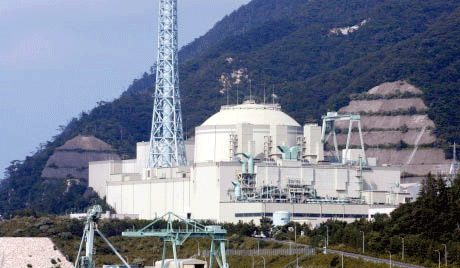
The new industry watchdog said Dec. 10 there is a high possibility that a fault line running directly beneath a reactor at Japan Atomic Power Co.’s Tsuruga nuclear plant in Fukui Prefecture is active. “Under the current circumstances, there is no way we can carry out the
safety assessments (that are required) for a restart (of the reactor),” NRA Chairman Shunichi Tanaka said.
This signals a major turning point in the nation’s nuclear regulation administration. Continue reading
Safety finding about Tsuruga plant brings gloom to Japan’s nuclear utilities
 Japan Utilities Plunge After Fault Found Under Nuclear Plant, Bloomberg, By Tsuyoshi Inajima – Dec 10, 2012 Kansai Electric Power Co. led declines in Japan’s utilities after geologists said an earthquake faultline may be active under a nuclear plant that houses the country’s oldest reactor. Kansai Electric shares fell as much as 9.7 percent, their biggest
intraday decline since Oct. 23, and closed 4.4 percent lower at 742yen in Tokyo. The Topix Electric Power & Gas Index fell 1 percent.
The company is the second-biggest stakeholder in Japan Atomic Power Co., which runs the Tsuruga nuclear plant on the coast 127 kilometers (79 miles) northeast of Osaka that was examined by geologists this month. The finding was announced yesterday and may lead to decommissioning of the unit.
“The assessment raises the risk” that the nuclear watchdog will come to a similar conclusion for other atomic generators under investigation, Reiji Ogino, a Tokyo-based analyst at Mitsubishi UFJ Morgan Stanley, said by phone today. Continue reading
1 This Month





PLEASE OPPOSE HR 8255 AND S.3639 – bills would accelerate satellite deployment, with no environmental review or safeguards – https://ncstd5li.quorum.us/campaign/169331/
To see nuclear-related stories in greater depth and intensity – go to https://nuclearinformation.wordpress.com
-
Archives
- October 2026 (74)
- September 2026 (339)
- August 2026 (330)
- July 2026 (355)
- June 2026 (287)
- May 2026 (306)
- April 2026 (356)
- March 2026 (251)
- February 2026 (267)
- January 2026 (308)
- December 2025 (358)
- November 2025 (359)
-
Categories
- 1
- 1 NUCLEAR ISSUES
- business and costs
- climate change
- culture and arts
- ENERGY
- environment
- health
- history
- indigenous issues
- Legal
- marketing of nuclear
- media
- opposition to nuclear
- PERSONAL STORIES
- politics
- politics international
- Religion and ethics
- safety
- secrets,lies and civil liberties
- spinbuster
- technology
- Uranium
- wastes
- weapons and war
- Women
- 2 WORLD
- ACTION
- AFRICA
- Atrocities
- AUSTRALIA
- Christina's notes
- Christina's themes
- culture and arts
- Events
- Fuk 2022
- Fuk 2023
- Fukushima 2017
- Fukushima 2018
- fukushima 2019
- Fukushima 2020
- Fukushima 2021
- general
- global warming
- Humour (God we need it)
- Nuclear
- RARE EARTHS
- Reference
- resources – print
- Resources -audiovicual
- Weekly Newsletter
- World
- World Nuclear
- YouTube
-
RSS
Entries RSS
Comments RSS

