Fukushima nuclear reactors: water pumped in just leaks out
 The melted core cracked the containment vessel, there really is no containment. So as soon as they pump the water in it leaks out again.
Loss of containment of nuclear fuel also exists within the spent fuel pools at Fukushima.
Fukushima Daiichi Reactor 3 Spent Fuel Pool – Fuel racks where refueling  machine mast rests http://www.youtube.com/watch?v=A3A1YA1lt8k&feature=player_embedded
Nuclear Expert: “The Melted Core Cracked The Containment Vessel ” There Really Is No Containment” At Fukushima Reactors http://www.opednews.com/articles/Nuclear-Expert–The-Melte-by-G-Washington-130302-594.html Nuclear Cores and Spent Fuel Pools Have Both Lost Containment Steven Starr – Director of the Clinical Laboratory Science Program at theUniversity of Missouri/Senior Scientist at Physicians for Social Responsibility – said :
The Japanese basically lied about what happened with the reactors for months. They said they were trying to prevent a meltdown, when in fact they knew within the first couple of days Reactors 1, 2, and 3 at Fukushima Daiichi had melted down, and they actually melted through the steel containment vessels.
So there was a worst case scenario that they were trying to hide, they even knew that at that time enormous amounts of radiation were released over Japan and some of it even went over Tokyo […] Continue reading
Fukushima becoming like a totalitarian state
 In his article, Nakajima likens the situation that of an almost totalitarian state, wherein one either adheres to the commonly held belief set or is seen as a potential threat
The government has created an environment wherein people are going about their daily lives, all the time wondering whether their child will develop cancer or leukemia, yet conditioned not to breathe a word about it. It’s like living in wartime Japan again.
 Lead Architect of Microsoft Windows 95: Something very much amiss in Fukushima — Like an almost totalitarian state — People now saying “For the sake of my child’s health, I’m not going to think about radiationhttp://enenews.com/lead-architect-of-microsoft-windows-95-something-very-much-amiss-in-fukushima-like-an-almost-totalitarian-state-people-now-saying-for-the-sake-of-my-childs-health-im-not-go Title: Japanese Blogger’s Troubling Insight into the Psyche of Post-Disaster Fukushima Residents
Author: Philip Kendall
Date: Mar. 1, 2013
In just 10 days’ time, two years will have passed since the magnitude-9.03 earthquake […]
According to one former Fukushima resident, however, there is something very much amiss in the prefecture. […] Continue reading
Misleading information masks true level of radiation received by Fukushima workers
 63 workers exposed to higher radiation than logged in their records,
March 02, 2013, THE ASAHI SHIMBUN by Toshio Tada and Jun Sato
Dozens of workers at the crippled Fukushima No. 1 nuclear power plant
were exposed to radiation levels higher than those registered in their
personal records, according to a health ministry investigation. Continue reading
Workers say Fukushima radioactive debris dumped in a river
Fukushima cleanup workers break silence: Ordered to dump ‘debris’ into river — Gov’t “appeared not to believe him”http://enenews.com/fukushima-cleanup-workers-break-silence-ordered-to-dump-debris-into-river-govt-appeared-not-to-believe-him
March 2nd, 2013
Asahi Shimbun,, March 1, 2013: CROOKED CLEANUP: Workers break silence to allege boss ordered corner-cutting […] Three laborers involved in radioactive cleanup around the Fukushima No. 1 nuclear plant have alleged that a supervisor told them to dump debris in a river […] At a news conference in the Diet building on Feb. 28, the men said a foreman ordered them to discard fallen branches and leaves into a river in an upland forest in Tamura, Fukushima Prefecture, in November 2012. […] this is the first time that decontamination workers have publicly come forward. […] The third man, in his 40s, said he related what had happened to officials at the Environment Ministry. He spoke to them for more than an hour, he said, but they appeared not to believe him. […]
See also: Asahi: River turned brown after dumping radioactive waste into water — “I was following an order, I am sorry for polluting
Ties to International Atomic Energy Agency constrain World Health Organisation’s Fukushima radiation report
 “Shameless”: New World Health Organization report shockingly downplays health risks after Fukushima — “WHO and other organisations must stop hiding the impact” http://enenews.com/shameless-new-world-health-organization-report-shockingly-downplays-health-risks-after-fukushima-other-organisations-stop-hiding-impact
Title: World Health Organisation Downplays Health Impacts of Fukushima Nuclear Disaster
Source: Greenpeace
Date: February 28 2013
Greenpeace today criticised the World Health Organisation for releasing a flawed new report that hides crucial information on the health impacts of the Fukushima nuclear disaster.
“The WHO report shamelessly downplays the impact of early radioactive releases from the Fukushima disaster on people inside the 20 km evacuation zone who were not able to leave the area quickly,” said Dr. Rianne Teule, Greenpeace International nuclear radiation expert.
“The WHO should have estimated the radiation exposure of these people to give a more accurate picture of the potential long-term impacts of Fukushima. The WHO report is clearly a political statement to protect the nuclear industry and not a scientific one with people’s health in mind.”
The people inside the 20 km zone have possibly been exposed to significant radiation doses of hundreds of mSv, according to the work of German nuclear expert Oda Becker. She used modelling based on the data from Fukushima plant operator TEPCO on radioactive releases to calculate potential doses for people 10, 15, 20 and 40 km from the reactors.
The WHO report and its PR spin shockingly downplay the likelihood that thousands of people are at risk of cancer from the Fukushima disaster. They hide the cancer impacts by emphasising small percentage increases in cancers. Those small percentages actually translate into thousands of people being at risk.
“The WHO’s flawed report leaves its job half done,” said Teule. “The WHO and other organisations must stop downplaying and hiding the impact of the Fukushima disaster and call for more emphasis on protecting the millions of people still living in contaminated areas.”
The WHO only releases reports on the impact of radiation releases on a population with the approval of the International Atomic Energy Agency.
See also: Film: World Health Organization beholden to nuclear interests — Physician: “Like having Dracula guard the blood bank” (VIDEOS)
Japan’s Prime Minister keen to restart nuclear reactors, but safety problems remain
skeptics worry that industry supporters in the government will manage to get around the regulations.
According to a report by the newspaper Asahi Shimbun, none of Japan’s 16 undamaged commercial nuclear plants would pass the new standards.
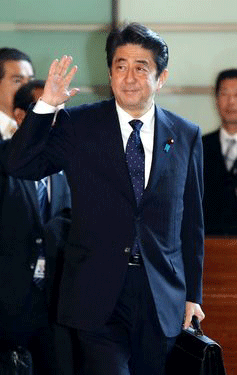 Japan to Begin Restarting Idled Nuclear Plants, Leader Says NYT By MARTIN FACKLER and HIROKO TABUCHI Matthew L. Wald contributed reporting from Washington. February 28, 2013 TOKYO — Japan will begin restarting its idled nuclear plants after new safety guidelines are in place later this year, Prime MinisterShinzo Abe said Thursday, moving to ensure a stable energy supply despite public safety concerns after the Fukushima disaster.
In a speech to Parliament, Mr. Abe pledged to restart nuclear plants that pass the tougher guidelines, which are expected to be adopted by a new independent watchdog agency, the Nuclear Regulation Authority, as early as July. He did not specify when any of the reactors might resume operation, and news reports have suggested that it might take months or even years to make the expensive upgrades needed to meet the new safety standards. Continue reading
Fukushima radiation is transforming Japan’s forest ecosystems
 Japan Scientists: Truly unusual deformities in Fukushima — Forests may be evolving into different ecosystems — “There’s been a sudden, large change” http://enenews.com/japan-scientists-truly-unusual-deformities-in-fukushima-theres-been-a-sudden-large-change-forests-may-be-evolving-into-different-ecosystems
February 27th, 2013
Excerpts from ‘Radiant Wildlands‘ by Winifred Bird and Jane Braxton in the Spring 2013 issue of Earth Island Journal
[…] When Joji Otaki began looking closely at the [pale grass blue butterflies] the size of a silver dollar, however, he was struck by abnormal patterns in the dark dots on their wings. Then he noticed dents in their eyes and strangely shaped wings and legs.
Otaki, a professor at the University of the Ryukyus in Okinawa, was in the Abukuma Mountains west of the disaster site collecting butterflies to study their response to the accident [2 months after 3/11].
[…] the aberrations they found took them by surprise. Abnormalities in the first generation were within normal boundaries. But when Otaki bred these butterflies in his laboratory, mutations in the offspring increased to 18 percent. That suggested inherited genetic damage. Field samples collected in September 2011, representing the fourth or fifth generation of butterflies since the disaster, had even higher abnormality rates. The changes may not all have been caused by radiation; Otaki had previously found evidence that temperature can affect wing markings. But the deformities his team found in antennae, legs, and other body parts are truly unusual, says Hokkaido University entomologist Shin-ichi Akimoto, who is studying the impact of Fukushima fallout on aphids. The abnormalities are troubling not only because insects are commonly assumed to be more resistant to radiation than humans, but also because they suggest the Fukushima nuclear disaster may be changing individual species, even entire forests.
“There is no question that ecosystems as a whole are suffering,” Otaki says. “There has been a sudden, large change.”
[…] As plants and animals continue to live in these irradiated environments, forests themselves may be evolving into different ecosystems. […]See also: Biologist on Mutated Butterflies: Study is overwhelming in its implications for humans — Japan Researcher: Insects were believed to be very resistant to radiation — Irregularly developed eyes, malformed antennae, much smaller wings (PHOTO)
Ocean fish to be studied for Fukushima radiation
 L.A. Times: NOAA to start testing wildlife for Fukushima contamination http://enenews.com/l-a-times-noaa-to-start-testing-wildlife-for-fukushima-radiation
February 26th, 2013
Title: Radioactive tuna from Fukushima? Scientists eat it up
Source: Los Angeles Times
Author: Eryn Brown
Date: February 25, 2013
Title: Radioactive tuna from Fukushima? Scientists eat it up
[…] In coming months, the three researchers and colleagues at the National Oceanic and Atmospheric Administration and other institutions plan to analyze hundreds more bluefin tuna, as well as albacore tuna; mahi mahi; ocean sunfish; opa; mako, blue and salmon sharks; loggerhead turtles; and sooty shearwaters, a type of migratory seabird.
They’ll examine samples collected in New Zealand, Hawaii and Alaska as well as in California. They might look through archived specimens for salmon and whales to test. Other research groups may track the contamination to study marine animals too, [Dan Madigan of Stanford University] said.
If scientists find Fukushima radiation in swordfish, for example, it will be the first evidence that the species migrates across the entire Pacific. […]
“Amazing”
They concluded that their tracking method worked, and that Fukushima provided “an unprecedented opportunity” for scientists to use radioactive tracers to follow animal movement. “This was just nature being amazing,” [Nicholas Fisher of Stony Brook University] said.
He imagines pulling together a map of the Pacific crisscrossed by the paths of radiation-toting animals — “an amazing image of transport … all from a little dot” in Japan, Madigan said.
See also: HuffPost: “Radioactive Fish Found In California” — Is it a good thing?
Girls most affected by Fukushima radiation – World Health Organisation
Japan to Begin Restarting Idled Nuclear Plants, Leader Says NYT By MARTIN FACKLER and HIROKO TABUCHI Matthew L. Wald contributed reporting from Washington. February 28, 2013 ”……..According to the study, girls exposed as infants to radioactivity in the most contaminated regions of Fukushima Prefecture faced a 70 percent higher risk of developing thyroid cancer than would be expected normally. The report pointed out, however, that the normal risk of thyroid cancer was just 0.75 percent, and that the additional lifetime risk would raise that to 1.25 percent.
 Girls exposed to radioactivity as infants in the most heavily contaminated areas also had a 6 percent higher risk of developing breast cancer, and a 4 percent higher risk of developing cancers that cause tumors. Meanwhile, boys exposed as infants had a 7 percent higher chance of developing leukemia.
The study also said that about a third of the emergency workers who remained to try to stabilize the Fukushima Daiichi plant were estimated to have a slightly increased risk of developing leukemia, thyroid cancer and other types of cancer.
The analysis was based on data available as of September 2011, and takes into account airborne contamination as well as contaminated food, water and other sources of contamination, the WH.O. said. http://www.nytimes.com/2013/03/01/world/asia/japan-to-begin-restarting-idled-nuclear-plants.html?_r=0
High increase in radiation in soil near Fukushima river
 Radiation level offshore Fukushima river increased to be 95 times much as 1 month before http://fukushima-diary.com/2013/02/radiation-level-offshore-fukushima-river-increased-to-be-95-times-much-as-1-month-before/
According to Tepco, the radiation level of sea ground soil jumped up by 950% from November to December in 2012.
The sampling location was 2km offshore of Ukedogawa in Namie machi, where is in 4~5 km north from Fukushima plant.
It was 25Bq/Kg in November, it was 2,370Bq/Kg in December.
Validity of Japan’s official radiation figures is in doubt
Rising doubts about Japan’s official radiation figures, DW 27 Feb 13, As the two-year anniversary of the world’s second-worst nuclear accident nears, citizen groups are questioning the accuracy of the government’s contamination data for the area around the Fukushima Dai-ichi nuclear plant…… ome volunteer groups are conducting out their own monitoring efforts and sharing the data on websites.
“We believe it is dangerous for people still living in highly contaminated areas,” said Hajime Matsukubo, a spokesman for the Tokyo-based Citizens’ Nuclear Information Center (CNIC). He points to independent studies indicating that people in Fukushima and Koriyama – cities well beyond the exclusion zone imposed by the government – are still exposed to high levels of radioactivity. Continue reading
Japan Mass Media Banned From Reporting Radiation Dangers
In contrast to official Japanese government policy which allows 20 millisieverts of annual background radiation, a joint French and Japanese NGO project found that “external radiation” continues to cause “unacceptable health risks for hundreds of thousands of citizens” and that government estimates ignore internal consumption of radionuclides through food, water and air.
Powerful Lies – The Fukushima Nuclear Disaster And The Radioactive Effects On Human Health By Richard Wilcox PhD 2-22-13 Rense.com, “……. How many people will die from Fukushima nuclear meltdown radiation? Two years have passed since Japan’s Fukushima nuclear disaster. Every day we learn of more evidence of the dangers of low-level radiation from a variety of natural and man-made causes, including medical x-rays and scans (11; 12). Our health, and particularly the health of people in Fukushima, is under increasing distress.
We now see evidence of children with thyroid cancer from the Fukushima area . It has also been revealed that the mass media in Japan is unofficially BANNED from discussing radiation issues. Journalists who write about radiation dangers will be fired whereas they are permitted to debate whether Japan should use nuclear energy or not .
The latter debate is permissible because it is long-term and changeable depending on the whims of government policy and manipulation of public sentiment. Serious discussion of radiation danger strikes fear in the heart of the public, and may also lead to costly liability payments, and is therefore taboo. Undoubtedly, the ban on discussing the danger of radiation in the media translates into public ignorance about radiation. It is astonishing to me that most of the people I talk to in Tokyo are only dimly aware that radiation is entering their bodies on a daily basis: from public water supply, food, drinks, ongoing air pollution emissions from the FNPP, and the burning of radioactive debris in public incinerators. People think that it is only a small risk. Continue reading
Radiation situation at Fukushima is unimaginably bad
 No workers were visible around the No. 3 reactor building. An unmanned crane was removing debris on the roof.
It is hazardous to human health to work in the reactor building where
radiation levels range from 20 to 100 millisieverts per hour.
The amount of radioactive water stored in tanks and other facilities
rose to 230,000 tons this month, up from 10,000 tons in July 2011.
In addition, an estimated 100,000 tons of water have accumulated in
the basements of buildings.
Decommissioning will not be completed for the next 30 to 40 years
High radiation bars decommissioning of Fukushima plant Asahi  Shimbun,
February 21, 2013
By HISASHI HATTORI/ Senior Staff Writer
Preparations for the mammoth task of decommissioning crippled reactors
at the Fukushima No. 1 nuclear power plant are being stymied by
continued high levels of radiation from the triple meltdowns there two
years ago.
Tokyo Electric Power Co., operator of the plant, has had to install
more tanks to store radioactive water, which continues to swell by
several hundreds of tons daily.
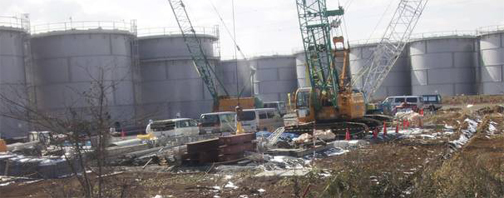
Asahi Shimbun reporters entered the No. 4 reactor building on Feb. 20,
accompanied by inspectors from the secretariat of the Nuclear
Regulation Authority, to assess the situation….. Continue reading
Cash strapped Japanese nuclear power companies selling uranium back to original sellers at a lower price!
A senior official of a major utility said the move was exceptional because it likely meant selling the uranium for less than the import price.
Japan Atomic Power takes rare step of selling uranium to pay off loans http://www.japantimes.co.jp/news/2013/02/21/national/japan-atomic-power-takes-rare-step-of-selling-uranium-to-pay-off-loans/#.USfWWB1wpLt
KYODO
A Japanese nuclear power company has taken the rare step of selling some of its uranium, apparently to help repay loans amid its faltering business conditions, according to sources.Japan Atomic Power Co. apparently needs to secure money to repay loans due in April amid uncertainty over when it can resume operating its three idled reactors.
Tokyo Electric Power Co. is considering taking similar action as it continues to face funding difficulties following the crisis at the Fukushima No. 1 complex, the sources said. Continue reading
No costs for nuclear firms that built Fukushima reactors, but residents must pay back compensation
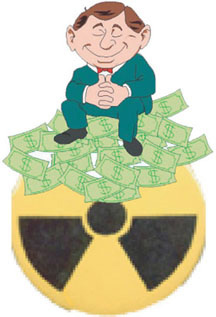 the firms that helped design and build the Fukushima reactors, such as General Electric, Toshiba and Hitachi, are not required to pay a cent in compensation.
Aslihan Tumer, Greenpeace’s international nuclear project leader, says some of the companies are continuing to profit from the reactor.
“Nuclear suppliers are completely protected from accepting any liability or being held accountable in case of an accident,” he said.
Residents paying back Fukushima compensation ABC News, By North Asia correspondent Mark Willacy Feb 19, 2013 Nearly two years on from the meltdowns at the Fukushima nuclear plant, there are accusations the nuclear industry is evading its responsibilities.
The disaster has mostly dropped out of the news in Japan and its victims remain largely hidden after being placed in tiny, so-called temporary apartments across the country.
The ABC has learned that TEPCO, the operator of the Fukushima plant, is handing out what are called “temporary compensation” payments – money handed out to victims of the meltdowns, but which must be repaid….. Continue reading
1 This Month





PLEASE OPPOSE HR 8255 AND S.3639 – bills would accelerate satellite deployment, with no environmental review or safeguards – https://ncstd5li.quorum.us/campaign/169331/
To see nuclear-related stories in greater depth and intensity – go to https://nuclearinformation.wordpress.com
-
Archives
- October 2026 (74)
- September 2026 (339)
- August 2026 (330)
- July 2026 (355)
- June 2026 (287)
- May 2026 (306)
- April 2026 (356)
- March 2026 (251)
- February 2026 (267)
- January 2026 (308)
- December 2025 (358)
- November 2025 (359)
-
Categories
- 1
- 1 NUCLEAR ISSUES
- business and costs
- climate change
- culture and arts
- ENERGY
- environment
- health
- history
- indigenous issues
- Legal
- marketing of nuclear
- media
- opposition to nuclear
- PERSONAL STORIES
- politics
- politics international
- Religion and ethics
- safety
- secrets,lies and civil liberties
- spinbuster
- technology
- Uranium
- wastes
- weapons and war
- Women
- 2 WORLD
- ACTION
- AFRICA
- Atrocities
- AUSTRALIA
- Christina's notes
- Christina's themes
- culture and arts
- Events
- Fuk 2022
- Fuk 2023
- Fukushima 2017
- Fukushima 2018
- fukushima 2019
- Fukushima 2020
- Fukushima 2021
- general
- global warming
- Humour (God we need it)
- Nuclear
- RARE EARTHS
- Reference
- resources – print
- Resources -audiovicual
- Weekly Newsletter
- World
- World Nuclear
- YouTube
-
RSS
Entries RSS
Comments RSS

