Another water storage tank leaking at Fukushima Daiichi power plant
Second leak detected at Fukushima nuclear plant Reuters | Apr 8, 2013, TOKYO: Radioactive water has apparently leaked from another underground storage tank at the crippled Fukushima Daiichi power plant, Tokyo Electric Power Co (Tepco) said on Sunday.
The volume of the latest leakage was believed to be small, it said. On Saturday, it said as much as 120 tonnes of radioactive water may have %leaked from another nearby storage tank.
The plant’s seven storage tanks are lined with water proof sheets meant to keep the contaminated water from leaking into the soil.The power company has faced a range of problems with leaks and with the plant’s cooling system.
Tepco said on Friday it lost the ability to cool radioactive fuel rods in one of the plant’s reactors for about three hours, the second cooling system failure at the plant in three weeks.
Nuclear fuel, even after use, has to be kept cool to prevent it from overheating and beginning a self-sustaining atomic reaction that could lead to meltdown http://timesofindia.indiatimes.com/world/rest-of-world/Second-leak-detected-at-Fukushima-nuclear-plant/articleshow/19435752.cms
Fukushima Daiichi tank leaks 120 tons of radioactive water
Kyodo: Radioactive leak is up to 120 tons from Fukushima Daiichi tank http://enenews.com/kyodo-radioactive-leak-is-up-to-120-tons-from-fukushima-daiichi-tank-video 7 April 13
Kyodo News April 6, 2013: Tokyo Electric Power Co. said Friday that up to 120 tons of contaminated water may have leaked into soil from one of the seven underground reservoir tanks at the crippled Fukushima Daiichi nuclear power plant. Around 13,000 cubic meters of contaminated water remain in the tank, with TEPCO having begun transferring it to other tanks nearby on Saturday morning, the utility said. It will take roughly two weeks to complete the transfer, TEPCO added. […]
NHK WORLD English: Tokyo Electric Power Company says a small amount of radioactive water may have seeped out of an underground water storage facility at the Fukushima Daiichi nuclear power plant. The water contained strontium. […] The level of radioactivity is considered by the utility to be low. […] The utility recently constructed 7 large-scale underground facilities for storing the water after removing some radioactive substances. Each facility can accommodate up to 14,000 tons of water. […]
RIA Novosti: : The company operating the disaster-hit Fukushima Daiichi nuclear power plant (NPP) in northern Japan warned about the possibility of radioactive water leak, the Kyodo news agency reported on Friday. […] Radioactive substances have been detected in the water that accumulated outside the tank, covered by three layers of waterproof sheets. The exact volume of leak is unknown, but radiation levels in the water stand at about 6,000 Becquerel per cubic centimeter. […]
Failure of Fukushima cooling system due to rat risk
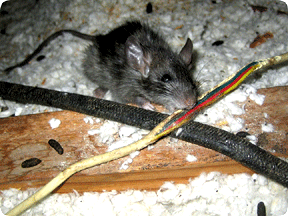 “We were installing wire nets to keep the rats out. But the end of one of the wires may have momentarily come into contact with a live terminal,” said Masayuki Ono, general manager at Tepco’s Nuclear Power and Plant Siting Division. “The next moment, there were sirens.”
Rat Chase Again Bedevils Fukushima Nuclear Plant http://www.nytimes.com/2013/04/06/world/asia/rat-chase-again-bedevils-fukushima-nuclear-plant.html?_r=0 By HIROKO TABUCHI April 5, 2013 TOKYO — Workers at the stricken Fukushima nuclear power plant who were installing wire nets Friday to keep rats away from a vital cooling system instead tripped up that system, causing it to fail for the second time in weeks. The spent-fuel pool at the site’s No. 3 reactor went without fresh cooling water for almost three hours on Friday afternoon, said the plant’s operator, the Tokyo Electric Power Company, or Tepco. Continue reading
The growth, and strength, of anti nuclear sentiment in Japan
The anti-nuclear movement will provide a challenge to the LDP and business community’s desire to restart Japan’s nuclear sector. The Japanese public expects the new Nuclear Regulation Authority to strictly enforce safety regulations at existing nuclear facilities. Whether anti-nuclear sentiment will maintain its strength at the local and national levels and influence policy makers will strongly shape Japanese nuclear energy policy.
 Post-Fukushima Nuclear Politics in Japan, Part 3: Empowered Anti-Nuclear Sentiment http://themonkeycage.org/2013/04/03/post-fukushima-nuclear-politics-in-japan-part-3-empowered-anti-nuclear-sentiment/ by DANIEL ALDRICH on APRIL 3, 2013 (This post is co-authored with James Platte and Jennifer Sklarew. Part 1 of this series is here. Part 2 is here.)
Since the Fukushima nuclear disaster, public support for nuclear power in Japan has declined sharply, and anti-nuclear politicians have become empowered in their own parties or formed new, often single-issue parties to leverage popular support. Even the relatively pro-nuclear Liberal Democratic Party (LDP) is facing challenges in openly promoting nuclear power. At the same time, the LDP must remain mindful of nuclear facility host communities, which continue to support nuclear power, and of the larger business community and the politically powerful regional utilities, which remain committed to nuclear power for economic reasons. Continue reading
Shellfish species disappears near Fukuhsima nuclear plant
UPI: ‘Shellfish gone near damaged nuke plant’ — Researcher: Likely extinct because of Fukushima nuclear crisis http://enenews.com/upi-shellfish-gone-near-damaged-nuke-plant-japan-researcher-extinction-likely-caused-by-fukushima-nuclear-crisis
April 2nd, 2013
Xinhua, April 1, 2013: Japanese researchers announced recently that a sort of shellfish called Thais clavigera disappeared in a 30-km coastal area near Japan’s crippled Fukushima Daiichi nuclear plant. […] Other shellfish species, such as Cellana grata, were found in the alert zone but the amount of them declined, with high dose of radioactive materials inside their bodies, according to the researchers. […] Toshihiro Horiguchi, a researcher from the environmental institute and the head of the team, said that it is a rare occurrence that Thais clavigera entirely disappeared from a 30-km long area, adding the extinct was probably caused by the nuclear crisis. The link between the disappearance and the catastrophic tsunami was excluded as the shell was also found in other areas that affected by the disaster, according to the team. […]
UPI, April 1, 2013: Shellfish gone near damaged nuke plant […] A species of shellfish has disappeared along an 18-mile stretch of coast near Japan’s devastated Fukushima Daiichi nuclear plant, scientists say. […] Other shellfish species were found in the alert zone but their numbers had declined and high levels of radioactive materials were detected in them, the researchers said. Lead researcher Toshihiro Horiguchi said the disappearance of Thais clavigera was likely a result of radiation from the damaged plant. […]
See also: Study: Significant decrease in abundance of Fukushima birds and butterflies as radiation levels increase -NYT
AUDIO Groundwater flows from Fukushima reactors to the ocean
 Tecpo shows groundwater flowing from Fukushima reactors into ocean April 2nd, 2013 http://enenews.com/tecpo-shows-groundwater-flowing-from-fukushima-reactors-into-ocean-photo
Title: Progress Status of the Groundwater Bypass Construction
Source: Tokyo Electric Power Company
Date: March 27, 2013
[…] Gradual Reduction of Groundwater
The groundwater level will be gradually reduced with the groundwater bypass put in operation. Careful water level control will be implemented to prevent the accumulated water in the buildings from leaking to the outside while monitoring the groundwater level reduction and its water quality. The sub-drains installed around the buildings will be fully utilized for the monitoring. An observation hole will be newly installed between the Reactor Building and the pump well. […]
See also: Graphic shows ‘direct discharge’ going from Fukushima Daiichi reactors into Pacific — Underground flow of contaminated water also indicated (VIDEO)
Tohoku Electric Power Company scraps plan for new nuclear power plant
 TOKYO, Japan, March 28, 2013 (ENS) – The Japanese utility that supplies electricity to seven prefectures on Japan’s main island of Honshu today officially withdrew its plan to build a new nuclear power plant near the site of the 2011 Fukushima nuclear disaster.
Tohoku Electric Power Company said Thursday that it will cancel the construction of the Namie-Odaka plant in view of strong local opposition.
Physicians counter the lies of World Health Organisation, on Fukushima radiation
Even though the global media is controlled by just a handful of mega-corporations (4; 5), some people (perhaps too few of them) – to their credit – do not instantly accept the WHO’s findings and are now becoming more vocal in their demands for accurate information.
 In contrast to WHO disinformation and what may only be described as pro-nuclear propaganda, a report from the International Physicians for the Prevention of Nuclear War (IPPNW) has analyzed some of the available data from Japan and found “[t]he initial health consequences of the nuclear catastrophe are now, two years after the incident, scientifically verifiable” (9).
WHO Lies Refuted: Physicians’ Group
 Predicts 100,000+ Fukushima
Cancer Incidences/Deaths
rense.com By Richard Wilcox, PhD
3-14-13 “All governments lie, but disaster lies in wait for countries whose officials smoke the same hashish they give out.” – I. F. Stone
In this new age of instant information, navigating the pitfalls of overload (too much); uncertainty (lack of); misinformation (poor quality); disinformation (intentional distortion, lies); is key in determining the scope of the Fukushima nuclear disaster and assessing immediate and long-term impacts on the international and Japanese public health. Fortunately we have one of the first attempts from researchers to set the record straight and calculate the death toll from the Fukushima nuclear disaster. The report comes from the courageous men and women of International Physicians for Preventing Nuclear War (IPPNW) who expose the Big Lie being perpetrated by the World Health Organization (WHO) that few ill health effects will occur.
Consider that it is standard operating procedure for governments and industry to obfuscate, cover-up and lie about a nuclear disaster as soon as it occurs. The chaos that unfolds during a nuclear disaster such as Fukushima is used in a carefully orchestrated Big Lie process whereby damage control and perception management allow the perpetrators of the Big Crime – Tokyo Electric Power Company, the Japanese government and the international nuclear apologists and nuclear industry – to eventually get off scot free (1).
Even though the Japanese government was fully aware that three reactors had melted down and another one severely damaged, and that people should have been evacuated in a much more bold and expedient manner, the phrase that will live in infamy, “there is no immediate danger,” was repeated during the worst days of the nuclear crisis by the government. …. Continue reading
Tokyo has the storage capacity for a solar powered city
 A Solar Powered Tokyo? http://www.energymatters.com.au/index.php?main_page=news_article&article_id=3661 28 March 13 Much of Tokyo’s power needs once supplied by nuclear power could be met by rooftop solar along with energy storage systems already in place.
Nuclear is still a dirty word to many in Japan following the Fukushima crisis, a disaster that will continue to negatively affect a large area for many years to come.
While solar power offers an attractive alternative; the issue remains of continual supply – particularly at night and during heavily overcast days.
A recent study examining the potential for rooftop photovoltaics in Tokyo to replace nuclear capacity reveals some of the answer is already in place – pumped hydroelectric storage. Continue reading
Japan’s Nuclear Regulation Authority suspect earthquake cause of Fukushima disaster
Japan: A New Nuclear Inquiry
http://www.nytimes.com/2013/03/28/world/asia/japan-a-new-nuclear-inquiry.html?_r=0By
THE ASSOCIATED PRESS March 27, 2013 Japanese government regulators
said Wednesday that for the first time they will conduct their own
investigation into the country’s nuclear crisis to address unanswered
questions. The March 2011 earthquake and tsunami cut power and
destroyed vital cooling systems at the Fukushima Daichi nuclear plant,
causing meltdowns at three of its reactors. Experts still suspect that
the quake, not the tsunami, may have set off the meltdowns.
The
Nuclear Regulation Authority said this issue, which could affect
antiquake measures at nuclear plants nationwide, would be part of its
investigation. The authority said the inquiry would also look into
other issues, including how much and from where radiation leaked at
the plant.
Increased radiation released as Fukushima cooling systems lost power
 Fukushima Spews More Radiation … Due to Tepco’s Carelessness Zero Hedge by George Washington on 03/21/2013 Power was lost to the cooling systems to virtually all of the spent fuel pools at Fukushima for more than a day.
Some of these fuel pools have lost containment, and are arguably the top short-term threat to humanity … and America’s national security.
The loss of cooling increased the radiation output from the pools. And the loss of power was due to carelessness by the operator of the Fukushima reactors. As nuclear expert Arnie Gundersen notes:
Is TEPCO doing an adequate job of keeping the Fukushima Daiichi nuclear power site safe?We don’t think so. Continue reading
Removal of anti nuclear members from Japan.s Energy Board
Japan’s Energy Board Meets After Dropping Anti-Nuclear Members Bloomberg, By Tsuyoshi Inajima – Mar 14, 2013 Japan’s ruling Liberal Democratic Party has removed most anti-nuclear researchers from a revamped post-Fukushima energy policy advisory board to the government that resumes discussions today.
After a landslide victory in a December election, Prime Minister Shinzo Abe has said the previous administration’s policy to abandon atomic power needs to be reviewed to help revive the world’s third-biggest economy. Continue reading
New York Symposium will hear the story of radiation contaminated US Navy men
The Story of Two Contaminated Navy Navigators,Fukushima and the Health Effects of Low Dose Radiation MARCH 06, 2013http://www.counterpunch.org/2013/03/06/fukushima-and-the-health-effects-of-low-dose-radiation/ by JOHN LaFORGE March 11 and 12, the Helen Caldicott Foundation is convening a symposium at the New York Academy of Medicine in New York City, “The Medical and Ecological Consequences of the Fukushima Nuclear Accident.”
Media attention may be brought to the gathering because of two US Navy navigators who will speak about their radioactive contamination while aboard the air craft carrier USS Reagan. They weren’t exposed by working around the carriers’ two Westinghouse propulsion reactors.
Navigators Maruice Enis, from Rochester, Minnesota, and Jamie Plym, from St. Agustine, Florida, were contaminated when Tokyo Electric Power Company reactors released unprecedented amounts of radiation to the air and the sea following the Great East Japan Earthquake and tsunami beginning March 11, 2011. Four of Tepco’s six Fukushima-Daiichi reactors were wrecked. Continue reading
High tadiation levels prevent workers from entering Fukushima nuclear reactors
 Inside Fukushima two years on: radiation levels too high to enter reactorsTelegraph UK, 6 March 13, Two years on from the second-worst nuclear disaster in history, The Telegraph’s Julian Ryall visits the Fukushima nuclear plant to see what progress – if any – is being made. By Julian Ryall, Fukushima Nuclear Plant, Japan
Radiation levels within three of the reactor buildings at the Fukushima Nuclear plant in Japan are still too high for people to start decommissioning the reactors, two years on from the second-worst nuclear disaster in history.
Scientists still do not have a firm understanding of the precise conditions of the reactor cores in three of the six units at the Fukushima Daiichi plant, and are resorting to using remote-controlled vehicles to get inside the tangle of wires, pipes and rubbles that has lain untouched since the tsunami tore through the facility. Continue reading
Safety inspections for Japan’s nuclear plants will delay any restart
 Japan’s nuclear plants unlikely to restart in 2013 By MarketWatch, 3 Mar 13, TOKYO–None of Japan’s nuclear power plants that have been idled since the nuclear crisis triggered by the March 2011 earthquake and tsunami are likely to restart operations within the year as safety checks under new standards are not expected to be completed, a Kyodo news agency survey of utilities showed Sunday.
Kansai Electric Power Co.’s Oi plant in Fukui Prefecture, currently the only operating nuclear plant in the country, is also likely to be suspended in September for routine checks regardless of the new safety standards that are planned to enter into force in July, according to the survey of the 10 power companies that have nuclear plants.
Kyodo reported the financial burden on the utilities is increasing as they enhance preventive measures following the nuclear crisis at the Fukushima Daiichi power plant.
The companies expect the cost of implementing the new standards will total at least 1.1 trillion yen ($11.75 billion), with Kansai Electric saying 285.5 billion yen is needed in the medium to long term.
Kyushu Electric Power Co. said it could restart two of its nuclear reactors in southwestern Japan in July if inspections by the Nuclear Regulation Authority are completed swiftly, but all the other utilities declined to provide specific dates……. Although the authority is now aiming to speed up the process, broader safety measures under the new standards are expected to make it difficult for inspections to be completed by the end of the year. http://www.marketwatch.com/story/japans-nuclear-plants-unlikely-to-restart-in-2013-2013-03-03
1 This Month





PLEASE OPPOSE HR 8255 AND S.3639 – bills would accelerate satellite deployment, with no environmental review or safeguards – https://ncstd5li.quorum.us/campaign/169331/
To see nuclear-related stories in greater depth and intensity – go to https://nuclearinformation.wordpress.com
-
Archives
- October 2026 (74)
- September 2026 (339)
- August 2026 (330)
- July 2026 (355)
- June 2026 (287)
- May 2026 (306)
- April 2026 (356)
- March 2026 (251)
- February 2026 (267)
- January 2026 (308)
- December 2025 (358)
- November 2025 (359)
-
Categories
- 1
- 1 NUCLEAR ISSUES
- business and costs
- climate change
- culture and arts
- ENERGY
- environment
- health
- history
- indigenous issues
- Legal
- marketing of nuclear
- media
- opposition to nuclear
- PERSONAL STORIES
- politics
- politics international
- Religion and ethics
- safety
- secrets,lies and civil liberties
- spinbuster
- technology
- Uranium
- wastes
- weapons and war
- Women
- 2 WORLD
- ACTION
- AFRICA
- Atrocities
- AUSTRALIA
- Christina's notes
- Christina's themes
- culture and arts
- Events
- Fuk 2022
- Fuk 2023
- Fukushima 2017
- Fukushima 2018
- fukushima 2019
- Fukushima 2020
- Fukushima 2021
- general
- global warming
- Humour (God we need it)
- Nuclear
- RARE EARTHS
- Reference
- resources – print
- Resources -audiovicual
- Weekly Newsletter
- World
- World Nuclear
- YouTube
-
RSS
Entries RSS
Comments RSS

