Sustained Public Opposition to nuclear power restart in Japan
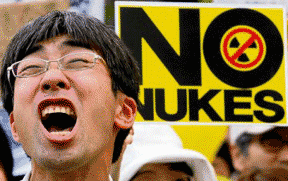 In the Wake of Fukushima: Japan’s Nuclear Energy Policy Impasse 60% of Japan’s 48 viable nuclear reactors,are not as yet being considered for application to the Nuclear Regulation Agency (NRA) for restart By Andrew Dewit Global Research, April 07, 2014
Asia-Pacific Journal “………..The most recent Japanese opinion poll on nuclear restarts is the March 18 survey by the Asahi Shimbun. It indicates that 59% of the Japanese public oppose restarts of any nuclear capacity, whereas only 28% support restarts. The poll’s results not only confirm that the opposition to nuclear is holding; it also shows a great sensitivity to risk. According to the poll, a mere 12% of the Japanese public have either no or only minimal concern regarding the risk of further nuclear accidents at facilities other than the infamous Fukushima Daiichi. By contrast, 50% have a fair degree of concern, and 36% have a very high degree of concern. In addition, the poll shows that only 4% of respondents regard the lack of nuclear waste disposal facilities as of no or only minimal concern. By contrast, 19% believe it is to some extent a problem. And a massive 76% regard it as a serious problem.7
Nationwide, there are 135 local communities that lie within 30 kilometers of a reactor, and 21 prefectures that are host to one or more reactors. The news service Kyodo Tsushin surveyed these 156 local governments in mid- to late-February of 2014, and found that only 13 were ready to agree to restarts without conditions. A further 24 would agree to restarts, but with conditions. Of the remainder, 32 declared their opposition to restarts, 66 replied that they could not decide, and 21 offered no reply at all.8 The NRA decided on March 13 to prioritize Kyushu Electric’s Sendai rectors 1 and 2 (in Kagoshima Prefecture) for restart.9 But that decision itself came under criticism, due to perceptions of undue haste amid suggestions that seismically active zones are nearby………. http://www.globalresearch.ca/in-the-wake-of-fukushima-japans-energy-policy-impasse/5376899?utm_source=rss&utm_medium=rss&utm_campaign=in-the-wake-of-fukushima-japans-energy-policy-impasse
Arguments for nuclear power losing credibility,as Japan’s utilities jostle for funding
 In the Wake of Fukushima: Japan’s Nuclear Energy Policy Impasse 60% of Japan’s 48 viable nuclear reactors,are not as yet being considered for application to the Nuclear Regulation Agency (NRA) for restart By Andrew Dewit Global Research, April 07, 2014
Asia-Pacific Journal
“…….Hard-Pressed Utilities
 As for the utilities themselves, Tepco is not viable in its current form, having lost a stunning 81.2% of its market capitalization between March 10 of 2011 and April 2 of 2014. It was nationalized in June 2012 via a YEN 1 trillion injection of public capital, “the biggest state intervention into a private non-bank asset since America’s 2009 bail-out of General Motors (Economist, 2012). Resolving pressing matters such as the Fukushima and area clean-up and compensation, the decomissioning of ruined assets and the like are well beyond Tepco’s means. Some specialists question whether the other nuclear-dependent utilities are viable as well (Kaneko, 2013), and in early April of 2014 Kyushu Electric and Hokkaido Electric were revealed to be in discussion with the public sector Development Bank of Japan for bailouts (Financial Times, April 2, 2014). Kyushu Electric’s reliance on nuclear power is 42% of generating assets and Hokkaido Electric’s reliance is 30%. Their respective losses of market capitalization are 38.9% and 58.2%.11
The Japanese public sector has thus long been in a powerful position vis-à-vis the utilities, enabling it to press for reform. But this authority was used sparingly by the central government, even under the previous Democratic Party administration. The Tepco bailout was notable for protracted negotiations between Tepco and its politico-bureaucratic allies and state officials. They were not bargaining about weighty matters such as ownership of the power grid, but rather salaries and the size of increases on rate-payers. Outsiders regarded it as “bewildering” to see such minor items on the table. The Financial Times’ Jonathan Soble, also a close follower of Japan’s post-Fukushima power crisis and politics, argued that it “underscored the depth and resilience of Tepco’s resilience, and that of the ‘nuclear village’ of utility executives, bureaucrats and lawmakers that built Japan’s atomic power industry.“12
But now Tepco’s siblings are lining up for bailout, and this seems unlikely to end. Like big utilities in Europe and North America, Japanese utilities face the existential challenge of the ICT, renewable and efficiency-driven “electricity revolution” summarized nicely by Brookings energy security specialists Charles Ebinger and John Banks.13 A recent very detailed article in Scientific American shows how America’s 3000-plus utilities are fighting a losing battle against solar power and smart grids.14 Centralized power and monopolized conventional-grid ownership are confronting a far larger tsunami than the mobile phone shock to land-line telephony. But Japan’s monopolized and nuclear-reliant utilities have the added conundrum of nuclear power’s delegitimation in a very seismically sensitive country.
After Fukushima, the Japanese public debate received a very accelerated course of instruction on how various political economies were responding to the risks of resource price increases as well as climate change and the opportunities of developing new industries in renewable energy and related fields. The public debate also became apprised of just how far behind Japan was in its deployment of energy alternatives such as solar and wind. Moreover, the old arguments that these forms of power generation were not suited to Japan, because of “unique” winds and lack of space, lost their credibility.
The Push for Local Resilience
In addition, local governments exhibit increasing efforts to seize opportunity in the emergence of alternatives to highly centralized and concentrated nuclear power. Centralized power, such as Tepco’s nuclear reactors, led to concentrated economic benefits for a few communities whereas the risks of accident were distributed among a much broader range of communities. Fukushima Prefecture’s post-3-11 commitment to 100% renewable energy by 2040 encouraged other prefectures and cities, including Tokyo, Kyoto, and Osaka, to adopt ambitious targets.15
Moreover, at the end of 2013, Japan’s 16 trillion yen power market featured 192 independent power producers, including such new entrants as Toyota. That number was 79 at the end of 2012, and there has thus been a 240% increase in the number of firms.16 Japan’s “feed in tariff” policy support for diffusing renewables, effective from July of 2012, saw over four gigawatts (roughly four large nuclear reactors worth) of new renewable capacity deployed in the initial year. Japanese domestic shipments of solar cells and modules during July-September of 2013 leapt to 2.075 gigawatts, over triple the 627 megawatt level of a year earlier.17 The Pew Research April 3, 2014 publication of “Who’s Winning the Clean Energy Race? 2013” argues that China remains the leader, at USD 54.2 billion, but that “Japan experienced the fastest investment growth in the world, increasing 80 percent, to almost $29 billion.”18
Since Japan’s public debate on energy is so polarized between Team Abe and the majority, it seems useful to examine which of the two idealized options – nuclear or green – offers the better return. Table 1 is an aid to this objective by its highlighting of the profoundly skewed energy R&D priorities of all the IEA countries. Over two-thirds of the 1980 peak in energy R&D expenditures by all IEA members was devoted to nuclear fission and fossil fuels. By contrast, only 12.3% was invested in renewables and only 6.4% in efficiency. Yet according to the IEA Energy Efficiency Market Report of 2013, global energy efficiency investment in 2011 was worth roughly USD 300 billion, “a similar scale to renewable energy and fossil fuel power investments.”19 Directly comparative data on nuclear power investments appear not to be available. But Mycle Schneider, and Antony Froggatt’s authoritative “The World Nuclear Industry Status Report 2013” reveals that the 2013 global total of 427 reactors with an installed capacity of 364 GWe was considerably lower than the 2010 peak of 444 reactors with an installed capacity of 375 GWe.20………… http://www.globalresearch.ca/in-the-wake-of-fukushima-japans-energy-policy-impasse/5376899?utm_source=rss&utm_medium=rss&utm_campaign=in-the-wake-of-fukushima-japans-energy-policy-impasse
Inside stories on the continuing Fukushima nuclear crisis
 Inside Sources: Fukushima crisis “actually far worse than anyone acknowledged… information withheld to prevent panic” – Professor: “Level of radiation was far worse than Navy officers anticipated” – US gov’t shredded documents for 4 days while drawing up plans to evacuate Japan — “Somebody was obviously very worried” http://enenews.com/inside-sources-fukushima-crisis-actually-worse-anyone-acknowledged-information-withheld-prevent-panic-professor-level-radiation-worse-navy-officers-anticipated-govt-shredded-documents-4-days-drawing?utm_source=feedburner&utm_medium=email&utm_campaign=Feed%3A+ENENe
Japan Times, Jeff Kingston of Temple Univ., Apr. 4, 2014: Kyle Cleveland, my colleague […] recently published a report […] a critical, but nuanced picture of a crisis that was closer to careening out of control than is generally acknowledged. […] Naval officers […] discovered the level of radiation was far worse than they anticipated. Radiation gauges on the [USS Reagan] measured levels of radiation at 100 nautical miles off the coast that were 30 times greater than normal. [Sailors report] significant health problems due to exposure to radiation […] Cleveland finds that there was considerable disagreement between various U.S. agencies about the severity of the risk […] Given that the U.S. government expanded the exclusionary zone in Fukushima to 80 km and developed contingency plans for a massive evacuation while shredding of documents continued for four days at the U.S. Embassy and military bases in Japan, somebody was obviously very worried. […] Some of his insider sources tell him that the crisis was actually far worse than anyone acknowledged at the time and that information was withheld to prevent a panic. Cleveland concludes that Japan’s nuclear reactors should not be restarted.
Professor Kyle Cleveland, Temple University Japan: “[The navy was] more risk averse than either the NRC (Nuclear Regulatory Commission) or State, and from day one was ringing alarms that were not entirely understood, not completely validated and not well received by the NRC and State. The navy was pushing the other federal agencies to take more aggressive actions because their radiation measurements were indicating dose rates that were more significant than what was implied by the abstract modeling […]”
Unidentified US Nuclear Expert: “Without a qualitatively different regulatory system, and in light of how Japan/Tepco responded to this crisis, Japan has not earned the right to have nuclear energy. No critically minded and informed person can evaluate this disaster and look at how Japan has responded in the aftermath and have any confidence that Japan will use nuclear energy safely. In the most seismically active country […] even if Japan had a robust regulatory structure and thoroughly integrated crisis protocols, nature conspires against the best-laid-plans of human institutions. And what Japan has is certainly not the best plan by any measure.”
Radioactive contamination of Japan by Fukushima nuclear disaster
Caldicott: All of Japan contaminated by Fukushima — “Realistic estimate is 60,000 km², occupied by 46 million people” — “Things are grim, it gets worse by the day” — Unheard of in history, 100s of tons of melted fuel may be in earth (VIDEO) http://tinyurl.com/ldeohpa
2014/03/08 【京都】未来を担う子どもたちの為に、今、私たち
Bay FM 99.9 – Byron Bay Australia, Feb. 26, 2014:
Dr. Helen Caldicott: Things are grim — it gets actually worse by the day. […] There have been 3 meltdowns, which is just unheard of in the history of nuclear age, Units 1, 2, and 3, so that means that molten cores of about 100 tons of uranium in 3 reactors have melted their way through 6 inches of steel in the reactor vessel through to the containment floors, possibly through feet of concrete and steel into the earth. >> Full broadcast hereDr. Helen Caldicott in Kyoto, Japan, Mar. 8, 2014:
Dr. Helen Caldicott: A more realistic estimate of contamination is 60,000 square kilometers, occupied by 46 million people including parts of Tokyo and surroundings. As you can see (map on right), the whole land mass is contaminated to a greater or lesser extent.Watch Dr. Caldicott’s Kyoto presentation here
Fukushima nuclear plant will end up an entombed ‘national sacrifice zone’
Former US Gov’t Official: Growing likelihood Fukushima reactors will be entombed — Nuclear ‘sacrifice zone’ where they can only try to reduce contamination from escaping — Unprecedented situation, it’s flowing into Pacific Ocean continually adding to plume soon to hit West Coast (AUDIO) http://enenews.com/former-govt-official-growing-likelihood-fukushima-reactors-will-be-entombed-nuclear-national-sacrifice-zone-only-try-reduce-contamination-escaping-unprecedented-situation-flowing-pacific-ocean-c?utm_source=feedburner&utm_medium=email&utm_campaign=Feed%3A+ENENews+%28Energy+News%
Fukushima at Three: Folklore vs. Facts, Institute for Policy Studies, Mar. 7, 2014:
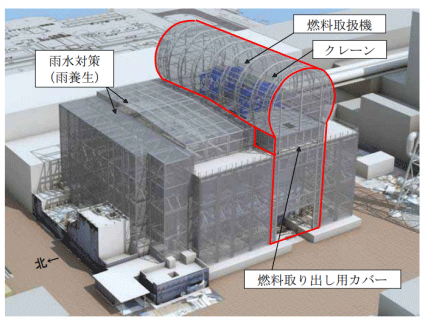 become a nuclear national sacrifice zone where only triage can be done to reduce the contamination.
At 48:30 in — Question: My father comes from the western part of Fukushima […] To this day we don’t know where the corium went, because no one can get close to it — and I think that’s the issue.
At 55:30 in — Alvarez: The technologies simply do not exist to handle and otherwise remove the highly radioactive cores of these reactors right now. We really don’t – this is all uncharted territory. […] I think that the likelihood of there being entombment of these reactors with their cores, it’s growing over time — and again it’s a national sacrifice zone scenario.
Japan’s government not measuring the worst of Fukushima radiation
 TV: Gov’t not measuring worst of Fukushima radiation — Over 100 Million gallons of radioactive water bleeding into ocean from plant — We’re beginning to see radiation in west coast water — Very concerned about eating fish from Pacific (VIDEO) http://enenews.com/tv-govt-not-measuring-worst-of-fukushima-radiation-over-100-million-gallons-of-radioactive-water-bleeding-into-ocean-from-plant-were-beginning-to-see-radiation-in-west-coast-water-very-c
Interview with Fairewinds’ Chief Engineer Arnie Gundersen on Al Jazeera, Mar. 27, 2014:
You run the risk of destroying the fabric of a country — it happened at Chernobyl and it’s happening right now in Japan. […] The nuclear plant on the Japanese side of the Pacific is bleeding radiation into the Pacific every day. About 400 tons of radioactive water every day for over 1,000 days now [105,668,000 gallons], has been pouring in to the Pacific. […] We are beginning to see low levels of radiation in the water […] Until our government, whether it’s states or national government, tell me what’s in the fish, I remain very concerned about eating the fish that are coming from the Pacific.Watch the broadcast here
Radiation readings kept secret, as Japan encourages Fukushima evacuees to return
J-GOV WITHHOLDS RADIATION READINGS FROM 3 FUKUSHIMA SITES
Fukushima Update MARCH 28, 2014 via Mainichi.jp / March 25, 2014 /A Cabinet Office team has delayed the release of radiation measurements from three Fukushima Prefecture municipalities, and plans to release them later with lower, recalculated results, the Mainichi learned on March 24.
The three municipalities are currently covered by evacuation orders imposed after the March 2011 Fukushima No. 1 nuclear plant meltdowns — evacuation orders the government plans to lift in the near future. According to one source, the original measurements were higher than expected, prompting the Cabinet Office team — set up to support victims of the nuclear disaster — to hold the results back over worries they would discourage residents from returning.
The Mainichi has acquired documents drawn up in November last year detailing the radiation measurements and intended for release. The documents, however, were never made public. According to this and other sources, the measurements were taken in September last year in the city of Tamura’s Miyakoji district, the village of Kawauchi and the village of Iitate by the Japan Atomic Energy Agency (JAEA) and the National Institute of Radiological Sciences (NIRS), using new dosimeters………http://fukushimaupdate.com/j-gov-withholds-radiation-readings-from-3-fukushima-sites/
Japanese tax-payers called upon to financially support nuclear industry
Another Japan nuclear operator turns to government for aid BY TAIGA URANAKA AND JAMES TOPHAM TOKYO Wed Apr 2, 2014 (Reuters) – Japan’s Kyushu Electric Power Co (9508.T) has become the second nuclear generator to seek state support this week as reactors across the country remain idled and industry losses mount three years after the Fukushima nuclear disaster.
Kyushu Electric, a regional monopoly that supplies power in southern Japan, said on Wednesday it was in talks with state-owned Development Bank of Japan for financial backing. On Tuesday, a source said Hokkaido Electric Power Co (9509.T), which supplies Japan’s northernmost island, had asked the same bank for financial assistance…….
We are in consultations with the Development Bank of Japan about receiving capital support, but since nothing has been decided I am unable to comment further,” said Kyushu spokesman Yuki Hirano.
Kyushu Electric is asking the bank to buy 100 billion yen of preferred stock in the company, a source said. The lender is considering the request, which was reported earlier by the Nikkei business newspaper.
If both Kyushu Electric and Hokkaido Electric get the aid, they would join the stricken Fukushima plant’s operator, Tokyo Electric Power Co (Tepco) (9501.T), in receiving government bailouts. Other nuclear operators may be forced to turn to the government, the Nikkei said on Tuesday.
In 2012, the government took a controlling stake in Tepco. The company still relies on constant taxpayer handouts to pay compensation to those affected by the nuclear disaster, which forced 160,000 people from their homes……..
Shares in Kyushu Electric were down 4.6 percent in mid-morning trade, after falling as much as 6.5 percent, versus a 1.1 percent rise in the benchmark Nikkei 225 .N225.
Kyushu Electric has estimated a net loss of 125 billion yen for the year ended March 31……
Prime Minister Shinzo Abe is moving to revive nuclear power as a core part of Japan’s energy mix, but many of those idled reactors will never be restarted.http://in.reuters.com/article/2014/04/02/japan-nuclear-kyushu-idINDEEA3100Z20140402
Radiation levels still up, but some Fukushima residents to go home
Fukushima residents cleared to return home (CNN) By Euan McKirdy, CNN April 1, 2014 — Hundreds of residents of an area contaminated by a catastrophic reactor meltdown at a nuclear plant in northeastern Japan have been allowed to return home three years after the disaster.
An evacuation order, declared in the aftermath of a devastating tsunami that crippled the Fukushima-Daiichi nuclear plant in March, 2011, was lifted at midnight on Monday from the Miyakoji district of Tamura city in Fukushima Prefecture.
Residents of the town, who have been in limbo ever since, are now free to re-inhabit their homes following decontamination work in the area……..
Radiation worries
However, concerns remain about background radiation levels and uncertainty surrounding the safety of the area, especially given past concerns about the reporting of radiation levels in the area by Fukushima’s operator, Tokyo Electric Power Company (TEPCO). Last month, Miyakoji residents were told at a community meeting that radiation contamination levels had lowered sufficiently to enable their return to the area — though some voiced concern over existing radiation levels despite decontamination efforts around some communities…….
Areas are declared suitable for habitation if residents are exposed to a maximum of 20 millisieverts of radiation per year. Officials have said they would like to get radiation exposure down to one millisievert a year……http://edition.cnn.com/2014/04/01/world/asia/fukushima-miyakoji-return/
Japan’s Basic Energy Plan – a (bad) April Fools Day joke
 Is the joke still on Fukushima this April Fools’? MAR 31, 2014 What’s wrong with this picture? Japan Times, Eric Johnson, Japan’s new Basic Energy Plan sees nuclear power as an important base load energy source. But whatever “base load” means politically, the public is lulled — fooled — into a sense that, despite Fukushima, nuclear will remain a logistically viable long-term option.
Yet the realities of Japan’s nuclear power industry show keeping nuclear are likely to be far more problematic — and expensive — than the pro-nuclear lobby wants to admit. Here are the most obvious hurdles.
First, as of 2013, of the remaining 48 reactors, three were more than 40 years and 13 were over 30 years old. The reactors were supposed to be decommissioned after 40 years but can now apply for a maximum two-decade extension.
Want to keep those reactors, with their increased risk of technical problems and thus lower efficiency rates, running until they’re 60? Even if they meet new safety standards, local governments hosting the reactors are sure to demand funding for pork-barrel projects in exchange for agreeing to any extension. Guess whose tax money will be used to ensure a continued flow of “cheap” nuclear power. Hint: look in the mirror.
 Even if restarted reactors run at pre-3/11 levels, estimates are their spent fuel pools will be overflowing like public toilets sooner rather than later. A Tokyo Shimbun calculation shows 33 reactors could see their pools full within six years. Government figures estimate the pools will be full within three to 16 years, with most filled to the brim within eight years.
What happens then? Tokyo is now pushing local governments to build interim storage facilities for the fuel before it’s sent to Rokkasho, Aomori Prefecture, for reprocessing. But despite promises of even more tax money for their coffers, no local government wants to host such a facility.
Finally, Japan’s population, about 127 million, will shrink to 107 million by 2040 while the working population, i.e. the large volume of electricity users, will decline by 30 percent. Furthermore, 21 percent of all Japanese will be 75 years or older, also by 2040. Who is going to need how much electricity?
So, the “nuclear will be an important base load” argument assumes: 1. Older plants can be run until they are 60 years without major problems and at a lower cost than other sources; 2. Within the next, say, 16 years, new storage facilities for spent fuel will be built somewhere; and 3. By 2040, a country with 16 percent less people than in 2010 and one-fifth the population over 75 will not use less energy than today.
What’s wrong with this picture?…….http://www.japantimes.co.jp/community/2014/03/31/issues/is-the-joke-still-on-fukushima-this-april-fools/
Japan’s ploy to return Fukushima evacuees – delaying radiation data
 Withholding of radiation readings exposes gov’t push for evacuees’ return, Mainichi, 29 Mar 14, Recent revelations that a Cabinet Office team delayed the release of radiation measurements from three Fukushima Prefecture areas, planning to release them with lower, recalculated results, have exposed a government push to have residents’ return to nuclear disaster-hit areas.
Experts have raised questions about the government’s move, suggesting that officials intended to send residents back to those areas from the outset and that they manipulated data to achieve that purpose.
The three areas — the Miyakoji district of the city of Tamura, the village of Kawauchi and the village of Iitate — remain subject to evacuation orders imposed after the 2011 Fukushima No. 1 nuclear plant meltdowns. The government plans to lift these orders in the near future. According to one source familiar with the measurement process, the original radiation exposure readings from new, individual dosimeters were higher than expected, prompting the Cabinet Office team to withhold the results. Officials feared the higher readings would discourage residents from returning……… http://mainichi.jp/english/english/perspectives/news/20140327p2a00m0na009000c.html
Powerful criticisms of Japan’s handling of the Fukushima nuclear crisis
(NaturalNews), March 27, 2014 by: Ethan A. Huff, staff writerThe three-year anniversary of the Fukushima Daiichi nuclear disaster recently passed, and a prominent nuclear expert has come out in protest of the way both the Japanese government and the country’s nuclear industry continue to handle the situation. During a recent episode of the Nuclear Hotseat podcast, celebrity and lawmaker Taro Yamamoto lamented how the Tokyo Electric Power Company (TEPCO) is still downplaying the threat of radiation, which he believes will end up “sacrificing” 99.99 percent of the Japanese population. In Japan, stated Yamamoto, it is still taboo to even talk about radiation, even though its effects have been felt throughout the country and even beyond its borders. Insinuating that the country as a whole has essentially buried its head in the sand on this important issue, Yamamoto called out the nuclear industry in particular for minimizing the radioactive impact of Fukushima, which many now believe to be the worst nuclear accident in recorded history.“Idiotic ideas — like restarting the nuclear plants — are being considered here in Japan,” stated Yamamoto during the interview. “I think it is wrong that people’s lives are being sacrificed because of money and the company profits… 99.99 percent of the people are being sacrificed.”
You can listen to this podcast episode here:
http://www.nuclearhotseat.com.
“[R]adioactive water is still leaking, there is still a very long way to go until it can be decommissioned, and we must be prepared for a long term battle which will go beyond the present generation,” wrote Fukushima resident Arao Shunsuke in a letter posted at DiaNuke.org. “Even now over 100,000 people from Fukushima are still living in miserable conditions in temporary housing.”
You can read Shunsuke’s full letter here:
http://www.dianuke.org………… http://www.naturalnews.com/044478_Japan_nuclear_industry_radiation.html#
Japanese municipality to sue central govt to stop new nuclear power plant
 Hakodate assembly OKs lawsuit against nuclear plant http://www.japantimes.co.jp/news/2014/03/26/national/hakodate-assembly-oks-lawsuit-against-nuclear-plant/#.UzQ9eqhdV9UKYODO HAKODATE, HOKKAIDO – The municipal assembly of Hakodate in Hokkaido on Wednesday approved a plan to sue the central government and an electric utility to stop construction of a nuclear power plant in neighboring Aomori Prefecture.
The assembly plans to file the lawsuit with the Tokyo District Court as early as April 3 in what will be the first nuclear power-related lawsuit against the central government by a local government.Located at the southern tip of Hokkaido, Hakodate is only 23 km across the Tsugaru Strait from the Oma plant, which Electric Power Development Co., better known as J-Power, started building in May 2008.
“In the event of an accident, Hakodate’s core industries of fishery and tourism would suffer devastating damage,” Mayor Toshiki Kudo said after the assembly unanimously approved the suit.Construction of the 1,383-megawatt plant was suspended in the wake of the Fukushima nuclear accident in 2011 but was resumed in October 2012.
J-Power plans to apply to the Nuclear Regulation Authority for safety assessment of the plant as early as this autumn. The plant will house an advanced boiling water reactor using plutonium-uranium mixed oxide fuel, which contains plutonium extracted from spent fuel.
Over 800 laborers missing from Fukushima nuclear plant
KPFA in Japan: I’ve learned over 800 people have disappeared from Fukushima plant — “May have been killed or died during work” — “Gov’t  actually in business with the Yakuza” (AUDIO) http://enenews.com/kpfa-in-japan-ive-learned-over-800-people-missing-from-fukushima-plant-they-may-have-been-killed-or-died-during-work-govt-is-actually-in-business-with-the-yakuza-audio?utm_source=feedburner&utm_medium=email&utm_campaign=Feed%3A+ENENews+%28Energy+News%29
KPFA Flashpoints, Mar. 10, 2014 (at 3:00 in):
Steve Zeltzer, reporting from Japan: One of the things I learned in Osaka from the president of the day laborers is that many of the day laborers being brought into the plant, they’re not being registered and they’re disappearing. There were over 800 day laborers who have disappeared from contact by the union, which means they may have been killed or died during work.
KPFA Flashpoints, Mar. 11, 2014 (at 4:00 in):
Zeltzer: The government now is in control of Tepco, which runs Fukushima plant, and they’ve allowed the use contract workers, through the Yakuza. So the government is actually in business with the Yakuza, allowing the Yakuza to bring in these workers, and we heard a report that many are not even being registered when they go into the plant so they’re not entitled to health care and also when they get sick and over-doses you can’t tell because they haven’t been registered, these are the contract workers at the plant. […] These workers are basically being used as cannon fodder. Some of them are not only day laborers but also immigrant workers who are being used as well to clean up the plant.
Rokkasho a big-box store for nuclear terrorists.

After spending tens of billions of dollars and decades on breeder-related programs, Tom Cochran said, countries find it hard to pull the plug.
“You have an entrenched bureaucracy and an entrenched research and development community and commercial interests invested in breeder technology, and these guys don’t go away,” Cochran said. “They’re believers … and they’re not going to give up. The really true believers don’t give up.”……..
“Stealing a weapon is too hard,” Cochran said. “But there is no big risk in fuel assemblies, or in taking things from a bulk handling facility that can be used to make weapons.” In this view, Rokkasho is a kind of big-box store for would-be nuclear terrorists.
A Washington-based physicist and nuclear contrarian, Cochran helped kill a vast plutonium-based nuclear industrial complex back in the 1970s, and now he’s at it again — lecturing at symposia, standing up at official meetings, and confronting nuclear industry representatives with warnings about how commercializing plutonium will put the public at enormous risk.
Where the story ends isn’t clear. But the stakes are large. Continue reading
1 This Month





PLEASE OPPOSE HR 8255 AND S.3639 – bills would accelerate satellite deployment, with no environmental review or safeguards – https://ncstd5li.quorum.us/campaign/169331/
To see nuclear-related stories in greater depth and intensity – go to https://nuclearinformation.wordpress.com
-
Archives
- October 2026 (58)
- September 2026 (339)
- August 2026 (330)
- July 2026 (355)
- June 2026 (287)
- May 2026 (306)
- April 2026 (356)
- March 2026 (251)
- February 2026 (267)
- January 2026 (308)
- December 2025 (358)
- November 2025 (359)
-
Categories
- 1
- 1 NUCLEAR ISSUES
- business and costs
- climate change
- culture and arts
- ENERGY
- environment
- health
- history
- indigenous issues
- Legal
- marketing of nuclear
- media
- opposition to nuclear
- PERSONAL STORIES
- politics
- politics international
- Religion and ethics
- safety
- secrets,lies and civil liberties
- spinbuster
- technology
- Uranium
- wastes
- weapons and war
- Women
- 2 WORLD
- ACTION
- AFRICA
- Atrocities
- AUSTRALIA
- Christina's notes
- Christina's themes
- culture and arts
- Events
- Fuk 2022
- Fuk 2023
- Fukushima 2017
- Fukushima 2018
- fukushima 2019
- Fukushima 2020
- Fukushima 2021
- general
- global warming
- Humour (God we need it)
- Nuclear
- RARE EARTHS
- Reference
- resources – print
- Resources -audiovicual
- Weekly Newsletter
- World
- World Nuclear
- YouTube
-
RSS
Entries RSS
Comments RSS

