IN Japan, huge public opposition to nuclear power is ignored by the Abe government
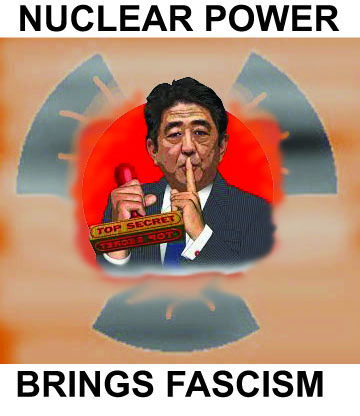 Abe administration ignored massive public opposition to nuclear power Asahi Shimbun, By ATSUSHI KOMORI/ Senior Staff Writer, 25 May 14, More than 90 percent of respondents during a public comment period on the Abe administration’s basic energy policy were opposed to nuclear power generation, according to an Asahi Shimbun estimate released on May 25.
The Asahi Shimbun made the determination by tallying how many  of 2,109 of about 19,000 comments sent to the government from December to January were in opposition.
Failing to take into account that overwhelming public sentiment, the Cabinet approved in April the basic energy policy, which described nuclear power generation as an “important base load electricity source.” The base load electricity source means that nuclear power will continue to be relied on to meet a percentage of the electricity demand, regardless of the season or time of day.
The Ministry of Economy, Trade and Industry released on Dec. 6, 2013, the draft of the basic energy policy, the first compiled by the Abe administration since the accident at the Fukushima No. 1 nuclear power plant triggered by the March 2011 Great East Japan Earthquake and tsunami.
After releasing the draft, the Abe administration gathered public comments for a month until Jan. 6 through e-mails, faxes and other means. In all, about 19,000 responses were sent to the government.
The industry ministry disclosed representative comments in February. However, it did not tally how many replies it received were for or against nuclear power generation………..
As for the 2,109 e-mails, The Asahi Shimbun counted how many were for or against nuclear power generation. It found that 2,008 of them, or 95.2 percent, opposed nuclear power generation. Only 33, or 1.6 percent, supported nuclear power. The remaining 68 e-mails, or 3.2 percent, were “other replies.”
As for the reasons why they opposed nuclear power generation, many of the 2,008 respondents said that the nuclear accident in Fukushima Prefecture has yet to be resolved or that there are no disposal sites for spent nuclear fuels. Some of the comments also criticized the draft plan, which regarded nuclear power as an important electricity source, for going against public opinion……… http://ajw.asahi.com/article/behind_news/politics/AJ201405250023
Legal ruling in Japan throws doubt on ANY nuclear reactor restarts
 Reflect on Fukui nuclear ruling, Japan Times 23 May 14 The Fukui District Court’s ruling this week that it will not allow the restart of two nuclear power reactors run by Kansai Electric Power Co. challenges the Abe administration’s energy policy of keeping nuclear power as a key source of the nation’s electricity supply despite the safety risks that materialized in the wake of the Fukushima nuclear power plant disaster in March 2011.
The court’s Wednesday ruling was on a lawsuit filed by a group of 189 people from Tokyo, Fukui and other prefectures against the 2012 restart of two of the reactors at
Kepco’s Oi Nuclear Power Plant in Oi, Fukui Prefecture.
The two Oi reactors — the first to have been reactivated after all of the nation’s nuclear reactors were shut down following the triple meltdowns at Tokyo Electric Power Co.’s Fukushima No. 1 plant — were taken offline last year for regular maintenance, leaving the nation again without nuclear power.
 The content of the court’s ruling, in effect, questions the plans by power firms and the government to restart more than a dozen nuclear reactors around the country just three years after the disaster in Fukushima, ……
The district court said the Nos. 3 and 4 reactors at the Oi plant have “structural deficiencies” in their safety measures against severe earthquakes, and determined that restarting their operation would violate the fundamental rights to life of plaintiffs who live within 250 km of the plant — the maximum range where the effects of a worst-case nuclear power plant disaster are estimated to spread in simulations based on the Fukushima case……
The ruling dismissed an argument by Kepco in court, noting that it is legally irrelevant to discuss people’s fundamental rights to life on the same level as the question of rising costs of generating electricity.
It went on to say that even if Japan suffers large trade deficits because of the nuclear power plant shutdowns, the real loss of national wealth is when people become unable to live stable lives on their land — an apparent reference to the shattered lives of those residents around the Fukushima plant who were forced to flee their homes. The court also called the radiation fallout from the Fukushima disaster “the worst environmental contamination” in Japan’s history and brushed aside as completely missing the point the argument that the nation needs to have nuclear power as a clean energy that reduces emissions of global warming gases.
One of the key points of the ruling is that operation of the Oi reactors needs to be stopped if there is “even a slightest chance” that the reactors’ ability to keep cooling their cores and contain radioactivity could be lost — as happened in the case of the Fukushima No. 1 plant — if the plant is crippled by severe earthquakes.
The crucial point of the ruling is its contention that it is inherently impossible to determine on scientific grounds that an earthquake more powerful than assumed in the operator’s worst-case scenario would not happen. It noted that since 2005, four nuclear power reactors around the country have experienced quake shocks more powerful than the maximum level anticipated on their sites. It is “groundless optimism” in this quake-prone country that such a temblor would never hit the Oi plant, the ruling stated……..
The Abe administration and the power companies need to stop and reflect on the Fukui court ruling in the context of what the events of the Fukushima disaster. The core meltdowns at Tepco’s Fukushima plant took place after the operator deliberately underestimated tsunami risks and failed to take necessary precautions. When it hit, Tepco sought to excuse its lack of preparedness by characterizing the tsunami as simply beyond the scope of “conventional assumptions.”
What the ruling called the “groundless optimism” about safety of the Oi plant can be a malady common to all nuclear power plants in this country. The “safety myth” in nuclear power was shattered in the Fukushima disaster. Such a myth should not be resurrected. http://www.japantimes.co.jp/opinion/2014/05/23/commentary/reflect-on-fukui-nuclear-ruling/#.U4ENcHJdWik
Thyroid cancer rates rise in Fukushima children
 50% jump in cancer in Fukushima children’s thyroids since last report 3 months ago — Now 90 cases suspected or confirmed — Gov’t Experts: “Difficult to determine” if cancers caused by nuclear disaster http://enenews.com/50-increase-in-cancer-in-fukushima-childrens-thyroids-since-last-report-3-months-ago-total-number-jumps-to-50-from-33-90-cases-suspected-or-confirmed?utm_source=feedburner&utm_medium=email&utm_campaign=Feed%3A+ENENews+%28Energy+News%29
Jiji Press, May 19, 2014: 50 Fukushima Children Confirmed as Thyroid Cancer Sufferers […] The cancer figure […] increased by 17 from the previously reported figure […] the panel said it is hard to think that there is a causal link between the children’s cancer and the March 2011 reactor meltdowns […]
Fukushima Voice, May 19, 2014: In summary, there were 17 more cancer cases confirmed since the last report on February 7th, 2014. The total number of cases confirmed or suspected of cancer is 90. Of these, 51 had surgeries as March 31, 2014 and 1 turned out to be a benign nodule, 49 were confirmed to be papillary thyroid cancer, and 1 still has no confirmed cytological diagnosis […] As usual, no information was offered such as the type of nodules […]
Total number of children whose initial examination results are confirmed: 287,056 […]
Assessment A1 148,182 (51.6%) (no nodules or cysts found)
Assessment A2 136,804 (47.7%) (nodules 5.0 mm or smaller or cysts 20.0 mm or smaller)
Assessment B 2,069 (0.7%) (nodules 5.1 mm or larger or cysts 20.1 mm or larger)
Assessment C 1 (0.0%) (requiring immediate secondary examination)
Japan Times, May 20, 2014: Number of Fukushima kids with thyroid cancer jumps by 17 from December […] 50 children in the prefecture have developed thyroid cancer [and] 39 children suspected of having developed cancer, sources said. The cancer figure was taken at the end of March […] the panel said it was difficult to determine that a causal link existed between the children’s cancers and the triple meltdown […] Once the results of the first round checkups become available, likely in August, the panel will again assess the thyroid cancer numbers and any possible connection between the cancers and the accident, the sources said.
17 new cases of thyroid cancers / 33 reported in Feb. 2014 = 51.5% increase
See also: Cancer Specialist in Fukushima: There are simply too many cases, I see a connection
Japan’s atomic bomb survivors – now a dwindling band
Hibakusha: Disappearing A-bomb survivors leave movement’s future in question Mainichi By Sakiko Takahashi, Hiroshima Bureau 20 May 14 HIROSHIMA — The sun cast its soft rays on the green summer vegetation as I headed on my way to visit atomic bomb survivor and poet Hiroshi Maruya, 89, this May 1 after I received his invitation…..
“Finally, only I am left,” said Maruya, his eyes wide open and his voice lonely.
At the end of April, a general meeting of an A-bomb survivors’ group was held at Hiroshima Kyoritsu Hospital, for which Maruya serves as honorary head. The subject of the meeting: how to shrink down the group’s activities. As chairman, Maruya spoke to those gathered, saying, “We haven’t the vitality to actively campaign against nuclear weapons, and must have the younger generation take over the reins.”
At the meeting the subject of disbanding the group even came up, but on the request of members it was decided to leave it in existence.
Meanwhile, as Maruya and I talked, he relayed to me his recent activities: heading to Tokyo to demand improvements for a law supporting A-bomb victims and his visit to South Korea’s Hapcheon County, said to be “South Korea’s Hiroshima” because of its many residents who were exposed to A-bomb radiation.
Regarding the end of the activities by A-bomb survivors’ groups as their members die out, Maruya said, “It’s sad, but I think this is what history is. For both nuclear weapons and nuclear plants, it’s about how vividly and carefully people’s memories of them are preserved, and about how much creativity is born in the process.”…….http://mainichi.jp/english/english/features/news/20140520p2a00m0na006000c.html
Manga artist not prepared to toe the reassuring official line on radiation and health
Manga depiction of nosebleed spurs debate on radiation health risks CTV News, Yuri Kageyama, The Associated Press May 19, 2014 TOKYO — A journalist finds his nose doesn’t stop bleeding after visiting the meltdown-stricken Fukushima nuclear plant. He also learns others suffer similar symptoms.
The scene from popular manga comic “Oishinbo,” published last month, has set off a hot public debate in Japan — a nation still traumatized by the world’s worst nuclear disaster since Chornobyl.
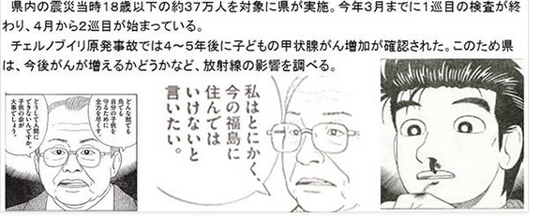
Local governments immediately protested the comic, saying it fosters unfounded fears of radiation.
Prime Minister Shinzo Abe chimed in over the weekend, reassuring the public there was no proof of a link between radiation and such illnesses. “The government will make the best effort to take action against baseless rumours,” he said.
Undeterred by the ruckus, Tokyo-based publisher Shogakukan added a special 10-page segment to weekly Big Comic Spirits magazine, published Monday, featuring criticism it had received as well as opinion from radiation experts.
Editor Hiroshi Murayama acknowledged he had been unsure about publishing the manga, subtitled “The Truth of Fukushima,” because he anticipated people would be offended. But he had decided that voice needed to be heard, he said.
“We hope the various views on the latest ‘Oishinbo’ will lead to a constructive debate into assessing our future,” he said in the special segment.
“Oishinbo,” a hit series usually about gourmet food, which began in the 1980s, will be discontinued temporarily in the magazine. But the publisher said that had been the plan even before the controversy. It is not clear when it will run again………..
Scientists say there is no exact safe limit to low dose radiation. A causal link to any individual’s disease is hard to prove, given the varieties of carcinogens and other risks in the environment.
Fukushima is monitoring the health of its residents, and carrying out thyroid checks on those ages 18 and under.
Seventy-five confirmed and suspected cases of thyroid cancer have been found in those tests, but it is unclear whether they are linked to radiation.
A group of Fukushima residents, who say they have suffered dizzy spells and nosebleeds since the disaster, came out last week in defence of “Oishinbo.” They said through their lawyer that they will speak out in Tokyo, but on condition of anonymity, perhaps wearing a traditional demon’s mask to protect themselves against ostracism and other social backlash over going public with fears about radiation.
In the final scenes of the Fukushima episodes of “Oishinbo,” the characters — drawn in trademark manga style with big eyes — talk about how they must save Fukushima. But they decide that the best way is to urge people living with radiation to have the courage to get out, with the help of the government.
Tetsu Kariya, the writer of “Oishinbo,” did not immediately respond to requests for an interview. But he said on his blog earlier this month that the intensity of the outrage set off by the nosebleed scene was unexpected.
Having researched Fukushima for two years, he was not about to write that Fukushima was safe and all was well — even if that may be what people wanted to hear.
“I can only write the truth,” he said. http://www.ctvnews.ca/health/manga-depiction-of-nosebleed-spurs-debate-on-radiation-health-risks-1.1828017#ixzz32JOTbOhy
Radiation levels in sea off Fukushima at record high
 Record high radiation in seawater off Fukushima plant, Japan Times, 17 May 14 Radiation has spiked to all-time highs at five monitoring points in waters adjacent to the crippled Fukushima No. 1 power station, plant operator Tokyo Electric Power Co. said Friday.
The measurements follow similar highs detected in groundwater at the plant. Officials of Tepco, as the utility is known, said the cause of the seawater spike is unknown.
Three of the monitoring sites are inside the wrecked plant’s adjacent port, which ships once used to supply it.
At one sampling point in the port, between the water intakes for the No. 2 and No. 3 reactors, 1,900 becquerels per liter of tritium was detected Monday, up from a previous high of 1,400 becquerels measured on April 14, Tepco said.
Nearby, also within the port, tritium levels were found to have spiked to 1,400 becquerels, from a previous high of 1,200 becquerels.
And at a point between the water intakes for the No. 1 and No. 2 reactors, seawater sampled Thursday was found to contain 840 becquerels of strontium-90, which causes bone cancer, and other beta ray-emitting isotopes, up from a previous record of 540 becquerels.
At two monitoring sites outside the port, seawater was found Monday to contain 8.7 becquerels and 4.3 becquerels of tritium. The second site was about 3 km away……… http://www.japantimes.co.jp/news/2014/05/17/national/record-high-radiation-in-seawater-off-fukushima-plant/#.U3ptgdJdWik
Spanner in the works for Fukushima’s planned ice wall against radiation
 Work on frozen soil walls at Fukushima plant hits glitch Asahi Shimbun, May 17, 2014 By AKIRA HATANO/ Staff Writer Plans to start construction in June of frozen underground soil walls at the crippled Fukushima No.1 nuclear power plant are now askew after concerns were raised by the nation’s nuclear watchdog body.
The Nuclear Regulation Authority said plant operator Tokyo Electric Power Co. has yet to submit documents demonstrating the safety and efficacy of the project, which is unprecedented in scale.
Announced in May 2013, the frozen walls are intended to stem the flow of groundwater into the nuclear complex.
“Once the project is started, it will be difficult to turn back,” said Toyoshi Fuketa, an NRA commissioner who is screening the project planned by TEPCO and the central government. “We have to thoroughly examine every aspect of this project because it is such a drastic measure.” TEPCO has been grappling with ways to staunch the daily flow of 400 tons of groundwater into the plant complex. The groundwater mixes with melted nuclear fuel debris and has significantly raised the volume of contaminated water that TEPCO has to deal with, in addition to tons of highly radioactive water used to cool the reactors.
The technique to build the walls of frozen soil is similar to a method used in the construction of tunnels.
A series of steel pipes that contain a liquid at minus 30 degrees spaced at 1-meter intervals will be placed around the buildings housing the four reactors, as well as the turbine buildings.
Stretching 1,500 meters, the frozen walls are expected to cut the inflow of groundwater to 130 tons from the current 400 tons a day.
TEPCO and the government plan to begin the actual freezing of soil in March 2015, with the expectation the walls could last for seven years.
The government has provided 32 billion yen ($313 million) in funding for the project…….
Fuketa pointed out at a review meeting that the document fell far short of providing the necessary safety assurances to pass screening.
The NRA told the utility to provide answers to 24 items that the watchdog is concerned about, such as the possibility of land sinking, leaks of contaminated water and countermeasures in the event the frozen soil thaws.
The NRA is also demanding that TEPCO explain how the construction of the walls of frozen soil will be able to cut the volume of contaminated water…….http://ajw.asahi.com/article/0311disaster/fukushima/AJ201405170031
Japan to check lefelong health of 20,000 Fukushima nuclear workers
 Lifelong health checks planned for 20,000 workers at Fukushima plant http://ajw.asahi.com/article/0311disaster/fukushima/AJ201405170037 THE ASAHI SHIMBUN 17 May 14, The government will look for increased rates of leukemia and other cancers linked to radiation exposure as part of a lifelong study of 20,000 workers mobilized in the recovery effort after the 2011 nuclear disaster.
The Ministry of Health, Labor and Welfare study is projected to be still continuing 60 years from now because many of the workers are in their early 20s. The triple meltdown at the Fukushima No. 1 nuclear power plant was triggered by the March 11, 2011, Great East Japan Earthquake and tsunami. The individuals taking part in the study worked at the plant between March 14 and Dec. 16 of that year.
A panel of experts on May 16 approved the ministry’s plan, including the methodology of the study, the subjects to be covered and conditions to be checked.
Under the plan, blood and liver function tests will be conducted once a year during routine health checks. Every three to five years, doctors will check for signs of kidney failure.
The ministry plans to start the study on a trial basis during the current fiscal year, which will then be expanded on a full-scale basis in fiscal 2015.
The ministry will decide at a later date which entity it will contract to carry out the study.
During the nine-month period in question, the government raised the safety limit for radiation exposure in cases of emergency from 100 millisieverts to 250 millisieverts.
Of the 20,000 workers, 174 were exposed to radiation doses that exceeded the safety limit of 100 millisieverts over five years for those working under normal conditions.
Fukushima’s ice wall – massive cost, massive drain on electricity
Record high radiation in seawater off Fukushima plant, Japan Times, 17 May 14 “………..Tepco is struggling to reduce contamination at the poorly protected plant, which was damaged by the March 2011 earthquake and tsunami. Measures include plans to build a gigantic underground ice wall around the plant to keep the daily flow of groundwater from entering the cracked reactor buildings and mingling with the highly radioactive cooling water in their basements.
The ice wall project is expected to cost ¥31.9 billion and will put a massive burden on the power grid when completed: It will need about 45.5 million kilowatt-hours of electricity to operate, equal to annual power consumption of 13,000 average households.
The project involves freezing the soil into barricades 30 meters deep and 2 meters thick for a distance of 1,500 meters around the buildings housing reactors 1 through 4.
The soil will be frozen by sinking pipes into the ground and running liquids through them at a temperature of minus 30 degrees.
On Friday, the Ministry of Economy, Trade and Industry and contractor Kajima Corp. demonstrated a miniature ice wall to reporters at the site.
“We can confirm the frozen soil’s effect in blocking water,” a ministry official said afterwards.
The department aims to begin construction next month. But the Nuclear Regulation Authority has not approved the plan, saying its backers have so far provided insufficient reassurances about public safety. International nuclear experts have also expressed concern about the effectiveness of the plan. http://www.japantimes.co.jp/news/2014/05/17/national/record-high-radiation-in-seawater-off-fukushima-plant/#.U3ptgdJdWik
Tepco to start dumping Fukushima water into the ocean next week
Japan’s TEPCO to Start Dumping Fukushima Water into Ocean Next Week MOSCOW, May 16 (RIA Novosti) – Tokyo Electric Power (TEPCO), the operator of the crippled Fukushima nuclear power plant, plans to begin releasing underground water near the facility into the Pacific Ocean as early as next Wednesday, The Asahi Shimbun reported Friday.
The first water to be released will total around 560 tons, the agency said citing an official from the Ministry of Economy, Trade and Industry. TEPCO will begin releasing the water as soon as it presents results of radiation tests to local government and the fishing industry.
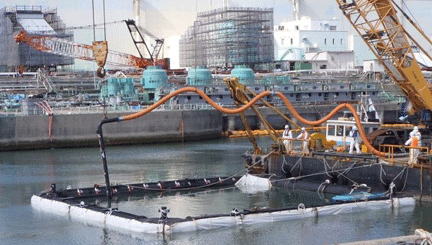
Initial talks between the government and TEPCO agreed that only water with 1,500 becquerels of radiation or less per liter could be released. Tests conducted by TEPCO and two outside agencies have revealed that the Fukushima underground water met the standards, averaging 220 to 240 becquerels of tritium per liter.
TEPCO began pumping out groundwater from the Fukushima nuclear plant in April in an effort to prevent further radioactive leaks.
The company continues to grapple with the problem of contaminated water storage, with about 450,000 tons of highly-radioactive water currently being stored in Fukushima’s underground facilities and tanks. Experts say some 15,000 tons is also being held in a service tunnel. According to recent estimates, up to 400 tons of contaminated water from the damaged plant is seeping into the Pacific Ocean every day.
In an effort to prevent further irradiation, TEPCO has adopted a plan to draw off groundwater from the plant. The fallout from Fukushima is later to be sent for analysis that will determine whether it is safe to be disposed of by dumping into the ocean.
The practice will allow the operator to reduce the accumulation of radioactive water at the plant by 100 tons a day……..https://news.google.com/news?ncl=d_uao6qIU8QsFkM74lsq0LkpKVl4M&q=radiation&lr=English&hl=en&sa=X&ei=l7N2U52sB8mtlQXZ_4HYBw&sqi=2&pjf=1&ved=0CDsQqgIwAw
Japan soon to start making ice wall around groundwater at Fukushima nuclear plant
Japan Tries Ice Wall to Stem Radiation Planned Frozen Barrier to Hold Back Water Contaminated by the Stricken Fukushima Daiichi Nuclear Plant WSJ, By MARI IWATA NARAHA, Japan—The idea of freezing ground to block the flow of water has been around for more than a century, but never has it been tried on the scale Japan plans at its stricken nuclear plant to hold back water contaminated by radiation.
As early as next month, workers are set to start installing pipes for a 1.5-kilometer-long and 30-meter-deep subterranean ice wall around four reactors of the Fukushima Daiichi nuclear plant here…….

The Fukushima effort is unprecedented because of the size of the apparatus—its electricity alone is projected to cost $1 million a month—and the period it is expected to operate. The Fukushima decommissioning is expected to take 40 years or longer.
The ice-wall plan has already met a hurdle. Continue reading
Low levels of radioactive cesium produced insect deformities at Fukushima
New study reveals deaths and mutations ”increased sharply’ from exposure to Fukushima contamination, “especially at low doses” — ‘Small’ levels of cesium may be ‘significantly toxic’ — Smithsonian: “In other words, things don’t look good for the animals living around Fukushima” http://enenews.com/just-in-new-study-reveals-sharp-increase-in-deaths-and-mutations-from-exposure-to-fukushima-contamination-especially-at-low-doses-small-levels-of-cesium-may-be-significantly-toxic?utm_source=feedburner&utm_medium=email&utm_campaign=Feed%3A+ENENews+%28Energy+News%29
 Smithsonian Magazine, May 14, 2014: Even Tiny Amounts of Radioactive Food Made Caterpillars Become Abnormal Butterflies […] Researchers in Japan […] discovered, even a small amount of radiation is too much. […] The scientists collected plant material from around Fukushima and fed it to pale grass blue butterfly caterpillars. When the caterpillars turned into butterflies, they suffered from mutations and were more likely to die early [… even if they] had only eaten a small amount of artificial caesium […] In other words, things don’t look good for the animals living around Fukushima.
Nature — Scientific Reports (pdf), Published May 15, 2014: [We] examined possible relationships between the dose of ingested cesium per larva and the mortality and abnormality rates. Both the mortality and abnormality rates increased sharply, especially at low doses […] the mortality and abnormality rates increased sharply, especially at low doses. Additionally, there seemed to be no threshold level below which no biological response could be detected. […] the dose-response data suggests that the relatively small level of artificial cesium from the Fukushima Dai-ichi NPP may be significantly toxic to some individuals in butterfly populations […] the half lethal [i.e. LD50, amount that will kill 50% of a test subjects] dose [is 1.9 Bq per larva] and the half abnormal dose [is 0.76 Bq per larva] […] relatively small [levels] of artificial cesium from the Fukushima Dai-ichi NPP may be significantly toxic to some individuals in butterfly populations […] we assert that the half lethal and abnormal doses we obtained were quite high. […] it should be noted that we sampled contaminated leaves from Fukushima City, which many people inhabit as though nothing had happened […] Implications of the half lethal and abnormal doses we obtained in the present study will impact future discussions on the effects of radioactive exposure on other organisms, including humans. […] In conclusion, it is important to recognize the risk of internal radiation exposure due to ingested radioactive cesium, at least for the pale grass blue butterfly, and likely for certain other organisms living in the polluted area, possibly including humans. […]
US nuclear companies keen to work on Fukushima clean-up
Kennedy vows U.S. help to Japan for Fukushima nuclear clean-up Planet Ark 5-May-14 Country: JAPAN Author: Yoko Kubota U.S. Ambassador to Japan Caroline Kennedy pledged U.S. support for the clean-up at Japan’s tsunami-wrecked Fukushima Daiichi nuclear power plant on Wednesday after her first visit to the site……..
Contaminated water accumulates at a rate of 400 tonnes a day at the plant as groundwater flows into the destroyed basements of the reactor buildings and mixes with highly radioactive water used to cool melted fuel.
Row upon row of huge blue and gray tanks that store contaminated water are lined up while pink, white and purple azalea bushes are in full bloom nearby. Overgrown plants curl onto the streets while pipes snake across the site where numerous cranes still stand.
About 1,200 to 1,300 tanks storing about 450,000 tonnes of contaminated water are on site and over the next two years Tepco wants to set up enough tanks to store 800,000 tonnes of water, said Kenichiro Matsui, a spokesman for the utility.
Up to 5,000 workers are on site each day, according to the Tepco spokesman, Matsui, up from about 4,000 a year ago. In future, that number is likely to increase to about 6,000, he said.
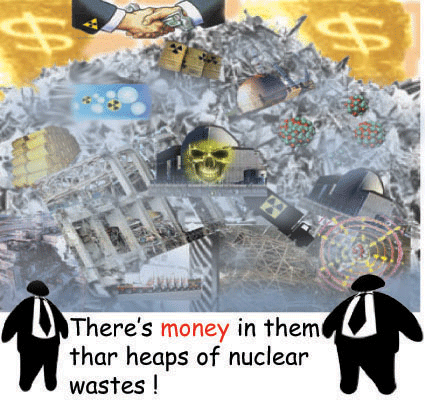 Overseas companies including U.S. ones are eager to get in on the clear-up work and the decommissioning of the six reactors at the wrecked plant but most contracts have gone to Japanese companies……..
It’s good that she’s here because the situation at the plant needs to be reported worldwide,” said one man who now works as a driver for plant workers after hitting his annual radiation exposure limit in his former job at the site.http://planetark.org/enviro-news/item/71554
Hundreds ill after Fukushima radioactive trash burned in major Japanese city
 Medical Expert: Hundreds ill after Fukushima nuclear plant rubble burned in major Japanese city — Suffering nosebleeds, problems with eyes, throats and skin — Gov’t: Radiation levels were ‘low enough’ to be safe (PHOTO) http://enenews.com/medical-expert-hundreds-ill-after-fukushima-nuclear-plant-rubble-burned-major-japanese-city-suffering-nosebleeds-problems-eyes-throats-skin-govt-radiation-levels-low-enough-be-safe?utm_source=feedburner&utm_medium=email&utm_campaign=Feed%3A+ENENews+%28Energy+News%29
Asahi Shimbun, May 13, 2014: The manga series [‘Oishinbo’] has been in print since 1983 [selling] 120 million copies […] the May 12 installment includes a segment in which residents of Osaka complain about health problems after a nearby incinerator processes rubble transported from the Fukushima No. 1 nuclear power plant.
Japan Times, May 13, 2014: Osaka Prefectural Government took issue with the assertion, expressed by a character based on real-life medical expert Eisuke Matsui, that about 800 people living around an incinerator there have been affected by burning tsunami debris tainted with radiation from Tohoku. […] Osaka Prefectural Government claimed that no local doctors or authorities have received reports of ill health due to debris incinerated in the city’s Maishima area, contradicting the assertion made by the manga’s character Matsui. […] At every stage of the disposal, the radiation level was stable and low enough to be safe, the government said. —CAPTION: [Matsui’s] character portrayed in the manga ‘Oishinbo’ claims that about 800 residents living near an incinerator in the city of Osaka have exhibited symptoms of illnesses caused by radioactive fallout
Kyodo News, May 13, 2014: Citing [an] expert [Oishinbo] said hundreds of people living near an incineration site in the city of Osaka […] experienced nosebleeds or unpleasant symptoms affecting their eyes, throats and skin.
“Extremely Unjust”: Osaka professor arrested — Publicly opposed burning radioactive debris
Doctor: 300 times more radiation released to atmosphere when burning debris than gov’t claims
From 2012: Fukushima will start burning radioactive waste — 100,000 Bq/kg to be incinerated
Watch — Gundersen: Lots of serious ramifications from burning of nuclear waste — We are basically creating Fukushima all over again (VIDEO)
“Potentially dangerous criminal”? – Mari Takenouchi who condemns nuclear power
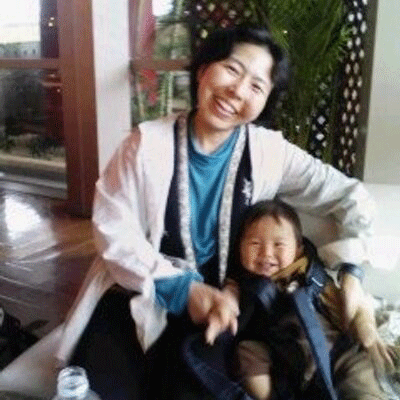 VICE: Japan mother may be jailed for “tweet critical of nuclear lobbyist” — Fukushima police travel 1,000 miles to interrogate her, examine computer — Officer: We only go outside prefecture for “potentially dangerous criminal” — “May be held without bail… without right to see lawyer”http://enenews.com/vice-japan-mother-fled-radiation-jail-tweet-critical-nuclear-lobbyist-fukushima-police-travel-1000-miles-interrogate-her-examine-computer-officer-only-prefecture-potentially-dangerous-criminal?utm_source=feedburner&utm_medium=email&utm_campaign=Feed%3A+ENENews+%28Energy+News%29VICE, Nathalie-Kyoko Stucky, May 11, 2014: Mari Takenouchi […] wrote a tweet critical of a nuclear lobbyist. Takenouchi may go to jail […] Prosecutors confirmed they will be flying to Okinawa […] to question her on May 13. Police have already traveled from Fukushima to Okinawa to interrogate her […] [She] fled her hometown of Tokyo with her infant son days after the disaster, hoping to avoid fallout from Fukushima. […] Takenouchi said police came to her apartment in Okinawa and examined her computer […] The prosecutor’s office will decide by July whether to indict […] she may be held without bail […] without a right to see a lawyer or have one present during questioning.
Lieutenant Tadashi Terashima, Fukushima police spokesman: “We only send police officers from one prefecture to another if the subject is really a potentially dangerous criminal.”
Translation of Takenouchi’s tweet: There’s a common point between the 2 criminals of the century. Yasuhiro Nakasone, who introduced nuclear plants in Japan, said: “I didn’t expect Japan in 2011 to become such a battered country.” Ryoko Ando, a (pro-establishment) citizen activist who hosts Ethos’ human experiments in Fukushima, said: “Is this the kind of world we’ve arrived at over the 67 years since the end of World Ward Two?”
VICE on Ryoko Ando: “The Japanese head of Fukushima Ethos, a project […] funded by the French nuclear energy lobby. Fukushima Ethos encourages residents to continue living in contaminated areas as long as decontamination procedures and radiation measurements continue to be done […] Ando reported it to the Fukushima Prefectural Police, accusing Takenouchi of either criminal defamation or criminal contempt.”
Takaaki Hattori, legal expert:“Unprecedented for the police to launch a contempt investigation against a journalist for a single tweet, made in the public interest. If all debates about nuclear energy in this country are going to become grounds for criminal investigations, freedom of speech will vanish. The fact that police even sent the case to the prosecution is disturbing.”
Japan Times, Feb. 12, 2014: “Japan fell from 22nd to 53rd place on [Reporters Without Borders’ World Press Freedom Index] for “the ban imposed by the authorities on independent coverage of any topic related directly or indirectly to the [Fukushima] accident.”
Sydney Morning Herald: “The cloud was at its thickest during the three hours Takenouchi and her son, Joe, spent outside […] Joe was exposed to 145 times the normal [radiation] level”
Watch Takenouchi describe her baby’s subsequent health problems here
1 This Month





PLEASE OPPOSE HR 8255 AND S.3639 – bills would accelerate satellite deployment, with no environmental review or safeguards – https://ncstd5li.quorum.us/campaign/169331/
To see nuclear-related stories in greater depth and intensity – go to https://nuclearinformation.wordpress.com
-
Archives
- October 2026 (58)
- September 2026 (339)
- August 2026 (330)
- July 2026 (355)
- June 2026 (287)
- May 2026 (306)
- April 2026 (356)
- March 2026 (251)
- February 2026 (267)
- January 2026 (308)
- December 2025 (358)
- November 2025 (359)
-
Categories
- 1
- 1 NUCLEAR ISSUES
- business and costs
- climate change
- culture and arts
- ENERGY
- environment
- health
- history
- indigenous issues
- Legal
- marketing of nuclear
- media
- opposition to nuclear
- PERSONAL STORIES
- politics
- politics international
- Religion and ethics
- safety
- secrets,lies and civil liberties
- spinbuster
- technology
- Uranium
- wastes
- weapons and war
- Women
- 2 WORLD
- ACTION
- AFRICA
- Atrocities
- AUSTRALIA
- Christina's notes
- Christina's themes
- culture and arts
- Events
- Fuk 2022
- Fuk 2023
- Fukushima 2017
- Fukushima 2018
- fukushima 2019
- Fukushima 2020
- Fukushima 2021
- general
- global warming
- Humour (God we need it)
- Nuclear
- RARE EARTHS
- Reference
- resources – print
- Resources -audiovicual
- Weekly Newsletter
- World
- World Nuclear
- YouTube
-
RSS
Entries RSS
Comments RSS

