At Fukushima nuclear emergency, safety inspectors were the first to flee
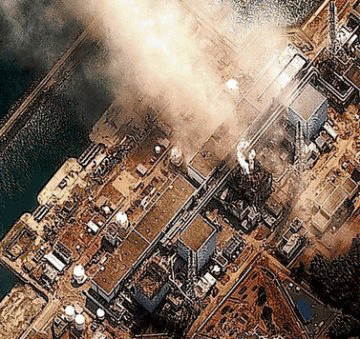 Nuclear safety inspectors first to flee stricken Fukushima plant June 03, 2014 Asahi Shimbun, By SHINICHI SEKINE/ Staff Writer Safety inspectors with the government’s nuclear watchdog body were the first to flee when disaster struck the Fukushima No. 1 nuclear power plant in March 2011.
The exodus of Nuclear and Industrial Safety Agency (NISA) officials compromised communications between the government and plant operator Tokyo Electric Power Co. at a critical juncture.
This unexpected turn of events shows that the government itself was not sure what role it should play in the nuclear crisis.
The plant manager, Masao Yoshida, who died last year of esophageal cancer, was questioned by the government’s Investigation Committee on the Accident at the Fukushima Nuclear Power Stations several months after the accident. The Asahi Shimbun obtained a copy of his testimony.
According to his testimony, on March 15, 2011, four days after the Fukushima plant was hit by the magnitude-9.0 Great East Japan Earthquake and tsunami, 90 percent of the workers in the plant withdrew to the Fukushima No. 2 nuclear power plant some 10 kilometers away, ignoring Yoshida’s order to remain in and around the compound of the No. 1 facility.
Before that, however, NISA inspectors fled the site immediately after the accident even though they should have stayed to assess what steps were needed to deal with the accident. They went to makeshift government headquarters set up about five kilometers from the No. 1 plant.
On March 15, the makeshift facility was transferred to Fukushima city, some 50 kilometers away. With all government safety inspectors absent from the No. 1 nuclear power plant, the government had no direct means to grasp what was happening there. As a result, it was forced to depend entirely on TEPCO for information.
But channels of communication between the government and TEPCO did not go smoothly. This chaotic situation prompted the prime minister, Naoto Kan, to go to TEPCO’s head office in Tokyo. That was the catalyst for the government and TEPCO to jointly set up headquarters in Tokyo, 230 kilometers away, to deal with the nuclear accident.
The government’s investigation committee’s reports based on Yoshida’s recall of the events highlight the withdrawal of the No. 1 plant’s workers to the No. 2 plant even though the government’s safety inspectors were the first to flee……..http://ajw.asahi.com/article/0311disaster/fukushima/AJ201406030026
Amid serious doubts, the Fukushima ice wall construction starts
 Japan builds underground ice wall at Fukushima nuclear plant http://www.abc.net.au/news/2014-06-02/japan-builds-fukushima-underground-ice-wall/5495358 Japan has started work on an underground ice wall at the crippled Fukushima nuclear plant, freezing the soil under broken reactors to slow the build-up of radioactive water. The wall is intended to block groundwater from nearby hillsides that has been flowing under the plant and mixing with polluted water already there.
The Nuclear Regulation Authority, the national watchdog, last week authorised construction of the ice wall at Fukushima Daiichi, owned and operated by Tokyo Electric Power (TEPCO).
“We started construction of the frozen earth wall this afternoon,” a TEPCO official told a news conference in Tokyo on Monday.
The government-funded scheme will see 1,550 pipes laid deep in the soil through which refrigerant will be piped to create the 1.5-kilometre frozen wall that will stem the inflow of groundwater.
“We plan to end all the construction work in March 2015 before starting trial operations,” the company official said, adding that the ice wall could be fully operational several months after construction was completed.
The ice wall is the latest in a series of clean-up operations being carried out after the worst nuclear disaster in a generation, in which three reactors went into meltdown.
The idea of freezing a section of soil, which was proposed for Fukushima last year, has previously been used to build tunnels near watercourses.
However, scientists point out that it has not been done on this scale before nor for the proposed length of time.
Coping with the huge – and growing – amount of water at the tsunami-damaged plant is proving to be one of the biggest challenges for TEPCO.
As well as all the water used to keep broken reactors cool, the utility must also deal with water that makes its way along subterranean watercourses from mountainsides to the sea. Last month TEPCO began a bypass system that diverts groundwater into the sea to try to reduce the volume of contaminated water.
Full decommissioning of the plant at Fukushima is expected to take several decades.
An area around the site remains out of bounds, and experts warn that some settlements may have to be abandoned because of high levels of radiation following the March 2011 accident.
A cry for help on behalf of Fukushima’s children subjected to radiation
Official in Fukushima: “Please Please HELP US!” — Hot particles of melted fuel are inhaled by children everyday — We are forced to have it in our bodies — “Please let all people in the world know the life we are living” http://enenews.com/official-in-fukushima-please-please-help-us-hot-particles-of-melted-fuel-are-inhaled-by-children-everyday-we-are-forced-to-have-it-in-our-bodies-please-let-all-people-in-the-world-kno?utm_source=feedburner&utm_medium=email&utm_campaign=Feed%3A+ENENews+%28Energy+News%29
Excerpts from Oyama Koichi of the Minamisoma City Council, May 13, 2014 — Translation byDissensus Japan, May 25, 2014:
- I want to shout for all the people in this world: “Please Please HELP US!”
- The cause substance have been found. This is an aggregate of radionuclides which starts with Uranium [in] a nuclear reactor at more than 5000°C.
- This mixed metal contains four different substances, α・β・γ and also have the possibility to radiate neutron ray.
- No creature on earth never knew this substance.
- We are forced to have those strong substances inside our body without knowing where it exactly stays.
- To say that “Cesium has got the same system as potassium and it will be discharged from the body” is just a lie! […]
- We are all manipulated by the words “radiation” and “radiation doze” without knowing the real identity of radiation source. We are not told the real facts of being irradiated […]
- They only compare radiation doze and natural potassium contained in bananas and manipulated people as if it was a scientific study. I really want the scholars patronized by the government to be punished by the rancorous of all children on this earth. […]
- The informations say that hot particles were diffused and flied in all directions in Japan. The particles from hell is flying in the air and people don’t protect themselves anymore three years after the nuclear accident and children are aspirating those horrible particles everyday!!!
- PLEASE PLEASE PLEASE HELP US! Please let all people in the world to know the life we are living since the accident, everyday and today.
Fukushima radiation has caused genetic deformities in generations of butterflies
Japan Scientist: We gave butterflies food from Fukushima… then, they died; Deformities get worse with each generation — TV: “Truly horrifying… it doesn’t really even look like a butterfly anymore” (PHOTOS & VIDEO) http://enenews.com/japan-scientist-butterflies-fed-leaves-fukushima-died-deformities-worse-generation-tv-doesnt-look-like-butterfly-anymore-especially-scary-photos-video?utm_source=feedburner&utm_medium=email&utm_campaign=Feed%3A+ENENews+%28Energy+News%29
Vice on HBO, Season 2 Episode 10, May 24, 2014 (at 5:30 in):
- Dr. Joji Otaki, lead researcher, University of Ryukyus: We collected houseplant leaves from Fukushima, and those leaves are given to [butterfly] larvae collected from Okinawa… Those larvae aresupposed to be healthy. But they ate contaminated food from Fukushima. Then we see what happens.
- Vikram Ghandi, Vice: What happened?
- Otaki: They died.
- Ghandi: Dr. Otaki’s experiments have shown the truly horrifying effects contaminated food can have on living organisms.
- Otaki: You can see wrinkled wings.
- Ghandi: It doesn’t really even look like a butterfly anymore.
- Otaki: We found that mortality rate and abnormality rate of the 2nd generation is much higher — even worse in the 3rd generation.
- Ghandi: The evidence contaminated food has increasingly worse effects over the course of generations is especially scary since one of Fukushima’s primary industries is agriculture.
- Kazuya Tarukawa, farmer in Sukagawa 50 miles from Fukushima Daiichi: We had been growing produce that measured 3,000 [Bq/kg] without even knowing it. Selling such produce to the markets made me feel severely guilty.
- Ghandi: His father was consumed with guilt.
- Tarukawa: He hung himself from the tree.
Every day over 75 tons of highly radioactive liquid leaking at Fukushima
Official: Breach at Fukushima reactor blamed on saltwater corrosion — Over 75 tons of highly radioactive liquid flowing out everyday (PHOTOS & VIDEO) http://enenews.com/official-breach-at-fukushima-reactor-blamed-on-saltwater-corrosion-over-75-tons-of-highly-radioactive-liquid-flowing-out-everyday-photos-video?utm_source=feedburner&utm_medium=email&utm_campaign=Feed%3A+ENENews+%28Energy+News%29
Kyodo News, May 28, 2014: [Tepco] has identified the location of a leak at the bottom of the container in the No. 1 reactor […] water was leaking from a joint in a pipe […] The metal bellow joint is likely to have been corroded [“destruction of materials from chemical reaction“] by seawater [the Tepco official said.] The official denied the possibility that the leakage was caused because the earthquake damaged equipment. He said the company will continue to investigate if there are other areas of leakage nearby.
Jiji Press, May 28, 2014: Tepco said it had confirmed water was leaking from a pipe in the reactor containment vessel inside the plant’s No. 1 reactor building. The utility used a camera-mounted remote-controlled robot […] water was leaking from the vessel’s bottom near the pipe, at a rate of up to 3.2 tons per hour [76.8 tons/day]. In the No. 1 to No. 3 reactor buildings, highly contaminated water leaking from the vessels has amassed, preventing work to remove nuclear fuel.
NHK,May 27, 2014: The water is leaking from a point on a pipe leading to the containment vessel. An image taken by a robot probe shows a black area on the brown pipe. The leak point is above a donut-shaped unit called a suppression chamber where a robotic investigation detected flows of contaminated water last November. The chamber is in the lower part of the containment vessel. […] A contaminated water leak has also been found in the containment vessel of the Number 3 reactor. Officials say they will now investigate the suppression chamber and other parts of the Number 2 reactor.
Watch footage of the Unit 1 suppression chamber survey published on May 28 here
Japan about to extract the teeth from its Nuclear safety Watchdog?
 The government should not be allowed to make the nuclear watchdog toothless by nominating experts who are convenient to it and the industry.
EDITORIAL: Nuclear watchdog must not be made toothless –The Asahi Shimbun, May 29 Prime Minister Shinzo Abe has a habit of trying to promote policy changes through political appointments. His administration seems to have employed this political ploy to achieve its goals in the area of nuclear safety inspections.
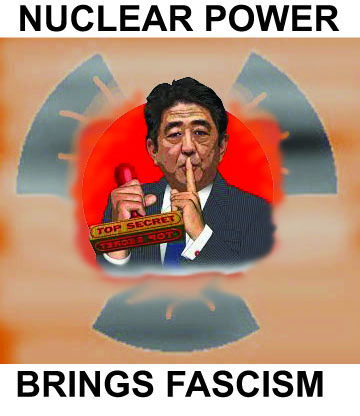
This is the only possible way to put proposed replacements for two outgoing commissioners of the Nuclear Regulation Authority (NRA) into perspective. Continue reading
Japan’s Abe govt determined to bring back nuclear, but the impediments are strong
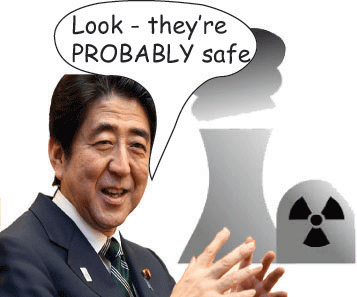 Abe and Kepco Push Nuclear Restart The government and nuclear companies maneuver to restart Japan’s reactors, as nearby cities dig in. The Diplomat, By Clint Richards May 29, 2014 As The Diplomat noted last week, Japan’s nuclear energy providers are struggling to remain profitable with all the country’s nuclear reactors currently offline. The government is highly aware of its struggling nuclear power sector, and the threat of another summer where Japan’s energy grid is stretched to the limit, and energy imports soar. With both of these problems in mind, three news items highlight the direction both the government and nuclear companies may take to avoid another summer energy crunch.
The Fukui District Court ruling would allow people living within 250 km of the plant the right to sue to have the plant closed. According to a separate Japan Times article, “The entire Kansai region, most of Chubu, including Nagoya, much of Chugoku, including Hiroshima, and roughly a third of Shikoku lies within 250 km of the Oi plant.”
Despite strong local opposition, Abe’s government is determined to bring back online as many nuclear reactors as logistically possible. On Wednesday, an NRA official told AFP that Abe’s government wants to replace two of five commissioners serving on the NRA when their terms expire. One of the commissioners Abe reportedly most wants to replace is Kunihiko Shimizu, who has been criticized for saying that at least two reactors sit on active fault lines………
Local governments and their constituencies are determined to keep the tragedy of Fukushima as far from their own doorstep as possible. The inability of Tepco to adequately address the continued problems at the Daiichi power plant only further reinforces the fear of people who live near existing reactors. Despite Abe’s insistence, local populations are likely to keep the number of reactors that come back online much lower than the government wants, at least in the near future, as long as the central government and energy providers give them veto power. http://thediplomat.com/2014/05/abe-and-kepco-push-nuclear-restart/
Pro nuclear expert replaces safety conscious seismic expert on Japan’s Nuclear Safety Agency
Pro-nuclear expert replacing NRA commissioner who raised flag on quake risk THE ASAHI SHIMBUN 29 May 14, http://ajw.asahi.com/article/behind_news/politics/AJ201405280023 Replacements for two outgoing commissioners of the Nuclear Regulation Authority suggest the Abe administration will find it easier to gain approval for restarts of the nation’s nuclear reactors.Few people in government circles and the nuclear industry will be sorry to see Kunihiko Shimazaki go. His successor is expected to more quickly give the green light to reactivate nuclear power plants.
Shimazaki, who is 68 and a professor of seismology, proved to be a thorn in the side of electric power companies with his calls for a reassessment of the force with which seismic waves and tsunami could pummel nuclear plants being considered for restarts. Kenzo Oshima, 71, a former undersecretary-general at the United Nations, is also stepping down. Both men are leaving because their terms expire in September.
Continued cover-up of health effects of Fukushima radiation
Cancer Expert in Fukushima: “There has undoubtedly been radiation poisoning, people shouldn’t be living here”; Officials only focus is covering up crisis — TV: On playground, we found radiation levels 2,000% higher than displayed by gov’t monitoring post (VIDEO) http://enenews.com/cancer-expert-fukushima-undoubtedly-radiation-poisoning-people-be-living-officials-only-focused-covering-crisis-tv-playground-found-radiation-levels-2000-higher-nearby-govt-monitoring-post-displaye
Fukushima VICE
Vice on HBO, Season 2 Episode 10, May 24, 2014 (at 3:45 in):
Dr. Masamichi Nishio, MD, Hokkaido Cancer Center radiologist who was examining children at elementary school 40 miles from Fukushima Daiichi: There has undoubtedly been radiation poisoning, so people should not be living here. But the government will not say that out loud. All they wanted to do was cover-up what had been done. There is a lot of secrecy. […]
Kayoko Hashimoto, Fukushima resident: The figures don’t add up. They don’t match what the government is saying.
Vikram Ghandi, Vice: The whole concept of these stationary Geiger counters becomes suspect when only a few feet away the readings are twice as high. And when you move even further away, those government monitors start feeling completely irrelevant. Over here by the edge of the school… Whoa. Sh*t. So the reading is now 3.5 [microSv/hr]. That level is 20 times higher than the monitoring post around the corner — on the playground, at an elementary school.
Vikram Gandh’s ‘Debrief’, May 24, 2014:
Shane Smith, Vice: Vikram Gandhi went to Fukushima, where levels of radiation have been drastically downplayed by the Japanese government. […]
Ghandi: Our Geiger counter was reading measurements up to 900 times the measurements we found in Tokyo.
Tepco’s hopes that a giant ice wall will solve radiation leak problem
Japan building giant ice wall at Fukushima after all as TEPCO gets go ahead RT May 28, 2014 Japan’s nuclear authority will allow Fukushima’s nuclear power plant operator, TEPCO, to build an underground ice wall isolating radioactive water build-up. This is despite earlier concerns that the wall might cause the ground to sink.
The Nuclear Regulation Authority (NRA) no longer has reservations about the 32 billion yen (US$314 million) government-funded project, in which a giant “wall of ice” is to be built around the crippled Fukushima No. 1 nuclear plant’s four reactors, Kyodo news agency reported.
The plan, which involves 1.5 kilometers of pipes with coolant powerful enough to make the earth around it freeze, earlier raised concerns that it could cause trouble by making the ground near the reactors less stable.
TEPCO officials have, however, persuaded NRA experts that the ground around the ice wall may sink only up to 16 mm, posing no threat to its stability.
“I think we have been able to confirm today the scale of ground sinking, which is what we have most feared as side effects of building the wall,” NRA Commissioner Toyoshi Fuketa told Kyodo.
While accepting the operator’s explanation, the NRA still has issues to discuss with TEPCO, which include ways to accurately measure the level of radioactive water accumulating inside the reactor buildings. The issue of contaminated groundwater seeping through the ground and into the ocean has for years been one of the major problems faced by TEPCO. ……
Public trust at a low ebb in Japan, as staff of Nuclear Regulation Agency changes
TEPCO public trust remains low as Japan shuffles nuclear watchdog http://www.channelnewsasia.com/news/asiapacific/tepco-public-trust/1125884.html The Japanese government announced it will replace two of its five officials on the Nuclear Regulation Authority, while the Tokyo Electric Power Co. (TEPCO) is still grappling with low public trust. TOKYO: Japan’s government has announced it will replace two of its five members on the Nuclear Regulation Authority which determines if a nuclear plant is ready for a restart.
Speculation is rising that the government is removing the seismic expert responsible for actually beefing up the requirements for nuclear plants. The Tokyo Electric Power Company (TEPCO) is eager to spread the message that the Kashiwazaki Kariwa (KK), one of the world’s largest nuclear plants, is ready to be restarted after having been offline since the March 2011 Fukushima nuclear plant disaster.
Nuclear Reform Monitoring Committee deputy chair Lady Barbara Judge, who was the former chair of the United Kingdom Atomic Energy Authority, supports an energy mix that includes nuclear power even in Japan where the risk of a massive earthquake is high.
In Japan, many continue to oppose the restart of nuclear power plants. There are lawsuits taking place all over Japan not only against nuclear power plants but also uranium-related facilities. In May, a local court ruled for the first time against the restart of Oi nuclear power plant in Fukui Prefecture.
“In a lawsuit to stop the Oi nuclear plant, the historic ruling was based on the fact that the risk cannot be controlled by humans” said Tamotsu Sugenami, secretariat of the Takagi Fund for Citizen Science.
“Immediately, those who support nuclear energy began a campaign stating that zero risk is an old way of thinking. We cannot tolerate this.”
Aside from the technical safety concerns, public trust in TEPCO also remains low. “They (TEPCO) put little films on their websites on what’s going on,” said Lady Judge.
“They’re trying to explain to the public what they’re doing inside of walls of power plants which is new. And that’s more important than anything in terms of regaining public trust.”
TEPCO is aware of its reputation problem but there is also the issue of compensation.
Co-author of the book “It’s necessary to dissolve TEPCO for the revival of the Japanese economy” Hideaki Takemura claims the government has bankrolled TEPCO with the banks pumping in some 2 trillion yen to salvage the company.
He said: “There has been no compensation from (TEPCO’s) own pocket. It’s using the government money to compensate the victims and deal with the accident. There is no company as irresponsible as that.”
There are clearly many questions in Japan’s ongoing nuclear debate but there is no question that the Abe government is as keen as ever to get the country’s nuclear power plants back online.
Radiation levels close popular tourist park in Ibaraki Prefecture
 HITACHI SEASIDE PARK CLOSED DUE TO RADIATION, FUKUSHIMA UPDATE MAY 26, 2014
via JapanCrush / May 25, 2014 / Netizens have been alarmed by the news from national broadcaster, NHK, that part of the beautiful Hitachi Seaside Park have been closed off due to a peak in radiation levels.Ibaraki Prefecture, which is home to the park, neighbours Fukushima Prefecture, and therefore concerns over radiation levels have been ongoing since the 2011 nuclear disaster.
From NHK.com – “…….Hitachi Seaside Park is one of Ibaraki prefecture’s leading tourist spots and had over 350000 visitors during Golden Week this year and from now on MLIT will be carrying out decontamination of the area.” http://fukushimaupdate.com/hitachi-seaside-park-closed-due-to-radiation-fears/
Japan’s nuclear regulator OK’s dodgy government funde plan for ice wall around Fukushima nuke plant
Japan to create underground ice wall at crippled nuclear plant https://au.news.yahoo.com/thewest/world/a/23861341/japan-to-create-underground-ice-wall-at-crippled-nuclear-plant/ Tokyo (AFP) – Japan’s nuclear regulator on Monday approved a plan to freeze the soil under the crippled Fukushima nuclear plant to try to slow the build-up of radioactive water, officials said.
The Nuclear Regulation Authority examined plans by Tokyo Electric Power Co (TEPCO) to construct an underground ice wall at the Fukushima Daiichi nuclear plant starting in June, regulatory officials said.
The wall is intended to block groundwater from nearby hillsides that has been flowing under the plant and mixing with polluted water used to cool reactors that went into meltdown after an earthquake and tsunami in March 2011.
Under the plan, which is funded by the government, the firm will circulate a special refrigerant through pipes in the soil to create the 1.5-kilometre (0.9-mile)frozen wall that will stem the inflow of groundwater.

“We had some concerns, including the possibility that part of the ground could sink,” one official said on condition of anonymity.
“But there were no major objections to the project during the meeting, and we concluded that TEPCO can go ahead with at least part of the project as proposed after going through further necessary procedures.” However, TEPCO may have to review other parts of the project amid fears it might affect existing structures at the plant such as underground drains, he added.
The idea of freezing a section of the ground, which was proposed for Fukushima last year, has previously been used in the construction of tunnels near watercourses.
However, scientists point out that it has not been done on this scale before nor for the proposed length of time.
Coping with the huge — and growing — amount of water at the tsunami-damaged plant is proving to be one of the biggest challenges for TEPCO, as it tries to clean up the mess after the worst nuclear disaster in a generation.
As well as all the water used to keep broken reactors cool, the utility must also deal with the water that makes its way along subterranean watercourses from mountainsides to the sea.
Last week TEPCO began a bypass system that diverts groundwater into the sea to try to reduce the volume of contaminated water.
Full decommissioning of the plant at Fukushima is expected to take several decades. An area around the plant remains out of bounds and experts warn that some settlements may have to be abandoned because of high levels of radiation.
Japan’s atomic survivors, Hibakusha in Peru, on their global voyage of nuclear warning
Global Voyage for a Nuclear Free World – Radiation survivors tell their story in Lima, Peru Peru This Week By Roxana Garmendia, 27 May 14 Hiroshima and Nagasaki survivors visit Lima as part of their worldwide tour campaign ‘world free of nuclear weapons.’Hiroshima and Nagasaki are two words one cannot easily forget. They represent the destruction and the immense human suffering and loss caused by the usage of nuclear weapons. On August 6, 1945, American airplanes dropped a nuclear bomb on the Japanese city of Hiroshima, and three days later on Nagasaki. 69 years have passed since then but the effects of such acts are still present to this day. To tell us more on these tragic events, a delegation of survivors recently visited Lima as part of their worldwide tour campaign on a ‘world free of nuclear weapons.’
A group of both men and women – most of them in their 70s – shared their memories and the consequences these events had in their lives and those of their families. They were young – if not infants – and some did remember those moments quite well; others learnt about them growing up and through their families. One man recalled his hair falling off and having open wounds in his legs and body caused by the radiation and from which worms would stem out; a lady being covered with a blanket by her mother, saving her from getting the radiation burns – different was the fate of the other family members who died soon after, she explained. More than 200,000 people have died of radiation sickness; the vast majority of them civilians.
There were, of course, those who survived the nuclear attacks; in Japan they are known as hibakushas. A hibakusha technically is someone that has been exposed to radiation within a few kilometers of the hypocenter or was not yet born but was carried by a pregnant woman that had been exposed to such radiation. It is estimated that there are more than 220,000 hibakushas alive – Japanese for the most part but also Koreans and Chinese who were brought to Japan as forced labor during those years. One percent of them are believed to still suffer from some disease related to the bombings. The effects of the radiation, it must be said, are both short and long-term, and may appear later.
It was not only the physical scars, illnesses and traumas that the hibakusha have suffered all along; they were also victims of discrimination. Jobs were difficult to get as people were afraid of any disease transfer. Likewise in social terms, it was not any better as the belief that the illness could be hereditary was very much in the air, and doubts about this still persist. A Japanese lady revealed, for example that all her children suffer from cancer, thyroid, and intestinal problems, common illnesses among other second generation hibakushas (approx. 300 to 500,000).
Several years after, the hibakushas organized themselves and managed to obtain some benefits from the Government. The Japanese Government provides them a monthly allowance and free medical treatment for those registered hibakushas. No compensation, however, was ever paid by the Americans even though they were the ones who threw the bombs……http://www.peruthisweek.com/news-global-voyage-for-nuclear-free-world-radiation-survivors-tell-their-story-in-lima-peru-103071
A legal precedent that could stall Japan’s nuclear power restart
 Oi ruling may fuel anti-nuclear push Plaintiffs elated as district court prioritizes rights over profits Japan Times, BY ERIC JOHNSTON MAY 22, 2014 Wednesday’s court ruling blocking restarts of the No. 3 and 4 reactors at Kansai Electric Power Co.’s Oi plant may embolden opponents of nuclear power nationwide.
It creates a legal precedent and could fuel resistance to restarts, throwing into question whether the administration of Prime Minister Shinzo Abe will be able to push ahead with them as swiftly as planned.
The government earlier asserted that the ruling, by the Fukui District Court, would have no impact on its plans.
Kepco announced Thursday it has appealed the lower court’s decision to the Kanazawa branch of the Nagoya High Court. There, the case could take two or three years to be decided……….
Kepco came under intense criticism from the Fukui court, which said the utility had made optimistic safety projections with no clear evidence. But in a move that could have ramifications nationwide, the court also ruled that 166 plaintiffs living within a 250-km radius of the Oi plant faced concrete dangers from the operation of nuclear power stations.
That could open the door to lawsuits from anyone living within 250 km of a nuclear plant, if the Fukui court’s decision is used as the basis for a claim that other utilities, as well as the Nuclear Regulation Authority, have created inadequate safety measures to deal with the possibility of an accident.
The entire Kansai region, most of Chubu, including Nagoya, much of Chugoku, including Hiroshima, and roughly a third of Shikoku lies within 250 km of the Oi plant.
Plaintiffs were particularly happy the court ruling included language that said providing electricity via nuclear plants is a mere economic activity, and as such has a lower priority than personal rights……..ww.japantimes.co.jp/news/2014/05/22/national/oi-ruling-may-fuel-anti-nuclear-push/#.U4PbrnJdWik
1 This Month





PLEASE OPPOSE HR 8255 AND S.3639 – bills would accelerate satellite deployment, with no environmental review or safeguards – https://ncstd5li.quorum.us/campaign/169331/
To see nuclear-related stories in greater depth and intensity – go to https://nuclearinformation.wordpress.com
-
Archives
- October 2026 (58)
- September 2026 (339)
- August 2026 (330)
- July 2026 (355)
- June 2026 (287)
- May 2026 (306)
- April 2026 (356)
- March 2026 (251)
- February 2026 (267)
- January 2026 (308)
- December 2025 (358)
- November 2025 (359)
-
Categories
- 1
- 1 NUCLEAR ISSUES
- business and costs
- climate change
- culture and arts
- ENERGY
- environment
- health
- history
- indigenous issues
- Legal
- marketing of nuclear
- media
- opposition to nuclear
- PERSONAL STORIES
- politics
- politics international
- Religion and ethics
- safety
- secrets,lies and civil liberties
- spinbuster
- technology
- Uranium
- wastes
- weapons and war
- Women
- 2 WORLD
- ACTION
- AFRICA
- Atrocities
- AUSTRALIA
- Christina's notes
- Christina's themes
- culture and arts
- Events
- Fuk 2022
- Fuk 2023
- Fukushima 2017
- Fukushima 2018
- fukushima 2019
- Fukushima 2020
- Fukushima 2021
- general
- global warming
- Humour (God we need it)
- Nuclear
- RARE EARTHS
- Reference
- resources – print
- Resources -audiovicual
- Weekly Newsletter
- World
- World Nuclear
- YouTube
-
RSS
Entries RSS
Comments RSS

