Japan Nuclear Prof.: Fukushima plant now a ‘swamp of radioactive material’ — Can’t stop pumping in more water because they don’t know where melted fuel went — Build roof over entire site? — Asahi: Continued presence of water threatens construction of ice wall around reactors http://enenews.com/japan-nuclear-prof-fukushima-plant-is-now-a-swamp-of-radioactive-material-cant-stop-pumping-in-more-water-because-tepco-doesnt-know-where-melted-fuel-went-build-roof-over-entire-site-t?utm_source=feedburner&utm_medium=email&

Interview with Professor Hiroaki Koide, Kyoto University Reactor Research Institute, translated by Fukushima Diary, July 13, 2014: Fukushima plant is now like a swamp of radioactive material due to the contaminated water […] Tepco should quit cooling with water since one year ago. However from Tepco’s assumption, it is impossible to shift to air cooling because they can’t identify the exact locations of molten fuel.
More from interview with Professor Koide,translated by Google: I think of that accident of Fukushima […] the human race has been encountered for the first time […] Rather than the cooling in the water, shouldswitch as soon as possible to the cooling method of another I think. […] I thought the most part rain is falling on the site […] so, I cut off the rain. In other words, it is such as paving the entire site. I think I think in some cases, that I would build a roof on the entire site […] in the premises of the Fukushima Daiichi nuclear power plant, but is in a state such as the swamp of radioactivity […]
Asahi Shimbun, July 9, 2014: 11,000 tons of contaminated water [are in] underground trenches connected to the No. 2 and No. 3 reactor turbine buildings. […] contaminated water began seeping into them after the onset of the March 2011 nuclear crisis. If the contaminated water is not removed from the trenches, it could eventually leak out. The Nuclear Regulation Authority instructed TEPCO to promptly remove the water, calling it the “most serious source of concern.” […] But TEPCO officials said the ice walls failed to form because of the constant flow of a maximum 2 milliliters of water per minute around the connecting points. Toyoshi Fuketa, an NRA commissioner, has instructed TEPCO to come up with steps to resolve the matter by the end of July, arguing that the frozen walls should be able to withstand certain levels of water flow under normal circumstances. The continued presence of water threatens to prevent the creation of outer frozen soil walls encircling the No. 1 through No. 4 reactors, which are a central part of TEPCO’s plans to reduce the amount of contaminated water at the plant.
Full interview with Prof. Koide available here (Japanese only)
July 16, 2014
Posted by Christina Macpherson |
Fukushima 2014 |
Leave a comment
To avoid that consequence, the commoners developed the idea of the “umbrella covenant”: Those who joined the protest signed their names in a circle resembling an open umbrella, making it hard to tell who signed first.
The situation over Japan’s nuclear restarts brings to mind that history, taught in Japanese grade schools, because it’s hard to tell who is the ringleader in bringing the nation’s 48 nuclear reactors back online.
As we reported today, the Nuclear Regulation Authority is set to say Wednesday that two Kyushu Electric Power Co. reactors in Satsuma-Sendai, Kagoshima prefecture, have complied with tougher post-Fukushima safety regulations.
The regulator says it is merely checking compliance with regulations, not verifying the complete safety of the reactors. Members of Prime Minister Shinzo Abe’s cabinet say they defer to the regulator when it comes to verifying safety. Leaders in Satsuma-Sendai say the city needs the central government’s approval before agreeing to restarts.
“The decision is too big. They are afraid of being responsible,” said Miwa Kiwaki, a volunteer helping a civil group in the Fukushima prefecture that has been petitioning the central government for criminal prosecution of those responsible for the Fukushima accident.
“The problem is nobody in Japan has any legal authority to enforce nuclear-power operations. Mr. Abe has to do something about the legal void if he thinks nuclear power is necessary,” said Junji Annen, a professor at Chuo University and the head of a government panel that discusses electricity prices.
Industrial electricity users say they hope for action soon to bring down power prices, which have risen because the nation is importing fuel to replace nuclear power. “A number of companies have already closed down, gone bankrupt, or decided to go overseas and cut staff,” 11 associations of manufacturers said in a joint statement in late May.
July 16, 2014
Posted by Christina Macpherson |
Japan, politics |
Leave a comment
Why Japan should resign as host of 2020 Summer Olympics OpEdNews 7/15/2014
By carol wolman, MD (about the author) In September 2013, the International Olympic Committee’s (IOC) met in Buenos Aires to elect a host city for the 2020 Summer Olympic Games. Japan’s Prime Minister Shinzo Abe assured the IOC that “the situation [at Fukushima Daiichi] is under control”, and convinced them to hold the Games in Tokyo.
Abe was lying. Unforunately, the site is nowhere near “under control.” Fukushima Daiichi, the nuclear reactor complex damaged by the earthquake/tsunami of March 2011, continues to spew forth radioactivity today. The groundwater, which connects with the Tokyo aquifer, picks up unacceptable levels of radiation from the molten reactor cores. There are radioactive hot spots all over northern Japan, including in Tokyo. The practice field for athletes is only 20 kilometers from the Fukushima Daiichi. If the 2020 Olympics do take place in Tokyo, Japan will be exposing the world’s finest young athletes to potentially harmful soil and water.
Siting the 2020 Olympics in Tokyo involves a huge risk. There are so many things that can still go wrong at Fukushima Daiichi over the next 6 years, that one wonders why the IOC was willing to go along with the obvious lies told by Abe-san. The answer is also obvious- the world economy and current political makeup depends on Japan’s stability, as Japan has the third largest economy on the planet, and is the linchpin of US policy in the Far East. Moreover, the powers that be are heavily invested in nuclear power, and want it to appear safe. The Olympic decision is meant to reassure everyone that Japan is fine and nuclear power is not to be feared, so as to maintain the status quo.
There is a systematic pattern of lying and coverup about conditions at Fukushima Daiichi.
Occasionally we hear that readings were wrong and there is 1000x as much radiation in the groundwater as we were told. Respected national and international groups such as the World Health Organization assure us that there are no deaths or cancer increases from the accident. This, despite the 80 cases of childhood thyroid cancer in the area after only three years, and despite the sick American sailors who were first responders, and despite the many people with nosebleeds, cancers, etc. Japan has a law prohibiting doctors from reporting radiation related diseases. And people who report radiation problems are likely to be prosecuted under the new security law.
So many things can go wrong at Fukushima Daiichi! There’s a 400 foot tower, damaged, that could fall at any time, and is too radioactive to approach and repair. Another huge earthquake, tsunami, typhoon, could destabilize any one of the damaged reactor buildings, topple a spent fuel pool, lead to another explosion. The precarious process of removing damaged rods from the spent fuel pools could fail, leading to an unquenchable nuclear fire. The underground melted cores from reactors 1, 2 or 3 could reach a critical mass. The ground could settle and cause the buildings to fall. Etc., etc, etc. Any of these mishaps could force workers to abandon the site, so that the cooling would stop and the complex would spread radiation over a wide portion of Japan, including Tokyo. If any of these things happen, the Olympics will have to be moved, when there is too little time to build a new complex somewhere else.
On April 1 st , 2014, a new management team was put in place, devoted to decommissioning and decontaminating the plant. It’s telling that it took Tokyo Electric Power Company (TEPCO) 3 years to make such an obvious move. One can only speculate that a combination of denial, corruption, and stupidity prevented this necessary reorganization. http://www.opednews.com/articles/Why-Japan-should-resign-as-by-carol-wolman-MD-Fukushima_Lying_Olympics_Radiation-140715-303.html
July 16, 2014
Posted by Christina Macpherson |
Japan, safety |
Leave a comment
 Kepco to pay customers to switch off in effort to reduce demand Ft.com 15 July 14 By Jonathan Soble in Tokyo On hot days this summer, some Japanese electricity customers will begin receiving an unusual offer from their energy supplier: a de facto bribe to get them out of the house and away from their air conditioners.
Kansai Electric Power, a utility in western Japan that is struggling to meet demand as a result of the post-Fukushima shutdown of nuclear plants across the country, has announced the experimental reward programme for about 800,000 customers whose homes are equipped with smart meters that monitor usage.
Utilities worldwide have long used financial incentives to induce customers to spread electricity consumption more evenly throughout the day, typically by charging different rates for daytime and night-time use. But Kepco, as the company is known, is taking the idea a step further: it plans to pay customers not to use electricity during peak daytime hours……….
Utilities have avoided outages thanks to nationwide power-saving campaigns – many office air conditioners are set to a far from chilly 28C – but supply is tight nonetheless……….in the aftermath of Fukushima much of the public remains wary of restarting plants: polls show a majority favour eliminating nuclear power for good. http://www.ft.com/intl/cms/s/0/5670af9e-0b22-11e4-9e55-00144feabdc0.html#axzz37ghBiVwG
July 16, 2014
Posted by Christina Macpherson |
ENERGY, Japan |
Leave a comment
Safety Clearance for Japan Reactors Won’t Guarantee Restarts WSJ, By MARI IWATA July 14, 2014 Gaining Local Approval Could Be Stumbling Block TOKYO—A victory by an antinuclear candidate in a local election points to the difficulty of restarting Japan’s nuclear reactors, all 48 of which are currently offline until they can pass new safety standards and gain local approval for restarting.
The nation’s nuclear regulator said Monday it was planning to release its review of two reactors in southern Japan’s Kagoshima prefecture on Wednesday, an indication of progress in efforts to get nuclear power in Japan back in operation. People on both sides of the nuclear debate have said the two reactors are likely to pass the technical review. But even then, the two units face local opposition and aren’t certain to restart soon. Japan’s other reactors likely face longer waits.
The election of antinuclear candidate Taizo Mikazuki as governor of Shiga prefecture on Sunday is a reminder of the continuing opposition to nuclear restarts in many areas bordering regions that host nuclear plants. Shiga prefecture is located next to Fukui prefecture, home to more than a dozen nuclear reactors. Mr. Mikazuki defeated a candidate backed by Prime Minister Shinzo Abe and succeeds an incumbent with antinuclear views who had insisted on having a say about restarting the Fukui reactors………..the government would continue to back restarts of nuclear reactors deemed safe by the nation’s Nuclear Regulation Authority.
The regulator, however, has said its decisions shouldn’t be treated as authoritative proof of safety……….
Some towns near the Kagoshima reactors have expressed concern about restarts. In one city within 30 kilometers (about 19 miles) of the two units, more than half of the approximately 30,000 residents signed a petition seeking to keep the units closed until better evacuation plans are adopted. The city council of another nearby city on Friday passed a motion objecting to restarts of the units.
Junji Annen, a professor at Chuo University and the head of a government panel that discusses electricity prices, said the current approval system is likely to produce gridlock since no single entity is in charge of pressing the nuclear-restart button. “The problem is nobody in Japan has any legal authority to enforce nuclear-power operations. Mr. Abe has to do something about the legal void if he thinks nuclear power is necessary,” Mr. Annen said.
The prime minister may hesitate to get heavily involved in decisions to restart nuclear reactors because his approval ratings have fallen recently after his unpopular decision to expand the potential role of Japanese military in international conflicts……….
In a poll by Jiji Press in early June, 51% of respondents supported Mr. Abe’s cabinet, but 52% said they were against restarting nuclear-power plants even if they were approved by the NRA.
—Toko Sekiguchi contributed to this article.http://online.wsj.com/articles/safety-clearance-for-japan-reactors-wont-guarantee-restarts-1405340244
July 16, 2014
Posted by Christina Macpherson |
Japan, safety |
Leave a comment
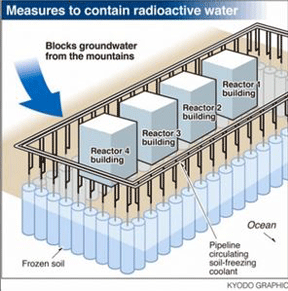 Doubts over ice wall to keep Fukushima safe from damaged nuclear reactors Frozen barrier, costing £185m, being built around Fukushima Daiichi’s four damaged reactors to contain irradiated water The Guardian, Monday 14 July 2014 “…..f all goes to plan, by next March Fukushima Daiichi’s four damaged reactors will be surrounded by an underground frozen wall that will be a barrier between highly toxic water used to cool melted fuel inside reactor basements and clean groundwater flowing in from surrounding hills.
Up to 400 tonnes of groundwater that flows into the basements each day must be pumped out, stored and treated – and on-site storage is edging closer to capacity. Decommissioning the plant will be impossible until its operator, Tokyo Electric Power [Tepco] addresses the water crisis.
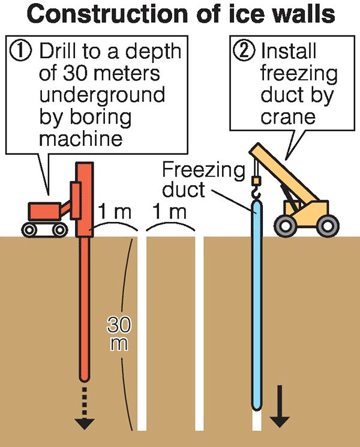
Last month workers from Tepco and the construction firm Kajima Corp began inserting 1,550 pipes 33 metres vertically into the ground to form a rectangular cordon around the reactors. Coolant set at -30C will be fed into the pipes, eventually freezing the surrounding earth to create an impermeable barrier.
“We started work a month ago and have installed more than 100 pipes, so it is all going according to plan to meet our deadline,” Tadafumi Asamura, a Kajima manager who is supervising the ice wall construction, said as workers braved rain, humidity and radiation to bore holes in the ground outside reactor No 4, scene of one of three hydrogen explosions at the plant in the early days of the crisis.
But sealing off the four reactors – three of which melted down in the March 2011 disaster – is costly and not without risks. The 32bn-yen (£185m) wall will be built with technology that has never been used on such a large scale.
“I’m not convinced the freeze wall is the best option,” Dale Klein, former head of the US Nuclear Regulatory Commission and a senior adviser to Tepco, recently told Kyodo News. “What I’m concerned about is unintended consequences. Where does that water go and what are the consequences of that? I think they need more testing and more analysis.”
The 1,500-metre wall will stay in use until 2020, using enough electricity every year to power 13,000 households, according to officials.
Over the next eight months, 360 workers from Tepco and Kajima will work in rotating shifts of up to four hours a day, with each shift beginning in the early evening to combat heat exhaustion. Each worker is wrapped in hazardous materials suits and full-face masks, along with tungsten-lined rubber torso bibs for added protection against radiation.Tepco’s record of mishaps in the three years since Fukushima Daiichi suffered a triple meltdown suggests the wall project will not be trouble free. The firm has had problems freezing irradiated water – using the same method being used to build the underground wall – that has accumulated in underground trenches, raising concerns that the ice technology is flawed…….http://www.theguardian.com/environment/2014/jul/13/doubts-giant-ice-wall-fukushima-nuclear-reactors
July 14, 2014
Posted by Christina Macpherson |
Fukushima 2014, Japan, technology |
Leave a comment
 TV: Fukushima radioactive releases into ocean can continue thousands of more years, says nuclear expert — Japan gov’t concerned with tracking radioactive waste in Pacific as it returns to Fukushima from U.S. West Coast after several decades (VIDEO) http://enenews.com/tv-radioactive-releases-pacific-thousands-years-fukushima-melted-fuel-be-removed-nuclear-expert-japan-govt-concerned-radioactive-waste-ocean-coming-fukushima-several-decades-after-being-west-coast?utm_source=feedburner&utm_medium=email&utm_campaign=Feed%3A+ENENews+%28Energy+News%29
American Chemical Society — Environmental Science & Technology (pdf),Apr. 29, 2014 (emphasis added): 135Cs/137Cs Isotopic Ratio as a New Tracer of Radiocesium Released from the Fukushima Nuclear Accident […] many important issues with respect to its atmospheric transport, deposition processes, and distributions in terrestrial and marine environments remain to be investigated. It has been estimated that ∼80% of the atmospherically released 137Cs was deposited in the western North Pacific Ocean, in addition to […] 137Cs directly discharged into the ocean […] continuous input of 137Cs into the ocean due to river runoff of the 137Cs deposited in heavily contaminated Fukushima forest soil can be expected. Recent studies have revealed the start of the transport of the Fukushima accident-sourced 137Cs into the ocean interior […] it is predicted that in 30 years the Fukushima accident-derived 137Cs will come back to the ocean surface in the western North Pacific Ocean off the Fukushima coast through its transport by the Kuroshio current. Thus, to understand the environmental behavior and the fate of Fukushima accident-sourced radionuclides in the environment, a powerful Cs tracer is strongly required, because the currently widely used 134Cs/137Cs activity ratio tracer will become unavailable in several years because of the rapid decay of 134Cs […] 135Cs has a half-life of 2 × 10^6 [2.3 million] years; therefore, we are confident that the 135Cs/137Cs isotopic ratio can be considered as a new powerful tracer for long-term source identification and environmental behavior studies. […] This study was supported […] partially by the Agency for Natural Resources and Energy, the Ministry of Economy, Trade and Industry (METI), Japan [7 of study’s 8 authors are from Japan’s National Institute of Radiological Sciences]
Nuclear analyst John Large, July 9, 2014: The cores remain active for hundreds, if not thousands, of years, so there’s a commitment to keep either the ice wall technology in place or to replace it with an alternate technology by some future generation. […] Water is coming off the escarpment above the three reactors, it’s then percolating through the ground — there’s hydrostatic pressures pushing the water up toward the sea level — it’s then collecting the fission products and radioactive products from the melted-down cores and taken out to sea. […] What I think they should now have a plan to tackle the root cause… How do you control, manage and eventually remove the reactor cores? […] If the reactor cores remain in there, it’s going to be a constant leachate (water that percolates through a solid and leaches out some of the constituents) of radioactivity.
Watch the interview with Large here
July 14, 2014
Posted by Christina Macpherson |
Fukushima 2014, Japan, oceans |
Leave a comment
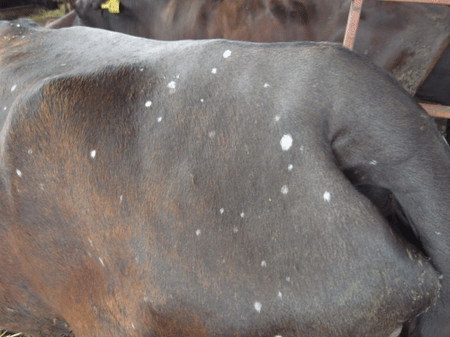
Japanese cows develop skin spots, mysterious disease; farmers fear radiation affecting humans, too http://www.naturalnews.com/045890_fukushima_cows_radiation_poisoning.html#ixzz37JFiFmJf Monday, July 07, 2014 by: Ethan A. Huff, staff writer (NaturalNews) Livestock with strange white spots covering their skin were put on display at a recent protest in front of Tokyo’s agriculture ministry, according to the Associated Press (AP). Two Japanese farmers, disturbed by the unusual markings, are calling on government officials to conduct a real investigation into what they believe is radiation poisoning from the shuttered Fukushima nuclear plant.
The damage is affecting hundreds of animals on farms near the plant, barring the sale of milk and meat due to safety concerns. And the Japanese government, say the farmers, has glossed over the problem by failing to properly investigate it and come up with an explanation, all the while pretending as though nothing is wrong.
“Our cows cannot be shipped as meat,” lamented Masami Yoshizawa, one of the farm’s organizers, before media and the public in Tokyo. “They are evidence of lives affected by radiation.”

Yoshizawa and fellow farmer Naoto Matsumara trucked it down to Tokyo together, bringing with them a black bull bearing the white spots. When they arrived in front of the ministry office, local police attempted to block the duo from bringing it onto the street so everyone could see it, claiming that the animal might be dangerous. But the farmers were ultimately successful in gaining the public’s attention, expressing vocal outrage over the loss of their farms, produce, and ultimately their livelihoods. In the aftermath of Fukushima, the Japanese government has taken a largely hands-off approach, siding with the Tokyo Electric Power Company (TEPCO) in minimizing the damage caused by a large earthquake and tsunami that struck the facility back in 2011.
“What if this started happening to people?” asked Matsumara, expressing concerns about the human impacts of Fukushima radiation. “We have to examine the cause of this and let people know what happened to these animals.”
Japanese government needs to take Fukushima radiation more seriously
According to the AP, Matsumara and Yoshizawa want the government to be more proactive in determining the cause of the white spots. They are also calling for an end to the culling of abandoned livestock, as well as the burning of radiation-contaminated vegetation that farmers need in order to keep feeding the suffering animals.
“The ministry told us they don’t know what is causing the spots,” added Yoshizawa. “Well, they need to do more research and figure it out. They can’t just run away, saying they don’t know.”
Despite making calls through a megaphone for Yoshimasa Hayashi, Tokyo’s farm minister, to come down in person to see the animal, Yoshizawa was unsuccessful in convincing anyone from the agency to make an appearance. The two farmers were, however, given access to the ministry’s reception desk, where they presented a written appeal for action.
In the interim, feral animals continue to run wild in the evacuation zone surrounding Fukushima. And the more than 100,000 “nuclear evacuees” who escaped the area after the disaster have largely resettled elsewhere, leaving nearby towns virtually abandoned.
“Discarded towns, discarded evacuees,” rattled an unsettled Yoshizawa. “The cattle and people are still living. We cannot remain silent.”
July 12, 2014
Posted by Christina Macpherson |
Fukushima 2014 |
Leave a comment
 The Yoshida Testimony. The Fukushima Nuclear accident as told by plant manager Masao Yoshida http://www.asahi.com/special/yoshida_report/en/ 12 July 14
Prologue
The Asahi Shimbun has recently obtained a copy of the transcripts of testimony given before a government investigation panel by Masao Yoshida, who served as general manager of the Fukushima No. 1 nuclear power plant when it succumbed to a Level 7 disaster, the highest on the International Nuclear Events Scale, following the Great East Japan Earthquake and tsunami of March 11, 2011.
The document remains the only available official transcript of the testimony by Yoshida, the on-site commander of efforts to bring the situation under control, who died in July 2013 without having disclosed much to media organizations about the accident at the plant, operated by Tokyo Electric Power Co.
The transcript, not to be released publicly at Yoshida’s request, was gathering dust in government offices.
28 hours, 400 pages
The Yoshida testimony report comprises seven parts and contains about 500,000 characters in total. It is printed on more than 400 pages of A4-size paper.
Eleven of the 13 interview sessions with Yoshida were conducted at a Japan Football Association Academy meeting room at the J-Village soccer training facility, 20 kilometers south of the Fukushima No. 1 nuclear plant. The remaining two sessions took place in a quake-proof control center building, Yoshida’s workplace, at the Fukushima No. 1 plant.
The government’s Investigation Committee on the Accident at the Fukushima Nuclear Power Stations of Tokyo Electric Power Co. interviewed 772 individuals over a total of 1,479 hours. The Yoshida testimony was compiled during that process.
While an interviewee was only questioned for slightly less than two hours on average, Yoshida was interviewed for more than 28 hours, and was asked to respond on how he acted and what he thought at decisive moments. Yotaro Hatamura, chairman of the investigation panel, called the Yoshida testimony “invaluable historic material” because it is Yoshida’s only available official transcript.
Anger, Angst, Sense
In the Yoshida testimony, he is not only telling his side of the story………..
Multiple disaster of unprecedented scale
The Fukushima nuclear disaster, which involved more than one reactor stricken simultaneously, was a multiple disaster that humankind had never experienced……..
Were lessons learned?
Unfortunately, the government investigation panel’s final report failed to discuss and review the actions and judgments made by individuals who were leading concerned organizations at the time–the prime minister, industry minister, director-general of the now-defunct Nuclear and Industrial Safety Agency, chairman of the NSC, president of TEPCO and general manager of the Fukushima No. 1 nuclear plant, although it is up to people to stop nuclear plants from running amok and up to people to save residents from nuclear damage.
Although the panel interviewed as many as 772 individuals involved, it failed to dig deep into essential aspects of the disaster because it made it a stated policy that it would not pursue the responsibility of individuals.
It is not too much to say that the government and power utilities are eagerly working toward preparing for restarts of nuclear reactors by adding height to seawalls, installing filter vents and reinforcing other facility components because the government investigation panel limited its analysis and reviews only to phenomenal aspects of the tragedy.
Voices of those who fought the unprecedented nuclear disaster should be engraved in history. History is humankind’s common property.
“I would like you to attend our hearing in the understanding that what you are going to tell us could be published almost in their original form,” a member of the government investigation panel told Yoshida during the first interview session. The Asahi Shimbun notes that Yoshida replied promptly, “That is OK.”
The government later released a written request by Yoshida that his interviews not be publicly disclosed.http://www.asahi.com/special/yoshida_report/en/
Reports in nine installments
This is an English translation of serial feature stories on the Yoshida testimony report that began running online on The Asahi Shimbun Digital on May 20.
The series focuses on the part of human action and judgments, which the government investigation panel questioned Yoshida about but seldom mentioned in its report, and addresses three issues: who is there to halt nuclear reactors; if residents can be evacuated; and if humans can stop a crisis.
In analyzing and reviewing the Yoshida testimony report, The Asahi Shimbun perused TEPCO’s teleconference records, a time-series table of events and TEPCO’s other in-house documents obtained from sources. The newspaper’s reporters also interviewed concerned parties.
July 12, 2014
Posted by Christina Macpherson |
Fukushima 2014 |
1 Comment
Stigmatized nuclear workers quit Japan utility. Bloomberg Business Week, By By Yuri Kageyama July 10, 2014 TOKYO (AP) — Stigma, pay cuts, and risk of radiation exposure are among the reasons why 3,000 employees have left the utility at the center of Japan’s 2011 nuclear disaster. Now there’s an additional factor: better paying jobs in the feel good solar energy industry.
Engineers and other employees at TEPCO, or Tokyo Electric Power Co., were once typical of Japan’s corporate culture that is famous for prizing loyalty to a single company and lifetime employment with it. But the March 2011 tsunami that swamped the coastal Fukushima Dai-ichi plant, sending three reactors into meltdown, changed that.
TEPCO was widely criticized for being inadequately prepared for a tsunami despite Japan’s long history of being hit by giant waves and for its confused response to the disaster. The public turned hostile toward the nuclear industry and TEPCO, or “Toh-den,” as the Japanese say it, became a dirty word.
Only 134 people quit TEPCO the year before the disaster. The departures ballooned to 465 in 2011, another 712 in 2012 and 488 last year. Seventy percent of those leaving were younger than 40. When the company offered voluntary retirement for the first time earlier this year, some 1,151 workers applied for the 1,000 available redundancy packages.
The exodus, which has reduced staff to about 35,700 people, adds to the challenges of the ongoing work at Fukushima Dai-ichi to keep meltdowns under control, remove the fuel cores and safely decommission the reactors, which is expected to take decades……
The factors pushing workers out have piled up. The financial strain of the disaster has led to brutal salary cuts while ongoing problems at Fukushima, such as substantial leaks of irradiated water, have reinforced the image of a bumbling and irresponsible organization…….http://www.businessweek.com/ap/2014-07-10/stigmatized-nuclear-workers-quit-japan-utility
July 12, 2014
Posted by Christina Macpherson |
employment, Japan |
Leave a comment
 Deutsche Bank lends $US1 billion in Japan’s solar gold rush, SMH, July 9, 2014 Chisaki Watanabe and Finbarr Flynn Deutsche Bank plans to lend about $US1 billion ($1.06 billion) for Japanese solar projects, joining Goldman Sachs in funding cleaner energy as the government struggles to restart nuclear power plants after the Fukushima disaster.
The bank is ready to provide financing for three to six projects in the next 12 to 18 months, said Hans Van Der Sande, director of Deutsche Bank’s structured products group at its Tokyo branch. The Frankfurt-based lender agreed last month to provide a 11.1 billion yen ($116 million) loan for a solar power project on a former golf course north of Tokyo to be operated by a unit of Spain’s Gestamp Renewables Corp.
Japan may add the most solar power capacity in the world this year, according to Bloomberg New Energy Finance, as a two- year-old incentive program attracted investors including Goldman Sachs…http://www.smh.com.au/business/carbon-economy/deutsche-bank-lends-us1-billion-in-japans-solar-gold-rush-20140709-zt0uh.html#ixzz378jMBQUy
July 12, 2014
Posted by Christina Macpherson |
business and costs, Japan, renewable |
Leave a comment
TEPCO: 90 out of 1,550 freezing ducts built so far http://the-japan-news.com/news/article/0001411769 The Yomiuri Shimbun 10 July 14 Tokyo Electric Power Co. unveiled on Tuesday the construction site of the ice wall at the crippled Fukushima No. 1 nuclear power plant for the first time since work began last month.
As a measure to halt the increase of contaminated water, the ice walls are aimed at freezing the ground around the Nos. 1 to 4 reactor buildings of the plant to block groundwater from flowing into reactor buildings and becoming contaminated.
Contaminated water at the nuclear plant currently amounts to about 500,000 tons. The government and TEPCO have been working on the construction in the hope of completing it early next fiscal year.
On Tuesday evening, about 30 workers drilled small holes about 30 meters deep around the No. 4 reactor building. Ducts to freeze underground soil are to be installed in the holes.
A total of 1,550 freezing ducts must be installed to surround the Nos. 1 to 4 reactor building area, measuring about 1.5 kilometers. However, TEPCO said only about 90 freezing ducts have been installed so far.

Due to heat exhaustion concerns during summer, workers at the construction site wear vests containing blue ice.
Meanwhile, the task of freezing tunnels filled with contaminated water using the same method involving the construction of an ice wall has been facing difficulties. The Nuclear Regulation Authority has therefore been calling on TEPCO to fundamentally revise construction plans.
Akira Ono, the chief of Fukushima No. 1 nuclear power plant, said: “We’ve already confirmed the effectiveness of ice walls through an on-site experiment. We will push ahead with the construction work forward as fast as we can.”
July 10, 2014
Posted by Christina Macpherson |
Fukushima 2014, Japan, Reference, technology |
Leave a comment
Stigmatized nuclear workers quit Japan utility. Bloomberg Business Week, By By Yuri Kageyama July 10, 2014 TOKYO (AP) —”………While TEPCO is out of favor with the public, the skills and experience of its employees that span the gamut of engineers, project managers, maintenance workers and construction and financial professionals, are not.
Energy industry experience is in particular demand as the development of solar and other green energy businesses is pushed along in Japan by generous government subsidies.
Currently the government pays solar plants 32 yen ($0.31) per kilowatt hour of energy. The so-called tariff for solar power varies by states and cities in the U.S., but they are as low as several cents. In Germany, it’s about 15 cents.
Sean Travers, Japan president of EarthStream, a London-based recruitment company that specializes in energy jobs, has been scrambling to woo TEPCO employees as foreign companies do more clean energy business in Japan.
“TEPCO employees are very well trained and have excellent knowledge of how the Japanese energy sector works, making them very attractive,” he said. Two top executives at U.S. solar companies doing business in Japan, First Solar director Karl Brutsaert and SunPower Japan director Takashi Sugihara, said they have interviewed former TEPCO employees for possible posts.
Besides their experience, knowledge of how the utility industry works and their contacts, with both private industry and government bureaucracy, are prized assets.
“It’s about the human network and the TEPCO employees have all the contacts,” said Travers, who says he has recruited about 20 people from TEPCO and is hoping to get more.
Yoshikawa, the former TEPCO maintenance worker, said he has received several offers for green-energy jobs that paid far better than his salary at TEPCO of 3 million yen ($30,000) a year.
Since September 2012, all TEPCO managers have had their salaries slashed by 30 percent, while workers in non-management positions had their pay reduced 20 percent. http://www.businessweek.com/ap/2014-07-10/stigmatized-nuclear-workers-quit-japan-utility
July 10, 2014
Posted by Christina Macpherson |
employment, Japan |
Leave a comment
 Fox News: “Leak at Fukushima nuclear plant threatens dangerous meltdown… Trouble is looming” — Officials: “No idea when it can resume cooling system for spent fuel pool” (PHOTOS) http://enenews.com/fox-news-leak-at-fukushima-nuclear-plant-threatens-dangerous-meltdown-trouble-is-looming-officials-no-idea-when-it-can-resume-cooling-system-for-spent-fuel-pool-photos
NHK WORLD, Jul. 7, 2014: No prospect to resume cooling No.5 fuel pool — The operator of the Fukushima Daiichi nuclear power plant says it has no idea when it can resume the cooling system for one of the spent fuel pools. [TEPCO] halted the cooling system at the No.5 reactor on Sunday after workers found seawater leaking from a pipe. Seawater is used to lower the temperature of coolant water […] they are still considering how to repair the pipe. […] TEPCO says the temperature will reach the company’s safety limit of 65 degrees in a little over a week. The operator plans to channel seawater into the pool to curb the rise in temperature.
Fox News, Jul. 7, 2014: Leak at Fukushima nuclear plant threatens dangerous meltdown — Trouble is looming at Japan’s Fukushima nuclear plant, as a leak has forced the shutdown of a cooling system that could cause temperatures to exceed dangerous levels. […] If the system is not repaired within the next nine days, temperatures are expected to soar […] Sunday, the temperature in the pool that holds the rods was about 73 degrees Fahrenheit but started increasing by 0.193 degrees per hour, TEPCO says. If no new cold water is pumped in at this rate, it will reach the dangerous threshold of 149 degrees (F) in roughly the next week. Such temperatures would increase the possibility of dangerous reactions and more radiation leaks in the plant.
See photos of the leak here
July 9, 2014
Posted by Christina Macpherson |
Fukushima 2014 |
Leave a comment
 Fukushima’s radioactive soil sparks fights, exposes the enormity and hopelessness of clean-up taskStraight, by MARTIN DUNPHY on JUL 4, 2014 “…….Soil would fill how many B.C. Places?In the months after the 2011 earthquake-and-tsunami catastrophe, environment ministry experts estimated that the amount of radioactive topsoil from parts of four surrounding prefectures that would have to be “decontaminated” and stored could be as high as 29 million cubic metres.
That would be about enough dirt to fill the 59,000-capacity B.C. Place Stadium 23 times.
However, Yuichi Moriguchi, a University of Tokyo environmental-engineering professor, pegged the amount at closer to 100 million cubic metres, enough to fill 80 B.C. Places.
Minister Ishihara had told reporters in Tokyo on June 16 that the dragged-out and often acrimonious soil-storage negotiations between Abe’s Liberal Democratic Party–led administration and local and state governments in Fukushima would be solved once the issue of “monetary value” was settled.
Fukushima residents, evacuees, the governor, and the mayors of Futaba and Okuma—the two towns adjacent to Daiichi that have been tentatively earmarked for storage facilities—were outraged by the comment.
They called it insensitive and said it failed to take into account their dislocation, fears, and sense of helplessness. They said it made them seem to be concerned only with compensation.
Minister underestimated reaction
The environment minister quickly backtracked, saying he was misconstrued, but he refused to retract his statement. After opposition pressure, however, he apologized during a June 19 parliamentary session and retracted his remark………
Many of the sites are already at or near capacity.
Costs could be wildly inaccurate
In December 2013, Tokyo announced that it would spend almost $1 billion to store 132,738 tonnes of radioactive soil already removed from near the crippled power plant. No towns came forward to offer to sell the approximately three to five square kilometres of land estimated to be needed to build the supposedly “interim” facility to house the waste, currently stored temporarily in different locations around Japan.
(That plan covers less than 150,000 tons of soil. Greenpeace International has claimed that as of February 2013, more than fourmillion tons of radioactive waste had been produced.)
The $1-billion cost of this plan might be severely underestimated, however. A disposal centre in Rokkasho, Aomori Prefecture, for low-level radioactive waste from the country’s nuclear plants (including metal parts and work clothing) cost $2 billion to build.
And it holds only 200,000 cubic metres of material.
The true cost for the planned “interim” facility could be in the tens of billions of dollars—or much higher.
Waste needs to be stored for 30 years
Prefecture officials and residents expressed skepticism about the unclear future location of “permanent” storage sites, noting that the material would have to be stored away for a minimum of 30 years and voicing fears that their towns would become the preferred perpetual spots…….
There are many areas outside this district that are contaminated as well, to varying degrees, including isolated “hot spots”. Some of these were found in Tokyo, more than 200 kilometres away from Daiichi. On the other hand, that original clean-up area consists of up to 70 percent woodlands, hills, and mountains, much of which (if not most) will probably never be touched by decontamination efforts.
Some areas may be deserted forever
And if more than five centimetres of topsoil needs to be scraped off to remove radioactive cesium, after years of rain and groundwater movement, the volume of material needing to be stored will rise accordingly. Prof. Tomoko M. Nakanishi, from the University of Tokyo’s graduate school of agriculture, conducted soil research in Fukushima post-disaster and had this to say about how readily radioactive cesium was absorbed by the soil: “It was like pollen with superglue.”
Friends of the Earth, an international network of environmental groups, reported in 2012 that a test soil-decontamination program for only three houses in Fukushima generated 35 tons of soil waste.
In the end, it will probably be areas around parks, residences, schools, hospitals, and other public buildings that will see the most attention from decontamination efforts.
Some parts of the surrounding prefectures may never see a return to levels of human activity to compare with pre-Fukushima. And some areas may remain deserted forever.
Oh, yeah, then there’s the ocean
This is without even mentioning the incalculable amount of radioactive groundwater and cooling water that has flowed into the Pacific Ocean nonstop since the first day of the disaster almost three-and-a-half years ago. Woods Hole Oceanographic Society scientists labelled this “the largest accidental release of radiation to the ocean in history”.
According to Greenpeace International, one month after the meltdowns, cesium-137 levels in the sea near Daiichi were 50 million times higher than pre-disaster measurements. (Cesium-137 has a half-life of 30 years; cesium-134’s is a bit more than two years.)
And Asahi—using data provided by Tokyo Electric Power Co. (TEPCO), the Daiichi plant operator—says that 462TBq (a terabecquerel equals one trillion Becquerels) of radioactive strontium have been dumped into the Pacific. Strontium is potentially far more dangerous to human life than either cesium-134 or cesium-137.
There have been conflicting reports about the amounts of even deadlier plutonium that might have been released into the soil, air, or water……http://www.straight.com/news/680196/fukushimas-radioactive-soil-sparks-fights-exposes-enormity-and-hopelessness-clean-task
July 7, 2014
Posted by Christina Macpherson |
environment, Fukushima 2014, Japan |
Leave a comment