Japanese nuclear power plant to restart without a crucial off-site emergency center

 Sendai nuclear plant set to restart without off-site emergency center July 07, 2014 THE ASAHI SHIMBUN by Toshio Kawada and Chikako Kawahara. The Sendai nuclear power plant in Kagoshima Prefecture could restart two reactors in autumn without a crucial emergency facility in place to deal with a possible nuclear accident and evacuations of host communities.
The Sendai plant, operated by Kyushu Electric Power Co., is expected to be the first to resume operations among all plants that have applied for safety screenings by the Nuclear Regulation Authority.
The Cabinet Office in September 2012 instructed all prefectures hosting nuclear power plants to ensure that off-site emergency centers be equipped with ventilation and other systems to prevent radiation contamination and be located between 5 and 30 kilometers from the nuclear plant.
It also mandated host prefectures to designate multiple backup facilities in case the functions of the off-site centers are crippled by a disaster, which is what occurred during the Fukushima nuclear disaster that started in March 2011.
The deadline for completion of the emergency off-site centers is September 2015.
Kagoshima prefectural government officials said construction of the off-site emergency center for the Sendai plant has lagged behind schedule due to delays in discussions with the central government…….
the Nuclear Regulation Authority is set to compile a draft of the safety screening results for the Sendai plant in Satsuma-Sendai as early as July 9. If the plant clears the NRA’s safety screening process, its two reactors will be restarted in autumn at the earliest.
Off-site emergency centers are supposed to function as the bases of operations for officials from the central government, local governments and utilities to combat a nuclear crisis and coordinate evacuations of residents…….
The government’s Investigation Committee on the Accident at the Fukushima Nuclear Power Stations has called for the prompt construction of off-site emergency centers.
But renovations and relocations of the emergency facilities are also behind schedule around Japan.
In addition to the Fukushima plant, off-site centers need to be relocated from the 5-km radius of four other nuclear power plants, including Shikoku Electric Power Co.’s Ikata nuclear plant in Ehime Prefecture.
An official of Ehime Prefecture said if an accident at the Ikata plant cripples the existing off-site center before September 2015, the front-line headquarters will be “relocated to a safe location like in the Fukushima crisis” in a stop-gap measure. http://ajw.asahi.com/article/0311disaster/fukushima/AJ201407070029
Fukushima’s molten nuclear fuel cores – no technology exists to fix them
Top U.S. Official: “The reality is, no technology exists anywhere to solve problem” of Fukushima’s  melted fuel — TV: Molten mass “will scorch into the earth” if not cooled, a ‘China Syndrome’; Geysers of radioactive steam shooting up for miles around (VIDEOS) http://enenews.com/top-official-reality-technology-exists-anywhere-solve-problem-fukushimas-melted-fuel-tv-molten-mass-will-scorch-earth-cooled-china-syndrome-geysers-radioactive-steam-shooting-miles-around-videos?utm_source=feedburner&utm_medium=email&utm_campaign=Feed%3A+ENENews+%28Energy+News%29
 NHK Nuclear Watch: US View on Fukushima Daiichi, July 2, 2014 (at 2:00 in):
- NHK: Experts say that one of the most difficult challenges of decommissioning the plant is removing fuel debris… And Magwood says that there is no magic wand to wipeout this problem.
- William Magwood, US Nuclear Regulatory Commission: I think people have to be realistic how difficult this is, how long it’s going to take. During my visit to Japan this week, people have asked me from time to time, “Are there technologies in the US that can help solve this problem?” The reality is there is no technology that exists anywhere to solve this problem.
- Watch the NHK broadcast here
‘Modern Marvels‘, History Channel (at 11:30 in):
- Narrator: With the [water] pumps off, the core is being uncovered and its temperature is over 2,000 degrees and rising. When the core reaches 5,000 degrees it will melt, becoming a molten mass — metallic lava that will burn through the 8 inch steel containment vessel. Once out of the plant it will scorch into the earth itself. What happens next could become an unrivaled technological disaster.
- Wilborn Hampton, New York Times reporter: They reach the water table, it will immediately turn to steam, boiling steam. There will be geysers of radioactivity steam shooting up in parking lots and driveways and streets and houses for miles around.
- Narrator: The nightmare scenario is known as the ‘China Syndrome’. Land surrounding the plant will become uninhabitable. A study some years earlier has suggested upwards of 40,000 people could die if the ‘China Syndrome’ becomes reality.
- Watch the History Channel broadcast here
Plutonium flows to the Pacific from Fukushima’s ruptured nuclear reactor containments
 Gov’t Expert: Plutonium is certainly being discharged into Pacific Ocean from Fukushima plant; Flowing out of ruptured containments — TV: Reactor water turns into ‘yellowish, fizzing liquid’ from damaged fuel rods… “It actually vibrates” (PHOTO & VIDEO) http://enenews.com/study-plutonium-being-discharged-fukushima-pacific-ocean-flowing-ruptured-containment-vessels-tv-reactor-water-becomes-yellowish-fizzing-liquid-damaged-fuel-rods-actually-vibrates-video?utm_source=feedburner&utm_medium=email&utm_campaign=Feed%3A+ENENews+%28Energy+News%29
P. Bossew, German Federal Office for Radiation Protection, PLUTONIUM EMISSION FROM THE FUKUSHIMA ACCIDENT (pdf), 2013 (emphasis added): While much has since been published on environmental contamination and exposure to radio-iodine and radio-caesium, little is known about releases of plutonium […] The inability to cool the fuel led to melting of parts of the reactor cores (which parts exactly, is not yet well known) […] [Causes of the containment] ruptures and leaks […] are not entirely clarified […] explosion seems to have produced further structural damage in the containments, at the one hand, and on the other hand released large amounts of radionuclides into the environment. […] the fraction of Pu released into the environment can be expected to be higher [than] atmospheric releases only. Certainly some Pu has been released with liquid effluents and discharged into the ocean. […] The liquid discharges certainly also contained Pu. […]
‘Modern Marvels‘ History Channel (at 19:45 in): It is now 28 hours since the accident at Three Mile Island began. The men in the control room have no way of looking into the reactor…. it now seems clear some of the 36,000 slendertubes holding the uranium fuel have cracked, this is allowing radioactivity to escape into the reactor coolant water. It is imperative operators know how much radioactivity is now in the coolant. Too much, and the nuclear chain reaction could restart… Foreman Ed Hauser agrees to risk his life to take the readings. This is allowing radioactivity to enter the coolant water. He is in for an even greater scare when he draws the coolant water sample. The water from the reactor should be clear; instead he stares at a yellowish, fizzing liquid… It actually vibrates in his hand.
120 Quadrillion becquerels of radioactive cesium into North Pacific Ocean from Fukushima
 Japan Gov’t-funded Study: Fukushima has released up to 120 Quadrillion becquerels of radioactive cesium into North Pacific Ocean — Does not include amounts that fell on land — Exceeds Chernobyl total, which accounts for releases deposited on land AND ocean (MAP) http://enenews.com/japan-govt-funded-study-fukushima-released-120-quadrillion-becquerels-radioactive-cesium-north-pacific-ocean-include-amount-deposited-land-higher-total-amount-released-chernobyl?utm_source=feedburner&utm_medium=email&utm_campaign=Feed%3A+ENENews+%28Energy+News%29 1 July 14,
Scientific Reports (Nature.com), Mar. 4 2014: The total amount of decay-corrected 134Cs in the [subtropical] mode water was an estimated about 6 PBq [petabecquerels, i.e. 6 quadrillion becquerels] corresponding to 10–60% of the total inventory of Fukushima-derived 134Cs in the North Pacific Ocean. […] The decay corrected ratio of 134Cs/137Cs in soils has been calculated to be 1.0, which suggests that the total amounts of 134Cs and 137Cs released from FNPP1 were equivalent. […] the total amount of Fukushima-derived radiocesium in the North Pacific remains uncertain, because it has been difficult to obtain sufficient samples of water, especially from subsurface and deep waters, in the vast North Pacific Ocean […] Estimates of the total 134Cs released to the North Pacific Ocean ranged from 10 PBq (direct discharge of 4 PBq + atmospheric deposition 6 PBq) to 46 PBq (16 + 30 PBq). Thus, the 6 PBq inventory accounts for 10–60% of the total release. However, the total inventory in the subtropical region derived from the activity in STMW [Subtropical Mode Water] may be underestimated, because CMW probably carried the radiocesium into the subtropical region, too […] The estimated inventory in the subtropical region (6 PBq or 10– 60% of the total inventory) is probably a lower limit of estimation because contribution of CMW [Central Mode Water] was not counted. […]
Funding: “This work was partially supported by a Grant-in-Aid… from the Ministry of Education, Culture, Sports, Science and Technology of Japan”
Note: The study states that up to 46 PBq of 134Cs is estimated to have been released into the North Pacific Ocean from Fukushima Daiichi. Yet, it also states that the 6 PBq in the study area represents between 10-60% of the total 134Cs released into the North Pacific Ocean. If the 10% figure is used, the total release into the N. Pacific would equal 60 PBq of 134Cs. The study also states the releases of 134Cs and 137Cs were equivalent, resulting in a total of 120 PBq into the N. Pacific. This total does not include releases deposited on land or in other bodies of water.
Chernobyl Comparison: A report by the Nuclear Enrgy Agency states that when more detailed deposition data eventually became available, the United Nations estimated the total Chernobyl release of 137Cs at 70 PBq. 134Cs is estimated to have been 53.7% of the 137Cs — approximately 38 PBq of 134Cs — resulting in a total of 108 PBq. Unlike the Fukushima total reported above, this does include all 134Cs and 137Cs releases from Chernobyl — not just what was deposited in the ocean.
Plutonium in the playground – Fukushima
Study: Fukushima plutonium in playground 60 km from nuclear plant — “Proves that indeed Plutonium has been emitted by the accident” — Some “in the form of fuel fragments”? — Up to 14 Billion Bq of Pu-239 and-240 released (MAP) http://enenews.com/study-fukushima-plutonium-in-playground-60-km-from-nuclear-plant-proves-that-indeed-plutonium-has-been-emitted-by-the-accident-some-may-be-in-
P. Bossew, German Federal Office for Radiation Protection, PLUTONIUM EMISSION FROM THE FUKUSHIMA ACCIDENT (pdf), 2013 (emphasis added): […] Apparently no explosive fuel fragmentation occurred, so that little, if any of the release happened in the form of fuel fragments. […] Only scattered data are available from the farther surroundings. It can be assumed that continuous and frequent monitoring of environmental media for Pu from locations more distant than a few km was deemed unnecessary […] Given two different sources (global and Fukushima fallout) with different, but known 238Pu : 239+240Pu ratios, the contributions of the both in a sample which is a mixture of both can be calculated […] we estimated a median 2.28 (95% conf. interval 1.98 –2.58), [15] and 2.19 ± 0.48 (1 ), [14], for Fukushima emissions. […] The background Pu ratio in global fallout has been reported 0.035 ± 0.008 […] a map of the 238Pu : 239+240Pu ratio in the region around the NPP […] The “trace” towards NW from the NPP, in which the Pu ratio deviates strongly from the background […] This proves that indeed Pu has been emitted by the accident […] For 238Pu, the Fukushima contribution is much higher than the global one in many places (as detectable at all) because the Pu ratio is much higher in Fukushima (~2.19) than in global fallout (~0.035). […] Keeping with [the total 137Cs release of] 15 PBq given by NISA […] we find an atmospheric emission of 239+240Pu equal 4.2 GBq. Using the upper estimate of released 137Cs, 50 PBq, a release of 14 GBq is found. [NISA 239+240Pu estimate = 6.4 GBq; Zheng et al. 239+240Pu estimate = 1.0 to 2.4 GBq] […] It should be stressed that the evidence of Pu from Fukushima does not pose any radiological concern […]
P. Bossew, German Federal Office for Radiation Protection, Hirosaki University, Anthropogenic Radionuclides in Environmental Samples from Fukushima Prefecture (pdf), 2013: Three samples [all taken approx. 60 km from FDNPP, 1 from a parking area in Koriyama city and 2 from a playground in Fukushima city] were measured twice […] Sample 4 was too small for a meaningful analysis. […] The result found in this study is consistent with a Pu/ Cs ratio reported by Imanaka et al. (2012) for a highly contaminated place in the Fukushima zone as below 1 E-6 […] Zheng et al. 2011 found 239+240 Pu/137Cs in soil, close to the NPP, as (3.6 ± 1.1) E-7 (only samples with 241Pu>0 considered, and Fukushima contribution 87% to the sample J-village, surface soil , as suggested by the authors), which is in good agreement with the results of this study.
Japan’s very shaky nuclear ‘renaissance’
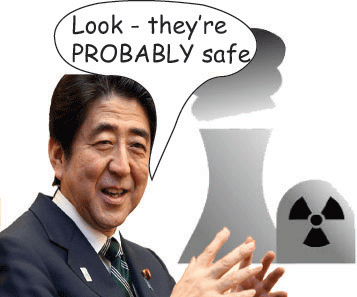 Abe’s nuclear renaissance ignores stiff opposition BY JEFF KINGSTON SPECIAL TO THE JAPAN TIMES 28 June 14 “……On April 11, 2014, Abe’s Cabinet approved a new national energy strategy that embraces nuclear power. This is not surprising given that Abe has vigorously promoted bringing idled reactors back online and is pitchman-in-chief for exports of nuclear technology and equipment. The new plan also opens the door to new reactor construction.
Abe’s nuclear renaissance has become complicated, however, following the revelation in May 2014 that the government and the Tokyo Electric Power Co. had been hiding the fact that almost all workers and managers at the Fukushima No. 1 nuclear plant bolted the scene and abandoned their posts on the morning of March 15, 2011, as the crisis seemed to be spiraling out of control. Instead of remaining on the plant site as ordered, most workers fled to the Fukushima No. 2 nuclear plant 10 km to the south. While such actions are understandable, the mass exodus raises the question of whether nuclear reactors can be operated safely if those responsible for conducting emergency operations cannot be relied on to carry out their duties.
Doubts about the Nuclear Regulatory Authority’s safety reviews are also gathering as the shambolic decommissioning operations at Fukushima undermine its credibility. Why did the NRA allow Tepco to cut corners and compromise safety, leading to extensive radioactive contamination of groundwater now seeping into the ocean? Reports of problems with malfunctioning decontamination equipment, leaky storage tanks for contaminated water and worker error are emblematic of the endless bungling. Why is Tepco, an exceptionally incompetent institution, being entrusted with such a crucial task?
The NRA’s failure to adequately monitor the cleanup raises questions about whether it has the capacity to oversee strict enforcement of new safety guidelines and institutionalize a culture of safety.
“We are not assuming that an accident the operator cannot control will take place,” NRA Chairman Tanaka explains, justifying reliance on the nuclear plant operator to manage a nuclear accident. In light of revelations, however, that is not a reassuring assumption………
The evacuation preparedness problem won’t go away and an improvised exodus means mayhem. It is therefore alarming that none of the clusters of towns in any of the designated evacuation zones around the nation’s nuclear plants has conducted a live evacuation drill.
The NRA is reviewing applications to restart 19 nuclear reactors.
The safety screenings involve confirming that they meet new stricter safety standards, but Niigata Gov. Hirohiko Izumida warns that this doesn’t mean they are safe to operate. He points out that local authorities are not able to cope with cascading simultaneous disasters as occurred in 2011, a risk the new guidelines do not address.
Perhaps this explains why a recent Asahi poll finds continued high public opposition to nuclear energy: 77 percent of respondents favor phasing out nuclear energy, while only 14 percent oppose such a policy.http://www.japantimes.co.jp/opinion/2014/06/28/commentary/abes-nuclear-renaissance-ignores-stiff-opposition/#.U7HUBpRdUnk
Germany an energy policy winner, Japan a loser
 In short, German policy gave renewables fair access to the grid, promoted competition, weakened monopolies, and helped citizens and communities own half of renewable capacity. In 2013, Germany’s nuclear generation reached a 30-year low while renewable generation, 56% greater, set a new record, reaching an average of 27% of domestic use in the first quarter of 2014 and a brief peak of 74% on 11 May.

How Opposite Energy Policies Turned The Fukushima Disaster Into A Loss For Japan And A Win For
Germany Forbes, Amory B Lovins 28 June 14 Japan thinks of itself as famously poor in energy, but this national identity rests on a semantic confusion. Japan is indeed poor in fossil fuels—but among all major industrial countries, it’s the richest in renewableenergy like sun, wind, and geothermal. For example, Japan has nine times Germany’s renewable energy resources. Yet Japan makes about nine times less of its electricity from renewables (excluding hydropower) than Germany does.
That’s not because Japan has inferior engineers or weaker industries, but only because Japan’s government allows its powerful allies—regional utility monopolies—to protect their profits by blocking competitors. Since there’s no mandatory wholesale power market, only about 1% of power is traded, and utilities own almost all the wires and power plants and hence can decide whom they will allow to compete against their own assets, the vibrant independent power sector has only a 2.3% market share; under real competition it would take most of the rest. These conditions have caused an extraordinary divergence between Japan’s and Germany’s electricity outcomes. Continue reading
To revitalise its economy, Japan needs to turn to renewable energy
To revitalize its economy and politics, Japan needs an efficiency-and-renewables leapfrog that enables the new energy economy, not protects the old one. Japanese frogs jump too, says Bashō’s famous haiku “The old pond / frog jumps in / plop.” But we’re still waiting for the plop
How Opposite Energy Policies Turned The Fukushima Disaster Into A Loss For Japan And A Win For Germany Forbes, Amory B Lovins 28 June 14 “……..More than the sacred sun on Japan’s flag, its leaders appear to worship old policies that retard wide use of the energy sources now taking over the global market. Since 2008, half the world’s added electric generating capacity has been renewable. Non-hydroelectric renewables, chiefly wind and solar, got a quarter-trillion dollars of private investment and added over 80 billion watts in each of the past three years. Three of the world’s top four economies—China, Japan, and Germany, as well as India—now produce more electricity from non-hydro renewables than from nuclear power. Japan is on that list only because its nuclear production is roughly zero; it remains the rich nations’ renewable laggard. Perhaps the unexpected May 2014 court decision that prohibited restart of the Oi reactors as unsafe, and for the first time prioritized public safety over utility profits, may signal an emergent change beyond the cosmetic reforms offered by the executive and legislative branches—2016 “deregulation” in name only.
In 2012 and 2013, China made more electricity from wind than from the world’s most aggressive nuclear power program. In 2013, China added more solar power than its first developer, the United States, has installed in its whole history. But Japan is heading in the opposite direction: of the 8 GW of renewables brought into operation in the first 20 months after it introduced renewable FITs in July 2012, 97.5% was solar and only 1% windpower. Windpower (especially onshore where it’s cheapest) is stymied, first by uniquely slow and onerous approval processes and then by outright rejection by utility monopsonists who get to bar competitors from their regional grids. Japan’s windpower association projects the same market share in 2050 that Spain achieved three years ago.
It’s not hard to figure out why. Solar power displaces daytime peak that’s costly to generate, but the way the solar feed-in tariff works, it’s profitable for utilities. In contrast, they lose money on cheap windpower that also runs at night, displacing coal and nuclear. Japan’s latest rules reiterate utilities’ right to refuse renewable power that would displace such legacy “baseload” plants. Japanese business leaders may be upset to learn that their electricity, among the world’s costliest, is even costlier because their utilities run their own costlier thermal plants while rejecting windpower with nearly zero operating cost.
The electricity reforms passed in late 2013 by the lower house of the Diet (23 years after Germany’s reforms began) still let Japan’s utilities reject cheaper renewable power for any reason or no reason. Many claim renewables could harm grid stability. So why do Germany, with 25% renewable electricity in 2013, and Denmark, with at least 47%, have Europe’s most reliable electricity, about ten times more reliable than America’s? These countries, like three others in Europe (none very rich in hydropower) that used roughly half-renewable electricity in 2013—Spain 45%, Scotland 46%, Portugal 58%—simply require fair grid access and competition. Of all major industrial nations, only Japan doesn’t.
Germany also uses energy more efficiently. In each of the past three years, German electricity consumption fell while GDP grew. During 1991–2013, i.e.since reunification, German real GDP grew 33% using 4% less primary energy and 2% less electricity, and emitting 21% less carbon. Even more ambitious savings are available and planned.
In contrast, Japan’s world-leading energy efficiency gains in the 1970s later stagnated. Japanese industry has continued to improve, and remains among the most efficient of 11 major industrial nations, but Japan ranks tenth in industrial cogeneration and commercial building efficiency, eighth in truck efficiency, and next-to-last (tied with the U.S.) in car efficiency. Yet Japan’s sky-high energy prices make energy efficiency very profitable, most of all in buildings. Semiconductor company Rohm’s office opposite Kyōto Station, for example, cut its energy use 46% and repaid its cost in two years. With a few exceptions, like the Tōkyō Metropolitan Government’s efficiency efforts, few Japanese buildings have received the kind of kaizen (continuous improvement) that has long distinguished Japanese industry.
To revitalize its economy and politics, Japan needs an efficiency-and-renewables leapfrog that enables the new energy economy, not protects the old one. Japanese frogs jump too, says Bashō’s famous haiku “The old pond / frog jumps in / plop.” But we’re still waiting for the plop.http://www.forbes.com/sites/amorylovins/2014/06/28/how-opposite-energy-policies-turned-the-fukushima-disaster-into-a-loss-for-japan-and-a-win-for-germany/
A legal precedent, as Japanese town sues government, in opposition to nuclear power
 Abe’s nuclear renaissance ignores stiff opposition BY JEFF KINGSTON SPECIAL TO THE JAPAN TIMES 28 June 14 “……….Are the potential dangers of hosting a reactor an acceptable risk given the alternative of economic decline and depopulation? Many communities in remote coastal areas where Japan’s fleet of reactors are sited are grappling with this calculus. Until now the Aomori Prefecture fishing port of Oma has been famous for its bluefin tuna catches, but that is changing due to the town’s decision to host a nuclear power plant.
Just across the Tsugaru Strait from Oma, the city of Hakodate, Hokkaido, filed a lawsuit earlier this year against the central government and the utility to block construction of the Oma mixed-oxide fuel (MOX) reactor. This is the first lawsuit in Japan of its kind in which a local government is the plaintiff seeking an injunction against building a nuclear plant. The two towns are separated by about 23 km of water, meaning that part of Hakodate, which has a population of 275,000, falls within the newly extended 30-km evacuation zone. The mayor of Hakodate complains that he is being asked to prepare an evacuation plan without adequate information and asserts that the lessons of Fukushima are being ignored as government support for nuclear energy does not include adequate assistance for disaster management, outsourcing it to local communities that lack sufficient capacity.
The possibility of legal entanglements casts a shadow over Abe’s nuclear renaissance as local governments and citizens groups mount challenges that could delay restarts and new plant construction. Indeed, in May 2014, the Fukui district court ruled against Kansai Electric Power Co. (Kepco) in a lawsuit filed by citizens who oppose the restart of the utility’s Oi reactors. The judge rejected Kepco’s claims that the reactors could be operated safely and asserted that the intrinsic dangers of nuclear reactors combined with the unpredictability of earthquakes endanger the fundamental constitutional rights of citizens.
This establishes a precedent that could influence 16 similar cases in the judicial pipeline, but Kepco is appealing the ruling and Abe’s spokesperson shrugged it off, insisting that it would have no influence on safety evaluations. His aplomb is understandable as Japan’s higher courts are reliably submissive in nuclear energy lawsuits.
Maybe this is why the government rules out a national referendum on nuclear energy because citizens are not so predictably compliant and oppose the vested interests Abe represents.http://www.japantimes.co.jp/opinion/2014/06/28/commentary/abes-nuclear-renaissance-ignores-stiff-opposition/#.U7HUBpRdUnk
Passionate calls from shareholders to shut down Fukushima nuclear power station
Japan’s TEPCO shareholders demand shutdown http://www.sbs.com.au/news/article/2014/06/26/japans-tepco-shareholders-demand-shutdownDozens of demonstrators with loud speakers and banners said on Thursday Tokyo Electric Power Co (TEPCO), which wants to restart some of the reactors at the world’s largest nuclear plant, amongst others, must act to not repeat the 2011 Fukushima Daiichi disaster.
There was pushing and shoving between security guards and demonstrators as they tried to approach shareholders going into the gathering. Activists from conservation group Greenpeace wore full protective suits and industrial face masks to remind shareholders what families who lived near Fukushima – where three reactors went into meltdown after an earthquake-sparked tsunami – must wear to check on their homes.
Katsutaka Idogawa, former mayor of Futaba town, which hosts the plant, lashed out at supporters of nuclear power, including TEPCO’s management, urging them to put their own ancestral land at risk.
“Why don’t you get exposed to radiation yourself? Why don’t you lose your homeland?” he asked as shareholders filed into Tokyo International Forum for the company’s annual meeting.
His town remains evacuated because of elevated levels of radiation, amid expectations that it will be decades before it is safe to return, if ever.
Idogawa, who bought TEPCO shares last year, said the firm has been slow to offer compensation to those who lost homes, jobs, farms and their communities, and that which has been offered has been inadequate. “You don’t pay enough compensation and don’t take responsibility (for the accident). I can’t forgive you!” he said. The sentiment was echoed during the meeting by fellow shareholders whose communities host other nuclear plants.
A woman from Niigata prefecture, where TEPCO hopes to start a major power station, also expressed her desire for the utility to end nuclear energy. “Are we going to make the same mistake that we had in Fukushima, also in Niigata?” she said. “Fellow shareholders, please support this proposal of scrapping the Kashiwazaki-Kariwa nuclear plant… and revitalising the site with plans for renewable energy,” she said.
Japan’s entire stable of 48 working reactors is offline, shuttered for safety checks in the months after the 2011 disaster.
The government and electricity companies, like TEPCO, would like to fire them up again, but public unease has so far prevented that, as has a new, toothier watchdog.
TEPCO has argued that restarting selected reactors at Kashiwazaki-Kariwa, the world’s largest nuclear power plant, is the key to ensuring the company’s survival as it battles huge costs.
The calls for an end to nuclear power were expected to be rejected by TEPCO, which is majority-owned by a government-backed fund designed to rescue it.
The government has poured billions of dollars into TEPCO to keep afloat a company that supplies electricity to Tokyo and its surrounding area, as it stumps up cash for decommissioning the reactors, cleaning up the mess they have made and paying compensation.
High proportion of deformities in migratory birds in Japan
Emergency research underway in Japan after birds found with perplexing deformities — “Something unusual occurring inside their bodies” — Never reported in 500,000 exams done before 3/11 — Now observed at every site across country, some over 1,000 km from Fukushima (PHOTO) http://enenews.com/emergency-surveys-in-japan-after-birds-found-with-perplexing-deformities-something-unusual-occurring-inside-their-bodies-never-reported-in-500000-exams-done-before-311-now-its-see?utm_source=feedburner&utm_medium=email&utm_campaign=Feed%3A+ENENews+%28Energy+News%29
Asahi Shimbun, June 25, 2014: [Noboru Nakamura, a researcher at the Yamashina Institute for Ornithology] has visited the riverbed [in Fukushima] 20 times […] looking into whether the earthquake or the accident at the Fukushima No. 1 nuclear power plant caused abnormal changes among wild birds. […] [Researchers] first verified abnormal change [200 kilometers from Fukushima Daiichi] in Niigata Prefecture […] Oct. 24, 2011, a common reed bunting, a small migratory bird, was found with uneven tail feathers that had a moth-eaten appearance. The institute started emergency surveys […] The most perplexing thing was the overly long feathers […] Its feathers very reliably grow to a certain length […] [Kiyoaki Ozaki, Yamashina Institute for Ornithology deputy director-general,] could not imagine a reason for them to be longer. By March 2012, the same abnormality was identified at all research sites across Japan, such as Tochigi, Ibaraki, Tokyo, Shizuoka, Shimane, Kagawa and Fukuoka [over 1,000 kilometers from Fukushima]. The proportion of birds with the abnormality was 13.8 percent. In at least one place, the ratio exceeded 25 percent. Birds born in 2011 account for 97.3 percent of the specimens with the abnormality. […] Researchers have found feathers that already appear moth-eaten when they split open the sheath. Some birds even grew back feathers with the same deformity after the researchers plucked out older, misshapen feathers. […] One thing is certain: The common reed […] pass through or stop in the Tohoku region during their migration.Noboru Nakamura, a researcher at the Yamashina Institute for Ornithology: “In Iitate, I caught a Japanese bush warbler in the net yesterday. It had feathers missing from the back of its head, and its skin was dark on that part. I found the same thing last year and the year before in Minami-Soma. I don’t know the reason.”
Kiyoaki Ozaki, Yamashina Institute for Ornithology deputy director-general: “Bird banding surveys of the common reed bunting began in 1961, and nearly 480,000 of the birds have been examined […] we monitor [their tail feathers] closely. But this sort of abnormality hasn’t been reported before. I’ve seen thousands of the birds, but it was the first time for me to see tail feathers like these. […] There is something unusual occurring inside the birds’ bodies, perhaps with their genes or hormone secretion. [It’s] in the realm of possibility [that it could be the effect of radioactive substances].”
Fukushima: Record high radiation levels at 18 locations between reactors and Pacific
 TV: New concerns at Fukushima; Radioactive material “spilling into ocean” from layer 80 feet deep, officials suspect — Jiji: Record high radiation levels at 18 locations between reactors and Pacific; Crisis far from under control (VIDEO) http://enenews.com/tv-new-concerns-at-fukushima-radioactive-material-spilling-into-ocean-from-layer-80-feet-deep-officials-suspect-jiji-new-record-high-radiation-levels-at-18-locations-near-pacific-problems?utm_source=feedburner&utm_m
Jiji Press, June 18, 2014: Radioactive contamination of groundwater at [Fukushima Daiichi] is far from being under control […] the source of contamination remains unclear and new record levels of radioactive substances have been detected in groundwater taken at a number of measuring points on the ocean side of the plant’s No. 1 to No. 4 reactors. Radioactivity levels in groundwater have hit new record highs at 18 of 32 measuring points on the ocean side since April, according to TEPCO. At the most polluted well, located east of the No. 2 reactor [there’s] 860,000 becquerels of beta ray-emitting radioactive substances such as strontium-90.
NHK WORLD, June 25, 2014: [TEPCO] has found that radioactive water can now easily spread in a deep layer of groundwater. It says it will speed up construction work on a barrier aimed at preventing contaminated water from leaking into the ocean. The deep layer of water is about 25 meters [82 feet] below the surface. […] water pressure in the [deep] layer was lower […] this makes it easier for contaminated water to spread [..] They suspect the radioactive water could be spilling into the ocean. TEPCO officials say the ongoing construction of the barrier may be to blame for the lower pressure. The work involves drilling into the deep layer. […] TEPCO officials say they will take more action to keep radioactive water from spreading in the deep layer. This will involve fortifying holes in an underground frozen-soil wall. Those holes go through the layer and are filled with pipes. […]
See also: Japan Nuclear Expert: Fukushima’s fuel could be about 100 ft. underground in 2 years (AUDIO)
Doubts about Fukushima’s ice wall against radioactive water leaks
 Fukushima ‘ice wall’ looking more like a dirt Slurpee http://america.aljazeera.com/blogs/scrutineer/2014/6/18/fukushima-ice-walllookingmorelikeadirtslurpee.html by Gregg Levine Skeptics of the plan to build a massive ice wall around Japan’s crippled Fukushima Daiichi nuclear facility didn’t have to wait particularly long for their first “I told you so.”
TEPCO, the nominal operator of the battered plant, announced Tuesday that while construction on the network of pipes, pumps, and compressors has begun on what is intended to be a huge ice barrier to prevent mountain runoff from mixing with radioactive water inside the facility, attempts to form a smaller ice wall around already-contaminated water are failing.
“We have yet to form the ice stopper because we can’t make the temperature low enough to freeze water,” a TEPCO spokesman said.
The project is already behind schedule and over budget, and engineers are adding more cooling pipes in hopes they can complete this first small step next month.
While the ground freezing procedure has been used to construct tunnels near waterways, it has never been used for nuclear cleanup and has never been done on such a massive scale. Estimates of the project’s success can best be termed “hopeful.” But freezing the ground around the plant is not strictly a “Why the hell not?” proposition. As previously noted, the plan comes with a list of concerns:
What if freezing causes the ground to sink? What if the ice and the ensuing expansion and contraction interrupts or further damages drainage in the reactor buildings? What if a heat wave or heat from the plant causes parts of the wall to melt? And, what if there is a prolonged loss of power to this cooling system?
The ice wall is only intended to help with the problem of irradiated runoff — the question of what to do with the thousands upon thousands of gallons of water contaminated in the daily fight to cool the melted cores of the damaged reactors and the stored rods in the spent fuel pools remains largely unanswered.
Last month TEPCO began diverting what they say is only moderately radioactive water into the ocean after assuring local fishermen that the levels were safe. Last summer, it was revealed that 300 tons of contaminated water was seeping from the nuclear site into the Pacific every day.
While freezing parts of the ground surrounding the disaster site may or may not be an effective part of the final cleanup and decommissioning, problems continue to outpace response at Fukushima. TEPCO’s experiment around the margins does nothing to address the hot mess at the core (as it were) of the crisis, and is cold comfort to those people still displaced or a country and hemisphere facing generations of radiologic contamination.
Illness and deaths among Fukushima’s nuclear clean-up volunteers
 Fukushima Guide: “Lots of people suddenly started having nose bleeds, cats and dogs too, it lasted for some time” after 3/11 — Article: Many who volunteered in Fukushima have died, including 2 students from group of 15 helping to decontaminate http://enenews.com/fukushima-guide-lots-of-people-suddenly-started-having-nose-bleeds-cats-and-dogs-too-it-lasted-for-some-time-after-311-article-many-who-volunteered-in-fukushima-have-died-including-2-stud?utm_source=feedburner&utm_medium=email&utm_campaign=Feed%3A+ENENews+%28Energy+News%29
Zukunashi no Hiyamizu, June 9, 2014 (h/t Dissensus Japan]: Why many of decontamination volunteers died — “Genpatsu Mondai” wrote a blog article in the May 21, 2014 titled “Joining the volunteer with Fukushima citizens result in sudden death!!! Two of fifteen students in the neighborhood already died from an unknown cause”. In this article, you can read many dead cases of volunteers who went to Fukushima and worked there. They went to contaminated area and worked for decontamination as volunteers. […] Basically the purpose of volunteers is to go to the contaminated area where the air dose rate is high and to work there.
Sulejman Brkic, June 12, 2014: We left for Fukushima by bus very early on May 31, from Yokohama […] At the rest area where we stopped to pick up our guide, Masumi K. […] According to Masumi san, the population is divided between those who trust the government and the ones who don’t […] Don’t forget Fukushima are the words spoken to us by Masumi K. […] Masumi is from Okuma which she fled with her family after the nuclear explosions in 2011 […] She has been also battling cancer for some time now […] her husband got seriously sick and needed a new kidney, Masumi gave him one of hers. […] [A] young anonymous worker [at Fukushima Daiichi] told us […] about so many small and big acts of exploitation […] that…well…one stops listening, not on purpose, but it’s just too much, too overwhelming, it starts sounding normal after a while, I am sorry I can’t remember all of it. At every step in that area one can see or hear or feel the Japanese government’s lies and crimes. […] After the young anonymous worker, Masumi K talked again. She told us, again among many other stories of suffering, about the increase in suicides, consumption of alcohol, domestic violence, depression…she also told us how after the ongoing nuclear disaster there was a time when quite lots of people suddenly started having nose bleeds, cats and dogs too, it lasted for some time and then it suddenly stopped.
40 times above normal – thyroid cancer rates in Fukushima’s children
 Fukushima’s Children are Dying (includes audio)http://ecowatch.com/2014/06/14/fukushima-children-dying/2/ Harvey Wasserman | June 14, 2014 Some 39 months after the multiple explosions at Fukushima, thyroid cancer rates among nearby children have skyrocketed to more than forty times (40x) normal.
More than 48 percent of some 375,000 young people—nearly 200,000 kids—tested by the Fukushima Medical University near the smoldering reactors now suffer from pre-cancerous thyroid abnormalities, primarily nodules and cysts. The rate is accelerating.
More than 120 childhood cancers have been indicated where just three would be expected, says Joseph Mangano, executive director of the Radiation and Public Health Project.
The nuclear industry and its apologists continue to deny this public health tragedy. Some have actually asserted that “not one person” has been affected by Fukushima’s massive radiation releases, which for some isotopes exceed Hiroshima by a factor of nearly 30.
But the deadly epidemic at Fukushima is consistent with impacts suffered among children near the 1979 accident at Three Mile Island and the 1986 explosion at Chernobyl, as well as findings at other commercial reactors. Continue reading
1 This Month





PLEASE OPPOSE HR 8255 AND S.3639 – bills would accelerate satellite deployment, with no environmental review or safeguards – https://ncstd5li.quorum.us/campaign/169331/
To see nuclear-related stories in greater depth and intensity – go to https://nuclearinformation.wordpress.com
-
Archives
- October 2026 (58)
- September 2026 (339)
- August 2026 (330)
- July 2026 (355)
- June 2026 (287)
- May 2026 (306)
- April 2026 (356)
- March 2026 (251)
- February 2026 (267)
- January 2026 (308)
- December 2025 (358)
- November 2025 (359)
-
Categories
- 1
- 1 NUCLEAR ISSUES
- business and costs
- climate change
- culture and arts
- ENERGY
- environment
- health
- history
- indigenous issues
- Legal
- marketing of nuclear
- media
- opposition to nuclear
- PERSONAL STORIES
- politics
- politics international
- Religion and ethics
- safety
- secrets,lies and civil liberties
- spinbuster
- technology
- Uranium
- wastes
- weapons and war
- Women
- 2 WORLD
- ACTION
- AFRICA
- Atrocities
- AUSTRALIA
- Christina's notes
- Christina's themes
- culture and arts
- Events
- Fuk 2022
- Fuk 2023
- Fukushima 2017
- Fukushima 2018
- fukushima 2019
- Fukushima 2020
- Fukushima 2021
- general
- global warming
- Humour (God we need it)
- Nuclear
- RARE EARTHS
- Reference
- resources – print
- Resources -audiovicual
- Weekly Newsletter
- World
- World Nuclear
- YouTube
-
RSS
Entries RSS
Comments RSS

