Final abandonment of Fukushima communities – as governor agrees to nuclear waste storage

 Fukushima governor accepts ‘temporary’ radioactive waste storage http://www.radioaustralia.net.au/international/2014-09-01/fukushima-governor-accepts-temporary-radioactive-waste-storage/1363279 1 September 2014,
The governor of Fukushima has agreed to accept the “temporary” storage of radioactive waste from the 2011 nuclear disaster. Yuhei Sato has been cajoled with the promises of subsidies if he accepts a Japanese government plan to build a depot on land near the battered Fukushima Daiichi plant.
“I have made an agonising decision to accept plans to construct temporary storage facilities in order to achieve recovery in the environment as soon as possible,” Mr Sato told central government ministers in Tokyo. A magnitude 9.0 earthquake and subsequent tsunami in March 2011 prompted the meltdown of the Fukushima nuclear plant on Japan’s northeast coast.
The resulting plumes of radiation contaminated areas far and wide, rendering a swathe of Fukushima uninhabitable and forcing tens of thousands of people from their homes.Tokyo’s solution has been to try to scrub the radiation from the affected areas, often by lifting topsoil in the hope that contamination levels will go down. This has left the problem of what to do with all the waste, with no community in Japan prepared to accept its permanent storage.
The government’s answer has been to seek a temporary fix while it works on getting a long-term plan in place.Mr Sato’s acquiescence came after prime minister Shinzo Abe’s government offered subsidies worth more than 300 billion yen ($2.9 billion), including land rent for the facility location.
Under the plan, the government will build storage units on an area of 16 square kilometres near the power plant.
While observers have long said the area around Fukushima is the only viable option, people already displaced have seen it as unacceptable because it would in effect finalise the abandonment of their communities.
Refueling crane console dropped into Fukushima Daiichi Reactor 3 spent fuel pool
TEPCO is working to check the 566 spent fuel assemblies in the Unit 3 spent fuel pool to see if any of them have been damaged by the most recent accident. According to decommissioning plans, the utility is scheduled to start removing spent fuel rods from the Unit 3 spent fuel pool in the first half of 2015 at the earliest.Tokyo Electric, who is in charge of cleanup operations at Fukushima Daiichi, told reporters that they have not detected any change in radiation levels around the spent fuel pool after the accident.
This is not the first time that debris and large objects have been accidentally dropped, pulled, or pushed into the Unit 3 spent fuel pool. Between 2012 and 2013, TEPCO workers used the remote control cranes to remove debris from atop the Unit 3 reactor building, and multiple instances were recorded where operators moving cranes via remote control knocked debris into the spent fuel pool or dislodged other materials on the roof.
In February 2013, workers accidentally knocked the 1.5 ton fuel handling machine mast into the Unit 3 spent fuel pool, and it was later found to have come to rest on top of the spent fuel racks after it narrowly avoided damaging the liner of the spent fuel pool.
The post Workers drop refueling crane console into Fukushima Daiichi Reactor 3 spent fuel pool appeared first on Enformable.
400-Kg Control Console Fell Into Fukushima Fuel Pool
 Tepco Says 400-Kg Control Console Fell Into Fukushima Fuel Pool Bloomberg, By Emi Urabe and Peter Langan Aug 29, 2014 Tokyo Electric Power Co. (9501) said it’s detected no change in radiation levels in the Fukushima Dai-Ichi No. 3 reactor building after a 400 kilogram piece of equipment slipped from a crane and fell back into a pool holding spent uranium fuel rods.
The accident happened at around 12:45 p.m. today as the company was attempting to move what it described as a crane control console, according to a statement on its website.
The console, which is about a meter wide and 1.6 meters high, was blown into the pool on March 14, 2011, when the No. 3 reactor building exploded following an earthquake and tsunami that wrecked the Fukushima plant.
Today, the utility known as Tepco was attempting to move the device as part of its cleanup at the site, said spokesman Hiroshi Itagaki. …….http://www.bloomberg.com/news/2014-08-29/tepco-says-400-kg-control-console-fell-into-fukushima-fuel-pool.html
Legal action against Fukushima Prefecture and Japan’s government
 Fukushima families sue prefecture, government for radiation exposure during meltdown crisis Japan Times 1 Sept 14 FUKUSHIMA – A group of parents and children who were residing in Fukushima Prefecture when the nuclear disaster unfolded in March 2011 is suing the central and prefectural governments for failing to take sufficient steps to protect children from radiation exposure during the crisis.
The 88 plaintiffs are demanding ¥100,000 each in compensation, according to the lawsuit filed Friday at the Fukushima District Court.
In a written complaint, they said the central and prefectural governments failed to promptly release accurate data on airborne radiation levels after the nuclear crisis, neglecting their duty to prevent residential radiation exposure as much as possible, and exposing children to radiation……http://www.japantimes.co.jp/news/2014/08/30/national/fukushima-families-sue-prefecture-government-for-radiation-exposure-during-meltdown-crisis/#.VAVeS9ddUnk
Fukushima’s young thyroid cancer sufferers – the tip of the coming cancer iceberg?
 Thyroid cancer diagnosed in 104 young people in Fukushima, Asahi Shimbun August 24, 2014 By YURI OIWA/ Staff Writer The number of young people in Fukushima Prefecture who have been diagnosed with definitive or suspected thyroid gland cancer, a disease often caused by radiation exposure, now totals 104, according to prefectural officials.
The 104 are among 300,000 young people who were aged 18 or under at the time of the 2011 Fukushima nuclear disaster and whose results of thyroid gland tests have been made available as of June 30. They were eligible for the tests administered by the prefectural government.
Of these 104, including 68 women, the number of definitive cases is 57, and one has been diagnosed with a benign tumor. The size of the tumors varies from 5 to 41 millimeters and averages 14 mm.
The average age of those diagnosed was 14.8 when the Great East Japan Earthquake and tsunami triggered the meltdowns at the Fukushima No. 1 nuclear power plant in March 2011……..
The figure can be extrapolated for comparison purposes to an average of more than 30 people per population of 100,000 having definitive or suspected thyroid gland cancer.
The figure is much higher than, for example, the development rate of thyroid cancer of 1.7 people per 100,000 among late teens based on the cancer patients’ registration in Miyagi Prefecture…….http://ajw.asahi.com/article/0311disaster/fukushima/AJ201408240011
Uranium industry has poor future selling to Japan, says former Japan P.M. Naoto Kan
 Better Market Your Uranium Someplace Else, Japan Appetite No Longer Huge as Before – Former PM Tells Australia Queensland Premier Campbell NewmanInternational Business Times, By Esther Tanquintic-Misa | August 28, 2014 Campbell Newman, premier of Australia‘s Queensland state, has gotten an advice from former Japanese Prime Minister Naoto Kan, and that is to market the country’s uranium to someplace else. This, as a new study said the bill of damages from the Fukushima Daiichi nuclear power plant meltdown will zoom to over $105 billion, double than the earlier estimates released by authorities in 2011.
While Japan may restart some of its 54 idled nuclear power plants, Kan said Japan’s appetite for the yellow cake uranium won’t be “anywhere the same levels of uranium it has in the past.”
Kan was in Australia last week on a trip sponsored by the Australian Conservation Foundation. A previous staunch supporter of nuclear power, Kan is now against uranium mining, having seen the effects of the Fukushima Daiichinuclear power plant meltdowns in March 2011.
Kan was Japan’s prime minister at the time of the Fukushima nuclear disaster three years ago.
“Even if some did restart it would be practically impossible to return to the kind of levels of operation that were in place before the March 2011 disaster,” Brisbane Times quoted Kan………
He also stressed the appeal of the yellow cake to fuel nuclear power plants had simmered down, and thus Queensland has China as the only potential country it can export its primary product.
“The trends we are seeing in the United States and Europe – and also because of the very high costs of nuclear power – we are not seeing a growth in this market,” he said………http://au.ibtimes.com/articles/564339/20140828/uranium-japan-appetite-kan-australia-queensland-newman.htm#.VADXudJdUnk
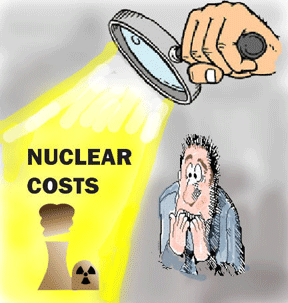
$105 billion is the estimated cost of Fukushima nuclear clean-up
 Better Market Your Uranium Someplace Else, Japan Appetite No Longer Huge as Before – Former PM Tells Australia Queensland Premier Campbell Newman International Business Times, By Esther Tanquintic-Misa | August 28,
“……….In the research made by Kenichi Oshima, environmental economics professor at Ritsumeikan University, and Masafumi Yokemoto, professor of environment policy at Osaka City University, they said the Fukushima Daiichi nuclear power plant tragedy will cost 11.08 trillion yen ($105 billion). The figure ballooned to include radiation clean-up and compensation to residents.
Specifically, the expenses will include
- 4.91 trillion yen ($47 billion) for compensation to residents in the affected area of the crippled Fukushima Daiichi nuclear plant
- 2.48 trillion yen ($23 billion) will be involved in the radiation cleanup of the territories
- 2.17 trillion yen to scrap the disaster-hit plant
- 1.06 trillion yen for the temporal storage of radioactive soil
Nevertheless, the researchers noted the amount still exclude costs for the final disposal of radioactive substances, compensation and plant decommissioning.
Oshima and Yokemoto said the cost will be shouldered by the Japanese people through taxes and utility bills.http://au.ibtimes.com/articles/564339/20140828/uranium-japan-appetite-kan-australia-queensland-newman.htm#.VADXudJdUnk
Tokyo’s radiation level 0.036 μSv/h before March 2011, now 13μSv/h.
 Radiological Disaster Survey in Tokyo Suburbs: 13μSv/h in Kashiwa, Chiba http://fukushimaemergencywhatcanwedo.blogspot.com.au/2014/08/
 radiological-disaster-survey-in-tokyo_26.html 2014-08-24 osted by dunrenard According to Ministry of Education, Culture, Sports, Science and Technology, the radiation level (gamma ray) in Tokyo was 0.036 μSv/h before 311. And now with the Japan fukushima nuclear
  contamination Tokyo 13μSv/h.

13μSv/h is 388 times more than what the Tokyo government measures at Shinjuku, 176 times more than their measurement in Edogawa-ku.
Here is what the Tokyo government finds at their (concrete and metal) monitoring posts (some of which are conveniently located 23 meters above ground):
http://monitoring.tokyo-eiken.go.jp/en/index.html
Sources:
Radiological Disaster Survey in Tokyo Suburbs: 13μSv/h in Kashiwa, Chiba 2014-08-24
https://www.youtube.com/watch?v=PUAPJc1ZUYU
Radiation back ground level was 0.036 μSv/h in Tokyo before 311
http://fukushima-diary.com/2012/12/radiation-back-ground-level-was-0-036-μsvh-in-tokyo-before-311/
Courtesy of Troy Livingstone and Bruce Brinkman
A legal precedent, as TEPCO us ruled liable for a Fukushima suicide
In a first, Japanese court rules that nuclear plant operator is liable for suicide WP, By Anna Fifield and Yuki Oda August 26 at 6:07 AM TOKYO — A court in Fukushima has ruled that Tokyo Electric Power Co., the Japanese nuclear power plant operator, can be held responsible for the suicide of a woman who became depressed after the 2011 disaster.
The court ordered Tepco to pay $470,000 to Mikio Watanabe and his children after his 58-year-old wife, Hamako, killed herself a few months after the nuclear meltdown in the wake of the earthquake and tsunami forced them out of their home and destroyed their livelihoods.
The ruling was the first time that the struggling utility has been found liable for a suicide resulting from the accident, and it could galvanize others seeking redress from the company…….
The family’s attorney declared the verdict a “complete victory.”
“This ruling is significant as the precedent of a case caused by the nuclear power plant accident,” Tsuguo Hirota said. “Today’s verdict will greatly influence future lawsuits.”……..http://www.washingtonpost.com/world/in-a-first-japanese-court-rules-that-nuclear-plant-operator-is-liable-for-suicide/2014/08/26/bc43af62-6c30-4e70-8e22-ffe1895727c1_story.html
Former Prime Minister Naoto Kan calls for full disclosure of Fukushima nuclear disaster testimony
Kan seeks full disclosure of testimony on nuclear crisis http://www.japantimes.co.jp/news/2014/08/26/national/kan-seeks-full-disclosure-testimony-nuclear-crisis/#.U_5HVMVdUnk CANBERRA – Former Prime Minister Naoto Kan called Tuesday for the full disclosure of testimony regarding the Fukushima nuclear crisis, including that of plant chief Masao Yoshida.
Kan, prime minister during the March 2011 disaster, welcomed the Abe administration’s decision to release Yoshida’s testimony in September.
“It is the most important material to understand the cause of the accident and how it developed,” he said.
Kan, known for his opposition to nuclear power, is currently visiting Australia at the invitation of an environmental group.
“It is necessary to re-examine all the facts” related to the nuclear crisis, he said.
The government had resisted releasing Yoshida’s testimony. Before he died of esophageal cancer in July 2013 at age 58, he signed a statement preventing the release of interviews, citing concerns that he would be misinterpreted. Yoshida was interviewed for more than 20 hours from July to November 2011 by a government panel examining the crisis.
The government is also preparing to disclose testimony by others involved in the disaster as soon as it obtains consent from the interviewees.
“Since public interest of the examination of the accident is extremely high, I believe testimony by then senior executives of Tokyo Electric, including the chairman and president, as well as records of its teleconferences, should be disclosed,” Kan said.
He said he has approved the release of his own testimony.
Multiple fuel cores ejected from Fukushima nuclear reactors
Studies show multiple fuel cores ejected from Fukushima reactors – Hot particles of uranium and plutonium fuels detected nearly 300 miles away http://fukushimaemergencywhatcanwedo.blogspot.com.au/2014/08/studies-show-multiple-fuel-cores.html
Source: pdf: http://bostonchemicaldata.com/wpi/mKaltofenNagoya2014.pdf
Kaltofen : Radioisotopes in dusts released by Fukushima Daiichi units [include] Uranium and plutonium fuels and transuranics such as americium and neptunium… individual radioactive particles [in an] Ibaraki dust sample [include] Eu, Y, Zr, Th, Ce, Sr… in 1 to 15 um size range…
Source: (pdf) : https://engineering.dartmouth.edu/%7Ed30345d/courses/engs43/MarcoKaltofen.pdf
Kaltofen : The Japanese samples came from as far north as Sapporo in Hokkaido Prefecture and as far south as Tokyo, a range of 780 km. Fifty nine samples of dust from Japan were analyzed… Radioisotopes specific to the Fukushima Daiichi accidents, including Cs134, Cs137, and Co60 were detected in dust samples taken throughout Northern Japan, including areas more than 200 km outside of the accident exclusion zone. Cs134 was detected at all of the Japanese sites tested… Japanese samples… analyzed in the first month after the accident also contained I131 and Am241… Radioactive dust has become a ubiquitous part of life in northern Japan.
Source: (pdf) : http://www.indymedia.ie/attachments/mar2014/kaltofenjp_measuringradioactivedustinnorthernjapan.pdf
Chris Harris, former licensed Senior Reactor Operator & engineer, Aug 21, 2014 (at 24:00 in): NHK just [broadcasted] that many studies are showing… that multiple cores — parts of it, or some, or even most of it — had been ejected. We thought that too. Once you breach containment, that was one of my big concerns — where did the core go after an explosion like? Whether it be steam or hydrogen explosion or a combination of both… it got ‘sneezed out’ all over the place. It’s totally – it’s a huge mess.
Source: (video interview with Harris here) : https://www.youtube.com/watch?feature=player_detailpage&v=tQ5hmieRTpQ#t=1438
U.S. personnel given strict radiation safety orders in Fukushima area March 16 – 19, 2011
 US Official: There were orders to not get within 230 miles of Fukushima Daiichi — Potassium iodide given to all defense personnel and families within 200 miles of plant — Over 1,100 kinds of radioactive material detected http://enenews.com/us-official-there-were-orders-not-to-go-within-230-miles-of-fukushima-daiichi-potassium-iodide-given-to-all-defense-personnel-and-families-within-200-miles-over-1100-kinds-of-radioactive-mater
 Assistant Secretary of Defense Jonathan Woodson, June 19, 2014: Between March 16 and 19, 2011, ships supporting OT [Operation Tomodachi] were directed to remain at least 100 nm [nautical miles] from Fukushima Daiichi and greater than 150 nm from Fukushima Daiichi along a 90 degree arc, or wedge, centered on the direction of wind from Fukushima Daiichi. The standoff distance from Fukushima Daiichi was temporarily increased to 200 nm [230 miles] on March 16, 2011, as a precaution following detection of abnormally high radiation levels above the Fukushima Daiichi Unit 3 containment building by the Japanese military. On March 19, 2011, the wedge was reduced to 125 nm…
Joint Effects Coordination Board/Joint Requirement Review Board Review:
- Mar. 17, 2011 — Personnel entering within the 100 nm radius of Fukushima Daiichi Nuclear Power Plants, KI [potassium iodide] should be administered.
- Mar. 21, 2011 — Mission: Distribute KI to all DOD personnel and families within 200 miles from the Fukushima power plant.
Defense Threat Reduction Agency (pdf), Sept. 2013: The Defense Threat Reduction Agency’s (DTRA) Hazard Prediction and Assessment Capability (HPAC) model was used to generate the radiation exposure rates and air activity concentrations for at-sea crew. Inputs to the HPAC model included data on the isotopes inside [Fukushima Daiichi’s] reactors that had the potential for release to the environment… Although HPAC’s output included over 1,100 isotopes, it was determined that the major contributors to inhalation doses were the following 10 isotopes: I-131, I-132, I-133, Cs-134, Cs-136, Cs-137, Te-129, Te-129m, Te-131m and Te-132.
Asahi Shimbun: about 1,000 kinds of radioactive materials [are in the] water at the crippled Fukushima No. 1 nuclear power plant, sources said.
International companies attempting to remove tritium from toxic water at Fukushima nuclear plant
 Three firms picked to help tackle toxic water at Fukushima No. 1 http://fukushimaemergencywhatcanwedo.blogspot.com.au/2014/08/three-firms-picked-to-help-tackle-toxic.html by dunrenard Aug 26, 2014 The government picked three overseas companies Tuesday to participate in a subsidized project to determine the best available technology for separating radioactive tritium from the toxic water building up at the Fukushima No. 1 nuclear plant.
Thus tritium-laced water is expected to accumulate at the plant in the absence of any method to remove the isotope.
The three firms chosen from 29 applicants are U.S. firm Kurion Inc., which offers technologies to treat nuclear and hazardous waste; GE Hitachi Nuclear Energy Canada Inc., a joint venture of Hitachi Ltd. and U.S. firm General Electric Co.; and Federal State Unitary Enterprise RosRAO, a Russian radioactive waste management firm.
The government will provide up to ¥1 billion for each examination of the technologies and running costs, and consider whether any of them can be applied to treat the water at Fukushima No. 1, the industry ministry said.
The three companies are to conclude their experiments by the end of March 2016, a ministry official said.
The official cautioned there is no guarantee that any of the technologies will be put to practical use.
Source: Japan Times
http://www.japantimes.co.jp/news/2014/08/26/national/three-firms-picked-help-tackle-toxic-water-fukushima-1/
Fukushima situation is a continuing international crisis, requiring international help
“There should be an international consortium of global experts from France, from Russia, from the United States, and Canada, putting their heads together with the Japanese and working out solutions,” she said.
Others believe that Japan needs to look northwest, towards the Kremlin. Chernobyl gave Russia and Ukraine a level of experience in handling nuclear failures that stands apart from most of the world
NO ONE WANTS YOU TO KNOW HOW BAD FUKUSHIMA MIGHT STILL BE VICE By Johnny Magdaleno Aug 19 2014 “…………When I asked past Nobel Peace Prize nominee Dr. Helen Caldicott these questions, she was quick to respond: “Because money matters more than people.”
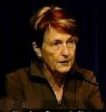 Dr. Caldicott was a faculty member at Harvard Medical School when she became president ofPhysicians for Social Responsibility, an American organization of doctors against nuclear warfare, climate change, and other environmental issues, in 1978. The organization, along with its parent body the International Physicians for the Prevention of Nuclear War, won the Nobel Peace Prize in 1985, a year after Caldicott left.
Last September, Caldicott organized a symposium at the New York Academy of Medicine entitled, “The Medical and Ecological Consequences of Fukushima,” and has a book coming out on the issue this October. Her expertise on the subject is founded on academic research, but also her lifelong role as a doctor practicing preventative medicine in the nuclear age.
“Japan produces parts for nuclear reactors, like reactor containment vessels,” she said in an interview with VICE. “They’re heavily invested in nuclear power, even though they actually have access to nine times more renewable energy than Germany.”
Although Caldicott says what separates Fukushima from Chernobyl is the continuous leakage of radioactive material, in her eyes they’re unified by an institutionalized effort to keep the veil from lifting. Continue reading
Long term effects of Fukushima radiation now becoming clear
Studies are revealing the impact that low-dose exposure to radiation is having on plants and animals after the Fukushima disaster in 2011. Biologists commenced research just a few months after the nuclear accident, now three years later the studies have been published in the Journal of Heredity. The research shows the genetic mutations and population declines that are occurring in a variety of non-human organisms.
“A growing body of empirical results from studies of birds, monkeys, butterflies, and other insects suggests that some species have been significantly impacted by the radioactive releases related to the Fukushima disaster,” Timothy Mousseau from the University of South Carolina in the US, who led one of the studies, explained in a press release.
All of the studies indicate that low-dose exposure to ionising radiation (the kind caused by the Fukushima meltdown) leads to increased mutation and genetic damage to both reproductive and non-reproductive cells.

Studies on this pale grass blue butterfly (pictured above) show slowed growth, reduction in size, higher mortality and abnormalities in butterflies from the affected areas and in their offspring. The butterfly on the left is suffering from mutations that stop it from escaping from its own cacoon.
“Detailed analyses of genetic impacts to natural populations could provide the information needed to predict recovery times for wild communities at Fukushima as well as any sites of future nuclear accidents,” Mousseau said in a press release. “There is an urgent need for greater investment in basic scientific research of the wild animals and plants of Fukushima.”
1 This Month





PLEASE OPPOSE HR 8255 AND S.3639 – bills would accelerate satellite deployment, with no environmental review or safeguards – https://ncstd5li.quorum.us/campaign/169331/
To see nuclear-related stories in greater depth and intensity – go to https://nuclearinformation.wordpress.com
-
Archives
- October 2026 (58)
- September 2026 (339)
- August 2026 (330)
- July 2026 (355)
- June 2026 (287)
- May 2026 (306)
- April 2026 (356)
- March 2026 (251)
- February 2026 (267)
- January 2026 (308)
- December 2025 (358)
- November 2025 (359)
-
Categories
- 1
- 1 NUCLEAR ISSUES
- business and costs
- climate change
- culture and arts
- ENERGY
- environment
- health
- history
- indigenous issues
- Legal
- marketing of nuclear
- media
- opposition to nuclear
- PERSONAL STORIES
- politics
- politics international
- Religion and ethics
- safety
- secrets,lies and civil liberties
- spinbuster
- technology
- Uranium
- wastes
- weapons and war
- Women
- 2 WORLD
- ACTION
- AFRICA
- Atrocities
- AUSTRALIA
- Christina's notes
- Christina's themes
- culture and arts
- Events
- Fuk 2022
- Fuk 2023
- Fukushima 2017
- Fukushima 2018
- fukushima 2019
- Fukushima 2020
- Fukushima 2021
- general
- global warming
- Humour (God we need it)
- Nuclear
- RARE EARTHS
- Reference
- resources – print
- Resources -audiovicual
- Weekly Newsletter
- World
- World Nuclear
- YouTube
-
RSS
Entries RSS
Comments RSS

