nuclear-news

The News That Matters about the Nuclear Industry Fukushima Chernobyl Mayak Three Mile Island Atomic Testing Radiation Isotope

Japan to reopen 1st nuclear plant after Fukushima disaster – despite volcano risks

AJ201410280088MSendai nuclear power plant

October 28, 2014

A town in southwest Japan became the first to approve the restart of a nuclear power station on Oct. 28, a step forward in Japan’s fraught process of reviving an industry left idled by the Fukushima nuclear crisis in 2011.

Kagoshima Prefecture’s Satsuma-sendai, a town of 100,000 that hosts the two-reactor Kyushu Electric Power Co. plant, is 1,000 km (600 miles) southwest of Tokyo and has long relied on the Sendai nuclear power plant for government subsidies and jobs.

Nineteen of the city’s 26 assembly members voted in favor of restarting the plant while four members voted against and three abstained, a city assembly member told Reuters.

The restart of Japan’s first reactors to receive clearance to restart under new rules imposed following the Fukushima disaster is unlikely until next year as Kyushu Electric still needs to pass operational safety checks.

All 48 of the country’s nuclear reactors were gradually taken offline after the nuclear disaster, the world’s worst since Chernobyl in 1986.

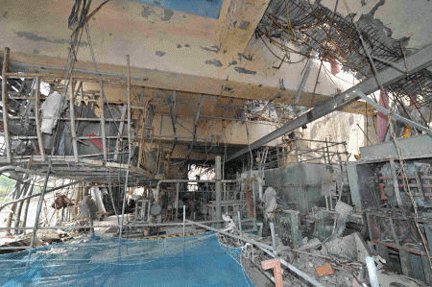
An earthquake and tsunami struck the Fukushima No. 1 plant, 220 km (130 miles) northeast of Tokyo, sparking triple nuclear meltdowns, forcing more than 160,000 residents to flee from nearby towns and contaminating water, food and air.

Japan has been forced to import expensive fossil fuels to replace atomic power, which previously supplied around 30 percent of the country’s electricity.

Prime Minister Shinzo Abe’s government is pushing to restart nuclear reactors, but has said he will defer to local authorities to approve a policy that is still unpopular with large swaths of the public.

The restart divided communities nearest to the plant, pitting the host township that gets direct benefits from siting reactors against other communities that do not reap the benefits but say they will be equally exposed to radioactive releases in the event of a disaster.

In Ichikikushikino, a town less than five km (three miles) from the Sendai plant, more than half the 30,000 residents signed a petition opposing the restart earlier this year.

In the lead-up to the local vote, officials held town halls in neighboring towns to explain the restart, where some residents complained that the public meetings were restrictive and did not address concerns about evacuation plans.

A fire broke out at Kyushu Electric’s other nuclear plant on Oct. 28, according to Japanese media. The fire started in an auxiliary building of the idled nuclear station and was extinguished by plant workers, the agency said. There were no injuries and no release of radioactive materials, it said.

mountinMount Ioyama

A local council has voted to re-open the Sendai Nuclear Power Plant on the outermost western coast of Japan, despite local opposition and meteorologists’ warnings, following tremors in a nearby volcano.

Nineteen out of 26 members of the city council of Satsumasendai approved the reopening that is scheduled to take place from early 2015. Like all of Japan’s 48 functional reactors, Sendai’s 890 MW generators were mothballed in the months following the 2011 earthquake and tsunami.

Satsumasendai, a town of 100,000 people, relies heavily on state subsidies and jobs, which are dependent on the continuing operation of the plant.

But other towns, located within sight of the plant, do not reap the same benefits, yet say they are being exposed to the same risks. A survey conducted by the local Minami-Nippon Shimbun newspaper earlier this year said that overall, 60 percent of those in the region were in favor of Sendai staying shut. In Ichikikushikino, a 30,000-strong community just 5 kilometers away, more than half of the population signed a petition opposing the restart. Fewer than half of the major businesses in the region reported that they backed a reopening, despite potential economic benefits.

Regional governor Yuichiro Ito has waved away the objections, insisting that only the city in which the plant is located is entitled to make the decision.

While most fears have centered around a lack of transparency and inadequate evacuation plans, Sendai is also located near the volcanically active Kirishima mountain range. Mount Ioyama, located just 65 kilometers away from the plant, has been experiencing tremors in recent weeks, prompting the Meteorological Agency to issue a warning. The government’s nuclear agency has dismissed volcanic risks over Sendai’s lifetime as “negligible,” however.

Satsumasendai’s Mayor Hideo Iwakiri welcomed the reopening, but said at the ensuing press conference that it would fall upon the government to ensure a repeat of the accident that damaged Fukushima, an outdated facility subject to loose oversight, is impossible.

September’s decision to initiate the return Japan’s nuclear capacity back online was taken by Prime Minister Shinzo Abe, who endorses nuclear production in the country, but has delegated the controversial call on reopening to local councils. Sendai was chosen after becoming the first plant to officially fulfill the government’s new stricter safety rules. It may also have been picked due to its geographical remoteness, and distance from the 2011 disaster area.

The primary reason for Abe’s nuclear drive been the expense in replacing the lost energy that constituted 30 percent of the country’s consumption, which the government says cost Japan an extra $35 billion last year. Japanese consumers have seen their energy bills climb by 20 percent since the disaster as a result.

But another concern remains the state of the country’s aging nuclear plants, which will cost $12 billion to upgrade. Meanwhile plans to build modern nuclear reactors – which were supposed to be responsible for half of the country’s nuclear power by 2030, according to previous government energy plans – have predictably been shelved in the wake of the disaster.

Sources:

Asahi Shimbun  http://ajw.asahi.com/article/behind_news/social_affairs/AJ201410280087

RT http://rt.com/news/200175-sendai-fukushima-nuclear-volcano/

October 29, 2014 Posted by | Japan | , , , | 1 Comment

Japanese doctors intimidated against linking Fukushima cancers, illnesses to nuclear radiation

radiation-warningTruly Frightening”: Doctors being threatened for linking illnesses to Fukushima — Strange tumors, kids dying, pets dying — Much higher incidences of whole range of health problems reported — Experts: 1,000,000 cancers, plus many other ailments possible (AUDIO & VIDEO) http://enenews.com/frightening-doctors-being-threatened-telling-patients-illnesses-related-fukushima-radiation-strange-tumors-kids-dying-pets-dying-higher-incidences-range-health-problems-being-reported-experts

Arnie Gundersen of Fairewinds Energy Education on Radio Ecoshock, released Oct 29, 2014:

  • Alex Smith, host of RadioEcoshock (at 10:30 in): We’ve heard almost nothing about the impacts [of the Fukushima catastrophe] on people in that region. There are accounts coming out of there of strange tumors, kids dying, pets dying — what have you heard? Can we ever expect an honest accounting from Japanese authorities?
  • Arnie Gundersen, nuclear engineer (emphasis added): That’s a pretty good summary, frankly. We continue to get information from people who live there about cancer rates — and illnesses in general, not just cancer. We think of radiation as a cancer causing thing, but it also causes many other ailments. Much higher incidences of a whole range of illnesses than they had in 2010, the year before the accident… We’re also working with doctors in Japan, and some brave doctors are saying that they’ve been threatened — that their hospital rights have been threatened — if you tell your patient this illness is radiation related you’ll lose your right to practice and things like that. So there’s enormous pressure on the medical community to tell the patients that what they’re experiencing is not at all related to radiation. The key is statistics, and the question is when will the statistics be released for mortality, morbidity, and general illnesses… We’re not seeing the data. The medical community now has to file every report that it writes with the IAEA, the International Atomic Energy Agency, before it’s issued. So if you’re a hospital, and you’ve got mortality data, you’re not allowed to issue that to the public until those reports have been cleared by the IAEA. Well, Article II of the IAEA charter is to promote nuclear power. So even if the hospital was conscientious — there’s a lot of political pressure not to be — but even if it was conscientious, there’s another step in the process, and they’ve got to clear an IAEA hurdle before those numbers are released.It’s truly frightening, the pressure the medical community is undergoing in Japan. Very few of them are willing to tell the truth.

Arnie Gundersen, nuclear engineer, Oct. 20, 2014 (at 15:00 in): There’s experts out there like me – independent experts – who are saying that as many as a million cancers may result.

Sneak peek of Oct. 29 broadcast here | Watch Oct. 20 presentation here

October 29, 2014 Posted by | civil liberties, health, Japan, secrets,lies and civil liberties | Leave a comment

Sinister implications of Japan’s secrecy law shown up in musical theatre in Tokyo

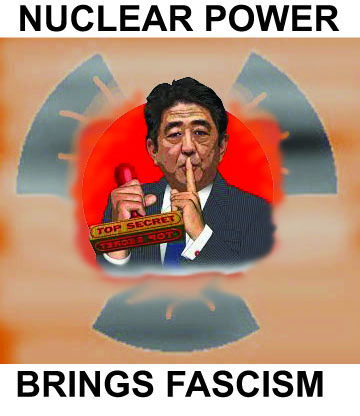
Abe NUCLEAR FASCISMMusical points to sinister nuclear implications, Japan Times, BY TOMOHIRO OSAKI OCT 28, 2014 A recent court-themed musical staged in Tokyo was, to say the least, an audacious dig at the contentious state secrets law scheduled to take effect in December.

Set several years after the law’s passage last December, the musical, performed last week in Nakano Ward by the social theater troupe Musical Guild Q, offered what its adviser said was a “fairly realistic” sneak peek into how the first-ever trial of violators of this law would play out. At the same time, it was also an attempt to sound the alarm about what critics of the law say is an attempt by the powers that be to retreat into a more controlled society like the one that existed during the Pacific War.

“The chief purpose of the musical was to alert the audience to the likelihood that after the law takes effect, even information that is vital to their everyday life can be unjustly taken away from them,” said veteran lawyer and rights activist Yuichi Kaido, who served as a special adviser for the show.

On trial during the musical, which is titled “The Secret Garden,” is a group of nine ordinary citizens………

the audience is gradually clued in to what the musical’s writer calls the secrets law’s “inseparable” connection with nuclear power, and its ulterior motive to help achieve Japan’s transformation into a nuclear weapons-capable nation………

lawyer Kaido says he hopes that a worried citizenry will continue to protest and do everything possible to show the government they oppose the law even after it takes effect on Dec. 10.

“I don’t want people to succumb to the law’s pressure, but continue to fight for their rights to access information they have every right to know about,” he said. http://www.japantimes.co.jp/news/2014/10/28/national/musical-points-sinister-nuclear-implications/#.VFFjIiLF8nk

October 29, 2014 Posted by | Japan, media | Leave a comment

New evidence shows connection between radiation exposure and aggressive thyroid cancer

thyroid-cancer-papillaryhighly-recommendedAggressive Thyroid Cancers Linked to Radiation Exposure http://www.medscape.com/viewarticle/834000 Roxanne Nelson October 28, 2014 Researchers who have followed the children and adolescents exposed to radioactive fallout from the the 1986 Chernobyl nuclear power plant accident have highlighted the fact that the thyroid cancers seen in these individuals are particularly aggressive. They say their work has implications for individuals affected by the 2011 nuclear reactor incidents in Fukushima, Japan.

The study is published online October 28 in Cancer.

The research team screened nearly 12,000 individuals from Belarus several times over a course of 9 years. Study participants were all under age 18 years when they were exposed to the Chernobyl radioactive fallout.

All individuals underwent up to three cycles of thyroid screening from 1997 to 2008. Radioactive iodine-131 (I-131) thyroid doses were estimated from individual thyroid activity measurements taken within 2 months after the accident, along with dosimetric data from questionnaires.

A total of 158 thyroid cancers were diagnosed in the 11,664-person cohort during 3 rounds of screening, which were conducted at roughly 2-year intervals.

The researchers found that higher I-131 thyroid doses were associated with higher frequency of solid or diffuse sclerosing variants of thyroid cancer (P < 0.01), as well as histologic features of cancer aggressiveness, such as lymphatic vessel invasion, intrathyroidal infiltration, and multifocality (all P < .03).

First author Lydia Zablotska, MD, PhD, associate professor in the Department of Epidemiology and Biostatistics at the University of California, San Francisco, explained that her group has previously shown that radioactive iodine exposure significantly increases the risk for thyroid cancer in a dose-dependent manner. But this new study demonstrates that exposure to I-131 is associated with distinct clinical features indicating more aggressive tumors.

“Our study has very important implications for clinical practice,” Dr Zablotska told Medscape Medical News, especially as they relate to radiation exposure that resulted from the 2011 nuclear reactor incidents in Fukushima, Japan. Continue reading →

October 29, 2014 Posted by | health, Japan, Ukraine | Leave a comment

Despite volcano warnings, Japanese Officials Vote to Reopen Nuclear Power Plant

safety-symbol-Smflag-japanJapanese Officials Vote to Reopen Nuclear Power Plant, Despite Volcanic Warnings, Newsweek,  By  10/28/14 Local officials have voted to reopen a nuclear plant in Japan, despite warnings of increased volcanic activity in the region from scientists.

The decision comes despite a warning on Friday that Japan’s Seismological Agency had documented an increase of activity in the Ioyama volcano, located 40 miles away from the power station……….

Japan sits on the ‘Pacific Ring of Fire’, an area of great instability in the earth’s crust, which is home to 75% of the world’s volcanoes.

Minor tremors were reported on Friday morning and soon after, Japanese officials warned of a potential eruption and called for hikers to avoid the area, which is popular with tourists.

The Sendai plant is also situated only 31 miles from Mount Sakurajima, an extremely active volcano which erupts on a regular basis. The documentation of new activity comes barely a month after the eruption of Mount Ontake, when 57 hikers were killed on its slopes. There were no accompanying signs of seismic activity prior to the eruption which might have alerted Japanese authorities to the impending disaster.

The vote has been seen as an attempt to resurrect the country’s nuclear industry, which the  Japanese government hopes to restart despite public opposition to nuclear energy in the wake of the Fukushima disaster. Prior to the disaster, the Japanese had derived 30 percent of their electricity from atomic power.

Japan’s Nuclear Regulation Authority (NRA) approved Sendai’s safety features in September, but the plant must still pass operational safety checks before it will be able to reopen. http://www.newsweek.com/japanese-officials-vote-reopen-nuclear-power-plant-despite-volcanic-warnings-280462

October 29, 2014 Posted by | Japan, safety | Leave a comment

Fukushima nuclear reactor No 2 – Extremely high level of radioactive cesium in nearby groundwater

Author-Fukushima-diary460,000,000 Bq/m3 of Cs-134/137 detected from mountain side of Reactor 2 Fukushima Diary,     26 Oct 14 Extremely high level of Cs-134/137 was detected in groundwater taken beside Reactor 2, Tepco announced on 10/24/2014. The specific state of underground is not verified yet.

It is groundwater taken from “sub-drain” located beside Reactor 2. (cf, Strontium-90 detected in potentially discharged water from Reactor 1 and 3

Cesium-137460,000,000 Bq/m3 of Cs-134/137 was detected from groundwater on 10/22/2014. 425,000,000 Bq/m3 of Cs-134/137 was also measured the next day.

From another sub-drain, 424,000,000 Bq/m3 was detected on 10/22/2014 as well. It was still 321,000,000 Bq/m3 the next day.

These sub-drains are located on the mountain side of Reactor 2, which is not affected by frequently reported groundwater contamination in the seaside of Reactor 2……….http://fukushima-diary.com/2014/10/460000000-bqm3-cs-134137-detected-mountain-side-reactor-2/

October 27, 2014 Posted by | Fukushima 2014 | Leave a comment

TEPCO’s ¥130 billion pretax profit for year

New! Worker has minor injury at Fukushima Nuclear site due to snow build up - Tepco report


Tepco projects ¥130 billion pretax profit for year KYODO Japan Times, OCT 25, 2014 Tokyo Electric Power Co., manager of the disaster-struck Fukushima No. 1 nuclear plant is expecting to log a group pretax profit of ¥130 billion for the business year through March 2015, even without restarting the giant Kashiwazaki-Kariwa plant or hiking rates again, sources familiar with the matter said Friday. … (subscribers only)  http://www.japantimes.co.jp/news/2014/10/25/business/tepco-projects-%C2%A5130-billion-pretax-profit-for-year/#.VE6s1CLF8nk

October 27, 2014 Posted by | business and costs, Japan | Leave a comment

28 of 32 Matsudo city children tested had thyroid nodules (≦5.0mm) but no medical follow-up,

Author-Fukushima-diary28 of 32 testees diagnosed A2 in thyroid inspection of Matsudo city Chiba http://fukushima-diary.com/2014/10/28-32-testees-diagnosed-a2-thyroid-inspection-matsudo-city-chiba/    28 of 32 testees were diagnosed as “A2″ in the thyroid inspection of Matsudo city, Chiba. The test was implemented from 6/1/2014 to 8/31/2014 and the result was announced on 9/26/2014.

A2 is given when the testee has thyroid nodule (≦5.0mm) or cyst (≦ 20.0mm). Matsudo city government however announces they won’t provide those testees with any medical follow-up for some reason.

The testees were supposed to be born 4/2/1992 ~ 4/1/2011. However, the children who already had the subjective symptoms were not given the right to have the test. The municipal government hasn’t made any announcement about why these children were eliminated from the testees.

October 27, 2014 Posted by | children, Japan | Leave a comment

Japan’s Sendai nuclear power plant may be at risk from volcanoes

safety-symbol-Smflag-japanIoyama volcano raises fears Japan’s Sendai nuclear power facility may be at risk, news,com,au 28 Oct 14 

“……….The waking of Mount Ioyama on the island of Kyushu comes after a recent warning from a prominent Japanese volcanologist about the Sendai nuclear plant’s vulnerability.

A cauldron eruption at one of several volcanoes surrounding the Sendai nuclear power plant could hit the reactors and cause a nationwide disaster, said Toshitsugu Fujii, head of a government-commissioned panel on volcanic eruption prediction.

Mount Ioyama sits virtually next door to the power plant. In recent weeks it has started experiencing tremors, the Japanese Metrological Agency’s volcano bureau says.

The implications for restarting the repaired Sendai nuclear power plant are serious……..

Now Mount Ioyama has suddenly gone from the dormant end of the threat scale to the second-highest. This means the area around the crater can be regarded as dangerous, and that small-scale eruptions are likely.

Another volatile giant, Mount Sakurajima, sits some 40km from the Sendai facility. This is a very active volcano with frequent minor eruptions. http://www.news.com.au/technology/environment/ioyama-volcano-raises-fears-japans-sendai-nuclear-power-facility-may-be-at-risk/story-fnjww1r5-1227102573947

October 27, 2014 Posted by | Japan, safety | Leave a comment

Removal of spent nuclear fuel rods from Fukushima reactor No 4 is almost complete

spent-fuel-rods-Fukushima-nTepco “Almost completed transferring spent fuel from Reactor 4 pool” http://fukushima-diary.com/2014/10/tepco-almost-completed-transferring-spent-fuel-reactor-4-pool/       26 Oct 14 On 10/19/2014, Tepco announced that they have already completed transferring 1,320 of 1331 spent fuel assemblies from Reactor 4 pool.

The rest of 11 spent fuel assemblies to include 3 damaged assemblies are to be transferred with the next lot planned by the end of November.

Still 180 of 202 new fuel assemblies are remaining in the pool, but Tepco announces the radiation level is low enough for human worker to manually handle.

So far, they have transferred the casks for 61 times.

October 27, 2014 Posted by | Fukushima 2014 | Leave a comment

Volcanic activity increasing in area near Japan’s nuclera power plant

Japan warns of increased activity at volcano near nuclear plant TOKYO Fri Oct 24, 2014 (Reuters) Reporting by Elaine Lies; Editing by Michael Perry– Japan warned on Friday that a volcano in southern Japan located roughly 64 km (40 miles) from a nuclear plant was showing signs of increased activity that could possibly lead to a small-scale eruption and warned people to stay away from the summit.

The warning comes nearly a month after another volcano, Mt Ontake, erupted suddenly when crowded with hikers, killing 57 people in Japan’s worst volcanic disaster in nearly 90 years.

Ioyama, a mountain on the southwestern island of Kyushu, has been shaken by small tremors and other signs of rising volcanic activity recently, including a tremor lasting as long as seven minutes, an official at the Japan Meteorological Agency’s volcano division said……..

Ioyama lies in the volcanically active Kirishima mountain range and is roughly 64 km from the Sendai nuclear plant run by Kyushu Electric Power Co, which the Japanese government wants to restart even though the public remains opposed to nuclear power following the Fukushima crisis.

Critics point out that the Sendai plant is located about 50 kms (31 miles) from Mount Sakurajima, an active volcano that erupts frequently. Five giant calderas, crater-like depressions formed by past eruptions, are also in the region, the closest one 40 kms (25 miles) away.

The plant still needs to pass operational safety checks as well as gain the approval of local authorities and may not restart till next year……..http://www.reuters.com/article/2014/10/24/us-japan-volcano-idUSKCN0ID0A320141024?feedType=RSS&feedName=worldNews

October 25, 2014 Posted by | Japan, safety | Leave a comment

Japan to sign up to convention that removes liability from companies making nuclear reactors

Abe,-Shinzo-nuke-1Japan to ratify international convention on nuclear accident compensation pact THE ASAHI SHIMBUN http://ajw.asahi.com/article/behind_news/politics/AJ201410240041

Japan intends to ratify an international convention that sets a global uniform standard for compensating victims of nuclear accidents.

The move is in line with fears of an increasing risk of a nuclear accident abroad with developing nations accelerating their efforts to construct nuclear power plants.

The convention limits responsibility for nuclear accidents to the operator of the nuclear plant, meaning companies that manufacture nuclear plant equipment would not be liable. That provision would make it easier for Japanese manufacturers to export nuclear technology.

However, critics charge that Japan has not yet adequately assessed the reasons for the catastrophic triple meltdown at the Fukushima No. 1 nuclear power plant in 2011 and that it is wrong to join a convention that would promote nuclear technology exports.

The Abe administration will submit a bill to the extraordinary Diet session now in progress to ratify the Convention on Supplementary Compensation for Nuclear Damage (CSC). Currently, five nations, including the United States, have ratified the treaty, which was adopted in 1997.

However, the treaty has still not entered into force because one provision has not been met–that the total installed nuclear capacity of the ratifying nations be at least 400,000 megawatts.

If Japan ratified the convention, that provision would be cleared. The United States has been lobbying Japan to join the pact. Continue reading →

October 25, 2014 Posted by | Japan, politics, politics international | Leave a comment

Japan’s new Trade and Energy minister holds shares in TEPCO

conflict-of-interestflag-japanSuga downplays conflict involving new trade chief’s Tepco stake, Japan Times, BY REIJI YOSHIDA, 25 OCT 14  STAFF WRITER

 Chief Cabinet Secretary Yoshihide Suga brushed aside concerns Friday about the new trade and industry minister’s 600-share stake in Tokyo Electric Power Co. and said that the government guidelines in place to protect Cabinet ministers from conflicts of interest would be followed………http://www.japantimes.co.jp/news/2014/10/25/national/politics-diplomacy/suga-downplays-conflict-involving-new-trade-chiefs-tepco-stake/#.VExUqyLF8nl

October 25, 2014 Posted by | Japan, secrets,lies and civil liberties | Leave a comment

Release of radioactive particles from Fukushima was in fact greater than from Chernobyl

Cesium-137Gov’t report reveals Fukushima radioactive release much larger than Chernobyl — Japan reactors could have emitted nearly four times as much cesium-137 http://enenews.com/govt-report-reveals-fukushima-radioactive-release-larger-chernobyl-japan-reactors-could-emitted-four-times-cesium-137?utm_source=feedburner&utm_medium=email&utm_campaign=Feed%3A+ENENews+%28Energy+News%29

Korea Atomic Energy Research Institute, funded by the Korean government, July 2014:
  • The Fukushima accident [led to a] release of huge radioactivity
  • It is reported… 4 times more radioactivity was released to the sea than to the atmosphere
  • Best-estimate source term of 137Cs… released into the atmosphere, is about 4%
  • Best-estimate release fraction of the 137Cs inventory that flowed into the sea…about 16%
  • Of the 4% inventory of 137Cs released into the atmosphere, only 0.8% was deposited in the Japanese land and the other 3.2% was transported to the sea or other areas
  • The inventory… available for release in the units 1-3… the time of accident [was] 7.6 – 8.2 x 10^17 [760 – 820 quadrillion] Bq for 137Cs
  • Because of the geographic location of the nuclear power plant — at the beach of the Pacific Ocean… more than 80% of the radioactivity released from the crippled reactors flowed into the sea

To determine the best estimate of the total 137Cs that was released into the environment from Fukushima, the 137Cs release fraction (4% atmosphere, 16% ocean) is multiplied by the 137Cs inventory for the 3 melted reactor cores (760 to 820 quadrillion Bq):

  • Ocean Release of 137Cs from Fukushima: 121.6 to 131.2 quadrillion Bq (16% x 760 to 820 quadrillion Bq)
  • Atmospheric Release of 137Cs from Fukushima: 30.4 to 32.8 quadrillion Bq (4% x 760 to 820 quadrillion Bq)
  • Total Release of 137Cs into the Environment from Fukushima: 152 to 164 quadrillion Bq
  • Total Release of 137Cs into the Environment from Chernobyl: 70 to 85 quadrillion Bq

However, the 137Cs inventory of 760 to 820 quadrillion Bq used by the Korea Atomic Energy Research Institute is significantly lower than the U.S. Department of Energy calculated:

  • DOE’s Total 137Cs Inventory in Reactors 1-3: 1.3E+18 Bq (1,300 quadrillion Bq)
  • Ocean 137Cs Release from Fukushima: 208 quadrillion Bq (16% x 1,300 quadrillion)
  • Atmospheric 137Cs Release from Fukushima: 52 quadrillion Bq (4% x 1,300 quadrillion)
  • Total 137Cs Release into the Environment from Fukushima: 260 quadrillion Bq
  • Total 137Cs Release into the Environment from Chernobyl: 70 to 85 quadrillion Bq

See also: Fukushima has released 80 Quadrillion Bq of cesium-137 — “The radioactive plume itself has actually arrived… it’s already here” on west coast of N. America (AUDIO)

October 23, 2014 Posted by | Fukushima continuing | Leave a comment

Disturbing accounts of sickness and death among Fukushima evacuees

radiation-warning“Never heard of so much sickness & death in such a short period” says Fukushima evacuee — Writes about strange diseases in young people, deadly tumors and hemorrhages, pets missing hair, child losing all their fingernails, polydactyl baby — Doctor: My friends are dying of cancer, one after another http://enenews.com/never-heard-sickness-death-short-period-fukushima-evacuee-writes-about-strange-diseases-young-people-deadly-tumors-hemorrhages-pets-missing-hair-child-losing-all-fingernails-polydactyl-baby?utm_source=feedburner&utm_medium=email&utm_campaign=Feed%3A+ENENews+%28Energy+News%29

Excerpts from message by a Fukushima evacuee, translated by World Network for Saving Children from Radiation
, Oct. 15, 2014: Mrs. Junko Honda… was a successful beauty salon owner who ran two salons… She recently [compiled the] unusual symptoms that she had heard about over the past three years… whose veracity she has been able to ascertain.

“I had never heard of so much sickness and death in such a short period of time” -Honda

Babies, Children, Young Adults
Sep ’11: Child… had nosebleeds very often… many others at school who had nose bleeding
Jun ’12: Child had headaches and nausea since the accident
Apr ’13: Friend of an evacuee gave birth to a polydactyl child [birth defect, extra fingers/toes]
Jul ’13: Younger friend of an evacuee… got ill with cancer
Mar ’14: Relative [in] middle school… got ill with rheumatism [and] medicine doesn’t work

Lymph, Thymus, Thyroid Gland Problems
Apr ’11: I felt strange feeling in my lymph nodes… salon staff also felt the same
Sep ’11: My friend’s father died with a tumor in the lymph glands
Sep ’11: Gynecologist mentioned there was an increase of lymph tumors
Jan ’13: Child of an evacuee [had] unsubsidized thyroid exam… thymus gland was swollen
Jan ’13: Several children… from Fukushima [also diagnosed with swollen] thymus gland
Sep ’13: Child of an evacuee had an unsubsidized thyroid examination… they found many cysts
Oct ’13: Friend, an evacuee age 35, developed thyroid cancer
Mar ’14: Friend of an evacuee, in her 30s, had thyroid surgery

Unusual Skin, Hair, Nail Problems
Apr ’11: Hair of our pets [dog & cat] become uneven because of hair loss to an unusual degree
Apr ’11: Reddish eczema on my daughter’s face [which] stayed until we evacuated
Sep ’11: Hairdresser friend and her sister have suffered dermatologic eczema since the accident
Jun ’12: [Child’s mother] experienced hair loss and… had sparser hair
Jun ’12: All the fingernails of a child evacuee from Sugakawa fell off after the accident

Adults Under Retirement Age
Sep ’11: Customer in her 40s got ill with a disease that cannot renew blood
Sep ’11: Woman in her 30s died from cardiac arrest
Aug ’12: My relative died suddenly of subarachnoid hemorrhage… in his 30s
Dec ’12: Resident in his 30s developed a tumor
Dec ’12: Resident in her 40s developed a tumor and died
Jan ’13: Doctor [said] his friends have been dying with cancer one after another
Mar ’13: Man in his 30s died suddenly
Mar ’13: 5 customers… had funerals of close family in very short period… 3 were in their 50s
Oct ’13: Male friend who was doing decontamination work died suddenly

See Video: ‘Hell of Fukushima in the immediate vicinity of the children’ (only in Japanese)

October 23, 2014 Posted by | Fukushima 2014 | Leave a comment