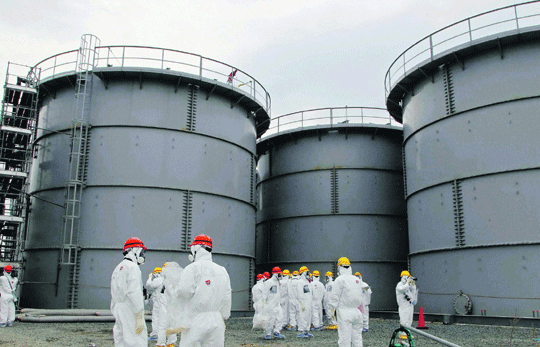
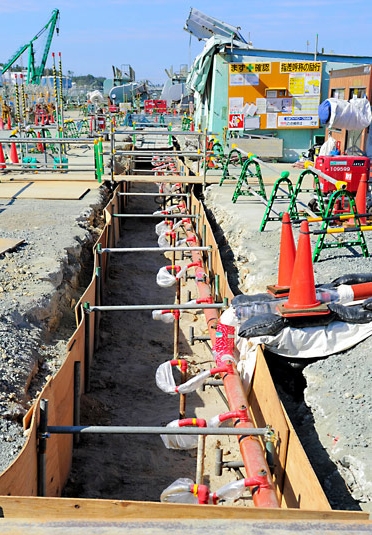
Preparatory work to build an interim storage site for radioactive waste is under way at the Okuma east industrial park (front) in Okuma, Fukushima Prefecture, on Feb. 3. The crippled Fukushima No. 1 nuclear power plant stands in the background.
February 04, 2015
The government has begun prep work on a parcel of land near the crippled Fukushima No. 1 nuclear power plant to receive its first delivery of radioactive debris from decontamination work in the area.
The Environment Ministry began the work for the interim storage site on Feb. 3, following its announcement last month that it had secured 60,000 square meters of land in industrial parks in the towns of Okuma and Futaba as a first step.
The move comes as companies owning large lots of land in the industrial parks are ready to sell their plots for the storage project.
While the plots owned by the companies account for just 2 percent of the total land needed to build storage site in Okuma and Futaba, which co-host the plant, the move will allow the government to begin shipping tainted debris by its target of March 11, the fourth anniversary of the nuclear disaster triggered by the Great East Japan Earthquake and tsunami.
The ministry plans to transfer 43,000 cubic meters of radioactive soil and other debris stored at 43 localities in the prefecture over a year on a trial basis.
The secured plots take up about 70 percent of the Futaba industrial park and Okuma east industrial park’s combined 440,000 square meters of land.
The Asahi Shimbun found that eight of the 13 companies that own property in the parks are willing to sell their land to the government and have already notified the appropriate officials of their decision.
Most of the companies are in the pharmaceutical and machinery industries and based in Tokyo.
“We doubt products we make here will sell anyway, even if we can someday resume operations,” said an official with a company that owns a factory in the Okuma park, referring to its decision to sell off the land. “We are afraid that (radiation-related) fears about products and produce from this area will linger.”
An official with a company in the Futaba park that also agreed to sell its land said: “We set up the factory about 20 years ago and hired many residents. We are more than happy to offer our land to help rebuild the local area.”
Residents of the two towns, where radiation levels remain high, continue to live outside the area after it was evacuated following the outbreak nuclear crisis.
Plots in the industrial parks were among the ministry’s first targets for the interim storage site. It is expected to be easier to start building the site on these plots because they house fewer buildings compared with other land.
Still, the ministry expects a prolonged battle to secure the 16 square kilometers needed for the storage site. “It will take a very long time,” said a senior ministry official.
The storage facility to be built in the towns will be designed to hold radioactive waste for up to 30 years.
Source: Asahi Shimbun
http://ajw.asahi.com/article/0311disaster/fukushima/AJ201502040078
February 5, 2015
Posted by dunrenard |
Japan | Fukushima continuing |
Leave a comment
February 03, 2015
Tokyo Electric Power Co. (TEPCO), the operator of the crippled Fukushima No. 1 nuclear plant, has agreed to pay some 420 million yen in compensation for property damage to residents who live in a radiation “hotspot” area, the Mainichi Shimbun has learned.
Fifty-two residents of 10 households living in parts of Minamisoma, Fukushima Prefecture, which is designated as a recommended special evacuation zone due to radiation hotspots, and another nine people of one household in a neighboring district sought compensation from TEPCO over property damage via an alternative dispute resolution process.
Attorneys representing the residents told the Mainichi Shimbun on Feb. 2 that TEPCO has agreed to pay some 420 million yen, a large portion of the compensation payment recommended by the government-backed dispute resolution center.
However, as the utility refused to pay compensation to the one household which is located outside the recommended evacuation zone, the plaintiffs will not accept the payment until TEPCO agrees to pay everyone who filed the claim.
The dispute resolution center presented a settlement proposal over property damage in the recommended evacuation zones to TEPCO in December last year. It was the first case for the center to accept such a claim filed by a group of residents in those areas.
TEPCO rejected the damage claim filed by the one household (about 10 million yen in compensation), saying that the utility will not handle dispute resolution requests from residents outside the radiation hotspot areas in the same manner as those filed by people living in the recommended evacuation zones.
Source: Mainichi
http://mainichi.jp/english/english/newsselect/news/20150203p2a00m0na008000c.html
February 4, 2015
Posted by dunrenard |
Japan | Fukushima continuing |
Leave a comment
 February 3, 2015
By 1/30/2015, Ushiku city government of Ibaraki announced 48 of 89 children were given A2 or B diagnosis in their thyroid inspection.
A2 is given when they find thyroid nodule (≦5.0mm) or cysts (≦20.0mm), B is given when they find thyroid nodule (≧ 5.1mm) or cysts (≧20.1mm).
Since last August, 50 more children had the inspection. 40 children were given A2, 8 children were given B in total.
Only less than half of the testees turned out to be free of any abnormality.
Ushiku city government states 40 children of A2 don’t need any follow-up inspection.
http://www.city.ushiku.lg.jp/scms/admin76381/data/doc/1421893197_doc_54_0.pdf
http://www.city.ushiku.lg.jp/scms/admin76381/data/doc/1383177176_doc_54_0.pdf
Source: Fukushima Diary
48 of 89 children found thyroid abnormality in Ushiku city Ibaraki
February 4, 2015
Posted by dunrenard |
Japan | Fukushima continuing |
1 Comment
Feb. 03, 2015
Tokyo Electric Power Co, operator of the wrecked Fukushima Daiichi nuclear power plant, on Tuesday recommenced clean-up work after a two-week break due to two fatal accidents at the Daiichi and Daini plants.
All work was halted following the accidents, in order for safety regulation checks to be conducted.
However, TEPCO said it expects delays to continue for up to a month on a project to build an ice wall intended to contain the leaking of contaminated water from reactors at the Daiichi plant, TV Asahi reported.
TEPCO has been fighting a daily battle against contaminated water since Fukushima was wrecked by an earthquake and tsunami in March 2011 and three reactors underwent meltdowns.
Water flushed over the wrecked reactors to keep them cool enough to prevent further radioactive releases is leaking into basements after contact with the melted uranium fuel.
The water mixes with groundwater that seeps into the basements, requiring more pumping, treatment and storage.
Missteps and leaks have dogged the efforts to contain the water, slowing down the overall decommissioning process, which is expected to take decades.
Source: Japan Today
http://www.japantoday.com/smartphone/view/national/clean-up-work-resumes-at-fukushima-daiichi-nuclear-plant
February 4, 2015
Posted by dunrenard |
Japan | Fukushima Daiichi |
2 Comments
Feb 3, 2015
Tokyo Electric Power Co. will probably not meet its target of completing by the end of March the first section of frozen soil shields to curb the buildup of radioactive water at the Fukushima No. 1 nuclear plant.
Construction is being delayed by two weeks to one month after two deadly accidents at Fukushima No. 1 and No. 2 nuclear plants last month forced the company to suspend work for safety checks, Tepco officials said Monday.
The shields are intended to block groundwater from the nearby mountains from flowing into the reactor building basements and mixing with water that has become highly radioactive after being used to cool the overheating reactors.
Tepco began the construction work last June.
The volume of contaminated water has been increasing by several hundred tons a day due partly to the inflow of groundwater.
Even after the construction is completed, Tepco will need approval from the Nuclear Regulation Authority to start circulating refrigerant to freeze the surrounding soil. The NRA is concerned that the shields may change the flow of groundwater and cause the ground to sink, which could allow contaminated water to flow out of the reactor buildings.
Source: Japan Times
http://www.japantimes.co.jp/news/2015/02/03/national/tepco-unlikely-complete-frozen-soil-shields-march/#.VNH5rC4bKKF
February 4, 2015
Posted by dunrenard |
Japan | Fukushima Daiichi |
Leave a comment
Feb 2, 2015
Tetsu Kariya, author of the gourmet manga “Oishinbo,” says in the series’ latest edition that radiation is so high in Fukushima Prefecture it is causing nosebleeds among local residents.
The theme echoes one in a previous story that critics panned when Kariya had the main character suffer a nosebleed after visiting the Fukushima No. 1 nuclear power plant.
The controversial episodes ran in Shogakukan Inc.’s Big Comic Spirits magazine last May. But when the manga was compiled into book form, critical passages, including one linking nosebleeds and radiation exposure, were watered down.
In his latest book, published by Yugensha, Kariya questions the Environment Ministry’s assertion that radiation is unlikely to be causing nosebleeds locally. He cites surveys that found that “many people” have been suffering nosebleeds in the prefecture.
Kariya has written extensively about the plight of Fukushima farmers and fishermen, whose troubles he has studied at first hand. He has visited places around the nuclear power station.
He said he altered some controversial episodes in the new book to prevent misunderstanding and to protect real people who were identifiable in previous episodes and who others criticized.
In the final chapter, Kariya emphasizes that the reconstruction of the lives of the people is far more important than the recovery of the land of Fukushima.
“It is only you who can protect yourselves,” he said, addressing them in general. “Please have the courage to flee from Fukushima.”
Source: Japan Times
http://www.japantimes.co.jp/news/2015/02/02/national/manga-artist-claims-again-fukushima-radiation-is-causing-nosebleeds/#.VNH4Ry4bKKG
February 4, 2015
Posted by dunrenard |
Japan | Fukushima continuing |
Leave a comment
Manga artist claims again Fukushima radiation is causing nosebleeds, Japan Times, Tetsu Kariya, author of the gourmet manga “Oishinbo,” says in the series’ latest edition that radiation is so high in Fukushima Prefecture it is causing nosebleeds among local residents.

The theme echoes one in a previous story that critics panned when Kariya had the main character suffer a nosebleed after visiting the Fukushima No. 1 nuclear power plant.
The controversial episodes ran in Shogakukan Inc.’s Big Comic Spirits magazine last May. But when the manga was compiled into book form, critical passages, including one linking nosebleeds and radiation exposure, were watered down.
In his latest book, published by Yugensha, Kariya questions the Environment Ministry’s assertion that radiation is unlikely to be causing nosebleeds locally. He cites surveys that found that “many people” have been suffering nosebleeds in the prefecture…..http://www.japantimes.co.jp/news/2015/02/02/national/manga-artist-claims-again-fukushima-radiation-is-causing-nosebleeds/#.VNF_0tKUcnk
February 4, 2015
Posted by Christina Macpherson |
Fukushima 2015, health, Japan, media |
1 Comment
 TV: Only ‘some’ of Fukushima melted fuel is now solid — Nuclear Expert: Molten core ‘re-melts’, even with enough cooling water — Japan Engineer: “The Fukushima accident was the first of its kind” (VIDEO) http://enenews.com/tv-only-fukushimas-melted-fuel-solid-nuclear-expert-molten-core-will-melt-enough-cooling-water-japan-engineer-fukushima-accident-first-kind-video?utm_source=feedburner&utm_medium=email&utm_campaign=Feed%3A+ENENews+%28Energy+News%29
NHK, Jan 27, 2015 (emphasis added): Groundwater entering the facility becomes tainted when it mixes with melted fuel inside the reactor containers. Tepco engineers believe some of the fuel has cooled down and turned into solid debris. But they don’t know the exact situation, so they’re hoping to take a look inside… Scientists have figured out a way of using muons to help them see substances hidden from views — like magma… When particles hit a high-density object like magma, they lose energy or are absorbed… it’s like an x-ray. Researchers are hoping to use the technique to get a better idea of what’s inside the reactors… Engineers will… try and determine the state of the melted fuel… Engineers say knowing what’s inside will help them figure out a way to decommission the plant.
Asahi Shimbun, Jan 24, 2015: [TEPCO] will use cosmic rays… to identify sites with melted fuel… They will first study the No. 1 reactor… by the end of this fiscal year, estimating how much fuel remains in the reactor[and] intend to extract the melted fuel after surrounding it with water… the plant operator will need to repair damaged sections of the containers to prevent water leaks… However… nuclear fuel at the base of the container cannot be seen using the muon technique…
Dr. Ing. Mazzini, Ph.D. Nuclear & Industrial Safety (pdf): Severe Accident Phenomenology…Milestones of Nuclear Safety: 2011 Fukushima Accident (1st for an External Event)
- Ex-Vessel Accident Phenomena:
-> The molten debris falls into the reactor cavity. This produces boiling off of whatever water is there. If sufficient water is present, the core would be cooled and solidify, and would subsequently re-melt.
-> Steam explosions may also occur at this time as the molten fuel falls onto water in the reactor cavity. This can disperse fuel, create radioactive aerosols, and increase the rate of heat transfer to the containment atmosphere.
-> Molten corium attacks the concrete basement, which proceeds to penetrate, and creates a cauldron that releases aerosols and gases [and] containment pressure rises.
DPA, Jan 28 2015: More delays expected in Fukushima nuclear plant clean-up… More delays in treating contaminated water from Japan’s crippled Fukushima nuclear power plant are likely, a senior official of a company involved in the clean-up said Wednesday. “Some schedule(s) would be delayed because the contaminated facility did not operate as planned,” [said] Yoshiki Ogata, director of the global nuclear project department of Mitsubishi… “The situation in the building is not clear,” he told dpa on the sidelines of a nuclear energy conference. Mitsubishi, along with Toshiba and Hitachi, are the three companies helping… Ogata said that the Fukushima accident was the first of its kind so there were a lot of challenges… “So, first stop the underground water from entering and also leakage to the sea…”
Watch the NHK broadcast here
January 31, 2015
Posted by Christina Macpherson |
Fukushima 2015 |
Leave a comment

Jan. 29, 2015
Japan’s environment ministry plans to soon start building initial facilities for storing radioactive waste stemming from decontamination work in Fukushima Prefecture, northern Japan.They are part of the intermediate storage complex to be built in a 16-square-kilometer area straddling the towns of Futaba and Okuma.The government earlier planned to start moving the waste to the site by the end of this month. But it canceled the plan due to delays in purchasing land and building facilities.The government now plans to start the transport by March 11th, the 4th anniversary of the earthquake and tsunami that led to the nuclear accident in 2011.
The ministry says construction of 2 initial storage facilities, each 10,000 square kilometers, will start next Tuesday at industrial parks in the intermediate site.The waste is to be kept there until intermediate storage facilities are completed. It remains unclear when their construction will begin, due to lack of progress in purchasing land.Huge amounts of radioactive soil and other waste stemming from decontamination work have been kept in each municipality of the prefecture.
Municipalities are asking the government to provide a concrete schedule for transporting the waste.
Source:NHK
January 30, 2015
Posted by dunrenard |
Japan |
Leave a comment

January 27, 2015
On 1/27/2015, Tepco announced they measured high density of Strontium-90 from groundwater in the seaside of Reactor 2.
It was 31,000,000 Bq/m3. The sampling point was the boring well, which is the closest to Reactor 2.
This is the highest density measured from this boring well, which is 10% more than the previous highest record.
The sampling date was last December. No Sr-90 data of January has been published.
http://www.tepco.co.jp/nu/fukushima-np/f1/smp/2015/images/2tb-east_15012701-j.pdf
Source: Fukushima Daiichi
31,000,000 Bq/m3 of Strontium-90 measured at the nearest boring well to Reactor 2
January 29, 2015
Posted by dunrenard |
Japan | Fukushima Daiichi, Strontium-90 |
Leave a comment
January 28th, 2015
Study: Global consequences from Fukushima-like nuclear disaster; Many nations at risk of ‘great exposure’ — Transport of hot particles to US was especially effective during worst releases after reactor explosions — Radioactivity confined ‘close to surface’ due to seasonal factors
T. Christoudias and Y. Proestos of The Cyprus Institute, J. Lelieveld of Max Planck Institute of Chemistry (Germany), Dec 12, 2014 (emphasis added):
- We estimate the contamination risks from the atmospheric dispersion of radionuclides released by severe nuclear power plant accidents… We present an overview of global risks… [These] risks exhibit seasonal variability, with the highest surface level concentrations of gaseous radionuclides in the Northern Hemisphere during winter [Fukushima crisis began with 10 days left in winter].
- The model setup was evaluated… using emission estimates from… Fukushima
- The risk posed from nuclear power plant accidents is not limited to the national or even regional level, but can assume global dimensions. Many nations may be subjected to great exposure after severe accidents.
- Our model shows increased surface-level concentrations throughout the Northern Hemisphere during the boreal winter months compared to the summer… Not only the expected risk magnitude is higher, but the geographical extent of the high concentrations of transported radionuclides is more pronounced towards the north… Horizontal advection [i.e. transfer] is more efficient in winter due to relatively stronger winds, and the concentrations are highest near the surface [and] surface level concentrations in the summer tend to be more localized in the emission region.
- Our results illustrate that accidents… could have significant trans-boundary consequences. The risk estimate [shows] increased surface level concentrations of gaseous radionuclides in the Northern Hemisphere during winter and a larger geographical extent towards the north and the east… This is related to the relatively shallow boundary layer in winter that confines the emitted radioactivity to the lowest part of the atmosphere close to the surface…It is the view of the authors that it is imperative to assess the risks from the atmospheric dispersion of radioactivity from potential NPP accidents [for] emergency response planning on national and international levels.
Source: http://www.mdpi.com/1996-1073/7/12/8338
JAMSTEC, Univ. of Tokyo, etc.: We show a numerical simulation for the long-range transport from the [Fukushima] plant to the US… Large-scale updraft [over] Japan from March 14 to 15 was found effective in lifting the particles [to the] jet stream that could carry the particles across the Pacific within 3 to 4 days [See study: On Mar. 15, Fukushima reactors emitted 100 quadrillion Bq of cesium into air — This one day was equal to total lifetime release from Chernobyl]… Some of the particles [had a] long-range atmospheric transport over — 10,000 km within 3 to 4 days… [R]adioactive materials were detected in that period over the east and west coasts of the U.S… In order for the particles to be transported with the jet stream, they must be lifted up from the surface boundary layer to the mid- or upper troposphere. Large-scale updraft was indeed observed… on March 14 through 15… [T]he westerlies in mid-March were thus particularly effective in the trans-Pacific transport of the radioactive materials…
Watch the numerical plume simulation here http://www.docin.com/p-773002550.html
Source: http://www.docin.com/p-773002550.html
January 29, 2015
Posted by dunrenard |
Canada, EUROPE, Japan, USA | Fukushima Daiichi |
Leave a comment
 Fukushima Watch: Tepco Two Months Behind on Cleaning Tainted Water http://blogs.wsj.com/japanrealtime/2015/01/26/fukushima-watch-tepco-two-months-behind-on-cleaning-tainted-water/ By MARI IWATA Tokyo Electric Power Co. says it will need an additional two months to process all the highly contaminated water in storage at the Fukushima Daiichi nuclear plant.
The power company previously said it would clean all the water by the end of March. A Tepco spokesman said Friday that the process had been slowed down by the need for workers to frequently clean the filters of the water processing system. He also said the system needed more initial adjustments than first expected when it came into use.
Tepco plans to give a more detailed outline of the water processing schedule in March, the spokesman said.
A large amount of groundwater keeps flowing underneath the reactors, creating about 300 to 400 tons a day of highly contaminated water. The water has been stored in about 1,000 tanks set up at the site.Tepco has been processing the water to remove most of the radioactive materials to reduce the contamination to a low level. The system is unable to remove tritium, a less harmful material.
The company now says it won’t finish processing the stored water until May. After that it will have sufficient capacity to deal with the daily inflows of groundwater.
January 26, 2015
Posted by Christina Macpherson |
Fukushima 2015 |
Leave a comment
Tepco suspends Fukushima No. 1 cleanup to probe fatal accidents Japan Times STAFF WRITER JAN 23, 2015 Tokyo Electric Power Co. has said it will suspend decommissioning work at the wrecked Fukushima No. 1 power plant until it completes safety checks related to two fatal accidents at its facilities in the prefecture this week……http://www.japantimes.co.jp/news/2015/01/23/national/tepco-suspends-fukushima-no-1-cleanup-to-probe-fatal-accidents/#.VMWMHtKUcnm
January 26, 2015
Posted by Christina Macpherson |
incidents, Japan |
Leave a comment
Japan’s deadly game of nuclear roulette, Japan Times, BY LEUREN MORET MAY 23 2004 Of all the places in all the world where no one in their right mind would build scores of nuclear power plants, Japan would be pretty near the top of the list.
The Japanese archipelago is located on the so-called Pacific Rim of Fire, a large active volcanic and tectonic zone ringing North and South America, Asia and island arcs in Southeast Asia. The major earthquakes and active volcanoes occurring there are caused by the westward movement of the Pacific tectonic plate and other plates leading to subduction under Asia.
Japan sits on top of four tectonic plates, at the edge of the subduction zone, and is in one of the most tectonically active regions of the world. It was extreme pressures and temperatures, resulting from the violent plate movements beneath the seafloor, that created the beautiful islands and volcanoes of Japan.
Nonetheless, like many countries around the world — where General Electric and Westinghouse designs are used in 85 percent of all commercial reactors — Japan has turned to nuclear power as a major energy source.
In fact the three top nuclear-energy countries are the United States, where the existence of 118 reactors was acknowledged by the Department of Energy in 2000, France with 72 and Japan, where 52 active reactors were cited in a December 2003 Cabinet White Paper.
The 52 reactors in Japan — which generate a little over 30 percent of its electricity — are located in an area the size of California, many within 150 km of each other and almost all built along the coast where seawater is available to cool them.
However, many of those reactors have been negligently sited on active faults, particularly in the subduction zone along the Pacific coast, where major earthquakes of magnitude 7-8 or more on the Richter scale occur frequently. The periodicity of major earthquakes in Japan is less than 10 years. There is almost no geologic setting in the world more dangerous for nuclear power than Japan — the third-ranked country in the world for nuclear reactors.
“I think the situation right now is very scary,” says Katsuhiko Ishibashi, a seismologist and professor at Kobe University. “It’s like a kamikaze terrorist wrapped in bombs just waiting to explode.”……..
Yoichi Kikuchi, a Japanese nuclear engineer who also became a whistle-blower, has told me personally of many safety problems at Japan’s nuclear power plants, such as cracks in pipes in the cooling system from vibrations in the reactor. He said the electric companies are “gambling in a dangerous game to increase profits and decrease government oversight.”
Sugaoka agreed, saying, “The scariest thing, on top of all the other problems, is that all nuclear power plants are aging, causing a deterioration of piping and joints which are always exposed to strong radiation and heat.”
Like most whistle-blowers, Sugaoka and Kikuchi are citizen heroes, but are now unemployed…….
It is not a question of whether or not a nuclear disaster will occur in Japan; it is a question of when it will occur. http://www.japantimes.co.jp/life/2004/05/23/to-be-sorted/japans-deadly-game-of-nuclear-roulette/#.VMMMH9KUcnk
January 24, 2015
Posted by Christina Macpherson |
Japan, safety |
Leave a comment
January 22, 2015
Japan’s nuclear watchdog gave the green light to the operator of the wrecked Fukushima nuclear power plant to discharge pumped up groundwater into the sea if radioactive substances in the water are within safety standards.
The Jan. 21 decision by the Nuclear Regulation Authority concerns groundwater from 41 wells, called subdrains, close to the No. 1 to No. 4 reactor buildings at the Fukushima No. 1 plant.
Operator Tokyo Electric Power Co. will be obliged to remove radioactive substances in the groundwater at its decontamination facilities.
The water must meet certain criteria before it is released into the sea.
The conditions per liter of water are: that radioactive cesium is less than 1 becquerel; radioactive substances that emit beta rays are less than 3 becquerels; and the level of tritium is less than 1,500 becquerels.
Although TEPCO does not have the means to remove tritium at its decontamination facilities, the levels of contamination must be within safety limits.
The NRA said the volume of groundwater that flows into the reactor buildings will be reduced by one-half.
However, it remains unclear if the plan will be implemented as TEPCO is keen to get the approval of local residents, many of whom depend on fishing for their livelihoods.
The utility has been holding meetings with local fishery cooperatives since the summer to explain what it involved. Some members of the cooperatives seemed receptive to the plan, but others were not.
Source: Asahi Shimbun
http://ajw.asahi.com/article/0311disaster/fukushima/AJ201501220054
January 23, 2015
Posted by dunrenard |
Japan | Fukushima Daiichi |
Leave a comment